205 Cultural
Studies
Prepared by Mayuri Pandya
Personal Information
Name :Mayuri Pandya
Roll No:14
Topic : British Cultural Materialism
Submitted To : S.B.Gardi Department of English,MKBU
What is Cultural Studies
"cultural studies" is hard to define.
Arising from the social turmoil of the 1960s, cultural studies is composed of
elements of Marxism, poststructuralism and postmodernism, feminism, gender
studies, anthropology, sociology, race and ethnic studies, film theory, urban
studies, public policy, popular culture studies, and postcolonial studies: those
fields that concentrate on social and cultural forces that either create community
or cause division and alienation.
Five Type of Cultural Studies
1.British Cultural Materialism
2.New Historicism
3.American Multiculturalism
4.Postmodernism and Popular Cultural
5.Postcolonial Studies
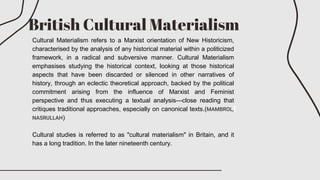
British Cultural Materialism
Cultural Materialism refers to a Marxist orientation of New Historicism,
characterised by the analysis of any historical material within a politicized
framework, in a radical and subversive manner. Cultural Materialism
emphasises studying the historical context, looking at those historical
aspects that have been discarded or silenced in other narratives of
history, through an eclectic theoretical approach, backed by the political
commitment arising from the influence of Marxist and Feminist
perspective and thus executing a textual analysis—close reading that
critiques traditional approaches, especially on canonical texts.(MAMBROL,
NASRULLAH)
Cultural studies is referred to as "cultural materialism" in Britain, and it
has a long tradition. In the later nineteenth century.
Matthew Arnold sought to redefine the "givens" of British culture.
Edward Burnett Tylor's pioneering anthropological study Primitive Culture (1877)
argued that "Culture or civilization, taken in its widest ethnographic sense, is a
complex whole which includes knowledge, belief, art, morals, law,custom, and any
other capabilities and habits acquired by man as a member of society".
Claude Levi-Strauss's influence moved British thinkers to assign "culture" to primitive
peoples, and they with the work of British scholars like
Raymond Williams, to attribute culture to the working class as well as the elite.
Williams memorably states: "There are no masses; there are only ways of seeing
[other] people as masses".
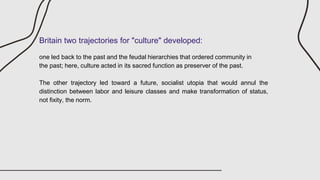
Britain two trajectories for "culture" developed:
one led back to the past and the feudal hierarchies that ordered community in
the past; here, culture acted in its sacred function as preserver of the past.
The other trajectory led toward a future, socialist utopia that would annul the
distinction between labor and leisure classes and make transformation of status,
not fixity, the norm.
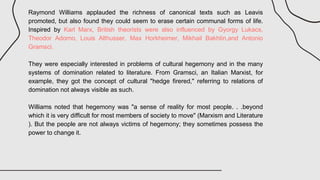
Raymond Williams applauded the richness of canonical texts such as Leavis
promoted, but also found they could seem to erase certain communal forms of life.
Inspired by Karl Marx, British theorists were also influenced by Gyorgy Lukacs,
Theodor Adorno, Louis Althusser, Max Horkheimer, Mikhail Bakhtin,and Antonio
Gramsci.
They were especially interested in problems of cultural hegemony and in the many
systems of domination related to literature. From Gramsci, an Italian Marxist, for
example, they got the concept of cultural "hedge firered," referring to relations of
domination not always visible as such.
Williams noted that hegemony was "a sense of reality for most people. . .beyond
which it is very difficult for most members of society to move" (Marxism and Literature
). But the people are not always victims of hegemony; they sometimes possess the
power to change it.
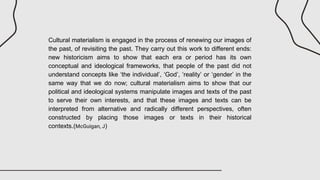
Cultural materialism is engaged in the process of renewing our images of
the past, of revisiting the past. They carry out this work to different ends:
new historicism aims to show that each era or period has its own
conceptual and ideological frameworks, that people of the past did not
understand concepts like ‘the individual’, ‘God’, ‘reality’ or ‘gender’ in the
same way that we do now; cultural materialism aims to show that our
political and ideological systems manipulate images and texts of the past
to serve their own interests, and that these images and texts can be
interpreted from alternative and radically different perspectives, often
constructed by placing those images or texts in their historical
contexts.(McGuigan, J)
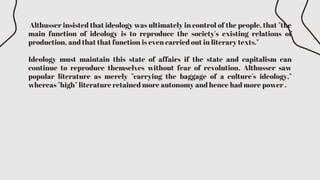
Althusser insisted that ideology was ultimately in control of the people, that "the
main function of ideology is to reproduce the society's existing relations of
production, and that that function is even carried out in literary texts."
Ideology must maintain this state of affairs if the state and capitalism can
continue to reproduce themselves without fear of revolution. Althusser saw
popular literature as merely "carrying the baggage of a culture's ideology,"
whereas "high" literature retained more autonomy and hence had more power .
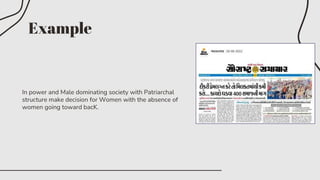
Example
In power and Male dominating society with Patriarchal
structure make decision for Women with the absence of
women going toward bacK.
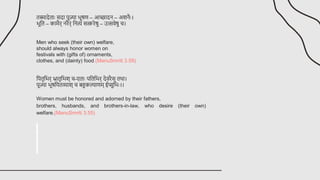
तस्मादेतााः सदा पूज्या भूषण – आच्छादन – अशनाः।
भूतत – कामर् नरर् तनत्यं सत्करेषु – उत्सवेषु च।
Men who seek (their own) welfare,
should always honor women on
festivals with (gifts of) ornaments,
clothes, and (dainty) food.(ManuSmriti 3.59)
तपतृतभर् भ्रातृतभश् च-एतााः पतततभर् देवरस् तथा।
पूज्या भूषतितव्याश् च बहुकल्याणम् ईप्सुतभाः।।
Women must be honored and adorned by their fathers,
brothers, husbands, and brothers-in-law, who desire (their own)
welfare.(ManuSmriti 3.55)
Citation
Althusser, Louis. For Marx. Trans. Ben Brewster. New york: pantheon,1969.
Bhaskar Ground Report." Divya Bhaskar [Mehsana], 28 Aug. 2022.
Cambridge Studies in Social Anthropology, no. 16. Cambridge:Cambridge University Press,1977.
Levi-Strauss, Claude. The Raw and the Cooked. Trans. john and Doreen Weightman. New York: Harpeg 1975.
Marxism andLiterature. New York: Oxford University, Press,1973.
MAMBROL, NASRULLAH. “New Historicism and Cultural Materialism – Literary Theory and Criticism.” Literary Theory and Criticism, 21 October 2016,
https://literariness.org/2016/10/21/new-historicism-and-cultural-materialism/. Accessed 7 October 2022.
McGuigan, J. (2016). Cultural Materialism. In: Neoliberal Culture. Palgrave Macmillan, London. https://doi.org/10.1057/9781137466464_6
“Sanskrit quotes on women - Manusminti Shlokas.” TFIStore, 18 April 2022, https://tfi-store.com/sanskrit-quotes-on-women-manusmiriti-shlokas/.
Accessed 7 October 2022.
Tylor, Edward Burnett. Primitiae Culture. New York: Holt, 1877
Willingham, John R., et al. A Handbook of Critical Approaches to Literature. Oxford University Press, 1992.
Williams, Raymond.1958.Culture and Society: 1780-1950. London: Chatto,.1958
THANK YOU

205 Cultural Studies

  • 1.
  • 2.
    Personal Information Name :MayuriPandya Roll No:14 Topic : British Cultural Materialism Submitted To : S.B.Gardi Department of English,MKBU
  • 3.
    What is CulturalStudies "cultural studies" is hard to define. Arising from the social turmoil of the 1960s, cultural studies is composed of elements of Marxism, poststructuralism and postmodernism, feminism, gender studies, anthropology, sociology, race and ethnic studies, film theory, urban studies, public policy, popular culture studies, and postcolonial studies: those fields that concentrate on social and cultural forces that either create community or cause division and alienation.
  • 4.
    Five Type ofCultural Studies 1.British Cultural Materialism 2.New Historicism 3.American Multiculturalism 4.Postmodernism and Popular Cultural 5.Postcolonial Studies
  • 5.
    British Cultural Materialism CulturalMaterialism refers to a Marxist orientation of New Historicism, characterised by the analysis of any historical material within a politicized framework, in a radical and subversive manner. Cultural Materialism emphasises studying the historical context, looking at those historical aspects that have been discarded or silenced in other narratives of history, through an eclectic theoretical approach, backed by the political commitment arising from the influence of Marxist and Feminist perspective and thus executing a textual analysis—close reading that critiques traditional approaches, especially on canonical texts.(MAMBROL, NASRULLAH) Cultural studies is referred to as "cultural materialism" in Britain, and it has a long tradition. In the later nineteenth century.
  • 6.
    Matthew Arnold soughtto redefine the "givens" of British culture. Edward Burnett Tylor's pioneering anthropological study Primitive Culture (1877) argued that "Culture or civilization, taken in its widest ethnographic sense, is a complex whole which includes knowledge, belief, art, morals, law,custom, and any other capabilities and habits acquired by man as a member of society". Claude Levi-Strauss's influence moved British thinkers to assign "culture" to primitive peoples, and they with the work of British scholars like Raymond Williams, to attribute culture to the working class as well as the elite. Williams memorably states: "There are no masses; there are only ways of seeing [other] people as masses".
  • 7.
    Britain two trajectoriesfor "culture" developed: one led back to the past and the feudal hierarchies that ordered community in the past; here, culture acted in its sacred function as preserver of the past. The other trajectory led toward a future, socialist utopia that would annul the distinction between labor and leisure classes and make transformation of status, not fixity, the norm.
  • 8.
    Raymond Williams applaudedthe richness of canonical texts such as Leavis promoted, but also found they could seem to erase certain communal forms of life. Inspired by Karl Marx, British theorists were also influenced by Gyorgy Lukacs, Theodor Adorno, Louis Althusser, Max Horkheimer, Mikhail Bakhtin,and Antonio Gramsci. They were especially interested in problems of cultural hegemony and in the many systems of domination related to literature. From Gramsci, an Italian Marxist, for example, they got the concept of cultural "hedge firered," referring to relations of domination not always visible as such. Williams noted that hegemony was "a sense of reality for most people. . .beyond which it is very difficult for most members of society to move" (Marxism and Literature ). But the people are not always victims of hegemony; they sometimes possess the power to change it.
  • 9.
    Cultural materialism isengaged in the process of renewing our images of the past, of revisiting the past. They carry out this work to different ends: new historicism aims to show that each era or period has its own conceptual and ideological frameworks, that people of the past did not understand concepts like ‘the individual’, ‘God’, ‘reality’ or ‘gender’ in the same way that we do now; cultural materialism aims to show that our political and ideological systems manipulate images and texts of the past to serve their own interests, and that these images and texts can be interpreted from alternative and radically different perspectives, often constructed by placing those images or texts in their historical contexts.(McGuigan, J)
  • 10.
    Althusser insisted thatideology was ultimately in control of the people, that "the main function of ideology is to reproduce the society's existing relations of production, and that that function is even carried out in literary texts." Ideology must maintain this state of affairs if the state and capitalism can continue to reproduce themselves without fear of revolution. Althusser saw popular literature as merely "carrying the baggage of a culture's ideology," whereas "high" literature retained more autonomy and hence had more power .
  • 11.
    Example In power andMale dominating society with Patriarchal structure make decision for Women with the absence of women going toward bacK.
  • 12.
    तस्मादेतााः सदा पूज्याभूषण – आच्छादन – अशनाः। भूतत – कामर् नरर् तनत्यं सत्करेषु – उत्सवेषु च। Men who seek (their own) welfare, should always honor women on festivals with (gifts of) ornaments, clothes, and (dainty) food.(ManuSmriti 3.59) तपतृतभर् भ्रातृतभश् च-एतााः पतततभर् देवरस् तथा। पूज्या भूषतितव्याश् च बहुकल्याणम् ईप्सुतभाः।। Women must be honored and adorned by their fathers, brothers, husbands, and brothers-in-law, who desire (their own) welfare.(ManuSmriti 3.55)
  • 13.
    Citation Althusser, Louis. ForMarx. Trans. Ben Brewster. New york: pantheon,1969. Bhaskar Ground Report." Divya Bhaskar [Mehsana], 28 Aug. 2022. Cambridge Studies in Social Anthropology, no. 16. Cambridge:Cambridge University Press,1977. Levi-Strauss, Claude. The Raw and the Cooked. Trans. john and Doreen Weightman. New York: Harpeg 1975. Marxism andLiterature. New York: Oxford University, Press,1973. MAMBROL, NASRULLAH. “New Historicism and Cultural Materialism – Literary Theory and Criticism.” Literary Theory and Criticism, 21 October 2016, https://literariness.org/2016/10/21/new-historicism-and-cultural-materialism/. Accessed 7 October 2022. McGuigan, J. (2016). Cultural Materialism. In: Neoliberal Culture. Palgrave Macmillan, London. https://doi.org/10.1057/9781137466464_6 “Sanskrit quotes on women - Manusminti Shlokas.” TFIStore, 18 April 2022, https://tfi-store.com/sanskrit-quotes-on-women-manusmiriti-shlokas/. Accessed 7 October 2022. Tylor, Edward Burnett. Primitiae Culture. New York: Holt, 1877 Willingham, John R., et al. A Handbook of Critical Approaches to Literature. Oxford University Press, 1992. Williams, Raymond.1958.Culture and Society: 1780-1950. London: Chatto,.1958
  • 14.