Gujarat Technological University
(Chandkheda, Ahmedabad)
Affiliated
Government Engineering College,
Bharuch
A project report on:
BOILING WATER REACTOR
Under subject of
Power Plant Engineering
B.E. Semester- VII
Branch- Mechanical
Presented by:
Sr. No. Name Enrollment No.
1 KHARVA TARUN 160140119034
2 KHER JAYDEEP 160140119035
3 LABBAI JISHAN 160140119037
4 LAD VIRAL 160140119038
5 LUHAR DHRUVESH 160140119039
6 MACHHI DHAVAL 160140119040
Guided By:-
Prof. U.V Joshi
Overview
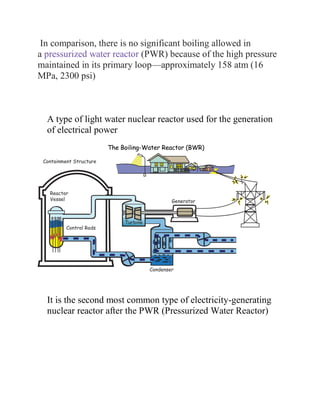
A boiling water reactor (BWR) uses demineralized water as a
coolant and neutron moderator. Heat is produced by nuclear
fission in the reactor core, and this causes the cooling water to
boil, producing steam. The steam is directly used to drive
a turbine, after which it is cooled in a condenser and converted
back to liquid water. This water is then returned to the reactor
core, completing the loop.
The cooling water is maintained at about 75 atm (7.6 MPa,
1000–1100 psi) so that it boils in the core at about 285 °C
(550 °F).
In comparison, there is no significant boiling allowed in
a pressurized water reactor (PWR) because of the high pressure
maintained in its primary loop—approximately 158 atm (16
MPa, 2300 psi)
A type of light water nuclear reactor used for the generation
of electrical power
It is the second most common type of electricity-generating
nuclear reactor after the PWR (Pressurized Water Reactor)
BWR vs PWR
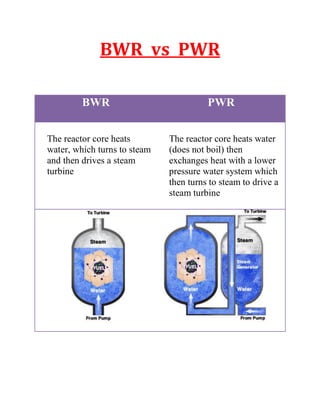
BWR PWR
The reactor core heats
water, which turns to steam
and then drives a steam
turbine
The reactor core heats water
(does not boil) then
exchanges heat with a lower
pressure water system which
then turns to steam to drive a
steam turbine
Control System
Changed by two ways
 Inserting or withdrawing control rods
 Changing the water flow through the reactor core
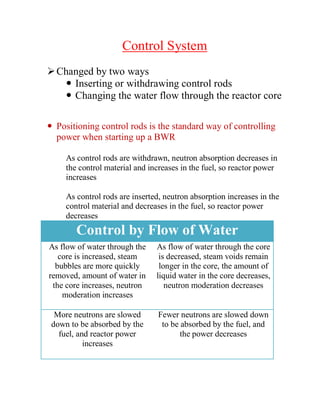
 Positioning control rods is the standard way of controlling
power when starting up a BWR
As control rods are withdrawn, neutron absorption decreases in
the control material and increases in the fuel, so reactor power
increases
As control rods are inserted, neutron absorption increases in the
control material and decreases in the fuel, so reactor power
decreases
Control by Flow of Water
As flow of water through the
core is increased, steam
bubbles are more quickly
removed, amount of water in
the core increases, neutron
moderation increases
As flow of water through the core
is decreased, steam voids remain
longer in the core, the amount of
liquid water in the core decreases,
neutron moderation decreases
More neutrons are slowed
down to be absorbed by the
fuel, and reactor power
increases
Fewer neutrons are slowed down
to be absorbed by the fuel, and
the power decreases
Steam Turbine
 Steam produced in the reactor core passes through steam
separators and dryer plates above the core, then goes
directly to the turbine
 The water contains traces of radionuclides so the turbine
must be shielded during operation and radiological
protection must be provided during maintenance
FUEL
Boiling water reactors must use enriched uranium as
their nuclear fuel, due to their use of light water. This is because
light water absorbs too many neutrons to be used with
natural uranium, so the fuel content of fissileUranium-235 must
be increased. This is done through uranium enrichment—which
increases the concentration of Uranium-235 from 0.7% to
around 4%.
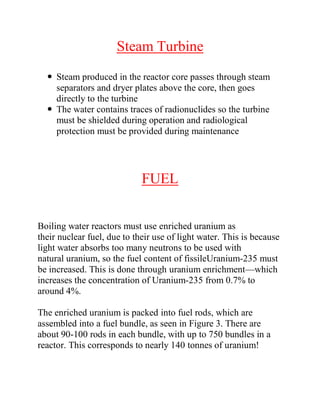
The enriched uranium is packed into fuel rods, which are
assembled into a fuel bundle, as seen in Figure 3. There are
about 90-100 rods in each bundle, with up to 750 bundles in a
reactor. This corresponds to nearly 140 tonnes of uranium!
Advantages:
 The pressure inside the reactor vessel is less than PWR as
water is allowed to boil inside the reactor. Therefore, the
reactor vessel can be much lighter than PWR and reduces
the cost of pressure vessel considerably.
 Pressure vessel is subject to significantly less irradiation
compared to a PWR, and so does not become as brittle with
age.
 Operates at a lower nuclear fuel temperature, largely due to
heat transfer by the latent heat of vaporization, as opposed
to sensible heat in PWRs.
 ower risk (probability) of a rupture causing loss of coolant
compared to a PWR, and lower risk of core damage should
such a rupture occur. This is due to fewer pipes, fewer large
diameter pipes, fewer welds and no steam generator tubes.
 It eliminates the use of heat exchanger, pressuriser,
circulating pump and piping. Therefore, the cost is further
reduced.
 The thermal efficiency of this reactor plant (30%) is
considerably higher than PWR plant.
 The metal temperature remains low for given output
conditions.
 Can operate at lower core power density levels using
natural circulation without forced flow.
Disadvantages:
 The steam leaving the reactor is slightly radioactive.
Therefore, light shielding of turbine and piping is
necessary.
 Larger pressure vessel than for a PWR of similar power,
with correspondingly higher cost, in particular for older
models that still use a main steam generator and associated
piping.
 BWRs require more complex calculations for managing
consumption of nuclear fuel during operation due to "two
phase (water and steam) fluid flow" in the upper part of the
core. This also requires more instrumentation in the reactor
core.
 It cannot meet the sudden changes in load on the plant.
 The power density of this reactor is nearly 50% of PWR,
therefore, the size of the vessel will be considerably large
compared with PWR.
 It requires enriched uranium as a fuel.

BOILING WATER REACTOR

  • 1.
    Gujarat Technological University (Chandkheda,Ahmedabad) Affiliated Government Engineering College, Bharuch A project report on: BOILING WATER REACTOR Under subject of Power Plant Engineering B.E. Semester- VII Branch- Mechanical Presented by: Sr. No. Name Enrollment No. 1 KHARVA TARUN 160140119034 2 KHER JAYDEEP 160140119035 3 LABBAI JISHAN 160140119037 4 LAD VIRAL 160140119038 5 LUHAR DHRUVESH 160140119039 6 MACHHI DHAVAL 160140119040 Guided By:- Prof. U.V Joshi
  • 2.
    Overview A boiling waterreactor (BWR) uses demineralized water as a coolant and neutron moderator. Heat is produced by nuclear fission in the reactor core, and this causes the cooling water to boil, producing steam. The steam is directly used to drive a turbine, after which it is cooled in a condenser and converted back to liquid water. This water is then returned to the reactor core, completing the loop. The cooling water is maintained at about 75 atm (7.6 MPa, 1000–1100 psi) so that it boils in the core at about 285 °C (550 °F).
  • 3.
    In comparison, thereis no significant boiling allowed in a pressurized water reactor (PWR) because of the high pressure maintained in its primary loop—approximately 158 atm (16 MPa, 2300 psi) A type of light water nuclear reactor used for the generation of electrical power It is the second most common type of electricity-generating nuclear reactor after the PWR (Pressurized Water Reactor)
  • 4.
    BWR vs PWR BWRPWR The reactor core heats water, which turns to steam and then drives a steam turbine The reactor core heats water (does not boil) then exchanges heat with a lower pressure water system which then turns to steam to drive a steam turbine
  • 5.
    Control System Changed bytwo ways  Inserting or withdrawing control rods  Changing the water flow through the reactor core  Positioning control rods is the standard way of controlling power when starting up a BWR As control rods are withdrawn, neutron absorption decreases in the control material and increases in the fuel, so reactor power increases As control rods are inserted, neutron absorption increases in the control material and decreases in the fuel, so reactor power decreases Control by Flow of Water As flow of water through the core is increased, steam bubbles are more quickly removed, amount of water in the core increases, neutron moderation increases As flow of water through the core is decreased, steam voids remain longer in the core, the amount of liquid water in the core decreases, neutron moderation decreases More neutrons are slowed down to be absorbed by the fuel, and reactor power increases Fewer neutrons are slowed down to be absorbed by the fuel, and the power decreases
  • 6.
    Steam Turbine  Steamproduced in the reactor core passes through steam separators and dryer plates above the core, then goes directly to the turbine  The water contains traces of radionuclides so the turbine must be shielded during operation and radiological protection must be provided during maintenance FUEL Boiling water reactors must use enriched uranium as their nuclear fuel, due to their use of light water. This is because light water absorbs too many neutrons to be used with natural uranium, so the fuel content of fissileUranium-235 must be increased. This is done through uranium enrichment—which increases the concentration of Uranium-235 from 0.7% to around 4%. The enriched uranium is packed into fuel rods, which are assembled into a fuel bundle, as seen in Figure 3. There are about 90-100 rods in each bundle, with up to 750 bundles in a reactor. This corresponds to nearly 140 tonnes of uranium!
  • 7.
    Advantages:  The pressureinside the reactor vessel is less than PWR as water is allowed to boil inside the reactor. Therefore, the reactor vessel can be much lighter than PWR and reduces the cost of pressure vessel considerably.  Pressure vessel is subject to significantly less irradiation compared to a PWR, and so does not become as brittle with age.  Operates at a lower nuclear fuel temperature, largely due to heat transfer by the latent heat of vaporization, as opposed to sensible heat in PWRs.  ower risk (probability) of a rupture causing loss of coolant compared to a PWR, and lower risk of core damage should such a rupture occur. This is due to fewer pipes, fewer large diameter pipes, fewer welds and no steam generator tubes.  It eliminates the use of heat exchanger, pressuriser, circulating pump and piping. Therefore, the cost is further reduced.  The thermal efficiency of this reactor plant (30%) is considerably higher than PWR plant.  The metal temperature remains low for given output conditions.  Can operate at lower core power density levels using natural circulation without forced flow.
  • 8.
    Disadvantages:  The steamleaving the reactor is slightly radioactive. Therefore, light shielding of turbine and piping is necessary.  Larger pressure vessel than for a PWR of similar power, with correspondingly higher cost, in particular for older models that still use a main steam generator and associated piping.  BWRs require more complex calculations for managing consumption of nuclear fuel during operation due to "two phase (water and steam) fluid flow" in the upper part of the core. This also requires more instrumentation in the reactor core.  It cannot meet the sudden changes in load on the plant.  The power density of this reactor is nearly 50% of PWR, therefore, the size of the vessel will be considerably large compared with PWR.  It requires enriched uranium as a fuel.