DIAPHRAGMATIC
HERNIA
PRESENTED BY:
M.C.KNIRANDA
ASSISTANT PROFESSOR
SSNSR, SU.
DEFINITION
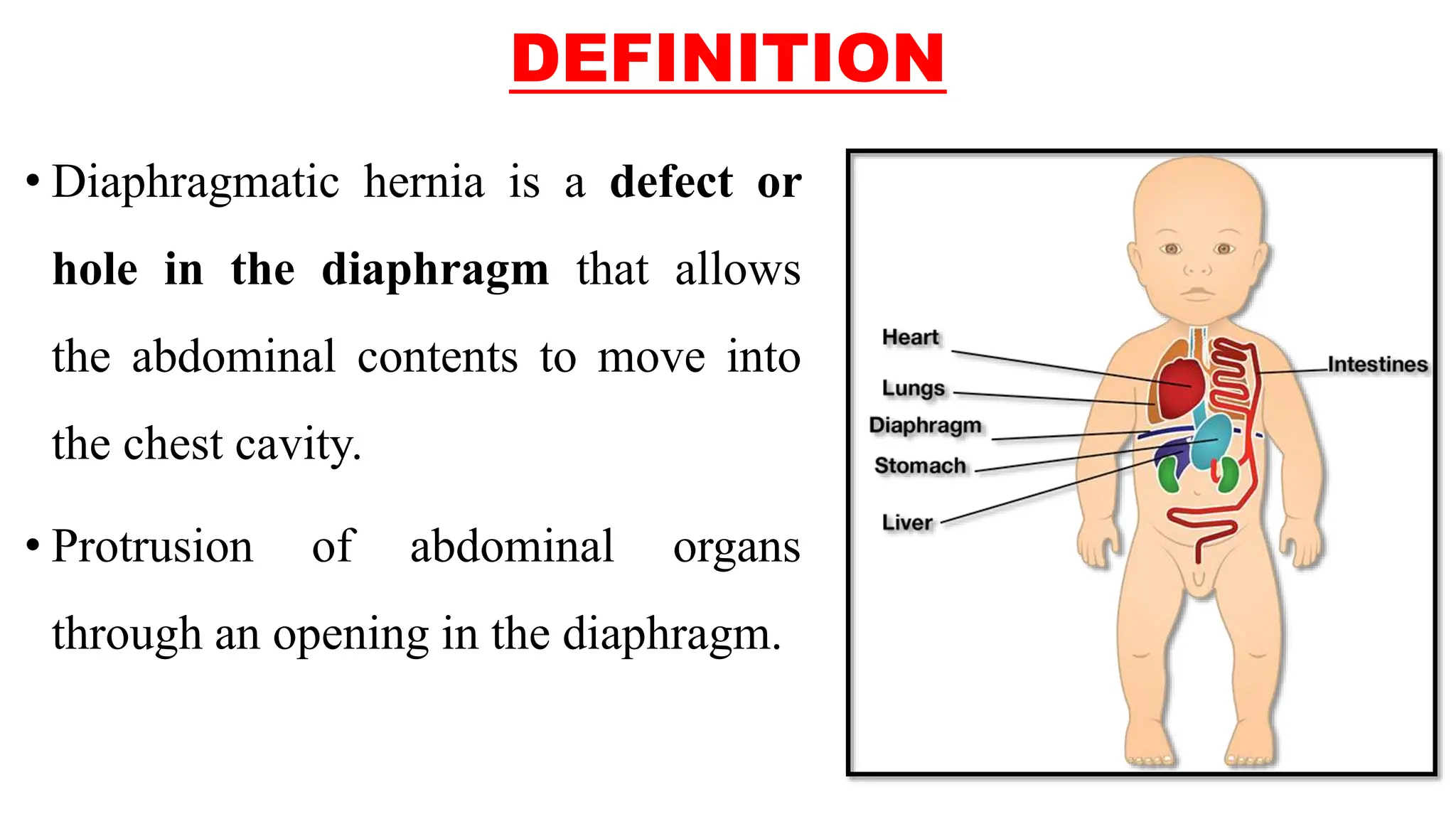
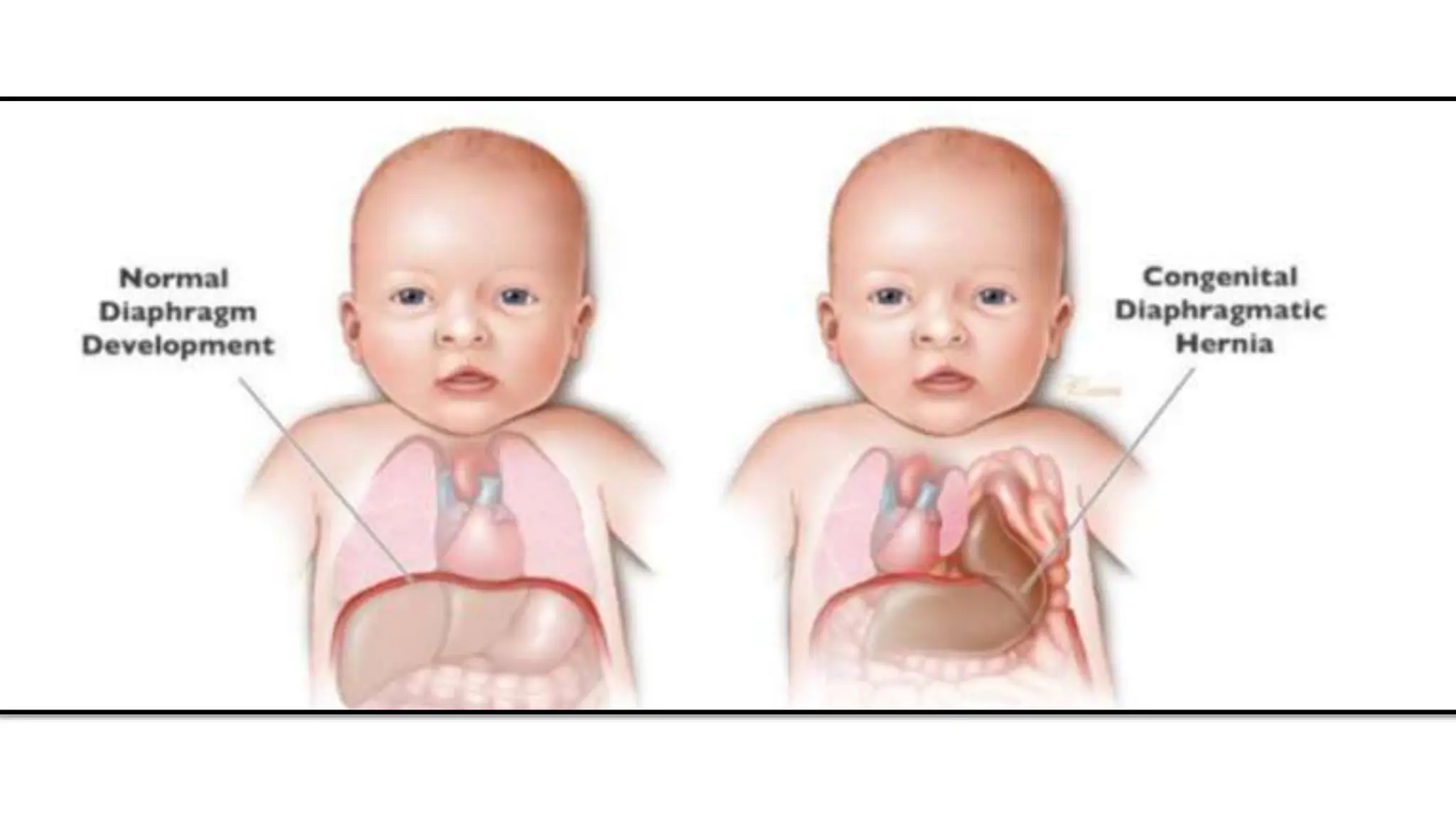
• Diaphragmatic hernia is a defect or
hole in the diaphragm that allows
the abdominal contents to move into
the chest cavity.
• Protrusion of abdominal organs
through an opening in the diaphragm.
INCIDENCE
• CDH is a life-threatening condition affecting one in every 2,500-
4,000 births.
• The most serious complication of CDH is inadequate lung
development.
TYPES OF CONGENITAL
DIAPHRAGMATIC HERNIA
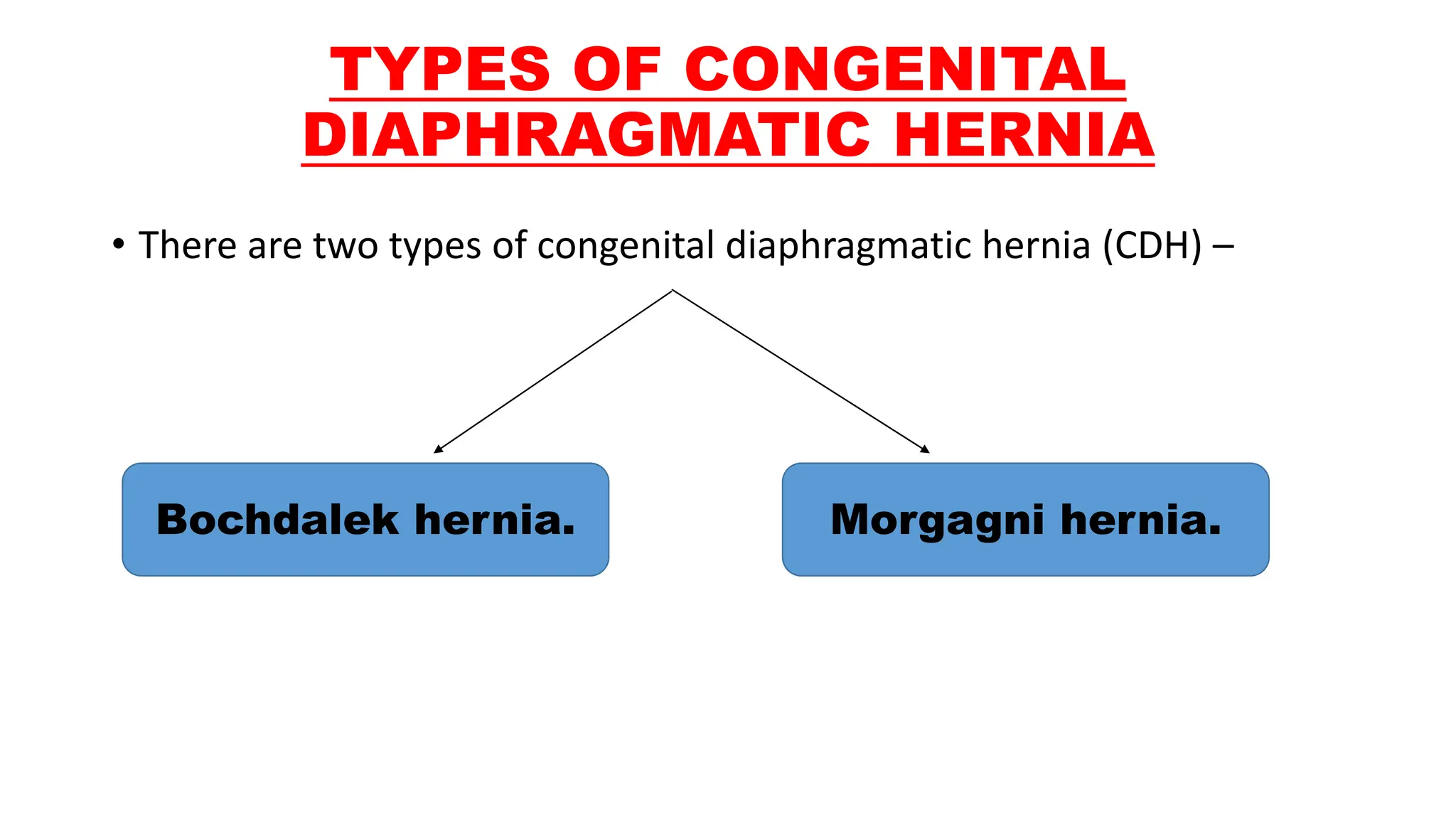
• There are two types of congenital diaphragmatic hernia (CDH) –
Bochdalek hernia. Morgagni hernia.
BOCHDALEK HERNIA
• A Bochdalek hernia is a hole in the diaphragm that can occur on the right or
left side.
• It is caused by either a malformation of the diaphragm or the intestines’
movement into the chest cavity as the diaphragm forms.
• Left-sided Bochdalek hernias are most common, accounting for 80% of cases.
• Bochdalek hernias that occur on the right side are far less common (10% of
cases), but can lead to worse outcomes due to the liver’s movement into the
diaphragm.
MORGAGNI HERNIA
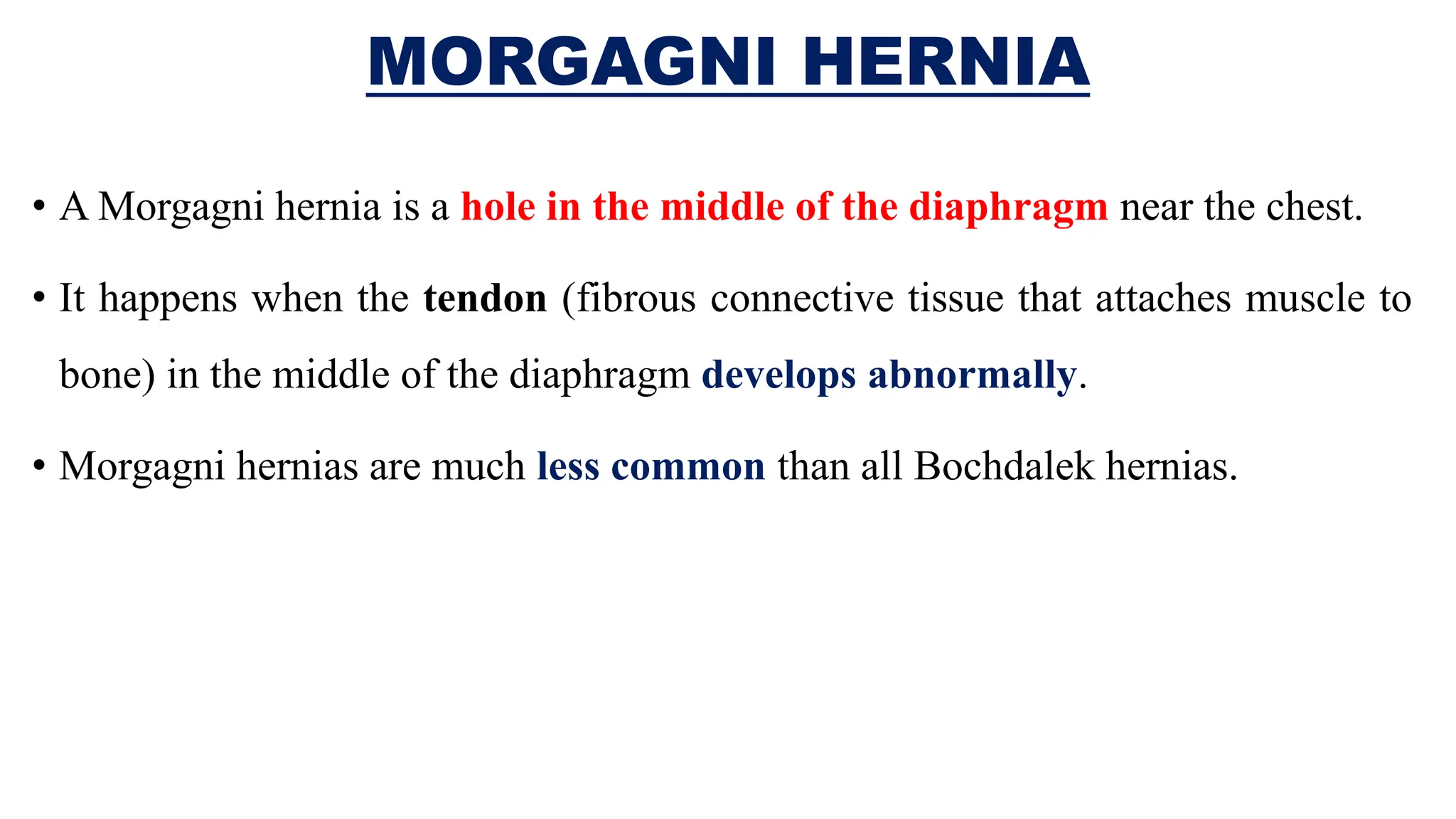
• A Morgagni hernia is a hole in the middle of the diaphragm near the chest.
• It happens when the tendon (fibrous connective tissue that attaches muscle to
bone) in the middle of the diaphragm develops abnormally.
• Morgagni hernias are much less common than all Bochdalek hernias.
• There is no known cause for the development of congenital
diaphragmatic hernias.
• There is nothing someone can do to cause or prevent their baby from
developing a congenital diaphragmatic hernia.
CAUSES OF CONGENITAL
DIAPHRAGMATIC HERNIA
CLINICAL MANIFESTATIONS
• When CDH is not diagnosed prenatally, the symptoms of a congenital
diaphragmatic hernia are observable soon after birth. While they vary
between each child, the most common symptoms of CDH include:
1) Breathing difficulty
2) Rapid breathing (hyperventilating)
3) Rapid heart rate (tachycardia)
4) Blue skin color (cyanosis)
5) One side of the chest is larger (Abnormal Chest Development)
6) Belly looks caved-in (concave/scaphoid)
 The specific symptoms of CDH are dependent on the type of hernia,
Bochdalek vs. Morgagni hernias.
 Babies with Morgagni hernias sometimes show no symptoms.
CLINICAL MANIFESTATIONS
DIAGNOSTIC EVALUATION
1) Fetal ultrasound: Diaphragmatic hernia can be diagnosed using fetal
ultrasound in the second and third trimesters of pregnancy.
• At the 20-week ultrasound, and is often first detected on a routine pre-natal
ultrasound.
2) A fetal echocardiogram: (ultrasound of the heart) may be done to check for
heart abnormalities before birth.
3) X-ray
4) Pulmonary Function Test
5) ABG analysis
TREATMENT
• Babies with a congenital diaphragmatic hernia
(CDH) can have different treatment plans
depending on the severity of the case.
• Most times, a baby is diagnosed with CDH in
utero, and during the pregnancy, a treatment
plan is developed prior to giving birth.
• Resuscitation with ventilatory support is of prime importance in
patients born with a CDH.
• ECMO has been shown to decrease the mortality of CDH.
• ECMO –(extracorporeal membrane oxygenation)
MEDICAL TREATMENT
• ECMO is a therapy used to treat people with life-threatening heart and
lung failure. ECMO involves the use a machine to replace some of the
functions of a patient's lungs or heart, or both simultaneously. While
ECMO therapy can be life-saving, it is not itself a treatment.
• The decision to utilize ECMO is made early in the disease process, usually
within 24 hours of birth.
• An ECMO machine circulates blood through a machine to remove carbon
dioxide and add oxygen.
MEDICAL TREATMENT
ECMO machine
• Maternal antenatal corticosteroid (e.g. Betamethasone and
dexamethasone) administration has also been employed in an effort
to improve fetal lung growth and maturity, but the available evidence
is insufficient to support its routine use.
• Prostaglandin E1 (PGE1) has been used to treat severe pulmonary
hypertension in patients with CDH.
MEDICAL TREATMENT
1) Median sternotomy, Lateral thoracotomy
2) Congenital diaphragmatic hernia repair
3) Fetoscopic Endoluminal Tracheal Occlusion (FETO)
SURGICAL TREATMENT
Median sternotomy
• Median sternotomy is a type of surgical procedure in which a vertical inline
incision is made along the sternum, after which the sternum itself is divided
using a sternal saw (bone cutter).
• This procedure provides access to the heart and lungs for surgical
procedures such as heart transplant, lung transplant.
Thoracotomy
• A thoracotomy is a surgical procedure in which a cut is made
between the ribs to see and reach the lungs or other organs in the
chest or thorax.
• A thoracotomy is performed for diagnosis or treatment of a disease
and allows doctors to visualize, biopsy or remove tissue as needed.
CONGENITAL DIAPHRAGMATIC
HERNIA REPAIR
•Congenital diaphragmatic hernia (CDH) repair is a
surgery to close an opening or space in a baby's
diaphragm.
• The surgery is done under general anesthesia.
• The surgeon usually makes a cut (incision) in the belly under the
lower ribs. This allows the organs in the area to be reached. The
surgeon gently pulls these organs down into place through the
opening in the diaphragm and into the abdominal cavity.
CONGENITAL DIAPHRAGMATIC HERNIA
REPAIR
• In less severe cases, the surgery can be done using smaller incisions in the
chest. A small video camera called a thoracoscope is placed through one of
the incisions. This allows the surgeon to view inside the chest.
• If the hole is small, it may be repaired with stitches. Otherwise, an
artificial patch is used to cover the hole.
CONGENITAL DIAPHRAGMATIC HERNIA
REPAIR
Fetoscopic Endoluminal Tracheal
Occlusion (FETO)
• Fetoscopic endoluminal tracheal occlusion, or FETO,
is a surgical procedure to treat the most severe cases
of congenital diaphragmatic hernia (CDH) that are
diagnosed in utero.
Fetoscopic Endoluminal Tracheal
Occlusion (FETO)
NURSING MANAGEMENT
• PRE-OPERATIVE CARE –
i. Reduce stimulation
ii. Resuscitation, if respiratory distress occurs
iii. Maintain oxygen saturation
iv. IV fluids are given
v. Keep the infant in semi-fowler’s position
vi. For pain relief ,after surgery administer analgesics
vii. Provide rest and comfort to the baby.
DIAPHRAGMATIC HERNIA               .pptx

DIAPHRAGMATIC HERNIA .pptx

  • 1.
  • 2.
    DEFINITION • Diaphragmatic herniais a defect or hole in the diaphragm that allows the abdominal contents to move into the chest cavity. • Protrusion of abdominal organs through an opening in the diaphragm.
  • 5.
    INCIDENCE • CDH isa life-threatening condition affecting one in every 2,500- 4,000 births. • The most serious complication of CDH is inadequate lung development.
  • 6.
    TYPES OF CONGENITAL DIAPHRAGMATICHERNIA • There are two types of congenital diaphragmatic hernia (CDH) – Bochdalek hernia. Morgagni hernia.
  • 7.
    BOCHDALEK HERNIA • ABochdalek hernia is a hole in the diaphragm that can occur on the right or left side. • It is caused by either a malformation of the diaphragm or the intestines’ movement into the chest cavity as the diaphragm forms. • Left-sided Bochdalek hernias are most common, accounting for 80% of cases. • Bochdalek hernias that occur on the right side are far less common (10% of cases), but can lead to worse outcomes due to the liver’s movement into the diaphragm.
  • 8.
    MORGAGNI HERNIA • AMorgagni hernia is a hole in the middle of the diaphragm near the chest. • It happens when the tendon (fibrous connective tissue that attaches muscle to bone) in the middle of the diaphragm develops abnormally. • Morgagni hernias are much less common than all Bochdalek hernias.
  • 9.
    • There isno known cause for the development of congenital diaphragmatic hernias. • There is nothing someone can do to cause or prevent their baby from developing a congenital diaphragmatic hernia. CAUSES OF CONGENITAL DIAPHRAGMATIC HERNIA
  • 10.
    CLINICAL MANIFESTATIONS • WhenCDH is not diagnosed prenatally, the symptoms of a congenital diaphragmatic hernia are observable soon after birth. While they vary between each child, the most common symptoms of CDH include: 1) Breathing difficulty 2) Rapid breathing (hyperventilating) 3) Rapid heart rate (tachycardia)
  • 11.
    4) Blue skincolor (cyanosis) 5) One side of the chest is larger (Abnormal Chest Development) 6) Belly looks caved-in (concave/scaphoid)  The specific symptoms of CDH are dependent on the type of hernia, Bochdalek vs. Morgagni hernias.  Babies with Morgagni hernias sometimes show no symptoms. CLINICAL MANIFESTATIONS
  • 12.
    DIAGNOSTIC EVALUATION 1) Fetalultrasound: Diaphragmatic hernia can be diagnosed using fetal ultrasound in the second and third trimesters of pregnancy. • At the 20-week ultrasound, and is often first detected on a routine pre-natal ultrasound. 2) A fetal echocardiogram: (ultrasound of the heart) may be done to check for heart abnormalities before birth. 3) X-ray 4) Pulmonary Function Test 5) ABG analysis
  • 13.
    TREATMENT • Babies witha congenital diaphragmatic hernia (CDH) can have different treatment plans depending on the severity of the case. • Most times, a baby is diagnosed with CDH in utero, and during the pregnancy, a treatment plan is developed prior to giving birth.
  • 14.
    • Resuscitation withventilatory support is of prime importance in patients born with a CDH. • ECMO has been shown to decrease the mortality of CDH. • ECMO –(extracorporeal membrane oxygenation) MEDICAL TREATMENT
  • 15.
    • ECMO isa therapy used to treat people with life-threatening heart and lung failure. ECMO involves the use a machine to replace some of the functions of a patient's lungs or heart, or both simultaneously. While ECMO therapy can be life-saving, it is not itself a treatment. • The decision to utilize ECMO is made early in the disease process, usually within 24 hours of birth. • An ECMO machine circulates blood through a machine to remove carbon dioxide and add oxygen. MEDICAL TREATMENT
  • 16.
  • 17.
    • Maternal antenatalcorticosteroid (e.g. Betamethasone and dexamethasone) administration has also been employed in an effort to improve fetal lung growth and maturity, but the available evidence is insufficient to support its routine use. • Prostaglandin E1 (PGE1) has been used to treat severe pulmonary hypertension in patients with CDH. MEDICAL TREATMENT
  • 18.
    1) Median sternotomy,Lateral thoracotomy 2) Congenital diaphragmatic hernia repair 3) Fetoscopic Endoluminal Tracheal Occlusion (FETO) SURGICAL TREATMENT
  • 19.
    Median sternotomy • Mediansternotomy is a type of surgical procedure in which a vertical inline incision is made along the sternum, after which the sternum itself is divided using a sternal saw (bone cutter). • This procedure provides access to the heart and lungs for surgical procedures such as heart transplant, lung transplant.
  • 20.
    Thoracotomy • A thoracotomyis a surgical procedure in which a cut is made between the ribs to see and reach the lungs or other organs in the chest or thorax. • A thoracotomy is performed for diagnosis or treatment of a disease and allows doctors to visualize, biopsy or remove tissue as needed.
  • 21.
    CONGENITAL DIAPHRAGMATIC HERNIA REPAIR •Congenitaldiaphragmatic hernia (CDH) repair is a surgery to close an opening or space in a baby's diaphragm.
  • 22.
    • The surgeryis done under general anesthesia. • The surgeon usually makes a cut (incision) in the belly under the lower ribs. This allows the organs in the area to be reached. The surgeon gently pulls these organs down into place through the opening in the diaphragm and into the abdominal cavity. CONGENITAL DIAPHRAGMATIC HERNIA REPAIR
  • 23.
    • In lesssevere cases, the surgery can be done using smaller incisions in the chest. A small video camera called a thoracoscope is placed through one of the incisions. This allows the surgeon to view inside the chest. • If the hole is small, it may be repaired with stitches. Otherwise, an artificial patch is used to cover the hole. CONGENITAL DIAPHRAGMATIC HERNIA REPAIR
  • 24.
    Fetoscopic Endoluminal Tracheal Occlusion(FETO) • Fetoscopic endoluminal tracheal occlusion, or FETO, is a surgical procedure to treat the most severe cases of congenital diaphragmatic hernia (CDH) that are diagnosed in utero.
  • 25.
  • 27.
    NURSING MANAGEMENT • PRE-OPERATIVECARE – i. Reduce stimulation ii. Resuscitation, if respiratory distress occurs iii. Maintain oxygen saturation iv. IV fluids are given v. Keep the infant in semi-fowler’s position vi. For pain relief ,after surgery administer analgesics vii. Provide rest and comfort to the baby.