HYPEROPIA(FARSIGHTEDNESS)
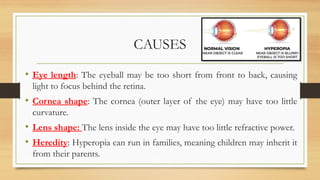
• Hyperopia, alsoknown as farsightedness, is a common
refractive error in children where the eye focuses light
behind the retina, making it difficult to see close objects
clearly.
3.
CAUSES
• Eye length:The eyeball may be too short from front to back, causing
light to focus behind the retina.
• Cornea shape: The cornea (outer layer of the eye) may have too little
curvature.
• Lens shape: The lens inside the eye may have too little refractive power.
• Heredity: Hyperopia can run in families, meaning children may inherit it
from their parents.
4.
SIGNS AND SYMPTOMS
•Blurred vision at close distances: Children may have trouble reading, writing, or
seeing objects close up.
• Eye strain and headaches: Trying to focus on close objects can cause eye strain and
headaches.
• Squinting: Children may squint to try and see more clearly.
• Rubbing their eyes: Frequent rubbing can be a sign of discomfort or effort to focus.
• Lack of interest in school or reading: Difficulty seeing clearly can make it hard for
children to learn and participate in activities.
5.
DIAGNOSTIC EVALUATION
• VisualAcuity Test: This test uses an eye chart to measure
vision clarity at different distances.
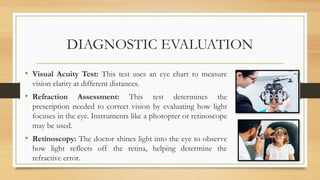
• Refraction Assessment: This test determines the
prescription needed to correct vision by evaluating how light
focuses in the eye. Instruments like a phoropter or retinoscope
may be used.
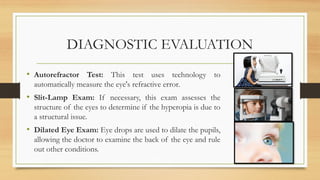
• Retinoscopy: The doctor shines light into the eye to observe
how light reflects off the retina, helping determine the
refractive error.
6.
DIAGNOSTIC EVALUATION
• AutorefractorTest: This test uses technology to
automatically measure the eye's refractive error.
• Slit-Lamp Exam: If necessary, this exam assesses the
structure of the eyes to determine if the hyperopia is due to
a structural issue.
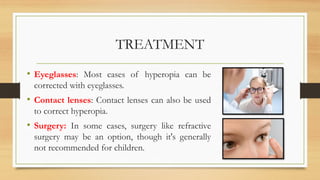
• Dilated Eye Exam: Eye drops are used to dilate the pupils,
allowing the doctor to examine the back of the eye and rule
out other conditions.
7.
TREATMENT
• Eyeglasses: Mostcases of hyperopia can be
corrected with eyeglasses.
• Contact lenses: Contact lenses can also be used
to correct hyperopia.
• Surgery: In some cases, surgery like refractive
surgery may be an option, though it's generally
not recommended for children.