

Diagnostic approach  Ig A nephropathy D.Agiimaa M.Tsendsuren Ph.D P.Chuluunhuu
Introduction   Ig A  nephropathy: First described by Berger and Hinglais in 1968  Primary glomerulonephritis  Circulating IgA immune complexes-mediated Similar in terms of pathogenesis with Shonlein-Henokh
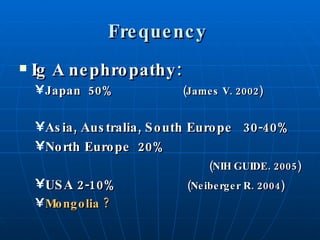
Frequency  Ig A   nephropathy: Japan  50%   (James V. 2002)   Asia, Australia, South Europe  30-40% North Europe  20%  (NIH GUIDE. 2005) USA 2-10%   (Neiberger R. 2004) Mongolia ?
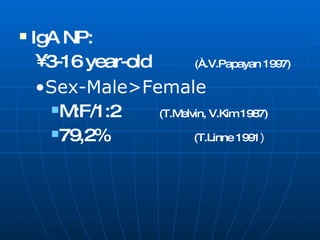
IgA NP: 3-16 year-old  (À.V.Papayan 1997) Sex-Male>Female M:F/1:2  (T.Melvin, V.Kim 1987) 79,2%  (T.Linne 1991 )
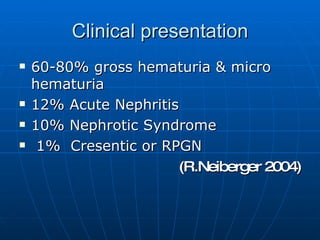
Clinical presentation 60-80% gross hematuria & micro hematuria  12% Acute Nephritis 10% Nephrotic Syndrome 1%  Cresentic or RPGN (R.Neiberger 2004)
Serum IgA elevation in only 8-16% of children (Neiberger R. 2004) Kidney biopsy presence of glomerular IgA deposits accompanied by a variety of histopathologic lesions Diagnosis
Ig AN   Poor prognosis  From 15 to 40 percent of patients will eventually have end-stage renal disease ( James V. Donadio et al. 2002 ) as many as 30-50% of cases progress to end-stage renal failure in 10 years (Neiberger R. 2004) Main cause of CRF in children in MCHRC  glomerulonephritis 51.6% Nephrotic+Hematuric syndrome 41% Shonlein-Henoch nephritis 31% Hematuric syndrome 19% Nephrotic syndrome 9%  (Ì. Tsendsuren et al. 2005)
Rationale MCH Center is a referral hospital which provides pediatric nephrology service for whole country.  Glomerulonephritis is one of the main causes of renal morbidity and CRF among children admitted to the Nephrology Department, MCH Center. IgA nephropathy is the most primitive glomerulonephritis, and requires the renal biopsy. So far, all types of glomerulonephritis were treated by syndromes in Mongolia.  There is an urgent needs to differentiate by biopsy glomerulonephritis and IgA nephropathy since they require different treatments.
Aim of the study   To establish a new diagnostic method of IgA N among children in Mongolia To identify and compare clinical and laboratory features (serum IgA) among children with IgAN and  Shonlein-Henoch nephritis To perform kidney biopsy among children with IgAN and  Shonlein-Henoch nephritis
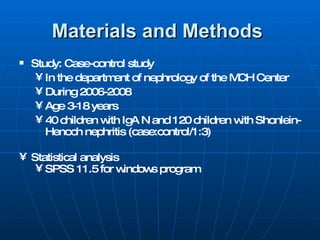
Materials and Methods   Study: Case-control study In the department of nephrology of the MCH Center  During 2006-2008 Age 3-18 years 40 children with IgA N and 120 children with Shonlein-Henoch nephritis (case:control/1:3)  Statistical analysis  SPSS 11.5 for windows program
Outcome A new diagnostic approach for Ig A nepropathy

Diagnostic Approach Ig A Nephropathy

  • 1.
    Diagnostic approach Ig A nephropathy D.Agiimaa M.Tsendsuren Ph.D P.Chuluunhuu
  • 2.
    Introduction Ig A nephropathy: First described by Berger and Hinglais in 1968 Primary glomerulonephritis Circulating IgA immune complexes-mediated Similar in terms of pathogenesis with Shonlein-Henokh
  • 3.
    Frequency IgA nephropathy: Japan 50% (James V. 2002) Asia, Australia, South Europe 30-40% North Europe 20% (NIH GUIDE. 2005) USA 2-10% (Neiberger R. 2004) Mongolia ?
  • 4.
    IgA NP: 3-16year-old (À.V.Papayan 1997) Sex-Male>Female M:F/1:2 (T.Melvin, V.Kim 1987) 79,2% (T.Linne 1991 )
  • 5.
    Clinical presentation 60-80%gross hematuria & micro hematuria 12% Acute Nephritis 10% Nephrotic Syndrome 1% Cresentic or RPGN (R.Neiberger 2004)
  • 6.
    Serum IgA elevationin only 8-16% of children (Neiberger R. 2004) Kidney biopsy presence of glomerular IgA deposits accompanied by a variety of histopathologic lesions Diagnosis
  • 7.
    Ig AN Poor prognosis From 15 to 40 percent of patients will eventually have end-stage renal disease ( James V. Donadio et al. 2002 ) as many as 30-50% of cases progress to end-stage renal failure in 10 years (Neiberger R. 2004) Main cause of CRF in children in MCHRC glomerulonephritis 51.6% Nephrotic+Hematuric syndrome 41% Shonlein-Henoch nephritis 31% Hematuric syndrome 19% Nephrotic syndrome 9% (Ì. Tsendsuren et al. 2005)
  • 8.
    Rationale MCH Centeris a referral hospital which provides pediatric nephrology service for whole country. Glomerulonephritis is one of the main causes of renal morbidity and CRF among children admitted to the Nephrology Department, MCH Center. IgA nephropathy is the most primitive glomerulonephritis, and requires the renal biopsy. So far, all types of glomerulonephritis were treated by syndromes in Mongolia. There is an urgent needs to differentiate by biopsy glomerulonephritis and IgA nephropathy since they require different treatments.
  • 9.
    Aim of thestudy To establish a new diagnostic method of IgA N among children in Mongolia To identify and compare clinical and laboratory features (serum IgA) among children with IgAN and Shonlein-Henoch nephritis To perform kidney biopsy among children with IgAN and Shonlein-Henoch nephritis
  • 10.
    Materials and Methods Study: Case-control study In the department of nephrology of the MCH Center During 2006-2008 Age 3-18 years 40 children with IgA N and 120 children with Shonlein-Henoch nephritis (case:control/1:3) Statistical analysis SPSS 11.5 for windows program
  • 11.
    Outcome A newdiagnostic approach for Ig A nepropathy

Editor's Notes

  • #2 Good afternoon everybody. Now I’m going to introduce short proposal
  • #3 Most common………caused by
  • #4 Frequency of IgAN varies differently in different countries. These percents are frequency of IgAN among primary glomerulonephritis.
  • #5 IgAN is more common in children between 3 to 16 year-olds, and as you can see, boys have IgAN twice more than girls. In Linne’s study, boys were seventy-nine point 2 percent of the patients.
  • #6 % of patients have
  • #7 Diagnosis are done by serum igA and kidney biopsy. Although IgAN is caused by circulating IgA containing immunocomplexes, serum IgA is elevated 8-16% of patients.
  • #11 Special questionnaire