

LUPUS
NEPHRITIS
By –
NIDHIL NARAYANAN
TBILISI STATE MEDICAL UNIVERSITY
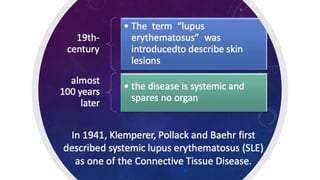
SYSTEMIC LUPUS ERYTHEMATOSUS
• Systemic lupus erythematosus is an autoimmune disease in which organs
and cells undergo damage initially mediated by tissue binding
autoantibodies and immune complexes
LUPUS NEPHRITIS
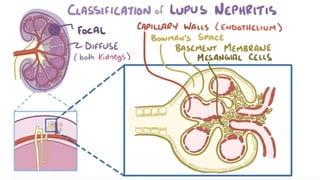
• •Lupus nephritis is histologically evident in most patients with SLE.
• •One of the most serious manifestations of SLE.
• •Usually arises within 5 years of diagnosis.
PATHOPHISIOLOGY
The characteristics of the nephritogenic
autoantibodies associated with lupus nephritis are as follows :
• i. Antigen specificity directed against nucleosome or double- stranded DNA
(dsDNA) - Some anti-dsDNA antibodies cross- react with the glomerular
basement membrane.
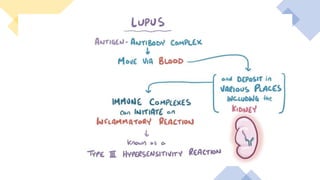
• ii. Higher-affinity autoantibodies may form intravascular immune complexes,
which are deposited in glomeruli.
• iii. Cationic autoantibodies have a higher affinity for the anionic glomerular
basement membrane.
• iv. Autoantibodies of certain isotypes (immunoglobulin IgG 1 and IgG 3) readily
activate complement.
ETIOLOGY
• There are multiple susceptibility
factors, which result in abnormal
immune responses, which
vary among different patients.
• These factors include:
• •Genetic factors
• •Immunologic factors
• Environmental factors
CLINICAL FEATURES:
SYMPTOMS
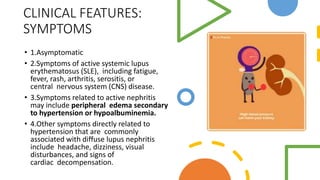
• 1.Asymptomatic
• 2.Symptoms of active systemic lupus
erythematosus (SLE), including fatigue,
fever, rash, arthritis, serositis, or
central nervous system (CNS) disease.
• 3.Symptoms related to active nephritis
may include peripheral edema secondary
to hypertension or hypoalbuminemia.
• 4.Other symptoms directly related to
hypertension that are commonly
associated with diffuse lupus nephritis
include headache, dizziness, visual
disturbances, and signs of
cardiac decompensation.
• •Focal and diffuse lupus nephritis: evidence of generalized active
SLE with the presence of a rash, oral or nasal ulcers, synovitis, or
serositis. Signs of active nephritis are also common.
• •Active lupus nephritis: hypertension, peripheral edema, and,
occasionally, cardiac decompensation.
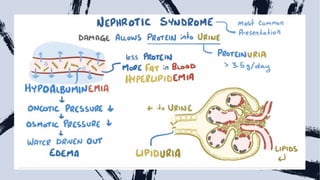
• •Membranous lupus nephritis: signs of an isolated nephrotic
syndrome are common. These include peripheral edema, ascites, and
pleural and pericardial effusions without hypertension.
• •Several studies have focused on the discrepancy between
clinical presentation and pathologic findings at renal biopsy
in patients with SLE.
• •Silent LN has been reported not only in class II but also in
class IV.
• •Even patients with low-level proteinuria (<1g/24h) have
demonstrated significant renal involvement with proliferative
LN (classes III or IV).
DIFFERENTIAL DIAGNOSES
• •Chronic Glomerulonephritis
• •Diffuse Proliferative Glomerulonephritis
• •Granulomatosis with Polyangiitis (Wegener Granulomatosis)
• •Membranous Glomerulonephritis
• •Polyarteritis Nodosa
• •Rapidly Progressive Glomerulonephritis
INVESTIGATIONS
• Evaluating renal function
• •To detect any renal involvement early.
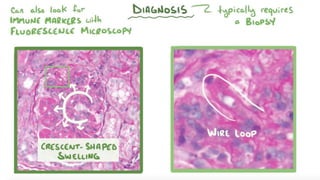
• Renal biopsy
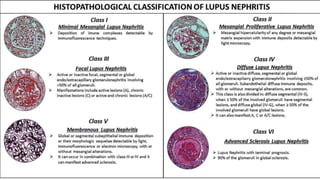
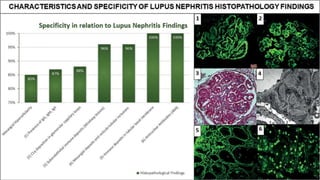
• •Classification is based on light microscopy, immunofluorescence,
and electron microscopy findings from renal biopsy specimens.
LABORATORY TESTS
• •Blood urea nitrogen (BUN)
• •Serum creatinine
• •Urine R/M/E (to check for protein, red blood cells [RBCs], and cellular casts)
• •A spot urine test for creatinine and protein concentration (normal creatinine
excretion is 1000 mg/24 h/1.75 m 2; normal protein excretion is 150-200 mg/24
h/1.75 m 2; normal urinary protein-to-creatinine ratio is <0.2)
• •A 24-hour urine test for creatinine clearance and protein excretion
LABORATORY
TESTS
• •ANA [for diagnosis SLE]
• •Antibodies to double-stranded DNA
(dsDNA), ↑
• •Complement (C3, C4, and CH50), ↓
• •Erythrocyte sedimentation rate
(ESR), ↑
• •C-reactive protein (CRP) levels. ↔
• •Anti-C1q antibodies ↑ [less sensitive
then Anti dsDNA, but more specific]
• Urinary biomarkers can accurately identify active lupus nephritis in
children:
• •Alpha-1-acid glycoprotein (AGP)
• •Ceruloplasmin
• •Lipocalin-like prostaglandin D synthase (LPGDS)
• •Transferrin
RENAL BIOPSY
• All patients with clinical evidence of
active LN, previously untreated,
undergo renal biopsy (unless strongly
contraindicated) for
• •Classified by current ISN/RPS
classification
• •Disease evaluated for activity and
chronicity
• •Identify additional or alternative
causes of renal disease
• •Determining prognosis and treatment
INDICATIONS FOR RENAL BIOPSY IN PATIENTS WITH
SYSTEMIC LUPUS ERYTHEMATOSUS
• •Increasing serum creatinine without compelling alternative causes (such
as sepsis, hypovolemia, or medication)
• •Confirmed proteinuria of 1.0 gm per 24 hours (either 24- hour urine
specimens or spot protein/creatinine ratios are acceptable)
• •Combinations of the following, assuming the findings are confirmed in at
least 2 tests done within a short period of time and in the absence of
alternative causes:
• •Proteinuria 0.5 gm per 24 hours plus hematuria, defined as 5 RBCs per
hpf
• •Proteinuria 0.5 gm per 24 hours plus cellular casts
TREATMENT
• The principal goal of therapy in lupus nephritis is to normalize renal
function or, at least, to prevent the progressive loss of renal function.
Therapy differs depending on the pathologic lesion. It is important to treat
extrarenal manifestations and other variables that may affect the kidneys.
• •Adjunctive Treatments
• •Primary disease management by immunosuppressive agents
• •Induction Therapy
• •Maintenance Therapy
• Lifestyle Changes
IMMUNOSUPPRESSIVE
AGENTS
• •Depends upon class of LN diagnosed
on kidney biopsy along with presence
of extra-renal manifestations of SLE
• •Goals of immunosuppressive
treatment:
• •Long-term preservation of renal
function,
• •Prevention of flares,
• •Avoidance of treatment-related
harms, and
• •Improved quality of life and survival.
CLASS I LN (MINIMAL-MESANGIAL LN)
• Treatment as dictated by the extrarenal clinical manifestations of lupus
• •Class I LN has no clinical kidney manifestations.
• •Class I LN is not associated with long-term impairment of kidney function
CLASS II LN (MESANGIAL-
PROLIFERATIVE LN)
• •May require treatment if proteinuria is greater than 1000 mg/day.
• •Consider prednisone in low-to-moderate doses (ie, 20-40 mg/day) for 1-3
months, with subsequent taper.
CLASS III LN (FOCAL) AND CLASS IV LN
(DIFFUSE)
• •At high risk of progressing to ESRD
• •Require aggressive therapy.
• •Therapy for class III and IV LN has 2 phases:
• •Initial/Induction phase: to rapidly decrease kidney inflammation
• •Maintenance phase: to consolidate treatment over a longer time.
CLASS V LN (MEMBRANOUS LN)
• Generally treated with prednisone for 1-
3 months, followed by tapering for 1-2 years if a response occurs. If no
response occurs, the drug is discontinued.
• Immunosuppressive drugs are generally not used
unless renal function worsens or a proliferative component is present on
renal biopsy samples.
CLASS VI LN (ADVANCED SCLEROSIS LN)
• Treated with corticosteroids and immunosuppressives only as di
ctated by the extrarenal manifestations of systemic lupus.
• Dialysis and
• Kidney transplantation
CONCLUSION
• Although SLE is a rare disease in pediatric
populations, its consequences may be
severe and even fatal. Although the
etiopathogenesis of LN in children and
adults is similar, the disease is more
severe in pediatric populations. Studies
on LN affecting children and adolescents
are required to detect new prognostic
markers and define specific therapeutic
schemes for individuals in this age range.
• Although the exact cause of lupus isn't yet known, which of these are
believed to be factors?
• A. An inherited gene
• B. Exposure to ultraviolet light
• C. Estrogen
• D. All of the above
• Which is a complication of lupus?
• A. Glaucoma
• B. Inflammation of the kidneys
• C. Lung cancer
• D. Dislocated shoulders
• Which of the following are Urinary biomarkers can accurately identify
active lupus nephritis in children ?
1. Alpha-1-acid glycoprotein (AGP)
2 Ceruloplasmin
3 Lipocalin-like prostaglandin D synthase (LPGDS)
4 ALL THE ABOVE
Lupus nephritis nids

Lupus nephritis nids

  • 1.
  • 3.
    SYSTEMIC LUPUS ERYTHEMATOSUS •Systemic lupus erythematosus is an autoimmune disease in which organs and cells undergo damage initially mediated by tissue binding autoantibodies and immune complexes
  • 4.
    LUPUS NEPHRITIS • •Lupusnephritis is histologically evident in most patients with SLE. • •One of the most serious manifestations of SLE. • •Usually arises within 5 years of diagnosis.
  • 5.
  • 7.
    The characteristics ofthe nephritogenic autoantibodies associated with lupus nephritis are as follows : • i. Antigen specificity directed against nucleosome or double- stranded DNA (dsDNA) - Some anti-dsDNA antibodies cross- react with the glomerular basement membrane. • ii. Higher-affinity autoantibodies may form intravascular immune complexes, which are deposited in glomeruli. • iii. Cationic autoantibodies have a higher affinity for the anionic glomerular basement membrane. • iv. Autoantibodies of certain isotypes (immunoglobulin IgG 1 and IgG 3) readily activate complement.
  • 8.
    ETIOLOGY • There aremultiple susceptibility factors, which result in abnormal immune responses, which vary among different patients. • These factors include: • •Genetic factors • •Immunologic factors • Environmental factors
  • 10.
    CLINICAL FEATURES: SYMPTOMS • 1.Asymptomatic •2.Symptoms of active systemic lupus erythematosus (SLE), including fatigue, fever, rash, arthritis, serositis, or central nervous system (CNS) disease. • 3.Symptoms related to active nephritis may include peripheral edema secondary to hypertension or hypoalbuminemia. • 4.Other symptoms directly related to hypertension that are commonly associated with diffuse lupus nephritis include headache, dizziness, visual disturbances, and signs of cardiac decompensation.
  • 11.
    • •Focal anddiffuse lupus nephritis: evidence of generalized active SLE with the presence of a rash, oral or nasal ulcers, synovitis, or serositis. Signs of active nephritis are also common. • •Active lupus nephritis: hypertension, peripheral edema, and, occasionally, cardiac decompensation. • •Membranous lupus nephritis: signs of an isolated nephrotic syndrome are common. These include peripheral edema, ascites, and pleural and pericardial effusions without hypertension.
  • 12.
    • •Several studieshave focused on the discrepancy between clinical presentation and pathologic findings at renal biopsy in patients with SLE. • •Silent LN has been reported not only in class II but also in class IV. • •Even patients with low-level proteinuria (<1g/24h) have demonstrated significant renal involvement with proliferative LN (classes III or IV).
  • 16.
    DIFFERENTIAL DIAGNOSES • •ChronicGlomerulonephritis • •Diffuse Proliferative Glomerulonephritis • •Granulomatosis with Polyangiitis (Wegener Granulomatosis) • •Membranous Glomerulonephritis • •Polyarteritis Nodosa • •Rapidly Progressive Glomerulonephritis
  • 17.
    INVESTIGATIONS • Evaluating renalfunction • •To detect any renal involvement early. • Renal biopsy • •Classification is based on light microscopy, immunofluorescence, and electron microscopy findings from renal biopsy specimens.
  • 18.
    LABORATORY TESTS • •Bloodurea nitrogen (BUN) • •Serum creatinine • •Urine R/M/E (to check for protein, red blood cells [RBCs], and cellular casts) • •A spot urine test for creatinine and protein concentration (normal creatinine excretion is 1000 mg/24 h/1.75 m 2; normal protein excretion is 150-200 mg/24 h/1.75 m 2; normal urinary protein-to-creatinine ratio is <0.2) • •A 24-hour urine test for creatinine clearance and protein excretion
  • 19.
    LABORATORY TESTS • •ANA [fordiagnosis SLE] • •Antibodies to double-stranded DNA (dsDNA), ↑ • •Complement (C3, C4, and CH50), ↓ • •Erythrocyte sedimentation rate (ESR), ↑ • •C-reactive protein (CRP) levels. ↔ • •Anti-C1q antibodies ↑ [less sensitive then Anti dsDNA, but more specific]
  • 20.
    • Urinary biomarkerscan accurately identify active lupus nephritis in children: • •Alpha-1-acid glycoprotein (AGP) • •Ceruloplasmin • •Lipocalin-like prostaglandin D synthase (LPGDS) • •Transferrin
  • 21.
    RENAL BIOPSY • Allpatients with clinical evidence of active LN, previously untreated, undergo renal biopsy (unless strongly contraindicated) for • •Classified by current ISN/RPS classification • •Disease evaluated for activity and chronicity • •Identify additional or alternative causes of renal disease • •Determining prognosis and treatment
  • 22.
    INDICATIONS FOR RENALBIOPSY IN PATIENTS WITH SYSTEMIC LUPUS ERYTHEMATOSUS • •Increasing serum creatinine without compelling alternative causes (such as sepsis, hypovolemia, or medication) • •Confirmed proteinuria of 1.0 gm per 24 hours (either 24- hour urine specimens or spot protein/creatinine ratios are acceptable) • •Combinations of the following, assuming the findings are confirmed in at least 2 tests done within a short period of time and in the absence of alternative causes: • •Proteinuria 0.5 gm per 24 hours plus hematuria, defined as 5 RBCs per hpf • •Proteinuria 0.5 gm per 24 hours plus cellular casts
  • 24.
    TREATMENT • The principalgoal of therapy in lupus nephritis is to normalize renal function or, at least, to prevent the progressive loss of renal function. Therapy differs depending on the pathologic lesion. It is important to treat extrarenal manifestations and other variables that may affect the kidneys. • •Adjunctive Treatments • •Primary disease management by immunosuppressive agents • •Induction Therapy • •Maintenance Therapy • Lifestyle Changes
  • 25.
    IMMUNOSUPPRESSIVE AGENTS • •Depends uponclass of LN diagnosed on kidney biopsy along with presence of extra-renal manifestations of SLE • •Goals of immunosuppressive treatment: • •Long-term preservation of renal function, • •Prevention of flares, • •Avoidance of treatment-related harms, and • •Improved quality of life and survival.
  • 26.
    CLASS I LN(MINIMAL-MESANGIAL LN) • Treatment as dictated by the extrarenal clinical manifestations of lupus • •Class I LN has no clinical kidney manifestations. • •Class I LN is not associated with long-term impairment of kidney function
  • 27.
    CLASS II LN(MESANGIAL- PROLIFERATIVE LN) • •May require treatment if proteinuria is greater than 1000 mg/day. • •Consider prednisone in low-to-moderate doses (ie, 20-40 mg/day) for 1-3 months, with subsequent taper.
  • 28.
    CLASS III LN(FOCAL) AND CLASS IV LN (DIFFUSE) • •At high risk of progressing to ESRD • •Require aggressive therapy. • •Therapy for class III and IV LN has 2 phases: • •Initial/Induction phase: to rapidly decrease kidney inflammation • •Maintenance phase: to consolidate treatment over a longer time.
  • 29.
    CLASS V LN(MEMBRANOUS LN) • Generally treated with prednisone for 1- 3 months, followed by tapering for 1-2 years if a response occurs. If no response occurs, the drug is discontinued. • Immunosuppressive drugs are generally not used unless renal function worsens or a proliferative component is present on renal biopsy samples.
  • 30.
    CLASS VI LN(ADVANCED SCLEROSIS LN) • Treated with corticosteroids and immunosuppressives only as di ctated by the extrarenal manifestations of systemic lupus. • Dialysis and • Kidney transplantation
  • 31.
    CONCLUSION • Although SLEis a rare disease in pediatric populations, its consequences may be severe and even fatal. Although the etiopathogenesis of LN in children and adults is similar, the disease is more severe in pediatric populations. Studies on LN affecting children and adolescents are required to detect new prognostic markers and define specific therapeutic schemes for individuals in this age range.
  • 32.
    • Although theexact cause of lupus isn't yet known, which of these are believed to be factors? • A. An inherited gene • B. Exposure to ultraviolet light • C. Estrogen • D. All of the above
  • 33.
    • Which isa complication of lupus? • A. Glaucoma • B. Inflammation of the kidneys • C. Lung cancer • D. Dislocated shoulders
  • 34.
    • Which ofthe following are Urinary biomarkers can accurately identify active lupus nephritis in children ? 1. Alpha-1-acid glycoprotein (AGP) 2 Ceruloplasmin 3 Lipocalin-like prostaglandin D synthase (LPGDS) 4 ALL THE ABOVE