
Presenter: Dr. Tanisha Richmond
Richmond Foot and Ankle Clinic
1323 W. 3rd St.
Dayton, Ohio 45402
937-228-3668-P
937-228-3660-F
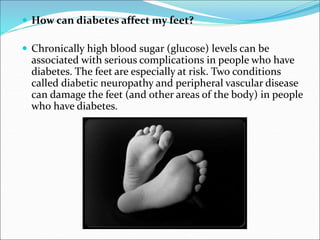
 How can diabetes affect my feet?
 Chronically high blood sugar (glucose) levels can be
associated with serious complications in people who have
diabetes. The feet are especially at risk. Two conditions
called diabetic neuropathy and peripheral vascular disease
can damage the feet (and other areas of the body) in people
who have diabetes.
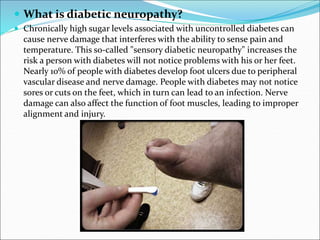
 What is diabetic neuropathy?
 Chronically high sugar levels associated with uncontrolled diabetes can
cause nerve damage that interferes with the ability to sense pain and
temperature. This so-called "sensory diabetic neuropathy" increases the
risk a person with diabetes will not notice problems with his or her feet.
Nearly 10% of people with diabetes develop foot ulcers due to peripheral
vascular disease and nerve damage. People with diabetes may not notice
sores or cuts on the feet, which in turn can lead to an infection. Nerve
damage can also affect the function of foot muscles, leading to improper
alignment and injury.
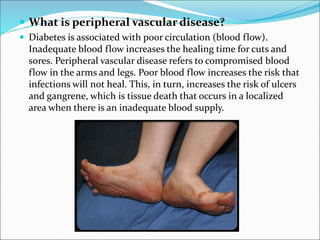
 What is peripheral vascular disease?
 Diabetes is associated with poor circulation (blood flow).
Inadequate blood flow increases the healing time for cuts and
sores. Peripheral vascular disease refers to compromised blood
flow in the arms and legs. Poor blood flow increases the risk that
infections will not heal. This, in turn, increases the risk of ulcers
and gangrene, which is tissue death that occurs in a localized
area when there is an inadequate blood supply.
 What are common foot problems of people with
diabetes?
 The following images show common foot problems
that anyone can get; however, those with diabetes are
at increased risk for serious complications associated
with these conditions, including infection and even
amputation.
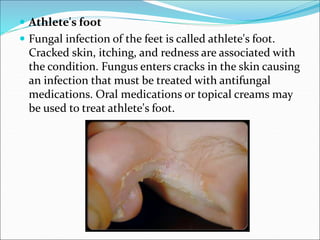
 Athlete's foot
 Fungal infection of the feet is called athlete's foot.
Cracked skin, itching, and redness are associated with
the condition. Fungus enters cracks in the skin causing
an infection that must be treated with antifungal
medications. Oral medications or topical creams may
be used to treat athlete's foot.
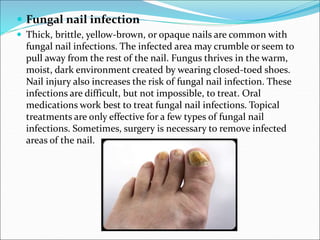
 Fungal nail infection
 Thick, brittle, yellow-brown, or opaque nails are common with
fungal nail infections. The infected area may crumble or seem to
pull away from the rest of the nail. Fungus thrives in the warm,
moist, dark environment created by wearing closed-toed shoes.
Nail injury also increases the risk of fungal nail infection. These
infections are difficult, but not impossible, to treat. Oral
medications work best to treat fungal nail infections. Topical
treatments are only effective for a few types of fungal nail
infections. Sometimes, surgery is necessary to remove infected
areas of the nail.
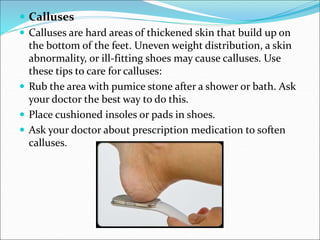
 Calluses
 Calluses are hard areas of thickened skin that build up on
the bottom of the feet. Uneven weight distribution, a skin
abnormality, or ill-fitting shoes may cause calluses. Use
these tips to care for calluses:
 Rub the area with pumice stone after a shower or bath. Ask
your doctor the best way to do this.
 Place cushioned insoles or pads in shoes.
 Ask your doctor about prescription medication to soften
calluses.
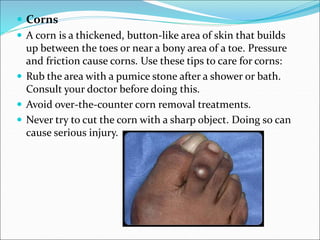
 Corns
 A corn is a thickened, button-like area of skin that builds
up between the toes or near a bony area of a toe. Pressure
and friction cause corns. Use these tips to care for corns:
 Rub the area with a pumice stone after a shower or bath.
Consult your doctor before doing this.
 Avoid over-the-counter corn removal treatments.
 Never try to cut the corn with a sharp object. Doing so can
cause serious injury.
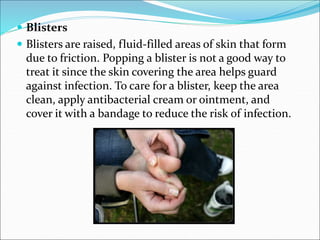
 Blisters
 Blisters are raised, fluid-filled areas of skin that form
due to friction. Popping a blister is not a good way to
treat it since the skin covering the area helps guard
against infection. To care for a blister, keep the area
clean, apply antibacterial cream or ointment, and
cover it with a bandage to reduce the risk of infection.
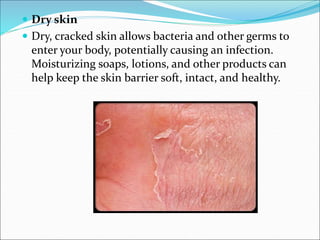
 Dry skin
 Dry, cracked skin allows bacteria and other germs to
enter your body, potentially causing an infection.
Moisturizing soaps, lotions, and other products can
help keep the skin barrier soft, intact, and healthy.
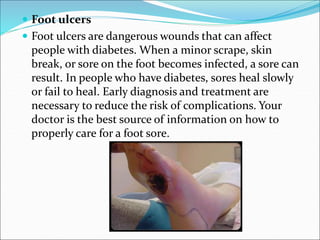
 Foot ulcers
 Foot ulcers are dangerous wounds that can affect
people with diabetes. When a minor scrape, skin
break, or sore on the foot becomes infected, a sore can
result. In people who have diabetes, sores heal slowly
or fail to heal. Early diagnosis and treatment are
necessary to reduce the risk of complications. Your
doctor is the best source of information on how to
properly care for a foot sore.
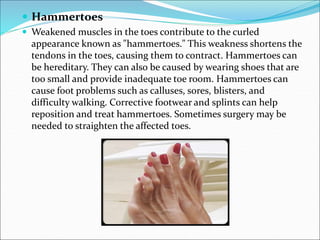
 Hammertoes
 Weakened muscles in the toes contribute to the curled
appearance known as "hammertoes." This weakness shortens the
tendons in the toes, causing them to contract. Hammertoes can
be hereditary. They can also be caused by wearing shoes that are
too small and provide inadequate toe room. Hammertoes can
cause foot problems such as calluses, sores, blisters, and
difficulty walking. Corrective footwear and splints can help
reposition and treat hammertoes. Sometimes surgery may be
needed to straighten the affected toes.
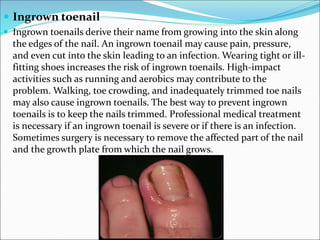
 Ingrown toenail
 Ingrown toenails derive their name from growing into the skin along
the edges of the nail. An ingrown toenail may cause pain, pressure,
and even cut into the skin leading to an infection. Wearing tight or ill-
fitting shoes increases the risk of ingrown toenails. High-impact
activities such as running and aerobics may contribute to the
problem. Walking, toe crowding, and inadequately trimmed toe nails
may also cause ingrown toenails. The best way to prevent ingrown
toenails is to keep the nails trimmed. Professional medical treatment
is necessary if an ingrown toenail is severe or if there is an infection.
Sometimes surgery is necessary to remove the affected part of the nail
and the growth plate from which the nail grows.
 Can these foot problems be prevented?
 Taking good care of your feet can prevent problems
before they start! Use the following tips to reduce your
risk of common foot problems and serious
complications associated with them.
 Diabetes and Foot Problems
Prevention Tip #1
 Living with diabetes requires you to pay special
attention to your health and your condition. Follow
your doctor's instructions regarding diet, exercise and
medication. Keeping your blood sugar (glucose) levels
within the recommended range is one of the best
things you can do to control your condition and
protect your feet.
 Diabetes and Foot Problems
Prevention Tip #2
 Carefully inspect your feet daily for redness, blisters, sores,
calluses, and other signs of irritation. Daily foot checks are
especially important if you have inadequate blood flow.
 Diabetes and Foot Problems
Prevention Tip #3
 Follow these foot care tips to properly care for your feet:
 Wash your feet daily with non-irritating soap and warm
water.
 Avoid soaking your feet.
 Dry your feet completely after bathing, paying special
attention to the areas between the toes.
 Avoid applying lotion to the areas between the toes.
 Ask your doctor which lotion is best for your skin type and
health condition
 Diabetes and Foot Problems
Prevention Tip #4
 After bathing, use a pumice stone or emery board to smooth
hardened areas of the feet that contain corns and calluses.
Working in one direction is most effective. Consult your
doctor on the proper way to use a pumice or emery board.
 Diabetes and Foot Problems
Prevention Tip #5
 Use the following toenail care tips to help prevent ingrown
toenails.
 Once a week, examine your toenails.
 Consult your doctor for the proper way to care for your
toenails.
 Diabetes and Foot Problems
Prevention Tip #6
 Proper footwear, socks, and stockings can go a long way to help protect
your feet. Follow these tips:
 Choose well-fitting socks and stockings that contain soft elastic.
 Wear socks to bed if your feet get chilly.
 Avoid sandals and walking barefoot, even at home.
 Wear properly-fitting shoes.
 Diabetes and Foot Problems
Prevention Tip #7
 Follow these tips to keep blood flowing to your feet:
 If you can, prop your feet up when sitting down
 Wiggle your toes frequently.
 Take frequent breaks to flex and point your toes and circle your feet in
both directions.
 Avoid crossing your legs, especially for long periods.
 Diabetes and Foot Problems
Prevention Tip #8
 Avoid smoking and if you do smoke, quit. Smoking aggravates
blood flow problems.
 Diabetes and Foot Problems
Prevention Tip #9
 People who have diabetes should see a foot doctor (podiatrist)
every 2 to 3 months, even when not experiencing foot problems.
At each check-up, ask the doctor to thoroughly examine your
feet. An annual foot exam should include:
 An examination of the tops and bottoms of the feet and in
between the toes
 An assessment of skin warmth and redness
 An assessment of pulses in the feet and temperature of the feet
 An assessment of sensation using a monofilament tool
 When should I contact my doctor?
 Call your doctor if you notice any of the following with
your feet:
 Changes in skin color or temperature
 Foot or ankle swelling
 The appearance of corns, calluses, ingrown toenails,
infected toenails, or dry, cracked skin
 Leg pain
 Foul-smelling, persistent, or unusual foot odor
THANK YOU
Richmond Foot and Ankle Clinic
1323 W. 3rd St.
Dayton, Ohio 45402
937-228-3668-P
937-228-3660-F

Diabetic foot power point

  • 1.
    Presenter: Dr. TanishaRichmond Richmond Foot and Ankle Clinic 1323 W. 3rd St. Dayton, Ohio 45402 937-228-3668-P 937-228-3660-F
  • 2.
     How candiabetes affect my feet?  Chronically high blood sugar (glucose) levels can be associated with serious complications in people who have diabetes. The feet are especially at risk. Two conditions called diabetic neuropathy and peripheral vascular disease can damage the feet (and other areas of the body) in people who have diabetes.
  • 3.
     What isdiabetic neuropathy?  Chronically high sugar levels associated with uncontrolled diabetes can cause nerve damage that interferes with the ability to sense pain and temperature. This so-called "sensory diabetic neuropathy" increases the risk a person with diabetes will not notice problems with his or her feet. Nearly 10% of people with diabetes develop foot ulcers due to peripheral vascular disease and nerve damage. People with diabetes may not notice sores or cuts on the feet, which in turn can lead to an infection. Nerve damage can also affect the function of foot muscles, leading to improper alignment and injury.
  • 4.
     What isperipheral vascular disease?  Diabetes is associated with poor circulation (blood flow). Inadequate blood flow increases the healing time for cuts and sores. Peripheral vascular disease refers to compromised blood flow in the arms and legs. Poor blood flow increases the risk that infections will not heal. This, in turn, increases the risk of ulcers and gangrene, which is tissue death that occurs in a localized area when there is an inadequate blood supply.
  • 5.
     What arecommon foot problems of people with diabetes?  The following images show common foot problems that anyone can get; however, those with diabetes are at increased risk for serious complications associated with these conditions, including infection and even amputation.
  • 6.
     Athlete's foot Fungal infection of the feet is called athlete's foot. Cracked skin, itching, and redness are associated with the condition. Fungus enters cracks in the skin causing an infection that must be treated with antifungal medications. Oral medications or topical creams may be used to treat athlete's foot.
  • 7.
     Fungal nailinfection  Thick, brittle, yellow-brown, or opaque nails are common with fungal nail infections. The infected area may crumble or seem to pull away from the rest of the nail. Fungus thrives in the warm, moist, dark environment created by wearing closed-toed shoes. Nail injury also increases the risk of fungal nail infection. These infections are difficult, but not impossible, to treat. Oral medications work best to treat fungal nail infections. Topical treatments are only effective for a few types of fungal nail infections. Sometimes, surgery is necessary to remove infected areas of the nail.
  • 8.
     Calluses  Callusesare hard areas of thickened skin that build up on the bottom of the feet. Uneven weight distribution, a skin abnormality, or ill-fitting shoes may cause calluses. Use these tips to care for calluses:  Rub the area with pumice stone after a shower or bath. Ask your doctor the best way to do this.  Place cushioned insoles or pads in shoes.  Ask your doctor about prescription medication to soften calluses.
  • 9.
     Corns  Acorn is a thickened, button-like area of skin that builds up between the toes or near a bony area of a toe. Pressure and friction cause corns. Use these tips to care for corns:  Rub the area with a pumice stone after a shower or bath. Consult your doctor before doing this.  Avoid over-the-counter corn removal treatments.  Never try to cut the corn with a sharp object. Doing so can cause serious injury.
  • 10.
     Blisters  Blistersare raised, fluid-filled areas of skin that form due to friction. Popping a blister is not a good way to treat it since the skin covering the area helps guard against infection. To care for a blister, keep the area clean, apply antibacterial cream or ointment, and cover it with a bandage to reduce the risk of infection.
  • 11.
     Dry skin Dry, cracked skin allows bacteria and other germs to enter your body, potentially causing an infection. Moisturizing soaps, lotions, and other products can help keep the skin barrier soft, intact, and healthy.
  • 12.
     Foot ulcers Foot ulcers are dangerous wounds that can affect people with diabetes. When a minor scrape, skin break, or sore on the foot becomes infected, a sore can result. In people who have diabetes, sores heal slowly or fail to heal. Early diagnosis and treatment are necessary to reduce the risk of complications. Your doctor is the best source of information on how to properly care for a foot sore.
  • 13.
     Hammertoes  Weakenedmuscles in the toes contribute to the curled appearance known as "hammertoes." This weakness shortens the tendons in the toes, causing them to contract. Hammertoes can be hereditary. They can also be caused by wearing shoes that are too small and provide inadequate toe room. Hammertoes can cause foot problems such as calluses, sores, blisters, and difficulty walking. Corrective footwear and splints can help reposition and treat hammertoes. Sometimes surgery may be needed to straighten the affected toes.
  • 14.
     Ingrown toenail Ingrown toenails derive their name from growing into the skin along the edges of the nail. An ingrown toenail may cause pain, pressure, and even cut into the skin leading to an infection. Wearing tight or ill- fitting shoes increases the risk of ingrown toenails. High-impact activities such as running and aerobics may contribute to the problem. Walking, toe crowding, and inadequately trimmed toe nails may also cause ingrown toenails. The best way to prevent ingrown toenails is to keep the nails trimmed. Professional medical treatment is necessary if an ingrown toenail is severe or if there is an infection. Sometimes surgery is necessary to remove the affected part of the nail and the growth plate from which the nail grows.
  • 15.
     Can thesefoot problems be prevented?  Taking good care of your feet can prevent problems before they start! Use the following tips to reduce your risk of common foot problems and serious complications associated with them.
  • 16.
     Diabetes andFoot Problems Prevention Tip #1  Living with diabetes requires you to pay special attention to your health and your condition. Follow your doctor's instructions regarding diet, exercise and medication. Keeping your blood sugar (glucose) levels within the recommended range is one of the best things you can do to control your condition and protect your feet.
  • 17.
     Diabetes andFoot Problems Prevention Tip #2  Carefully inspect your feet daily for redness, blisters, sores, calluses, and other signs of irritation. Daily foot checks are especially important if you have inadequate blood flow.  Diabetes and Foot Problems Prevention Tip #3  Follow these foot care tips to properly care for your feet:  Wash your feet daily with non-irritating soap and warm water.  Avoid soaking your feet.  Dry your feet completely after bathing, paying special attention to the areas between the toes.  Avoid applying lotion to the areas between the toes.  Ask your doctor which lotion is best for your skin type and health condition
  • 18.
     Diabetes andFoot Problems Prevention Tip #4  After bathing, use a pumice stone or emery board to smooth hardened areas of the feet that contain corns and calluses. Working in one direction is most effective. Consult your doctor on the proper way to use a pumice or emery board.  Diabetes and Foot Problems Prevention Tip #5  Use the following toenail care tips to help prevent ingrown toenails.  Once a week, examine your toenails.  Consult your doctor for the proper way to care for your toenails.
  • 19.
     Diabetes andFoot Problems Prevention Tip #6  Proper footwear, socks, and stockings can go a long way to help protect your feet. Follow these tips:  Choose well-fitting socks and stockings that contain soft elastic.  Wear socks to bed if your feet get chilly.  Avoid sandals and walking barefoot, even at home.  Wear properly-fitting shoes.  Diabetes and Foot Problems Prevention Tip #7  Follow these tips to keep blood flowing to your feet:  If you can, prop your feet up when sitting down  Wiggle your toes frequently.  Take frequent breaks to flex and point your toes and circle your feet in both directions.  Avoid crossing your legs, especially for long periods.
  • 20.
     Diabetes andFoot Problems Prevention Tip #8  Avoid smoking and if you do smoke, quit. Smoking aggravates blood flow problems.  Diabetes and Foot Problems Prevention Tip #9  People who have diabetes should see a foot doctor (podiatrist) every 2 to 3 months, even when not experiencing foot problems. At each check-up, ask the doctor to thoroughly examine your feet. An annual foot exam should include:  An examination of the tops and bottoms of the feet and in between the toes  An assessment of skin warmth and redness  An assessment of pulses in the feet and temperature of the feet  An assessment of sensation using a monofilament tool
  • 21.
     When shouldI contact my doctor?  Call your doctor if you notice any of the following with your feet:  Changes in skin color or temperature  Foot or ankle swelling  The appearance of corns, calluses, ingrown toenails, infected toenails, or dry, cracked skin  Leg pain  Foul-smelling, persistent, or unusual foot odor
  • 22.
    THANK YOU Richmond Footand Ankle Clinic 1323 W. 3rd St. Dayton, Ohio 45402 937-228-3668-P 937-228-3660-F