May 23, 2013
Business Days Romania
Don Seymour – IBM Sales & Solutions – CEE
A briefing on
- Operational Excellence through BPM
© 2013 IBM CorporationConfidential
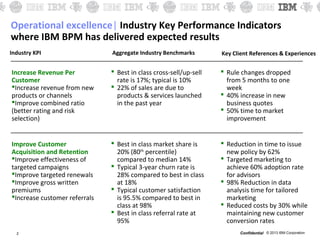
Industry KPI Aggregate Industry Benchmarks Key Client References & Experiences
Increase Revenue Per
Customer
Increase revenue from new
products or channels
Improve combined ratio
(better rating and risk
selection)
 Best in class cross-sell/up-sell
rate is 17%; typical is 10%
 22% of sales are due to
products & services launched
in the past year
 Rule changes dropped
from 5 months to one
week
 40% increase in new
business quotes
 50% time to market
improvement
Improve Customer
Acquisition and Retention
Improve effectiveness of
targeted campaigns
Improve targeted renewals
Improve gross written
premiums
Increase customer referrals
 Best in class market share is
20% (80th
percentile)
compared to median 14%
 Typical 3-year churn rate is
28% compared to best in class
at 18%
 Typical customer satisfaction
is 95.5% compared to best in
class at 98%
 Best in class referral rate at
95%
 Reduction in time to issue
new policy by 62%
 Targeted marketing to
achieve 60% adoption rate
for advisors
 98% Reduction in data
analysis time for tailored
marketing
 Reduced costs by 30% while
maintaining new customer
conversion rates
2
Operational excellence| Industry Key Performance Indicators
where IBM BPM has delivered expected results
© 2013 IBM CorporationConfidential
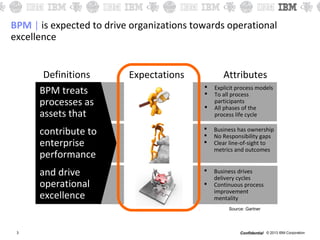
Definitions
3
Expectations Attributes
BPM | is expected to drive organizations towards operational
excellence
Visibility
Accountability
Adaptability
BPM treats
processes as
assets that
contribute to
enterprise
performance
and drive
operational
excellence
 Explicit process models
 To all process
participants
 All phases of the
process life cycle
 Business has ownership
 No Responsibility gaps
 Clear line-of-sight to
metrics and outcomes
 Business drives
delivery cycles
 Continuous process
improvement
mentality
Source: Gartner
© 2013 IBM CorporationConfidential
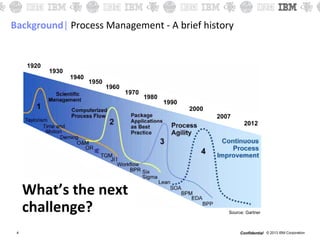
Background| Process Management - A brief history
1920
1930
1940
1950
1960
1970
1980
1990
2000
2007
2012
What’s the next
challenge? Source: Gartner
4
© 2013 IBM CorporationConfidential
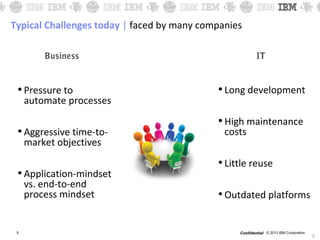
•Pressure to
automate processes
•Aggressive time-to-
market objectives
•Application-mindset
vs. end-to-end
process mindset
Business
•Long development
•High maintenance
costs
•Little reuse
•Outdated platforms
IT
5
Typical Challenges today | faced by many companies
5
© 2013 IBM CorporationConfidential
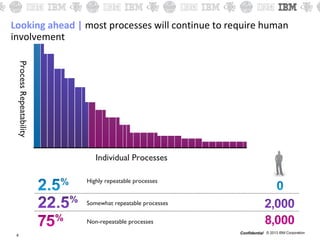
Individual Processes
ProcessRepeatability
Non-repeatable processes
Highly repeatable processes
Somewhat repeatable processes
Looking ahead | most processes will continue to require human
involvement
6
© 2013 IBM CorporationConfidential
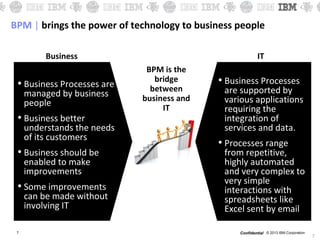
Business IT
BPM is the
bridge
between
business and
IT
7
BPM | brings the power of technology to business people
• Business Processes are
managed by business
people
• Business better
understands the needs
of its customers
• Business should be
enabled to make
improvements
• Some improvements
can be made without
involving IT
• Business Processes
are supported by
various applications
requiring the
integration of
services and data.
• Processes range
from repetitive,
highly automated
and very complex to
very simple
interactions with
spreadsheets like
Excel sent by email
7
© 2013 IBM CorporationConfidential
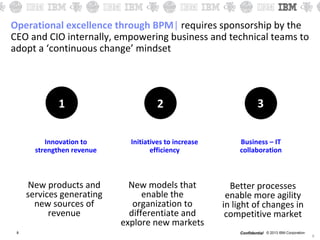
New products and
services generating
new sources of
revenue
New models that
enable the
organization to
differentiate and
explore new markets
Better processes
enable more agility
in light of changes in
competitive market
8
Business – IT
collaboration
8
Innovation to
strengthen revenue
Initiatives to increase
efficiency
Operational excellence through BPM| requires sponsorship by the
CEO and CIO internally, empowering business and technical teams to
adopt a ‘continuous change’ mindset
© 2013 IBM CorporationConfidential9
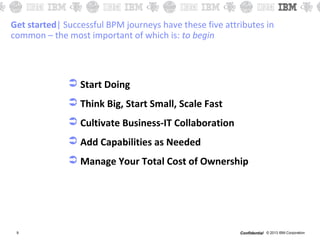
 Start Doing
 Think Big, Start Small, Scale Fast
 Cultivate Business-IT Collaboration
 Add Capabilities as Needed
 Manage Your Total Cost of Ownership
Get started| Successful BPM journeys have these five attributes in
common – the most important of which is: to begin
© 2013 IBM CorporationConfidential10
Thank you.
Don Seymour don.seymour@cz.ibm.com

Dgs presentation at business days_v4 don

  • 1.
    May 23, 2013 BusinessDays Romania Don Seymour – IBM Sales & Solutions – CEE A briefing on - Operational Excellence through BPM
  • 2.
    © 2013 IBMCorporationConfidential Industry KPI Aggregate Industry Benchmarks Key Client References & Experiences Increase Revenue Per Customer Increase revenue from new products or channels Improve combined ratio (better rating and risk selection)  Best in class cross-sell/up-sell rate is 17%; typical is 10%  22% of sales are due to products & services launched in the past year  Rule changes dropped from 5 months to one week  40% increase in new business quotes  50% time to market improvement Improve Customer Acquisition and Retention Improve effectiveness of targeted campaigns Improve targeted renewals Improve gross written premiums Increase customer referrals  Best in class market share is 20% (80th percentile) compared to median 14%  Typical 3-year churn rate is 28% compared to best in class at 18%  Typical customer satisfaction is 95.5% compared to best in class at 98%  Best in class referral rate at 95%  Reduction in time to issue new policy by 62%  Targeted marketing to achieve 60% adoption rate for advisors  98% Reduction in data analysis time for tailored marketing  Reduced costs by 30% while maintaining new customer conversion rates 2 Operational excellence| Industry Key Performance Indicators where IBM BPM has delivered expected results
  • 3.
    © 2013 IBMCorporationConfidential Definitions 3 Expectations Attributes BPM | is expected to drive organizations towards operational excellence Visibility Accountability Adaptability BPM treats processes as assets that contribute to enterprise performance and drive operational excellence  Explicit process models  To all process participants  All phases of the process life cycle  Business has ownership  No Responsibility gaps  Clear line-of-sight to metrics and outcomes  Business drives delivery cycles  Continuous process improvement mentality Source: Gartner
  • 4.
    © 2013 IBMCorporationConfidential Background| Process Management - A brief history 1920 1930 1940 1950 1960 1970 1980 1990 2000 2007 2012 What’s the next challenge? Source: Gartner 4
  • 5.
    © 2013 IBMCorporationConfidential •Pressure to automate processes •Aggressive time-to- market objectives •Application-mindset vs. end-to-end process mindset Business •Long development •High maintenance costs •Little reuse •Outdated platforms IT 5 Typical Challenges today | faced by many companies 5
  • 6.
    © 2013 IBMCorporationConfidential Individual Processes ProcessRepeatability Non-repeatable processes Highly repeatable processes Somewhat repeatable processes Looking ahead | most processes will continue to require human involvement 6
  • 7.
    © 2013 IBMCorporationConfidential Business IT BPM is the bridge between business and IT 7 BPM | brings the power of technology to business people • Business Processes are managed by business people • Business better understands the needs of its customers • Business should be enabled to make improvements • Some improvements can be made without involving IT • Business Processes are supported by various applications requiring the integration of services and data. • Processes range from repetitive, highly automated and very complex to very simple interactions with spreadsheets like Excel sent by email 7
  • 8.
    © 2013 IBMCorporationConfidential New products and services generating new sources of revenue New models that enable the organization to differentiate and explore new markets Better processes enable more agility in light of changes in competitive market 8 Business – IT collaboration 8 Innovation to strengthen revenue Initiatives to increase efficiency Operational excellence through BPM| requires sponsorship by the CEO and CIO internally, empowering business and technical teams to adopt a ‘continuous change’ mindset
  • 9.
    © 2013 IBMCorporationConfidential9  Start Doing  Think Big, Start Small, Scale Fast  Cultivate Business-IT Collaboration  Add Capabilities as Needed  Manage Your Total Cost of Ownership Get started| Successful BPM journeys have these five attributes in common – the most important of which is: to begin
  • 10.
    © 2013 IBMCorporationConfidential10 Thank you. Don Seymour don.seymour@cz.ibm.com

Editor's Notes

  • #3 Operational excellence is a philosophy of leadership focused on the sustainable improvement of key performance metrics APQC = American Productivity and Quality Center, the World’s largest database of operational excellence benchmarks and best practices We looked at specific industry KPIs and their associated benchmarks to identify the areas where and BPM could drive productivity improvement Many IBM customers have realized benefits that exceed the industry benchmarks
  • #4 BPM is a discipline, which supports long term change in organizational culture, behaviour and performance Let’s use a definition from Gartner as to what BPM is and what is expected from it Visibility, Accountability and Adaptability
  • #5 As you can see, Process Management has evolved over time but the principle of sustainable improvement has been a constant. Where have we come from over the course of ~100 years of effort to become more efficient? What are some of the challenge we face as we go forward?
  • #6 In my experience, most companies at the beginning of their BPM journey have challenges that look like this. How do we get these groups to work more effectively together? The business wants to go faster but may lack an end-to-end view of their processes. IT wants to go faster, but a greater % of the work needed to transform and improve business processes is their to do while at the same time they are resource constrained
  • #7 How do we make people more productive, when for processes where humans are involved will become less orchestrated, less repeatable / able to automate? This seems like a step backward but not when visibility and SLA-based measurement is the principal actor, driving operational excellence, and with BPM as an enabling tool. The processes, then, where humans exist in a few years will be those where the rules that define the entirety of the flow cannot be defined in advance. But milestones can still be defined, even for the crude case-type processes today. Participants will be able to measure their work against these milestones based on the built-in visibility of processes, and their decisions and judgments will guide the flows.
  • #8 BPM can make both groups, business and IT work more productively. BPM shifts some of the responsibility and workload from IT to the business. In return, IT resources are freed up for other valuable work (integration, services, data) and the business manages processes, the delivery cycle and prioritization of process improvements based on their understanding of the needs of its customers
  • #9 To be successful with BPM as an enabler of operational excellence, everyone in the organization needs to be on board, from the CEO on down BPM should be the center piece of an organization’s strategy to: manage and execute change in an increasingly hypercompetitive environment – to adapt, thrive and survive efficiently align the organization with the customers’ wants and needs continuously improve processes – seeking process optimization by defining, measuring and improving your process Benefits of a BPM-led effort toward operational excellence include: Improve operational efficiency Reduce operational Risk Improve Service Quality - KPIs/ SLAs to the internal and external clients Improve Agility Holistic approach to the process Extend value from business solutions
  • #10 POINTS: 1. ‘To win the lottery, you must first buy a ticket’ 2. It ’s important not to lose sight of the vision, while ensuring small successes to build on. It is not difficult to succeed in BPM but very easy to fail . 3. Projects must realize benefits to be sustainable