Introduction to BPM
(Business Process Management)
2
What is BPM?
 Process
 The act of taking something through an established … set of procedures to
convert it from one form to another, as a manufacturing or administrative
procedure.1
 Business Process
 At its most generic, any set of activities performed by a business that is
initiated by an event, transforms information, materials or business
commitments, and produces an output.2
 Business Process Management
 Aligning processes with the organization's strategic goals, designing and
implementing process architectures, establishing process measurement
systems that align with organizational goals, and educating and organizing
managers so that they will manage processes effectively.2
 A holistic management approach that promotes business effectiveness and
efficiency while striving for innovation, flexibility, and integration with
technology. Business process management attempts to improve processes
continuously. It could therefore be described as a "process optimization
process." 1
3
Why Undertake BPM?
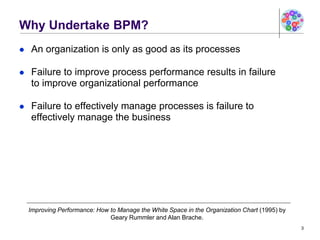
 An organization is only as good as its processes
 Failure to improve process performance results in failure
to improve organizational performance
 Failure to effectively manage processes is failure to
effectively manage the business
Improving Performance: How to Manage the White Space in the Organization Chart (1995) by
Geary Rummler and Alan Brache.
4
Business Case for BPM
 Improve quality of products and services – achieve large savings by
reducing rework and returns, which increases customer satisfaction
 Spend more time making money – improve productivity and work
satisfaction by eliminating confusing and ineffective processes, and
focusing resources on high value processes
 Improve organizational teamwork – improve the level of teamwork
through the use of cross-functional teams to document and improve
processes
 Retain knowledge – capturing currently implicit knowledge, improved
knowledge transfer to new hires (i.e., those who will replace retiring Baby
Boomers)
 Achieve world-class safety performance, increase risk management –
increase safety and health of the workforce, improve compliance with
internal policies and external regulations
BA 553: Business Process Management 5
6
Questions
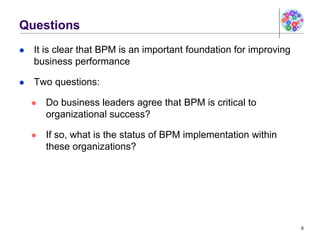
 It is clear that BPM is an important foundation for improving
business performance
 Two questions:
 Do business leaders agree that BPM is critical to
organizational success?
 If so, what is the status of BPM implementation within
these organizations?
BA 553: Business Process Management 7
Status of BPM Implementation
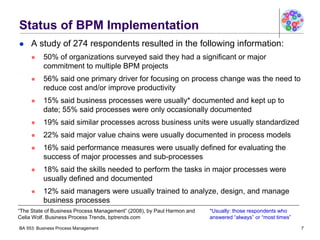
 A study of 274 respondents resulted in the following information:
 50% of organizations surveyed said they had a significant or major
commitment to multiple BPM projects
 56% said one primary driver for focusing on process change was the need to
reduce cost and/or improve productivity
 15% said business processes were usually* documented and kept up to
date; 55% said processes were only occasionally documented
 19% said similar processes across business units were usually standardized
 22% said major value chains were usually documented in process models
 16% said performance measures were usually defined for evaluating the
success of major processes and sub-processes
 18% said the skills needed to perform the tasks in major processes were
usually defined and documented
 12% said managers were usually trained to analyze, design, and manage
business processes
*Usually: those respondents who
answered “always” or “most times”
“The State of Business Process Management” (2008), by Paul Harmon and
Celia Wolf. Business Process Trends, bptrends.com
BA 553: Business Process Management 8
Status of BPM (Cont’d.)
 A smaller study of BPM implementation found:
 68% had implemented BPM within the past 2 years
 43% said the focus of BPM was the organization’s
operations
 Most said they used a methodology:
 30% said they used Lean or Six Sigma
 48% said they used an in-house methodology
 Only 19% said they had a dedicated BPM group
http://bpmbusiness.typepad.com/business_of_bpm/2007/05/aps_benchmarkin.html
Developing BPM Skills
 BPM is about understanding and improving the processes in
an organization
 Because of this, it can help you as an employee in any type of
organization, whether industry or a nonprofit organization,
government or a private company, service or manufacturing
 The skills you use in this course will therefore be helpful in
any job interview
BA 553: Business Process Management 9

BPM.ppt

  • 1.
    Introduction to BPM (BusinessProcess Management)
  • 2.
    2 What is BPM? Process  The act of taking something through an established … set of procedures to convert it from one form to another, as a manufacturing or administrative procedure.1  Business Process  At its most generic, any set of activities performed by a business that is initiated by an event, transforms information, materials or business commitments, and produces an output.2  Business Process Management  Aligning processes with the organization's strategic goals, designing and implementing process architectures, establishing process measurement systems that align with organizational goals, and educating and organizing managers so that they will manage processes effectively.2  A holistic management approach that promotes business effectiveness and efficiency while striving for innovation, flexibility, and integration with technology. Business process management attempts to improve processes continuously. It could therefore be described as a "process optimization process." 1
  • 3.
    3 Why Undertake BPM? An organization is only as good as its processes  Failure to improve process performance results in failure to improve organizational performance  Failure to effectively manage processes is failure to effectively manage the business Improving Performance: How to Manage the White Space in the Organization Chart (1995) by Geary Rummler and Alan Brache.
  • 4.
    4 Business Case forBPM  Improve quality of products and services – achieve large savings by reducing rework and returns, which increases customer satisfaction  Spend more time making money – improve productivity and work satisfaction by eliminating confusing and ineffective processes, and focusing resources on high value processes  Improve organizational teamwork – improve the level of teamwork through the use of cross-functional teams to document and improve processes  Retain knowledge – capturing currently implicit knowledge, improved knowledge transfer to new hires (i.e., those who will replace retiring Baby Boomers)  Achieve world-class safety performance, increase risk management – increase safety and health of the workforce, improve compliance with internal policies and external regulations
  • 5.
    BA 553: BusinessProcess Management 5
  • 6.
    6 Questions  It isclear that BPM is an important foundation for improving business performance  Two questions:  Do business leaders agree that BPM is critical to organizational success?  If so, what is the status of BPM implementation within these organizations?
  • 7.
    BA 553: BusinessProcess Management 7 Status of BPM Implementation  A study of 274 respondents resulted in the following information:  50% of organizations surveyed said they had a significant or major commitment to multiple BPM projects  56% said one primary driver for focusing on process change was the need to reduce cost and/or improve productivity  15% said business processes were usually* documented and kept up to date; 55% said processes were only occasionally documented  19% said similar processes across business units were usually standardized  22% said major value chains were usually documented in process models  16% said performance measures were usually defined for evaluating the success of major processes and sub-processes  18% said the skills needed to perform the tasks in major processes were usually defined and documented  12% said managers were usually trained to analyze, design, and manage business processes *Usually: those respondents who answered “always” or “most times” “The State of Business Process Management” (2008), by Paul Harmon and Celia Wolf. Business Process Trends, bptrends.com
  • 8.
    BA 553: BusinessProcess Management 8 Status of BPM (Cont’d.)  A smaller study of BPM implementation found:  68% had implemented BPM within the past 2 years  43% said the focus of BPM was the organization’s operations  Most said they used a methodology:  30% said they used Lean or Six Sigma  48% said they used an in-house methodology  Only 19% said they had a dedicated BPM group http://bpmbusiness.typepad.com/business_of_bpm/2007/05/aps_benchmarkin.html
  • 9.
    Developing BPM Skills BPM is about understanding and improving the processes in an organization  Because of this, it can help you as an employee in any type of organization, whether industry or a nonprofit organization, government or a private company, service or manufacturing  The skills you use in this course will therefore be helpful in any job interview BA 553: Business Process Management 9