Download to read offline
![170 PHI DELTA KAPPAN
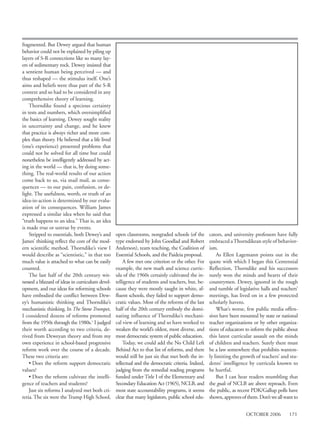
As the battle for influence over school re-
form continues in the 21st century, Mr. Gib-
boney finds that Edward Thorndike main-
tains the upper hand over John Dewey.
One cannot understand the history
of education in the United States
during the twentieth century unless
one realizes that Edward L. Thorn-
dike won and John Dewey lost.
— Ellen Condliffe Lagemann1
I
N THAT brief statement, historian
Ellen Lagemann provides a useful scaf-
folding for understanding the problems
education faces today, nearly a century after
Dewey published Democracy and Education
(1916). In the juxtaposition of these two
figures, we can see one of the primary rea-
sons that 80% of education reforms pro-
posed and implemented over the past half
century have yielded such poor results.
The mechanistic view of learning es-
poused by Thorndike dominated the last
half of the 20th century in so-called school
reform. With the signing of the No Child
Left Behind (NCLB) Act in 2002, Thorn-
dike’s ghost marched at the head of the re-
form parade while the chief marshal, Presi-
dent George W. Bush, flanked by legisla-
tors of both parties, waved approvingly from
the reviewing stand.
In what did Thorndike, who died in
1949, believe? In short, he believed in the
possibility of a science of education so pow-
erful that experts alone would be able to de-
cide what to teach, how to teach it, and how
to evaluate it. In The Transformation of the
School, Lawrence Cremin describes Thorn-
dike’s faith in numbers as “unbounded.”
Indeed, he believed that such value-laden
matters as setting the aims of education could
be done efficiently by experts, using the kind
of science he was developing. Thorndike’s
little band of experts (mostly psychologists)
included no informed teachers.
Thorndike’s research also led him to be-
lieve in the specific nature of the transfer of
learning. This meant that learning to think
in one subject, such as physics, did no more
to increase general intelligence than learn-
ing in any other subject. According to this
view, subjects such as bookkeeping or Latin
appeared to be equal in their effect on in-
telligence.2
This view led many educators to
question the value of academic subjects, a
position about which Thorndike himself had
some doubts.
Dewey’s ideas on the transfer of learning
were fundamentally more humanistic than
Thorndike’s. Dewey believed subject matter
in schools exists to make the quality of
democratic life as good as it can be under
given conditions. He asserted that a teacher
ought to try to arouse a continuing inter-
est in learning throughout a student’s life.
Dewey argued that people within the broad
span of normal human abilities had a vast
capacity for learning and that a critical in-
telligence was essential for democratic life.
In Democracy and Education, he stated, “Since
growth is the characteristic of life, educa-
tion is all one with growing; it has no end
beyond itself. [One can judge the value of a
good school to] the extent in which it creates
a desire for continued [learning] and sup-
plies means for making the desire effectivein
[practice].”3
Notice that, where Thorndike
takes a cramped, narrow path between sub-
jects and confounds transfer of learning with
intelligence measured by tests, Dewey takes
an expansive, generous view of transfer. He
includes all normal citizens within his view
and argues that the goal of schools ought to
be developing an attitude — the love of
learning. And ultimately schools should be
judged on how well they meet this difficult
goal. In other words, what is transferred
when a student learns something that is truly
important is intangible and immeasurable by
tests. It is an attitude, the desire to learn. Sub-
ject matter is but one among many means
used to attain this central objective, which is
sadly overlooked in today’s race for higher
test scores.
To put the distinction sharply, Thorn-
dike saw humans in the image of the ma-
chine; Dewey saw them in the image of life.
Why has America, at the beginning of
the 21st century, chosen the machine over
life as the template for educating our bio-
logical and cultural replacements? Thorn-
dike is famous for his statement that any-
thing that exists, exists in some quantity. I
wish that more teachers, policy makers, and
education reporters would remember his next
sentence: “To know [something] thorough-
ly involves knowing its quantity as well as
its quality.”4
In these words, there is reason
to believe that even Thorndike had some
intimations that numbers and measurement
were not, by themselves, enough to “thor-
oughly know a thing,” such as the full con-
text of a student living in poverty or a stu-
dent living in affluence.
There is no doubt that Thorndike’s stim-
ulus-response theory was mechanistic and
CENTENNIAL REFLECTIONSIntelligence by Design: Thorndike
Versus Dewey BY RICHARD A. GIBBONEY
RICHARD A. GIBBONEY, a past member
of the board of the John Dewey Society, is
a professor emeritus at the University of
Pennsylvania, Philadelphia, and the author
of The Stone Trumpet (SUNY Press, 1994).
He wishes to dedicate this column to the
memory of WilliamVanTil (8 January 1911–
24 May 2006).](https://image.slidesharecdn.com/dewyvsthorndike-130728054524-phpapp01/85/Dewy-vs-Thorndike-CENTENNIAL-REFLECTIONS-1-320.jpg)

The article explores the influence of Edward Thorndike and John Dewey on education reform, highlighting that Thorndike's mechanistic view has led to ineffective reforms prevalent in the 20th century, particularly illustrated by the No Child Left Behind Act. It emphasizes Dewey's humanistic approach, which focuses on fostering a love of learning rather than merely measuring intelligence through standardized tests. The author argues for a renewed commitment to Dewey's principles to address the root causes of educational failure, particularly poverty, rather than relying on flawed metrics.


