Burp Suite Extension Writing Workshop
DevSecCon Singapore
March 01, 2019
SanoopThomas & Samandeep Singh
Thank You
Thank you for showing up.
2
» SanoopThomas
• Organizer – BSides Singapore
• https://bsidessg.org/
• 9+ years in Information Security
• Created Halcyon IDE – an IDE for Nmap Script Developers
• https://halcyon-ide.org/
• Hosting SecTools Podcast at Infosec Campus
• https://infoseccampus.com/
• Barely get time to write blogpost, but presentations/talks are updated
• https://devilslab.in/
• Presented at OWASP India, Nullcon Goa, HITBGSEC, ROOTCON, BlackHat Arsenal (USA, Asia) and Defcon
• Tweet me at - @s4n7h0
3
AboutUs
4
AboutUs
» Samandeep Singh
• Principal Security Consultant at SEC Consult Singapore
• OSCE, OSCP, CRT
• Co-Organizer – BSides Singapore
• 6+ years in Information Security
• Author of XVWA – a WebSec learning app
• Interested in SDR, Windows Exploitation, Mainframe Hacking
• Licensed scuba and sky diver
• Adventure sports and traveller in free time
• Tweet me at - @samanL33T
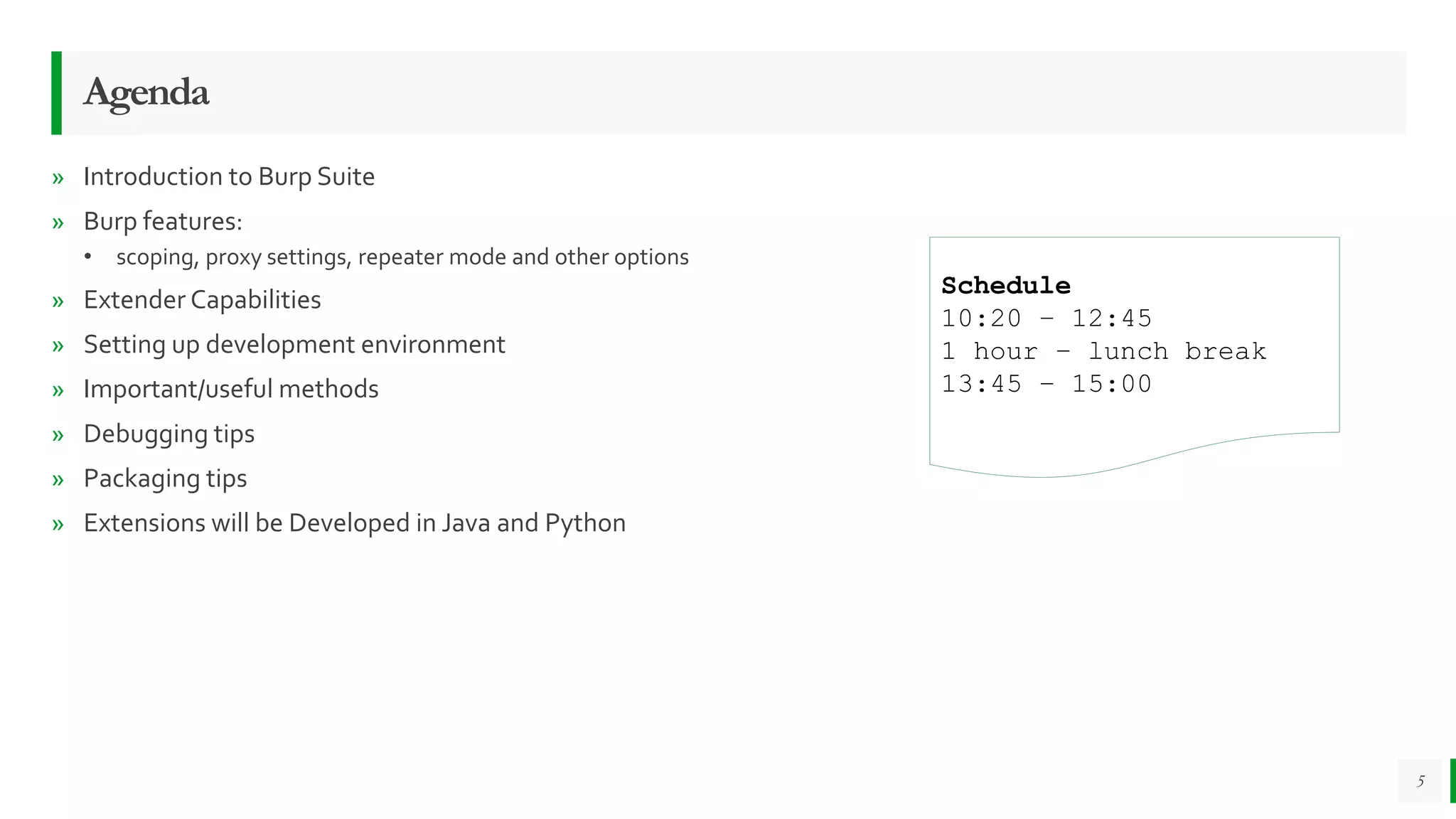
Agenda
» Introduction to Burp Suite
» Burp features:
• scoping, proxy settings, repeater mode and other options
» Extender Capabilities
» Setting up development environment
» Important/useful methods
» Debugging tips
» Packaging tips
» Extensions will be Developed in Java and Python
5
Schedule
10:20 – 12:45
1 hour – lunch break
13:45 – 15:00
Abouttheworkshop
» Kickstarter to burp extension development; not a java or python course
» This is a trimmed version of our 2 day extensive development workshop
» Hands-on development. i.e., we code and debug together here
» Improve your code if you see a chance
» Mistakes are okay.We learn from this more
» Questions are welcome at any given time. Feel free to interrupt
6
IntroductiontoBurpSuite
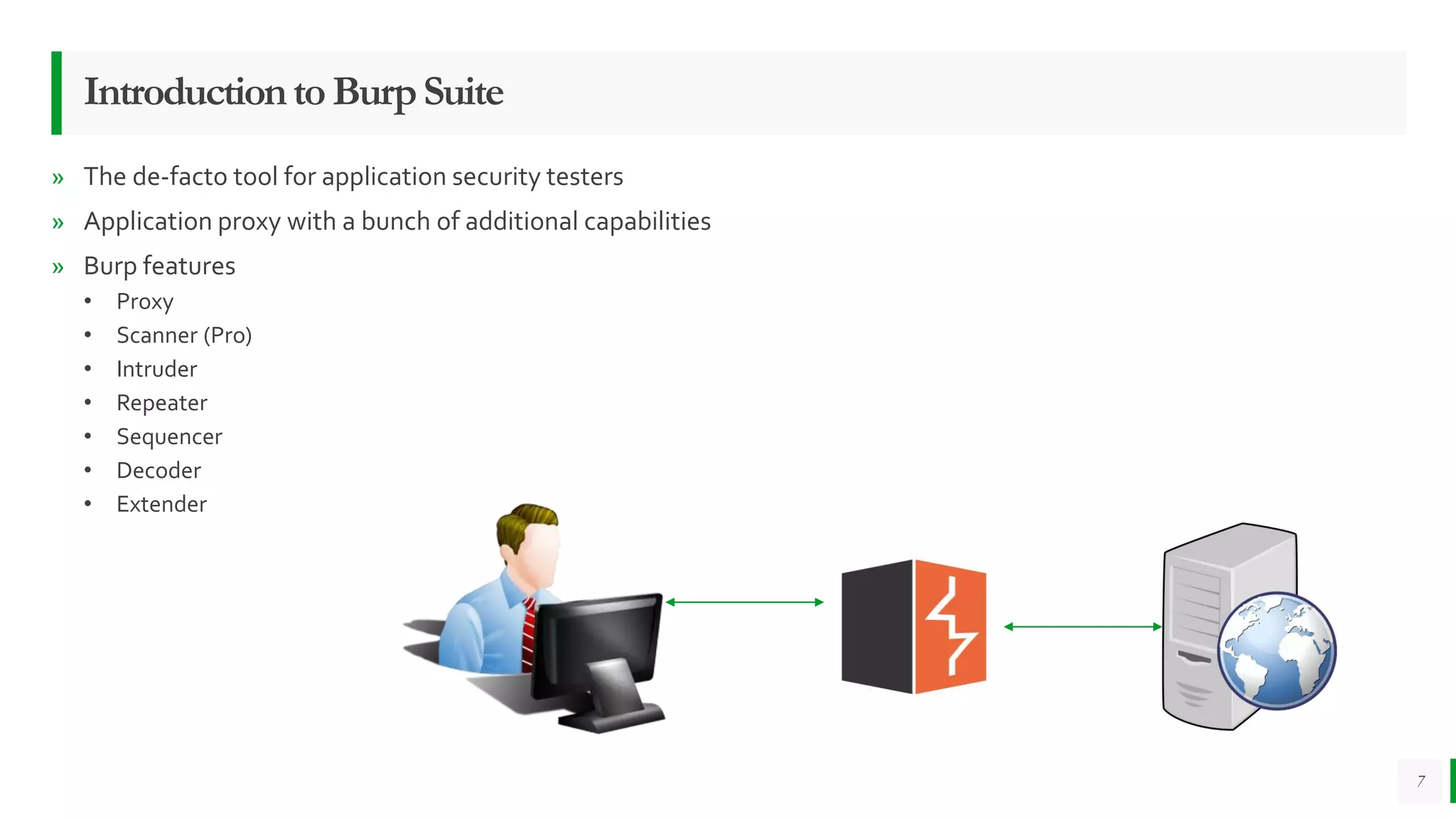
» The de-facto tool for application security testers
» Application proxy with a bunch of additional capabilities
» Burp features
• Proxy
• Scanner (Pro)
• Intruder
• Repeater
• Sequencer
• Decoder
• Extender
7
Exercise#1:
Burp Suite crash course
Objective:
» Getting started with burp
» Setting up browser
» Working with intercept options, repeater and more
» Know what to automate using burp extensions
» Analyzing request/response pairs
8
BurpExtensions
» API to Burp functionalities
» Extensions can be written in:
• Java
• Python (JPython)
• Ruby (JRuby)
9
ExtenderCapabilities
» Process and modify HTTP requests and responses for all Burp tools.
» Access key runtime data, such as the Proxy history, target site map, and Scanner issues.
» Initiate actions like scanning and spidering.
» Implement custom scan checks and register scan issues.
» Customize the placement of attack insertion points within scanned requests.
» Provide custom Intruder payloads and payload processors.
» Query and update the Suite-wide target scope.
» Query and update the session handling cookie jar.
» Implement custom session handling actions.
10
ExtenderCapabilities(cont..)
» Add custom tabs and context menu items to Burp's user interface.
» Use Burp's native HTTP message editor within your own user interface.
» Customize Burp's HTTP message editor to handle data formats that Burp does not natively support.
» Analyze HTTP requests and responses to obtain headers, parameters, cookies, etc.
» Build, modify and issue HTTP requests and retrieve responses.
» Read and modify Burp's configuration settings.
» Save and restore Burp's state.
11
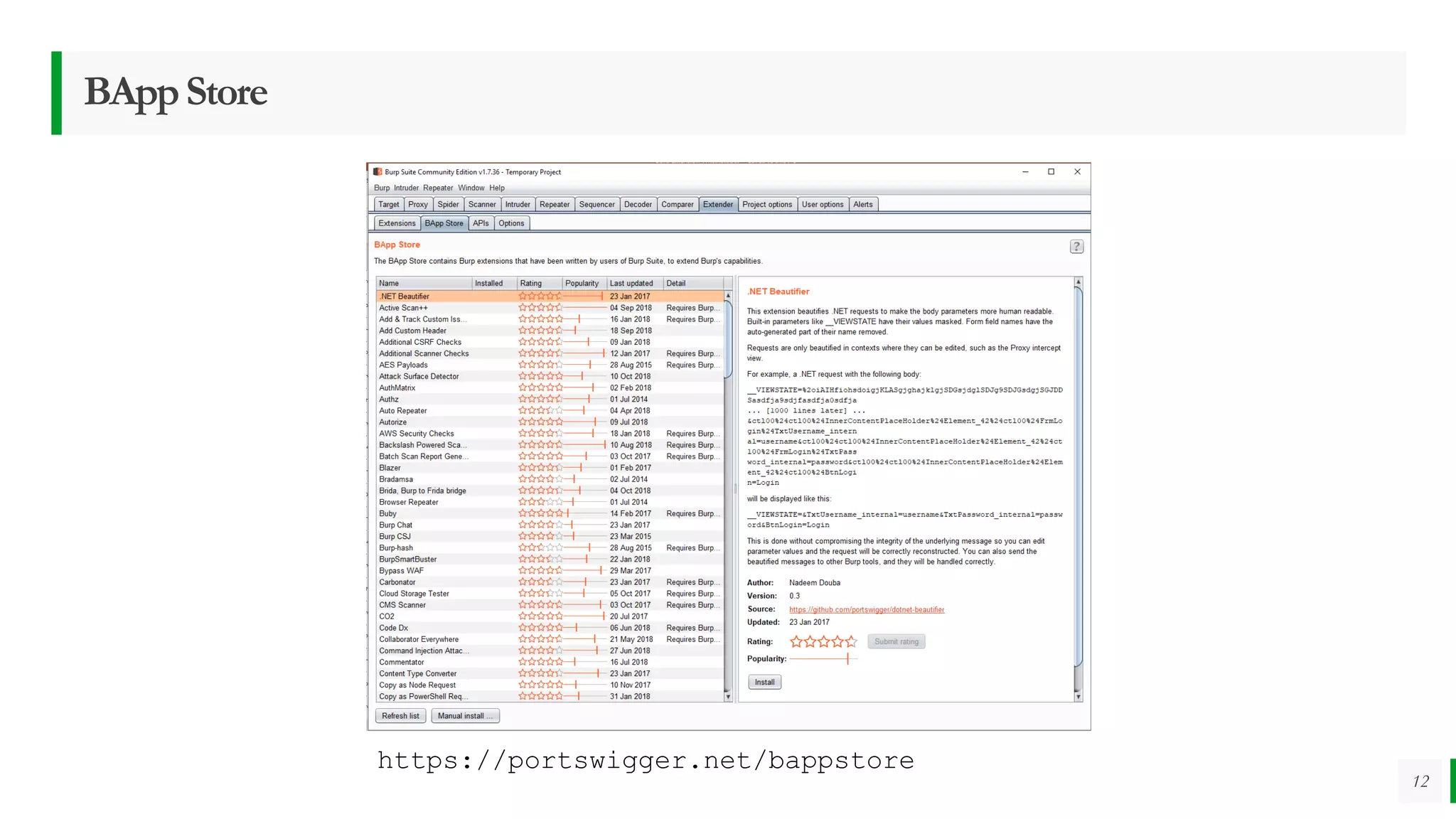
BAppStore
12
https://portswigger.net/bappstore
LabSetup
» Burp Suite Community Edition
• https://portswigger.net/burp/
» Extender APIs
» Test Application
» Development Environments
• Java
• Python
» Test application : http://10.191.35.228/xvwa
13
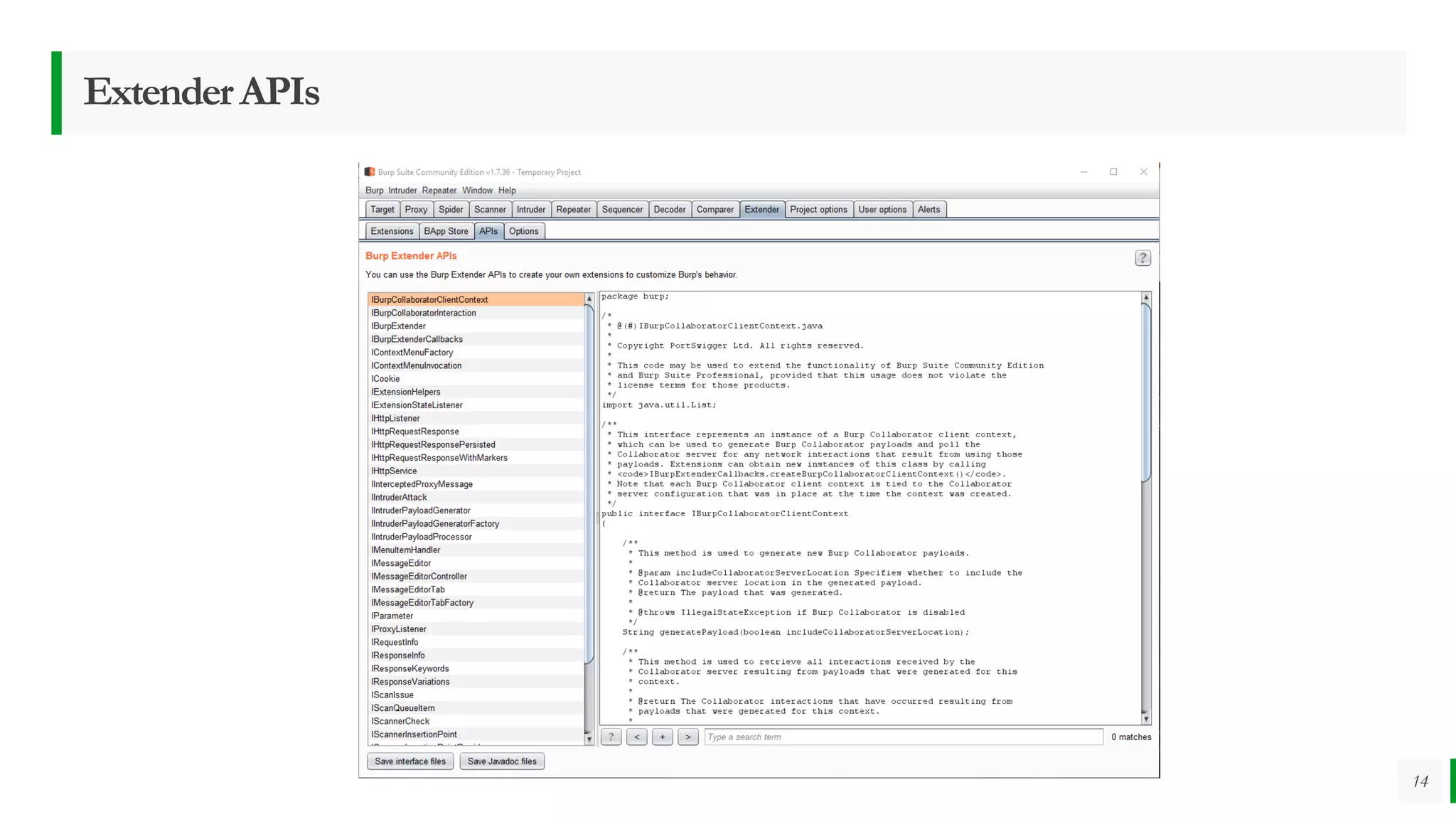
ExtenderAPIs
14
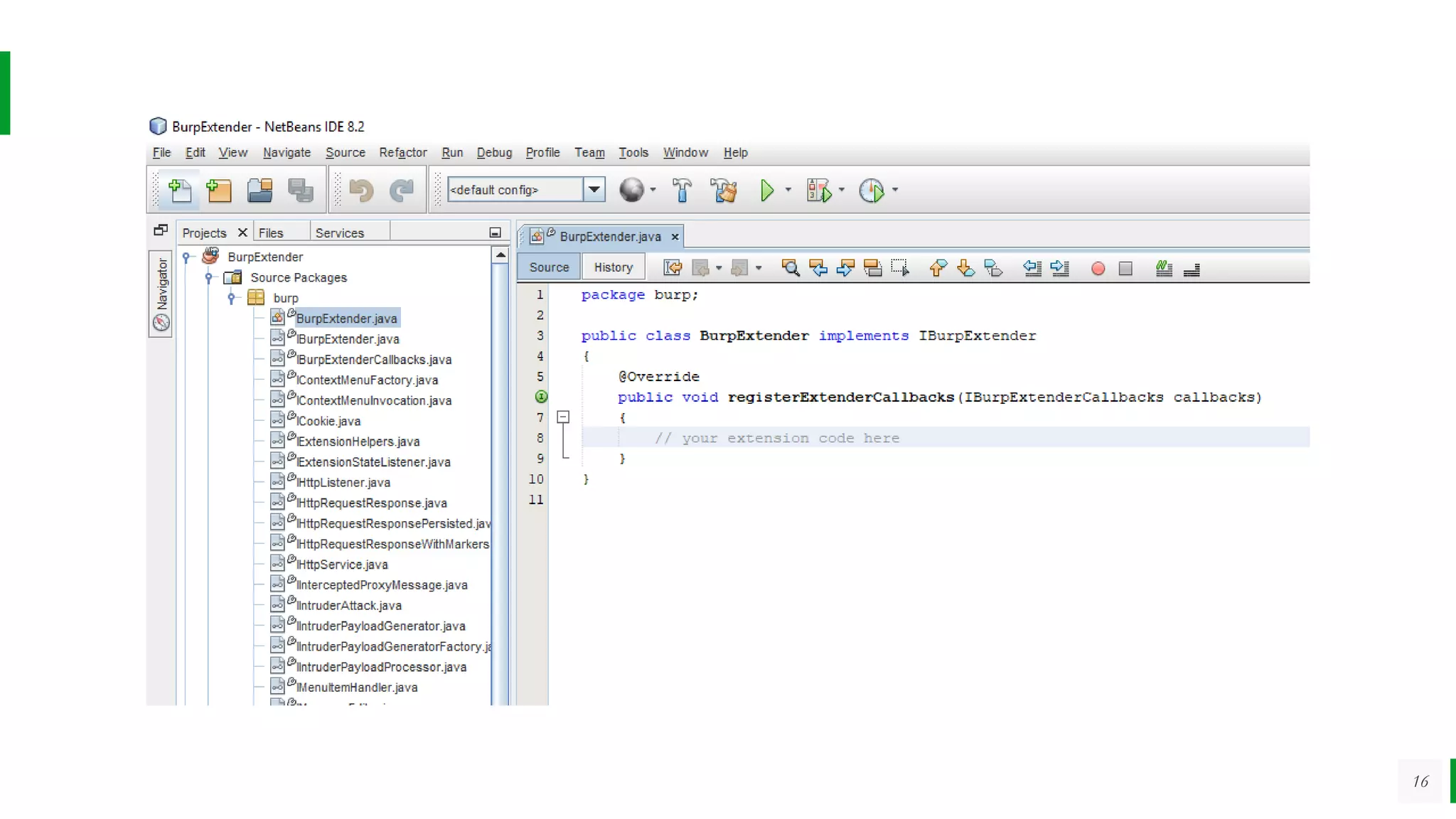
SetupforJava
» Create a project in your favourite IDE
» Create a package “burp” and copy all Extender API files
» Create a java class “BurpExtender”
» Download NetBeans project
• https://portswigger.net/burp/extender/examples/emptyextension.zip
» This workshop will be using NetBeans version 8.2
15
16
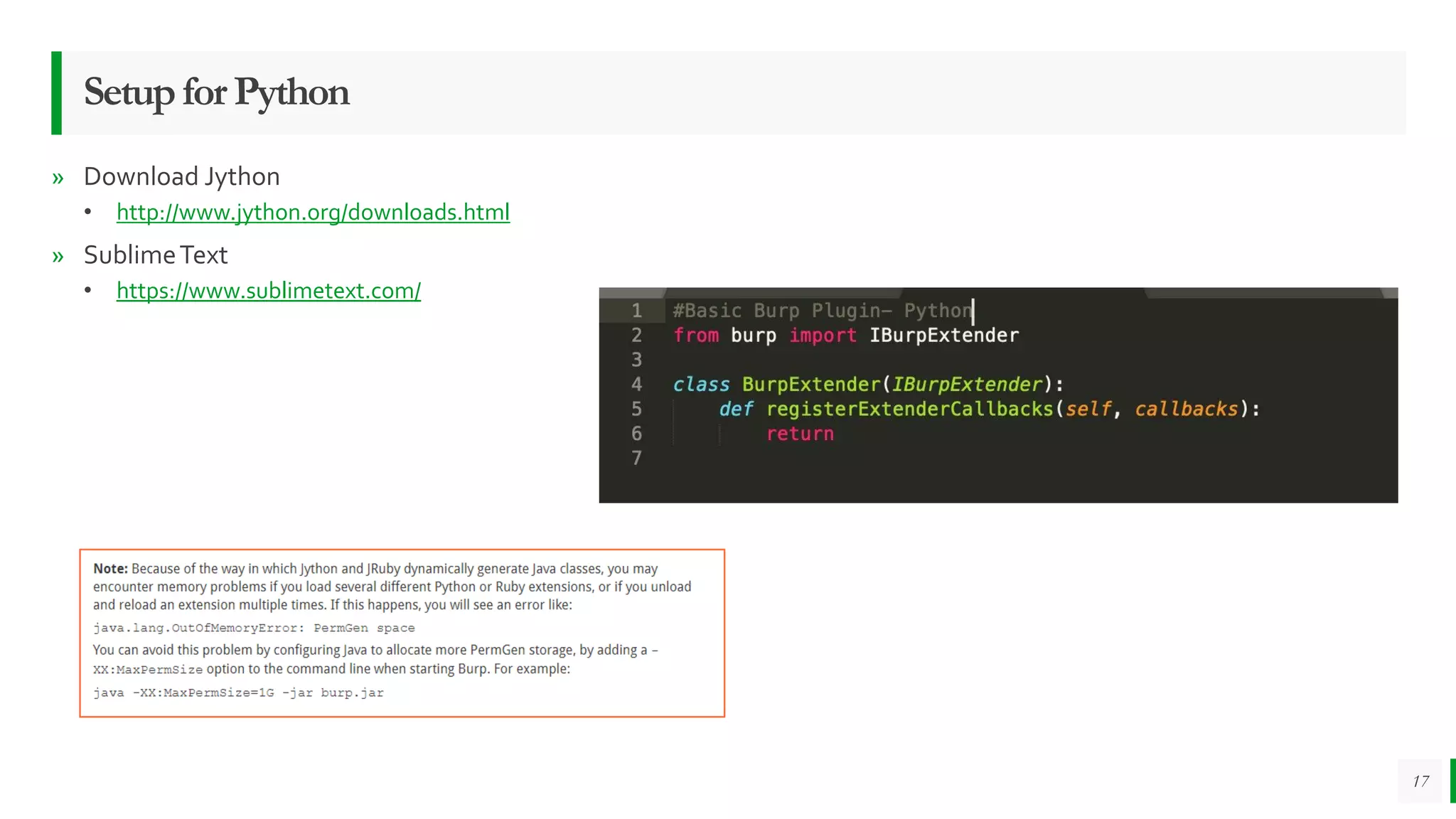
SetupforPython
» Download Jython
• http://www.jython.org/downloads.html
» SublimeText
• https://www.sublimetext.com/
17
Exercise#2:
Setting up development environment
Objective:
» Setup environment for Java
» Setup environment for Python
18
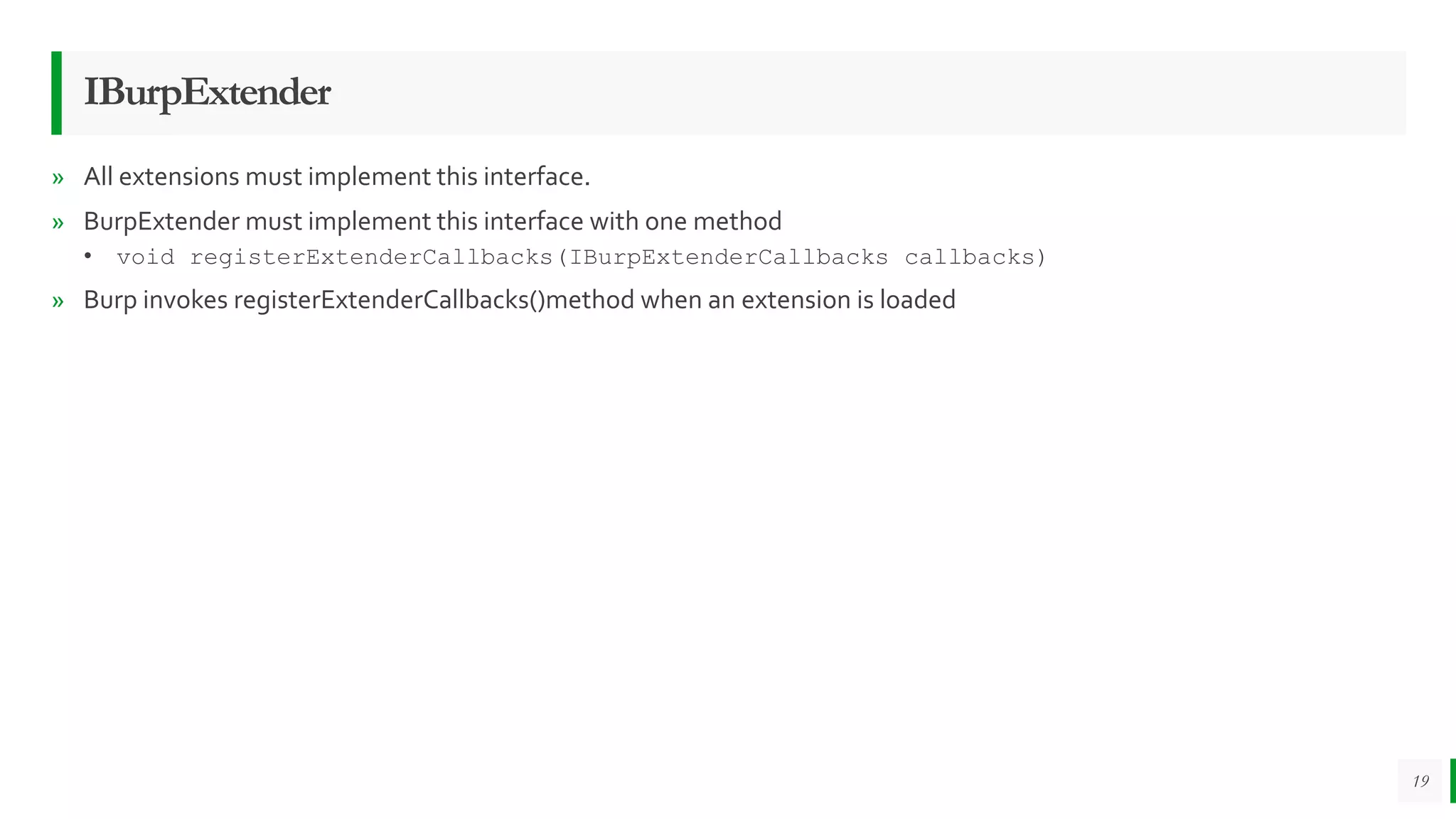
IBurpExtender
» All extensions must implement this interface.
» BurpExtender must implement this interface with one method
• void registerExtenderCallbacks(IBurpExtenderCallbacks callbacks)
» Burp invokes registerExtenderCallbacks()method when an extension is loaded
19
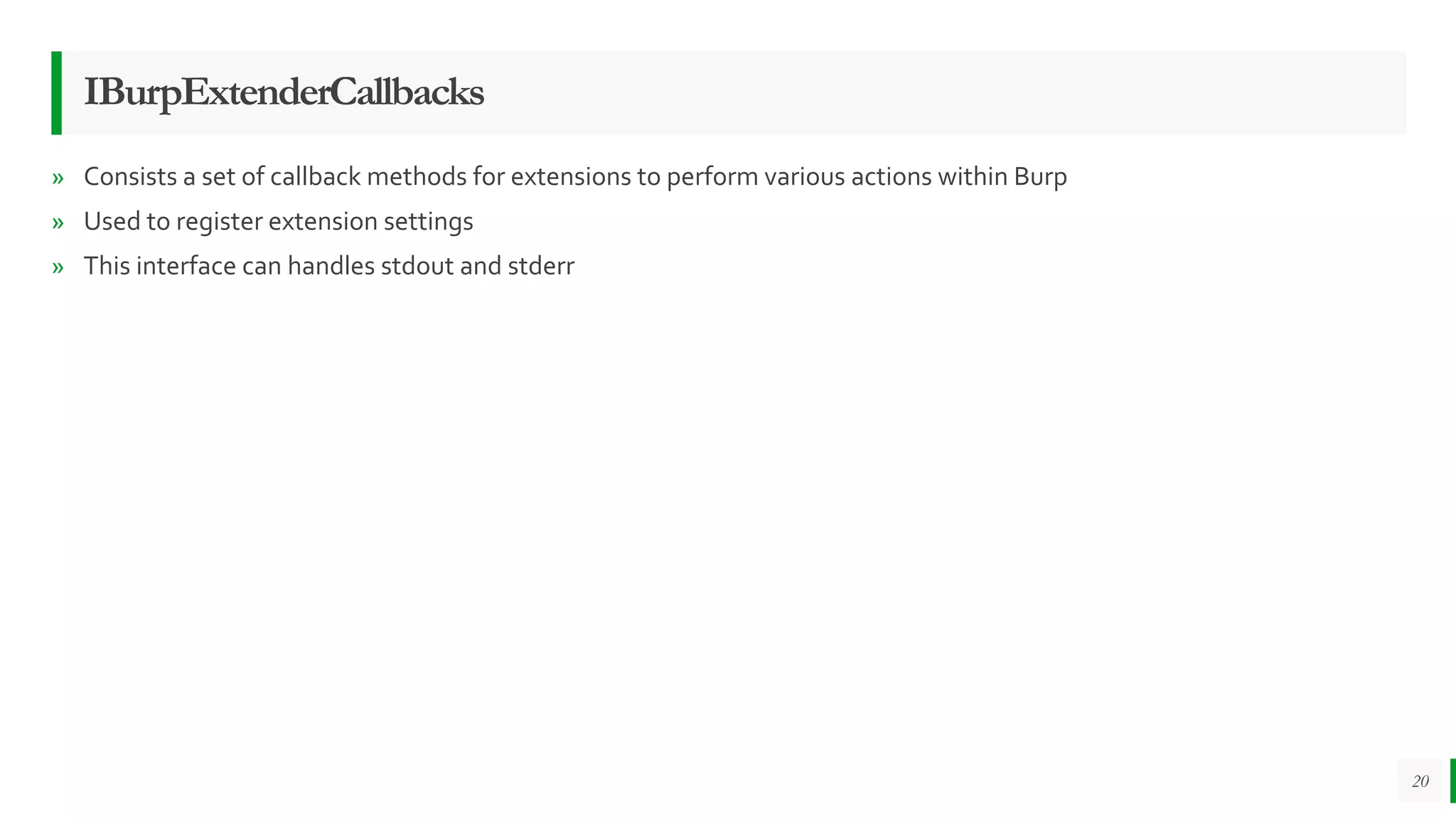
IBurpExtenderCallbacks
» Consists a set of callback methods for extensions to perform various actions within Burp
» Used to register extension settings
» This interface can handles stdout and stderr
20
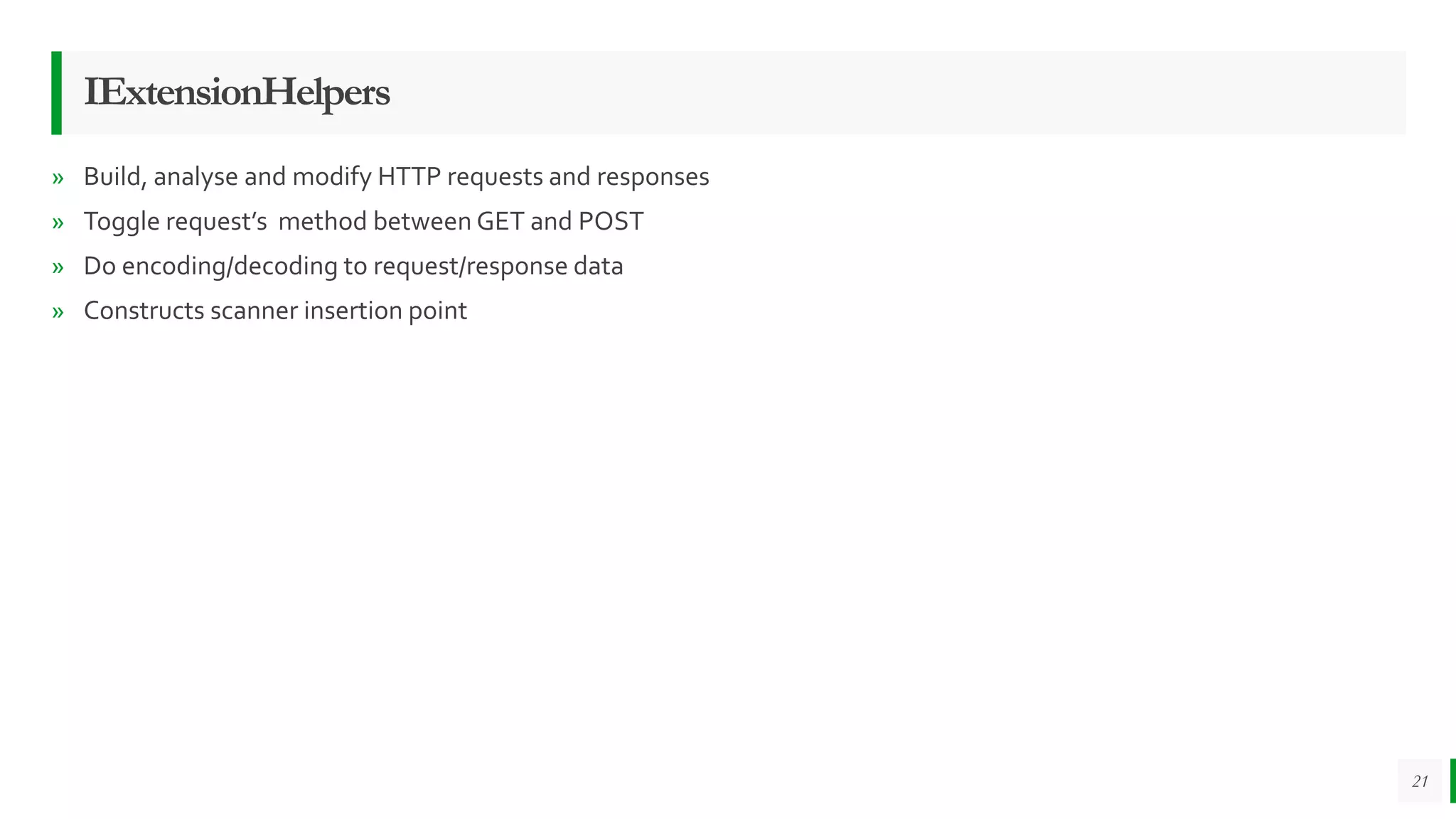
IExtensionHelpers
» Build, analyse and modify HTTP requests and responses
» Toggle request’s method between GET and POST
» Do encoding/decoding to request/response data
» Constructs scanner insertion point
21
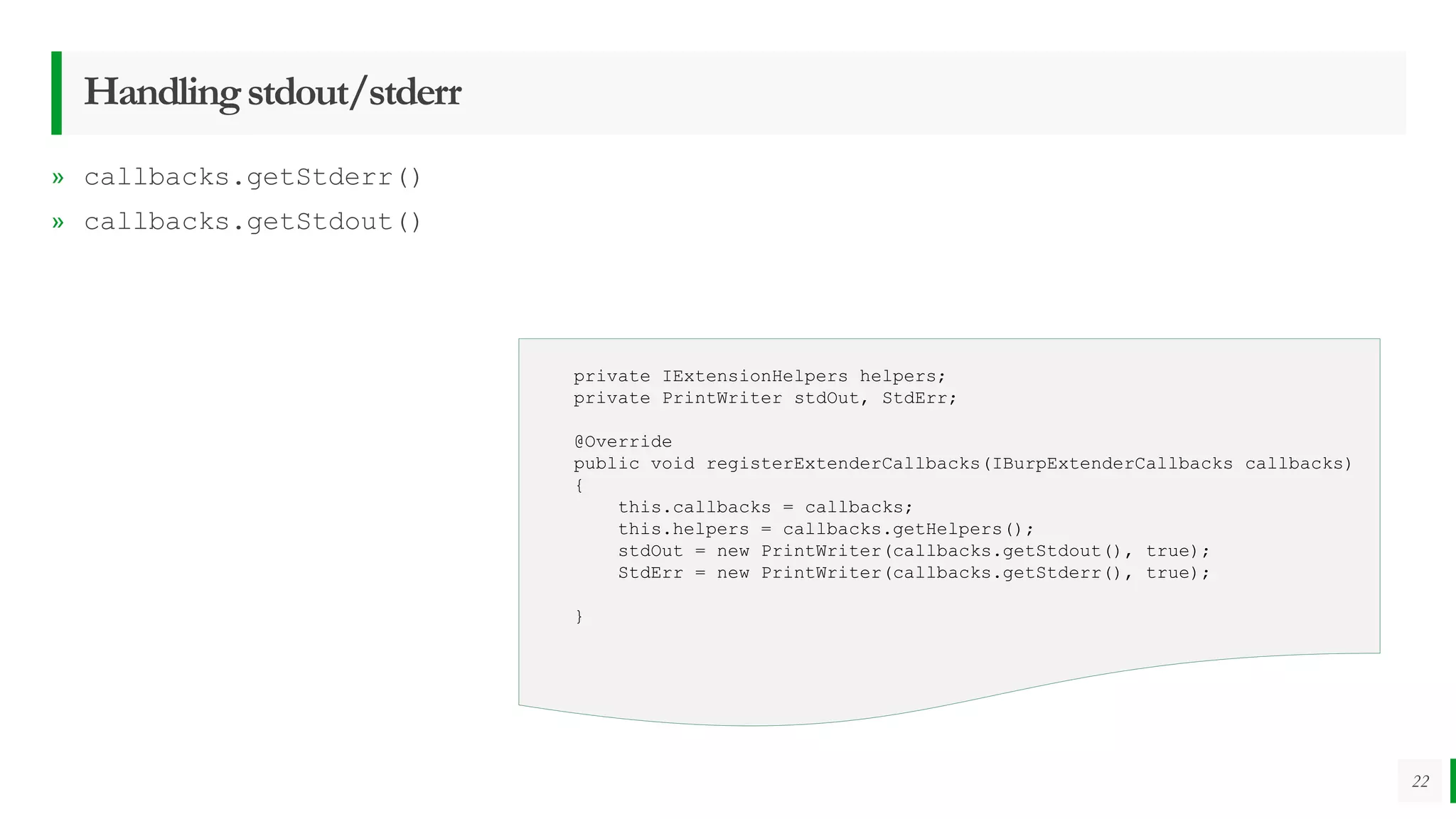
Handlingstdout/stderr
» callbacks.getStderr()
» callbacks.getStdout()
22
private IExtensionHelpers helpers;
private PrintWriter stdOut, StdErr;
@Override
public void registerExtenderCallbacks(IBurpExtenderCallbacks callbacks)
{
this.callbacks = callbacks;
this.helpers = callbacks.getHelpers();
stdOut = new PrintWriter(callbacks.getStdout(), true);
StdErr = new PrintWriter(callbacks.getStderr(), true);
}
ExtensionSettings
» callbacks.setExtensionName(String extName)
» callbacks.issueAlert(String msg)
23
Exercise#3:
Using stdOut/stdErr for extension with alert on loading
Objective:
» Create extension with name
» Use stdOut and stdErr to show messages
» Issue alert on load
24
Someusefulmethods
» IBurpExtenderCallbacks
• IHttpRequestResponse makeHttpRequest(IHttpService httpService, byte[] request);
• void registerHttpListener(IHttpListener listener);
• void registerProxyListener(IProxyListener listener);
» IExtensionHelper
• IRequestInfo analyzeRequest(byte[] request);
• IResponseInfo analyzeResponse(byte[] response);
• IParameter getRequestParameter(byte[] request, String parameterName);
• byte[] addParameter(byte[] request, IParameter parameter);
• byte[] toggleRequestMethod(byte[] request);
• byte[] buildHttpMessage(List headers, byte[] body);
» IRequestInfo
• List<String> getHeaders();
• List<IParameter> getParameters();
25
Exercise#4:
Analyze and match from server response
Objective:
» Analyse test application for request and responses
» Find server header in the responses.
» Trigger message if server header found
» Parse server header value and show in messages.
26
Exercise#5:
Using iMessageEditorTab to analyze/parse HTTP content
Objective:
» Implement iMessageEditorTab
» Show tab if request or response contain specific
keyword
» Parse and print messages in iMessageEditorTab
27
DebuggingTips
» Version updates may change APIs too. Use the latest
» Run burp from terminal
» Memory problems with Jython and Jruby
• java.lang.OutOfMemoryError: PermGen space
» In case of above error, allocate more PermGen storage
• java -XX:MaxPermSize=1G -jar burp.jar
28
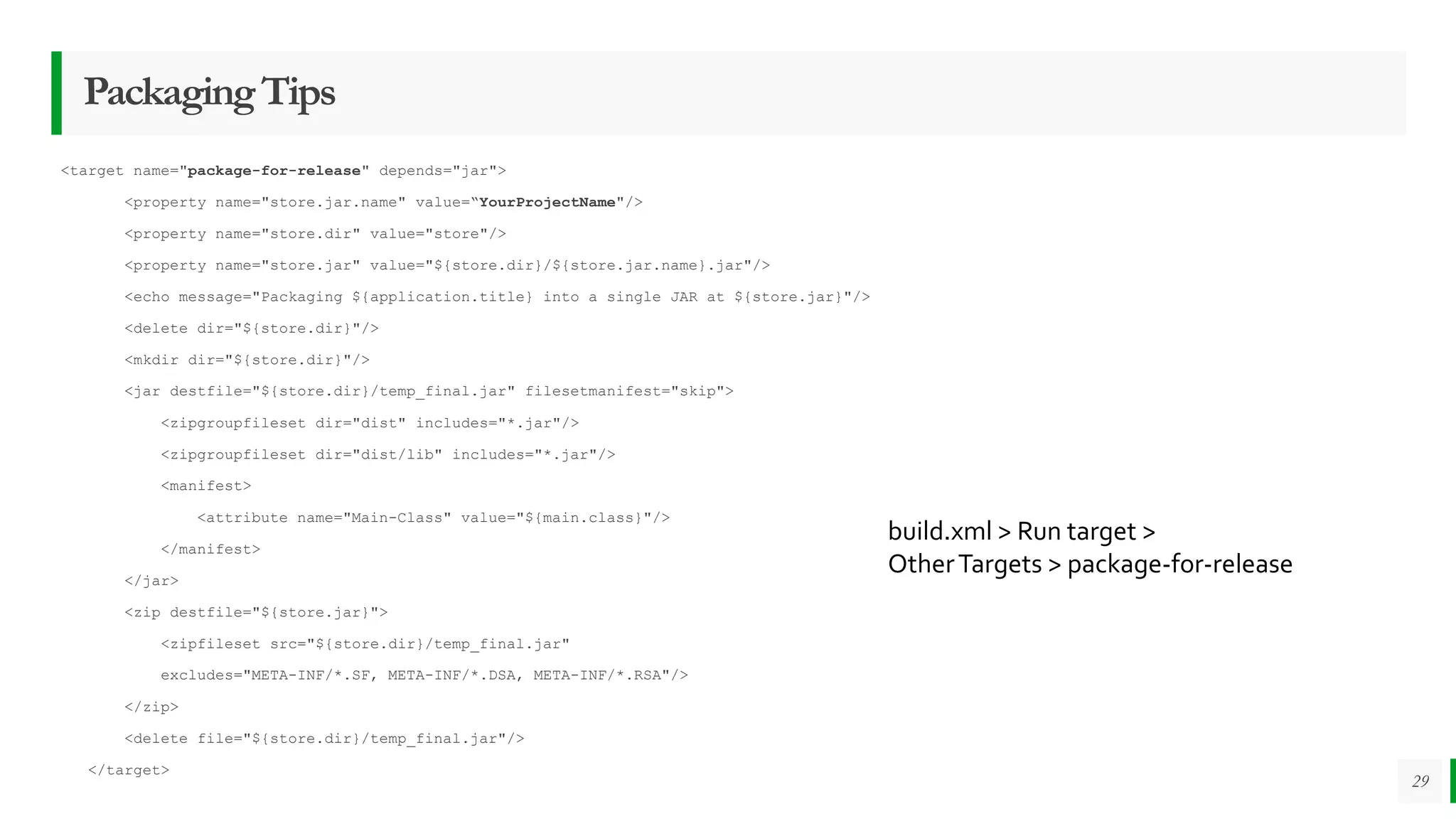
PackagingTips
<target name="package-for-release" depends="jar">
<property name="store.jar.name" value=“YourProjectName"/>
<property name="store.dir" value="store"/>
<property name="store.jar" value="${store.dir}/${store.jar.name}.jar"/>
<echo message="Packaging ${application.title} into a single JAR at ${store.jar}"/>
<delete dir="${store.dir}"/>
<mkdir dir="${store.dir}"/>
<jar destfile="${store.dir}/temp_final.jar" filesetmanifest="skip">
<zipgroupfileset dir="dist" includes="*.jar"/>
<zipgroupfileset dir="dist/lib" includes="*.jar"/>
<manifest>
<attribute name="Main-Class" value="${main.class}"/>
</manifest>
</jar>
<zip destfile="${store.jar}">
<zipfileset src="${store.dir}/temp_final.jar"
excludes="META-INF/*.SF, META-INF/*.DSA, META-INF/*.RSA"/>
</zip>
<delete file="${store.dir}/temp_final.jar"/>
</target>
29
build.xml > Run target >
OtherTargets > package-for-release
Thank You
-----
Reach us at:
SanoopThomas
s4n7h0@infoseccampus.com
twitter.com/s4n7h0
Samandeep Singh
s.singh@sec-consult.com
twitter.com/samanL33T

DevSecCon Singapore 2019: Workshop - Burp extension writing workshop

  • 1.
    Burp Suite ExtensionWriting Workshop DevSecCon Singapore March 01, 2019 SanoopThomas & Samandeep Singh
  • 2.
    Thank You Thank youfor showing up. 2
  • 3.
    » SanoopThomas • Organizer– BSides Singapore • https://bsidessg.org/ • 9+ years in Information Security • Created Halcyon IDE – an IDE for Nmap Script Developers • https://halcyon-ide.org/ • Hosting SecTools Podcast at Infosec Campus • https://infoseccampus.com/ • Barely get time to write blogpost, but presentations/talks are updated • https://devilslab.in/ • Presented at OWASP India, Nullcon Goa, HITBGSEC, ROOTCON, BlackHat Arsenal (USA, Asia) and Defcon • Tweet me at - @s4n7h0 3 AboutUs
  • 4.
    4 AboutUs » Samandeep Singh •Principal Security Consultant at SEC Consult Singapore • OSCE, OSCP, CRT • Co-Organizer – BSides Singapore • 6+ years in Information Security • Author of XVWA – a WebSec learning app • Interested in SDR, Windows Exploitation, Mainframe Hacking • Licensed scuba and sky diver • Adventure sports and traveller in free time • Tweet me at - @samanL33T
  • 5.
    Agenda » Introduction toBurp Suite » Burp features: • scoping, proxy settings, repeater mode and other options » Extender Capabilities » Setting up development environment » Important/useful methods » Debugging tips » Packaging tips » Extensions will be Developed in Java and Python 5 Schedule 10:20 – 12:45 1 hour – lunch break 13:45 – 15:00
  • 6.
    Abouttheworkshop » Kickstarter toburp extension development; not a java or python course » This is a trimmed version of our 2 day extensive development workshop » Hands-on development. i.e., we code and debug together here » Improve your code if you see a chance » Mistakes are okay.We learn from this more » Questions are welcome at any given time. Feel free to interrupt 6
  • 7.
    IntroductiontoBurpSuite » The de-factotool for application security testers » Application proxy with a bunch of additional capabilities » Burp features • Proxy • Scanner (Pro) • Intruder • Repeater • Sequencer • Decoder • Extender 7
  • 8.
    Exercise#1: Burp Suite crashcourse Objective: » Getting started with burp » Setting up browser » Working with intercept options, repeater and more » Know what to automate using burp extensions » Analyzing request/response pairs 8
  • 9.
    BurpExtensions » API toBurp functionalities » Extensions can be written in: • Java • Python (JPython) • Ruby (JRuby) 9
  • 10.
    ExtenderCapabilities » Process andmodify HTTP requests and responses for all Burp tools. » Access key runtime data, such as the Proxy history, target site map, and Scanner issues. » Initiate actions like scanning and spidering. » Implement custom scan checks and register scan issues. » Customize the placement of attack insertion points within scanned requests. » Provide custom Intruder payloads and payload processors. » Query and update the Suite-wide target scope. » Query and update the session handling cookie jar. » Implement custom session handling actions. 10
  • 11.
    ExtenderCapabilities(cont..) » Add customtabs and context menu items to Burp's user interface. » Use Burp's native HTTP message editor within your own user interface. » Customize Burp's HTTP message editor to handle data formats that Burp does not natively support. » Analyze HTTP requests and responses to obtain headers, parameters, cookies, etc. » Build, modify and issue HTTP requests and retrieve responses. » Read and modify Burp's configuration settings. » Save and restore Burp's state. 11
  • 12.
  • 13.
    LabSetup » Burp SuiteCommunity Edition • https://portswigger.net/burp/ » Extender APIs » Test Application » Development Environments • Java • Python » Test application : http://10.191.35.228/xvwa 13
  • 14.
  • 15.
    SetupforJava » Create aproject in your favourite IDE » Create a package “burp” and copy all Extender API files » Create a java class “BurpExtender” » Download NetBeans project • https://portswigger.net/burp/extender/examples/emptyextension.zip » This workshop will be using NetBeans version 8.2 15
  • 16.
  • 17.
    SetupforPython » Download Jython •http://www.jython.org/downloads.html » SublimeText • https://www.sublimetext.com/ 17
  • 18.
    Exercise#2: Setting up developmentenvironment Objective: » Setup environment for Java » Setup environment for Python 18
  • 19.
    IBurpExtender » All extensionsmust implement this interface. » BurpExtender must implement this interface with one method • void registerExtenderCallbacks(IBurpExtenderCallbacks callbacks) » Burp invokes registerExtenderCallbacks()method when an extension is loaded 19
  • 20.
    IBurpExtenderCallbacks » Consists aset of callback methods for extensions to perform various actions within Burp » Used to register extension settings » This interface can handles stdout and stderr 20
  • 21.
    IExtensionHelpers » Build, analyseand modify HTTP requests and responses » Toggle request’s method between GET and POST » Do encoding/decoding to request/response data » Constructs scanner insertion point 21
  • 22.
    Handlingstdout/stderr » callbacks.getStderr() » callbacks.getStdout() 22 privateIExtensionHelpers helpers; private PrintWriter stdOut, StdErr; @Override public void registerExtenderCallbacks(IBurpExtenderCallbacks callbacks) { this.callbacks = callbacks; this.helpers = callbacks.getHelpers(); stdOut = new PrintWriter(callbacks.getStdout(), true); StdErr = new PrintWriter(callbacks.getStderr(), true); }
  • 23.
  • 24.
    Exercise#3: Using stdOut/stdErr forextension with alert on loading Objective: » Create extension with name » Use stdOut and stdErr to show messages » Issue alert on load 24
  • 25.
    Someusefulmethods » IBurpExtenderCallbacks • IHttpRequestResponsemakeHttpRequest(IHttpService httpService, byte[] request); • void registerHttpListener(IHttpListener listener); • void registerProxyListener(IProxyListener listener); » IExtensionHelper • IRequestInfo analyzeRequest(byte[] request); • IResponseInfo analyzeResponse(byte[] response); • IParameter getRequestParameter(byte[] request, String parameterName); • byte[] addParameter(byte[] request, IParameter parameter); • byte[] toggleRequestMethod(byte[] request); • byte[] buildHttpMessage(List headers, byte[] body); » IRequestInfo • List<String> getHeaders(); • List<IParameter> getParameters(); 25
  • 26.
    Exercise#4: Analyze and matchfrom server response Objective: » Analyse test application for request and responses » Find server header in the responses. » Trigger message if server header found » Parse server header value and show in messages. 26
  • 27.
    Exercise#5: Using iMessageEditorTab toanalyze/parse HTTP content Objective: » Implement iMessageEditorTab » Show tab if request or response contain specific keyword » Parse and print messages in iMessageEditorTab 27
  • 28.
    DebuggingTips » Version updatesmay change APIs too. Use the latest » Run burp from terminal » Memory problems with Jython and Jruby • java.lang.OutOfMemoryError: PermGen space » In case of above error, allocate more PermGen storage • java -XX:MaxPermSize=1G -jar burp.jar 28
  • 29.
    PackagingTips <target name="package-for-release" depends="jar"> <propertyname="store.jar.name" value=“YourProjectName"/> <property name="store.dir" value="store"/> <property name="store.jar" value="${store.dir}/${store.jar.name}.jar"/> <echo message="Packaging ${application.title} into a single JAR at ${store.jar}"/> <delete dir="${store.dir}"/> <mkdir dir="${store.dir}"/> <jar destfile="${store.dir}/temp_final.jar" filesetmanifest="skip"> <zipgroupfileset dir="dist" includes="*.jar"/> <zipgroupfileset dir="dist/lib" includes="*.jar"/> <manifest> <attribute name="Main-Class" value="${main.class}"/> </manifest> </jar> <zip destfile="${store.jar}"> <zipfileset src="${store.dir}/temp_final.jar" excludes="META-INF/*.SF, META-INF/*.DSA, META-INF/*.RSA"/> </zip> <delete file="${store.dir}/temp_final.jar"/> </target> 29 build.xml > Run target > OtherTargets > package-for-release
  • 30.
    Thank You ----- Reach usat: SanoopThomas s4n7h0@infoseccampus.com twitter.com/s4n7h0 Samandeep Singh s.singh@sec-consult.com twitter.com/samanL33T