2018
ELECO
Zulfidin Khodzhaev1
, Cem Ayyıldız2
, Güneş Karabulut Kurt1
Istanbul Technical University1
, Giga OHM2
Device Fingerprinting
for Authentication
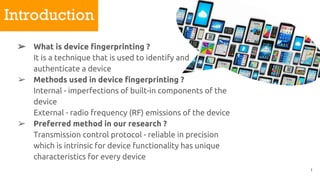
➢ What is device fingerprinting ?
It is a technique that is used to identify and
authenticate a device
➢ Methods used in device fingerprinting ?
Internal - imperfections of built-in components of the
device
External - radio frequency (RF) emissions of the device
➢ Preferred method in our research ?
Transmission control protocol - reliable in precision
which is intrinsic for device functionality has unique
characteristics for every device
Introduction
1
Research
Question
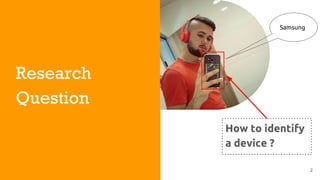
How to identify
a device ?
2
Samsung
Why is it
Important ?
3
Tracking Security
➢ Using internal components exploit
the Internet Control Message
➢ Protocol (ICMP) timestamp-based
fingerprinting to identify mobile
phones over a WLAN
4
❏ M. Cristea and B. Groza, “Fingerprinting
smartphones remotely via ICMP
timestamps,” IEEE Communications Letters,
vol. 17, no. 6, pp. 1081–1083, 2013.
Related
Research
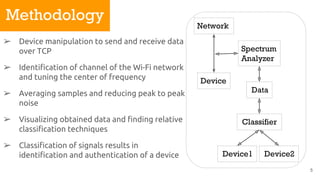
➢ Device manipulation to send and receive data
over TCP
➢ Identification of channel of the Wi-Fi network
and tuning the center of frequency
➢ Averaging samples and reducing peak to peak
noise
➢ Visualizing obtained data and finding relative
classification techniques
➢ Classification of signals results in
identification and authentication of a device
Methodology
Network
Device
Spectrum
Analyzer
Data
Classifier
Device2Device1
5
➢ Calculation of distance between
neighboring instances
➢ The training data - to make a
prediction
➢ Testing data - to assess predictions
made
➢ Calculation of distance between
trained data and testing data
➢ Data is classified into a group in
which the distance is the shortest
Technique
6
Data
Instance1
Training
Instance2 Instance3
Other
Instances
Testing
Distance
Device1 Device2
7
Formulation
iPhone 7 Xiaomi Mi A1 7
Test setup
Jetson TX2
iPhone 7 Xiaomi Mi A1
NI PXIe-1082
8
Result and
Discussion
Iphone 7 Xiaomi Mi A1 7
9
K=3 100% 56%
K=4 100% 56%
K=5 100% 64%
➢ Importance of nearest instances
➢ Results for mobile devices seem to
be promising
➢ More advanced classification
techniques needed
➢ Different devices should be tested
➢ Electronic devices are part of our
society and they should be as secure
as possible
➢ DSL and ADSL modems
10
Conclusion
and future
research
11
Reference
➢ G. Baldini and G. Steri, “Survey of techniques for the identification of mobile using the physical fingerprints of the
built-in components,” IEEE Communications Surveys & Tutorials, vol. 19, no. 3, pp. 1761–1789, 2017.
➢ B. D. Fulcher and N. S. Jones, “Highly comparative feature-based time-series classification,” IEEE Transactions on
Knowledge and Data Engineering, vol. 26, no. 12, pp. 3026–3037, 2014.
➢ J. E. V. Ferreira, C. H. S. da Costa, R. M. de Miranda, and A. F. de Figueiredo, “The use of the k nearest neighbor method
to classify the representative elements,” Educación Química, vol. 26, no. 3, pp. 195 – 201, 2015. [Online]. Available:
http://www.sciencedirect.com/science/article/pii/S0187893X15000312
➢ P. Mulak and N. Talhar, “Analysis of distance measures using k-nearest neighbor algorithm on kdd dataset,”
International Journal of Science and Research, vol. 4, no. 7, pp. 2101–2104, 2015.
➢ T. Kohno, A. Broido, and K. C. Claffy, “Remote physical device fingerprinting,” IEEE Transactions on Dependable and
Secure Computing, vol. 2, no. 2, pp. 93–108, 2005.
➢ M. Cristea and B. Groza, “Fingerprinting smartphones remotely via ICMP timestamps,” IEEE Communications Letters,
vol. 17, no. 6, pp. 1081–1083, 2013.
Dinlediğiniz için teşekkürler.

Device Fingerprinting for Authentication

  • 1.
    2018 ELECO Zulfidin Khodzhaev1 , CemAyyıldız2 , Güneş Karabulut Kurt1 Istanbul Technical University1 , Giga OHM2 Device Fingerprinting for Authentication
  • 2.
    ➢ What isdevice fingerprinting ? It is a technique that is used to identify and authenticate a device ➢ Methods used in device fingerprinting ? Internal - imperfections of built-in components of the device External - radio frequency (RF) emissions of the device ➢ Preferred method in our research ? Transmission control protocol - reliable in precision which is intrinsic for device functionality has unique characteristics for every device Introduction 1
  • 3.
  • 4.
    Why is it Important? 3 Tracking Security
  • 5.
    ➢ Using internalcomponents exploit the Internet Control Message ➢ Protocol (ICMP) timestamp-based fingerprinting to identify mobile phones over a WLAN 4 ❏ M. Cristea and B. Groza, “Fingerprinting smartphones remotely via ICMP timestamps,” IEEE Communications Letters, vol. 17, no. 6, pp. 1081–1083, 2013. Related Research
  • 6.
    ➢ Device manipulationto send and receive data over TCP ➢ Identification of channel of the Wi-Fi network and tuning the center of frequency ➢ Averaging samples and reducing peak to peak noise ➢ Visualizing obtained data and finding relative classification techniques ➢ Classification of signals results in identification and authentication of a device Methodology Network Device Spectrum Analyzer Data Classifier Device2Device1 5
  • 7.
    ➢ Calculation ofdistance between neighboring instances ➢ The training data - to make a prediction ➢ Testing data - to assess predictions made ➢ Calculation of distance between trained data and testing data ➢ Data is classified into a group in which the distance is the shortest Technique 6 Data Instance1 Training Instance2 Instance3 Other Instances Testing Distance Device1 Device2
  • 8.
  • 9.
    Test setup Jetson TX2 iPhone7 Xiaomi Mi A1 NI PXIe-1082 8
  • 10.
    Result and Discussion Iphone 7Xiaomi Mi A1 7 9 K=3 100% 56% K=4 100% 56% K=5 100% 64% ➢ Importance of nearest instances
  • 11.
    ➢ Results formobile devices seem to be promising ➢ More advanced classification techniques needed ➢ Different devices should be tested ➢ Electronic devices are part of our society and they should be as secure as possible ➢ DSL and ADSL modems 10 Conclusion and future research
  • 12.
    11 Reference ➢ G. Baldiniand G. Steri, “Survey of techniques for the identification of mobile using the physical fingerprints of the built-in components,” IEEE Communications Surveys & Tutorials, vol. 19, no. 3, pp. 1761–1789, 2017. ➢ B. D. Fulcher and N. S. Jones, “Highly comparative feature-based time-series classification,” IEEE Transactions on Knowledge and Data Engineering, vol. 26, no. 12, pp. 3026–3037, 2014. ➢ J. E. V. Ferreira, C. H. S. da Costa, R. M. de Miranda, and A. F. de Figueiredo, “The use of the k nearest neighbor method to classify the representative elements,” Educación Química, vol. 26, no. 3, pp. 195 – 201, 2015. [Online]. Available: http://www.sciencedirect.com/science/article/pii/S0187893X15000312 ➢ P. Mulak and N. Talhar, “Analysis of distance measures using k-nearest neighbor algorithm on kdd dataset,” International Journal of Science and Research, vol. 4, no. 7, pp. 2101–2104, 2015. ➢ T. Kohno, A. Broido, and K. C. Claffy, “Remote physical device fingerprinting,” IEEE Transactions on Dependable and Secure Computing, vol. 2, no. 2, pp. 93–108, 2005. ➢ M. Cristea and B. Groza, “Fingerprinting smartphones remotely via ICMP timestamps,” IEEE Communications Letters, vol. 17, no. 6, pp. 1081–1083, 2013.
  • 13.