International Journal on Recent and Innovation Trends in Computing and Communication ISSN: 2321-8169
Volume: 6 Issue: 6 233 - 235
______________________________________________________________________________________
233
IJRITCC | June 2018, Available @ http://www.ijritcc.org
_______________________________________________________________________________________
IoT and Fingerprint Based Door Looking System
Prof. Mohammad Nasirruddin
Department of Electronics and Telecommunication
Anjuman College of Engineering and Technology
Nagpur, India
mn151819@gmail.com
Ankita Balpande
Department of Electronics and Telecommunication
Anjuman College of Engineering and Technology
Nagpur, India
ankita.balpande@gmail.com
Prerna Kachhwaha
Department of Electronics and Telecommunication
Anjuman College of Engineering and Technology
Nagpur, India
Prerna09.k@gmail.com
Payal Bondre
Department of Electronics and Telecommunication
Anjuman College of Engineering and Technology
Nagpur, India
payalbondre10@gmail.com
Mrunal Gawande
Department of Electronics and Telecommunication
Anjuman College of Engineering and Technology
Nagpur, India
mrunal.g.121@gmail.com
Abstract— This project presents a door locking system which suggests two ways for unlocking a door using Internet of Things (IoT) and
Fingerprint. Most of the major door lock security systems have several loopholes which could be broken down to gain access to the desired
places, and it creates a concern for a secure lifestyle and proper working environment. People can access Internet services by using their cell
phone, laptop and various gadgets. Fingerprint is a reliable biometric feature having a wide range of applications that require authentication.
Biometric systems such as fingerprint provide tools to enforce reliable logs of system transactions and protect an individual’s right to privacy. In
the proposed system, fingerprints of the authorized users are enrolled and verified to provide access to a facility that is used by multiple users. A
user can also be removed and a new user can be enrolled in the system. We have implemented a centralized control system from where we can
control who can enter in which rooms and who cannot. This is an Arduino Mega device based. Fingerprints are stored dynamically in a database
for computing the different statistics.
Keywords-Internet of Things; fingerprint; security; Arduino; GSM;
__________________________________________________*****_________________________________________________
I. INTRODUCTION
An proficient, low power consumption and low cost
embedded admittance control system for Smart locker security
and remote monitoring[3] based on finger print detection is
very important for wide range of commercial and security
application. Many countries are steadily adopting smart home
security control system. Today most of the home and office
applications that we interact with contain microprocessors. All
of these appliances have some user interface, but many users
become irritated with the difficulty of using the complex
functions of their appliances. In this project a framework and
appliance is developed for the security application allows users
to interact with appliances through a separate user Interface
device that they are already carrying. Smart phones and
biometric devices are culpable for given that interfaces are
common, and have communication capabilities to allow
connection to appliances, and are already being used for a wide
range of different applications. This project framework
indulges in an abstract specification and a common protocol for
describing appliances, a two-way communication protocol, and
automatic interface generation software that allows user
interfaces to be personalized to users and the devices they are
using [2]. The most prominent part of any enterprise security
system is precisely sensing visitor who arrive and leave through
the door. An entry guard can be managed remotely, identifying
visitors at Door and notifying to user via mobile phone is the
most accepted way to undertake security. The proposed system
has added arrangements like view webpage through mobile
phone [3]. Furthermore, voice alert or siren activated to vigilant
authorities when impostor detected. The system identifies the
visitor’s presence, captures fingerprints and transfers to lockers
owner to recognize the visitors. The system also generates
database output whenever a person tries to open the locker. The
user can directly login and interact with the embedded device
in real time without the need to maintain an additional server. It
International Journal on Recent and Innovation Trends in Computing and Communication ISSN: 2321-8169
Volume: 6 Issue: 6 233 - 235
______________________________________________________________________________________
234
IJRITCC | June 2018, Available @ http://www.ijritcc.org
_______________________________________________________________________________________
has a variety of features such as energy efficient, intelligence,
low cost, portability and high performance.
II. LITERATURE SURVEY
Research on IoT and biometric methods has gained
renewed attention in recent years brought on by an increase in
security concerns. The recent world attitude towards terrorism
has influenced people and their governments to take action and
be more proactive in security issues. This need for security also
extends to the need for individuals to protect, among other
things, their working environments, homes, personal
possessions and assets. Many biometric techniques have been
developed and are being improved with the most successful
being applied in everyday law enforcement and security
applications. Among them, fingerprint recognition is
considered to be the most powerful technique for utmost
security authentication. Advances in sensor technology and an
increasing demand for biometrics are driving a burgeoning
biometric industry to develop new technologies. As
commercial incentives increase, many new technologies for
person identification are being developed, each with its own
strengths and weaknesses and a potential niche market. This
section reviews some well-known biometrics with special
emphasis to fingerprint.
Enhanced Fingerprinting and Trajectory prediction for IoT
Localization in Smart buildings we came to know LNM, which
uses NR signal Fingerprint Markov Chain for Localizing in
smart building environment and Matching Algorithm.
Fingerprint based Door Locking System we came to know
Result obtained in providing the security is quite reliable, the
aspects existing with the present technologies by the use of
finger print Biometric as authentication technology.
III. PROPOSED SYETEM
A. Power Supply
A power supply is an electronic device that supplies electric
energy to an electrical load. The primary function of a power
supply is to convert one form of electrical energy to another
and, as a result, power supplies are sometimes referred to as
electric power converters.
B. Fingerprint
A fingerprint is a biometric device that is used to
authenticate the user based on the user fingerprint stored in the
software.
C. Aurdino MEGA
Arduino is an open-source prototyping platform based on
easy-to-use hardware and software. Arduino consists of both a
physical programmable circuit board and a piece of software,
or IDE runs on your computer, used to write and upload
computer code to the physical board.
D. LCD Display
The LCD display is used to see whether the entered
password is correct or not. It is also used to interface with the
project to output lock status.
E. GSM Module
GSM (Global System for Mobile communications) is an
open, digital cellular technology used for transmitting mobile
voice and data services. GSM differs from first generation
wireless systems in that it uses digital technology and Time
Division Multiple Access (TDMA) transmission methods.
GSM is a circuit-switched system that divides each 200
kHz channel into eight 25 kHz time-slots. GSM operates in the
900MHz and 1.8GHz bands in Europe and the 1.9GHz and
850MHz bands in the US. The 850MHz band is also used for
GSM and 3GSM in Australia, Canada and many South
American countries.
F. Motor Driver IC298
Most of the microcontrollers operate on very low voltage
(5v) and current while the motors require
higher voltages and current So, the microcontrollers cannot
provide them such higher current. For this purpose we use
motor driver ICs. Motor driver is a little current amplifier. It
takes a low current signal and gives out a high current signal
which can drive a motor. It can also control the direction of
motor.
IV. PROJECT DESCRIPTION
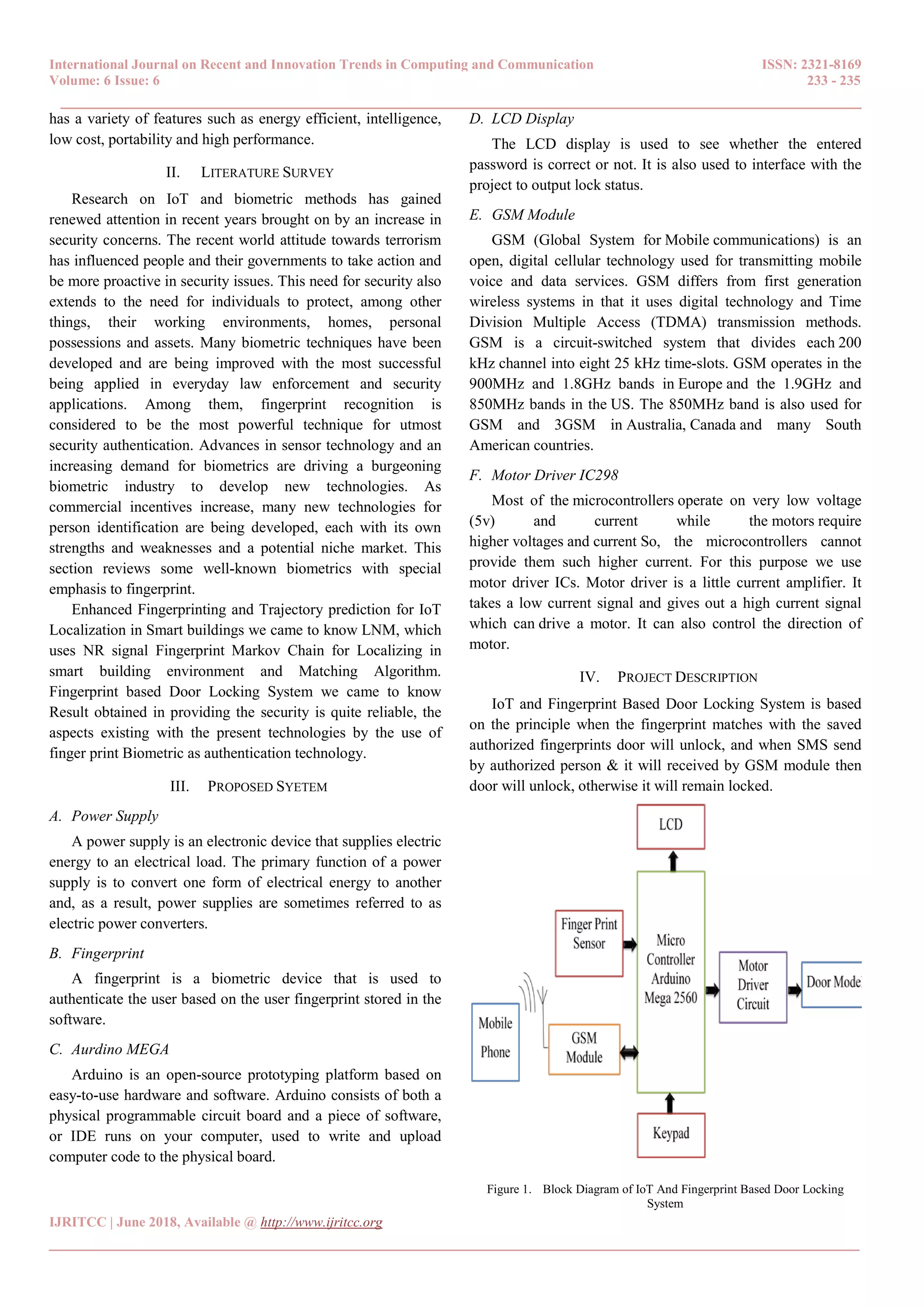
IoT and Fingerprint Based Door Locking System is based
on the principle when the fingerprint matches with the saved
authorized fingerprints door will unlock, and when SMS send
by authorized person & it will received by GSM module then
door will unlock, otherwise it will remain locked.
Figure 1. Block Diagram of IoT And Fingerprint Based Door Locking
System
International Journal on Recent and Innovation Trends in Computing and Communication ISSN: 2321-8169
Volume: 6 Issue: 6 233 - 235
______________________________________________________________________________________
235
IJRITCC | June 2018, Available @ http://www.ijritcc.org
_______________________________________________________________________________________
In this project there are two ways to open a door by using
mobile phone and fingerprint sensor. For first unlock method if
the fingerprint matches with the saved authorized fingerprints
door will unlock, otherwise it will remain locked. For second
unlock method if the SMS send by authorized person will
received by GSM module then door will unlock, otherwise it
will remain locked.
The project communicates over SMS (Short Message
Service) using GSM module. Combining both methods the
door will unlocks, when an authorized person will place a
finger on the fingerprint sensor, or if SMS is received by the
GSM module door unlocks and the LCD displays a message.
Fingerprint module is connected with Arduino, Arduino is
used to rotate motor which is connected with the latch of door
and it will display status on LCD. When user places his/her
finger on fingerprint sensor, if the fingerprints matches with
stored fingerprints the Arduino runs the program accordingly
which gives output to motor driver circuit which is responsible
for rotation of motor i.e. clockwise or anticlockwise.
On other hand when a SMS is sent by mobile phone to the
SIM inserted in the GSM Module, if the message is received
the Arduino runs the program accordingly which gives output
to motor driver circuit which is responsible for rotation of
motor i.e. clockwise or anticlockwise. Mobile phone
communicates with GSM module wirelessly, Arduino is used
to rotate motor which is connected with the latch of door and it
will display status on LCD.
V. CONCLUSION
The project is being tested in protous and is working
properly. It is also tested in bread board and is properly
working. It has lots of application like we can use this project
in door for home and office security, lockers, ATM, and
anywhere where security is needed. Here we can easily change
the password and it has features like if wrong password is
entered more than three times it would be locked until and
unless reset button is pressed. In this project we have used very
less component so it is cost effective and it is less complicated
than a simple micro controller based code lock system. Digital
code lock is totally based on Arduino. Arduino has been the
brain of thousands of projects. As compare to other
microcontroller.
REFERENCES
[1] Annie P. Oommen, Rahul A, Pranav, Ponni S4, Renjith
Nadeshan, “Design and Implementation of a Digital CodeLock”
International Journal of Advanced Research in Electrical,
Electronics and Instrumentation Engineering (An ISO
3297:2007 Certified Organization), Vol. 3, Issue 2, February
2014.
[2] Jeremy Blum ,” Exploring Arduino: Tools and Techniques for
Engineering Wizardry”, Wiley publishers,4th edition(2004).
[3] P.Mercy Angelina,T.M.Sirisha” large scale Contextual
recommender systems of online learning”
[4] A. Juels RFID security and privacy: A research survey IEEE
Journal on chosen areas in Computing, 24(2):381– 394,
February 2006.
[5] Prakash Kumar, Pradeep Kumar, “Arduino Based Wireless
Intrusion Detection Using IR Sensor and GSM”, International
Journal of Computer Science and Mobile Computing, Vol.
2,Issue. 5, May 2013, pg.417 – 42
[6] Jasti Sai Krishna, T.M.Sirisha,K.Valli Madhavi” Image retrieval
based on texture using various Discrete Wavelet Transform sub
bands”
[7] Himani Goyal, “Wireless Display using RF-Module”,
International Journal of Inventive Engineering and Sciences
(IJIES) ISSN: 2319 9598, Volume-3 Issue-2, January 2015.nm
[8] P.Durga Sateesh Reddy,T.M.Sirisha” Improve Data Security For
Cloud Storage Using Two Components”
[9] K. Govindaraju, S. Boopathi, F. ParvezAhmed,
S.ThulasiRam,M.Jagadeeshraja,“Embedded Based Vehicle
Speed Control System Using Wireless Technology”,
International Journal of Innovative Research in Electrical,
Electronics, Instrumentation and Control Engineering, vol. 2,
issue 8, august 2014.
[10] V. Subramanian, P. C. Chang, D. Huang, J. B. Lee, S. E.
Molesa, D. R. Redinger, and S. K.Volkman, "All-printed RFID
Tags: Materials, Devices, and Circuit Implications", VLSI
Design, 2006.
[11] Kamran Ahasan, Paul Kingston IEEE paper on “rfid
applications: an Introductory and exploratory study”.
[12] U.Ravindra Kumar,T.M.Sirisha” Hack free audit based on
encryption in cloud”.
[13] Gynanendra K Verma, PawanTripathi, IIT Allahabad a paper on
“ADigital security system with door locks system using
rfidtechnology”.
[14] B.sandhya,T.M. Sirisha” Dynamic Multi Keyword Scheme over
Encrypted Images”.
Figure 2. Circuit Diagram of the project

IoT and Fingerprint Based Door Looking System

  • 1.
    International Journal onRecent and Innovation Trends in Computing and Communication ISSN: 2321-8169 Volume: 6 Issue: 6 233 - 235 ______________________________________________________________________________________ 233 IJRITCC | June 2018, Available @ http://www.ijritcc.org _______________________________________________________________________________________ IoT and Fingerprint Based Door Looking System Prof. Mohammad Nasirruddin Department of Electronics and Telecommunication Anjuman College of Engineering and Technology Nagpur, India mn151819@gmail.com Ankita Balpande Department of Electronics and Telecommunication Anjuman College of Engineering and Technology Nagpur, India ankita.balpande@gmail.com Prerna Kachhwaha Department of Electronics and Telecommunication Anjuman College of Engineering and Technology Nagpur, India Prerna09.k@gmail.com Payal Bondre Department of Electronics and Telecommunication Anjuman College of Engineering and Technology Nagpur, India payalbondre10@gmail.com Mrunal Gawande Department of Electronics and Telecommunication Anjuman College of Engineering and Technology Nagpur, India mrunal.g.121@gmail.com Abstract— This project presents a door locking system which suggests two ways for unlocking a door using Internet of Things (IoT) and Fingerprint. Most of the major door lock security systems have several loopholes which could be broken down to gain access to the desired places, and it creates a concern for a secure lifestyle and proper working environment. People can access Internet services by using their cell phone, laptop and various gadgets. Fingerprint is a reliable biometric feature having a wide range of applications that require authentication. Biometric systems such as fingerprint provide tools to enforce reliable logs of system transactions and protect an individual’s right to privacy. In the proposed system, fingerprints of the authorized users are enrolled and verified to provide access to a facility that is used by multiple users. A user can also be removed and a new user can be enrolled in the system. We have implemented a centralized control system from where we can control who can enter in which rooms and who cannot. This is an Arduino Mega device based. Fingerprints are stored dynamically in a database for computing the different statistics. Keywords-Internet of Things; fingerprint; security; Arduino; GSM; __________________________________________________*****_________________________________________________ I. INTRODUCTION An proficient, low power consumption and low cost embedded admittance control system for Smart locker security and remote monitoring[3] based on finger print detection is very important for wide range of commercial and security application. Many countries are steadily adopting smart home security control system. Today most of the home and office applications that we interact with contain microprocessors. All of these appliances have some user interface, but many users become irritated with the difficulty of using the complex functions of their appliances. In this project a framework and appliance is developed for the security application allows users to interact with appliances through a separate user Interface device that they are already carrying. Smart phones and biometric devices are culpable for given that interfaces are common, and have communication capabilities to allow connection to appliances, and are already being used for a wide range of different applications. This project framework indulges in an abstract specification and a common protocol for describing appliances, a two-way communication protocol, and automatic interface generation software that allows user interfaces to be personalized to users and the devices they are using [2]. The most prominent part of any enterprise security system is precisely sensing visitor who arrive and leave through the door. An entry guard can be managed remotely, identifying visitors at Door and notifying to user via mobile phone is the most accepted way to undertake security. The proposed system has added arrangements like view webpage through mobile phone [3]. Furthermore, voice alert or siren activated to vigilant authorities when impostor detected. The system identifies the visitor’s presence, captures fingerprints and transfers to lockers owner to recognize the visitors. The system also generates database output whenever a person tries to open the locker. The user can directly login and interact with the embedded device in real time without the need to maintain an additional server. It
  • 2.
    International Journal onRecent and Innovation Trends in Computing and Communication ISSN: 2321-8169 Volume: 6 Issue: 6 233 - 235 ______________________________________________________________________________________ 234 IJRITCC | June 2018, Available @ http://www.ijritcc.org _______________________________________________________________________________________ has a variety of features such as energy efficient, intelligence, low cost, portability and high performance. II. LITERATURE SURVEY Research on IoT and biometric methods has gained renewed attention in recent years brought on by an increase in security concerns. The recent world attitude towards terrorism has influenced people and their governments to take action and be more proactive in security issues. This need for security also extends to the need for individuals to protect, among other things, their working environments, homes, personal possessions and assets. Many biometric techniques have been developed and are being improved with the most successful being applied in everyday law enforcement and security applications. Among them, fingerprint recognition is considered to be the most powerful technique for utmost security authentication. Advances in sensor technology and an increasing demand for biometrics are driving a burgeoning biometric industry to develop new technologies. As commercial incentives increase, many new technologies for person identification are being developed, each with its own strengths and weaknesses and a potential niche market. This section reviews some well-known biometrics with special emphasis to fingerprint. Enhanced Fingerprinting and Trajectory prediction for IoT Localization in Smart buildings we came to know LNM, which uses NR signal Fingerprint Markov Chain for Localizing in smart building environment and Matching Algorithm. Fingerprint based Door Locking System we came to know Result obtained in providing the security is quite reliable, the aspects existing with the present technologies by the use of finger print Biometric as authentication technology. III. PROPOSED SYETEM A. Power Supply A power supply is an electronic device that supplies electric energy to an electrical load. The primary function of a power supply is to convert one form of electrical energy to another and, as a result, power supplies are sometimes referred to as electric power converters. B. Fingerprint A fingerprint is a biometric device that is used to authenticate the user based on the user fingerprint stored in the software. C. Aurdino MEGA Arduino is an open-source prototyping platform based on easy-to-use hardware and software. Arduino consists of both a physical programmable circuit board and a piece of software, or IDE runs on your computer, used to write and upload computer code to the physical board. D. LCD Display The LCD display is used to see whether the entered password is correct or not. It is also used to interface with the project to output lock status. E. GSM Module GSM (Global System for Mobile communications) is an open, digital cellular technology used for transmitting mobile voice and data services. GSM differs from first generation wireless systems in that it uses digital technology and Time Division Multiple Access (TDMA) transmission methods. GSM is a circuit-switched system that divides each 200 kHz channel into eight 25 kHz time-slots. GSM operates in the 900MHz and 1.8GHz bands in Europe and the 1.9GHz and 850MHz bands in the US. The 850MHz band is also used for GSM and 3GSM in Australia, Canada and many South American countries. F. Motor Driver IC298 Most of the microcontrollers operate on very low voltage (5v) and current while the motors require higher voltages and current So, the microcontrollers cannot provide them such higher current. For this purpose we use motor driver ICs. Motor driver is a little current amplifier. It takes a low current signal and gives out a high current signal which can drive a motor. It can also control the direction of motor. IV. PROJECT DESCRIPTION IoT and Fingerprint Based Door Locking System is based on the principle when the fingerprint matches with the saved authorized fingerprints door will unlock, and when SMS send by authorized person & it will received by GSM module then door will unlock, otherwise it will remain locked. Figure 1. Block Diagram of IoT And Fingerprint Based Door Locking System
  • 3.
    International Journal onRecent and Innovation Trends in Computing and Communication ISSN: 2321-8169 Volume: 6 Issue: 6 233 - 235 ______________________________________________________________________________________ 235 IJRITCC | June 2018, Available @ http://www.ijritcc.org _______________________________________________________________________________________ In this project there are two ways to open a door by using mobile phone and fingerprint sensor. For first unlock method if the fingerprint matches with the saved authorized fingerprints door will unlock, otherwise it will remain locked. For second unlock method if the SMS send by authorized person will received by GSM module then door will unlock, otherwise it will remain locked. The project communicates over SMS (Short Message Service) using GSM module. Combining both methods the door will unlocks, when an authorized person will place a finger on the fingerprint sensor, or if SMS is received by the GSM module door unlocks and the LCD displays a message. Fingerprint module is connected with Arduino, Arduino is used to rotate motor which is connected with the latch of door and it will display status on LCD. When user places his/her finger on fingerprint sensor, if the fingerprints matches with stored fingerprints the Arduino runs the program accordingly which gives output to motor driver circuit which is responsible for rotation of motor i.e. clockwise or anticlockwise. On other hand when a SMS is sent by mobile phone to the SIM inserted in the GSM Module, if the message is received the Arduino runs the program accordingly which gives output to motor driver circuit which is responsible for rotation of motor i.e. clockwise or anticlockwise. Mobile phone communicates with GSM module wirelessly, Arduino is used to rotate motor which is connected with the latch of door and it will display status on LCD. V. CONCLUSION The project is being tested in protous and is working properly. It is also tested in bread board and is properly working. It has lots of application like we can use this project in door for home and office security, lockers, ATM, and anywhere where security is needed. Here we can easily change the password and it has features like if wrong password is entered more than three times it would be locked until and unless reset button is pressed. In this project we have used very less component so it is cost effective and it is less complicated than a simple micro controller based code lock system. Digital code lock is totally based on Arduino. Arduino has been the brain of thousands of projects. As compare to other microcontroller. REFERENCES [1] Annie P. Oommen, Rahul A, Pranav, Ponni S4, Renjith Nadeshan, “Design and Implementation of a Digital CodeLock” International Journal of Advanced Research in Electrical, Electronics and Instrumentation Engineering (An ISO 3297:2007 Certified Organization), Vol. 3, Issue 2, February 2014. [2] Jeremy Blum ,” Exploring Arduino: Tools and Techniques for Engineering Wizardry”, Wiley publishers,4th edition(2004). [3] P.Mercy Angelina,T.M.Sirisha” large scale Contextual recommender systems of online learning” [4] A. Juels RFID security and privacy: A research survey IEEE Journal on chosen areas in Computing, 24(2):381– 394, February 2006. [5] Prakash Kumar, Pradeep Kumar, “Arduino Based Wireless Intrusion Detection Using IR Sensor and GSM”, International Journal of Computer Science and Mobile Computing, Vol. 2,Issue. 5, May 2013, pg.417 – 42 [6] Jasti Sai Krishna, T.M.Sirisha,K.Valli Madhavi” Image retrieval based on texture using various Discrete Wavelet Transform sub bands” [7] Himani Goyal, “Wireless Display using RF-Module”, International Journal of Inventive Engineering and Sciences (IJIES) ISSN: 2319 9598, Volume-3 Issue-2, January 2015.nm [8] P.Durga Sateesh Reddy,T.M.Sirisha” Improve Data Security For Cloud Storage Using Two Components” [9] K. Govindaraju, S. Boopathi, F. ParvezAhmed, S.ThulasiRam,M.Jagadeeshraja,“Embedded Based Vehicle Speed Control System Using Wireless Technology”, International Journal of Innovative Research in Electrical, Electronics, Instrumentation and Control Engineering, vol. 2, issue 8, august 2014. [10] V. Subramanian, P. C. Chang, D. Huang, J. B. Lee, S. E. Molesa, D. R. Redinger, and S. K.Volkman, "All-printed RFID Tags: Materials, Devices, and Circuit Implications", VLSI Design, 2006. [11] Kamran Ahasan, Paul Kingston IEEE paper on “rfid applications: an Introductory and exploratory study”. [12] U.Ravindra Kumar,T.M.Sirisha” Hack free audit based on encryption in cloud”. [13] Gynanendra K Verma, PawanTripathi, IIT Allahabad a paper on “ADigital security system with door locks system using rfidtechnology”. [14] B.sandhya,T.M. Sirisha” Dynamic Multi Keyword Scheme over Encrypted Images”. Figure 2. Circuit Diagram of the project