Team Collaboration Competencies
for Complex Social Challenges
Relating Systems Thinking and Design (RSD9) | OCT 2020
Master’s Research Project, OCAD University
Strategic Foresight and Innovation (SFI)
Goran Matic | goran.matic@gmail.com
Why do we need a new type
of collaboration for
complexity?
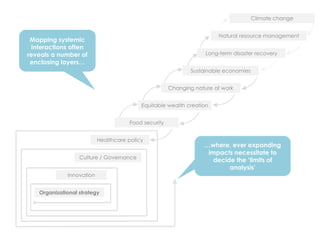
Recursive Phenomena:
Indefinite Boundaries &
Systemic Enclosedness
Organizational strategy
Innovation
Culture / Governance
Healthcare policy
Food security
Equitable wealth creation
Changing nature of work
Sustainable economies
Long-term disaster recovery
Natural resource management
Climate change
…where, ever expanding
impacts necessitate to
decide the ‘limits of
analysis’
Mapping systemic
interactions often
reveals a number of
enclosing layers…
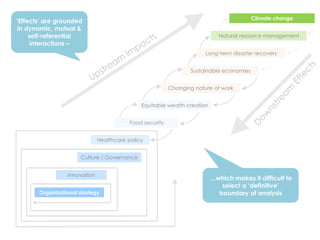
Organizational strategy
Innovation
Culture / Governance
Healthcare policy
Food security
Equitable wealth creation
Changing nature of work
Sustainable economies
Long-term disaster recovery
Natural resource management
Climate change
…which makes it difficult to
select a ‘definitive’
boundary of analysis
‘Effects’ are grounded
in dynamic, mutual &
self-referential
interactions –
Diverse perspectives
needed to
‘frame’ the situation –
Which requires collaboration.
* Relates to the concept of ‘Requisite Variety’ (Ashby, 1956)
No definitive heuristic exists
to negotiate the ‘correct’
boundary of understanding –
Which leads to conflict over
necessary perspectives.
How might we better
understand ‘complexity’ –
To help enable collaboration?
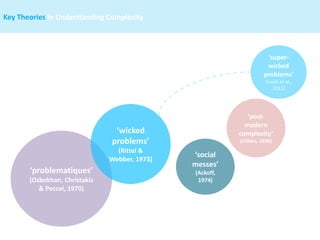
Key Theories in Understanding Complexity
‘super-
wicked
problems’
(Levin et al.,
2012)
‘problematiques’
(Ozbekhan, Christakis
& Peccei, 1970)
‘wicked
problems’
(Rittel &
Webber, 1973)
‘social
messes’
(Ackoff,
1974)
‘post-
modern
complexity’
(Cilliers, 1998)
‘Social Messes’
(Ackoff, 1979)
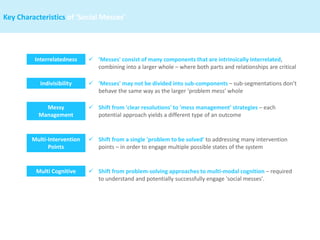
Interrelatedness
Indivisibility
Messy
Management
✓ 'Messes' consist of many components that are intrinsically interrelated,
combining into a larger whole – where both parts and relationships are critical
✓ 'Messes' may not be divided into sub-components – sub-segmentations don’t
behave the same way as the larger 'problem mess' whole
✓ Shift from 'clear resolutions' to 'mess management' strategies – each
potential approach yields a different type of an outcome
Multi-Intervention
Points
✓ Shift from a single 'problem to be solved' to addressing many intervention
points – in order to engage multiple possible states of the system
Multi Cognitive ✓ Shift from problem-solving approaches to multi-modal cognition – required
to understand and potentially successfully engage 'social messes'.
Key Characteristics of ‘Social Messes’
‘Problematiques’
& The Club of Rome
(Ozbekhan, Christakis & Peccei, 1970)
* Outlined as 49 ‘continuously interacting’ challenges
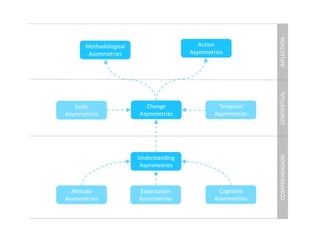
Scale
Asymmetries
Temporal
Asymmetries
Action
Asymmetries
Change
Asymmetries
Methodological
Asymmetries
Understanding
Asymmetries
Attitude
Asymmetries
Expectation
Asymmetries
Cognitive
Asymmetries
CONTEXTUAL
COMPREHENSION
INFLECTION
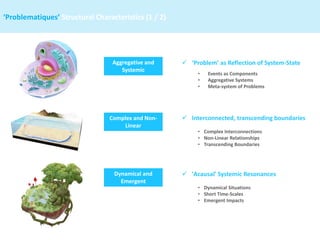
Aggregative and
Systemic
Complex and Non-
Linear
Dynamical and
Emergent
✓ ‘Problem’ as Reflection of System-State
• Events as Components
• Aggregative Systems
• Meta-system of Problems
✓ Interconnected, transcending boundaries
• Complex Interconnections
• Non-Linear Relationships
• Transcending Boundaries
✓ 'Acausal' Systemic Resonances
• Dynamical Situations
• Short Time-Scales
• Emergent Impacts
‘Problematiques’ Structural Characteristics (1 / 2)
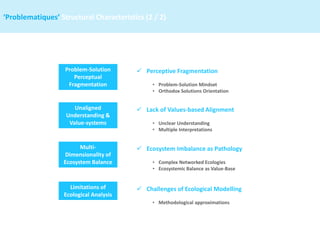
Problem-Solution
Perceptual
Fragmentation
Unaligned
Understanding &
Value-systems
✓ Perceptive Fragmentation
• Problem-Solution Mindset
• Orthodox Solutions Orientation
✓ Lack of Values-based Alignment
• Unclear Understanding
• Multiple Interpretations
‘Problematiques’ Structural Characteristics (2 / 2)
Multi-
Dimensionality of
Ecosystem Balance
Limitations of
Ecological Analysis
✓ Ecosystem Imbalance as Pathology
• Complex Networked Ecologies
• Ecosystemic Balance as Value-Base
✓ Challenges of Ecological Modelling
• Methodological approximations
Conceptual Synthesis:
towards the
“Affordances” of
Complexity
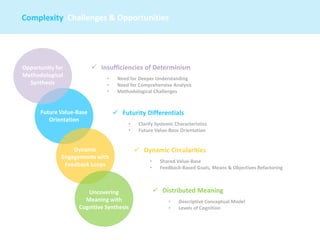
Opportunity for
Methodological
Synthesis
Future Value-Base
Orientation
Dynamic
Engagements with
Feedback Loops
Uncovering
Meaning with
Cognitive Synthesis
✓ Insufficiencies of Determinism
• Need for Deeper Understanding
• Need for Comprehensive Analysis
• Methodological Challenges
✓ Futurity Differentials
• Clarify Systemic Characteristics
• Future Value-Base Orientation
✓ Dynamic Circularities
• Shared Value-Base
• Feedback-Based Goals, Means & Objectives Refactoring
✓ Distributed Meaning
• Descriptive Conceptual Model
• Levels of Cognition
Complexity Challenges & Opportunities | Towards a Theoretical Synthesis
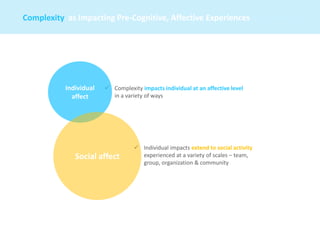
✓ Complexity impacts individual at an affective level
in a variety of ways
✓ Individual impacts extend to social activity
experienced at a variety of scales – team,
group, organization & community
Individual
affect
Social affect
Complexity as Impacting Pre-Cognitive, Affective Experiences | Towards a
Conceptual Synthesis:
“Complex Social
Challenges”
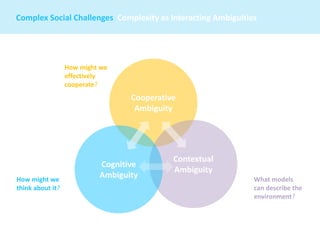
How might we
think about it?
How might we
effectively
cooperate?
Cooperative
Ambiguity
Contextual
Ambiguity
Cognitive
Ambiguity What models
can describe the
environment?
Complex Social Challenges Complexity as Interacting Ambiguities | Towards a
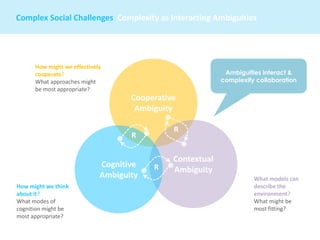
How might we think
about it?
What modes of
cognition might be
most appropriate?
How might we effectively
cooperate?
What approaches might
be most appropriate?
Complex Social Challenges Complexity as Interacting Ambiguities | Towards a
Cooperative
Ambiguity
Contextual
Ambiguity
Cognitive
Ambiguity What models can
describe the
environment?
What might be
most fitting?
R
R
Ambiguities interact &
complexify collaboration
Collaborative Model
for
Complex Social
Challenges
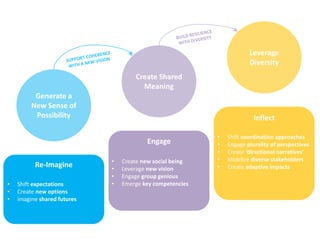
Create Shared
Meaning
Leverage
Diversity
Generate a
New Sense of
Possibility
Re-Imagine
Engage
Inflect
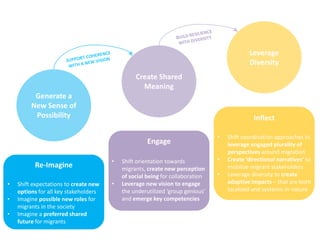
• Shift expectations
• Create new options
• imagine shared futures
• Create new social being
• Leverage new vision
• Engage group genious
• Emerge key competencies
• Shift coordination approaches
• Engage plurality of perspectives
• Create ‘directional narratives’
• Mobilize diverse stakeholders
• Create adaptive impacts
Proposed Framework:
“Cognitive Resilience
Enablers”
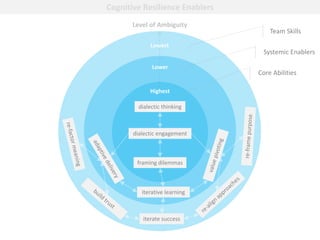
Lowest
Cognitive Resilience Enablers
Lower
Highest
Level of Ambiguity
dialectic thinking
dialectic engagement
framing dilemmas
iterative learning
iterate success
Team Skills
Systemic Enablers
Core Abilities
Proposed Collaborative
Model:
“Complexity Engagement
Loop”
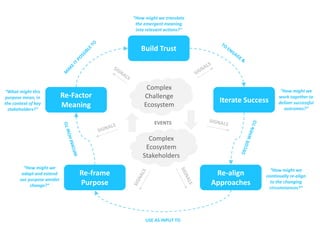
Re-Factor
Meaning
Iterate Success
Build Trust
Re-align
Approaches
Re-frame
Purpose
USE AS INPUT TO
Complex
Challenge
Ecosystem
Complex
Ecosystem
Stakeholders
EVENTS
“What might this
purpose mean, in
the context of key
stakeholders?“
“How might we translate
the emergent meaning
into relevant actions?“
“How might we
work together to
deliver successful
outcomes?“
“How might we
continually re-align
to the changing
circumstances?“
“How might we
adapt and extend
our purpose amidst
change?“
Proposed Approach:
“Complexity-Oriented
Teams”
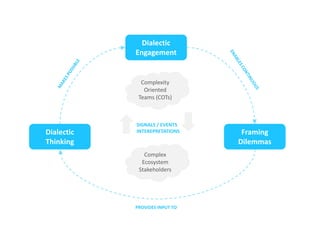
Dialectic
Thinking
Framing
Dilemmas
Dialectic
Engagement
PROVIDES INPUT TO
Complexity
Oriented
Teams (COTs)
Complex
Ecosystem
Stakeholders
SIGNALS / EVENTS
INTEREPRETATIONS
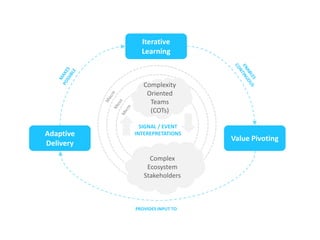
Adaptive
Delivery
Value Pivoting
Iterative
Learning
PROVIDES INPUT TO
Complexity
Oriented
Teams
(COTs)
Complex
Ecosystem
Stakeholders
SIGNAL / EVENT
INTEREPRETATIONS
Use Case:
Syrian Migrants
Create Shared
Meaning
Leverage
Diversity
Generate a
New Sense of
Possibility
Re-Imagine
Engage
Inflect
• Shift expectations to create new
options for all key stakeholders
• Imagine possible new roles for
migrants in the society
• Imagine a preferred shared
future for migrants
• Shift orientation towards
migrants, create new perception
of social being for collaboration
• Leverage new vision to engage
the underutilized ‘group genious’
and emerge key competencies
• Shift coordination approaches to
leverage engaged plurality of
perspectives around migration
• Create ‘directional narratives’ to
mobilize migrant stakeholders
• Leverage diversity to create
adaptive impacts – that are both
localized and systemic in nature
Re-Imagine
Generate a
New Sense of
Possibility Engage
Inflect
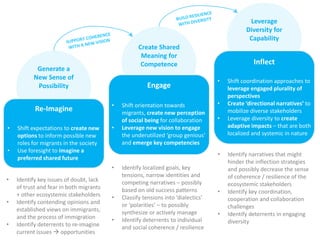
• Identify key issues of doubt, lack
of trust and fear in both migrants
+ other ecosystemic stakeholders
• Identify contending opinions and
established views on immigrants,
and the process of immigration
• Identify deterrents to re-imagine
current issues → opportunities
• Shift expectations to create new
options to inform possible new
roles for migrants in the society
• Use foresight to imagine a
preferred shared future
Create Shared
Meaning for
Competence
Leverage
Diversity for
Capability
• Identify localized goals, key
tensions, narrow identities and
competing narratives – possibly
based on old success patterns
• Classify tensions into ‘dialectics’
or ‘polarities’ – to possibly
synthesize or actively manage
• Identify deterrents to individual
and social coherence / resilience
• Identify narratives that might
hinder the inflection strategies
and possibly decrease the sense
of coherence / resilience of the
ecosystemic stakeholders
• Identify key coordination,
cooperation and collaboration
challenges
• Identify deterrents in engaging
diversity
• Shift orientation towards
migrants, create new perception
of social being for collaboration
• Leverage new vision to engage
the underutilized ‘group genious’
and emerge key competencies
• Shift coordination approaches to
leverage engaged plurality of
perspectives
• Create ‘directional narratives’ to
mobilize diverse stakeholders
• Leverage diversity to create
adaptive impacts – that are both
localized and systemic in nature
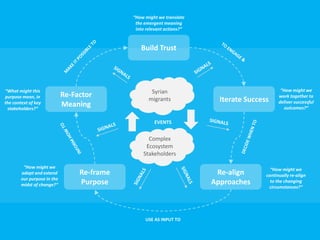
Re-Factor
Meaning
Iterate Success
Build Trust
Re-align
Approaches
Re-frame
Purpose
USE AS INPUT TO
Syrian
migrants
Complex
Ecosystem
Stakeholders
EVENTS
“What might this
purpose mean, in
the context of key
stakeholders?“
“How might we translate
the emergent meaning
into relevant actions?“
“How might we
work together to
deliver successful
outcomes?“
“How might we
continually re-align
to the changing
circumstances?“
“How might we
adapt and extend
our purpose in the
midst of change?“
Re-Factor
Meaning
Iterate Success
Build Trust
Re-align
Approaches
Re-frame
Purpose
USE AS INPUT TO
Syrian
migrants
Complex
Ecosystem
Stakeholders
EVENTS
“What might this
purpose mean, in
the context of key
stakeholders?“
“How might we translate
the emergent meaning
into relevant actions?“
“How might we
work together to
deliver successful
outcomes?“
“How might we
continually re-align
to the changing
circumstances?“
“How might we
adapt and extend
our purpose in the
midst of change?“
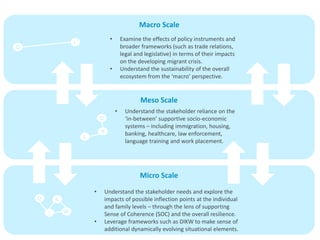
Micro Scale
Meso Scale
Macro Scale
• Examine the effects of policy instruments and
broader frameworks (such as trade relations,
legal and legislative) in terms of their impacts
on the developing migrant crisis.
• Understand the sustainability of the overall
ecosystem from the ‘macro’ perspective.
• Understand the stakeholder reliance on the
‘in-between’ supportive socio-economic
systems – including immigration, housing,
banking, healthcare, law enforcement,
language training and work placement.
• Understand the stakeholder needs and explore the
impacts of possible inflection points at the individual
and family levels – through the lens of supporting
Sense of Coherence (SOC) and the overall resilience.
• Leverage frameworks such as DIKW to make sense of
additional dynamically evolving situational elements.
Thank you!
Relating Systems Thinking and Design (RSD9) | OCT 2020
Master’s Research Project, OCAD University
Strategic Foresight and Innovation (SFI)
Goran Matic | goran.matic@gmail.com
Team Collaboration Competencies for Complex Social Challenges
(Matic, 2017)
http://openresearch.ocadu.ca/id/eprint/1990/

Team Collaboration Competencies for Complex Social Challenges

  • 1.
    Team Collaboration Competencies forComplex Social Challenges Relating Systems Thinking and Design (RSD9) | OCT 2020 Master’s Research Project, OCAD University Strategic Foresight and Innovation (SFI) Goran Matic | goran.matic@gmail.com
  • 2.
    Why do weneed a new type of collaboration for complexity?
  • 3.
  • 4.
    Organizational strategy Innovation Culture /Governance Healthcare policy Food security Equitable wealth creation Changing nature of work Sustainable economies Long-term disaster recovery Natural resource management Climate change …where, ever expanding impacts necessitate to decide the ‘limits of analysis’ Mapping systemic interactions often reveals a number of enclosing layers…
  • 5.
    Organizational strategy Innovation Culture /Governance Healthcare policy Food security Equitable wealth creation Changing nature of work Sustainable economies Long-term disaster recovery Natural resource management Climate change …which makes it difficult to select a ‘definitive’ boundary of analysis ‘Effects’ are grounded in dynamic, mutual & self-referential interactions –
  • 6.
    Diverse perspectives needed to ‘frame’the situation – Which requires collaboration. * Relates to the concept of ‘Requisite Variety’ (Ashby, 1956)
  • 7.
    No definitive heuristicexists to negotiate the ‘correct’ boundary of understanding – Which leads to conflict over necessary perspectives.
  • 8.
    How might webetter understand ‘complexity’ – To help enable collaboration?
  • 9.
    Key Theories inUnderstanding Complexity ‘super- wicked problems’ (Levin et al., 2012) ‘problematiques’ (Ozbekhan, Christakis & Peccei, 1970) ‘wicked problems’ (Rittel & Webber, 1973) ‘social messes’ (Ackoff, 1974) ‘post- modern complexity’ (Cilliers, 1998)
  • 10.
  • 11.
    Interrelatedness Indivisibility Messy Management ✓ 'Messes' consistof many components that are intrinsically interrelated, combining into a larger whole – where both parts and relationships are critical ✓ 'Messes' may not be divided into sub-components – sub-segmentations don’t behave the same way as the larger 'problem mess' whole ✓ Shift from 'clear resolutions' to 'mess management' strategies – each potential approach yields a different type of an outcome Multi-Intervention Points ✓ Shift from a single 'problem to be solved' to addressing many intervention points – in order to engage multiple possible states of the system Multi Cognitive ✓ Shift from problem-solving approaches to multi-modal cognition – required to understand and potentially successfully engage 'social messes'. Key Characteristics of ‘Social Messes’
  • 12.
    ‘Problematiques’ & The Clubof Rome (Ozbekhan, Christakis & Peccei, 1970) * Outlined as 49 ‘continuously interacting’ challenges
  • 13.
  • 14.
    Aggregative and Systemic Complex andNon- Linear Dynamical and Emergent ✓ ‘Problem’ as Reflection of System-State • Events as Components • Aggregative Systems • Meta-system of Problems ✓ Interconnected, transcending boundaries • Complex Interconnections • Non-Linear Relationships • Transcending Boundaries ✓ 'Acausal' Systemic Resonances • Dynamical Situations • Short Time-Scales • Emergent Impacts ‘Problematiques’ Structural Characteristics (1 / 2)
  • 15.
    Problem-Solution Perceptual Fragmentation Unaligned Understanding & Value-systems ✓ PerceptiveFragmentation • Problem-Solution Mindset • Orthodox Solutions Orientation ✓ Lack of Values-based Alignment • Unclear Understanding • Multiple Interpretations ‘Problematiques’ Structural Characteristics (2 / 2) Multi- Dimensionality of Ecosystem Balance Limitations of Ecological Analysis ✓ Ecosystem Imbalance as Pathology • Complex Networked Ecologies • Ecosystemic Balance as Value-Base ✓ Challenges of Ecological Modelling • Methodological approximations
  • 16.
  • 17.
    Opportunity for Methodological Synthesis Future Value-Base Orientation Dynamic Engagementswith Feedback Loops Uncovering Meaning with Cognitive Synthesis ✓ Insufficiencies of Determinism • Need for Deeper Understanding • Need for Comprehensive Analysis • Methodological Challenges ✓ Futurity Differentials • Clarify Systemic Characteristics • Future Value-Base Orientation ✓ Dynamic Circularities • Shared Value-Base • Feedback-Based Goals, Means & Objectives Refactoring ✓ Distributed Meaning • Descriptive Conceptual Model • Levels of Cognition Complexity Challenges & Opportunities | Towards a Theoretical Synthesis
  • 18.
    ✓ Complexity impactsindividual at an affective level in a variety of ways ✓ Individual impacts extend to social activity experienced at a variety of scales – team, group, organization & community Individual affect Social affect Complexity as Impacting Pre-Cognitive, Affective Experiences | Towards a
  • 19.
  • 20.
    How might we thinkabout it? How might we effectively cooperate? Cooperative Ambiguity Contextual Ambiguity Cognitive Ambiguity What models can describe the environment? Complex Social Challenges Complexity as Interacting Ambiguities | Towards a
  • 21.
    How might wethink about it? What modes of cognition might be most appropriate? How might we effectively cooperate? What approaches might be most appropriate? Complex Social Challenges Complexity as Interacting Ambiguities | Towards a Cooperative Ambiguity Contextual Ambiguity Cognitive Ambiguity What models can describe the environment? What might be most fitting? R R Ambiguities interact & complexify collaboration
  • 22.
  • 23.
    Create Shared Meaning Leverage Diversity Generate a NewSense of Possibility Re-Imagine Engage Inflect • Shift expectations • Create new options • imagine shared futures • Create new social being • Leverage new vision • Engage group genious • Emerge key competencies • Shift coordination approaches • Engage plurality of perspectives • Create ‘directional narratives’ • Mobilize diverse stakeholders • Create adaptive impacts
  • 24.
  • 25.
    Lowest Cognitive Resilience Enablers Lower Highest Levelof Ambiguity dialectic thinking dialectic engagement framing dilemmas iterative learning iterate success Team Skills Systemic Enablers Core Abilities
  • 26.
  • 27.
    Re-Factor Meaning Iterate Success Build Trust Re-align Approaches Re-frame Purpose USEAS INPUT TO Complex Challenge Ecosystem Complex Ecosystem Stakeholders EVENTS “What might this purpose mean, in the context of key stakeholders?“ “How might we translate the emergent meaning into relevant actions?“ “How might we work together to deliver successful outcomes?“ “How might we continually re-align to the changing circumstances?“ “How might we adapt and extend our purpose amidst change?“
  • 28.
  • 29.
    Dialectic Thinking Framing Dilemmas Dialectic Engagement PROVIDES INPUT TO Complexity Oriented Teams(COTs) Complex Ecosystem Stakeholders SIGNALS / EVENTS INTEREPRETATIONS
  • 30.
    Adaptive Delivery Value Pivoting Iterative Learning PROVIDES INPUTTO Complexity Oriented Teams (COTs) Complex Ecosystem Stakeholders SIGNAL / EVENT INTEREPRETATIONS
  • 31.
  • 32.
    Create Shared Meaning Leverage Diversity Generate a NewSense of Possibility Re-Imagine Engage Inflect • Shift expectations to create new options for all key stakeholders • Imagine possible new roles for migrants in the society • Imagine a preferred shared future for migrants • Shift orientation towards migrants, create new perception of social being for collaboration • Leverage new vision to engage the underutilized ‘group genious’ and emerge key competencies • Shift coordination approaches to leverage engaged plurality of perspectives around migration • Create ‘directional narratives’ to mobilize migrant stakeholders • Leverage diversity to create adaptive impacts – that are both localized and systemic in nature
  • 33.
    Re-Imagine Generate a New Senseof Possibility Engage Inflect • Identify key issues of doubt, lack of trust and fear in both migrants + other ecosystemic stakeholders • Identify contending opinions and established views on immigrants, and the process of immigration • Identify deterrents to re-imagine current issues → opportunities • Shift expectations to create new options to inform possible new roles for migrants in the society • Use foresight to imagine a preferred shared future Create Shared Meaning for Competence Leverage Diversity for Capability • Identify localized goals, key tensions, narrow identities and competing narratives – possibly based on old success patterns • Classify tensions into ‘dialectics’ or ‘polarities’ – to possibly synthesize or actively manage • Identify deterrents to individual and social coherence / resilience • Identify narratives that might hinder the inflection strategies and possibly decrease the sense of coherence / resilience of the ecosystemic stakeholders • Identify key coordination, cooperation and collaboration challenges • Identify deterrents in engaging diversity • Shift orientation towards migrants, create new perception of social being for collaboration • Leverage new vision to engage the underutilized ‘group genious’ and emerge key competencies • Shift coordination approaches to leverage engaged plurality of perspectives • Create ‘directional narratives’ to mobilize diverse stakeholders • Leverage diversity to create adaptive impacts – that are both localized and systemic in nature
  • 34.
    Re-Factor Meaning Iterate Success Build Trust Re-align Approaches Re-frame Purpose USEAS INPUT TO Syrian migrants Complex Ecosystem Stakeholders EVENTS “What might this purpose mean, in the context of key stakeholders?“ “How might we translate the emergent meaning into relevant actions?“ “How might we work together to deliver successful outcomes?“ “How might we continually re-align to the changing circumstances?“ “How might we adapt and extend our purpose in the midst of change?“
  • 35.
    Re-Factor Meaning Iterate Success Build Trust Re-align Approaches Re-frame Purpose USEAS INPUT TO Syrian migrants Complex Ecosystem Stakeholders EVENTS “What might this purpose mean, in the context of key stakeholders?“ “How might we translate the emergent meaning into relevant actions?“ “How might we work together to deliver successful outcomes?“ “How might we continually re-align to the changing circumstances?“ “How might we adapt and extend our purpose in the midst of change?“
  • 36.
    Micro Scale Meso Scale MacroScale • Examine the effects of policy instruments and broader frameworks (such as trade relations, legal and legislative) in terms of their impacts on the developing migrant crisis. • Understand the sustainability of the overall ecosystem from the ‘macro’ perspective. • Understand the stakeholder reliance on the ‘in-between’ supportive socio-economic systems – including immigration, housing, banking, healthcare, law enforcement, language training and work placement. • Understand the stakeholder needs and explore the impacts of possible inflection points at the individual and family levels – through the lens of supporting Sense of Coherence (SOC) and the overall resilience. • Leverage frameworks such as DIKW to make sense of additional dynamically evolving situational elements.
  • 37.
    Thank you! Relating SystemsThinking and Design (RSD9) | OCT 2020 Master’s Research Project, OCAD University Strategic Foresight and Innovation (SFI) Goran Matic | goran.matic@gmail.com Team Collaboration Competencies for Complex Social Challenges (Matic, 2017) http://openresearch.ocadu.ca/id/eprint/1990/