Developmental Evaluation
Cameron D. Norman PhD CE
Principal CENSE Research + Design
Adjunct Professor, Dalla Lana School of Public Health, University of Toronto
@cdnorman
August 28, 2013
Outline
• Thinking about the problem(s)
• What is Developmental Evaluation?
• Methods
• Case Examples
• Discussion & dialogue
Same Evaluation Tools / "
Different Thinking Tools
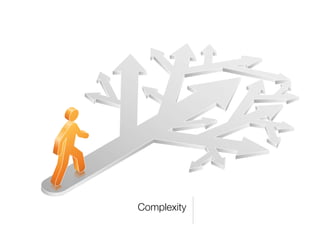
Complexity
Example: Organizing a children’s
party
Evaluation & Measurement:
Problems & Opportunities
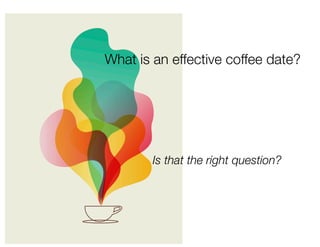
What is an effective coffee date?
Is that the right question?
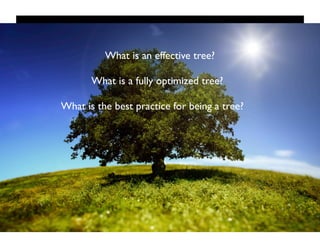
What is an effective tree? 	

What is the best practice for being a tree? 	

What is a fully optimized tree?
Do you know what is inside before you crack it open?
Confusing moving things with static things
The Importance of Theory
What is Developmental Evaluation?
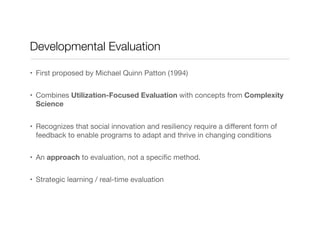
Developmental Evaluation
•  First proposed by Michael Quinn Patton (1994)
•  Combines Utilization-Focused Evaluation with concepts from Complexity
Science
•  Recognizes that social innovation and resiliency require a different form of
feedback to enable programs to adapt and thrive in changing conditions
•  An approach to evaluation, not a specific method. 
•  Strategic learning / real-time evaluation
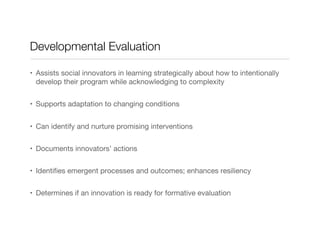
Developmental Evaluation
•  Assists social innovators in learning strategically about how to intentionally
develop their program while acknowledging to complexity
•  Supports adaptation to changing conditions
•  Can identify and nurture promising interventions
•  Documents innovators’ actions 
•  Identifies emergent processes and outcomes; enhances resiliency
•  Determines if an innovation is ready for formative evaluation
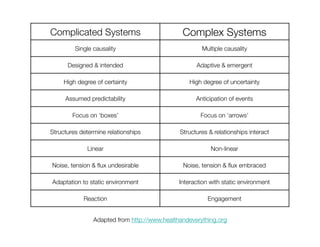
Complicated Systems
 Complex Systems
Single causality
 Multiple causality
Designed & intended
 Adaptive & emergent
High degree of certainty
 High degree of uncertainty
Assumed predictability
 Anticipation of events
Focus on ‘boxes’
 Focus on ‘arrows’
Structures determine relationships
 Structures & relationships interact
Linear
 Non-linear
Noise, tension & flux undesirable
 Noise, tension & flux embraced
Adaptation to static environment
 Interaction with static environment
Reaction
 Engagement
Adapted from http://www.healthandeverything.org
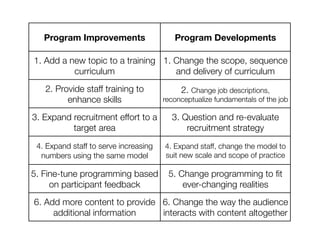
Program Improvements
 Program Developments
1. Add a new topic to a training
curriculum
1. Change the scope, sequence
and delivery of curriculum
2. Provide staff training to
enhance skills
2. Change job descriptions,
reconceptualize fundamentals of the job
3. Expand recruitment effort to a
target area
3. Question and re-evaluate
recruitment strategy
4. Expand staff to serve increasing
numbers using the same model
4. Expand staff, change the model to
suit new scale and scope of practice
5. Fine-tune programming based
on participant feedback
5. Change programming to fit
ever-changing realities
6. Add more content to provide
additional information
6. Change the way the audience
interacts with content altogether
Design Thinking
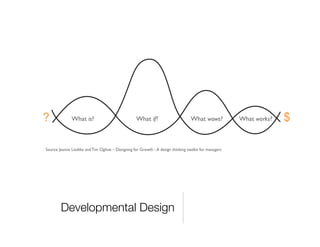
Developmental Design
Methods & Methodology
Mindfulness
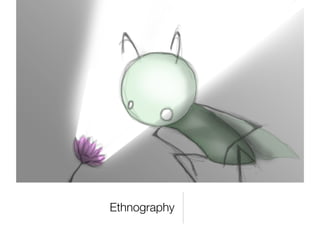
Ethnography
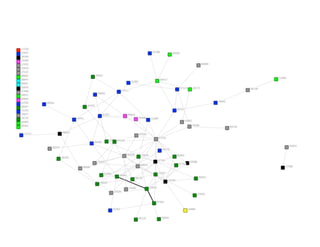
Network Analysis
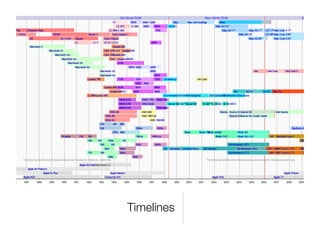
Timelines
Visual Thinking
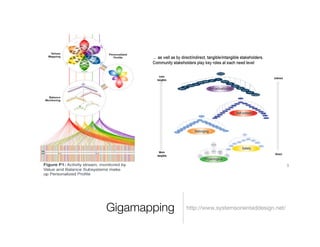
Gigamapping
 http://www.systemsorienteddesign.net/
Idea Generation
Knowledge Mobilization
Strategic Learning
Discussion
Cameron D. Norman PhD	
  
@cdnorman
censemaking.com

Developmental Evaluation for Social Innovation

  • 1.
    Developmental Evaluation Cameron D.Norman PhD CE Principal CENSE Research + Design Adjunct Professor, Dalla Lana School of Public Health, University of Toronto @cdnorman August 28, 2013
  • 2.
    Outline • Thinking about theproblem(s) • What is Developmental Evaluation? • Methods • Case Examples • Discussion & dialogue
  • 3.
    Same Evaluation Tools/ " Different Thinking Tools
  • 4.
  • 5.
    Example: Organizing achildren’s party
  • 6.
  • 7.
    What is aneffective coffee date? Is that the right question?
  • 8.
    What is aneffective tree? What is the best practice for being a tree? What is a fully optimized tree?
  • 9.
    Do you knowwhat is inside before you crack it open?
  • 11.
    Confusing moving thingswith static things
  • 12.
  • 13.
  • 14.
    Developmental Evaluation •  Firstproposed by Michael Quinn Patton (1994) •  Combines Utilization-Focused Evaluation with concepts from Complexity Science •  Recognizes that social innovation and resiliency require a different form of feedback to enable programs to adapt and thrive in changing conditions •  An approach to evaluation, not a specific method. •  Strategic learning / real-time evaluation
  • 15.
    Developmental Evaluation •  Assistssocial innovators in learning strategically about how to intentionally develop their program while acknowledging to complexity •  Supports adaptation to changing conditions •  Can identify and nurture promising interventions •  Documents innovators’ actions •  Identifies emergent processes and outcomes; enhances resiliency •  Determines if an innovation is ready for formative evaluation
  • 16.
    Complicated Systems ComplexSystems Single causality Multiple causality Designed & intended Adaptive & emergent High degree of certainty High degree of uncertainty Assumed predictability Anticipation of events Focus on ‘boxes’ Focus on ‘arrows’ Structures determine relationships Structures & relationships interact Linear Non-linear Noise, tension & flux undesirable Noise, tension & flux embraced Adaptation to static environment Interaction with static environment Reaction Engagement Adapted from http://www.healthandeverything.org
  • 17.
    Program Improvements ProgramDevelopments 1. Add a new topic to a training curriculum 1. Change the scope, sequence and delivery of curriculum 2. Provide staff training to enhance skills 2. Change job descriptions, reconceptualize fundamentals of the job 3. Expand recruitment effort to a target area 3. Question and re-evaluate recruitment strategy 4. Expand staff to serve increasing numbers using the same model 4. Expand staff, change the model to suit new scale and scope of practice 5. Fine-tune programming based on participant feedback 5. Change programming to fit ever-changing realities 6. Add more content to provide additional information 6. Change the way the audience interacts with content altogether
  • 18.
  • 19.
  • 20.
  • 21.
  • 22.
  • 23.
  • 25.
  • 26.
  • 27.
  • 28.
  • 29.
  • 30.
  • 31.
  • 32.
    Cameron D. NormanPhD   @cdnorman censemaking.com