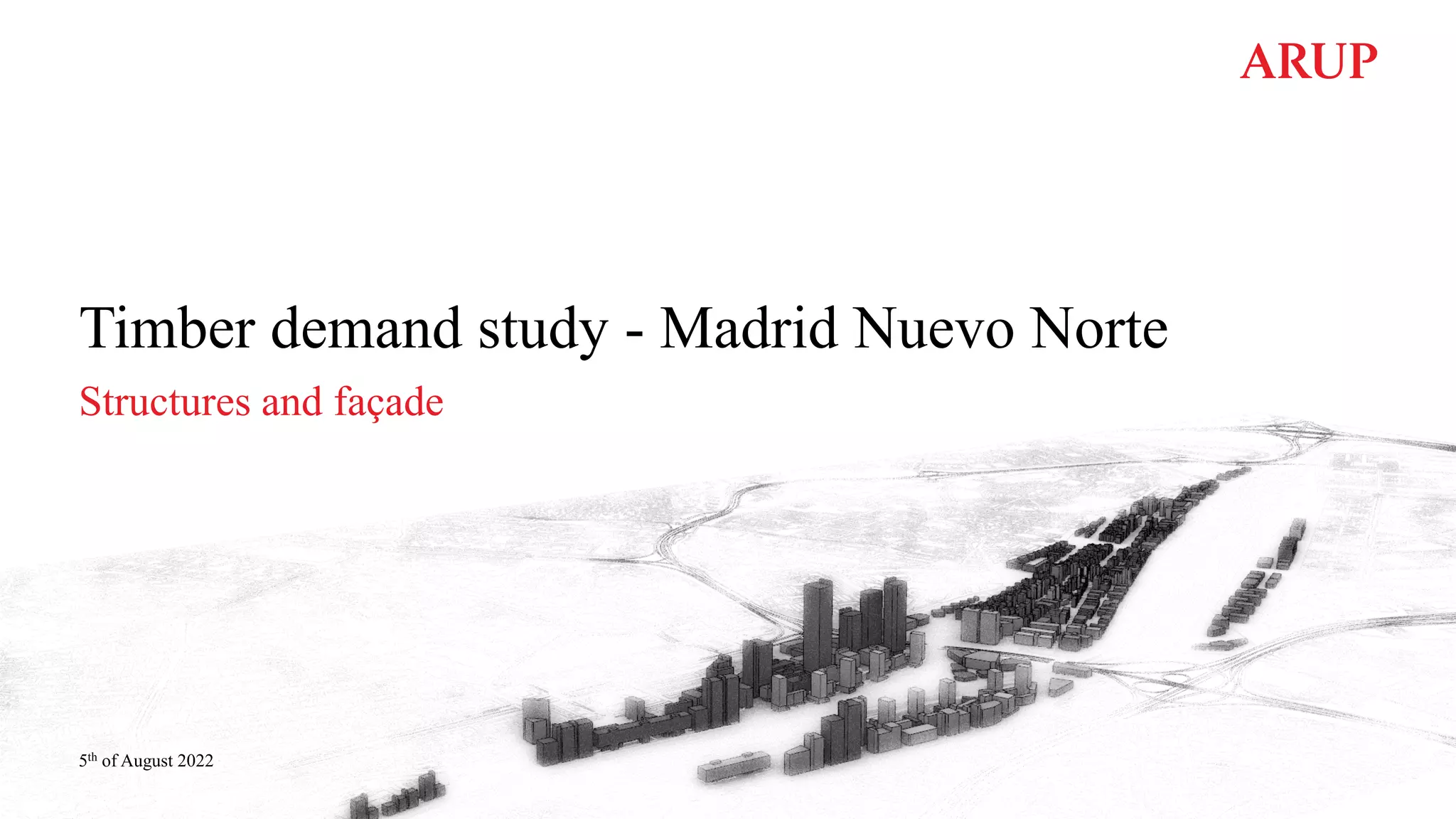
Timber demand study - Madrid Nuevo Norte
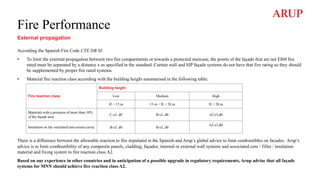
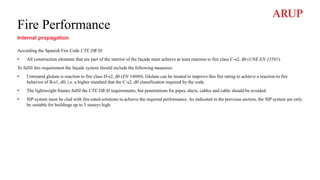
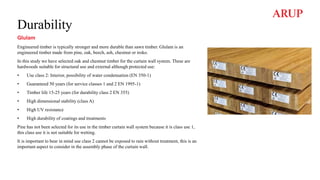
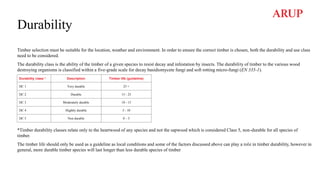
Structures and façade
5th of August 2022
Index
Timber Demand Study MNN
Introduction
Scope of study
General assumptions
Glossary
MNN building typologies and classification
Timber demand study workflow
Structure
Timber structural system
Residential building structural framing
Office building structural framing
Public building structural framing
Façade
Timber façade systems
Timber façade typologies and quantities
Office building façade system
Residential building façade system
Public building façade system
Timber demand results
Arup inForm result viewer guidance
Project references
Next steps
Appendix 1: structural basis of design
Appendix 2: façade basis of design
Introduction
Introduction
Timber Demand Study Madrid Nuevo Norte (MNN)
This study has been carried out as part of the European Cities for climate-Neutral Construction - Bio-based and circular buildings
project in Madrid and Milan (EU CINCO), sponsored by Laudes Foundation. This project lies within the framework of Climate-KIC’s
Deep Demonstration programme Healthy, Clean Cities (HCC), which seeks to reduce embodied carbon in buildings and infrastructure
through bio-based and circular strategies. It aims to decarbonise the construction sector to contribute to the EU climate neutrality
targets, and to identify and explore options for intervening in the entire value chain of materials throughout their whole-life cycle,
aligning and coordinating innovative decision-making processes from several interdisciplinary stakeholders at once.
Based on feedback from interviews with different agents of the timber sector in recent months, such as manufacturers, producers,
associations, etc., a series of barriers and opportunities have been identified related to greater adoption of timber in Spanish
construction. One of the keys to promoting the production and use of construction-grade timber in Spain is guaranteeing a stable
demand and supply of raw materials. This action is strongly conditioned by forest growth times; therefore, the promotion of a local
timber market is a medium-term task.
Distrito Castellana Norte (DCN) has positioned itself as a driver for change. A clear commitment to the use of timber in construction
might help guarantee the stability of supply during the extensive Madrid Nuevo Norte (MMN) building construction stage, which is
planned to span 20 years, from 2025 to 2045. A set of actions has therefore been proposed to identify opportunities for connection
between timber producers and potential timber demand based on simulating the adoption of timber construction at scale on MNN.
The first action proposed is to estimate the potential demand for timber in the MNN masterplan in order to establish supply needs in an
idealized scenario of timber-based construction. This study aims to achieve this by simulating the maximum volume of timber demand
for the structures and façades for the different building typologies based on the current MNN building massing provided by DCN.
Scope of study
Scope of study
Timber Demand Study MNN
The scope of this study involves simulating maximum technically and economically reasonable timber demand for the structure and
façades of the buildings that form part of the Madrid Nuevo Norte masterplan.
For the structure, the study proposes vertical and horizontal framing options for each of the building height and use categories
identified in the building massing, in order to extract global structural timber quantity estimates.
For the façades, different systems are presented and proposals for each building heigh and use category are provided, including with
pre-sizing of timber elements to estimate the volume of timber demand for the facades of the buildings included in the masterplan.
In order to carry out these simulation studies, several assumptions have been made, as described in the following section of this
report and in the basis of design appendices.
All quantity figures derived in this study are based on high-level estimates and preliminary sizing of timber elements, therefore
they should only be considered as very approximate. The demand results summarized in the output section of this report should be
interpreted as orders of magnitude, rather than definitive quantities.
General assumptions
General assumptions
Timber Demand Study MNN
The following general assumptions have been made for this structural timber study:
• The Madrid Nuevo Norte (MNN) massing model used is as provided by Distrito Castellana Norte (DCN)
• The stability system for each building is assumed to be provided by reinforced concrete (RC) cores or steel bracing, i.e.
excluded from this timber study. If timber structures were to be used for the stability systems of some of the buildings (e.g.
low/medium rise), the impact on the total timber demand would be relatively small.
• Interpretation of “commercial use” in the use categories provided: assumed retail capacity at ground floor level contained in
“podium” type structures that would not be in timber, therefore not considered in the scope of this study.
• Constant typical grids have been assumed all the way up the building for the typical frame sizing. Any significant grid
transfers would require different materials, i.e. steel or concrete.
• The timber framing proposals put forward in this study are based on maximizing the use of structural timber where
reasonable to do so, in order to establish maximum demand figures. In reality, many different factors that are not considered
in this study will affect the final choice of structure and façade materials for each individual building.
• Basements have not been considered in the scope of this study. The heights of the buildings have been assumed from the
base of the modelled volumes in the MNN massing data provided.
• This study assumes that all timber will be sourced from FSC or PEFC certified suppliers, or equivalent, to guarantee
sustainable sourcing.
Glossary
Glossary
The following abbreviations are used in this report
• Glulam: Glue Laminated Timber
• CLT: Cross-Laminated Timber
• TCC: Timber Concrete Composite
• MNN: Madrid Nuevo Norte
• DCN: Distrito Castellana Norte
• RC: Reinforced Concrete
• ULS: Ultimate Limit State
• SLS: Serviceability Limit State
• GFA: Gross Floor Area
• EC5: Eurocode 5
• SIP: Structural Insulated Panels
• CTE: Código Técnico de la Edificación
• EPS: Expanded Polystyrene Insulation
• XPS: Extruded Polystyrene Insulation
• TGU: Triple Glass Unit
• DGU: Double Glass Unit
• OSB: Oriented Strand Board
• WWR: Window Wall Ratio
• EPDM: Ethylene-Propylene Diene Monomer
• BoD: Basis of Design
MNN building typologies and classification
Building typologies and classification
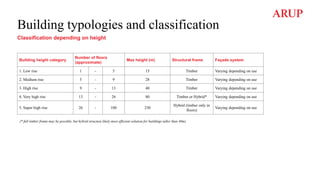
Classification depending on height
Building height category
Number of floors
(approximate)
Max height (m) Structural frame Façade system
1. Low rise 1 - 5 15 Timber Varying depending on use
2. Medium rise 5 - 9 28 Timber Varying depending on use
3. High rise 9 - 13 40 Timber Varying depending on use
4. Very high rise 13 - 26 80 Timber or Hybrid* Varying depending on use
5. Super high rise 26 - 100 230
Hybrid (timber only in
floors)
Varying depending on use
(* full timber frame may be possible, but hybrid structure likely most efficient solution for buildings taller than 40m)
Building typologies and classification
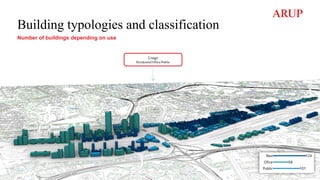
Usage
Residential/Office/Public
Number of buildings depending on use
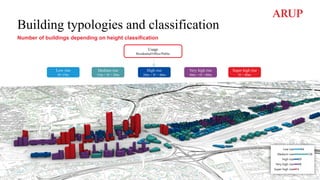
Building typologies and classification
Low rise
H<15m
Medium rise
15m < H < 28m
High rise
28m < H < 40m
Very high rise
40m < H < 80m
Super high rise
H > 80m
Usage
Residential/Office/Public
Number of buildings depending on height classification
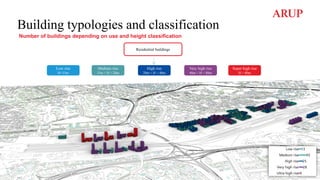
Building typologies and classification
Low rise
H<15m
Medium rise
15m < H < 28m
High rise
28m < H < 40m
Very high rise
40m < H < 80m
Super high rise
H > 80m
Residential buildings
Number of buildings depending on use and height classification
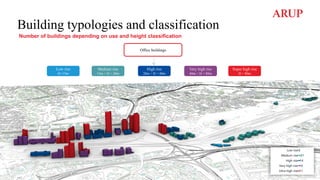
Building typologies and classification
Low rise
H<15m
Medium rise
15m < H < 28m
High rise
28m < H < 40m
Very high rise
40m < H < 80m
Super high rise
H > 80m
Office buildings
Number of buildings depending on use and height classification
Building typologies and classification
Low rise
H<15m
Medium rise
15m < H < 28m
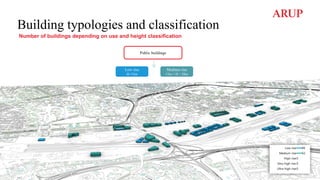
Public buildings
Number of buildings depending on use and height classification
Timber Demand Study Workflow
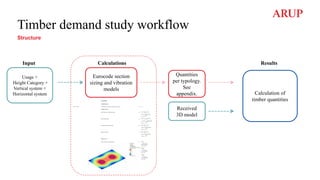
Timber demand study workflow
Usage +
Height Category +
Vertical system +
Horizontal system
Eurocode section
sizing and vibration
models
Received
3D model
Quantities
per typology.
See
appendix. Calculation of
timber quantities
Input Calculations Results
Structure
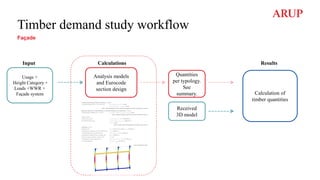
Timber demand study workflow
Usage +
Height Category +
Loads +WWR +
Façade system
Analysis models
and Eurocode
section design
Received
3D model
Quantities
per typology.
See
summary. Calculation of
timber quantities
Input Calculations Results
Façade
Structure
Timber Structural Systems
Floor systems
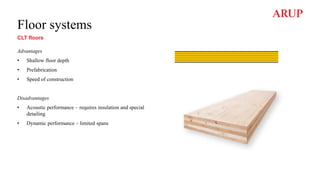
CLT floors
Advantages
• Shallow floor depth
• Prefabrication
• Speed of construction
Disadvantages
• Acoustic performance – requires insulation and special
detailing
• Dynamic performance – limited spans
Floor systems
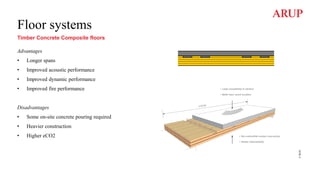
Timber Concrete Composite floors
Advantages
• Longer spans
• Improved acoustic performance
• Improved dynamic performance
• Improved fire performance
Disadvantages
• Some on-site concrete pouring required
• Heavier construction
• Higher eCO2
©
KLH
Floor systems
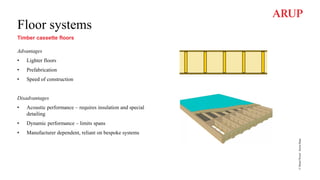
Timber cassette floors
Advantages
• Lighter floors
• Prefabrication
• Speed of construction
Disadvantages
• Acoustic performance – requires insulation and special
detailing
• Dynamic performance – limits spans
• Manufacturer dependent, reliant on bespoke systems
©
Metsä
Wood
–
Kerto-Ripa
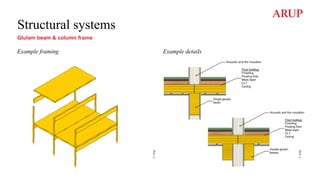
Example details
Structural systems
Glulam beam & column frame
Example framing
©
Arup
©
Arup
Structural systems
Glulam beam & column frame
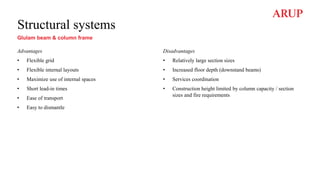
Advantages
• Flexible grid
• Flexible internal layouts
• Maximize use of internal spaces
• Short lead-in times
• Ease of transport
• Easy to dismantle
Disadvantages
• Relatively large section sizes
• Increased floor depth (downstand beams)
• Services coordination
• Construction height limited by column capacity / section
sizes and fire requirements
Structural systems
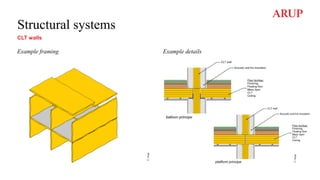
CLT walls
Example framing Example details
©
Arup
©
Arup
Structural systems
CLT walls
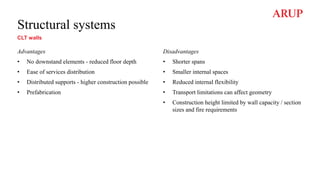
Advantages
• No downstand elements - reduced floor depth
• Ease of services distribution
• Distributed supports - higher construction possible
• Prefabrication
Disadvantages
• Shorter spans
• Smaller internal spaces
• Reduced internal flexibility
• Transport limitations can affect geometry
• Construction height limited by wall capacity / section
sizes and fire requirements
Example framing
Structural systems
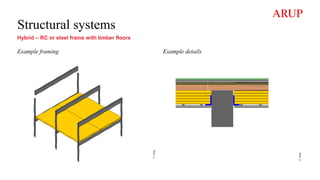
Hybrid – RC or steel frame with timber floors
Example details
©
Arup
©
Arup
Structural systems
Hybrid – RC or Steel frame with timber floors
Advantages
• Structural frame can be steel or concrete (in-situ or
precast)
• Not limited by building height
• Timber floor solutions same as timber frame
structure: CLT or TCC
• Lighter construction than conventional RC / steel
• Steel frame can have beams with voids for services
integration
• Reduced loads on foundations compared to
conventional steel / concrete building
Disadvantages
• Heavier construction than timber framing
• Higher eCO2
Similarly to other timber structural systems:
• Taller buildings require exposed timber surfaces to be
limited (fire)
• Authority approvals may be barrier to using timber
structure in high-rise buildings
Structural systems
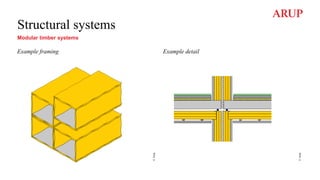
Modular timber systems
Example framing Example detail
©
Arup
©
Arup
Structural systems
Timber modular
Advantages
• Repetition / prefabrication
• Integrated services and finishes
• Speed of construction
• Economy of scale
Disadvantages
• Construction lead-in time
• Module size constraints to architecture
• Transport limitations
• Duplication of floors / ceilings
• Reduced internal spaces and flexibility
• Usually lower load capacity – low/medium rise only
• Acoustic & fire detailing can be challenging
• Usually bespoke systems that are manufacturer
dependant, therefore this option has not been
considered in the scope of this study
Structure
Residential building structural framing
Residential buildings
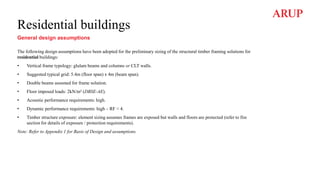
General design assumptions
The following design assumptions have been adopted for the preliminary sizing of the structural timber framing solutions for
residential buildings:
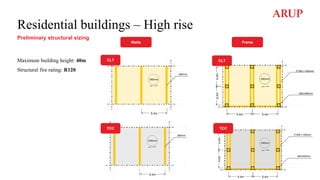
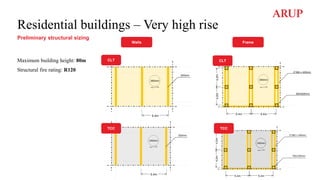
• Vertical frame typology: glulam beams and columns or CLT walls.
• Suggested typical grid: 5.4m (floor span) x 4m (beam span).
• Double beams assumed for frame solution.
• Floor imposed loads: 2kN/m² (DBSE-AE).
• Acoustic performance requirements: high.
• Dynamic performance requirements: high – RF < 4.
• Timber structure exposure: element sizing assumes frames are exposed but walls and floors are protected (refer to fire
section for details of exposure / protection requirements).
Note: Refer to Appendix 1 for Basis of Design and assumptions.
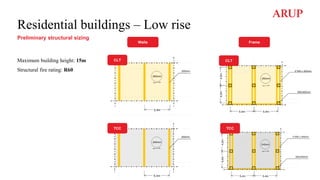
Residential buildings – Low rise
Preliminary structural sizing
Maximum building height: 15m
Structural fire rating: R60
Walls
CLT
TCC
Frame
CLT
TCC
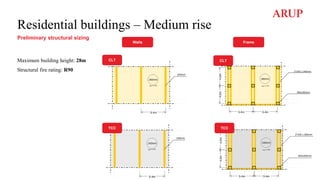
Maximum building height: 28m
Structural fire rating: R90
Residential buildings – Medium rise
Walls
CLT
TCC
Frame
CLT
TCC
Preliminary structural sizing
Residential buildings – High rise
Walls
CLT
TCC
Frame
CLT
TCC
Maximum building height: 40m
Structural fire rating: R120
Preliminary structural sizing
Maximum building height: 80m
Structural fire rating: R120
Residential buildings – Very high rise
Walls
CLT
TCC
Frame
CLT
TCC
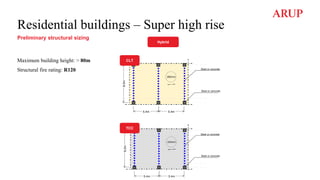
Preliminary structural sizing
Residential buildings – Super high rise
Hybrid
CLT
TCC
Maximum building height: > 80m
Structural fire rating: R120
Preliminary structural sizing
Structure
Office building structural framing
Office buildings
General design assumptions
The following design assumptions have been adopted for the preliminary sizing of the structural timber framing solutions for
office buildings:
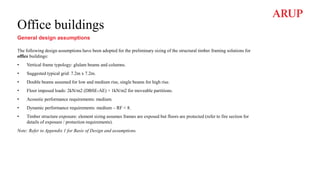
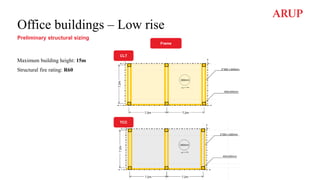
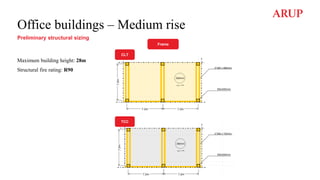
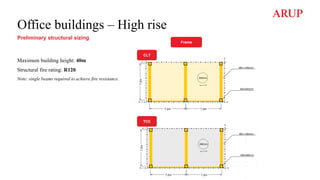
• Vertical frame typology: glulam beams and columns.
• Suggested typical grid: 7.2m x 7.2m.
• Double beams assumed for low and medium rise, single beams for high rise.
• Floor imposed loads: 2kN/m2 (DBSE-AE) + 1kN/m2 for moveable partitions.
• Acoustic performance requirements: medium.
• Dynamic performance requirements: medium – RF < 8.
• Timber structure exposure: element sizing assumes frames are exposed but floors are protected (refer to fire section for
details of exposure / protection requirements).
Note: Refer to Appendix 1 for Basis of Design and assumptions.
Office buildings – Low rise
Preliminary structural sizing
Frame
CLT
TCC
Maximum building height: 15m
Structural fire rating: R60
Office buildings – Medium rise
Preliminary structural sizing
Frame
CLT
TCC
Maximum building height: 28m
Structural fire rating: R90
Office buildings – High rise
Preliminary structural sizing
Maximum building height: 40m
Structural fire rating: R120
Note: single beams required to achieve fire resistance.
Frame
CLT
TCC
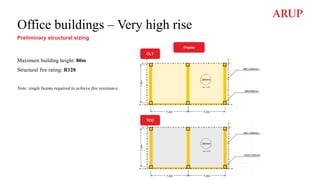
Office buildings – Very high rise
Preliminary structural sizing
Frame
CLT
TCC
Maximum building height: 80m
Structural fire rating: R120
Note: single beams required to achieve fire resistance.
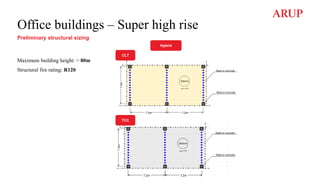
Office buildings – Super high rise
Preliminary structural sizing
Hybrid
CLT
TCC
Maximum building height: > 80m
Structural fire rating: R120
Structure
Public building structural framing
Public buildings
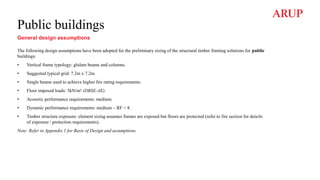
General design assumptions
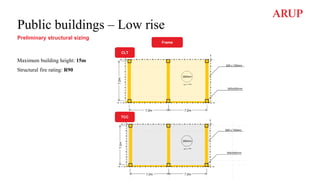
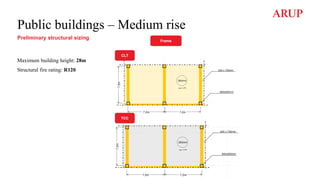
The following design assumptions have been adopted for the preliminary sizing of the structural timber framing solutions for public
buildings:
• Vertical frame typology: glulam beams and columns.
• Suggested typical grid: 7.2m x 7.2m.
• Single beams used to achieve higher fire rating requirements.
• Floor imposed loads: 5kN/m² (DBSE-AE).
• Acoustic performance requirements: medium.
• Dynamic performance requirements: medium – RF < 8.
• Timber structure exposure: element sizing assumes frames are exposed but floors are protected (refer to fire section for details
of exposure / protection requirements).
Note: Refer to Appendix 1 for Basis of Design and assumptions.
Public buildings – Low rise
Preliminary structural sizing
Frame
CLT
TCC
Maximum building height: 15m
Structural fire rating: R90
Public buildings – Medium rise
Preliminary structural sizing Frame
CLT
TCC
Maximum building height: 28m
Structural fire rating: R120
Façade
Timber Façade Systems
Timber façades systems
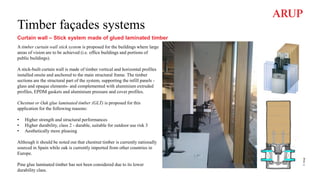
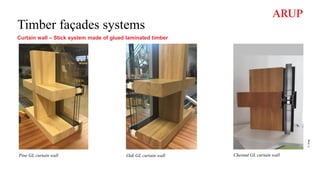
Curtain wall – Stick system made of glued laminated timber
A timber curtain wall stick system is proposed for the buildings where large
areas of vision are to be achieved (i.e. office buildings and portions of
public buildings).
A stick-built curtain wall is made of timber vertical and horizontal profiles
installed onsite and anchored to the main structural frame. The timber
sections are the structural part of the system, supporting the infill panels -
glass and opaque elements- and complemented with aluminium extruded
profiles, EPDM gaskets and aluminium pressure and cover profiles.
Chestnut or Oak glue laminated timber (GLT) is proposed for this
application for the following reasons:
• Higher strength and structural performances
• Higher durability, class 2 - durable, suitable for outdoor use risk 3
• Aesthetically more pleasing
Although it should be noted out that chestnut timber is currently nationally
sourced in Spain while oak is currently imported from other countries in
Europe.
Pine glue laminated timber has not been considered due to its lower
durability class.
©
Arup
Timber façades systems
Curtain wall – Stick system made of glued laminated timber
Pine GL curtain wall Oak GL curtain wall Chesnut GL curtain wall
©
Arup
Timber façades systems
Curtain wall – Stick system made of glued laminated timber
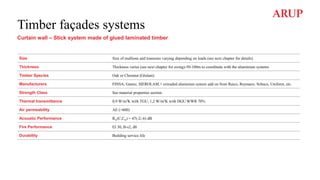
Size Size of mullions and transoms varying depending on loads (see next chapter for details)
Thickness Thickness varies (see next chapter for sizing)-50-100m to coordinate with the aluminium systems
Timber Species Oak or Chestnut (Glulam)
Manufacturers FINSA, Gamiz, SIEROLAM,+ extruded aluminiun system add on from Raico, Reynaers, Schuco, Uniform, etc.
Strength Class See material properties section.
Thermal transmittance 0,9 W/m2K with TGU, 1,2 W/m2K with DGU WWR 70%
Air permeability AE (>600)
Acoustic Performance Rw(C,Ctr) = 47(-2;-6) dB
Fire Performance EI 30, B-s2, d0
Durability Building service life
Timber façades systems
Curtain wall – Stick system made of glued laminated timber
Advantages
• Standard solution – easy to manufacture.
• Short period of design and fabrication.
• Installation can be done without tower cranes.
• Allows the generation of large areas of vision.
• Excellent durability if properly protected.
• Aesthetically pleasing.
Disadvantages
• Installation is made on site piece by piece and therefore is relatively
slow.
• Stick system requires scaffolding on site which may be difficult in
some cases.
• On-site installation is worse for quality control.
• Limited capacity for accommodation of differential vertical
movements between floors.
Timber façades systems
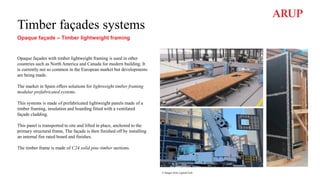
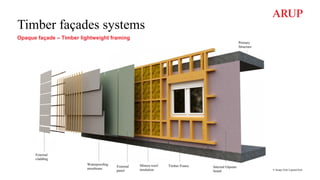
Opaque façade – Timber lightweight framing
Opaque façades with timber lightweight framing is used in other
countries such as North America and Canada for modern building. It
is currently not so common in the European market but developments
are being made.
The market in Spain offers solutions for lightweight timber framing
modular prefabricated systems.
This systems is made of prefabricated lightweight panels made of a
timber framing, insulation and boarding fitted with a ventilated
façade cladding.
This panel is transported to site and lifted in place, anchored to the
primary structural frame, The façade is then finished off by installing
an internal fire rated board and finishes.
The timber frame is made of C24 solid pine timber sections.
© Images from LignumTech
Timber façades systems
Opaque façade – Timber lightweight framing
© Image from LignumTech
Timber façades systems
Opaque façade – Timber lightweight framing
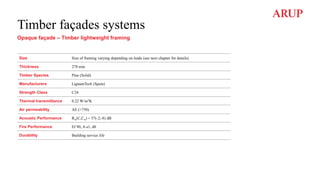
Size Size of framing varying depending on loads (see next chapter for details)
Thickness 278 min
Timber Species Pine (Solid)
Manufacturers LignumTech (Spain)
Strength Class C24
Thermal transmittance 0.22 W/m2K
Air permeability AE (>750)
Acoustic Performance Rw(C,Ctr) = 57(-2;-8) dB
Fire Performance EI 90, A-s1, d0
Durability Building service life
Timber façades systems
Opaque façade – Timber lightweight framing
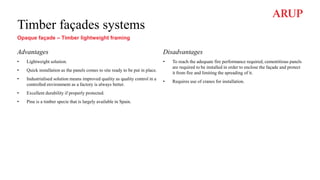
Advantages
• Lightweight solution.
• Quick installation as the panels comes to site ready to be put in place.
• Industrialised solution means improved quality as quality control in a
controlled environment as a factory is always better.
• Excellent durability if properly protected.
• Pine is a timber specie that is largely available in Spain.
Disadvantages
• To reach the adequate fire performance required, cementitious panels
are required to be installed in order to enclose the façade and protect
it from fire and limiting the spreading of it.
• Requires use of cranes for installation.
Timber façades systems
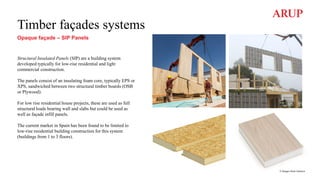
Opaque façade – SIP Panels
Structural Insulated Panels (SIP) are a building system
developed typically for low-rise residential and light
commercial construction.
The panels consist of an insulating foam core, typically EPS or
XPS, sandwiched between two structural timber boards (OSB
or Plywood).
For low rise residential house projects, these are used as full
structural loads bearing wall and slabs but could be used as
well as façade infill panels.
The current market in Spain has been found to be limited to
low-rise residential building construction for this system
(buildings from 1 to 3 floors).
© Images from Garnica
Timber façades systems
Opaque façade – SIP Panels
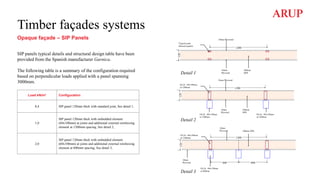
SIP panels typical details and structural design table have been
provided from the Spanish manufacturer Garnica.
The following table is a summary of the configuration required
based on perpendicular loads applied with a panel spanning
3000mm.
Load kN/m² Configuration
0,4 SIP panel 120mm thick with standard joint, See detail 1,
1,0
SIP panel 120mm thick with embedded element
(60x100mm) at joints and additional external reinforcing
element at 1200mm spacing, See detail 2,
2,0
SIP panel 120mm thick with embedded element
(60x100mm) at joints and additional external reinforcing
element at 600mm spacing, See detail 3,
Detail 1
Detail 2
Detail 3
Timber façades systems
Opaque façade – SIP Panels
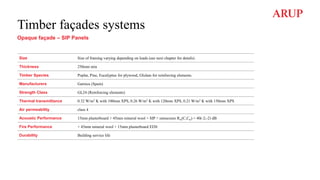
Size Size of framing varying depending on loads (see next chapter for details)
Thickness 250mm min
Timber Species Poplar, Pine, Eucalyptus for plywood, Glulam for reinforcing elements.
Manufacturers Garnica (Spain)
Strength Class GL24 (Reinforcing elements)
Thermal transmittance 0.32 W/m2 K with 100mm XPS, 0.26 W/m2 K with 120mm XPS, 0.21 W/m2 K with 150mm XPS
Air permeability class 4
Acoustic Performance 15mm plasterboard + 45mm mineral wool + SIP + rainscreen Rw(C,Ctr) = 40(-2;-2) dB
Fire Performance + 45mm mineral wool + 15mm plasterboard EI30
Durability Building service life
Timber façades systems
Opaque façade – SIP Panels
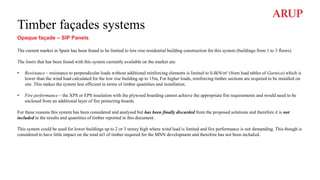
The current market in Spain has been found to be limited to low-rise residential building construction for this system (buildings from 1 to 3 floors).
The limits that has been found with this system currently available on the market are:
• Resistance – resistance to perpendicular loads without additional reinforcing elements is limited to 0,4kN/m² (from load tables of Garnica) which is
lower than the wind load calculated for the low rise building up to 15m, For higher loads, reinforcing timber sections are required to be installed on
site. This makes the system less efficient in terms of timber quantities and installation.
• Fire performance – the XPS or EPS insulation with the plywood boarding cannot achieve the appropriate fire requirements and would need to be
enclosed from an additional layer of fire protecting boards.
For these reasons this system has been considered and analysed but has been finally discarded from the proposed solutions and therefore it is not
included in the results and quantities of timber reported in this document.
This system could be used for lower buildings up to 2 or 3 storey high where wind load is limited and fire performance is not demanding. This though is
considered to have little impact on the total m3 of timber required for the MNN development and therefore has not been included.
Timber façades systems
Opaque façade – CLT Walls
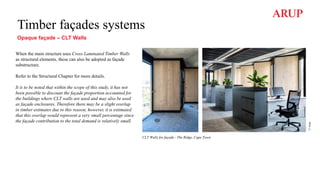
When the main structure uses Cross Laminated Timber Walls
as structural elements, these can also be adopted as façade
substructure.
Refer to the Structural Chapter for more details.
It is to be noted that within the scope of this study, it has not
been possible to discount the façade proportion accounted for
the buildings where CLT walls are used and may also be used
as façade enclosures. Therefore there may be a slight overlap
in timber estimates due to this reason, however, it is estimated
that this overlap would represent a very small percentage since
the façade contribution to the total demand is relatively small.
CLT Walls for façade - The Ridge, Cape Town
©
Arup
Façade
Timber Façade Typologies and Quantities
Building typologies and classification
Façade
The systems presented above have been applied to the different building typologies in the following manner in order to calculate the
total façade system timber demand:
• Office buildings: assumed to be clad 100% with timber curtain wall stick system. This is due to the typical requirement for
office buildings of natural light and openness toward the outside.
• Residential buildings: assumed to be clad 100% with lightweight timber frame prefabricated panels with varying
window/wall ratio (40/60, 50/50, 60/40). This is due to the energy performance requirements that limit the maximum U-value of
the envelope.
• Public buildings: can have different types of use and therefore have different façade requirements. This study assumes that these
façades would be a mix of timber curtain wall stick system and opaque lightweight timber frame panels. For estimating the timber
demand there is the option of choosing 25%, 50% or 75% of curtain wall system to be applied to the façade, the rest will be
made of lightweight timber frame system.
Note: Refer to Appendix 2 for Basis of Design and assumptions.
Façade
Office building façade system
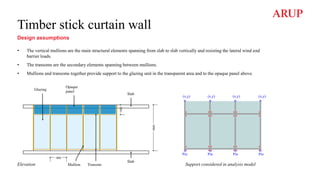
Timber stick curtain wall
Design assumptions
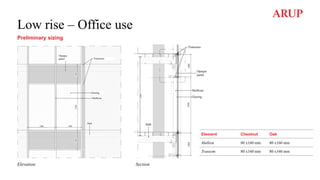
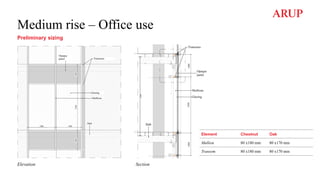
• The vertical mullions are the main structural elements spanning from slab to slab vertically and resisting the lateral wind and
barrier loads.
• The transoms are the secondary elements spanning between mullions.
• Mullions and transoms together provide support to the glazing unit in the transparent area and to the opaque panel above.
Elevation Support considered in analysis model
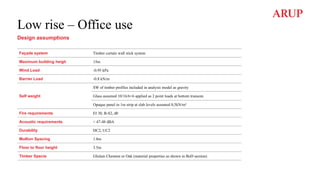
Low rise – Office use
Design assumptions
Façade system Timber curtain wall stick system
Maximum building heigh 15m
Wind Load -0.95 kPa
Barrier Load -0.8 kN/m
Self weight
SW of timber profiles included in analysis model as gravity
Glass assumed 10/16/6+6 applied as 2 point loads at bottom transom.
Opaque panel in 1m strip at slab levels assumed 0,5kN/m²
Fire requirements EI 30, B-S2, d0
Acoustic requirements < 47-48 dBA
Durability DC2, UC2
Mullion Spacing 1.8m
Floor to floor height 3.5m
Timber Specie Glulam Chestnut or Oak (material properties as shown in BoD section)
Low rise – Office use
Preliminary sizing
Elevation Section
Element Chestnut Oak
Mullion 80 x160 mm 80 x160 mm
Transom 80 x160 mm 80 x160 mm
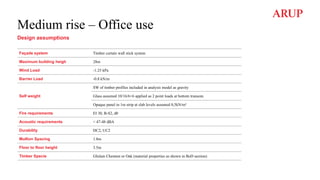
Medium rise – Office use
Design assumptions
Façade system Timber curtain wall stick system
Maximum building heigh 28m
Wind Load -1.25 kPa
Barrier Load -0.8 kN/m
Self weight
SW of timber profiles included in analysis model as gravity
Glass assumed 10/16/6+6 applied as 2 point loads at bottom transom.
Opaque panel in 1m strip at slab levels assumed 0,5kN/m²
Fire requirements EI 30, B-S2, d0
Acoustic requirements < 47-48 dBA
Durability DC2, UC2
Mullion Spacing 1.8m
Floor to floor height 3.5m
Timber Specie Glulam Chestnut or Oak (material properties as shown in BoD section)
Medium rise – Office use
Preliminary sizing
Elevation Section
Element Chestnut Oak
Mullion 80 x180 mm 80 x170 mm
Transom 80 x180 mm 80 x170 mm
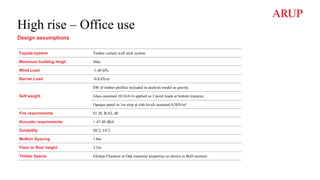
High rise – Office use
Design assumptions
Façade system Timber curtain wall stick system
Maximum building heigh 40m
Wind Load -1.40 kPa
Barrier Load -0.8 kN/m
Self weight
SW of timber profiles included in analysis model as gravity
Glass assumed 10/16/6+6 applied as 2 point loads at bottom transom.
Opaque panel in 1m strip at slab levels assumed 0,5kN/m²
Fire requirements EI 30, B-S2, d0
Acoustic requirements < 47-48 dBA
Durability DC2, UC2
Mullion Spacing 1.8m
Floor to floor height 3.5m
Timber Specie Glulam Chestnut or Oak (material properties as shown in BoD section)
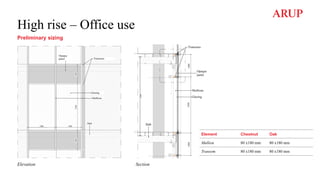
High rise – Office use
Preliminary sizing
Elevation Section
Element Chestnut Oak
Mullion 80 x180 mm 80 x180 mm
Transom 80 x180 mm 80 x180 mm
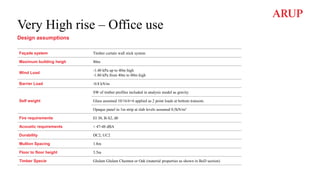
Very High rise – Office use
Design assumptions
Façade system Timber curtain wall stick system
Maximum building heigh 80m
Wind Load
-1.40 kPa up to 40m high
-1.80 kPa from 40m to 80m high
Barrier Load -0.8 kN/m
Self weight
SW of timber profiles included in analysis model as gravity
Glass assumed 10/16/6+6 applied as 2 point loads at bottom transom.
Opaque panel in 1m strip at slab levels assumed 0,5kN/m²
Fire requirements EI 30, B-S2, d0
Acoustic requirements < 47-48 dBA
Durability DC2, UC2
Mullion Spacing 1.8m
Floor to floor height 3.5m
Timber Specie Glulam Glulam Chestnut or Oak (material properties as shown in BoD section)
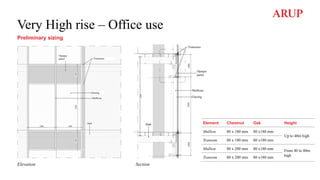
Very High rise – Office use
Preliminary sizing
Elevation Section
Element Chestnut Oak Height
Mullion 80 x 180 mm 80 x180 mm
Up to 40m high
Transom 80 x 180 mm 80 x180 mm
Mullion 80 x 200 mm 80 x180 mm From 40 to 80m
high
Transom 80 x 200 mm 80 x180 mm
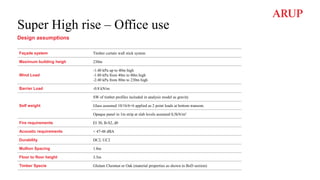
Super High rise – Office use
Design assumptions
Façade system Timber curtain wall stick system
Maximum building heigh 230m
Wind Load
-1.40 kPa up to 40m high
-1.80 kPa from 40m to 80m high
-2.40 kPa from 80m to 230m high
Barrier Load -0.8 kN/m
Self weight
SW of timber profiles included in analysis model as gravity
Glass assumed 10/16/6+6 applied as 2 point loads at bottom transom.
Opaque panel in 1m strip at slab levels assumed 0,5kN/m²
Fire requirements EI 30, B-S2, d0
Acoustic requirements < 47-48 dBA
Durability DC2, UC2
Mullion Spacing 1.8m
Floor to floor height 3.5m
Timber Specie Glulam Chestnut or Oak (material properties as shown in BoD section)
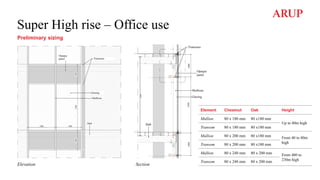
Super High rise – Office use
Preliminary sizing
Elevation Section
Element Chestnut Oak Height
Mullion 80 x 180 mm 80 x180 mm
Up to 40m high
Transom 80 x 180 mm 80 x180 mm
Mullion 80 x 200 mm 80 x180 mm From 40 to 80m
high
Transom 80 x 200 mm 80 x180 mm
Mullion 80 x 240 mm 80 x 200 mm From 480 to
230m high
Transom 80 x 240 mm 80 x 200 mm
Façade
Residential building façade system
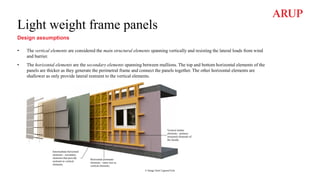
Light weight frame panels
Design assumptions
• The vertical elements are considered the main structural elements spanning vertically and resisting the lateral loads from wind
and barrier.
• The horizontal elements are the secondary elements spanning between mullions. The top and bottom horizontal elements of the
panels are thicker as they generate the perimetral frame and connect the panels together. The other horizontal elements are
shallower as only provide lateral restraint to the vertical elements.
© Image from LignumTech
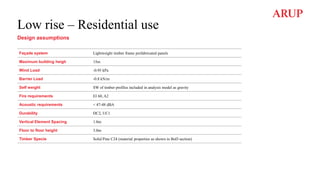
Low rise – Residential use
Design assumptions
Façade system Lightweight timber frame prefabricated panels
Maximum building heigh 15m
Wind Load -0.95 kPa
Barrier Load -0.8 kN/m
Self weight SW of timber profiles included in analysis model as gravity
Fire requirements EI 60, A2
Acoustic requirements < 47-48 dBA
Durability DC2, UC1
Vertical Element Spacing 1.0m
Floor to floor height 3.0m
Timber Specie Solid Pine C24 (material properties as shown in BoD section)
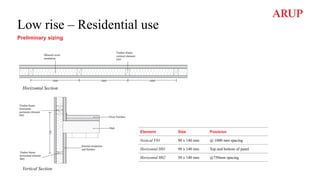
Low rise – Residential use
Preliminary sizing
Horizontal Section
Vertical Section
Element Size Posision
Vertical V01 90 x 140 mm @ 1000 mm spacing
Horizontal H01 90 x 140 mm Top and bottom of panel
Horizontal H02 50 x 140 mm @750mm spacing
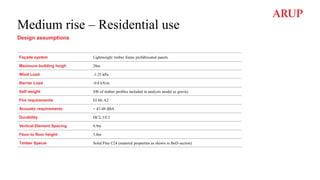
Medium rise – Residential use
Design assumptions
Façade system Lightweight timber frame prefabricated panels
Maximum building heigh 28m
Wind Load -1.25 kPa
Barrier Load -0.8 kN/m
Self weight SW of timber profiles included in analysis model as gravity
Fire requirements EI 60, A2
Acoustic requirements < 47-48 dBA
Durability DC2, UC1
Vertical Element Spacing 0.9m
Floor to floor height 3.0m
Timber Specie Solid Pine C24 (material properties as shown in BoD section)
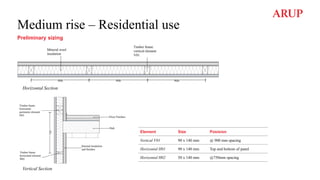
Medium rise – Residential use
Preliminary sizing
Horizontal Section
Vertical Section
Element Size Posision
Vertical V01 90 x 140 mm @ 900 mm spacing
Horizontal H01 90 x 140 mm Top and bottom of panel
Horizontal H02 50 x 140 mm @750mm spacing
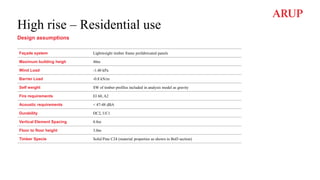
High rise – Residential use
Design assumptions
Façade system Lightweight timber frame prefabricated panels
Maximum building heigh 40m
Wind Load -1.40 kPa
Barrier Load -0.8 kN/m
Self weight SW of timber profiles included in analysis model as gravity
Fire requirements EI 60, A2
Acoustic requirements < 47-48 dBA
Durability DC2, UC1
Vertical Element Spacing 0.8m
Floor to floor height 3.0m
Timber Specie Solid Pine C24 (material properties as shown in BoD section)
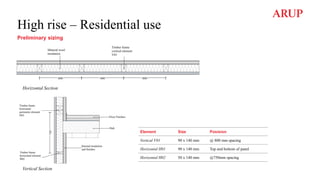
High rise – Residential use
Preliminary sizing
Horizontal Section
Vertical Section
Element Size Posision
Vertical V01 90 x 140 mm @ 800 mm spacing
Horizontal H01 90 x 140 mm Top and bottom of panel
Horizontal H02 50 x 140 mm @750mm spacing
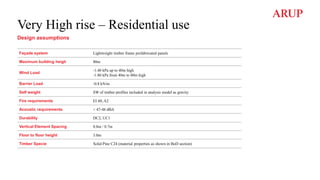
Very High rise – Residential use
Design assumptions
Façade system Lightweight timber frame prefabricated panels
Maximum building heigh 80m
Wind Load
-1.40 kPa up to 40m high
-1.80 kPa from 40m to 80m high
Barrier Load -0.8 kN/m
Self weight SW of timber profiles included in analysis model as gravity
Fire requirements EI 60, A2
Acoustic requirements < 47-48 dBA
Durability DC2, UC1
Vertical Element Spacing 0.8m / 0.7m
Floor to floor height 3.0m
Timber Specie Solid Pine C24 (material properties as shown in BoD section)
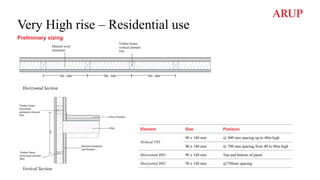
Very High rise – Residential use
Preliminary sizing
Horizontal Section
Vertical Section
Element Size Posision
Vertical V01
90 x 140 mm @ 800 mm spacing up to 40m high
90 x 140 mm @ 700 mm spacing from 40 to 80m high
Horizontal H01 90 x 140 mm Top and bottom of panel
Horizontal H02 50 x 140 mm @750mm spacing
Super High rise – Residential use
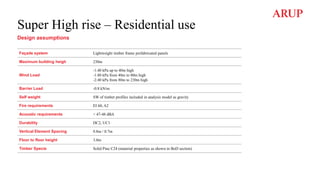
Design assumptions
Façade system Lightweight timber frame prefabricated panels
Maximum building heigh 230m
Wind Load
-1.40 kPa up to 40m high
-1.80 kPa from 40m to 80m high
-2.40 kPa from 80m to 230m high
Barrier Load -0.8 kN/m
Self weight SW of timber profiles included in analysis model as gravity
Fire requirements EI 60, A2
Acoustic requirements < 47-48 dBA
Durability DC2, UC1
Vertical Element Spacing 0.8m / 0.7m
Floor to floor height 3.0m
Timber Specie Solid Pine C24 (material properties as shown in BoD section)
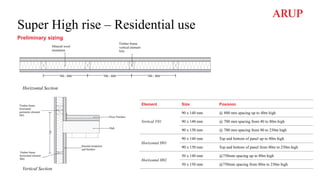
Super High rise – Residential use
Preliminary sizing
Horizontal Section
Vertical Section
Element Size Posision
Vertical V01
90 x 140 mm @ 800 mm spacing up to 40m high
90 x 140 mm @ 700 mm spacing from 40 to 80m high
90 x 150 mm @ 700 mm spacing from 80 to 230m high
Horizontal H01
90 x 140 mm Top and bottom of panel up to 80m high
90 x 150 mm Top and bottom of panel from 80m to 230m high
Horizontal H02
50 x 140 mm @750mm spacing up to 80m high
50 x 150 mm @750mm spacing from 80m to 230m high
Façade
Public building façade system
Public Buildings
Preliminary sizing
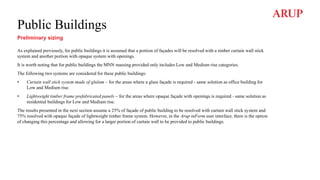
As explained previously, for public buildings it is assumed that a portion of façades will be resolved with a timber curtain wall stick
system and another portion with opaque system with openings.
It is worth noting that for public buildings the MNN massing provided only includes Low and Medium rise categories.
The following two systems are considered for these public buildings:
• Curtain wall stick system made of glulam – for the areas where a glass façade is required - same solution as office building for
Low and Medium rise.
• Lightweight timber frame prefabricated panels – for the areas where opaque façade with openings is required - same solution as
residential buildings for Low and Medium rise.
The results presented in the next section assume a 25% of façade of public building to be resolved with curtain wall stick system and
75% resolved with opaque façade of lightweight timber frame system. However, in the Arup inForm user interface, there is the option
of changing this percentage and allowing for a larger portion of curtain wall to be provided to public buildings.
Timber Demand Results
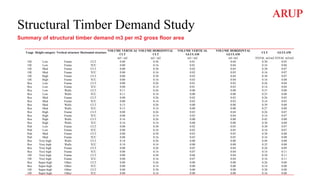
Structural Timber Demand Study
Usage Height category Vertical structure Horizontal structure
VOLUME VERTICAL
CLT
VOLUME HORIZONTAL
CLT
VOLUME VERTICAL
GLULAM
VOLUME HORIZONTAL
GLULAM
CLT GLULAM
m3 / m2 m3 / m2 m3 / m2 m3 /m2 TOTAL m3/m2 TOTAL m3/m2
Ofi Low Frame CLT 0.00 0.30 0.01 0.04 0.30 0.05
Ofi Low Frame TCC 0.00 0.16 0.01 0.04 0.16 0.06
Ofi Med Frame CLT 0.00 0.30 0.02 0.05 0.30 0.07
Ofi Med Frame TCC 0.00 0.16 0.02 0.05 0.16 0.07
Ofi High Frame CLT 0.00 0.30 0.03 0.04 0.30 0.07
Ofi High Frame TCC 0.00 0.16 0.03 0.04 0.16 0.08
Res Low Frame CLT 0.00 0.26 0.01 0.02 0.26 0.04
Res Low Frame TCC 0.00 0.14 0.01 0.03 0.14 0.04
Res Low Walls CLT 0.11 0.26 0.00 0.00 0.37 0.00
Res Low Walls TCC 0.11 0.14 0.00 0.00 0.25 0.00
Res Med Frame CLT 0.00 0.26 0.02 0.03 0.26 0.05
Res Med Frame TCC 0.00 0.14 0.02 0.03 0.14 0.05
Res Med Walls CLT 0.13 0.26 0.00 0.00 0.39 0.00
Res Med Walls TCC 0.13 0.14 0.00 0.00 0.27 0.00
Res High Frame CLT 0.00 0.26 0.03 0.04 0.26 0.07
Res High Frame TCC 0.00 0.14 0.03 0.04 0.14 0.07
Res High Walls CLT 0.16 0.26 0.00 0.00 0.42 0.00
Res High Walls TCC 0.16 0.14 0.00 0.00 0.30 0.00
Pub Low Frame CLT 0.00 0.30 0.02 0.05 0.30 0.07
Pub Low Frame TCC 0.00 0.16 0.02 0.05 0.16 0.07
Pub Med Frame CLT 0.00 0.30 0.03 0.05 0.30 0.08
Pub Med Frame TCC 0.00 0.16 0.03 0.05 0.16 0.08
Res Very high Walls CLT 0.18 0.26 0.00 0.00 0.44 0.00
Res Very high Walls TCC 0.18 0.14 0.00 0.00 0.32 0.00
Res Very high Frame CLT 0.00 0.26 0.05 0.04 0.26 0.09
Res Very high Frame TCC 0.00 0.14 0.07 0.04 0.14 0.11
Ofi Very high Frame CLT 0.00 0.30 0.06 0.04 0.30 0.11
Ofi Very high Frame TCC 0.00 0.16 0.07 0.04 0.16 0.11
Res Super-high Other CLT 0.00 0.26 0.00 0.00 0.26 0.00
Res Super-high Other TCC 0.00 0.14 0.00 0.00 0.14 0.00
Ofi Super-high Other CLT 0.00 0.30 0.00 0.00 0.30 0.00
Ofi Super-high Other TCC 0.00 0.16 0.00 0.00 0.16 0.00
Summary of structural timber demand m3 per m2 gross floor area
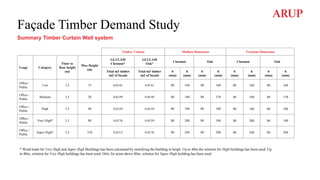
Façade Timber Demand Study
Summary Timber Curtain Wall system
Timber Volume Mullion Dimension Transom Dimension
Usage Category
Floor to
floor height
(m)
Max Height
(m)
GLULAM
Chestnut*
GLULAM
Oak*
Chestnut Oak Chestnut Oak
Total m3 timber
/m2 of facade
Total m3 timber
/m2 of facade
b
(mm)
h
(mm)
b
(mm)
h
(mm)
b
(mm)
h
(mm)
b
(mm)
h
(mm)
Office /
Public
Low 3,5 15 0.0141 0.0141 80 160 80 160 80 160 80 160
Office /
Public
Medium 3,5 28 0.0159 0.0150 80 180 80 170 80 180 80 170
Office /
Public
High 3,5 40 0.0159 0.0159 80 180 80 180 80 180 80 180
Office /
Public
Very High* 3,5 80 0.0176 0.0159 80 200 80 180 80 200 80 180
Office /
Public
Super High* 3,5 230 0.0212 0.0176 80 240 80 200 80 240 80 200
* Wind loads for Very High and Super High Buildings has been calculated by stratifying the building in heigh. Up to 40m the solution for High buildings has been used. Up
to 80m, solution for Very High buildings has been used. Only for areas above 80m, solution for Super High building has been used.
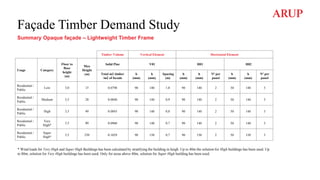
Façade Timber Demand Study
Summary Opaque façade – Lightweight Timber Frame
Timber Volume Vertical Element Horizontal Element
Usage Category
Floor to
floor
height
(m)
Max
Height
(m)
Solid Pine V01 H01 H02
Total m3 timber
/m2 of facade
b
(mm)
h
(mm)
Spacing
(m)
b
(mm)
h
(mm)
Nº per
panel
b
(mm)
h
(mm)
Nº per
panel
Residential /
Public
Low 3,0 15 0.0798 90 140 1,0 90 140 2 50 140 3
Residential /
Public
Medium 3,5 28 0.0840 90 140 0,9 90 140 2 50 140 3
Residential /
Public
High 3,5 40 0.0893 90 140 0,8 90 140 2 50 140 3
Residential /
Public
Very
High*
3,5 80 0.0960 90 140 0,7 90 140 2 50 140 3
Residential /
Public
Super
High*
3,5 230 0.1029 90 150 0,7 90 150 2 50 150 3
* Wind loads for Very High and Super High Buildings has been calculated by stratifying the building in heigh. Up to 40m the solution for High buildings has been used. Up
to 80m, solution for Very High buildings has been used. Only for areas above 80m, solution for Super High building has been used.
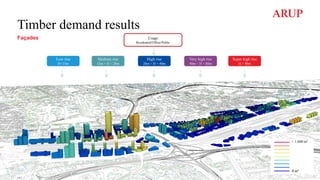
Timber demand results
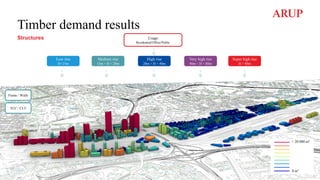
Low rise
H<15m
Medium rise
15m < H < 28m
High rise
28m < H < 40m
Very high rise
40m < H < 80m
Super high rise
H > 80m
Usage
Residential/Office/Public
> 20.000 m3
0 m3
TCC / CLT
Frame / Walls
Structures
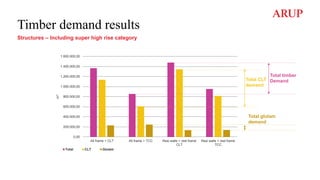
0,00
200.000,00
400.000,00
600.000,00
800.000,00
1.000.000,00
1.200.000,00
1.400.000,00
1.600.000,00
All frame + CLT All frame + TCC Resi walls + rest frame
CLT
Resi walls + rest frame
TCC
m
3
Total CLT Glulam
Total timber
Demand
Total glulam
demand
Total CLT
demand
Timber demand results
Structures – Including super high rise category
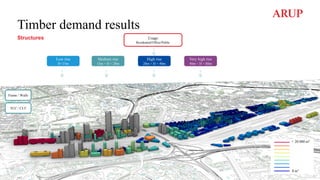
Low rise
H<15m
Medium rise
15m < H < 28m
High rise
28m < H < 40m
Very high rise
40m < H < 80m
Usage
Residential/Office/Public
> 20.000 m3
0 m3
TCC / CLT
Frame / Walls
Timber demand results
Structures
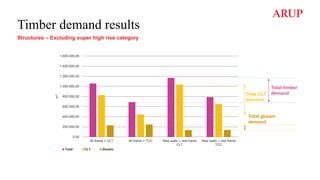
0,00
200.000,00
400.000,00
600.000,00
800.000,00
1.000.000,00
1.200.000,00
1.400.000,00
1.600.000,00
All frame + CLT All frame + TCC Resi walls + rest frame
CLT
Resi walls + rest frame
TCC
m
3
Total CLT Glulam
Total timber
demand
Total glulam
demand
Total CLT
demand
Timber demand results
Structures – Excluding super high rise category
> 1.600 m3
0 m3
Low rise
H<15m
Medium rise
15m < H < 28m
High rise
28m < H < 40m
Very high rise
40m < H < 80m
Super high rise
H > 80m
Usage
Residential/Office/Public
0 m3
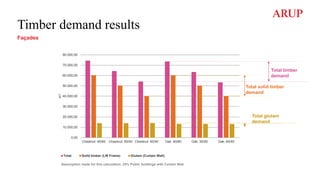
Timber demand results
Façades
0,00
10.000,00
20.000,00
30.000,00
40.000,00
50.000,00
60.000,00
70.000,00
80.000,00
Chestnut: 40/60 Chestnut: 50/50 Chestnut: 60/40 Oak: 40/60 Oak: 50/50 Oak: 60/40
m
3
Total Solid timber (LW Frame) Glulam (Curtain Wall)
Timber demand results
Total timber
demand
Total glulam
demand
Total solid timber
demand
Façades
Assumption made for this calculation: 25% Public buildings with Curtain Wall
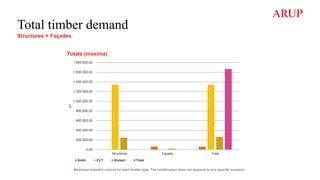
Total timber demand
0,00
200.000,00
400.000,00
600.000,00
800.000,00
1.000.000,00
1.200.000,00
1.400.000,00
1.600.000,00
1.800.000,00
Structures Façade Total
m
3
Totals (maxima)
Solid CLT Glulam Total
Structures + Façades
Maximum possible volume for each timber type. The combination does not respond to any specific scenario.
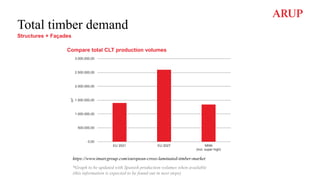
Total timber demand
0,00
500.000,00
1.000.000,00
1.500.000,00
2.000.000,00
2.500.000,00
3.000.000,00
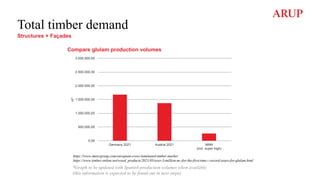
EU 2021 EU 2027 MNN
(incl. super high)
m
3
Compare total CLT production volumes
https://www.imarcgroup.com/european-cross-laminated-timber-market
Structures + Façades
*Graph to be updated with Spanish production volumes when available
(this information is expected to be found out in next steps)
0,00
500.000,00
1.000.000,00
1.500.000,00
2.000.000,00
2.500.000,00
3.000.000,00
Germany 2021 Austria 2021 MNN
(incl. super high)
m
3
Compare glulam production volumes
Total timber demand
https://www.imarcgroup.com/european-cross-laminated-timber-market
https://www.timber-online.net/wood_products/2021/05/over-3-million-m--for-the-first-time---record-years-for-glulam.html
Structures + Façades
*Graph to be updated with Spanish production volumes when available
(this information is expected to be found out in next steps)
Arup inForm
Result Viewer Guidance
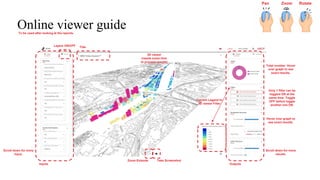
Online viewer guide
Pan Zoom Rotate
Inputs Outputs
Title
Zoom Extends Take Screenshot
Current Legend to
3D viewer Filter
3D viewer
(needs some time
to process results)
Only 1 filter can be
toggled ON at the
same time. Toggle
OFF before toggle
another one ON.
Total number. Hover
over graph to see
exact results.
Hover over graph to
see exact results.
Scroll down for more
results.
Scroll down for more
input.
Layers ON/OFF
To be used after looking at the reports.
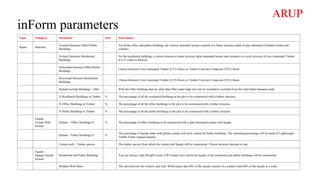
inForm parameters
Type Category Parameter Unit Description
Inputs Structure
Vertical Structure Office/Public
Buildings
-
For all the office and public buildings, the vertical structural system consists of a frame structure made of glue laminated (Glulam) beams and
columns.
Vertical Structure Residential
Buildings
-
For the residential buildings, a choice between a frame structure (glue laminated beams and columns) or a wall structure (Cross Laminated Timber
(CLT) walls) is allowed.
Horizontal Structure Office/Public
Buildings
- Choose between Cross Laminated Timber (CLT) floors or Timber Concrete Composite (TCC) floors.
Horizontal Structure Residential
Buildings
- Choose between Cross Laminated Timber (CLT) floors or Timber Concrete Composite (TCC) floors.
Include/exclude Buildings > 80m - With this filter buildings that are taller than 80m (super high rise) can be included or excluded from the total timber demand study.
% Residential Buildings in Timber % The percentage of all the residential buildings in the plot to be constructed with a timber structure.
% Office Buildings in Timber % The percentage of all the office buildings in the plot to be constructed with a timber structure.
% Public Buildings in Timber % The percentage of all the public buildings in the plot to be constructed with a timber structure.
Façade –
Curtain Wall
System
Glulam – Office Buildings % % The percentage of office buildings to be constructed with a glue laminated curtain wall façade.
Glulam – Public Buildings % %
The percentage of façade made with glulam curtain wall stick system for Public buildings. The remaining percentage will be made of Lightweight
Timber Frame (opaque façade).
Curtain wall – Timber species - The timber species from which the curtain wall façade will be constructed. Choose between chestnut or oak.
Façade –
Opaque Façade
System
Residential and Public Buildings - You can choose Light Weight Frame (LW Frame) from which the façade of the residential and public buildings will be constructed.
Window/Wall Ratio - The ratio between the window and wall. 40/60 means that 40% of the façade consists of a window (and 60% of the façade is a wall).
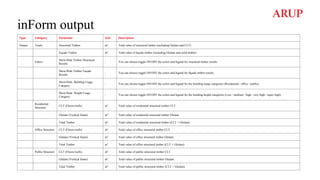
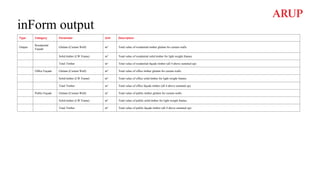
inForm output
Type Category Parameter Unit Description
Output Totals Structural Timber m3 Total value of structural timber (including Glulam and CLT)
Façade Timber m3 Total value of façade timber (including Glulam and solid timber)
Filters
Show/Hide Timber Structural
Results
- You can choose toggle ON/OFF the colors and legend for structural timber results.
Show/Hide Timber Façade
Results
- You can choose toggle ON/OFF the colors and legend for façade timber results.
Show/Hide Building Usage
Category
- You can choose toggle ON/OFF the colors and legend for the building usage categories (Residential / office / public)
Show/Hide Height Usage
Category
- You can choose toggle ON/OFF the colors and legend for the building height categories (Low / medium / high / very high / super high)
Residential
Structure
CLT (Floors/walls) m3 Total value of residential structural timber CLT.
Glulam (Vertical frame) m3 Total value of residential structural timber Glulam.
Total Timber m3 Total value of residential structural timber (CLT + Glulam).
Office Structure CLT (Floors/walls) m3 Total value of office structural timber CLT.
Glulam (Vertical frame) m3 Total value of office structural timber Glulam.
Total Timber m3 Total value of office structural timber (CLT + Glulam).
Public Structure CLT (Floors/walls) m3 Total value of public structural timber CLT.
Glulam (Vertical frame) m3 Total value of public structural timber Glulam.
Total Timber m3 Total value of public structural timber (CLT + Glulam).
inForm output
Type Category Parameter Unit Description
Output
Residential
Façade
Glulam (Curtain Wall) m3 Total value of residential timber glulam for curtain walls.
Solid timber (LW Frame) m3 Total value of residential solid timber for light weight frames.
Total Timber m3 Total value of residential façade timber (all 4 above summed up)
Office Façade Glulam (Curtain Wall) m3 Total value of office timber glulam for curtain walls.
Solid timber (LW Frame) m3 Total value of office solid timber for light weight frames.
Total Timber m3 Total value of office façade timber (all 4 above summed up)
Public Façade Glulam (Curtain Wall) m3 Total value of public timber glulam for curtain walls.
Solid timber (LW Frame) m3 Total value of public solid timber for light weight frames.
Total Timber m3 Total value of public façade timber (all 4 above summed up)
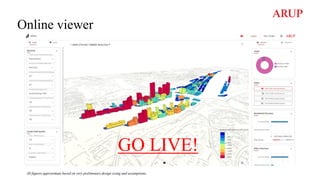
Online viewer
GO LIVE!
All figures approximate based on very preliminary design sizing and assumptions.
Additional information on viewer
If you see this, please refresh your page.
It takes some time to calculate all the timber numbers, please be patient. This
depends on the calculations in the background and on the internet speed.
If you have any questions regarding the interface, please contact us.
Project References
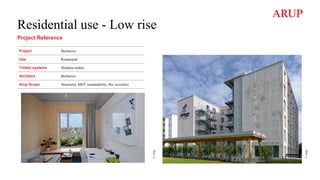
Residential use - Low rise
Project Reference
©
Arup
©
Arup
Project Berlinovo
Use Residential
Timber systems Modular timber
Architect Berlinovo
Arup Scope Structures, MEP, sustainability, fire, acoustics
Residential use - Low rise
Project Reference
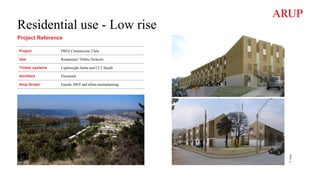
Project PRES Constitución, Chile
Use Residential / Public (School)
Timber systems Lightweight frame and CLT façade
Architect Elemental
Arup Scope Façade, MEP and urban masteplanning
©
Arup
Residential use - Medium rise
Project Reference
©
Images
by
LignumTech
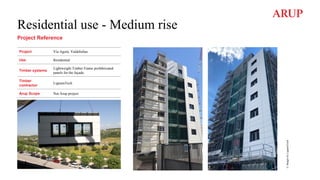
Project Via Agorá, Valdebebas
Use Residential
Timber systems
Lightweight Timber Frame prefabricated
panels for the façade.
Timber
contractor
LignumTech
Arup Scope Not Arup project
Residential use – High rise
Project Reference
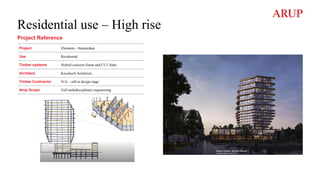
Project Elements - Amsterdam
Use Residential
Timber systems Hybrid concrete frame and CLT slabs
Architect Koschuch Architects
Timber Contractor N/A – still at design stage
Arup Scope Full multidisciplinary engineering
Residential use – High rise
Project Reference
©
Team
V
Architectuur
©
Arup
/
Team
V
Architectuur
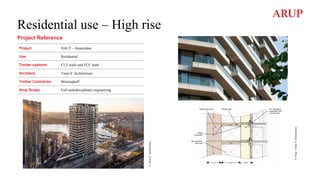
Project HAUT - Amsterdam
Use Residential
Timber systems CLT walls and TCC slabs
Architect Team V Architectuur
Timber Contractor Brüninghoff
Arup Scope Full multidisciplinary engineering
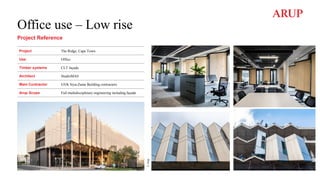
Office use – Low rise
Project Reference
Project The Ridge, Cape Town
Use Office
Timber systems CLT façade
Architect StudioMAS
Main Contractor GVK Siya-Zama Building contractors
Arup Scope Full multidisciplinary engineering including façade
©
Arup
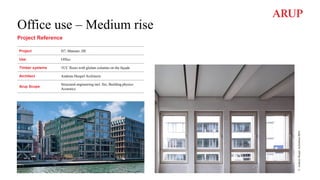
Office use – Medium rise
Project Reference
Project H7, Münster, DE
Use Office
Timber systems TCC floors with glulam columns on the façade
Architect Andreas Heupel Architects
Arup Scope
Structural engineering incl. fire, Building physics
Acoustics
©
Andreas
Heupel
Architekten
BDA
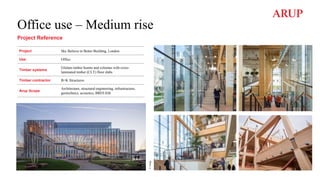
Office use – Medium rise
Project Reference
Project Sky Believe in Better Building, London
Use Office
Timber systems
Glulam timber beams and columns with cross-
laminated timber (CLT) floor slabs
Timber contractor B+K Structures
Arup Scope
Architecture, structural engineering, infrastructure,
geotechnics, acoustics, BREEAM
©
Arup
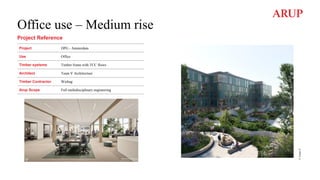
Office use – Medium rise
Project Reference
©
Team
V
Project DPG - Amsterdam
Use Office
Timber systems Timber frame with TCC floors
Architect Team V Architectuur
Timber Contractor Wiehag
Arup Scope Full multidisciplinary engineering
Office use – Medium rise
Project Reference
©
HK
Architeckten
©
HK
Architeckten
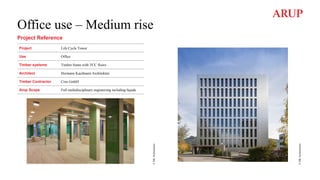
Project Life Cycle Tower
Use Office
Timber systems Timber frame with TCC floors
Architect Hermann Kaufmann Architekten
Timber Contractor Cree GmbH
Arup Scope Full multidisciplinary engineering including façade
Office use – Medium rise
Project Reference
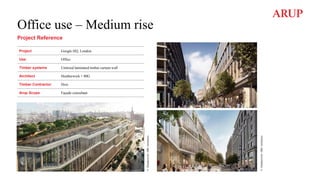
Project Google HQ, London
Use Office
Timber systems Unitized laminated timber curtain wall
Architect Heatherwick + BIG
Timber Contractor Hess
Arup Scope Façade consultant
©
Heatherwick
+BIG
Architects
©
Heatherwick
+BIG
Architects
Office use – Medium Rise
Project Reference
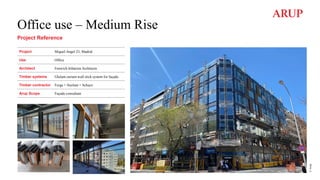
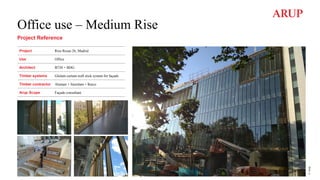
Project Miguel Angel 23, Madrid
Use Office
Architect Fenwich Iribarren Architects
Timber systems Glulam curtain wall stick system for façade.
Timber contractor Ferga + Sierlam + Schuco
Arup Scope Façade consultant
©
Arup
Office use – Medium Rise
Project Reference
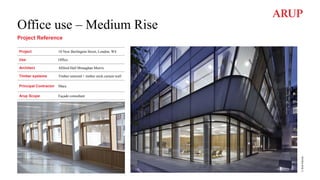
Project 10 New Burlington Street, London, W4
Use Office
Architect Allford Hall Monaghan Morris
Timber systems Timber unitized + timber stick curtain wall
Principal Contractor Mace
Arup Scope Façade consultant
©
Rob
Parrish
Office use – Medium Rise
Project Reference
Project Rios Rosas 26, Madrid
Use Office
Architect B720 + BDG
Timber systems Glulam curtain wall stick system for façade.
Timber contractor Aluman + Sierolam + Raico
Arup Scope Façade consultant
©
Arup
Public use – Low Rise
Project Reference
©
Arup
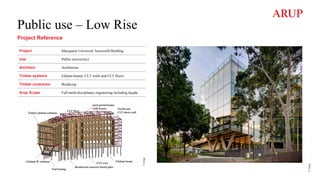
Project Macquarie University Ainsworth Building
Use Public (university)
Architect Architectus
Timber systems Glulam beams, CLT walls and CLT floors
Timber contractor Buildcorp
Arup Scope Full multi-disciplinary engineering including façade
©
Arup
Next Steps
Next steps
Following this study, the proposed next steps to identify opportunities for connecting timber producers and timber demand, as well as the projects
partners assigned to develop each task, are shown below:
• Develop decision framework for the demand side (investor, developer, designers) – Material Economics
• Data provision, participation and self-assessment of capacity to meet demand side requirements – Democratic Society
• Develop impact analysis for the timber supply chain (foresters, manufacturers, localities and regions) – Dark Matter Labs
• Finance and investment impact analysis for demand and supply side – Bankers without Boundaries
• Establish and grow municipal support – Universidad Politécnica de Madrid
• Explore policy and fiscal instruments for uptake of circular timber in buildings - Universidad Politécnica de Madrid
• Engage and activate a network of stakeholders – Democratic Society
Once the framework and mechanisms to boost timber construction are drafted, we suggest to:
• Develop pilot timber projects to push the development of the local construction sector and overcome barriers in public opinion
• Use the pilot projects to quantify the benefits of timber construction techniques in terms of embodied carbon reduction
Appendix 1
Structural basis of design
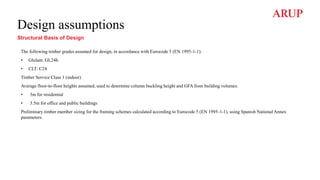
Design assumptions
Structural Basis of Design
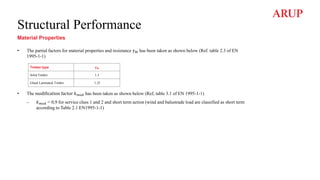
The following timber grades assumed for design, in accordance with Eurocode 5 (EN 1995-1-1):
• Glulam: GL24h
• CLT: C24
Timber Service Class 1 (indoor)
Average floor-to-floor heights assumed, used to determine column buckling height and GFA from building volumes:
• 3m for residential
• 3.5m for office and public buildings
Preliminary timber member sizing for the framing schemes calculated according to Eurocode 5 (EN 1995-1-1), using Spanish National Annex
parameters.
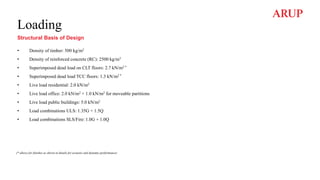
Loading
Structural Basis of Design
• Density of timber: 500 kg/m3
• Density of reinforced concrete (RC): 2500 kg/m3
• Superimposed dead load on CLT floors: 2.7 kN/m2 *
• Superimposed dead load TCC floors: 1.3 kN/m2 *
• Live load residential: 2.0 kN/m2
• Live load office: 2.0 kN/m2 + 1.0 kN/m2 for moveable partitions
• Live load public buildings: 5.0 kN/m2
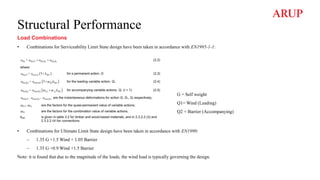
• Load combinations ULS: 1.35G + 1.5Q
• Load combinations SLS/Fire: 1.0G + 1.0Q
(* allows for finishes as shown in details for acoustic and dynamic performance)
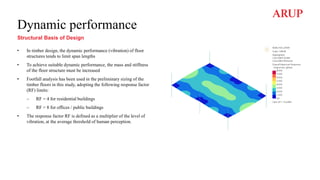
Dynamic performance
Structural Basis of Design
• In timber design, the dynamic performance (vibration) of floor
structures tends to limit span lengths
• To achieve suitable dynamic performance, the mass and stiffness
of the floor structure must be increased
• Footfall analysis has been used in the preliminary sizing of the
timber floors in this study, adopting the following response factor
(RF) limits:
– RF = 4 for residential buildings
– RF = 8 for offices / public buildings
• The response factor RF is defined as a multiplier of the level of
vibration, at the average threshold of human perception.
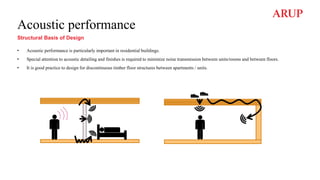
Acoustic performance
• Acoustic performance is particularly important in residential buildings.
• Special attention to acoustic detailing and finishes is required to minimize noise transmission between units/rooms and between floors.
• It is good practice to design for discontinuous timber floor structures between apartments / units.
Structural Basis of Design
Durability
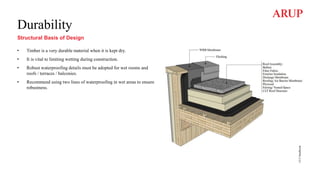
• Timber is a very durable material when it is kept dry.
• It is vital to limiting wetting during construction.
• Robust waterproofing details must be adopted for wet rooms and
roofs / terraces / balconies.
• Recommend using two lines of waterproofing in wet areas to ensure
robustness.
CLT
Handbook
Structural Basis of Design
Services integration strategy
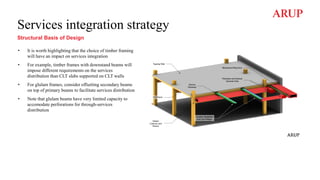
• It is worth highlighting that the choice of timber framing
will have an impact on services integration
• For example, timber frames with downstand beams will
impose different requirements on the services
distribution than CLT slabs supported on CLT walls
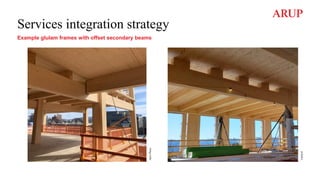
• For glulam frames, consider offsetting secondary beams
on top of primary beams to facilitate services distribution
• Note that glulam beams have very limited capacity to
accomodate perforations for through-services
distribution
Structural Basis of Design
Services integration strategy
Example glulam frames with offset secondary beams
Apex
Plaza
Catalyst
Fire safety
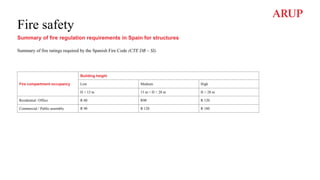
Summary of fire regulation requirements in Spain for structures
Summary of fire ratings required by the Spanish Fire Code (CTE DB – SI).
Fire compartment occupancy
Building height
Low Medium High
H < 15 m 15 m < H < 28 m H > 28 m
Residential / Office R 60 R90 R 120
Commercial / Public assembly R 90 R 120 R 180
Fire safety
Structure - Low rise
Residential buildings (< 15m)
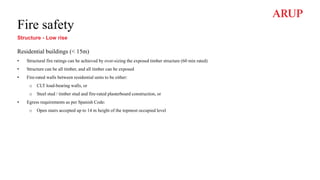
• Structural fire ratings can be achieved by over-sizing the exposed timber structure (60 min rated)
• Structure can be all timber, and all timber can be exposed
• Fire-rated walls between residential units to be either:
o CLT load-bearing walls, or
o Steel stud / timber stud and fire-rated plasterboard construction, or
• Egress requirements as per Spanish Code:
o Open stairs accepted up to 14 m height of the topmost occupied level
Fire safety
Strcture - Low rise
Office and commercial / public buildings (<15 m)
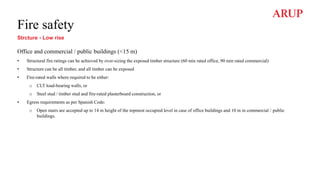
• Structural fire ratings can be achieved by over-sizing the exposed timber structure (60 min rated office, 90 min rated commercial)
• Structure can be all timber, and all timber can be exposed
• Fire-rated walls where required to be either:
o CLT load-bearing walls, or
o Steel stud / timber stud and fire-rated plasterboard construction, or
• Egress requirements as per Spanish Code:
o Open stairs are accepted up to 14 m height of the topmost occupied level in case of office buildings and 10 m in commercial / public
buildings.
Fire safety
Structure - Medium rise
Residential (15 m < H < 28 m)
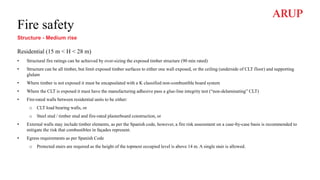
• Structural fire ratings can be achieved by over-sizing the exposed timber structure (90 min rated)
• Structure can be all timber, but limit exposed timber surfaces to either one wall exposed, or the ceiling (underside of CLT floor) and supporting
glulam
• Where timber is not exposed it must be encapsulated with a K classified non-combustible board system
• Where the CLT is exposed it must have the manufacturing adhesive pass a glue-line integrity test (“non-delaminating” CLT)
• Fire-rated walls between residential units to be either:
o CLT load bearing walls, or
o Steel stud / timber stud and fire-rated plasterboard construction, or
• External walls may include timber elements, as per the Spanish code, however, a fire risk assessment on a case-by-case basis is recommended to
mitigate the risk that combustibles in façades represent.
• Egress requirements as per Spanish Code
o Protected stairs are required as the height of the topmost occupied level is above 14 m. A single stair is allowed.
Fire safety
Structure - Medium rise
Office and commercial / public buildings (15 m < H < 28 m)
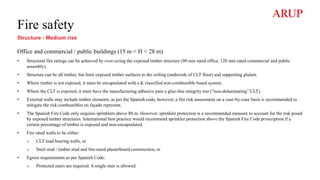
• Structural fire ratings can be achieved by over-sizing the exposed timber structure (90 min rated office, 120 min rated commercial and public
assembly).
• Structure can be all timber, but limit exposed timber surfaces to the ceiling (underside of CLT floor) and supporting glulam.
• Where timber is not exposed, it must be encapsulated with a K classified non-combustible board system.
• Where the CLT is exposed, it must have the manufacturing adhesive pass a glue-line integrity test (“non-delaminating” CLT).
• External walls may include timber elements, as per the Spanish code, however, a fire risk assessment on a case-by-case basis is recommended to
mitigate the risk combustibles on façade represent.
• The Spanish Fire Code only requires sprinklers above 80 m. However, sprinkler protection is a recommended measure to account for the risk posed
by exposed timber structures. International best practice would recommend sprinkler protection above the Spanish Fire Code prescription if a
certain percentage of timber is exposed and non-encapsulated.
• Fire rated walls to be either:
o CLT load bearing walls, or
o Steel stud / timber stud and fire-rated plasterboard construction, or
• Egress requirements as per Spanish Code:
o Protected stairs are required. A single stair is allowed.
Fire safety
Structure - High rise
Residential (H > 28 m)
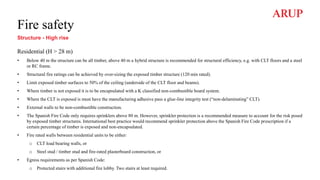
• Below 40 m the structure can be all timber, above 40 m a hybrid structure is recommended for structural efficiency, e.g. with CLT floors and a steel
or RC frame.
• Structural fire ratings can be achieved by over-sizing the exposed timber structure (120 min rated).
• Limit exposed timber surfaces to 50% of the ceiling (underside of the CLT floor and beams).
• Where timber is not exposed it is to be encapsulated with a K classified non-combustible board system.
• Where the CLT is exposed is must have the manufacturing adhesive pass a glue-line integrity test (“non-delaminating” CLT).
• External walls to be non-combustible construction.
• The Spanish Fire Code only requires sprinklers above 80 m. However, sprinkler protection is a recommended measure to account for the risk posed
by exposed timber structures. International best practice would recommend sprinkler protection above the Spanish Fire Code prescription if a
certain percentage of timber is exposed and non-encapsulated.
• Fire rated walls between residential units to be either:
o CLT load bearing walls, or
o Steel stud / timber stud and fire-rated plasterboard construction, or
• Egress requirements as per Spanish Code:
o Protected stairs with additional fire lobby. Two stairs at least required.
Fire safety
Structure - High rise
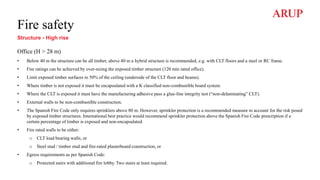
Office (H > 28 m)
• Below 40 m the structure can be all timber, above 40 m a hybrid structure is recommended, e.g. with CLT floors and a steel or RC frame.
• Fire ratings can be achieved by over-sizing the exposed timber structure (120 min rated office).
• Limit exposed timber surfaces to 50% of the ceiling (underside of the CLT floor and beams).
• Where timber is not exposed it must be encapsulated with a K classified non-combustible board system.
• Where the CLT is exposed it must have the manufacturing adhesive pass a glue-line integrity test (“non-delaminating” CLT).
• External walls to be non-combustible construction.
• The Spanish Fire Code only requires sprinklers above 80 m. However, sprinkler protection is a recommended measure to account for the risk posed
by exposed timber structures. International best practice would recommend sprinkler protection above the Spanish Fire Code prescription if a
certain percentage of timber is exposed and non-encapsulated.
• Fire rated walls to be either:
o CLT load bearing walls, or
o Steel stud / timber stud and fire-rated plasterboard construction, or
• Egress requirements as per Spanish Code:
o Protected stairs with additional fire lobby. Two stairs at least required.
Fire safety
Structure - High rise
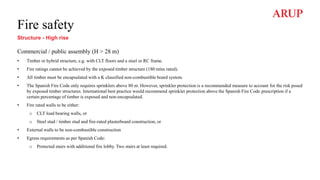
Commercial / public assembly (H > 28 m)
• Timber or hybrid structure, e.g. with CLT floors and a steel or RC frame.
• Fire ratings cannot be achieved by the exposed timber structure (180 mins rated).
• All timber must be encapsulated with a K classified non-combustible board system.
• The Spanish Fire Code only requires sprinklers above 80 m. However, sprinkler protection is a recommended measure to account for the risk posed
by exposed timber structures. International best practice would recommend sprinkler protection above the Spanish Fire Code prescription if a
certain percentage of timber is exposed and non-encapsulated.
• Fire rated walls to be either:
o CLT load bearing walls, or
o Steel stud / timber stud and fire-rated plasterboard construction, or
• External walls to be non-combustible construction
• Egress requirements as per Spanish Code:
o Protected stairs with additional fire lobby. Two stairs at least required.
Fire testing
Integrity and insulation requirements
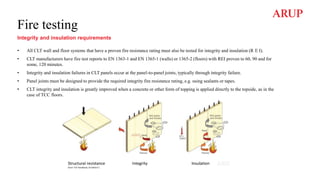
• All CLT wall and floor systems that have a proven fire resistance rating must also be tested for integrity and insulation (R E I).
• CLT manufacturers have fire test reports to EN 1363-1 and EN 1365-1 (walls) or 1365-2 (floors) with REI proven to 60, 90 and for
some, 120 minutes.
• Integrity and insulation failures in CLT panels occur at the panel-to-panel joints, typically through integrity failure.
• Panel joints must be designed to provide the required integrity fire resistance rating, e.g. using sealants or tapes.
• CLT integrity and insulation is greatly improved when a concrete or other form of topping is applied directly to the topside, as in the
case of TCC floors.
Fire testing
Fire rated connections and K classification
• CLT panel connections are tested by the CLT manufacturer as
part of their EN 1365 fire tests and must be specified in the
design as per the test.
• CLT panel connections fire resistance performance can also be
analysed by engineered methods where not supported by fire
testing.
• Glulam beam-to-beam, beam-to-column and column-to-column
connections are assessed through fire engineered analysis
methods, supported by fire testing.
• Fire ratings up to 120 mins have been proven through fire
testing for both CLT and glulam elements.
• Where timber is to be protected from fire the non-combustible board
coverings are classified through a specific fire test.
• Fire testing methodology and classification using EN 13501-2 with
testing to EN 14135.
• Referred to as a “K” fire-protection ability classification.
• Where a K60 classification is achieved, the board product prevents
the underlying timber from charring and being part of the fire for at
least 60 mins.
Fire testing
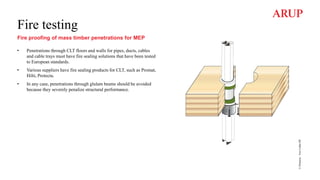
Fire proofing of mass timber penetrations for MEP
• Penetrations through CLT floors and walls for pipes, ducts, cables
and cable trays must have fire sealing solutions that have been tested
to European standards.
• Various suppliers have fire sealing products for CLT, such as Promat,
Hilti, Protecta.
• In any case, penetrations through glulam beams should be avoided
because they severely penalize structural performance.
©
Protecta
–
Fire
Collar
FR
Fire resistance
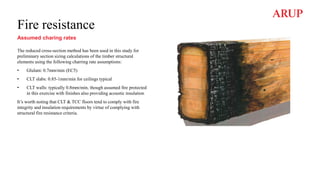
Assumed charing rates
The reduced cross-section method has been used in this study for
preliminary section sizing calculations of the timber structural
elements using the following charring rate assumptions:
• Glulam: 0.7mm/min (EC5)
• CLT slabs: 0.85-1mm/min for ceilings typical
• CLT walls: typically 0.8mm/min, though assumed fire protected
in this exercise with finishes also providing acoustic insulation
It’s worth noting that CLT & TCC floors tend to comply with fire
integrity and insulation requirements by virtue of complying with
structural fire resistance criteria.
Appendix 2
Façade basis of design
Structural Performance
Façade design assumptions
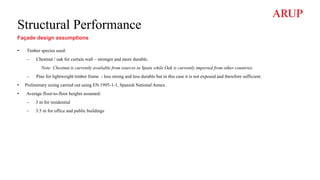
• Timber species used:
– Chestnut / oak for curtain wall – stronger and more durable.
Note: Chestnut is currently available from sources in Spain while Oak is currently imported from other countries.
– Pine for lightweight timber frame - less strong and less durable but in this case it is not exposed and therefore sufficient.
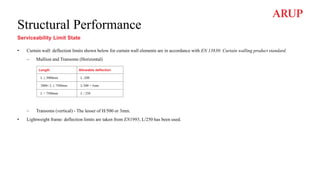
• Preliminary sizing carried out using EN 1995-1-1, Spanish National Annex.
• Average floor-to-floor heights assumed:
– 3 m for residential
– 3.5 m for office and public buildings
Structural Performance
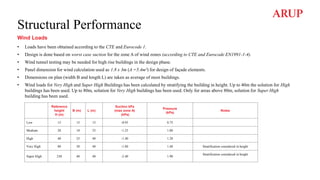
Wind Loads
• Loads have been obtained according to the CTE and Eurocode 1.
• Design is done based on worst case suction for the zone A of wind zones (according to CTE and Eurocode EN1991-1-4).
• Wind tunnel testing may be needed for high rise buildings in the design phase.
• Panel dimension for wind calculation used as 1.8 x 3m (A =5.4m²) for design of façade elements.
• Dimensions on plan (width B and length L) are taken as average of most buildings.
• Wind loads for Very High and Super High Buildings has been calculated by stratifying the building in height. Up to 40m the solution for High
buildings has been used. Up to 80m, solution for Very High buildings has been used. Only for areas above 80m, solution for Super High
building has been used.
Reference
height
H (m)
B (m) L (m)
Suction kPa
(max zone A)
(kPa)
Pressure
(kPa)
Notes
Low 15 15 15 -0.95 0.75
Medium 28 18 25 -1.25 1.00
High 40 25 40 -1.40 1.20
Very High 80 30 40 -1.80 1.40 Stratification considered in height
Super High 230 40 40 -2.40 1.90
Stratification considered in height
Structural Performance
Barrier Loads
• Loads have been obtained according to the CTE DBSE-AE.
Category of use Horizontal Line Load (kN/m) applied at 1,2m from FFL Notes
Residential (A1) 0.8
Office (B) 0.8
Public (A1-C1-C2-C3-C4-D) 0.8 /1.6*
Most of the areas will be zones of categories A1-C1-C2 and D
where the barrier load to be considered is 0.8kN/m.
For this study, 0.8kN/m is the value considered as only few
areas will be required to be C3 and C4 where the load of
1.6kN/m is required.
Structural Performance
Material Properties
• Material properties used in the timber façade calculations summarised in the following tables.
Property
Chestnut
Glulam *
Oak
Glulam *
Solid Pine
C24 from EN338
Characteristic bending strength - fm,k 30 MPa 33 MPa 24 MPa
Characteristic tensile strength
Parallel, ft,0,k
Perpendicular, ft,90,k
20 MPa
0.7 MPa
23 MPa
0.6 MPa
14.5 MPa
0.4 MPa
Characteristic compressive strength
Parallel, fc,0,k:
Perpendicular, fc,90,k
45 MPa
5.5 MPa
45 MPa
8.0 MPa
21 MPa
2.5 MPa
Characteristic shear strength - fv,k 5.0 MPa 4.0 MPa 4.0 MPa
Characteristic Modulus of elasticity
Mean parallel, E0,mean:
Mean perpendicular, E90,mean:
13000 MPa
1400 MPa
14400 Mpa
800 MPa
11000 MPa
370MPa
Shear Modulus
Mean, Gmean: 810 MPa 850 MPa 690 MPa
Characteristic density - ρk 520 kg/m3 690 kg/m3 350 kg/m3
* Properties based on manufacturer data sheets
Structural Performance
Material Properties
• The partial factors for material properties and resistance 𝛾𝑀 has been taken as shown below (Ref. table 2.3 of EN
1995-1-1)
Timber type 𝛄𝐌
Solid Timber 1.3
Glued Laminated Timber 1.25
• The modification factor 𝑘𝑚𝑜𝑑 has been taken as shown below (Ref, table 3.1 of EN 1995-1-1)
– 𝑘𝑚𝑜𝑑 = 0,9 for service class 1 and 2 and short term action (wind and balustrade load are classified as short term
according to Table 2.1 EN1995-1-1)
Structural Performance
Serviceability Limit State
• Curtain wall: deflection limits shown below for curtain wall elements are in accordance with EN 13830: Curtain walling product standard.
– Mullion and Transoms (Horizontal)
– Transoms (vertical) - The lesser of H/500 or 3mm.
• Lightweight frame: deflection limits are taken from EN1995, L/250 has been used.
Length Allowable deflection
L ≤ 3000mm L /200
3000< L ≤ 7500mm L/300 + 5mm
L > 7500mm L / 250
Structural Performance
Load Combinations
• Combinations for Ultimate Limit State design have been taken in accordance with EN1990:
– 1.35 G +1.5 Wind + 1.05 Barrier
– 1.35 G +0.9 Wind +1.5 Barrier
Note: it is found that due to the magnitude of the loads, the wind load is typically governing the design.
G = Self weight
Q1= Wind (Leading)
Q2 = Barrier (Accompanying)
• Combinations for Serviceability Limit State design have been taken in accordance with EN1995-1-1:
Energy Performance
Control of energy demand through the building envelope
According to the CTE DB HE 1, façades performance must ensure to limit energy demand to achieve comfort conditions in accordance with its
use - office buildings: with a high internal load, and residential buildings: with a low internal load – and the climatic conditions of the
environment – Madrid, climate zone D3:
• A minimum level of overall thermal insulation (K) and of the elements in contact with the exterior (Ulim), including thermal bridges
• Control of the air permeability of the elements (Q100 and n50)
• Limiting excess solar gains in summer (qsol,jul)
• Avoiding loss of internal heat (Ulim)
• Ensure that this performance is maintained over time by limiting interstitial condensation.
To fulfil the requirements set up by the local standards the quality of the façade systems presented in this report has been evaluated through two
parameters:
• the overall thermal transmittance (K)
• the permeability of the building (n50)
Although the solar control (qsol,jul) is the third parameter used to evaluated the quality of a façade, this parameter is outside the scope of the study
due to its relationship with the solar gains through the glazed areas.
In this report we will be focusing on the opaque areas of the façades.
The thermal transmittance (U) of each element belonging to the thermal envelope shall not exceed the limit value (Ulim) of the following table
3.1.1.a-CTE DB HE1
Thermal transmittance used in calculation for the different timber façade systems and other cladding types is summarised in the following table:
Energy Performance
Thermal transmittance of the building envelope for Madrid (Ulim) [W/m2K]
Cladding Winter climatic zone D [W/m2K]
Walls in contact with outside air (US, UM) 0.41
Windows (UH) 1.80
Roof (Us) 0.35
Floor in contact with soild (UT) 0.65
Cladding U [W/m2K]
Timber curtain wall (UM) 1.20
Windows (UH) in residential buldings 1.60
Ligthweigth frame (UM) 0.25
SIP (UM) 0.32
Roof (US) 0.15
Floor in contact with soild (UT) 0.15
Energy Performance
Overall heat transfer coefficient (K) [W/m2K]
Compacity
V/A [m3/m2]
New buildings
Winter climatic zone D [W/m2K]
Commercial building Residential building
V/A ≤ 1 0.54 0.48
V/A ≥ 4 0.70 0.67
The overall heat transmission coefficient through the building envelope (K) shall not exceed the limit value (Klim) obtained from table 3.1.1.b and C-
CTE DB HE1:
Compacity (V/A): Ratio of the volume enclosed by the thermal envelope (V) of the building (or part of the building) to the sum of the heat exchange
surfaces with the outside air (or part of the building) and the sum of the heat exchange surfaces with the outside air or ground of the building
envelope (A = ΣAi), of the thermal envelope (A = ΣAi). It is expressed in m³/m².
The overall heat transfer coefficient have been calculated for different scenarios of compacity and WWR:
• Office building V/A ≥ 4 – WWR 60 – 70 % (60% transparent area/ 40% opaque area; 70% transparent area/ 30% opaque area)
• Office building V/A ≤ 1 – WWR 50% (50% transparent area/ 50% opaque area)
• Residential building V/A ≥ 4 – WWR 40 – 50 - 60%
Energy Performance
Airtightness (Q 100,lim [m3/h,m2]) and Limitation of condensation
Two indicators are set to limit uncontrolled air flows through the envelope:
• The windows airtightness will be better than class 3, 9 m3 /h·m2, values according to UNE EN 12207:2017.
• The air change ratio through the thermal envelope of the building at a differential pressure of 50 Pa (n50) shall not exceed the limit value in table
3.1.3.b (HE1). The air change ratio will be checked by testing from method 1 or 2 of UNE-EN ISO 9972:2019 Thermal performance of buildings.
Q 100,lim [m3 /h·m2]
Airtightness (Q 100,lim) ≤ 9
Compacity V/A
[m3/m2]
Limit value of the air change ratio at a pressure of 50 Pa,
n50 [h-1 ]
V/A ≤ 2 6
V/A ≥ 4 3
• All façade systems have incorporated a vapor barrier on the warm side of the façade.
Acoustic Performance
According to the data obtained from the noise map ‘Mapa estratégico de ruido de Madrid 2016’, the buildings will be exposed to daytime noise level up
to 75 dBA.
CTE DB HR set up different noise attenuation requirements against traffic noise based on the daytime noise level, the building use and the WWR. The
following table shows the most demanding attenuation values against traffic noise that must provide the different façades:
Mapa estratégico de ruido de Madrid 2016
Grandes ejes A1 D05, Chamartín
Cladding RAtr [dBA]
Residential buildings- Façade 47-48
Residential buildings- Windows 55-60
Commercial buildings- CW 47-48
Fire Performance
External propagation
According the Spanish Fire Code CTE DB SI:
• To limit the external propagation between two fire compartments or towards a protected staircase, the points of the façade that are not EI60 fire
rated must be separated by a distance x as specified in the standard. Curtain wall and SIP façade systems do not have that fire rating so they should
be supplemented by proper fire rated systems.
• Material fire reaction class according with the building height summarised in the following table:
There is a difference between the allowable reaction to fire stipulated in the Spanish and Arup’s global advice to limit combustibles on facades. Arup’s
advice is to limit combustibility of any composite panels, cladding, façades, internal or external wall systems and associated core / filler / insulation
material and fixing system to fire reaction class A2.
Based on our experience in other countries and in anticipation of a possible upgrade in regulatory requirements, Arup advise that all façade
systems for MNN should achieve fire reaction class A2.
Fire reaction class
Building height
Low Medium High
H < 15 m 15 m < H < 28 m H > 28 m
Materials with a presence of more than 10%
of the façade area
C-s3, d0 B-s3, d0 A2-s3,d0
Insulation on the ventilated rain screen cavity B-s3, d0 B-s3, d0
A2-s3,d0
Fire Performance
Internal propagation
According the Spanish Fire Code CTE DB SI:
• All construction elements that are part of the interior of the façade must achieve at least reaction to fire class C-s2, d0 (UNE EN 13501).
To fulfil this requirement the façade system should include the following measures:
• Untreated glulam is reaction to fire class D-s2, d0 (EN 14080). Glulam can be treated to improve this fire rating to achieve a reaction to fire
behavior of B-s1, d0, i.e. a higher standard that the C-s2, d0 classification required by the code.
• The lightweight frames fulfil the CTE DB SI requirements, but penetrations for pipes, ducts, cables and cable should be avoided.
• SIP system must be clad with fire-rated solutions to achieve the required performance. As indicated in the previous section, the SIP system are only
be suitable for buildings up to 3 storeys high.
Durability
Glulam
Engineered timber is typically stronger and more durable than sawn timber. Glulam is an
engineered timber made from pine, oak, beech, ash, chestnut or iroko.
In this study we have selected oak and chestnut timber for the curtain wall system. These are
hardwoods suitable for structural use and external although protected use:
• Use class 2: Interior, possibility of water condensation (EN 350-1)
• Guaranteed 50 years (for service classes 1 and 2 EN 1995-1)
• Timber life 15-25 years (for durability class 2 EN 355)
• High dimensional stability (class A)
• High UV resistance
• High durability of coatings and treatments
Pine has not been selected for its use in the timber curtain wall system because it is class use 1,
this class use it is not suitable for wetting.
It is important to bear in mind use class 2 cannot be exposed to rain without treatment, this is an
important aspect to consider in the assembly phase of the curtain wall.
Durability
Timber selection must be suitable for the location, weather and environment. In order to ensure the correct timber is chosen, both the durability and use class
need to be considered.
The durability class is the ability of the timber of a given species to resist decay and infestation by insects. The durability of timber to the various wood
destroying organisms is classified within a five-grade scale for decay basidiomycete fungi and soft rotting micro-fungi (EN 335-1).
*Timber durability classes relate only to the heartwood of any species and not the sapwood which is considered Class 5, non-durable for all species of
timber.
The timber life should only be used as a guideline as local conditions and some of the factors discussed above can play a role in timber durability, however in
general, more durable timber species will last longer than less durable species of timber
Durability class * Description Timber life (guideline)
DC 1 Very durable 25 +
DC 2 Durable 15 - 25
DC 3 Moderately durable 10 - 15
DC 4 Slightly durable 5 - 10
DC 5 Non durable 0 – 5
Durability
The concept of use class is related to the likelihood of a structural element to be attacked by biotic agents and is mainly a function of the degree of
humidity it will reach during its service life. The differences between the use classes are based on differences in environment exposures that can make
the wood or wood-based products susceptible to biological deterioration (EN 355-1).
There is an intrinsic relationship between moisture content and the performance of timber, as wood is a naturally hydroscopic material. This means
moisture will have an impact on the durability of any wooden product. For this reason, timber shall be protected in accordance with the class of use to
which they belong and as defined.
Use classes Situation
UC 1
Inside a construction
Not exposed to the weather and wetting
UC 2
Cover and not exposed to the weather.
Occasional, but not persistent, wetting can occur
UC 3.1
Above ground and exposed to the weather
Products will not remain wet for long periods
UC 3.2
Above ground and exposed to the weather
Products will remain wet for long periods
UC 4 Product is in direct contact with ground and/or fresh water
UC 5 Product is permanently or regularly submerged in salt water
Durability
Some timber carries natural resistance to water while others require treatment if they are to be directly exposed to it. The aim of preventive wood protection
is to keep the likelihood of damage from these sources at an acceptable level. Preservative treatment provides natural wood with additional durability.
However, not all treated wood is the same, the level of preservative protection could be very different. Two main types of treatment processes exist, these are
high pressure and low pressure.
• High Pressure vacuum treatment: good for getting timber suitable for external use and it can provide the timber with a 15-60 year service life.
• Double vacuum low pressure treatment: for use classes 1, 2 and 3.1 (Coated) and can deliver a service life between 30-60 years service life.
Timber Demand Study Report. Structures and façade - HCC EU CINCO

Timber Demand Study Report. Structures and façade - HCC EU CINCO

  • 1.
    Timber demand study- Madrid Nuevo Norte Structures and façade 5th of August 2022
  • 2.
    Index Timber Demand StudyMNN Introduction Scope of study General assumptions Glossary MNN building typologies and classification Timber demand study workflow Structure Timber structural system Residential building structural framing Office building structural framing Public building structural framing Façade Timber façade systems Timber façade typologies and quantities Office building façade system Residential building façade system Public building façade system Timber demand results Arup inForm result viewer guidance Project references Next steps Appendix 1: structural basis of design Appendix 2: façade basis of design
  • 3.
  • 4.
    Introduction Timber Demand StudyMadrid Nuevo Norte (MNN) This study has been carried out as part of the European Cities for climate-Neutral Construction - Bio-based and circular buildings project in Madrid and Milan (EU CINCO), sponsored by Laudes Foundation. This project lies within the framework of Climate-KIC’s Deep Demonstration programme Healthy, Clean Cities (HCC), which seeks to reduce embodied carbon in buildings and infrastructure through bio-based and circular strategies. It aims to decarbonise the construction sector to contribute to the EU climate neutrality targets, and to identify and explore options for intervening in the entire value chain of materials throughout their whole-life cycle, aligning and coordinating innovative decision-making processes from several interdisciplinary stakeholders at once. Based on feedback from interviews with different agents of the timber sector in recent months, such as manufacturers, producers, associations, etc., a series of barriers and opportunities have been identified related to greater adoption of timber in Spanish construction. One of the keys to promoting the production and use of construction-grade timber in Spain is guaranteeing a stable demand and supply of raw materials. This action is strongly conditioned by forest growth times; therefore, the promotion of a local timber market is a medium-term task. Distrito Castellana Norte (DCN) has positioned itself as a driver for change. A clear commitment to the use of timber in construction might help guarantee the stability of supply during the extensive Madrid Nuevo Norte (MMN) building construction stage, which is planned to span 20 years, from 2025 to 2045. A set of actions has therefore been proposed to identify opportunities for connection between timber producers and potential timber demand based on simulating the adoption of timber construction at scale on MNN. The first action proposed is to estimate the potential demand for timber in the MNN masterplan in order to establish supply needs in an idealized scenario of timber-based construction. This study aims to achieve this by simulating the maximum volume of timber demand for the structures and façades for the different building typologies based on the current MNN building massing provided by DCN.
  • 5.
  • 6.
    Scope of study TimberDemand Study MNN The scope of this study involves simulating maximum technically and economically reasonable timber demand for the structure and façades of the buildings that form part of the Madrid Nuevo Norte masterplan. For the structure, the study proposes vertical and horizontal framing options for each of the building height and use categories identified in the building massing, in order to extract global structural timber quantity estimates. For the façades, different systems are presented and proposals for each building heigh and use category are provided, including with pre-sizing of timber elements to estimate the volume of timber demand for the facades of the buildings included in the masterplan. In order to carry out these simulation studies, several assumptions have been made, as described in the following section of this report and in the basis of design appendices. All quantity figures derived in this study are based on high-level estimates and preliminary sizing of timber elements, therefore they should only be considered as very approximate. The demand results summarized in the output section of this report should be interpreted as orders of magnitude, rather than definitive quantities.
  • 7.
  • 8.
    General assumptions Timber DemandStudy MNN The following general assumptions have been made for this structural timber study: • The Madrid Nuevo Norte (MNN) massing model used is as provided by Distrito Castellana Norte (DCN) • The stability system for each building is assumed to be provided by reinforced concrete (RC) cores or steel bracing, i.e. excluded from this timber study. If timber structures were to be used for the stability systems of some of the buildings (e.g. low/medium rise), the impact on the total timber demand would be relatively small. • Interpretation of “commercial use” in the use categories provided: assumed retail capacity at ground floor level contained in “podium” type structures that would not be in timber, therefore not considered in the scope of this study. • Constant typical grids have been assumed all the way up the building for the typical frame sizing. Any significant grid transfers would require different materials, i.e. steel or concrete. • The timber framing proposals put forward in this study are based on maximizing the use of structural timber where reasonable to do so, in order to establish maximum demand figures. In reality, many different factors that are not considered in this study will affect the final choice of structure and façade materials for each individual building. • Basements have not been considered in the scope of this study. The heights of the buildings have been assumed from the base of the modelled volumes in the MNN massing data provided. • This study assumes that all timber will be sourced from FSC or PEFC certified suppliers, or equivalent, to guarantee sustainable sourcing.
  • 9.
  • 10.
    Glossary The following abbreviationsare used in this report • Glulam: Glue Laminated Timber • CLT: Cross-Laminated Timber • TCC: Timber Concrete Composite • MNN: Madrid Nuevo Norte • DCN: Distrito Castellana Norte • RC: Reinforced Concrete • ULS: Ultimate Limit State • SLS: Serviceability Limit State • GFA: Gross Floor Area • EC5: Eurocode 5 • SIP: Structural Insulated Panels • CTE: Código Técnico de la Edificación • EPS: Expanded Polystyrene Insulation • XPS: Extruded Polystyrene Insulation • TGU: Triple Glass Unit • DGU: Double Glass Unit • OSB: Oriented Strand Board • WWR: Window Wall Ratio • EPDM: Ethylene-Propylene Diene Monomer • BoD: Basis of Design
  • 11.
    MNN building typologiesand classification
  • 12.
    Building typologies andclassification Classification depending on height Building height category Number of floors (approximate) Max height (m) Structural frame Façade system 1. Low rise 1 - 5 15 Timber Varying depending on use 2. Medium rise 5 - 9 28 Timber Varying depending on use 3. High rise 9 - 13 40 Timber Varying depending on use 4. Very high rise 13 - 26 80 Timber or Hybrid* Varying depending on use 5. Super high rise 26 - 100 230 Hybrid (timber only in floors) Varying depending on use (* full timber frame may be possible, but hybrid structure likely most efficient solution for buildings taller than 40m)
  • 13.
    Building typologies andclassification Usage Residential/Office/Public Number of buildings depending on use
  • 14.
    Building typologies andclassification Low rise H<15m Medium rise 15m < H < 28m High rise 28m < H < 40m Very high rise 40m < H < 80m Super high rise H > 80m Usage Residential/Office/Public Number of buildings depending on height classification
  • 15.
    Building typologies andclassification Low rise H<15m Medium rise 15m < H < 28m High rise 28m < H < 40m Very high rise 40m < H < 80m Super high rise H > 80m Residential buildings Number of buildings depending on use and height classification
  • 16.
    Building typologies andclassification Low rise H<15m Medium rise 15m < H < 28m High rise 28m < H < 40m Very high rise 40m < H < 80m Super high rise H > 80m Office buildings Number of buildings depending on use and height classification
  • 17.
    Building typologies andclassification Low rise H<15m Medium rise 15m < H < 28m Public buildings Number of buildings depending on use and height classification
  • 18.
  • 19.
    Timber demand studyworkflow Usage + Height Category + Vertical system + Horizontal system Eurocode section sizing and vibration models Received 3D model Quantities per typology. See appendix. Calculation of timber quantities Input Calculations Results Structure
  • 20.
    Timber demand studyworkflow Usage + Height Category + Loads +WWR + Façade system Analysis models and Eurocode section design Received 3D model Quantities per typology. See summary. Calculation of timber quantities Input Calculations Results Façade
  • 21.
  • 22.
    Floor systems CLT floors Advantages •Shallow floor depth • Prefabrication • Speed of construction Disadvantages • Acoustic performance – requires insulation and special detailing • Dynamic performance – limited spans
  • 23.
    Floor systems Timber ConcreteComposite floors Advantages • Longer spans • Improved acoustic performance • Improved dynamic performance • Improved fire performance Disadvantages • Some on-site concrete pouring required • Heavier construction • Higher eCO2 © KLH
  • 24.
    Floor systems Timber cassettefloors Advantages • Lighter floors • Prefabrication • Speed of construction Disadvantages • Acoustic performance – requires insulation and special detailing • Dynamic performance – limits spans • Manufacturer dependent, reliant on bespoke systems © Metsä Wood – Kerto-Ripa
  • 25.
    Example details Structural systems Glulambeam & column frame Example framing © Arup © Arup
  • 26.
    Structural systems Glulam beam& column frame Advantages • Flexible grid • Flexible internal layouts • Maximize use of internal spaces • Short lead-in times • Ease of transport • Easy to dismantle Disadvantages • Relatively large section sizes • Increased floor depth (downstand beams) • Services coordination • Construction height limited by column capacity / section sizes and fire requirements
  • 27.
    Structural systems CLT walls Exampleframing Example details © Arup © Arup
  • 28.
    Structural systems CLT walls Advantages •No downstand elements - reduced floor depth • Ease of services distribution • Distributed supports - higher construction possible • Prefabrication Disadvantages • Shorter spans • Smaller internal spaces • Reduced internal flexibility • Transport limitations can affect geometry • Construction height limited by wall capacity / section sizes and fire requirements
  • 29.
    Example framing Structural systems Hybrid– RC or steel frame with timber floors Example details © Arup © Arup
  • 30.
    Structural systems Hybrid –RC or Steel frame with timber floors Advantages • Structural frame can be steel or concrete (in-situ or precast) • Not limited by building height • Timber floor solutions same as timber frame structure: CLT or TCC • Lighter construction than conventional RC / steel • Steel frame can have beams with voids for services integration • Reduced loads on foundations compared to conventional steel / concrete building Disadvantages • Heavier construction than timber framing • Higher eCO2 Similarly to other timber structural systems: • Taller buildings require exposed timber surfaces to be limited (fire) • Authority approvals may be barrier to using timber structure in high-rise buildings
  • 31.
    Structural systems Modular timbersystems Example framing Example detail © Arup © Arup
  • 32.
    Structural systems Timber modular Advantages •Repetition / prefabrication • Integrated services and finishes • Speed of construction • Economy of scale Disadvantages • Construction lead-in time • Module size constraints to architecture • Transport limitations • Duplication of floors / ceilings • Reduced internal spaces and flexibility • Usually lower load capacity – low/medium rise only • Acoustic & fire detailing can be challenging • Usually bespoke systems that are manufacturer dependant, therefore this option has not been considered in the scope of this study
  • 33.
  • 34.
    Residential buildings General designassumptions The following design assumptions have been adopted for the preliminary sizing of the structural timber framing solutions for residential buildings: • Vertical frame typology: glulam beams and columns or CLT walls. • Suggested typical grid: 5.4m (floor span) x 4m (beam span). • Double beams assumed for frame solution. • Floor imposed loads: 2kN/m² (DBSE-AE). • Acoustic performance requirements: high. • Dynamic performance requirements: high – RF < 4. • Timber structure exposure: element sizing assumes frames are exposed but walls and floors are protected (refer to fire section for details of exposure / protection requirements). Note: Refer to Appendix 1 for Basis of Design and assumptions.
  • 35.
    Residential buildings –Low rise Preliminary structural sizing Maximum building height: 15m Structural fire rating: R60 Walls CLT TCC Frame CLT TCC
  • 36.
    Maximum building height:28m Structural fire rating: R90 Residential buildings – Medium rise Walls CLT TCC Frame CLT TCC Preliminary structural sizing
  • 37.
    Residential buildings –High rise Walls CLT TCC Frame CLT TCC Maximum building height: 40m Structural fire rating: R120 Preliminary structural sizing
  • 38.
    Maximum building height:80m Structural fire rating: R120 Residential buildings – Very high rise Walls CLT TCC Frame CLT TCC Preliminary structural sizing
  • 39.
    Residential buildings –Super high rise Hybrid CLT TCC Maximum building height: > 80m Structural fire rating: R120 Preliminary structural sizing
  • 40.
  • 41.
    Office buildings General designassumptions The following design assumptions have been adopted for the preliminary sizing of the structural timber framing solutions for office buildings: • Vertical frame typology: glulam beams and columns. • Suggested typical grid: 7.2m x 7.2m. • Double beams assumed for low and medium rise, single beams for high rise. • Floor imposed loads: 2kN/m2 (DBSE-AE) + 1kN/m2 for moveable partitions. • Acoustic performance requirements: medium. • Dynamic performance requirements: medium – RF < 8. • Timber structure exposure: element sizing assumes frames are exposed but floors are protected (refer to fire section for details of exposure / protection requirements). Note: Refer to Appendix 1 for Basis of Design and assumptions.
  • 42.
    Office buildings –Low rise Preliminary structural sizing Frame CLT TCC Maximum building height: 15m Structural fire rating: R60
  • 43.
    Office buildings –Medium rise Preliminary structural sizing Frame CLT TCC Maximum building height: 28m Structural fire rating: R90
  • 44.
    Office buildings –High rise Preliminary structural sizing Maximum building height: 40m Structural fire rating: R120 Note: single beams required to achieve fire resistance. Frame CLT TCC
  • 45.
    Office buildings –Very high rise Preliminary structural sizing Frame CLT TCC Maximum building height: 80m Structural fire rating: R120 Note: single beams required to achieve fire resistance.
  • 46.
    Office buildings –Super high rise Preliminary structural sizing Hybrid CLT TCC Maximum building height: > 80m Structural fire rating: R120
  • 47.
  • 48.
    Public buildings General designassumptions The following design assumptions have been adopted for the preliminary sizing of the structural timber framing solutions for public buildings: • Vertical frame typology: glulam beams and columns. • Suggested typical grid: 7.2m x 7.2m. • Single beams used to achieve higher fire rating requirements. • Floor imposed loads: 5kN/m² (DBSE-AE). • Acoustic performance requirements: medium. • Dynamic performance requirements: medium – RF < 8. • Timber structure exposure: element sizing assumes frames are exposed but floors are protected (refer to fire section for details of exposure / protection requirements). Note: Refer to Appendix 1 for Basis of Design and assumptions.
  • 49.
    Public buildings –Low rise Preliminary structural sizing Frame CLT TCC Maximum building height: 15m Structural fire rating: R90
  • 50.
    Public buildings –Medium rise Preliminary structural sizing Frame CLT TCC Maximum building height: 28m Structural fire rating: R120
  • 51.
  • 52.
    Timber façades systems Curtainwall – Stick system made of glued laminated timber A timber curtain wall stick system is proposed for the buildings where large areas of vision are to be achieved (i.e. office buildings and portions of public buildings). A stick-built curtain wall is made of timber vertical and horizontal profiles installed onsite and anchored to the main structural frame. The timber sections are the structural part of the system, supporting the infill panels - glass and opaque elements- and complemented with aluminium extruded profiles, EPDM gaskets and aluminium pressure and cover profiles. Chestnut or Oak glue laminated timber (GLT) is proposed for this application for the following reasons: • Higher strength and structural performances • Higher durability, class 2 - durable, suitable for outdoor use risk 3 • Aesthetically more pleasing Although it should be noted out that chestnut timber is currently nationally sourced in Spain while oak is currently imported from other countries in Europe. Pine glue laminated timber has not been considered due to its lower durability class. © Arup
  • 53.
    Timber façades systems Curtainwall – Stick system made of glued laminated timber Pine GL curtain wall Oak GL curtain wall Chesnut GL curtain wall © Arup
  • 54.
    Timber façades systems Curtainwall – Stick system made of glued laminated timber Size Size of mullions and transoms varying depending on loads (see next chapter for details) Thickness Thickness varies (see next chapter for sizing)-50-100m to coordinate with the aluminium systems Timber Species Oak or Chestnut (Glulam) Manufacturers FINSA, Gamiz, SIEROLAM,+ extruded aluminiun system add on from Raico, Reynaers, Schuco, Uniform, etc. Strength Class See material properties section. Thermal transmittance 0,9 W/m2K with TGU, 1,2 W/m2K with DGU WWR 70% Air permeability AE (>600) Acoustic Performance Rw(C,Ctr) = 47(-2;-6) dB Fire Performance EI 30, B-s2, d0 Durability Building service life
  • 55.
    Timber façades systems Curtainwall – Stick system made of glued laminated timber Advantages • Standard solution – easy to manufacture. • Short period of design and fabrication. • Installation can be done without tower cranes. • Allows the generation of large areas of vision. • Excellent durability if properly protected. • Aesthetically pleasing. Disadvantages • Installation is made on site piece by piece and therefore is relatively slow. • Stick system requires scaffolding on site which may be difficult in some cases. • On-site installation is worse for quality control. • Limited capacity for accommodation of differential vertical movements between floors.
  • 56.
    Timber façades systems Opaquefaçade – Timber lightweight framing Opaque façades with timber lightweight framing is used in other countries such as North America and Canada for modern building. It is currently not so common in the European market but developments are being made. The market in Spain offers solutions for lightweight timber framing modular prefabricated systems. This systems is made of prefabricated lightweight panels made of a timber framing, insulation and boarding fitted with a ventilated façade cladding. This panel is transported to site and lifted in place, anchored to the primary structural frame, The façade is then finished off by installing an internal fire rated board and finishes. The timber frame is made of C24 solid pine timber sections. © Images from LignumTech
  • 57.
    Timber façades systems Opaquefaçade – Timber lightweight framing © Image from LignumTech
  • 58.
    Timber façades systems Opaquefaçade – Timber lightweight framing Size Size of framing varying depending on loads (see next chapter for details) Thickness 278 min Timber Species Pine (Solid) Manufacturers LignumTech (Spain) Strength Class C24 Thermal transmittance 0.22 W/m2K Air permeability AE (>750) Acoustic Performance Rw(C,Ctr) = 57(-2;-8) dB Fire Performance EI 90, A-s1, d0 Durability Building service life
  • 59.
    Timber façades systems Opaquefaçade – Timber lightweight framing Advantages • Lightweight solution. • Quick installation as the panels comes to site ready to be put in place. • Industrialised solution means improved quality as quality control in a controlled environment as a factory is always better. • Excellent durability if properly protected. • Pine is a timber specie that is largely available in Spain. Disadvantages • To reach the adequate fire performance required, cementitious panels are required to be installed in order to enclose the façade and protect it from fire and limiting the spreading of it. • Requires use of cranes for installation.
  • 60.
    Timber façades systems Opaquefaçade – SIP Panels Structural Insulated Panels (SIP) are a building system developed typically for low-rise residential and light commercial construction. The panels consist of an insulating foam core, typically EPS or XPS, sandwiched between two structural timber boards (OSB or Plywood). For low rise residential house projects, these are used as full structural loads bearing wall and slabs but could be used as well as façade infill panels. The current market in Spain has been found to be limited to low-rise residential building construction for this system (buildings from 1 to 3 floors). © Images from Garnica
  • 61.
    Timber façades systems Opaquefaçade – SIP Panels SIP panels typical details and structural design table have been provided from the Spanish manufacturer Garnica. The following table is a summary of the configuration required based on perpendicular loads applied with a panel spanning 3000mm. Load kN/m² Configuration 0,4 SIP panel 120mm thick with standard joint, See detail 1, 1,0 SIP panel 120mm thick with embedded element (60x100mm) at joints and additional external reinforcing element at 1200mm spacing, See detail 2, 2,0 SIP panel 120mm thick with embedded element (60x100mm) at joints and additional external reinforcing element at 600mm spacing, See detail 3, Detail 1 Detail 2 Detail 3
  • 62.
    Timber façades systems Opaquefaçade – SIP Panels Size Size of framing varying depending on loads (see next chapter for details) Thickness 250mm min Timber Species Poplar, Pine, Eucalyptus for plywood, Glulam for reinforcing elements. Manufacturers Garnica (Spain) Strength Class GL24 (Reinforcing elements) Thermal transmittance 0.32 W/m2 K with 100mm XPS, 0.26 W/m2 K with 120mm XPS, 0.21 W/m2 K with 150mm XPS Air permeability class 4 Acoustic Performance 15mm plasterboard + 45mm mineral wool + SIP + rainscreen Rw(C,Ctr) = 40(-2;-2) dB Fire Performance + 45mm mineral wool + 15mm plasterboard EI30 Durability Building service life
  • 63.
    Timber façades systems Opaquefaçade – SIP Panels The current market in Spain has been found to be limited to low-rise residential building construction for this system (buildings from 1 to 3 floors). The limits that has been found with this system currently available on the market are: • Resistance – resistance to perpendicular loads without additional reinforcing elements is limited to 0,4kN/m² (from load tables of Garnica) which is lower than the wind load calculated for the low rise building up to 15m, For higher loads, reinforcing timber sections are required to be installed on site. This makes the system less efficient in terms of timber quantities and installation. • Fire performance – the XPS or EPS insulation with the plywood boarding cannot achieve the appropriate fire requirements and would need to be enclosed from an additional layer of fire protecting boards. For these reasons this system has been considered and analysed but has been finally discarded from the proposed solutions and therefore it is not included in the results and quantities of timber reported in this document. This system could be used for lower buildings up to 2 or 3 storey high where wind load is limited and fire performance is not demanding. This though is considered to have little impact on the total m3 of timber required for the MNN development and therefore has not been included.
  • 64.
    Timber façades systems Opaquefaçade – CLT Walls When the main structure uses Cross Laminated Timber Walls as structural elements, these can also be adopted as façade substructure. Refer to the Structural Chapter for more details. It is to be noted that within the scope of this study, it has not been possible to discount the façade proportion accounted for the buildings where CLT walls are used and may also be used as façade enclosures. Therefore there may be a slight overlap in timber estimates due to this reason, however, it is estimated that this overlap would represent a very small percentage since the façade contribution to the total demand is relatively small. CLT Walls for façade - The Ridge, Cape Town © Arup
  • 65.
  • 66.
    Building typologies andclassification Façade The systems presented above have been applied to the different building typologies in the following manner in order to calculate the total façade system timber demand: • Office buildings: assumed to be clad 100% with timber curtain wall stick system. This is due to the typical requirement for office buildings of natural light and openness toward the outside. • Residential buildings: assumed to be clad 100% with lightweight timber frame prefabricated panels with varying window/wall ratio (40/60, 50/50, 60/40). This is due to the energy performance requirements that limit the maximum U-value of the envelope. • Public buildings: can have different types of use and therefore have different façade requirements. This study assumes that these façades would be a mix of timber curtain wall stick system and opaque lightweight timber frame panels. For estimating the timber demand there is the option of choosing 25%, 50% or 75% of curtain wall system to be applied to the façade, the rest will be made of lightweight timber frame system. Note: Refer to Appendix 2 for Basis of Design and assumptions.
  • 67.
  • 68.
    Timber stick curtainwall Design assumptions • The vertical mullions are the main structural elements spanning from slab to slab vertically and resisting the lateral wind and barrier loads. • The transoms are the secondary elements spanning between mullions. • Mullions and transoms together provide support to the glazing unit in the transparent area and to the opaque panel above. Elevation Support considered in analysis model
  • 69.
    Low rise –Office use Design assumptions Façade system Timber curtain wall stick system Maximum building heigh 15m Wind Load -0.95 kPa Barrier Load -0.8 kN/m Self weight SW of timber profiles included in analysis model as gravity Glass assumed 10/16/6+6 applied as 2 point loads at bottom transom. Opaque panel in 1m strip at slab levels assumed 0,5kN/m² Fire requirements EI 30, B-S2, d0 Acoustic requirements < 47-48 dBA Durability DC2, UC2 Mullion Spacing 1.8m Floor to floor height 3.5m Timber Specie Glulam Chestnut or Oak (material properties as shown in BoD section)
  • 70.
    Low rise –Office use Preliminary sizing Elevation Section Element Chestnut Oak Mullion 80 x160 mm 80 x160 mm Transom 80 x160 mm 80 x160 mm
  • 71.
    Medium rise –Office use Design assumptions Façade system Timber curtain wall stick system Maximum building heigh 28m Wind Load -1.25 kPa Barrier Load -0.8 kN/m Self weight SW of timber profiles included in analysis model as gravity Glass assumed 10/16/6+6 applied as 2 point loads at bottom transom. Opaque panel in 1m strip at slab levels assumed 0,5kN/m² Fire requirements EI 30, B-S2, d0 Acoustic requirements < 47-48 dBA Durability DC2, UC2 Mullion Spacing 1.8m Floor to floor height 3.5m Timber Specie Glulam Chestnut or Oak (material properties as shown in BoD section)
  • 72.
    Medium rise –Office use Preliminary sizing Elevation Section Element Chestnut Oak Mullion 80 x180 mm 80 x170 mm Transom 80 x180 mm 80 x170 mm
  • 73.
    High rise –Office use Design assumptions Façade system Timber curtain wall stick system Maximum building heigh 40m Wind Load -1.40 kPa Barrier Load -0.8 kN/m Self weight SW of timber profiles included in analysis model as gravity Glass assumed 10/16/6+6 applied as 2 point loads at bottom transom. Opaque panel in 1m strip at slab levels assumed 0,5kN/m² Fire requirements EI 30, B-S2, d0 Acoustic requirements < 47-48 dBA Durability DC2, UC2 Mullion Spacing 1.8m Floor to floor height 3.5m Timber Specie Glulam Chestnut or Oak (material properties as shown in BoD section)
  • 74.
    High rise –Office use Preliminary sizing Elevation Section Element Chestnut Oak Mullion 80 x180 mm 80 x180 mm Transom 80 x180 mm 80 x180 mm
  • 75.
    Very High rise– Office use Design assumptions Façade system Timber curtain wall stick system Maximum building heigh 80m Wind Load -1.40 kPa up to 40m high -1.80 kPa from 40m to 80m high Barrier Load -0.8 kN/m Self weight SW of timber profiles included in analysis model as gravity Glass assumed 10/16/6+6 applied as 2 point loads at bottom transom. Opaque panel in 1m strip at slab levels assumed 0,5kN/m² Fire requirements EI 30, B-S2, d0 Acoustic requirements < 47-48 dBA Durability DC2, UC2 Mullion Spacing 1.8m Floor to floor height 3.5m Timber Specie Glulam Glulam Chestnut or Oak (material properties as shown in BoD section)
  • 76.
    Very High rise– Office use Preliminary sizing Elevation Section Element Chestnut Oak Height Mullion 80 x 180 mm 80 x180 mm Up to 40m high Transom 80 x 180 mm 80 x180 mm Mullion 80 x 200 mm 80 x180 mm From 40 to 80m high Transom 80 x 200 mm 80 x180 mm
  • 77.
    Super High rise– Office use Design assumptions Façade system Timber curtain wall stick system Maximum building heigh 230m Wind Load -1.40 kPa up to 40m high -1.80 kPa from 40m to 80m high -2.40 kPa from 80m to 230m high Barrier Load -0.8 kN/m Self weight SW of timber profiles included in analysis model as gravity Glass assumed 10/16/6+6 applied as 2 point loads at bottom transom. Opaque panel in 1m strip at slab levels assumed 0,5kN/m² Fire requirements EI 30, B-S2, d0 Acoustic requirements < 47-48 dBA Durability DC2, UC2 Mullion Spacing 1.8m Floor to floor height 3.5m Timber Specie Glulam Chestnut or Oak (material properties as shown in BoD section)
  • 78.
    Super High rise– Office use Preliminary sizing Elevation Section Element Chestnut Oak Height Mullion 80 x 180 mm 80 x180 mm Up to 40m high Transom 80 x 180 mm 80 x180 mm Mullion 80 x 200 mm 80 x180 mm From 40 to 80m high Transom 80 x 200 mm 80 x180 mm Mullion 80 x 240 mm 80 x 200 mm From 480 to 230m high Transom 80 x 240 mm 80 x 200 mm
  • 79.
  • 80.
    Light weight framepanels Design assumptions • The vertical elements are considered the main structural elements spanning vertically and resisting the lateral loads from wind and barrier. • The horizontal elements are the secondary elements spanning between mullions. The top and bottom horizontal elements of the panels are thicker as they generate the perimetral frame and connect the panels together. The other horizontal elements are shallower as only provide lateral restraint to the vertical elements. © Image from LignumTech
  • 81.
    Low rise –Residential use Design assumptions Façade system Lightweight timber frame prefabricated panels Maximum building heigh 15m Wind Load -0.95 kPa Barrier Load -0.8 kN/m Self weight SW of timber profiles included in analysis model as gravity Fire requirements EI 60, A2 Acoustic requirements < 47-48 dBA Durability DC2, UC1 Vertical Element Spacing 1.0m Floor to floor height 3.0m Timber Specie Solid Pine C24 (material properties as shown in BoD section)
  • 82.
    Low rise –Residential use Preliminary sizing Horizontal Section Vertical Section Element Size Posision Vertical V01 90 x 140 mm @ 1000 mm spacing Horizontal H01 90 x 140 mm Top and bottom of panel Horizontal H02 50 x 140 mm @750mm spacing
  • 83.
    Medium rise –Residential use Design assumptions Façade system Lightweight timber frame prefabricated panels Maximum building heigh 28m Wind Load -1.25 kPa Barrier Load -0.8 kN/m Self weight SW of timber profiles included in analysis model as gravity Fire requirements EI 60, A2 Acoustic requirements < 47-48 dBA Durability DC2, UC1 Vertical Element Spacing 0.9m Floor to floor height 3.0m Timber Specie Solid Pine C24 (material properties as shown in BoD section)
  • 84.
    Medium rise –Residential use Preliminary sizing Horizontal Section Vertical Section Element Size Posision Vertical V01 90 x 140 mm @ 900 mm spacing Horizontal H01 90 x 140 mm Top and bottom of panel Horizontal H02 50 x 140 mm @750mm spacing
  • 85.
    High rise –Residential use Design assumptions Façade system Lightweight timber frame prefabricated panels Maximum building heigh 40m Wind Load -1.40 kPa Barrier Load -0.8 kN/m Self weight SW of timber profiles included in analysis model as gravity Fire requirements EI 60, A2 Acoustic requirements < 47-48 dBA Durability DC2, UC1 Vertical Element Spacing 0.8m Floor to floor height 3.0m Timber Specie Solid Pine C24 (material properties as shown in BoD section)
  • 86.
    High rise –Residential use Preliminary sizing Horizontal Section Vertical Section Element Size Posision Vertical V01 90 x 140 mm @ 800 mm spacing Horizontal H01 90 x 140 mm Top and bottom of panel Horizontal H02 50 x 140 mm @750mm spacing
  • 87.
    Very High rise– Residential use Design assumptions Façade system Lightweight timber frame prefabricated panels Maximum building heigh 80m Wind Load -1.40 kPa up to 40m high -1.80 kPa from 40m to 80m high Barrier Load -0.8 kN/m Self weight SW of timber profiles included in analysis model as gravity Fire requirements EI 60, A2 Acoustic requirements < 47-48 dBA Durability DC2, UC1 Vertical Element Spacing 0.8m / 0.7m Floor to floor height 3.0m Timber Specie Solid Pine C24 (material properties as shown in BoD section)
  • 88.
    Very High rise– Residential use Preliminary sizing Horizontal Section Vertical Section Element Size Posision Vertical V01 90 x 140 mm @ 800 mm spacing up to 40m high 90 x 140 mm @ 700 mm spacing from 40 to 80m high Horizontal H01 90 x 140 mm Top and bottom of panel Horizontal H02 50 x 140 mm @750mm spacing
  • 89.
    Super High rise– Residential use Design assumptions Façade system Lightweight timber frame prefabricated panels Maximum building heigh 230m Wind Load -1.40 kPa up to 40m high -1.80 kPa from 40m to 80m high -2.40 kPa from 80m to 230m high Barrier Load -0.8 kN/m Self weight SW of timber profiles included in analysis model as gravity Fire requirements EI 60, A2 Acoustic requirements < 47-48 dBA Durability DC2, UC1 Vertical Element Spacing 0.8m / 0.7m Floor to floor height 3.0m Timber Specie Solid Pine C24 (material properties as shown in BoD section)
  • 90.
    Super High rise– Residential use Preliminary sizing Horizontal Section Vertical Section Element Size Posision Vertical V01 90 x 140 mm @ 800 mm spacing up to 40m high 90 x 140 mm @ 700 mm spacing from 40 to 80m high 90 x 150 mm @ 700 mm spacing from 80 to 230m high Horizontal H01 90 x 140 mm Top and bottom of panel up to 80m high 90 x 150 mm Top and bottom of panel from 80m to 230m high Horizontal H02 50 x 140 mm @750mm spacing up to 80m high 50 x 150 mm @750mm spacing from 80m to 230m high
  • 91.
  • 92.
    Public Buildings Preliminary sizing Asexplained previously, for public buildings it is assumed that a portion of façades will be resolved with a timber curtain wall stick system and another portion with opaque system with openings. It is worth noting that for public buildings the MNN massing provided only includes Low and Medium rise categories. The following two systems are considered for these public buildings: • Curtain wall stick system made of glulam – for the areas where a glass façade is required - same solution as office building for Low and Medium rise. • Lightweight timber frame prefabricated panels – for the areas where opaque façade with openings is required - same solution as residential buildings for Low and Medium rise. The results presented in the next section assume a 25% of façade of public building to be resolved with curtain wall stick system and 75% resolved with opaque façade of lightweight timber frame system. However, in the Arup inForm user interface, there is the option of changing this percentage and allowing for a larger portion of curtain wall to be provided to public buildings.
  • 93.
  • 94.
    Structural Timber DemandStudy Usage Height category Vertical structure Horizontal structure VOLUME VERTICAL CLT VOLUME HORIZONTAL CLT VOLUME VERTICAL GLULAM VOLUME HORIZONTAL GLULAM CLT GLULAM m3 / m2 m3 / m2 m3 / m2 m3 /m2 TOTAL m3/m2 TOTAL m3/m2 Ofi Low Frame CLT 0.00 0.30 0.01 0.04 0.30 0.05 Ofi Low Frame TCC 0.00 0.16 0.01 0.04 0.16 0.06 Ofi Med Frame CLT 0.00 0.30 0.02 0.05 0.30 0.07 Ofi Med Frame TCC 0.00 0.16 0.02 0.05 0.16 0.07 Ofi High Frame CLT 0.00 0.30 0.03 0.04 0.30 0.07 Ofi High Frame TCC 0.00 0.16 0.03 0.04 0.16 0.08 Res Low Frame CLT 0.00 0.26 0.01 0.02 0.26 0.04 Res Low Frame TCC 0.00 0.14 0.01 0.03 0.14 0.04 Res Low Walls CLT 0.11 0.26 0.00 0.00 0.37 0.00 Res Low Walls TCC 0.11 0.14 0.00 0.00 0.25 0.00 Res Med Frame CLT 0.00 0.26 0.02 0.03 0.26 0.05 Res Med Frame TCC 0.00 0.14 0.02 0.03 0.14 0.05 Res Med Walls CLT 0.13 0.26 0.00 0.00 0.39 0.00 Res Med Walls TCC 0.13 0.14 0.00 0.00 0.27 0.00 Res High Frame CLT 0.00 0.26 0.03 0.04 0.26 0.07 Res High Frame TCC 0.00 0.14 0.03 0.04 0.14 0.07 Res High Walls CLT 0.16 0.26 0.00 0.00 0.42 0.00 Res High Walls TCC 0.16 0.14 0.00 0.00 0.30 0.00 Pub Low Frame CLT 0.00 0.30 0.02 0.05 0.30 0.07 Pub Low Frame TCC 0.00 0.16 0.02 0.05 0.16 0.07 Pub Med Frame CLT 0.00 0.30 0.03 0.05 0.30 0.08 Pub Med Frame TCC 0.00 0.16 0.03 0.05 0.16 0.08 Res Very high Walls CLT 0.18 0.26 0.00 0.00 0.44 0.00 Res Very high Walls TCC 0.18 0.14 0.00 0.00 0.32 0.00 Res Very high Frame CLT 0.00 0.26 0.05 0.04 0.26 0.09 Res Very high Frame TCC 0.00 0.14 0.07 0.04 0.14 0.11 Ofi Very high Frame CLT 0.00 0.30 0.06 0.04 0.30 0.11 Ofi Very high Frame TCC 0.00 0.16 0.07 0.04 0.16 0.11 Res Super-high Other CLT 0.00 0.26 0.00 0.00 0.26 0.00 Res Super-high Other TCC 0.00 0.14 0.00 0.00 0.14 0.00 Ofi Super-high Other CLT 0.00 0.30 0.00 0.00 0.30 0.00 Ofi Super-high Other TCC 0.00 0.16 0.00 0.00 0.16 0.00 Summary of structural timber demand m3 per m2 gross floor area
  • 95.
    Façade Timber DemandStudy Summary Timber Curtain Wall system Timber Volume Mullion Dimension Transom Dimension Usage Category Floor to floor height (m) Max Height (m) GLULAM Chestnut* GLULAM Oak* Chestnut Oak Chestnut Oak Total m3 timber /m2 of facade Total m3 timber /m2 of facade b (mm) h (mm) b (mm) h (mm) b (mm) h (mm) b (mm) h (mm) Office / Public Low 3,5 15 0.0141 0.0141 80 160 80 160 80 160 80 160 Office / Public Medium 3,5 28 0.0159 0.0150 80 180 80 170 80 180 80 170 Office / Public High 3,5 40 0.0159 0.0159 80 180 80 180 80 180 80 180 Office / Public Very High* 3,5 80 0.0176 0.0159 80 200 80 180 80 200 80 180 Office / Public Super High* 3,5 230 0.0212 0.0176 80 240 80 200 80 240 80 200 * Wind loads for Very High and Super High Buildings has been calculated by stratifying the building in heigh. Up to 40m the solution for High buildings has been used. Up to 80m, solution for Very High buildings has been used. Only for areas above 80m, solution for Super High building has been used.
  • 96.
    Façade Timber DemandStudy Summary Opaque façade – Lightweight Timber Frame Timber Volume Vertical Element Horizontal Element Usage Category Floor to floor height (m) Max Height (m) Solid Pine V01 H01 H02 Total m3 timber /m2 of facade b (mm) h (mm) Spacing (m) b (mm) h (mm) Nº per panel b (mm) h (mm) Nº per panel Residential / Public Low 3,0 15 0.0798 90 140 1,0 90 140 2 50 140 3 Residential / Public Medium 3,5 28 0.0840 90 140 0,9 90 140 2 50 140 3 Residential / Public High 3,5 40 0.0893 90 140 0,8 90 140 2 50 140 3 Residential / Public Very High* 3,5 80 0.0960 90 140 0,7 90 140 2 50 140 3 Residential / Public Super High* 3,5 230 0.1029 90 150 0,7 90 150 2 50 150 3 * Wind loads for Very High and Super High Buildings has been calculated by stratifying the building in heigh. Up to 40m the solution for High buildings has been used. Up to 80m, solution for Very High buildings has been used. Only for areas above 80m, solution for Super High building has been used.
  • 97.
    Timber demand results Lowrise H<15m Medium rise 15m < H < 28m High rise 28m < H < 40m Very high rise 40m < H < 80m Super high rise H > 80m Usage Residential/Office/Public > 20.000 m3 0 m3 TCC / CLT Frame / Walls Structures
  • 98.
    0,00 200.000,00 400.000,00 600.000,00 800.000,00 1.000.000,00 1.200.000,00 1.400.000,00 1.600.000,00 All frame +CLT All frame + TCC Resi walls + rest frame CLT Resi walls + rest frame TCC m 3 Total CLT Glulam Total timber Demand Total glulam demand Total CLT demand Timber demand results Structures – Including super high rise category
  • 99.
    Low rise H<15m Medium rise 15m< H < 28m High rise 28m < H < 40m Very high rise 40m < H < 80m Usage Residential/Office/Public > 20.000 m3 0 m3 TCC / CLT Frame / Walls Timber demand results Structures
  • 100.
    0,00 200.000,00 400.000,00 600.000,00 800.000,00 1.000.000,00 1.200.000,00 1.400.000,00 1.600.000,00 All frame +CLT All frame + TCC Resi walls + rest frame CLT Resi walls + rest frame TCC m 3 Total CLT Glulam Total timber demand Total glulam demand Total CLT demand Timber demand results Structures – Excluding super high rise category
  • 101.
    > 1.600 m3 0m3 Low rise H<15m Medium rise 15m < H < 28m High rise 28m < H < 40m Very high rise 40m < H < 80m Super high rise H > 80m Usage Residential/Office/Public 0 m3 Timber demand results Façades
  • 102.
    0,00 10.000,00 20.000,00 30.000,00 40.000,00 50.000,00 60.000,00 70.000,00 80.000,00 Chestnut: 40/60 Chestnut:50/50 Chestnut: 60/40 Oak: 40/60 Oak: 50/50 Oak: 60/40 m 3 Total Solid timber (LW Frame) Glulam (Curtain Wall) Timber demand results Total timber demand Total glulam demand Total solid timber demand Façades Assumption made for this calculation: 25% Public buildings with Curtain Wall
  • 103.
    Total timber demand 0,00 200.000,00 400.000,00 600.000,00 800.000,00 1.000.000,00 1.200.000,00 1.400.000,00 1.600.000,00 1.800.000,00 StructuresFaçade Total m 3 Totals (maxima) Solid CLT Glulam Total Structures + Façades Maximum possible volume for each timber type. The combination does not respond to any specific scenario.
  • 104.
    Total timber demand 0,00 500.000,00 1.000.000,00 1.500.000,00 2.000.000,00 2.500.000,00 3.000.000,00 EU2021 EU 2027 MNN (incl. super high) m 3 Compare total CLT production volumes https://www.imarcgroup.com/european-cross-laminated-timber-market Structures + Façades *Graph to be updated with Spanish production volumes when available (this information is expected to be found out in next steps)
  • 105.
    0,00 500.000,00 1.000.000,00 1.500.000,00 2.000.000,00 2.500.000,00 3.000.000,00 Germany 2021 Austria2021 MNN (incl. super high) m 3 Compare glulam production volumes Total timber demand https://www.imarcgroup.com/european-cross-laminated-timber-market https://www.timber-online.net/wood_products/2021/05/over-3-million-m--for-the-first-time---record-years-for-glulam.html Structures + Façades *Graph to be updated with Spanish production volumes when available (this information is expected to be found out in next steps)
  • 106.
  • 107.
    Online viewer guide PanZoom Rotate Inputs Outputs Title Zoom Extends Take Screenshot Current Legend to 3D viewer Filter 3D viewer (needs some time to process results) Only 1 filter can be toggled ON at the same time. Toggle OFF before toggle another one ON. Total number. Hover over graph to see exact results. Hover over graph to see exact results. Scroll down for more results. Scroll down for more input. Layers ON/OFF To be used after looking at the reports.
  • 108.
    inForm parameters Type CategoryParameter Unit Description Inputs Structure Vertical Structure Office/Public Buildings - For all the office and public buildings, the vertical structural system consists of a frame structure made of glue laminated (Glulam) beams and columns. Vertical Structure Residential Buildings - For the residential buildings, a choice between a frame structure (glue laminated beams and columns) or a wall structure (Cross Laminated Timber (CLT) walls) is allowed. Horizontal Structure Office/Public Buildings - Choose between Cross Laminated Timber (CLT) floors or Timber Concrete Composite (TCC) floors. Horizontal Structure Residential Buildings - Choose between Cross Laminated Timber (CLT) floors or Timber Concrete Composite (TCC) floors. Include/exclude Buildings > 80m - With this filter buildings that are taller than 80m (super high rise) can be included or excluded from the total timber demand study. % Residential Buildings in Timber % The percentage of all the residential buildings in the plot to be constructed with a timber structure. % Office Buildings in Timber % The percentage of all the office buildings in the plot to be constructed with a timber structure. % Public Buildings in Timber % The percentage of all the public buildings in the plot to be constructed with a timber structure. Façade – Curtain Wall System Glulam – Office Buildings % % The percentage of office buildings to be constructed with a glue laminated curtain wall façade. Glulam – Public Buildings % % The percentage of façade made with glulam curtain wall stick system for Public buildings. The remaining percentage will be made of Lightweight Timber Frame (opaque façade). Curtain wall – Timber species - The timber species from which the curtain wall façade will be constructed. Choose between chestnut or oak. Façade – Opaque Façade System Residential and Public Buildings - You can choose Light Weight Frame (LW Frame) from which the façade of the residential and public buildings will be constructed. Window/Wall Ratio - The ratio between the window and wall. 40/60 means that 40% of the façade consists of a window (and 60% of the façade is a wall).
  • 109.
    inForm output Type CategoryParameter Unit Description Output Totals Structural Timber m3 Total value of structural timber (including Glulam and CLT) Façade Timber m3 Total value of façade timber (including Glulam and solid timber) Filters Show/Hide Timber Structural Results - You can choose toggle ON/OFF the colors and legend for structural timber results. Show/Hide Timber Façade Results - You can choose toggle ON/OFF the colors and legend for façade timber results. Show/Hide Building Usage Category - You can choose toggle ON/OFF the colors and legend for the building usage categories (Residential / office / public) Show/Hide Height Usage Category - You can choose toggle ON/OFF the colors and legend for the building height categories (Low / medium / high / very high / super high) Residential Structure CLT (Floors/walls) m3 Total value of residential structural timber CLT. Glulam (Vertical frame) m3 Total value of residential structural timber Glulam. Total Timber m3 Total value of residential structural timber (CLT + Glulam). Office Structure CLT (Floors/walls) m3 Total value of office structural timber CLT. Glulam (Vertical frame) m3 Total value of office structural timber Glulam. Total Timber m3 Total value of office structural timber (CLT + Glulam). Public Structure CLT (Floors/walls) m3 Total value of public structural timber CLT. Glulam (Vertical frame) m3 Total value of public structural timber Glulam. Total Timber m3 Total value of public structural timber (CLT + Glulam).
  • 110.
    inForm output Type CategoryParameter Unit Description Output Residential Façade Glulam (Curtain Wall) m3 Total value of residential timber glulam for curtain walls. Solid timber (LW Frame) m3 Total value of residential solid timber for light weight frames. Total Timber m3 Total value of residential façade timber (all 4 above summed up) Office Façade Glulam (Curtain Wall) m3 Total value of office timber glulam for curtain walls. Solid timber (LW Frame) m3 Total value of office solid timber for light weight frames. Total Timber m3 Total value of office façade timber (all 4 above summed up) Public Façade Glulam (Curtain Wall) m3 Total value of public timber glulam for curtain walls. Solid timber (LW Frame) m3 Total value of public solid timber for light weight frames. Total Timber m3 Total value of public façade timber (all 4 above summed up)
  • 111.
    Online viewer GO LIVE! Allfigures approximate based on very preliminary design sizing and assumptions.
  • 112.
    Additional information onviewer If you see this, please refresh your page. It takes some time to calculate all the timber numbers, please be patient. This depends on the calculations in the background and on the internet speed. If you have any questions regarding the interface, please contact us.
  • 113.
  • 114.
    Residential use -Low rise Project Reference © Arup © Arup Project Berlinovo Use Residential Timber systems Modular timber Architect Berlinovo Arup Scope Structures, MEP, sustainability, fire, acoustics
  • 115.
    Residential use -Low rise Project Reference Project PRES Constitución, Chile Use Residential / Public (School) Timber systems Lightweight frame and CLT façade Architect Elemental Arup Scope Façade, MEP and urban masteplanning © Arup
  • 116.
    Residential use -Medium rise Project Reference © Images by LignumTech Project Via Agorá, Valdebebas Use Residential Timber systems Lightweight Timber Frame prefabricated panels for the façade. Timber contractor LignumTech Arup Scope Not Arup project
  • 117.
    Residential use –High rise Project Reference Project Elements - Amsterdam Use Residential Timber systems Hybrid concrete frame and CLT slabs Architect Koschuch Architects Timber Contractor N/A – still at design stage Arup Scope Full multidisciplinary engineering
  • 118.
    Residential use –High rise Project Reference © Team V Architectuur © Arup / Team V Architectuur Project HAUT - Amsterdam Use Residential Timber systems CLT walls and TCC slabs Architect Team V Architectuur Timber Contractor Brüninghoff Arup Scope Full multidisciplinary engineering
  • 119.
    Office use –Low rise Project Reference Project The Ridge, Cape Town Use Office Timber systems CLT façade Architect StudioMAS Main Contractor GVK Siya-Zama Building contractors Arup Scope Full multidisciplinary engineering including façade © Arup
  • 120.
    Office use –Medium rise Project Reference Project H7, Münster, DE Use Office Timber systems TCC floors with glulam columns on the façade Architect Andreas Heupel Architects Arup Scope Structural engineering incl. fire, Building physics Acoustics © Andreas Heupel Architekten BDA
  • 121.
    Office use –Medium rise Project Reference Project Sky Believe in Better Building, London Use Office Timber systems Glulam timber beams and columns with cross- laminated timber (CLT) floor slabs Timber contractor B+K Structures Arup Scope Architecture, structural engineering, infrastructure, geotechnics, acoustics, BREEAM © Arup
  • 122.
    Office use –Medium rise Project Reference © Team V Project DPG - Amsterdam Use Office Timber systems Timber frame with TCC floors Architect Team V Architectuur Timber Contractor Wiehag Arup Scope Full multidisciplinary engineering
  • 123.
    Office use –Medium rise Project Reference © HK Architeckten © HK Architeckten Project Life Cycle Tower Use Office Timber systems Timber frame with TCC floors Architect Hermann Kaufmann Architekten Timber Contractor Cree GmbH Arup Scope Full multidisciplinary engineering including façade
  • 124.
    Office use –Medium rise Project Reference Project Google HQ, London Use Office Timber systems Unitized laminated timber curtain wall Architect Heatherwick + BIG Timber Contractor Hess Arup Scope Façade consultant © Heatherwick +BIG Architects © Heatherwick +BIG Architects
  • 125.
    Office use –Medium Rise Project Reference Project Miguel Angel 23, Madrid Use Office Architect Fenwich Iribarren Architects Timber systems Glulam curtain wall stick system for façade. Timber contractor Ferga + Sierlam + Schuco Arup Scope Façade consultant © Arup
  • 126.
    Office use –Medium Rise Project Reference Project 10 New Burlington Street, London, W4 Use Office Architect Allford Hall Monaghan Morris Timber systems Timber unitized + timber stick curtain wall Principal Contractor Mace Arup Scope Façade consultant © Rob Parrish
  • 127.
    Office use –Medium Rise Project Reference Project Rios Rosas 26, Madrid Use Office Architect B720 + BDG Timber systems Glulam curtain wall stick system for façade. Timber contractor Aluman + Sierolam + Raico Arup Scope Façade consultant © Arup
  • 128.
    Public use –Low Rise Project Reference © Arup Project Macquarie University Ainsworth Building Use Public (university) Architect Architectus Timber systems Glulam beams, CLT walls and CLT floors Timber contractor Buildcorp Arup Scope Full multi-disciplinary engineering including façade © Arup
  • 129.
  • 130.
    Next steps Following thisstudy, the proposed next steps to identify opportunities for connecting timber producers and timber demand, as well as the projects partners assigned to develop each task, are shown below: • Develop decision framework for the demand side (investor, developer, designers) – Material Economics • Data provision, participation and self-assessment of capacity to meet demand side requirements – Democratic Society • Develop impact analysis for the timber supply chain (foresters, manufacturers, localities and regions) – Dark Matter Labs • Finance and investment impact analysis for demand and supply side – Bankers without Boundaries • Establish and grow municipal support – Universidad Politécnica de Madrid • Explore policy and fiscal instruments for uptake of circular timber in buildings - Universidad Politécnica de Madrid • Engage and activate a network of stakeholders – Democratic Society Once the framework and mechanisms to boost timber construction are drafted, we suggest to: • Develop pilot timber projects to push the development of the local construction sector and overcome barriers in public opinion • Use the pilot projects to quantify the benefits of timber construction techniques in terms of embodied carbon reduction
  • 131.
  • 132.
    Design assumptions Structural Basisof Design The following timber grades assumed for design, in accordance with Eurocode 5 (EN 1995-1-1): • Glulam: GL24h • CLT: C24 Timber Service Class 1 (indoor) Average floor-to-floor heights assumed, used to determine column buckling height and GFA from building volumes: • 3m for residential • 3.5m for office and public buildings Preliminary timber member sizing for the framing schemes calculated according to Eurocode 5 (EN 1995-1-1), using Spanish National Annex parameters.
  • 133.
    Loading Structural Basis ofDesign • Density of timber: 500 kg/m3 • Density of reinforced concrete (RC): 2500 kg/m3 • Superimposed dead load on CLT floors: 2.7 kN/m2 * • Superimposed dead load TCC floors: 1.3 kN/m2 * • Live load residential: 2.0 kN/m2 • Live load office: 2.0 kN/m2 + 1.0 kN/m2 for moveable partitions • Live load public buildings: 5.0 kN/m2 • Load combinations ULS: 1.35G + 1.5Q • Load combinations SLS/Fire: 1.0G + 1.0Q (* allows for finishes as shown in details for acoustic and dynamic performance)
  • 134.
    Dynamic performance Structural Basisof Design • In timber design, the dynamic performance (vibration) of floor structures tends to limit span lengths • To achieve suitable dynamic performance, the mass and stiffness of the floor structure must be increased • Footfall analysis has been used in the preliminary sizing of the timber floors in this study, adopting the following response factor (RF) limits: – RF = 4 for residential buildings – RF = 8 for offices / public buildings • The response factor RF is defined as a multiplier of the level of vibration, at the average threshold of human perception.
  • 135.
    Acoustic performance • Acousticperformance is particularly important in residential buildings. • Special attention to acoustic detailing and finishes is required to minimize noise transmission between units/rooms and between floors. • It is good practice to design for discontinuous timber floor structures between apartments / units. Structural Basis of Design
  • 136.
    Durability • Timber isa very durable material when it is kept dry. • It is vital to limiting wetting during construction. • Robust waterproofing details must be adopted for wet rooms and roofs / terraces / balconies. • Recommend using two lines of waterproofing in wet areas to ensure robustness. CLT Handbook Structural Basis of Design
  • 137.
    Services integration strategy •It is worth highlighting that the choice of timber framing will have an impact on services integration • For example, timber frames with downstand beams will impose different requirements on the services distribution than CLT slabs supported on CLT walls • For glulam frames, consider offsetting secondary beams on top of primary beams to facilitate services distribution • Note that glulam beams have very limited capacity to accomodate perforations for through-services distribution Structural Basis of Design
  • 138.
    Services integration strategy Exampleglulam frames with offset secondary beams Apex Plaza Catalyst
  • 139.
    Fire safety Summary offire regulation requirements in Spain for structures Summary of fire ratings required by the Spanish Fire Code (CTE DB – SI). Fire compartment occupancy Building height Low Medium High H < 15 m 15 m < H < 28 m H > 28 m Residential / Office R 60 R90 R 120 Commercial / Public assembly R 90 R 120 R 180
  • 140.
    Fire safety Structure -Low rise Residential buildings (< 15m) • Structural fire ratings can be achieved by over-sizing the exposed timber structure (60 min rated) • Structure can be all timber, and all timber can be exposed • Fire-rated walls between residential units to be either: o CLT load-bearing walls, or o Steel stud / timber stud and fire-rated plasterboard construction, or • Egress requirements as per Spanish Code: o Open stairs accepted up to 14 m height of the topmost occupied level
  • 141.
    Fire safety Strcture -Low rise Office and commercial / public buildings (<15 m) • Structural fire ratings can be achieved by over-sizing the exposed timber structure (60 min rated office, 90 min rated commercial) • Structure can be all timber, and all timber can be exposed • Fire-rated walls where required to be either: o CLT load-bearing walls, or o Steel stud / timber stud and fire-rated plasterboard construction, or • Egress requirements as per Spanish Code: o Open stairs are accepted up to 14 m height of the topmost occupied level in case of office buildings and 10 m in commercial / public buildings.
  • 142.
    Fire safety Structure -Medium rise Residential (15 m < H < 28 m) • Structural fire ratings can be achieved by over-sizing the exposed timber structure (90 min rated) • Structure can be all timber, but limit exposed timber surfaces to either one wall exposed, or the ceiling (underside of CLT floor) and supporting glulam • Where timber is not exposed it must be encapsulated with a K classified non-combustible board system • Where the CLT is exposed it must have the manufacturing adhesive pass a glue-line integrity test (“non-delaminating” CLT) • Fire-rated walls between residential units to be either: o CLT load bearing walls, or o Steel stud / timber stud and fire-rated plasterboard construction, or • External walls may include timber elements, as per the Spanish code, however, a fire risk assessment on a case-by-case basis is recommended to mitigate the risk that combustibles in façades represent. • Egress requirements as per Spanish Code o Protected stairs are required as the height of the topmost occupied level is above 14 m. A single stair is allowed.
  • 143.
    Fire safety Structure -Medium rise Office and commercial / public buildings (15 m < H < 28 m) • Structural fire ratings can be achieved by over-sizing the exposed timber structure (90 min rated office, 120 min rated commercial and public assembly). • Structure can be all timber, but limit exposed timber surfaces to the ceiling (underside of CLT floor) and supporting glulam. • Where timber is not exposed, it must be encapsulated with a K classified non-combustible board system. • Where the CLT is exposed, it must have the manufacturing adhesive pass a glue-line integrity test (“non-delaminating” CLT). • External walls may include timber elements, as per the Spanish code, however, a fire risk assessment on a case-by-case basis is recommended to mitigate the risk combustibles on façade represent. • The Spanish Fire Code only requires sprinklers above 80 m. However, sprinkler protection is a recommended measure to account for the risk posed by exposed timber structures. International best practice would recommend sprinkler protection above the Spanish Fire Code prescription if a certain percentage of timber is exposed and non-encapsulated. • Fire rated walls to be either: o CLT load bearing walls, or o Steel stud / timber stud and fire-rated plasterboard construction, or • Egress requirements as per Spanish Code: o Protected stairs are required. A single stair is allowed.
  • 144.
    Fire safety Structure -High rise Residential (H > 28 m) • Below 40 m the structure can be all timber, above 40 m a hybrid structure is recommended for structural efficiency, e.g. with CLT floors and a steel or RC frame. • Structural fire ratings can be achieved by over-sizing the exposed timber structure (120 min rated). • Limit exposed timber surfaces to 50% of the ceiling (underside of the CLT floor and beams). • Where timber is not exposed it is to be encapsulated with a K classified non-combustible board system. • Where the CLT is exposed is must have the manufacturing adhesive pass a glue-line integrity test (“non-delaminating” CLT). • External walls to be non-combustible construction. • The Spanish Fire Code only requires sprinklers above 80 m. However, sprinkler protection is a recommended measure to account for the risk posed by exposed timber structures. International best practice would recommend sprinkler protection above the Spanish Fire Code prescription if a certain percentage of timber is exposed and non-encapsulated. • Fire rated walls between residential units to be either: o CLT load bearing walls, or o Steel stud / timber stud and fire-rated plasterboard construction, or • Egress requirements as per Spanish Code: o Protected stairs with additional fire lobby. Two stairs at least required.
  • 145.
    Fire safety Structure -High rise Office (H > 28 m) • Below 40 m the structure can be all timber, above 40 m a hybrid structure is recommended, e.g. with CLT floors and a steel or RC frame. • Fire ratings can be achieved by over-sizing the exposed timber structure (120 min rated office). • Limit exposed timber surfaces to 50% of the ceiling (underside of the CLT floor and beams). • Where timber is not exposed it must be encapsulated with a K classified non-combustible board system. • Where the CLT is exposed it must have the manufacturing adhesive pass a glue-line integrity test (“non-delaminating” CLT). • External walls to be non-combustible construction. • The Spanish Fire Code only requires sprinklers above 80 m. However, sprinkler protection is a recommended measure to account for the risk posed by exposed timber structures. International best practice would recommend sprinkler protection above the Spanish Fire Code prescription if a certain percentage of timber is exposed and non-encapsulated. • Fire rated walls to be either: o CLT load bearing walls, or o Steel stud / timber stud and fire-rated plasterboard construction, or • Egress requirements as per Spanish Code: o Protected stairs with additional fire lobby. Two stairs at least required.
  • 146.
    Fire safety Structure -High rise Commercial / public assembly (H > 28 m) • Timber or hybrid structure, e.g. with CLT floors and a steel or RC frame. • Fire ratings cannot be achieved by the exposed timber structure (180 mins rated). • All timber must be encapsulated with a K classified non-combustible board system. • The Spanish Fire Code only requires sprinklers above 80 m. However, sprinkler protection is a recommended measure to account for the risk posed by exposed timber structures. International best practice would recommend sprinkler protection above the Spanish Fire Code prescription if a certain percentage of timber is exposed and non-encapsulated. • Fire rated walls to be either: o CLT load bearing walls, or o Steel stud / timber stud and fire-rated plasterboard construction, or • External walls to be non-combustible construction • Egress requirements as per Spanish Code: o Protected stairs with additional fire lobby. Two stairs at least required.
  • 147.
    Fire testing Integrity andinsulation requirements • All CLT wall and floor systems that have a proven fire resistance rating must also be tested for integrity and insulation (R E I). • CLT manufacturers have fire test reports to EN 1363-1 and EN 1365-1 (walls) or 1365-2 (floors) with REI proven to 60, 90 and for some, 120 minutes. • Integrity and insulation failures in CLT panels occur at the panel-to-panel joints, typically through integrity failure. • Panel joints must be designed to provide the required integrity fire resistance rating, e.g. using sealants or tapes. • CLT integrity and insulation is greatly improved when a concrete or other form of topping is applied directly to the topside, as in the case of TCC floors.
  • 148.
    Fire testing Fire ratedconnections and K classification • CLT panel connections are tested by the CLT manufacturer as part of their EN 1365 fire tests and must be specified in the design as per the test. • CLT panel connections fire resistance performance can also be analysed by engineered methods where not supported by fire testing. • Glulam beam-to-beam, beam-to-column and column-to-column connections are assessed through fire engineered analysis methods, supported by fire testing. • Fire ratings up to 120 mins have been proven through fire testing for both CLT and glulam elements. • Where timber is to be protected from fire the non-combustible board coverings are classified through a specific fire test. • Fire testing methodology and classification using EN 13501-2 with testing to EN 14135. • Referred to as a “K” fire-protection ability classification. • Where a K60 classification is achieved, the board product prevents the underlying timber from charring and being part of the fire for at least 60 mins.
  • 149.
    Fire testing Fire proofingof mass timber penetrations for MEP • Penetrations through CLT floors and walls for pipes, ducts, cables and cable trays must have fire sealing solutions that have been tested to European standards. • Various suppliers have fire sealing products for CLT, such as Promat, Hilti, Protecta. • In any case, penetrations through glulam beams should be avoided because they severely penalize structural performance. © Protecta – Fire Collar FR
  • 150.
    Fire resistance Assumed charingrates The reduced cross-section method has been used in this study for preliminary section sizing calculations of the timber structural elements using the following charring rate assumptions: • Glulam: 0.7mm/min (EC5) • CLT slabs: 0.85-1mm/min for ceilings typical • CLT walls: typically 0.8mm/min, though assumed fire protected in this exercise with finishes also providing acoustic insulation It’s worth noting that CLT & TCC floors tend to comply with fire integrity and insulation requirements by virtue of complying with structural fire resistance criteria.
  • 151.
  • 152.
    Structural Performance Façade designassumptions • Timber species used: – Chestnut / oak for curtain wall – stronger and more durable. Note: Chestnut is currently available from sources in Spain while Oak is currently imported from other countries. – Pine for lightweight timber frame - less strong and less durable but in this case it is not exposed and therefore sufficient. • Preliminary sizing carried out using EN 1995-1-1, Spanish National Annex. • Average floor-to-floor heights assumed: – 3 m for residential – 3.5 m for office and public buildings
  • 153.
    Structural Performance Wind Loads •Loads have been obtained according to the CTE and Eurocode 1. • Design is done based on worst case suction for the zone A of wind zones (according to CTE and Eurocode EN1991-1-4). • Wind tunnel testing may be needed for high rise buildings in the design phase. • Panel dimension for wind calculation used as 1.8 x 3m (A =5.4m²) for design of façade elements. • Dimensions on plan (width B and length L) are taken as average of most buildings. • Wind loads for Very High and Super High Buildings has been calculated by stratifying the building in height. Up to 40m the solution for High buildings has been used. Up to 80m, solution for Very High buildings has been used. Only for areas above 80m, solution for Super High building has been used. Reference height H (m) B (m) L (m) Suction kPa (max zone A) (kPa) Pressure (kPa) Notes Low 15 15 15 -0.95 0.75 Medium 28 18 25 -1.25 1.00 High 40 25 40 -1.40 1.20 Very High 80 30 40 -1.80 1.40 Stratification considered in height Super High 230 40 40 -2.40 1.90 Stratification considered in height
  • 154.
    Structural Performance Barrier Loads •Loads have been obtained according to the CTE DBSE-AE. Category of use Horizontal Line Load (kN/m) applied at 1,2m from FFL Notes Residential (A1) 0.8 Office (B) 0.8 Public (A1-C1-C2-C3-C4-D) 0.8 /1.6* Most of the areas will be zones of categories A1-C1-C2 and D where the barrier load to be considered is 0.8kN/m. For this study, 0.8kN/m is the value considered as only few areas will be required to be C3 and C4 where the load of 1.6kN/m is required.
  • 155.
    Structural Performance Material Properties •Material properties used in the timber façade calculations summarised in the following tables. Property Chestnut Glulam * Oak Glulam * Solid Pine C24 from EN338 Characteristic bending strength - fm,k 30 MPa 33 MPa 24 MPa Characteristic tensile strength Parallel, ft,0,k Perpendicular, ft,90,k 20 MPa 0.7 MPa 23 MPa 0.6 MPa 14.5 MPa 0.4 MPa Characteristic compressive strength Parallel, fc,0,k: Perpendicular, fc,90,k 45 MPa 5.5 MPa 45 MPa 8.0 MPa 21 MPa 2.5 MPa Characteristic shear strength - fv,k 5.0 MPa 4.0 MPa 4.0 MPa Characteristic Modulus of elasticity Mean parallel, E0,mean: Mean perpendicular, E90,mean: 13000 MPa 1400 MPa 14400 Mpa 800 MPa 11000 MPa 370MPa Shear Modulus Mean, Gmean: 810 MPa 850 MPa 690 MPa Characteristic density - ρk 520 kg/m3 690 kg/m3 350 kg/m3 * Properties based on manufacturer data sheets
  • 156.
    Structural Performance Material Properties •The partial factors for material properties and resistance 𝛾𝑀 has been taken as shown below (Ref. table 2.3 of EN 1995-1-1) Timber type 𝛄𝐌 Solid Timber 1.3 Glued Laminated Timber 1.25 • The modification factor 𝑘𝑚𝑜𝑑 has been taken as shown below (Ref, table 3.1 of EN 1995-1-1) – 𝑘𝑚𝑜𝑑 = 0,9 for service class 1 and 2 and short term action (wind and balustrade load are classified as short term according to Table 2.1 EN1995-1-1)
  • 157.
    Structural Performance Serviceability LimitState • Curtain wall: deflection limits shown below for curtain wall elements are in accordance with EN 13830: Curtain walling product standard. – Mullion and Transoms (Horizontal) – Transoms (vertical) - The lesser of H/500 or 3mm. • Lightweight frame: deflection limits are taken from EN1995, L/250 has been used. Length Allowable deflection L ≤ 3000mm L /200 3000< L ≤ 7500mm L/300 + 5mm L > 7500mm L / 250
  • 158.
    Structural Performance Load Combinations •Combinations for Ultimate Limit State design have been taken in accordance with EN1990: – 1.35 G +1.5 Wind + 1.05 Barrier – 1.35 G +0.9 Wind +1.5 Barrier Note: it is found that due to the magnitude of the loads, the wind load is typically governing the design. G = Self weight Q1= Wind (Leading) Q2 = Barrier (Accompanying) • Combinations for Serviceability Limit State design have been taken in accordance with EN1995-1-1:
  • 159.
    Energy Performance Control ofenergy demand through the building envelope According to the CTE DB HE 1, façades performance must ensure to limit energy demand to achieve comfort conditions in accordance with its use - office buildings: with a high internal load, and residential buildings: with a low internal load – and the climatic conditions of the environment – Madrid, climate zone D3: • A minimum level of overall thermal insulation (K) and of the elements in contact with the exterior (Ulim), including thermal bridges • Control of the air permeability of the elements (Q100 and n50) • Limiting excess solar gains in summer (qsol,jul) • Avoiding loss of internal heat (Ulim) • Ensure that this performance is maintained over time by limiting interstitial condensation. To fulfil the requirements set up by the local standards the quality of the façade systems presented in this report has been evaluated through two parameters: • the overall thermal transmittance (K) • the permeability of the building (n50) Although the solar control (qsol,jul) is the third parameter used to evaluated the quality of a façade, this parameter is outside the scope of the study due to its relationship with the solar gains through the glazed areas. In this report we will be focusing on the opaque areas of the façades.
  • 160.
    The thermal transmittance(U) of each element belonging to the thermal envelope shall not exceed the limit value (Ulim) of the following table 3.1.1.a-CTE DB HE1 Thermal transmittance used in calculation for the different timber façade systems and other cladding types is summarised in the following table: Energy Performance Thermal transmittance of the building envelope for Madrid (Ulim) [W/m2K] Cladding Winter climatic zone D [W/m2K] Walls in contact with outside air (US, UM) 0.41 Windows (UH) 1.80 Roof (Us) 0.35 Floor in contact with soild (UT) 0.65 Cladding U [W/m2K] Timber curtain wall (UM) 1.20 Windows (UH) in residential buldings 1.60 Ligthweigth frame (UM) 0.25 SIP (UM) 0.32 Roof (US) 0.15 Floor in contact with soild (UT) 0.15
  • 161.
    Energy Performance Overall heattransfer coefficient (K) [W/m2K] Compacity V/A [m3/m2] New buildings Winter climatic zone D [W/m2K] Commercial building Residential building V/A ≤ 1 0.54 0.48 V/A ≥ 4 0.70 0.67 The overall heat transmission coefficient through the building envelope (K) shall not exceed the limit value (Klim) obtained from table 3.1.1.b and C- CTE DB HE1: Compacity (V/A): Ratio of the volume enclosed by the thermal envelope (V) of the building (or part of the building) to the sum of the heat exchange surfaces with the outside air (or part of the building) and the sum of the heat exchange surfaces with the outside air or ground of the building envelope (A = ΣAi), of the thermal envelope (A = ΣAi). It is expressed in m³/m². The overall heat transfer coefficient have been calculated for different scenarios of compacity and WWR: • Office building V/A ≥ 4 – WWR 60 – 70 % (60% transparent area/ 40% opaque area; 70% transparent area/ 30% opaque area) • Office building V/A ≤ 1 – WWR 50% (50% transparent area/ 50% opaque area) • Residential building V/A ≥ 4 – WWR 40 – 50 - 60%
  • 162.
    Energy Performance Airtightness (Q100,lim [m3/h,m2]) and Limitation of condensation Two indicators are set to limit uncontrolled air flows through the envelope: • The windows airtightness will be better than class 3, 9 m3 /h·m2, values according to UNE EN 12207:2017. • The air change ratio through the thermal envelope of the building at a differential pressure of 50 Pa (n50) shall not exceed the limit value in table 3.1.3.b (HE1). The air change ratio will be checked by testing from method 1 or 2 of UNE-EN ISO 9972:2019 Thermal performance of buildings. Q 100,lim [m3 /h·m2] Airtightness (Q 100,lim) ≤ 9 Compacity V/A [m3/m2] Limit value of the air change ratio at a pressure of 50 Pa, n50 [h-1 ] V/A ≤ 2 6 V/A ≥ 4 3 • All façade systems have incorporated a vapor barrier on the warm side of the façade.
  • 163.
    Acoustic Performance According tothe data obtained from the noise map ‘Mapa estratégico de ruido de Madrid 2016’, the buildings will be exposed to daytime noise level up to 75 dBA. CTE DB HR set up different noise attenuation requirements against traffic noise based on the daytime noise level, the building use and the WWR. The following table shows the most demanding attenuation values against traffic noise that must provide the different façades: Mapa estratégico de ruido de Madrid 2016 Grandes ejes A1 D05, Chamartín Cladding RAtr [dBA] Residential buildings- Façade 47-48 Residential buildings- Windows 55-60 Commercial buildings- CW 47-48
  • 164.
    Fire Performance External propagation Accordingthe Spanish Fire Code CTE DB SI: • To limit the external propagation between two fire compartments or towards a protected staircase, the points of the façade that are not EI60 fire rated must be separated by a distance x as specified in the standard. Curtain wall and SIP façade systems do not have that fire rating so they should be supplemented by proper fire rated systems. • Material fire reaction class according with the building height summarised in the following table: There is a difference between the allowable reaction to fire stipulated in the Spanish and Arup’s global advice to limit combustibles on facades. Arup’s advice is to limit combustibility of any composite panels, cladding, façades, internal or external wall systems and associated core / filler / insulation material and fixing system to fire reaction class A2. Based on our experience in other countries and in anticipation of a possible upgrade in regulatory requirements, Arup advise that all façade systems for MNN should achieve fire reaction class A2. Fire reaction class Building height Low Medium High H < 15 m 15 m < H < 28 m H > 28 m Materials with a presence of more than 10% of the façade area C-s3, d0 B-s3, d0 A2-s3,d0 Insulation on the ventilated rain screen cavity B-s3, d0 B-s3, d0 A2-s3,d0
  • 165.
    Fire Performance Internal propagation Accordingthe Spanish Fire Code CTE DB SI: • All construction elements that are part of the interior of the façade must achieve at least reaction to fire class C-s2, d0 (UNE EN 13501). To fulfil this requirement the façade system should include the following measures: • Untreated glulam is reaction to fire class D-s2, d0 (EN 14080). Glulam can be treated to improve this fire rating to achieve a reaction to fire behavior of B-s1, d0, i.e. a higher standard that the C-s2, d0 classification required by the code. • The lightweight frames fulfil the CTE DB SI requirements, but penetrations for pipes, ducts, cables and cable should be avoided. • SIP system must be clad with fire-rated solutions to achieve the required performance. As indicated in the previous section, the SIP system are only be suitable for buildings up to 3 storeys high.
  • 166.
    Durability Glulam Engineered timber istypically stronger and more durable than sawn timber. Glulam is an engineered timber made from pine, oak, beech, ash, chestnut or iroko. In this study we have selected oak and chestnut timber for the curtain wall system. These are hardwoods suitable for structural use and external although protected use: • Use class 2: Interior, possibility of water condensation (EN 350-1) • Guaranteed 50 years (for service classes 1 and 2 EN 1995-1) • Timber life 15-25 years (for durability class 2 EN 355) • High dimensional stability (class A) • High UV resistance • High durability of coatings and treatments Pine has not been selected for its use in the timber curtain wall system because it is class use 1, this class use it is not suitable for wetting. It is important to bear in mind use class 2 cannot be exposed to rain without treatment, this is an important aspect to consider in the assembly phase of the curtain wall.
  • 167.
    Durability Timber selection mustbe suitable for the location, weather and environment. In order to ensure the correct timber is chosen, both the durability and use class need to be considered. The durability class is the ability of the timber of a given species to resist decay and infestation by insects. The durability of timber to the various wood destroying organisms is classified within a five-grade scale for decay basidiomycete fungi and soft rotting micro-fungi (EN 335-1). *Timber durability classes relate only to the heartwood of any species and not the sapwood which is considered Class 5, non-durable for all species of timber. The timber life should only be used as a guideline as local conditions and some of the factors discussed above can play a role in timber durability, however in general, more durable timber species will last longer than less durable species of timber Durability class * Description Timber life (guideline) DC 1 Very durable 25 + DC 2 Durable 15 - 25 DC 3 Moderately durable 10 - 15 DC 4 Slightly durable 5 - 10 DC 5 Non durable 0 – 5
  • 168.
    Durability The concept ofuse class is related to the likelihood of a structural element to be attacked by biotic agents and is mainly a function of the degree of humidity it will reach during its service life. The differences between the use classes are based on differences in environment exposures that can make the wood or wood-based products susceptible to biological deterioration (EN 355-1). There is an intrinsic relationship between moisture content and the performance of timber, as wood is a naturally hydroscopic material. This means moisture will have an impact on the durability of any wooden product. For this reason, timber shall be protected in accordance with the class of use to which they belong and as defined. Use classes Situation UC 1 Inside a construction Not exposed to the weather and wetting UC 2 Cover and not exposed to the weather. Occasional, but not persistent, wetting can occur UC 3.1 Above ground and exposed to the weather Products will not remain wet for long periods UC 3.2 Above ground and exposed to the weather Products will remain wet for long periods UC 4 Product is in direct contact with ground and/or fresh water UC 5 Product is permanently or regularly submerged in salt water
  • 169.
    Durability Some timber carriesnatural resistance to water while others require treatment if they are to be directly exposed to it. The aim of preventive wood protection is to keep the likelihood of damage from these sources at an acceptable level. Preservative treatment provides natural wood with additional durability. However, not all treated wood is the same, the level of preservative protection could be very different. Two main types of treatment processes exist, these are high pressure and low pressure. • High Pressure vacuum treatment: good for getting timber suitable for external use and it can provide the timber with a 15-60 year service life. • Double vacuum low pressure treatment: for use classes 1, 2 and 3.1 (Coated) and can deliver a service life between 30-60 years service life.