Vasculogenesis
• It is the process of formation of new vessels
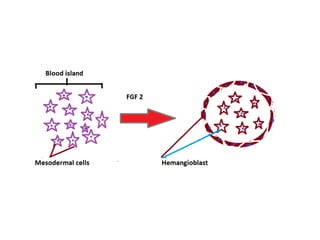
from blood islands
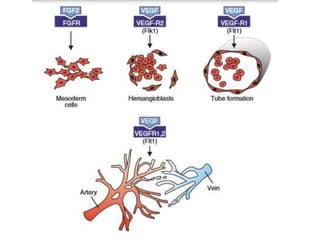
Process of vasculogenesis
• At 3rd week of development
• In the wall of yolk sac
• Blood islands are produce from mesoderm
• Process
• Mesodermal cells produce blood islands
• Mesodermal cells are converted into hemangioblast by
fibroblast growth factor 2 (FGF 2)
Process of vasculogenesis
• Hemangioblast are a common precursor for veesel and
blood cell formation
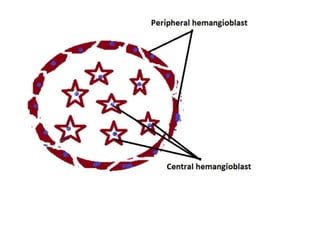
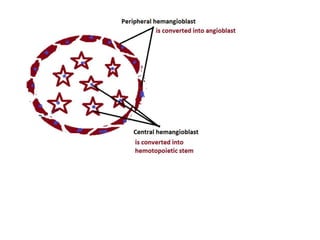
• Hemangioblast of center of blood islands form
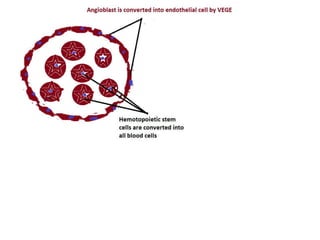
hematopoietic stem cells , the precursor of all blood cells
• The peripheral hemangioblast differentiate into
angioblasts , the precursor of blood vessels
• Angioblast is converted into endothelial cells by VEGF
secreted by surrounding mesoderm cells
Angiogenesis
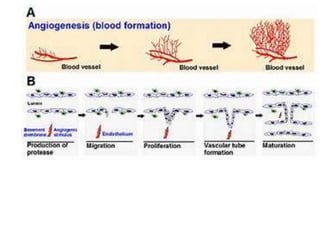
• it is the process of formation of new
vessels by budding and branching from
pre-existing vessels
Thank you
Development of arterial system
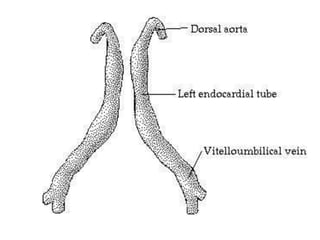
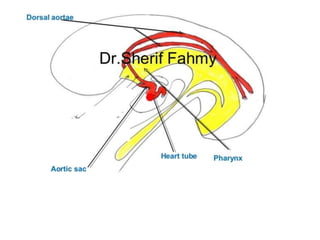
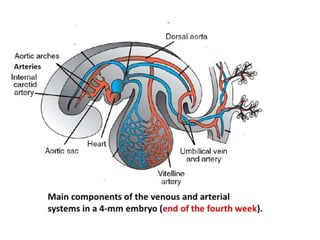
• Aortic arch arteries
• Dorsal aorta
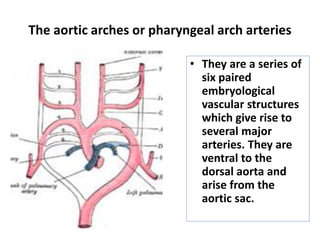
The aortic arches or pharyngeal arch arteries
• They are a series of
six paired
embryological
vascular structures
which give rise to
several major
arteries. They are
ventral to the
dorsal aorta and
arise from the
aortic sac.
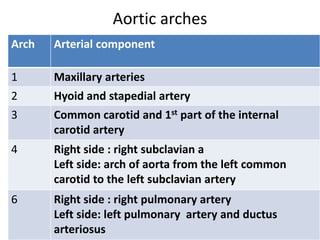
Aortic arches
Arch Arterial component
1 Maxillary arteries
2 Hyoid and stapedial artery
3 Common carotid and 1st part of the internal
carotid artery
4 Right side : right subclavian a
Left side: arch of aorta from the left common
carotid to the left subclavian artery
6 Right side : right pulmonary artery
Left side: left pulmonary artery and ductus
arteriosus
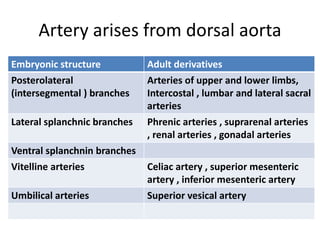
Artery arises from dorsal aorta
Embryonic structure Adult derivatives
Posterolateral
(intersegmental ) branches
Arteries of upper and lower limbs,
Intercostal , lumbar and lateral sacral
arteries
Lateral splanchnic branches Phrenic arteries , suprarenal arteries
, renal arteries , gonadal arteries
Ventral splanchnin branches
Vitelline arteries Celiac artery , superior mesenteric
artery , inferior mesenteric artery
Umbilical arteries Superior vesical artery
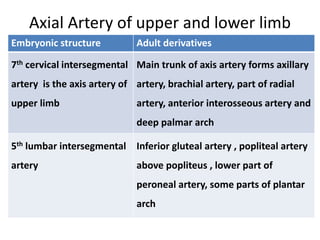
Axial Artery of upper and lower limb
Embryonic structure Adult derivatives
7th cervical intersegmental
artery is the axis artery of
upper limb
Main trunk of axis artery forms axillary
artery, brachial artery, part of radial
artery, anterior interosseous artery and
deep palmar arch
5th lumbar intersegmental
artery
Inferior gluteal artery , popliteal artery
above popliteus , lower part of
peroneal artery, some parts of plantar
arch
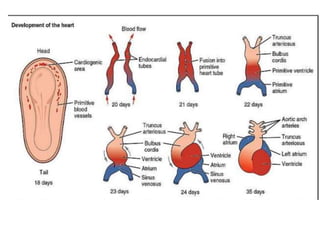
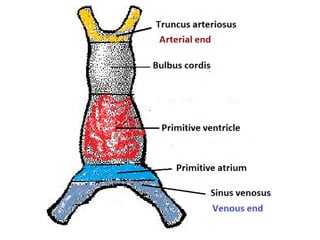
• Development of heart tube
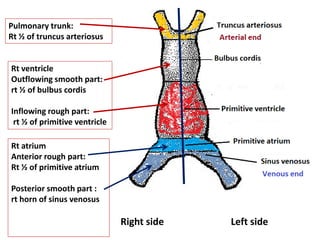
Pulmonary trunk:
Rt ½ of truncus arteriosus
Rt ventricle
Outflowing smooth part:
rt ½ of bulbus cordis
Inflowing rough part:
rt ½ of primitive ventricle
Rt atrium
Anterior rough part:
Rt ½ of primitive atrium
Posterior smooth part :
rt horn of sinus venosus
Right side Left side
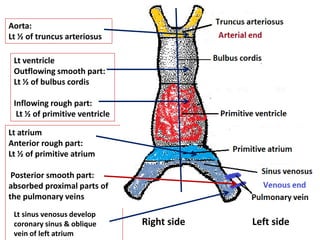
Aorta:
Lt ½ of truncus arteriosus
Lt ventricle
Outflowing smooth part:
Lt ½ of bulbus cordis
Inflowing rough part:
Lt ½ of primitive ventricle
Lt atrium
Anterior rough part:
Lt ½ of primitive atrium
Posterior smooth part:
absorbed proximal parts of
the pulmonary veins
Right side Left side
Lt sinus venosus develop
coronary sinus & oblique
vein of left atrium
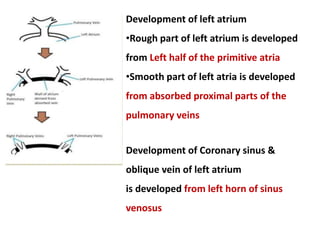
Development of left atrium
•Rough part of left atrium is developed
from Left half of the primitive atria
•Smooth part of left atria is developed
from absorbed proximal parts of the
pulmonary veins
Development of Coronary sinus &
oblique vein of left atrium
is developed from left horn of sinus
venosus
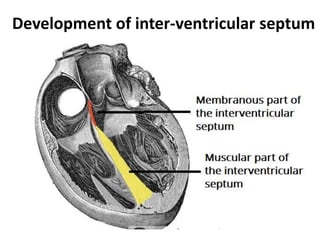
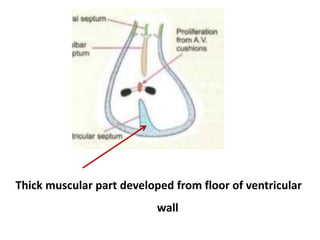
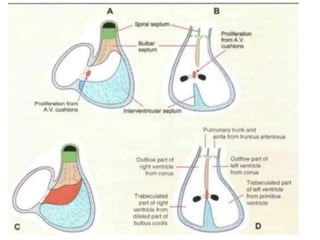
Development of inter-ventricular septum
Thick muscular part developed from floor of ventricular
wall
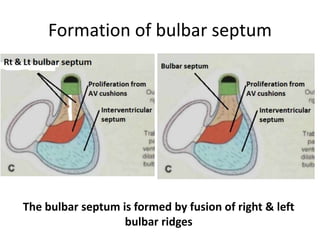
Formation of bulbar septum
The bulbar septum is formed by fusion of right & left
bulbar ridges
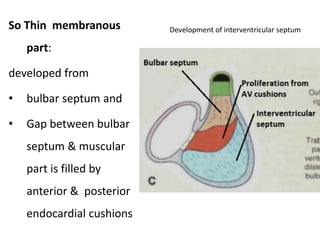
Development of interventricular septum
So Thin membranous
part:
developed from
• bulbar septum and
• Gap between bulbar
septum & muscular
part is filled by
anterior & posterior
endocardial cushions
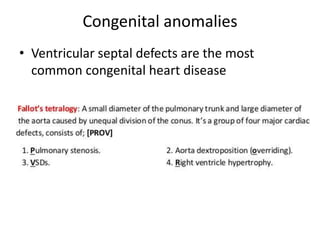
Congenital anomalies
• Ventricular septal defects are the most
common congenital heart disease
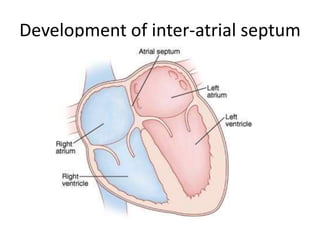
Development of inter-atrial septum
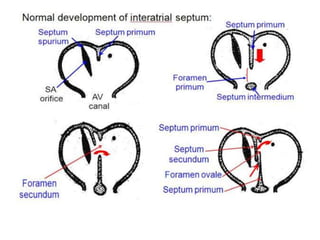
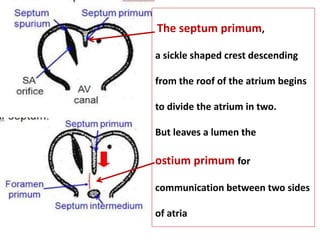
The septum primum,
a sickle shaped crest descending
from the roof of the atrium begins
to divide the atrium in two.
But leaves a lumen the
ostium primum for
communication between two sides
of atria
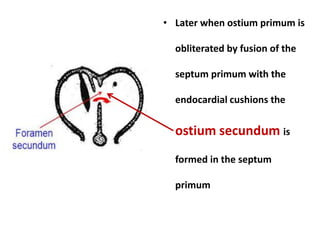
• Later when ostium primum is
obliterated by fusion of the
septum primum with the
endocardial cushions the
ostium secundum is
formed in the septum
primum
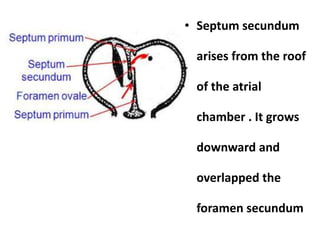
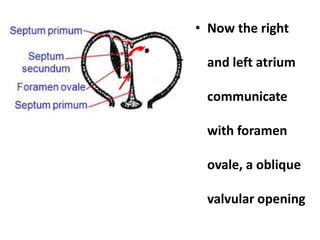
• Septum secundum
arises from the roof
of the atrial
chamber . It grows
downward and
overlapped the
foramen secundum
• Now the right
and left atrium
communicate
with foramen
ovale, a oblique
valvular opening
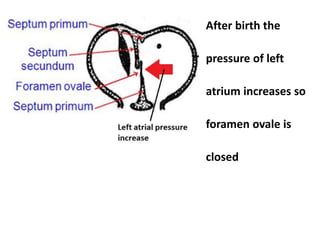
After birth the
pressure of left
atrium increases so
foramen ovale is
closed
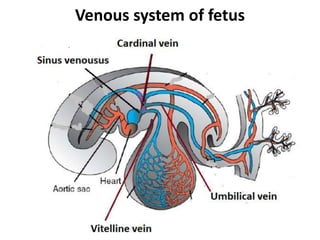
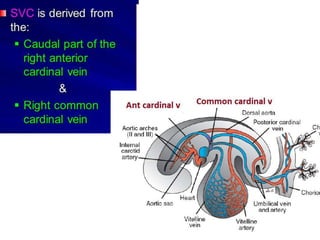
Venous system of fetus
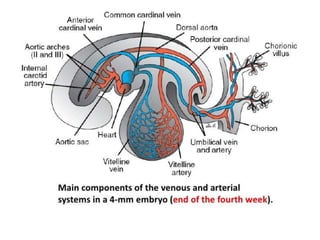
• Sinus venosus has three tributaries
1. Cardinal vein
2. Vitelline vein
3. Umbilical vein
• Arteries and veins of fetus
Venous system of fetus
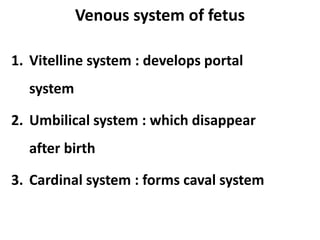
1. Vitelline system : develops portal
system
2. Umbilical system : which disappear
after birth
3. Cardinal system : forms caval system
Venous system of fetus
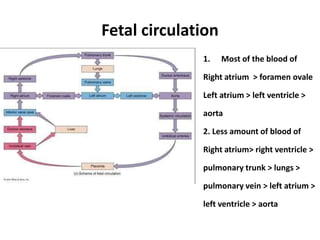
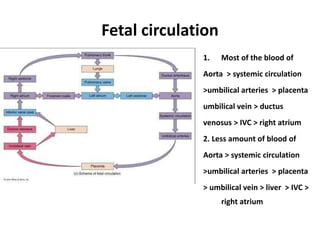
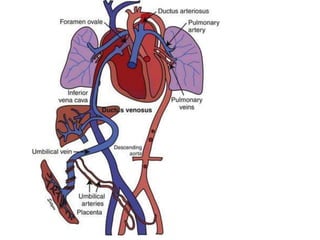
Fetal circulation
1. Most of the blood of
Right atrium > foramen ovale
Left atrium > left ventricle >
aorta
2. Less amount of blood of
Right atrium> right ventricle >
pulmonary trunk > lungs >
pulmonary vein > left atrium >
left ventricle > aorta
Fetal circulation
1. Most of the blood of
Aorta > systemic circulation
>umbilical arteries > placenta
umbilical vein > ductus
venosus > IVC > right atrium
2. Less amount of blood of
Aorta > systemic circulation
>umbilical arteries > placenta
> umbilical vein > liver > IVC >
right atrium
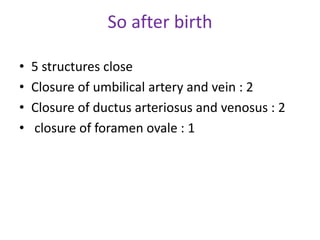
So after birth
• 5 structures close
• Closure of umbilical artery and vein : 2
• Closure of ductus arteriosus and venosus : 2
• closure of foramen ovale : 1
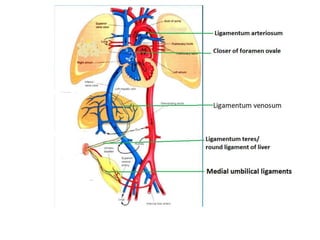
Fate of following structures after birth
• two umbilical arteries is converted into superior vesical artery and
medial umbilical ligament
• two umbilical veins,
• The right umbilical vein degenerates and the left umbilical vein
becomes the ligamentum teres around the liver
• Ductus arteriosus is converted into ligamentum arteriosum
• Ductus venosus is converted into ligamentum venosum
• foramen ovale usually obliterated but sometimes patent (open)
• Thank you

development of CVS 2022.pptx

  • 2.
    Vasculogenesis • It isthe process of formation of new vessels from blood islands
  • 3.
    Process of vasculogenesis •At 3rd week of development • In the wall of yolk sac • Blood islands are produce from mesoderm • Process • Mesodermal cells produce blood islands • Mesodermal cells are converted into hemangioblast by fibroblast growth factor 2 (FGF 2)
  • 4.
    Process of vasculogenesis •Hemangioblast are a common precursor for veesel and blood cell formation • Hemangioblast of center of blood islands form hematopoietic stem cells , the precursor of all blood cells • The peripheral hemangioblast differentiate into angioblasts , the precursor of blood vessels • Angioblast is converted into endothelial cells by VEGF secreted by surrounding mesoderm cells
  • 10.
    Angiogenesis • it isthe process of formation of new vessels by budding and branching from pre-existing vessels
  • 12.
  • 13.
    Development of arterialsystem • Aortic arch arteries • Dorsal aorta
  • 17.
    The aortic archesor pharyngeal arch arteries • They are a series of six paired embryological vascular structures which give rise to several major arteries. They are ventral to the dorsal aorta and arise from the aortic sac.
  • 18.
    Aortic arches Arch Arterialcomponent 1 Maxillary arteries 2 Hyoid and stapedial artery 3 Common carotid and 1st part of the internal carotid artery 4 Right side : right subclavian a Left side: arch of aorta from the left common carotid to the left subclavian artery 6 Right side : right pulmonary artery Left side: left pulmonary artery and ductus arteriosus
  • 19.
    Artery arises fromdorsal aorta Embryonic structure Adult derivatives Posterolateral (intersegmental ) branches Arteries of upper and lower limbs, Intercostal , lumbar and lateral sacral arteries Lateral splanchnic branches Phrenic arteries , suprarenal arteries , renal arteries , gonadal arteries Ventral splanchnin branches Vitelline arteries Celiac artery , superior mesenteric artery , inferior mesenteric artery Umbilical arteries Superior vesical artery
  • 20.
    Axial Artery ofupper and lower limb Embryonic structure Adult derivatives 7th cervical intersegmental artery is the axis artery of upper limb Main trunk of axis artery forms axillary artery, brachial artery, part of radial artery, anterior interosseous artery and deep palmar arch 5th lumbar intersegmental artery Inferior gluteal artery , popliteal artery above popliteus , lower part of peroneal artery, some parts of plantar arch
  • 21.
  • 26.
    Pulmonary trunk: Rt ½of truncus arteriosus Rt ventricle Outflowing smooth part: rt ½ of bulbus cordis Inflowing rough part: rt ½ of primitive ventricle Rt atrium Anterior rough part: Rt ½ of primitive atrium Posterior smooth part : rt horn of sinus venosus Right side Left side
  • 27.
    Aorta: Lt ½ oftruncus arteriosus Lt ventricle Outflowing smooth part: Lt ½ of bulbus cordis Inflowing rough part: Lt ½ of primitive ventricle Lt atrium Anterior rough part: Lt ½ of primitive atrium Posterior smooth part: absorbed proximal parts of the pulmonary veins Right side Left side Lt sinus venosus develop coronary sinus & oblique vein of left atrium
  • 28.
    Development of leftatrium •Rough part of left atrium is developed from Left half of the primitive atria •Smooth part of left atria is developed from absorbed proximal parts of the pulmonary veins Development of Coronary sinus & oblique vein of left atrium is developed from left horn of sinus venosus
  • 29.
  • 30.
    Thick muscular partdeveloped from floor of ventricular wall
  • 31.
    Formation of bulbarseptum The bulbar septum is formed by fusion of right & left bulbar ridges
  • 32.
    Development of interventricularseptum So Thin membranous part: developed from • bulbar septum and • Gap between bulbar septum & muscular part is filled by anterior & posterior endocardial cushions
  • 34.
    Congenital anomalies • Ventricularseptal defects are the most common congenital heart disease
  • 35.
  • 36.
    The septum primum, asickle shaped crest descending from the roof of the atrium begins to divide the atrium in two. But leaves a lumen the ostium primum for communication between two sides of atria
  • 37.
    • Later whenostium primum is obliterated by fusion of the septum primum with the endocardial cushions the ostium secundum is formed in the septum primum
  • 38.
    • Septum secundum arisesfrom the roof of the atrial chamber . It grows downward and overlapped the foramen secundum
  • 39.
    • Now theright and left atrium communicate with foramen ovale, a oblique valvular opening
  • 40.
    After birth the pressureof left atrium increases so foramen ovale is closed
  • 42.
    Venous system offetus • Sinus venosus has three tributaries 1. Cardinal vein 2. Vitelline vein 3. Umbilical vein
  • 43.
    • Arteries andveins of fetus
  • 45.
    Venous system offetus 1. Vitelline system : develops portal system 2. Umbilical system : which disappear after birth 3. Cardinal system : forms caval system
  • 46.
  • 49.
    Fetal circulation 1. Mostof the blood of Right atrium > foramen ovale Left atrium > left ventricle > aorta 2. Less amount of blood of Right atrium> right ventricle > pulmonary trunk > lungs > pulmonary vein > left atrium > left ventricle > aorta
  • 50.
    Fetal circulation 1. Mostof the blood of Aorta > systemic circulation >umbilical arteries > placenta umbilical vein > ductus venosus > IVC > right atrium 2. Less amount of blood of Aorta > systemic circulation >umbilical arteries > placenta > umbilical vein > liver > IVC > right atrium
  • 53.
    So after birth •5 structures close • Closure of umbilical artery and vein : 2 • Closure of ductus arteriosus and venosus : 2 • closure of foramen ovale : 1
  • 54.
    Fate of followingstructures after birth • two umbilical arteries is converted into superior vesical artery and medial umbilical ligament • two umbilical veins, • The right umbilical vein degenerates and the left umbilical vein becomes the ligamentum teres around the liver • Ductus arteriosus is converted into ligamentum arteriosum • Ductus venosus is converted into ligamentum venosum • foramen ovale usually obliterated but sometimes patent (open)
  • 55.