Development of Aortic Arch,
Thoracic and Abdominal Aorta
And Venous system
Dr svr Krishna,
Senior resident,
Vascular surgery,
Medanta the medicity
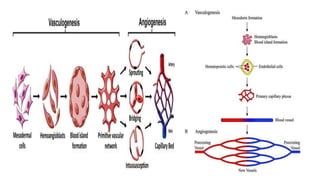
Basic Terminology
• Once endothelial cells are established as vascular elements, they
begin to sprout and bud, forming simple capillary networks.
• vascular endothelial growth factor (VEGF)- Stable vascular network
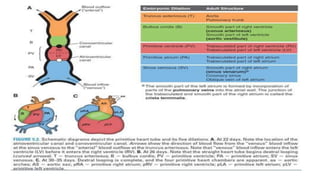
Basics of embryology of heart
• Heart is first seen in the form of two
endothelial heart tubes- 18th day of
foetal life
• Fusion results in a single tube with a
series of dilatations (Bulbus cordis ,
Ventricle , Atrium ,Sinus venosus) and
begins to beat by 22nd day
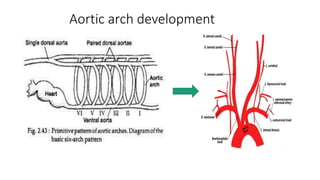
Aortic arch development
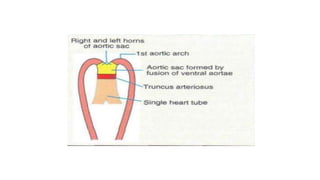
Parts of Primitive Aorta
• 1. Ventral aorta-Ventral to foregut
• 2. Arched portion-connected to first pharyngeal arch
• 3. Dorsal aorta-Dorsal to foregut
1st and 2nd arches (maxillary and stapedial)
• 1st pair of aortic arches hidden
in the mandibular arch and
participates in formation of
the maxillary artery
• 2nd pair of aortic arches give
rise to stapedial and hyoid
arteries.
3rd arch(carotids)
• 3rd pair of aortic arches make
their appearance at the end of
week 4. They give rise to
the common
carotids and proximal portions
of the internal carotid arteries.
• Portion of dorsal aorta b/w 3rd
and 4th (ductus
caroticus)disappear
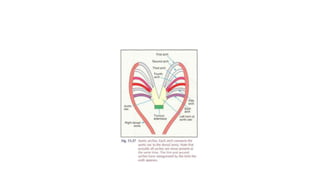
First, second and fifth arches disappear
The paired dorsal aortas fuse at the level of the seventh
cervical vertebra to become the thoracic and abdominal aorta.
The dorsal aorta between the third and fourth arches involutes
so that blood entering the third arch perfuses the head only.
The third arch and its branches become the carotid system. The right dorsal aorta distal
to the right seventh intersegmental artery involutes so that blood entering the right
fourth arch perfuses the right upper limb. This system becomes the right subclavian
artery.
The distal part of the right sixth arch involutes, but the distal
part of the left sixth arch persists and becomes the ductus
arteriosus.
The right fourth arch, the dorsal aorta distal to the right fourth
arch+ right seventh intersegmental artery - Right subclavian
artery
Left fourth arch+ left dorsal aorta distal to it become part of
the Aortic archLeft seventh intersegmental artery - left subclavian artery
Pulmonary arteries form from the sixth arch with the ductus
arteriosus present
Patent ductus arteriosus becomes ligamentum arteriosum
later on
Aortic Arch Anomalies
• BOVINE ARCH
• DOUBLE ARCH
• RIGHT ARCH
• PATENT DUCTUS ARTERIOSIS
• ABERRANT RIGHT SUBCLAVIAN ARTERY
• INTERRUPTED AORTIC ARCH
• COARCTATION
• ANOMALOUS ORIGIN OF PULMONARYARTERY
• ABNORMAL LEFT ARCH
• ABNORMAL RIGHT ARCH
• CERVICALARCH
BOVINE ARCH
• Most common anomaly -8% in
whites and 25% in blacks
• Found in African descents
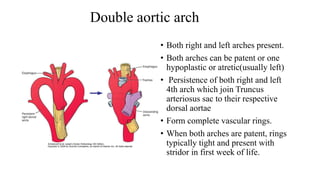
Double aortic arch
• Both right and left arches present.
• Both arches can be patent or one
hypoplastic or atretic(usually left)
• Persistence of both right and left
4th arch which join Truncus
arteriosus sac to their respective
dorsal aortae
• Form complete vascular rings.
• When both arches are patent, rings
typically tight and present with
stridor in first week of life.
PATENT DUCTUS ARTERIOSIS
• The ductus arteriosus, which is
normally occluded soon after
birth, may remain patent
• Communication between the
pulmonary artery and the aorta
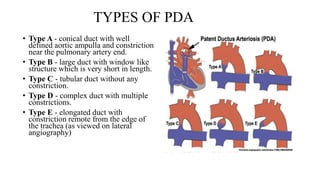
TYPES OF PDA
• Type A - conical duct with well
defined aortic ampulla and constriction
near the pulmonary artery end.
• Type B - large duct with window like
structure which is very short in length.
• Type C - tubular duct without any
constriction.
• Type D - complex duct with multiple
constrictions.
• Type E - elongated duct with
constriction remote from the edge of
the trachea (as viewed on lateral
angiography)
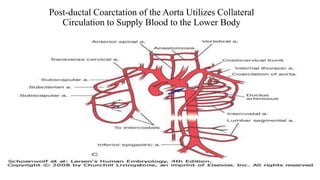
COARCTATION OF THE AORTA
• Aorta may show a localized
narrowing of its lumen
• May be distal to the attachment
of the ductus (postductal)
• proximal to the attachment
(preductal)
Post-ductal Coarctation of the Aorta Utilizes Collateral
Circulation to Supply Blood to the Lower Body
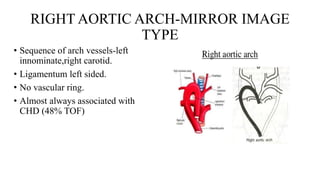
RIGHT AORTIC ARCH-MIRROR IMAGE
TYPE
• Sequence of arch vessels-left
innominate,right carotid.
• Ligamentum left sided.
• No vascular ring.
• Almost always associated with
CHD (48% TOF)
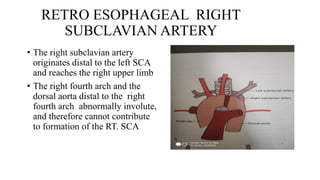
RETRO ESOPHAGEAL RIGHT
SUBCLAVIAN ARTERY
• The right subclavian artery
originates distal to the left SCA
and reaches the right upper limb
• The right fourth arch and the
dorsal aorta distal to the right
fourth arch abnormally involute,
and therefore cannot contribute
to formation of the RT. SCA
DEVELOPMENT OF DTAAND
ABDOMINALAORTA
• During the fourth week, the
paired dorsal aortas caudal to the
level of the seventh cervical
somite fuse to become the
descending (thoracic and
abdominal) aorta.
• Dorsal, Ventral, and Lateral
branches
• Dorsal branches- dorsal branches
supply the developing neural
tube and epimere
• ventral branches- superior
thoracic artery, internal thoracic
artery, and the superior epigastric
arteries.
• At the lumbar level, the dorsal intersegmental branches become
lumbar arteries, with the fifth lumbar pair remaining as the common
iliac arteries.
• Lumbar ventral branches form Allantoic and Vitelline vessels.
• As the gastrointestinal tract develops, the Vitelline arteries become its
blood supply and fuse to become the three unpaired gut vessels: the
Celiac artery supplying the foregut, the Superior mesenteric artery
supplying the Midgut, and the Inferior mesenteric artery supplying the
Hindgut.
Lateral segmental arteries
• The lateral segmental arteries supply the primitive urogenital ridge,
which is the source of the gonads and kidney, adrenal and gonadal
arteries
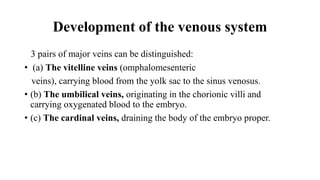
Development of the venous system
3 pairs of major veins can be distinguished:
• (a) The vitelline veins (omphalomesenteric
veins), carrying blood from the yolk sac to the sinus venosus.
• (b) The umbilical veins, originating in the chorionic villi and
carrying oxygenated blood to the embryo.
• (c) The cardinal veins, draining the body of the embryo proper.
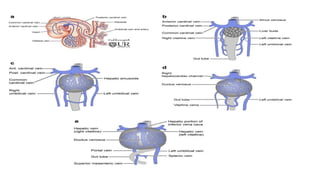
Vitelline veins
• 2 vitelline veins : Right and Left
• Each one divided into distal, middle and proximal parts by the
developing liver
• The distal parts of 2 veins anastomosis around the duodenum to
form the portal vein
• The middle part of 2 veins forming the liver sinusoids
• The proximal part of the left vein disappear
• The proximal part of the right above the liver forming the
Hepato-cardiac part of the IVC
At first 2 umbilical veins are present (right and left)The right vein completely disappearsThe proximal part of the left vein disappearsThe distal part of the left vein carries blood from the placenta
to the liver
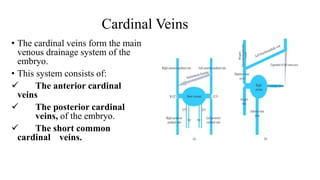
Cardinal Veins
• The cardinal veins form the main
venous drainage system of the
embryo.
• This system consists of:
 The anterior cardinal
veins
 The posterior cardinal
veins, of the embryo.
 The short common
cardinal veins.
In fifth to the seventh week, posterior cardinal system on both side
regressed:
• (a) the supracardinal veins, which drain the body wall by way of
the intercostal veins
• (b) the subcardinal veins, which mainly drain the kidneys
• (c) the sacrocardinal veins, which drain the lower extremities
• 2 posterior cardinal veins, with the
development the greater part of posterior
cardinal veins disappear in both sides and the
supracardinal veins take their places
• The right supracardinal vein with a small
portion of the right posterior cardinal vein
forming the azygos vein
• The left supracardinal vein forms the
hemiazygos veins which drains in the
azygos vein
posterior cardinal veins and the
supracardinal veins
subcardinal veins
• 2 subcardinal veins and anastomosis in between the left
subcardinal vein disappears, and only its distal portion
remains as the left gonadalvein
• The anastomosis between the subcardinal veins forms the left
renal vein.
• The right subcardinal vein develops into the renal segment
of the inferior vena cava and a small distal portion forms the
right gonadal vein which drain into the inferior vena cava
Sacrocardinal veins
• The anastomosis between the sacrocardinal veins forms the left
common iliac vein.
• The right sacrocardinal vein becomes the sacrocardinal
segment of the inferior vena cava.
• Renal segment of the inferior vena cava connects with the
hepatic segment, which is derived from the right vitelline vein,
• The inferior vena cava, consisting of hepatic, renal, and
sacrocardinal segments, is complete.
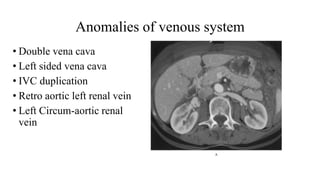
Anomalies of venous system
• Double vena cava
• Left sided vena cava
• IVC duplication
• Retro aortic left renal vein
• Left Circum-aortic renal
vein
Miscellaneous
• Persistent sciatic artery
• Popliteal entrapment syndrome
Persistent sciatic artery
• If the iliofemoral artery fails to
develop, the sciatic artery may
persist as the dominant vessel
supplying blood to the thigh.
• This is a rare anomaly, with an
incidence of 0.05%
Popliteal entrapment syndrome
• Popliteal entrapment syndrome is
caused by displacement of the
popliteal artery medial to the
medial head of the
gastrocnemius.
• It results from migration of the
medial head of the
gastrocnemius that forces the
vessels across the popliteal fossa
and entraps them against the
medial condyle of the femur
Thank u

Aortic arch and venous system development

  • 1.
    Development of AorticArch, Thoracic and Abdominal Aorta And Venous system Dr svr Krishna, Senior resident, Vascular surgery, Medanta the medicity
  • 2.
  • 4.
    • Once endothelialcells are established as vascular elements, they begin to sprout and bud, forming simple capillary networks. • vascular endothelial growth factor (VEGF)- Stable vascular network
  • 5.
    Basics of embryologyof heart • Heart is first seen in the form of two endothelial heart tubes- 18th day of foetal life • Fusion results in a single tube with a series of dilatations (Bulbus cordis , Ventricle , Atrium ,Sinus venosus) and begins to beat by 22nd day
  • 7.
  • 8.
    Parts of PrimitiveAorta • 1. Ventral aorta-Ventral to foregut • 2. Arched portion-connected to first pharyngeal arch • 3. Dorsal aorta-Dorsal to foregut
  • 11.
    1st and 2ndarches (maxillary and stapedial) • 1st pair of aortic arches hidden in the mandibular arch and participates in formation of the maxillary artery • 2nd pair of aortic arches give rise to stapedial and hyoid arteries.
  • 12.
    3rd arch(carotids) • 3rdpair of aortic arches make their appearance at the end of week 4. They give rise to the common carotids and proximal portions of the internal carotid arteries. • Portion of dorsal aorta b/w 3rd and 4th (ductus caroticus)disappear
  • 13.
    First, second andfifth arches disappear The paired dorsal aortas fuse at the level of the seventh cervical vertebra to become the thoracic and abdominal aorta. The dorsal aorta between the third and fourth arches involutes so that blood entering the third arch perfuses the head only. The third arch and its branches become the carotid system. The right dorsal aorta distal to the right seventh intersegmental artery involutes so that blood entering the right fourth arch perfuses the right upper limb. This system becomes the right subclavian artery. The distal part of the right sixth arch involutes, but the distal part of the left sixth arch persists and becomes the ductus arteriosus. The right fourth arch, the dorsal aorta distal to the right fourth arch+ right seventh intersegmental artery - Right subclavian artery Left fourth arch+ left dorsal aorta distal to it become part of the Aortic archLeft seventh intersegmental artery - left subclavian artery Pulmonary arteries form from the sixth arch with the ductus arteriosus present Patent ductus arteriosus becomes ligamentum arteriosum later on
  • 15.
    Aortic Arch Anomalies •BOVINE ARCH • DOUBLE ARCH • RIGHT ARCH • PATENT DUCTUS ARTERIOSIS • ABERRANT RIGHT SUBCLAVIAN ARTERY • INTERRUPTED AORTIC ARCH • COARCTATION • ANOMALOUS ORIGIN OF PULMONARYARTERY • ABNORMAL LEFT ARCH • ABNORMAL RIGHT ARCH • CERVICALARCH
  • 16.
    BOVINE ARCH • Mostcommon anomaly -8% in whites and 25% in blacks • Found in African descents
  • 18.
    Double aortic arch •Both right and left arches present. • Both arches can be patent or one hypoplastic or atretic(usually left) • Persistence of both right and left 4th arch which join Truncus arteriosus sac to their respective dorsal aortae • Form complete vascular rings. • When both arches are patent, rings typically tight and present with stridor in first week of life.
  • 19.
    PATENT DUCTUS ARTERIOSIS •The ductus arteriosus, which is normally occluded soon after birth, may remain patent • Communication between the pulmonary artery and the aorta
  • 20.
    TYPES OF PDA •Type A - conical duct with well defined aortic ampulla and constriction near the pulmonary artery end. • Type B - large duct with window like structure which is very short in length. • Type C - tubular duct without any constriction. • Type D - complex duct with multiple constrictions. • Type E - elongated duct with constriction remote from the edge of the trachea (as viewed on lateral angiography)
  • 21.
    COARCTATION OF THEAORTA • Aorta may show a localized narrowing of its lumen • May be distal to the attachment of the ductus (postductal) • proximal to the attachment (preductal)
  • 22.
    Post-ductal Coarctation ofthe Aorta Utilizes Collateral Circulation to Supply Blood to the Lower Body
  • 23.
    RIGHT AORTIC ARCH-MIRRORIMAGE TYPE • Sequence of arch vessels-left innominate,right carotid. • Ligamentum left sided. • No vascular ring. • Almost always associated with CHD (48% TOF)
  • 24.
    RETRO ESOPHAGEAL RIGHT SUBCLAVIANARTERY • The right subclavian artery originates distal to the left SCA and reaches the right upper limb • The right fourth arch and the dorsal aorta distal to the right fourth arch abnormally involute, and therefore cannot contribute to formation of the RT. SCA
  • 25.
    DEVELOPMENT OF DTAAND ABDOMINALAORTA •During the fourth week, the paired dorsal aortas caudal to the level of the seventh cervical somite fuse to become the descending (thoracic and abdominal) aorta. • Dorsal, Ventral, and Lateral branches • Dorsal branches- dorsal branches supply the developing neural tube and epimere • ventral branches- superior thoracic artery, internal thoracic artery, and the superior epigastric arteries.
  • 26.
    • At thelumbar level, the dorsal intersegmental branches become lumbar arteries, with the fifth lumbar pair remaining as the common iliac arteries. • Lumbar ventral branches form Allantoic and Vitelline vessels. • As the gastrointestinal tract develops, the Vitelline arteries become its blood supply and fuse to become the three unpaired gut vessels: the Celiac artery supplying the foregut, the Superior mesenteric artery supplying the Midgut, and the Inferior mesenteric artery supplying the Hindgut. Lateral segmental arteries • The lateral segmental arteries supply the primitive urogenital ridge, which is the source of the gonads and kidney, adrenal and gonadal arteries
  • 27.
    Development of thevenous system 3 pairs of major veins can be distinguished: • (a) The vitelline veins (omphalomesenteric veins), carrying blood from the yolk sac to the sinus venosus. • (b) The umbilical veins, originating in the chorionic villi and carrying oxygenated blood to the embryo. • (c) The cardinal veins, draining the body of the embryo proper.
  • 29.
    Vitelline veins • 2vitelline veins : Right and Left • Each one divided into distal, middle and proximal parts by the developing liver • The distal parts of 2 veins anastomosis around the duodenum to form the portal vein • The middle part of 2 veins forming the liver sinusoids • The proximal part of the left vein disappear • The proximal part of the right above the liver forming the Hepato-cardiac part of the IVC
  • 31.
    At first 2umbilical veins are present (right and left)The right vein completely disappearsThe proximal part of the left vein disappearsThe distal part of the left vein carries blood from the placenta to the liver
  • 32.
    Cardinal Veins • Thecardinal veins form the main venous drainage system of the embryo. • This system consists of:  The anterior cardinal veins  The posterior cardinal veins, of the embryo.  The short common cardinal veins.
  • 33.
    In fifth tothe seventh week, posterior cardinal system on both side regressed: • (a) the supracardinal veins, which drain the body wall by way of the intercostal veins • (b) the subcardinal veins, which mainly drain the kidneys • (c) the sacrocardinal veins, which drain the lower extremities
  • 35.
    • 2 posteriorcardinal veins, with the development the greater part of posterior cardinal veins disappear in both sides and the supracardinal veins take their places • The right supracardinal vein with a small portion of the right posterior cardinal vein forming the azygos vein • The left supracardinal vein forms the hemiazygos veins which drains in the azygos vein posterior cardinal veins and the supracardinal veins
  • 36.
    subcardinal veins • 2subcardinal veins and anastomosis in between the left subcardinal vein disappears, and only its distal portion remains as the left gonadalvein • The anastomosis between the subcardinal veins forms the left renal vein. • The right subcardinal vein develops into the renal segment of the inferior vena cava and a small distal portion forms the right gonadal vein which drain into the inferior vena cava
  • 37.
    Sacrocardinal veins • Theanastomosis between the sacrocardinal veins forms the left common iliac vein. • The right sacrocardinal vein becomes the sacrocardinal segment of the inferior vena cava. • Renal segment of the inferior vena cava connects with the hepatic segment, which is derived from the right vitelline vein, • The inferior vena cava, consisting of hepatic, renal, and sacrocardinal segments, is complete.
  • 38.
    Anomalies of venoussystem • Double vena cava • Left sided vena cava • IVC duplication • Retro aortic left renal vein • Left Circum-aortic renal vein
  • 39.
    Miscellaneous • Persistent sciaticartery • Popliteal entrapment syndrome
  • 40.
    Persistent sciatic artery •If the iliofemoral artery fails to develop, the sciatic artery may persist as the dominant vessel supplying blood to the thigh. • This is a rare anomaly, with an incidence of 0.05%
  • 41.
    Popliteal entrapment syndrome •Popliteal entrapment syndrome is caused by displacement of the popliteal artery medial to the medial head of the gastrocnemius. • It results from migration of the medial head of the gastrocnemius that forces the vessels across the popliteal fossa and entraps them against the medial condyle of the femur
  • 42.