PERSONAL
DEVELOPMENT/PANSARILIN
G KAUNLARAN
Life seems to have become a bewildering
maze at times. Thus, you try to reflect on your
common beliefs. Amidst these developments,
it helps recognize how the different
physiological, cognitive, emotional, spiritual,
and social developments are in a dynamic
relationship. By recognizing such changes, you
can understand and evaluate your thoughts.
THESE ARE FIVE AREAS OF PERSONAL
DEVELOPMENT NAMELY: (1) PHYSIOLOGICAL
DEVELOPMENT, (2) EMOTIONAL DEVELOPMENT,
(3) SOCIAL DEVELOPMENT, (4) COGNITIVE
DEVELOPMENT, AND (5) SPIRITUAL
DEVELOPMENT.
Physiological Development: Physical health is defined as the
condition of your body, taking into consideration everything from
the absence of disease to fitness level. It is important to take care
of your body. Live healthy, eat healthy foods, get enough sleep,
exercise regularly, and avoid drugs and alcohol. Manage stress
and go for regular medical check-ups. Practice good hygiene.
Emotional Development: Emotional health is an important part
of overall health. Emotionally healthy people are in control of their
thoughts, feelings, and behaviors. They can cope with life’s
challenges. Emotions are responses that generate biochemical
reactions in our bodies and changing the physical state.
Social Development: Social Development refers to how people
develop social and emotional skills across the lifespan, with
particular attention to childhood and adolescence. Healthy social
development allows us to form positive relationships with family,
friends, teachers, and other people in our lives.
Cognitive Development: It means how people think, explore, and
figure things out. It is the development of knowledge, skills, problem-
solving, and dispositions, which helps a person to think about and
understand the world around them. Brain development is part of
cognitive development. This aspect of self is enhanced when one
attends school to study and learn or engages in other mental
endeavors.
Spiritual Development: Spiritual development is defined as
discovering oneself beyond the ego known as the soul, spirit, or the
―inner essence that is often disregarded or taken for granted
‖
(Llaneza-Ramos, 2017). It is when one experiences a glimpse of the
―inner guide of one’s beliefs and values as one discovers the
‖
meaning of life.
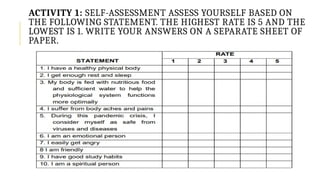
ACTIVITY 1: SELF-ASSESSMENT ASSESS YOURSELF BASED ON
THE FOLLOWING STATEMENT. THE HIGHEST RATE IS 5 AND THE
LOWEST IS 1. WRITE YOUR ANSWERS ON A SEPARATE SHEET OF
PAPER.
Analysis: After having a brief self-assessment
regarding your physical, emotional, social,
cognitive, and spiritual development, what are the
things you want to improve or develop further?
Why is this so?
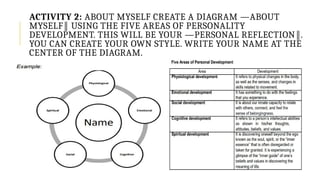
ACTIVITY 2: ABOUT MYSELF CREATE A DIAGRAM ―ABOUT
MYSELF USING THE FIVE AREAS OF PERSONALITY
‖
DEVELOPMENT. THIS WILL BE YOUR ―PERSONAL REFLECTION .
‖
YOU CAN CREATE YOUR OWN STYLE. WRITE YOUR NAME AT THE
CENTER OF THE DIAGRAM.
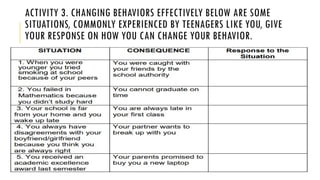
ACTIVITY 3. CHANGING BEHAVIORS EFFECTIVELY BELOW ARE SOME
SITUATIONS, COMMONLY EXPERIENCED BY TEENAGERS LIKE YOU, GIVE
YOUR RESPONSE ON HOW YOU CAN CHANGE YOUR BEHAVIOR.
Guide Questions: Answer the following on a separate sheet of
paper.
1. Are there things you want to change within you at present?
What are they?
2. How do you feel when you experience punishment from
committing violations in school? How about when you receive
awards in school?
3. Why is it important to change yourself for the better?
Instruction: Provide your best picture. Create your
graphic organizer or draw a circle on a blank sheet of
paper and divide the circle into 8 segments. Put your
picture in the centre. In each segment write some
descriptions of the different aspects of yourself as follow.
ACTIVITY 2: ME, MYSELF AND I
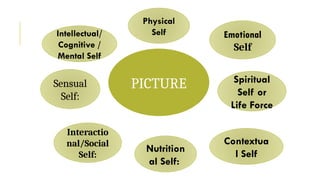
PICTURE
Physical
Self
Intellectual/
Cognitive /
Mental Self
Sensual
Self:
Emotional
Self
Spiritual
Self or
Life Force
Nutrition
al Self:
Interactio
nal/Social
Self:
Contextua
l Self
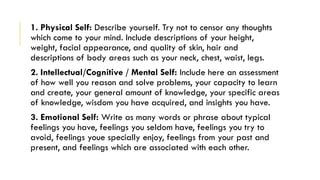
1. Physical Self: Describe yourself. Try not to censor any thoughts
which come to your mind. Include descriptions of your height,
weight, facial appearance, and quality of skin, hair and
descriptions of body areas such as your neck, chest, waist, legs.
2. Intellectual/Cognitive / Mental Self: Include here an assessment
of how well you reason and solve problems, your capacity to learn
and create, your general amount of knowledge, your specific areas
of knowledge, wisdom you have acquired, and insights you have.
3. Emotional Self: Write as many words or phrase about typical
feelings you have, feelings you seldom have, feelings you try to
avoid, feelings youe specially enjoy, feelings from your past and
present, and feelings which are associated with each other.
4. Sensual Self: Write how you feel as a sensual person. What sense do
you use most – sight, hearing, speaking, smelling, touching? How do you
feel about the different ways you take in information - through the eyes,
ears, mouth, nose, and skin. In what ways do you let information in and
out of your body?
5. Interactional/Social Self: Include descriptions of your strengths and
weaknesses in intimate relationships and relationships to friends, family,
classmates and strangers in social settings. Describe the strengths and
weaknesses which your friends and family have noticed. Describe what
kind of son or daughter, brother or sister you are.
6. Nutritional Self: How do you nourish yourself? What foods do you
like and dislike? What do you like and dislike about these?
7. Contextual Self: Descriptors could be in the areas of maintenance of
your living environment: reaction to light, temperature, space, weather,
colors, sound and seasons and your impact on the environment.
8. Spiritual Self or Life Force: Write words or phrases which tell about
how you feel in this area. This could include your feelings about
yourself and organized religion, reactions about your spiritual
connections to others, feelings about your spiritual development and
history, and thought about your metaphysical self. Think about your
inner peace and joy. Think about your spiritual regimen or routine.
ASPECTS OF THE SELF The self-concept is represented by
several aspects of the self. It is conceived as collection of
multiple, context-dependent selves. This construct believes that
context activates particular regions of self-knowledge and self-
relevant feedback affects self-evaluations. A deeper look on
the different aspects of self can identify specific areas for self-
regulation, stability and improvement.
ASPECTS OF THE SELF.
THREE BASIC, BUT VERY DIFFERENT ASPECTS
OF THE SELF.
1. Physical Or Tangible Aspects- as they relate to the body (height,
weight, facial appearance, and quality of skin, hair and descriptions of
body areas such as your neck, chest, waist, legs)
➢ Many individuals put a strong emphasis on the physical aspect of the
self. The body is tangible, obvious, and we respond to it easily. More
time and money is spent on enhancing the physical component than
either of the other two aspects. This does not mean, however, that the
body is healthy or strong. The body provides a place to house the spirit
(often experienced as feelings) and the mind (often experienced as
thought).
2. Intellectual And Conscious Aspects as they relate to the mind
(include how well you reason and solve problems, your capacity to learn
and create, your general amount of knowledge, your specific areas of
knowledge, wisdom you have acquired, and insights you have.)
➢ It may be important to some that their mind can be prominent and
well educated. The mind is important, as it is the part of the self that
directs the other two aspects. The mind learns what to do and
communicates the information to the body and the feelings. What the
mind believes, the body manifests or acts on, and the emotions feel, or
respond with. People store both healthy and destructive thoughts and
beliefs and responds to life's circumstances in the most prominent manner.
The mind provides access creativity and serenity which are necessary for
such processes as prayer, forgiveness, acceptance, and passion.
3. Emotional and Intuitive Aspects/ Spiritual Self or Life Force as
they relate to the spirit and feelings Emotional relates to typical feelings
you have, feelings you seldom have, feelings you try to avoid, feelings you
especially enjoy, feelings from your past and present, and feelings which
are associated with each other. This aspects of self affects your state of
being, and they are very important in dealing with people and events.
Intuitive Aspects/ Spiritual Self or Life Force relates to your faith and
relationship with the creator Creativity relates to your feelings about
yourself and organized religion, reactions about your spiritual connections
to others, feelings about your spiritual development and history, and
thought about your metaphysical self. Think about your inner peace and
joy. Think about your spiritual regimen or routine.
➢ The human emotions are the most feared aspect of the self, as individuals
are reluctant and unprepared to manage them. Managing feelings is like
trying to hold water in the palm of your hand. They are illusive and
deceptive. A decision made under emotional stress and strain usually
impacts emotions negatively. Negative emotions that are not managed are
stored and repressed. Repression is destructive to a content self since all
feelings, not only negative ones are stored away. Accessing feelings when
they are needed now becomes difficult, leaving the individual numb and
hopeless. For instance, a girl realizes that she is giving much attention on
the physical aspects and less attention on her intellectual self. In this way,
she can discover how much money and time spent maintaining her
physique and its consequences in her grades. By this honest evaluation of
herself, she can plan effective actions to improve her study habits. She can
start seeking for help and for related books to read or browse articles to help
her improve her study habits.
ADDITIONAL: ASPECTS OF DEVELOPMENT
Sensual Self Relates to our senses. How we use our senses, how we
react or receive information and in what ways do you let information in
and out of your body.
Interactional / Social Self Relates on our relationship with other people
particularly those with your peers and family. Relates about your
strength or weaknesses in a relationship (as child, siblings, friend or
partner).
Nutritional Self Relates to nutritional status. What are the foods you
take to keep your body healthy? Exercise made?
Contextual Self Relates to your reaction to light, temperature, space,
weather, colours, sound and seasons and your impact on the
environment.
ACTIVITY 3. READ, DISCOVER, BE
ENCOURAGED: PLAN FOR YOUR SUCCESS!
INSTRUCTION: READ THE STORY OF TWO SUCCESSFUL
PERSONALITIES. DISCOVER THEIR CHARACTERISTICS AND
ANSWER THE QUESTIONS BELOW.
1. Manny Pacquiao’s Unbelievable Success
Story Will Inspire You
2. The Pia Wurtzbach Success Story
ACTIVITY 3. WATCH, DISCOVER, BE
ENCOURAGED: PLAN FOR YOUR SUCCESS!
1. Can you identify with any of the characters mentioned –
Manny Pacquio and Pia Alonzo Wurtzbach? In what ways?
2. What lessons can you learn from the character you have
chosen?
3. How would you like your life story to be told? Share/write
your own future story.
LET’S WATCH
WATCH THE STORY ABOUT THE“TWO
WOLF” AND ANSWER THE QUESTIONS.
Knowing which wolf to feed is the first step towards recognizing you
have control over your own self.
Have you ever had thoughts, feelings or acted in ways that were
unacceptable to yourself but felt powerless to control? The purpose of
this story is to help you find ways to manage your mind so that you can
live your life more in accordance with what your own judgment says is
best for you.
As we grow up, we gradually become aware of the many things in the
external world which are largely beyond our ability to control. These
include other people in general and most events in our lives. Initially
this is difficult to accept, but a more shocking realization is that there
are many things about ourselves that we seem powerless to control.
Some of these are our own thoughts, feelings, and actions which
unfortunately can be the source of much distress. It may be thoughts
such as “I cannot stop hating my teacher for not giving me high
grades.” It may involve an emotion e.g. “My girlfriend left me and I
cannot stop feeling sad, lonely and unloved.” It can also be in the form
of a behaviour such as the inability to control one's craving for food
such as cakes and chocolates.”
LET’S WATCH
ACTIVITY 4. THE POWER TRIAD:
THOUGHTS, FEELINGS AND ACTIONS
Instruction: Write your thoughts, feelings and opinions on
the following questions. By taking time to do this, you will
learn to better manage your mind, feelings, and actions
and consciously feeding the good wolf in you.
The STORY OF THE TWO WOLVES gives rise to a number of questions.
1. How aware are you of the two different opposing “wolves” operating
within your mind, one of which leads to pain and a diminished sense of
life and the other to a joyous, meaningful, and fulfilling life?
2. When was the time you feel disappointed by the choice of behavior
because you knew that there was a more positive option but you just
didn’t choose it?
3. What ways or techniques or exercises do you use to strengthen yourself
so as to increase its potency to choose and hence control your life?
4. In what specific ways do you feed the negative wolf?
5. What specific ways do you use to feed the positive wolf?
A REAL WINNER is one who is able to:
• win over his/her battles and difficulties in life and turns them into
a learning and glorifying experience;
• find meaning in pleasant and unpleasant events in his life;
• live in peace with difficult people and difficult situations;
• win the goodwill of others, their respect and admiration;
• get what he wants using win-win strategies; never at the expense of
others;
• discover and use opportunities to his best advantage
• develop and use his talents and abilities to the best advantage and
in so doing, make
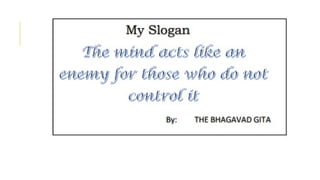
ACTIVITY 5: I AM IN CONTROL!
INSTRUCTION: CREATE YOUR OWN SLOGAN DECLARING
THAT YOU’RE IN CONTROL OF YOUR THOUGHTS.
POSITIVE THINKING WILL LEAD YOU POSITIVE ACTION
AND RESULT.
NOTE: YOU CAN DRAW, PAINT OR USE INDIGENOUS
MATERIALS. BE CREATIVE AND INNOVATIVE!
PERDEV2- L2 Areas of Personal Devlopment.pptx

PERDEV2- L2 Areas of Personal Devlopment.pptx

  • 1.
  • 2.
    Life seems tohave become a bewildering maze at times. Thus, you try to reflect on your common beliefs. Amidst these developments, it helps recognize how the different physiological, cognitive, emotional, spiritual, and social developments are in a dynamic relationship. By recognizing such changes, you can understand and evaluate your thoughts.
  • 3.
    THESE ARE FIVEAREAS OF PERSONAL DEVELOPMENT NAMELY: (1) PHYSIOLOGICAL DEVELOPMENT, (2) EMOTIONAL DEVELOPMENT, (3) SOCIAL DEVELOPMENT, (4) COGNITIVE DEVELOPMENT, AND (5) SPIRITUAL DEVELOPMENT. Physiological Development: Physical health is defined as the condition of your body, taking into consideration everything from the absence of disease to fitness level. It is important to take care of your body. Live healthy, eat healthy foods, get enough sleep, exercise regularly, and avoid drugs and alcohol. Manage stress and go for regular medical check-ups. Practice good hygiene.
  • 4.
    Emotional Development: Emotionalhealth is an important part of overall health. Emotionally healthy people are in control of their thoughts, feelings, and behaviors. They can cope with life’s challenges. Emotions are responses that generate biochemical reactions in our bodies and changing the physical state. Social Development: Social Development refers to how people develop social and emotional skills across the lifespan, with particular attention to childhood and adolescence. Healthy social development allows us to form positive relationships with family, friends, teachers, and other people in our lives.
  • 5.
    Cognitive Development: Itmeans how people think, explore, and figure things out. It is the development of knowledge, skills, problem- solving, and dispositions, which helps a person to think about and understand the world around them. Brain development is part of cognitive development. This aspect of self is enhanced when one attends school to study and learn or engages in other mental endeavors. Spiritual Development: Spiritual development is defined as discovering oneself beyond the ego known as the soul, spirit, or the ―inner essence that is often disregarded or taken for granted ‖ (Llaneza-Ramos, 2017). It is when one experiences a glimpse of the ―inner guide of one’s beliefs and values as one discovers the ‖ meaning of life.
  • 6.
    ACTIVITY 1: SELF-ASSESSMENTASSESS YOURSELF BASED ON THE FOLLOWING STATEMENT. THE HIGHEST RATE IS 5 AND THE LOWEST IS 1. WRITE YOUR ANSWERS ON A SEPARATE SHEET OF PAPER.
  • 7.
    Analysis: After havinga brief self-assessment regarding your physical, emotional, social, cognitive, and spiritual development, what are the things you want to improve or develop further? Why is this so?
  • 8.
    ACTIVITY 2: ABOUTMYSELF CREATE A DIAGRAM ―ABOUT MYSELF USING THE FIVE AREAS OF PERSONALITY ‖ DEVELOPMENT. THIS WILL BE YOUR ―PERSONAL REFLECTION . ‖ YOU CAN CREATE YOUR OWN STYLE. WRITE YOUR NAME AT THE CENTER OF THE DIAGRAM.
  • 9.
    ACTIVITY 3. CHANGINGBEHAVIORS EFFECTIVELY BELOW ARE SOME SITUATIONS, COMMONLY EXPERIENCED BY TEENAGERS LIKE YOU, GIVE YOUR RESPONSE ON HOW YOU CAN CHANGE YOUR BEHAVIOR.
  • 10.
    Guide Questions: Answerthe following on a separate sheet of paper. 1. Are there things you want to change within you at present? What are they? 2. How do you feel when you experience punishment from committing violations in school? How about when you receive awards in school? 3. Why is it important to change yourself for the better?
  • 12.
    Instruction: Provide yourbest picture. Create your graphic organizer or draw a circle on a blank sheet of paper and divide the circle into 8 segments. Put your picture in the centre. In each segment write some descriptions of the different aspects of yourself as follow. ACTIVITY 2: ME, MYSELF AND I
  • 13.
    PICTURE Physical Self Intellectual/ Cognitive / Mental Self Sensual Self: Emotional Self Spiritual Selfor Life Force Nutrition al Self: Interactio nal/Social Self: Contextua l Self
  • 14.
    1. Physical Self:Describe yourself. Try not to censor any thoughts which come to your mind. Include descriptions of your height, weight, facial appearance, and quality of skin, hair and descriptions of body areas such as your neck, chest, waist, legs. 2. Intellectual/Cognitive / Mental Self: Include here an assessment of how well you reason and solve problems, your capacity to learn and create, your general amount of knowledge, your specific areas of knowledge, wisdom you have acquired, and insights you have. 3. Emotional Self: Write as many words or phrase about typical feelings you have, feelings you seldom have, feelings you try to avoid, feelings youe specially enjoy, feelings from your past and present, and feelings which are associated with each other.
  • 15.
    4. Sensual Self:Write how you feel as a sensual person. What sense do you use most – sight, hearing, speaking, smelling, touching? How do you feel about the different ways you take in information - through the eyes, ears, mouth, nose, and skin. In what ways do you let information in and out of your body? 5. Interactional/Social Self: Include descriptions of your strengths and weaknesses in intimate relationships and relationships to friends, family, classmates and strangers in social settings. Describe the strengths and weaknesses which your friends and family have noticed. Describe what kind of son or daughter, brother or sister you are. 6. Nutritional Self: How do you nourish yourself? What foods do you like and dislike? What do you like and dislike about these?
  • 16.
    7. Contextual Self:Descriptors could be in the areas of maintenance of your living environment: reaction to light, temperature, space, weather, colors, sound and seasons and your impact on the environment. 8. Spiritual Self or Life Force: Write words or phrases which tell about how you feel in this area. This could include your feelings about yourself and organized religion, reactions about your spiritual connections to others, feelings about your spiritual development and history, and thought about your metaphysical self. Think about your inner peace and joy. Think about your spiritual regimen or routine.
  • 18.
    ASPECTS OF THESELF The self-concept is represented by several aspects of the self. It is conceived as collection of multiple, context-dependent selves. This construct believes that context activates particular regions of self-knowledge and self- relevant feedback affects self-evaluations. A deeper look on the different aspects of self can identify specific areas for self- regulation, stability and improvement. ASPECTS OF THE SELF.
  • 19.
    THREE BASIC, BUTVERY DIFFERENT ASPECTS OF THE SELF. 1. Physical Or Tangible Aspects- as they relate to the body (height, weight, facial appearance, and quality of skin, hair and descriptions of body areas such as your neck, chest, waist, legs) ➢ Many individuals put a strong emphasis on the physical aspect of the self. The body is tangible, obvious, and we respond to it easily. More time and money is spent on enhancing the physical component than either of the other two aspects. This does not mean, however, that the body is healthy or strong. The body provides a place to house the spirit (often experienced as feelings) and the mind (often experienced as thought).
  • 20.
    2. Intellectual AndConscious Aspects as they relate to the mind (include how well you reason and solve problems, your capacity to learn and create, your general amount of knowledge, your specific areas of knowledge, wisdom you have acquired, and insights you have.) ➢ It may be important to some that their mind can be prominent and well educated. The mind is important, as it is the part of the self that directs the other two aspects. The mind learns what to do and communicates the information to the body and the feelings. What the mind believes, the body manifests or acts on, and the emotions feel, or respond with. People store both healthy and destructive thoughts and beliefs and responds to life's circumstances in the most prominent manner. The mind provides access creativity and serenity which are necessary for such processes as prayer, forgiveness, acceptance, and passion.
  • 21.
    3. Emotional andIntuitive Aspects/ Spiritual Self or Life Force as they relate to the spirit and feelings Emotional relates to typical feelings you have, feelings you seldom have, feelings you try to avoid, feelings you especially enjoy, feelings from your past and present, and feelings which are associated with each other. This aspects of self affects your state of being, and they are very important in dealing with people and events. Intuitive Aspects/ Spiritual Self or Life Force relates to your faith and relationship with the creator Creativity relates to your feelings about yourself and organized religion, reactions about your spiritual connections to others, feelings about your spiritual development and history, and thought about your metaphysical self. Think about your inner peace and joy. Think about your spiritual regimen or routine.
  • 22.
    ➢ The humanemotions are the most feared aspect of the self, as individuals are reluctant and unprepared to manage them. Managing feelings is like trying to hold water in the palm of your hand. They are illusive and deceptive. A decision made under emotional stress and strain usually impacts emotions negatively. Negative emotions that are not managed are stored and repressed. Repression is destructive to a content self since all feelings, not only negative ones are stored away. Accessing feelings when they are needed now becomes difficult, leaving the individual numb and hopeless. For instance, a girl realizes that she is giving much attention on the physical aspects and less attention on her intellectual self. In this way, she can discover how much money and time spent maintaining her physique and its consequences in her grades. By this honest evaluation of herself, she can plan effective actions to improve her study habits. She can start seeking for help and for related books to read or browse articles to help her improve her study habits.
  • 23.
    ADDITIONAL: ASPECTS OFDEVELOPMENT Sensual Self Relates to our senses. How we use our senses, how we react or receive information and in what ways do you let information in and out of your body. Interactional / Social Self Relates on our relationship with other people particularly those with your peers and family. Relates about your strength or weaknesses in a relationship (as child, siblings, friend or partner). Nutritional Self Relates to nutritional status. What are the foods you take to keep your body healthy? Exercise made? Contextual Self Relates to your reaction to light, temperature, space, weather, colours, sound and seasons and your impact on the environment.
  • 24.
    ACTIVITY 3. READ,DISCOVER, BE ENCOURAGED: PLAN FOR YOUR SUCCESS! INSTRUCTION: READ THE STORY OF TWO SUCCESSFUL PERSONALITIES. DISCOVER THEIR CHARACTERISTICS AND ANSWER THE QUESTIONS BELOW. 1. Manny Pacquiao’s Unbelievable Success Story Will Inspire You 2. The Pia Wurtzbach Success Story
  • 25.
    ACTIVITY 3. WATCH,DISCOVER, BE ENCOURAGED: PLAN FOR YOUR SUCCESS! 1. Can you identify with any of the characters mentioned – Manny Pacquio and Pia Alonzo Wurtzbach? In what ways? 2. What lessons can you learn from the character you have chosen? 3. How would you like your life story to be told? Share/write your own future story.
  • 26.
  • 28.
    WATCH THE STORYABOUT THE“TWO WOLF” AND ANSWER THE QUESTIONS.
  • 29.
    Knowing which wolfto feed is the first step towards recognizing you have control over your own self. Have you ever had thoughts, feelings or acted in ways that were unacceptable to yourself but felt powerless to control? The purpose of this story is to help you find ways to manage your mind so that you can live your life more in accordance with what your own judgment says is best for you.
  • 30.
    As we growup, we gradually become aware of the many things in the external world which are largely beyond our ability to control. These include other people in general and most events in our lives. Initially this is difficult to accept, but a more shocking realization is that there are many things about ourselves that we seem powerless to control. Some of these are our own thoughts, feelings, and actions which unfortunately can be the source of much distress. It may be thoughts such as “I cannot stop hating my teacher for not giving me high grades.” It may involve an emotion e.g. “My girlfriend left me and I cannot stop feeling sad, lonely and unloved.” It can also be in the form of a behaviour such as the inability to control one's craving for food such as cakes and chocolates.”
  • 31.
  • 32.
    ACTIVITY 4. THEPOWER TRIAD: THOUGHTS, FEELINGS AND ACTIONS Instruction: Write your thoughts, feelings and opinions on the following questions. By taking time to do this, you will learn to better manage your mind, feelings, and actions and consciously feeding the good wolf in you.
  • 33.
    The STORY OFTHE TWO WOLVES gives rise to a number of questions. 1. How aware are you of the two different opposing “wolves” operating within your mind, one of which leads to pain and a diminished sense of life and the other to a joyous, meaningful, and fulfilling life? 2. When was the time you feel disappointed by the choice of behavior because you knew that there was a more positive option but you just didn’t choose it? 3. What ways or techniques or exercises do you use to strengthen yourself so as to increase its potency to choose and hence control your life? 4. In what specific ways do you feed the negative wolf? 5. What specific ways do you use to feed the positive wolf?
  • 34.
    A REAL WINNERis one who is able to: • win over his/her battles and difficulties in life and turns them into a learning and glorifying experience; • find meaning in pleasant and unpleasant events in his life; • live in peace with difficult people and difficult situations; • win the goodwill of others, their respect and admiration; • get what he wants using win-win strategies; never at the expense of others; • discover and use opportunities to his best advantage • develop and use his talents and abilities to the best advantage and in so doing, make
  • 35.
    ACTIVITY 5: IAM IN CONTROL! INSTRUCTION: CREATE YOUR OWN SLOGAN DECLARING THAT YOU’RE IN CONTROL OF YOUR THOUGHTS. POSITIVE THINKING WILL LEAD YOU POSITIVE ACTION AND RESULT. NOTE: YOU CAN DRAW, PAINT OR USE INDIGENOUS MATERIALS. BE CREATIVE AND INNOVATIVE!