Lesson 2: Knowing Oneself –
Characteristics, Habits, and
Experiences
Who Am I?
1. What are the things or who are the people that/who make you feel confident?
_________________________________________________________________________
__
_________________________________________________________________________
__
2. What makes you doubtful to yourself?
_________________________________________________________________________
__
_________________________________________________________________________
__
3. How do thoughts of other people about you affect your mood?
_________________________________________________________________________
__
_________________________________________________________________________
__
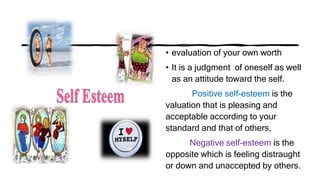
• evaluation of your own worth
• It is a judgment of oneself as well
as an attitude toward the self.
Positive self-esteem is the
valuation that is pleasing and
acceptable according to your
standard and that of others,
Negative self-esteem is the
opposite which is feeling distraught
or down and unaccepted by others.
Factors to identify the level of self-esteem
• own appearance –
• how satisfied you are in a relationship; and –
• how you view your performance.
•
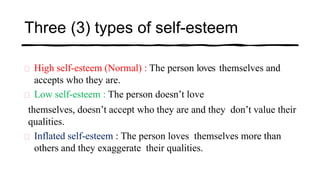
Three (3) types of self-esteem
• Persons can
High self-esteem (Normal) : The person loves themselves and
accepts who they are.
Low self-esteem : The person doesn’t love
themselves, doesn’t accept who they are and they don’t value their
qualities.
Inflated self-esteem : The person loves themselves more than
others and they exaggerate their qualities.
Self-efficacy
• not considered as a trait. “[It] does not refer to your
abilities but rather to your beliefs about what you
can do with your abilities” (Stajkovic & Luthans,
1998).
• It is your will to produce an effect on a specific
thing.
• It is your self-belief to effectively achieve your
most important goal.
• The stronger the belief, the bigger the possibility
to achieve a positive result.
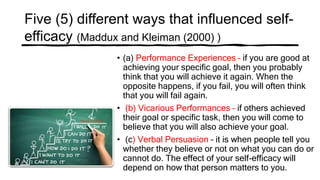
Five (5) different ways that influenced self-
efficacy (Maddux and Kleiman (2000) )
• (a) Performance Experiences – if you are good at
achieving your specific goal, then you probably
think that you will achieve it again. When the
opposite happens, if you fail, you will often think
that you will fail again.
• (b) Vicarious Performances – if others achieved
their goal or specific task, then you will come to
believe that you will also achieve your goal.
• (c) Verbal Persuasion – it is when people tell you
whether they believe or not on what you can do or
cannot do. The effect of your self-efficacy will
depend on how that person matters to you.
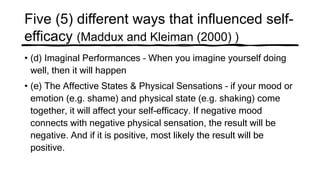
Five (5) different ways that influenced self-
efficacy (Maddux and Kleiman (2000) )
• (d) Imaginal Performances – When you imagine yourself doing
well, then it will happen
• (e) The Affective States & Physical Sensations – if your mood or
emotion (e.g. shame) and physical state (e.g. shaking) come
together, it will affect your self-efficacy. If negative mood
connects with negative physical sensation, the result will be
negative. And if it is positive, most likely the result will be
positive.
Self identity
Self and Identity
1. Self as Social Actor
We are portraying different roles and behaving for every type/set of
people in front of us since we all care about what people think about us. It is
practically for social acceptance.
2. Self as Motivated Agent
People act based on their purpose. They do things based on their own
dreams, desires, and planned goals for the future. This, though, is not easily
identifiable since it is self-conceptualized, unless it was shared with us.
3. Self as Autobiographical Author
He/she as the creator of his/her own entire life story. It is about how
oneself is developed from his/her past, up to the present, and what he/she will
become in the future.
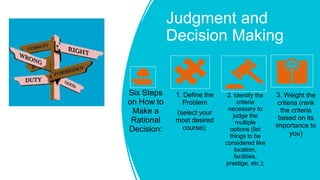
Judgment and
Decision Making
Six Steps
on How to
Make a
Rational
Decision:
1. Define the
Problem
(select your
most desired
course);
2. Identify the
criteria
necessary to
judge the
multiple
options (list
things to be
considered like
location,
facilities,
prestige, etc.);
3. Weight the
criteria (rank
the criteria
based on its
importance to
you)
Judgment and
Decision Making
Six Steps
on How to
Make a
Rational
Decision:
1. Define the
Problem
(select your
most desired
course);
2. Identify the
criteria
necessary to
judge the
multiple
options (list
things to be
considered like
location,
facilities,
prestige, etc.);
3. Weight the
criteria (rank
the criteria
based on its
importance to
you)
Judgment and Decision Making
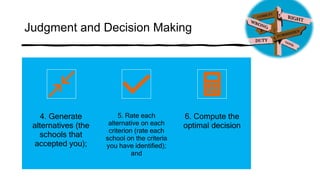
4. Generate
alternatives (the
schools that
accepted you);
5. Rate each
alternative on each
criterion (rate each
school on the criteria
you have identified);
and
6. Compute the
optimal decision
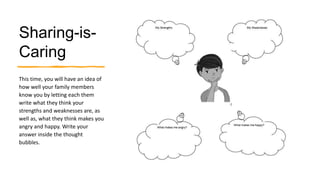
Sharing-is-
Caring
This time, you will have an idea of
how well your family members
know you by letting each them
write what they think your
strengths and weaknesses are, as
well as, what they think makes you
angry and happy. Write your
answer inside the thought
bubbles.
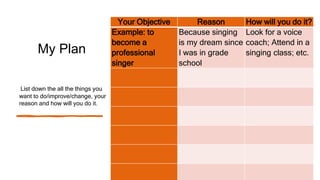
My Plan
List down the all the things you
want to do/improve/change, your
reason and how will you do it.
Your Objective Reason How will you do it?
Example: to
become a
professional
singer
Because singing
is my dream since
I was in grade
school
Look for a voice
coach; Attend in a
singing class; etc.
“What matters
most is how you
see yourself”

Lesson 2 Perdev.pptx

  • 1.
    Lesson 2: KnowingOneself – Characteristics, Habits, and Experiences
  • 2.
    Who Am I? 1.What are the things or who are the people that/who make you feel confident? _________________________________________________________________________ __ _________________________________________________________________________ __ 2. What makes you doubtful to yourself? _________________________________________________________________________ __ _________________________________________________________________________ __ 3. How do thoughts of other people about you affect your mood? _________________________________________________________________________ __ _________________________________________________________________________ __
  • 3.
    • evaluation ofyour own worth • It is a judgment of oneself as well as an attitude toward the self. Positive self-esteem is the valuation that is pleasing and acceptable according to your standard and that of others, Negative self-esteem is the opposite which is feeling distraught or down and unaccepted by others.
  • 4.
    Factors to identifythe level of self-esteem • own appearance – • how satisfied you are in a relationship; and – • how you view your performance. •
  • 5.
    Three (3) typesof self-esteem • Persons can High self-esteem (Normal) : The person loves themselves and accepts who they are. Low self-esteem : The person doesn’t love themselves, doesn’t accept who they are and they don’t value their qualities. Inflated self-esteem : The person loves themselves more than others and they exaggerate their qualities.
  • 7.
    Self-efficacy • not consideredas a trait. “[It] does not refer to your abilities but rather to your beliefs about what you can do with your abilities” (Stajkovic & Luthans, 1998). • It is your will to produce an effect on a specific thing. • It is your self-belief to effectively achieve your most important goal. • The stronger the belief, the bigger the possibility to achieve a positive result.
  • 8.
    Five (5) differentways that influenced self- efficacy (Maddux and Kleiman (2000) ) • (a) Performance Experiences – if you are good at achieving your specific goal, then you probably think that you will achieve it again. When the opposite happens, if you fail, you will often think that you will fail again. • (b) Vicarious Performances – if others achieved their goal or specific task, then you will come to believe that you will also achieve your goal. • (c) Verbal Persuasion – it is when people tell you whether they believe or not on what you can do or cannot do. The effect of your self-efficacy will depend on how that person matters to you.
  • 9.
    Five (5) differentways that influenced self- efficacy (Maddux and Kleiman (2000) ) • (d) Imaginal Performances – When you imagine yourself doing well, then it will happen • (e) The Affective States & Physical Sensations – if your mood or emotion (e.g. shame) and physical state (e.g. shaking) come together, it will affect your self-efficacy. If negative mood connects with negative physical sensation, the result will be negative. And if it is positive, most likely the result will be positive.
  • 10.
  • 11.
    Self and Identity 1.Self as Social Actor We are portraying different roles and behaving for every type/set of people in front of us since we all care about what people think about us. It is practically for social acceptance. 2. Self as Motivated Agent People act based on their purpose. They do things based on their own dreams, desires, and planned goals for the future. This, though, is not easily identifiable since it is self-conceptualized, unless it was shared with us. 3. Self as Autobiographical Author He/she as the creator of his/her own entire life story. It is about how oneself is developed from his/her past, up to the present, and what he/she will become in the future.
  • 12.
    Judgment and Decision Making SixSteps on How to Make a Rational Decision: 1. Define the Problem (select your most desired course); 2. Identify the criteria necessary to judge the multiple options (list things to be considered like location, facilities, prestige, etc.); 3. Weight the criteria (rank the criteria based on its importance to you)
  • 13.
    Judgment and Decision Making SixSteps on How to Make a Rational Decision: 1. Define the Problem (select your most desired course); 2. Identify the criteria necessary to judge the multiple options (list things to be considered like location, facilities, prestige, etc.); 3. Weight the criteria (rank the criteria based on its importance to you)
  • 14.
    Judgment and DecisionMaking 4. Generate alternatives (the schools that accepted you); 5. Rate each alternative on each criterion (rate each school on the criteria you have identified); and 6. Compute the optimal decision
  • 15.
    Sharing-is- Caring This time, youwill have an idea of how well your family members know you by letting each them write what they think your strengths and weaknesses are, as well as, what they think makes you angry and happy. Write your answer inside the thought bubbles.
  • 16.
    My Plan List downthe all the things you want to do/improve/change, your reason and how will you do it. Your Objective Reason How will you do it? Example: to become a professional singer Because singing is my dream since I was in grade school Look for a voice coach; Attend in a singing class; etc.
  • 17.
    “What matters most ishow you see yourself”

Editor's Notes

  • #2 Adolescence is the period when a young individual develops from a child into an adult. There are a lot of changes that happen to an adolescent like you and some of those are: how you look, how you take your role in the community, how other people expect you in making decisions on your own, and how you perceive yourself. Although the "Self" is one of the determinants of what we thought about ourselves, it is also the result of what we think and/or do. Many people believe that we are the product of our own experiences. Those experiences shape our unique qualities and habits that define who we as a person and differ from others. Your features or own qualities that made you a unique are characteristics; when you do something repeatedly and regularly it is a habit; and experiences are the skills or knowledge you have gained because you have done it already from the past. Now let us focus on when and how our characteristics, habits, and experiences develop and manifest by identifying some of the factors that may affect a person’s “Self” -- the foundation of all human behavior. It is our sense of identity and of who we are as an individual (James 1890; Mead, 1934).
  • #5 Our self-esteem may change from time to time depending on the situation we encounter in our daily life. Since it can be partly a trait that someone can possess. It depends on how you perceive the things coming your way.
  • #9 Maddux and Kleiman (2000) define and explain the five (5) different ways that influenced self-efficacy beliefs from the ideas of Albert Badura, a professor and a psychologist.
  • #10 Maddux and Kleiman (2000) define and explain the five (5) different ways that influenced self-efficacy beliefs from the ideas of Albert Badura, a professor and a psychologist.
  • #12 Have you tried to talk to yourself in front of the mirror? What did you see? According to William James, a psychologist, “the self is what happens when I reflect upon ME". Taylor (1989) described the self as a Reflective Project. How we see ourselves is geared toward improving ourselves depending on a lot of factors. Dan McAdam, a psychologist, reiterated that even there are many ways on how we reflect to improve ourselves, it brings us back to these three (3) categories: