LET'S LEARN!
E D U C A T I O N A N D L E A R N I N G P R E S E N T A T I O N
RIMBERIO CO
PERSONAL
DEVELOPMENT
LESSON 1:
KNOWING ONESELF
RIMBERIO CO
As an individual, we commonly see other
people’s manner of doing things, belief, and
lifestyle. Most of the time, we give comments
and/or judgment on how they behave and react
in certain scenarios. However, it is observed
that most people find it hard to make good and
sound evaluation towards their own behavior,
traits and personality. In this lesson, we will try
to know ourselves better by having careful
reflections on how we see ourselves as an
individual and understanding our characters
particularly as young and late adolescent as
part of the developmental stages of man.
Start knowing yourself better. Kindly work with a partner (anyone who is available to
give you some assistance) and assess how well you know yourself by listing down
your values, characteristics and/or traits using the Four Quadrants of Oneself. (Be
guided by the instructions below.) Be able to discuss to your teacher/guide or
partner/buddy the result of this activity using your output.
RIMBERIO CO
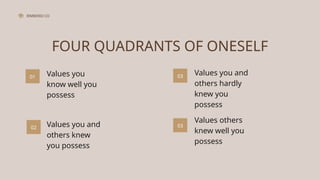
FOUR QUADRANTS OF ONESELF
01 Values you
know well you
possess
02
03
03
Values you and
others knew
you possess
Values others
knew well you
possess
Values you and
others hardly
knew you
possess
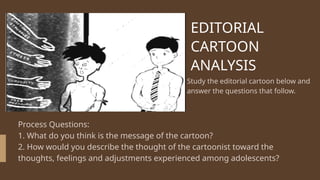
EDITORIAL
CARTOON
ANALYSIS
Study the editorial cartoon below and
answer the questions that follow.
Process Questions:
1. What do you think is the message of the cartoon?
2. How would you describe the thought of the cartoonist toward the
thoughts, feelings and adjustments experienced among adolescents?
DISCUSSION...
The activity enables you to express yourself by digging deeper to
your own point of view on the things around you.
In this lesson you will get to understand some philosophies
discussing the principles of knowing oneself and later have a
clear perspective of your own personalities. Let's begin with
defining Self-Development
is a process of discovering
oneself by realizing one's
potentials and capabilities that
are shaped over time either by
studying in a formal school or
through environmental factors
SELF-DEVELOPMENT
is an old maxim or aphorism
which in time has been used in
varied literature and
consequently gained different
meanings
KNOW THYSELF
“An unexamined life
is not worth living” -
Socrates
is one’s abstract and general idea about
him/herself particularly toward his/her unique
personality and his/her own perception about
his/her set of values, point of views and behavior
SELF-CONCEPT
This means that it is in the mind that we know
everything about ourselves like our identity,
passion, interest, feelings, and/or intellect, thus
everything that we are comes from the mind.
SELF-CONCEPT
THREE COMPONENTS OF
PERSONALITY
to satisfy man's desire without thinking
much of the situation
ID, EGO, AND SUPEREGO
ID
EGO
give a more socially accepted means of getting
the desires and wants of a person without
getting to hurt others feelings.
SUPEREGO
superego directs a man’s life in order for him
to avoid hurting
DISCUSSING AND
UNDERSTANDING THE TERMS
ANF PHILOSOPHIES OF
KNOWING ONESELF
1. Self-Development
2. Knowing Thyself
3. Id
4. Ego
5. Superego
DISCUSS THE PASSAGE
“Knowing others is
intelligence; knowing yourself
is true wisdom. Mastering
others is strength; mastering
yourself is true power.” -Lao
Tzu
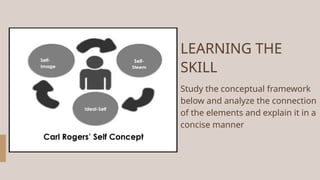
LEARNING THE
SKILL
Study the conceptual framework
below and analyze the connection
of the elements and explain it in a
concise manner
Share his/her unique
characteristics, habits, and
experiences.
Objective:
Self-awareness is an understanding of oneself as unique from others.
As an individual, we commonly observe, and undeniably judge other
people’s manners, beliefs, and lifestyle. However, it can be perceived,
though, that most people find it hard to make good and sound
evaluation toward their own behavior, traits, and personality. In this
lesson, we will try to know ourselves better by having careful reflections
on how we see ourselves as an individual and understanding our
characters particularly as young and late adolescent.
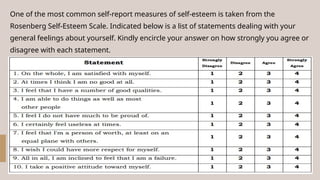
One of the most common self-report measures of self-esteem is taken from the
Rosenberg Self-Esteem Scale. Indicated below is a list of statements dealing with your
general feelings about yourself. Kindly encircle your answer on how strongly you agree or
disagree with each statement.
Guide Questions:
1. What item do you find comfortable to
answer?
2. Does this activity determine your
general feelings? Why or why not?
Adolescence is the period when a young
individual develops from a child into an adult.
There are many changes that can happen to an
adolescent like you and some of those are: how
you look, how you take your role in the
community, how other people expect you in
making decisions on your own, and how you
perceive yourself. Although the "Self" is one of
the factors of what we thought about ourselves,
it is also the result of what we think and/or do.
Now let us focus on when and how our
characteristics, habits, and experiences develop
and manifest by identifying some of the factors
that may affect a person’s “Self”.
Self-Esteem
Self-esteem is your evaluation of your own
worth. It may be positive or negative. Positive
self-esteem is the valuation that is pleasing and
acceptable according to your standard and that
of others, while negative self-esteem is the
opposite which is feeling distraught or down and
unaccepted by others. Our self-concept will
contain many positive thoughts and we will have
high self-esteem if we have completed an
Self-Efficacy
Efficacy has a specific impact on behavior and
emotions, allowing people to effectively manage
problems and achieve desired outcomes. It is
your desire to influence something specific. It's a
self-confidence in your ability to attain your most
significant goal. The greater the likelihood of
achieving a positive outcome, the stronger the
belief. For example, if you want to get a better
grade and are secure in your belief, it will
Self-Efficacy
You can perform a certain job or achieving a specific goal by
means of these five (5) different ways that influenced self-efficacy,
from the ideas of Albert Badura, a professor, and a psychologist.
(a)Performance Experiences – if you are good at achieving your
specific goal, then you probably think that you will achieve it
again. When the opposite happens, if you fail, you will often
think that you will fail again.
(b)Vicarious Performances – if others achieved their goal or
specific task, then you'll come to believe that you will also
achieve your goal.
(c) Verbal Persuasion – it is when people tell you whether they
believe or not on what you can do or cannot do. The effect of
your self-efficacy will depend on how that person matters to
Self and Identity
Have you tried to talk with yourself in front of the mirror?
What did you see?
According to William James, a psychologist, “the self is
what happens when I reflect upon ME".
Taylor described the self as a Reflective Project. How we
see ourselves is geared toward improving ourselves
depending on a lot of factors.
Dan McAdam, a psychologist, reiterated that even there are
many ways on how we reflect to improve ourselves, it brings
us back to these three (3) categories:
1. Self as Social Actor - We are portraying different roles
and behaving for every type/set of people in front of us
since we all care about what people think about us. It is
Judgment and Decision
Making
As an individual, you are expected to act and decide on your
own. Most people tend to decide based on the intuitions
and available information that could be a hindrance in
making a wise decision and that could be a habit.
For instance, you applied for different courses in six (6)
different universities, and you were able to qualify in all.
Now, how will you decide? To help you, the idea of
Bazerman and Moore in 2013 reiterated by Jhangiani that
suggests the Six Steps on How to Make a Rational Decision:
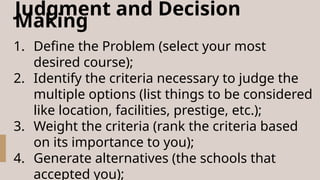
Judgment and Decision
Making
1. Define the Problem (select your most
desired course);
2. Identify the criteria necessary to judge the
multiple options (list things to be considered
like location, facilities, prestige, etc.);
3. Weight the criteria (rank the criteria based
on its importance to you);
4. Generate alternatives (the schools that
accepted you);
You now have the idea on how things affect
oneself. Knowing those factors, aspects,
indicators, and ways to know yourself better was
just an instrument to help you be able to meet
and embrace your being.
Who you are, what you do, and what you have
been through are ultimate reasons why you are
unique from others.
This activity will let you dig deeper by
“Me, Myself and I”
Think of a particular situation that you
have been required to decide on your
own for a very important matter.
1. What makes you doubtful to yourself?
2. For that instance, how the thoughts
of other people about you affect your
mood?
Some “One” Dear
You learned from the previous text that Self is a “Reflective
Project”. We do reflective assessment, and we keep on
trying to change ourselves for what we think is the best. Big
part of the reflecting process are considerations like how
you think people perceive you. However, sometimes you
could get so caught up with a lot of things that you tend to
fail to formally project yourself to others.
This activity will open the chance for you to tell everything
that you want to say to a person dear to you. You are tasked
to create a letter for someone that matters to you. Share all
your learnings, your discovered characteristics, habits, and
experiences that you failed to tell him/her before.

1. KNOWING ONESELF of Personal Development

  • 1.
    LET'S LEARN! E DU C A T I O N A N D L E A R N I N G P R E S E N T A T I O N RIMBERIO CO
  • 2.
  • 3.
    RIMBERIO CO As anindividual, we commonly see other people’s manner of doing things, belief, and lifestyle. Most of the time, we give comments and/or judgment on how they behave and react in certain scenarios. However, it is observed that most people find it hard to make good and sound evaluation towards their own behavior, traits and personality. In this lesson, we will try to know ourselves better by having careful reflections on how we see ourselves as an individual and understanding our characters particularly as young and late adolescent as part of the developmental stages of man.
  • 4.
    Start knowing yourselfbetter. Kindly work with a partner (anyone who is available to give you some assistance) and assess how well you know yourself by listing down your values, characteristics and/or traits using the Four Quadrants of Oneself. (Be guided by the instructions below.) Be able to discuss to your teacher/guide or partner/buddy the result of this activity using your output.
  • 5.
    RIMBERIO CO FOUR QUADRANTSOF ONESELF 01 Values you know well you possess 02 03 03 Values you and others knew you possess Values others knew well you possess Values you and others hardly knew you possess
  • 6.
    EDITORIAL CARTOON ANALYSIS Study the editorialcartoon below and answer the questions that follow. Process Questions: 1. What do you think is the message of the cartoon? 2. How would you describe the thought of the cartoonist toward the thoughts, feelings and adjustments experienced among adolescents?
  • 7.
    DISCUSSION... The activity enablesyou to express yourself by digging deeper to your own point of view on the things around you. In this lesson you will get to understand some philosophies discussing the principles of knowing oneself and later have a clear perspective of your own personalities. Let's begin with defining Self-Development
  • 8.
    is a processof discovering oneself by realizing one's potentials and capabilities that are shaped over time either by studying in a formal school or through environmental factors SELF-DEVELOPMENT
  • 9.
    is an oldmaxim or aphorism which in time has been used in varied literature and consequently gained different meanings KNOW THYSELF “An unexamined life is not worth living” - Socrates
  • 10.
    is one’s abstractand general idea about him/herself particularly toward his/her unique personality and his/her own perception about his/her set of values, point of views and behavior SELF-CONCEPT
  • 11.
    This means thatit is in the mind that we know everything about ourselves like our identity, passion, interest, feelings, and/or intellect, thus everything that we are comes from the mind. SELF-CONCEPT
  • 12.
    THREE COMPONENTS OF PERSONALITY tosatisfy man's desire without thinking much of the situation ID, EGO, AND SUPEREGO ID EGO give a more socially accepted means of getting the desires and wants of a person without getting to hurt others feelings. SUPEREGO superego directs a man’s life in order for him to avoid hurting
  • 13.
    DISCUSSING AND UNDERSTANDING THETERMS ANF PHILOSOPHIES OF KNOWING ONESELF 1. Self-Development 2. Knowing Thyself 3. Id 4. Ego 5. Superego
  • 14.
    DISCUSS THE PASSAGE “Knowingothers is intelligence; knowing yourself is true wisdom. Mastering others is strength; mastering yourself is true power.” -Lao Tzu
  • 15.
    LEARNING THE SKILL Study theconceptual framework below and analyze the connection of the elements and explain it in a concise manner
  • 16.
    Share his/her unique characteristics,habits, and experiences. Objective:
  • 17.
    Self-awareness is anunderstanding of oneself as unique from others. As an individual, we commonly observe, and undeniably judge other people’s manners, beliefs, and lifestyle. However, it can be perceived, though, that most people find it hard to make good and sound evaluation toward their own behavior, traits, and personality. In this lesson, we will try to know ourselves better by having careful reflections on how we see ourselves as an individual and understanding our characters particularly as young and late adolescent.
  • 18.
    One of themost common self-report measures of self-esteem is taken from the Rosenberg Self-Esteem Scale. Indicated below is a list of statements dealing with your general feelings about yourself. Kindly encircle your answer on how strongly you agree or disagree with each statement.
  • 19.
    Guide Questions: 1. Whatitem do you find comfortable to answer? 2. Does this activity determine your general feelings? Why or why not?
  • 20.
    Adolescence is theperiod when a young individual develops from a child into an adult. There are many changes that can happen to an adolescent like you and some of those are: how you look, how you take your role in the community, how other people expect you in making decisions on your own, and how you perceive yourself. Although the "Self" is one of the factors of what we thought about ourselves, it is also the result of what we think and/or do. Now let us focus on when and how our characteristics, habits, and experiences develop and manifest by identifying some of the factors that may affect a person’s “Self”.
  • 21.
    Self-Esteem Self-esteem is yourevaluation of your own worth. It may be positive or negative. Positive self-esteem is the valuation that is pleasing and acceptable according to your standard and that of others, while negative self-esteem is the opposite which is feeling distraught or down and unaccepted by others. Our self-concept will contain many positive thoughts and we will have high self-esteem if we have completed an
  • 22.
    Self-Efficacy Efficacy has aspecific impact on behavior and emotions, allowing people to effectively manage problems and achieve desired outcomes. It is your desire to influence something specific. It's a self-confidence in your ability to attain your most significant goal. The greater the likelihood of achieving a positive outcome, the stronger the belief. For example, if you want to get a better grade and are secure in your belief, it will
  • 23.
    Self-Efficacy You can performa certain job or achieving a specific goal by means of these five (5) different ways that influenced self-efficacy, from the ideas of Albert Badura, a professor, and a psychologist. (a)Performance Experiences – if you are good at achieving your specific goal, then you probably think that you will achieve it again. When the opposite happens, if you fail, you will often think that you will fail again. (b)Vicarious Performances – if others achieved their goal or specific task, then you'll come to believe that you will also achieve your goal. (c) Verbal Persuasion – it is when people tell you whether they believe or not on what you can do or cannot do. The effect of your self-efficacy will depend on how that person matters to
  • 24.
    Self and Identity Haveyou tried to talk with yourself in front of the mirror? What did you see? According to William James, a psychologist, “the self is what happens when I reflect upon ME". Taylor described the self as a Reflective Project. How we see ourselves is geared toward improving ourselves depending on a lot of factors. Dan McAdam, a psychologist, reiterated that even there are many ways on how we reflect to improve ourselves, it brings us back to these three (3) categories: 1. Self as Social Actor - We are portraying different roles and behaving for every type/set of people in front of us since we all care about what people think about us. It is
  • 25.
    Judgment and Decision Making Asan individual, you are expected to act and decide on your own. Most people tend to decide based on the intuitions and available information that could be a hindrance in making a wise decision and that could be a habit. For instance, you applied for different courses in six (6) different universities, and you were able to qualify in all. Now, how will you decide? To help you, the idea of Bazerman and Moore in 2013 reiterated by Jhangiani that suggests the Six Steps on How to Make a Rational Decision:
  • 26.
    Judgment and Decision Making 1.Define the Problem (select your most desired course); 2. Identify the criteria necessary to judge the multiple options (list things to be considered like location, facilities, prestige, etc.); 3. Weight the criteria (rank the criteria based on its importance to you); 4. Generate alternatives (the schools that accepted you);
  • 27.
    You now havethe idea on how things affect oneself. Knowing those factors, aspects, indicators, and ways to know yourself better was just an instrument to help you be able to meet and embrace your being. Who you are, what you do, and what you have been through are ultimate reasons why you are unique from others. This activity will let you dig deeper by
  • 28.
    “Me, Myself andI” Think of a particular situation that you have been required to decide on your own for a very important matter. 1. What makes you doubtful to yourself? 2. For that instance, how the thoughts of other people about you affect your mood?
  • 29.
    Some “One” Dear Youlearned from the previous text that Self is a “Reflective Project”. We do reflective assessment, and we keep on trying to change ourselves for what we think is the best. Big part of the reflecting process are considerations like how you think people perceive you. However, sometimes you could get so caught up with a lot of things that you tend to fail to formally project yourself to others. This activity will open the chance for you to tell everything that you want to say to a person dear to you. You are tasked to create a letter for someone that matters to you. Share all your learnings, your discovered characteristics, habits, and experiences that you failed to tell him/her before.