UNIT 1: SELF-DEVELOPMENT
MODULE 1:
KNOWING AND UNDERSTANDING ONESELF DURING MIDDLE AND LATE
ADOLESCENCE
Objectives:
At the end of this module, you will be able to:
1. Explain that knowing yourself can make you
accept your strengths and limitations and
dealing with others better;
2. Share your unique characteristics, habits and
experiences; and,
3. Start and maintain a journal.
SELF-CONCEPT
Self-Concept  refers to your awareness
of yourself. The actual self and the ideal
self are two broad categories of self-
concept.
Ideal Self  is the self that you aspire to be. It is the one
that you hope will possess characteristics similar to that
of a mentor or some other worldly figure.
Actual Self  is the one that you actually see. It is the
self that has characteristics that you were nurtured or, in
some cases, born to have. Actual self is built on self-
knowledge.
Self-knowledge is derived from social interactions that
provide insight into how others react to you.
ACTUAL SELF
 Who we actually are.
 How we think, we feel, look, and act.
 Can be seen by others (self-image).
IDEAL SELF
 How we want to be.
 It is an idealized image that we have developed
over time.
 Could include components ow what our parents
have taught us.
 What we admire in others.
 Our society promotes.
 Our best interest.
PERSONAL
EFFECTIVENESS
Personal Effectiveness means
making use of all the personal resources
to enable you to achieve life goals.
 Talents
 Skills
 Energy and Time
TALENT a special and usually inborn
ability.
SKILL the ability to use one’s
knowledge effectively and reality in
execution or performance.
KNOWLEDGE the fact or condition of knowing
something with familiarity gained through
experience or association.
 Being self-aware
 Making the most of your strengths
 Learning new skills and techniques
 Behavioral flexibility
I N N A T E C H A R A C T E R I S T I C S
 Talents first are needed to be identified and then
developed to be used in a particular subject area
(science, literature, sports, politics, etc.).
 Experience includes knowledge and skills that we
acquire in the process of cognitive and practical
activities.
 Knowledge is required for setting goals, defining
an action plan to achieve them and risk
assessment.
 Skills also determine whether real actions are
performed in accordance with the plan.
Skills that will greatly
increase the efficiency
of any person who
owns the:
DETERMINATION
DETERMINATION
 Allows you to focus only on achieving a
specific goal without being distracted by
less important things or spontaneous
desires.
 It may be developed with the help of self-
discipline exercise.
SELF-CONFIDENCE
Self-Confidence
 Appears in the process of personal
development, as a result of getting aware of
yourself, your actions and their
consequences.
 It is manifested in speech, appearance,
dressing, gait, and physical condition.
PERSISTENCE
PERSISTENCE
It makes you keep moving forward
regardless of emerging obstacles.
It can also be developed with the help of
self-discipline exercise.
MANAGING
STRESS
Managing Stress
It helps combat stress that arise in
daily life from the environment and
other people.
Stress arises from the uncertainty in
an unknown situation when a lack of
information creates the risk of
negative consequences of your
actions.
PROBLEM – SOLVING
SKILLS
Problem – Solving Skills
They help cope with the problems
encountered with a lack of experience.
It increases efficiency by adopting new
ways oh achieving goals when obtaining
a new experience.
CREATIVITY
Creativity
It allows you to find extraordinary
ways to carry out a specific action
that no one has tried to use.
Generating Ideas
It helps you achieve goals using
new, original, unconventional ideas.
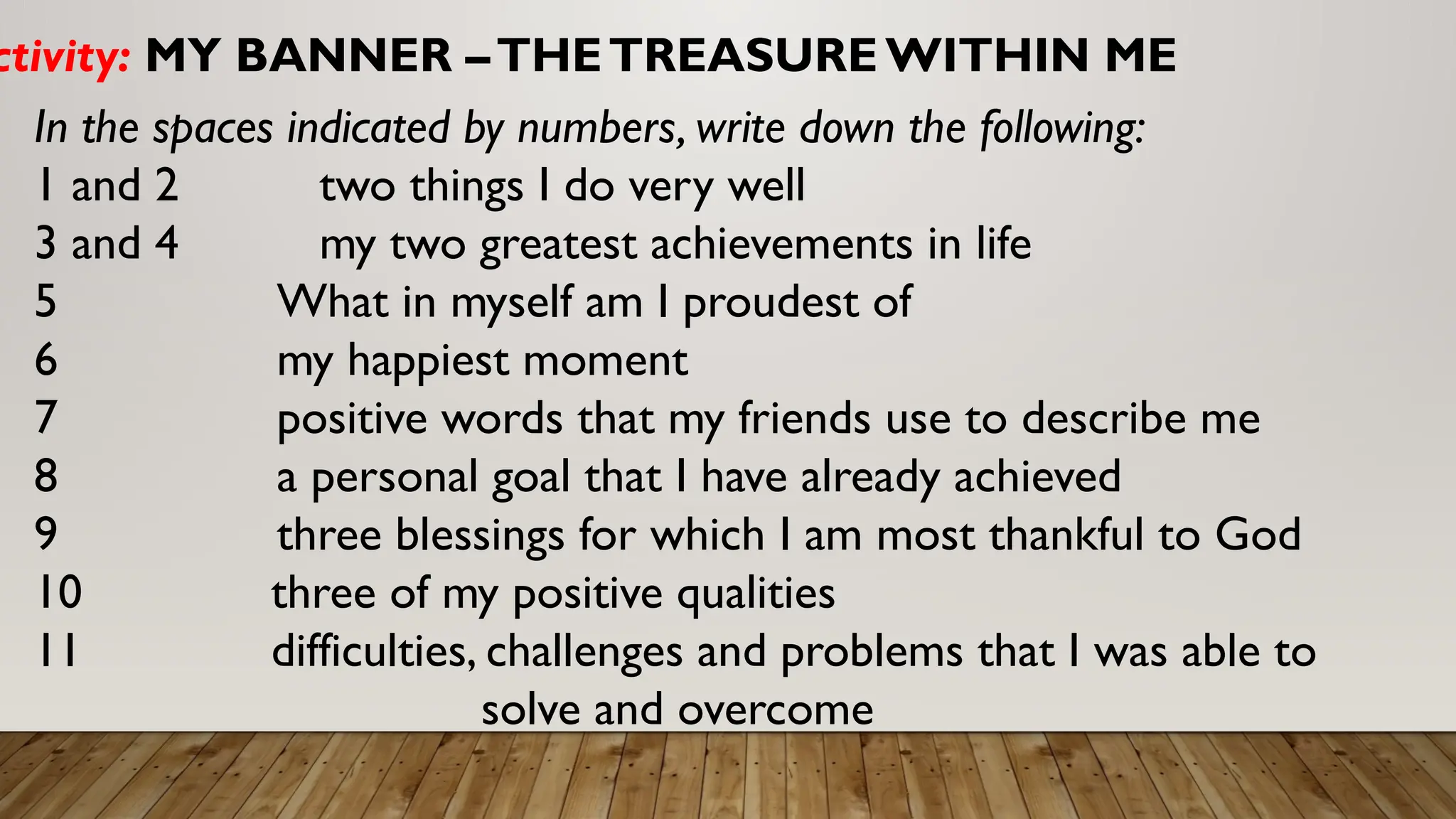
ctivity: MY BANNER –THETREASUREWITHIN ME
In the spaces indicated by numbers, write down the following:
1 and 2 two things I do very well
3 and 4 my two greatest achievements in life
5 What in myself am I proudest of
6 my happiest moment
7 positive words that my friends use to describe me
8 a personal goal that I have already achieved
9 three blessings for which I am most thankful to God
10 three of my positive qualities
11 difficulties, challenges and problems that I was able to
solve and overcome
BUILD ON YOUR
STRENGTHS AND
WORK ON YOUR
WEAKNESSES
FAILURE emanate from
weaknesses that are not
recognized or probably
recognized but not given
appropriate attention or remedy.
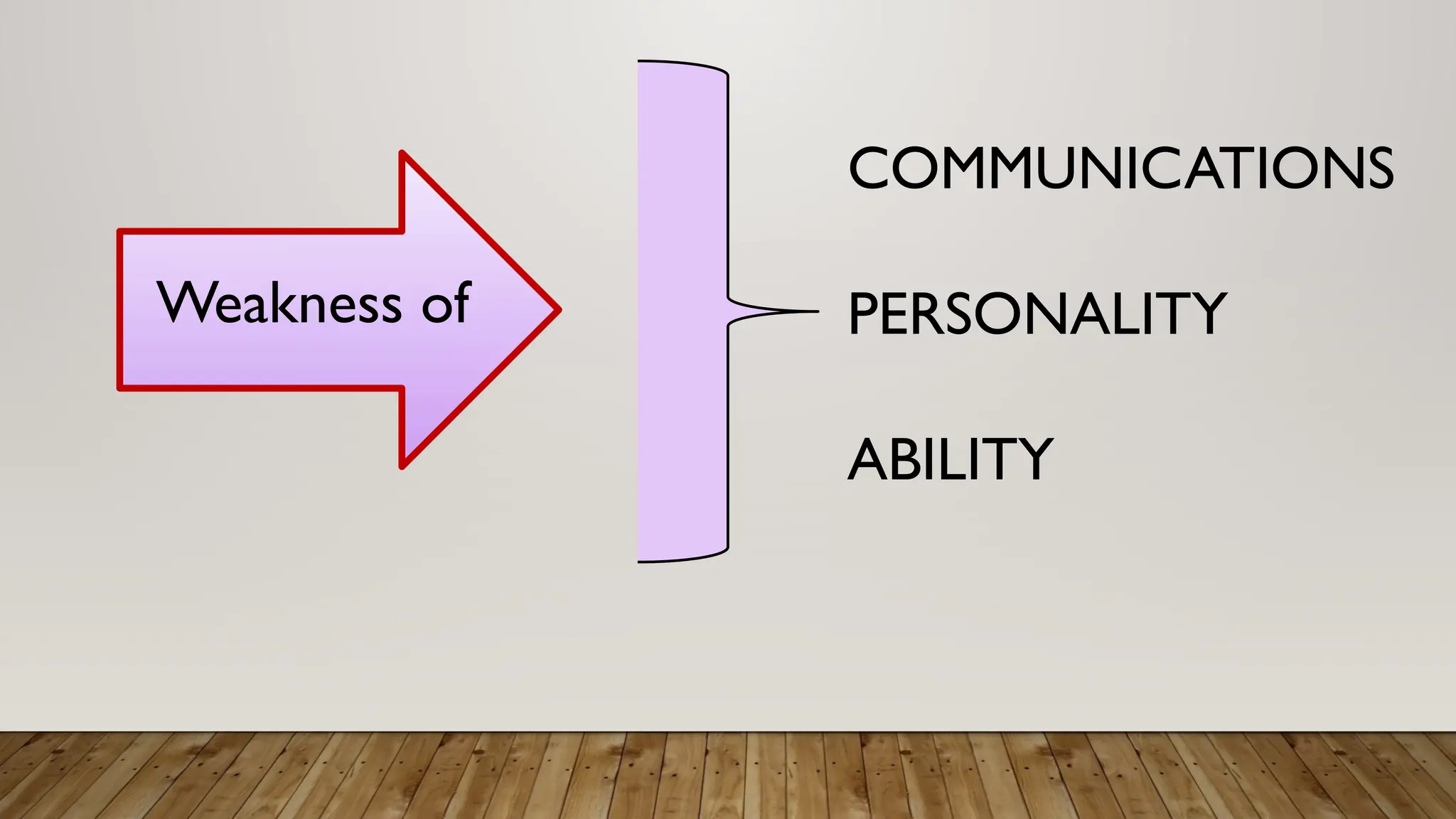
Weakness of
COMMUNICATIONS
PERSONALITY
ABILITY
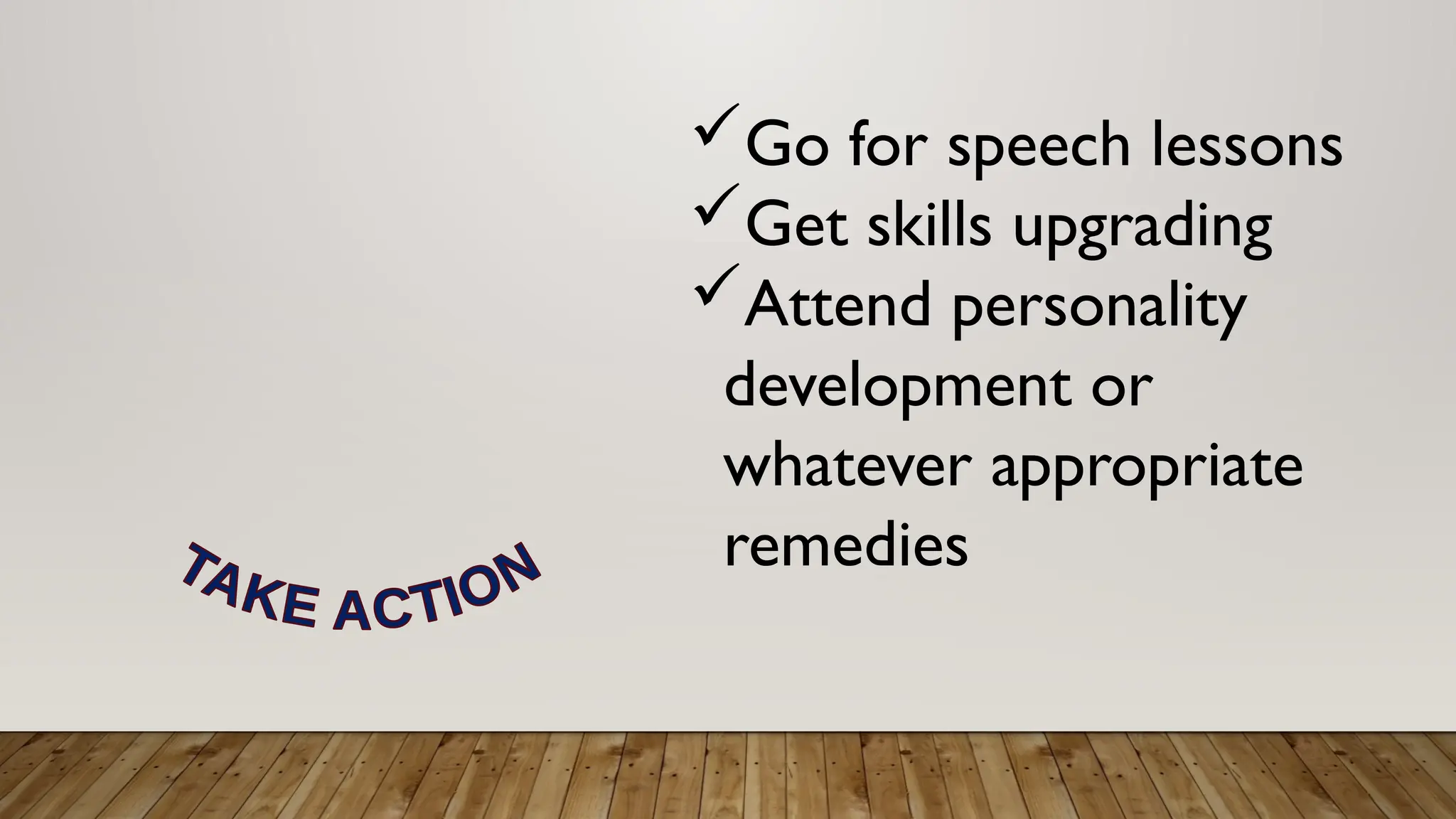
Go for speech lessons
Get skills upgrading
Attend personality
development or
whatever appropriate
remedies
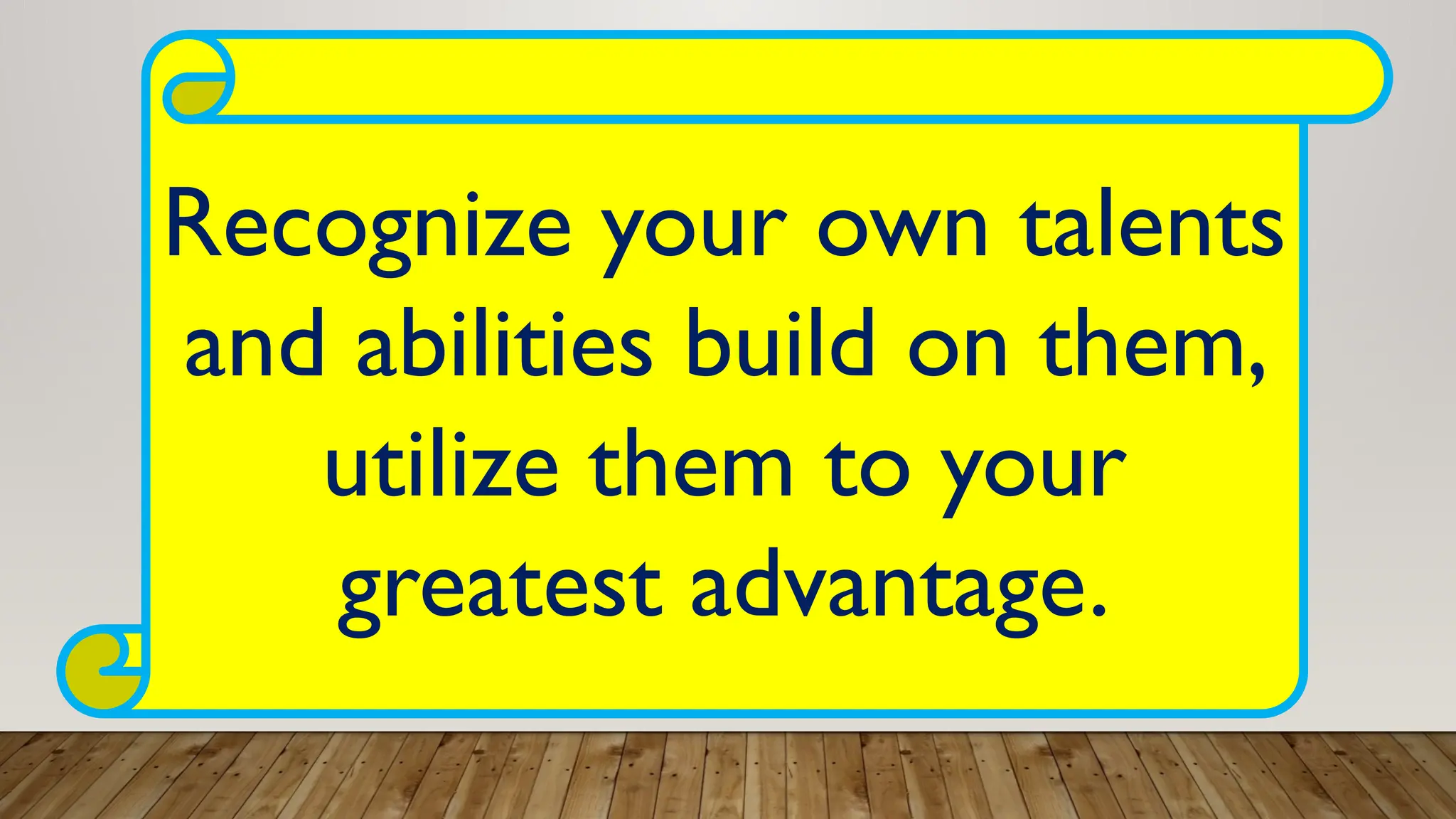
Recognize your own talents
and abilities build on them,
utilize them to your
greatest advantage.
STORY:YOU NEEDTO
TAKE CHARGE OF
YOUR FUTURE
3 KINDS OF
PEOPLE IN THIS
WORLD
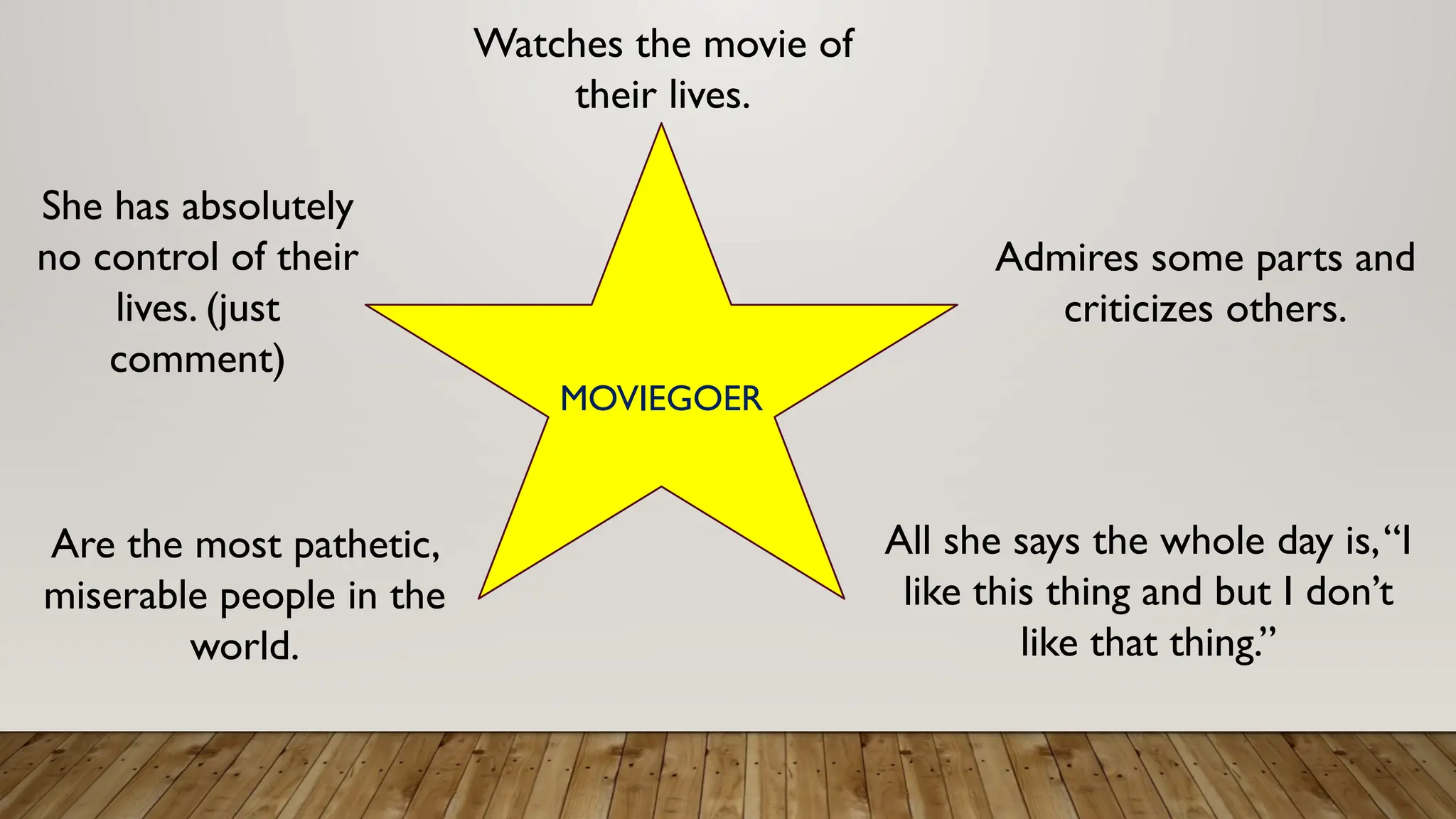
MOVIEGOER
Watches the movie of
their lives.
Admires some parts and
criticizes others.
All she says the whole day is,“I
like this thing and but I don’t
like that thing.”
She has absolutely
no control of their
lives. (just
comment)
Are the most pathetic,
miserable people in the
world.
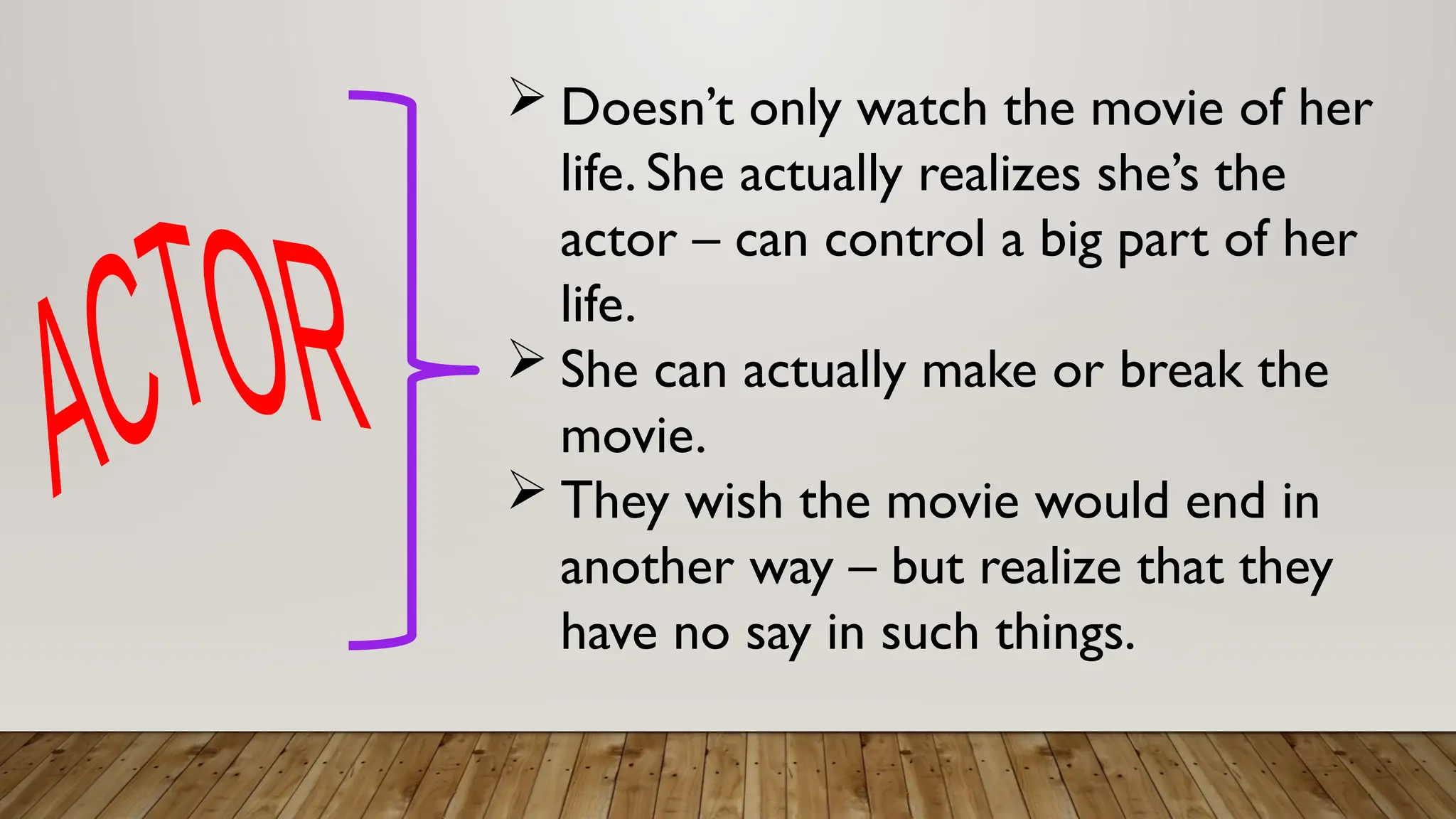
 Doesn’t only watch the movie of her
life. She actually realizes she’s the
actor – can control a big part of her
life.
 She can actually make or break the
movie.
 They wish the movie would end in
another way – but realize that they
have no say in such things.
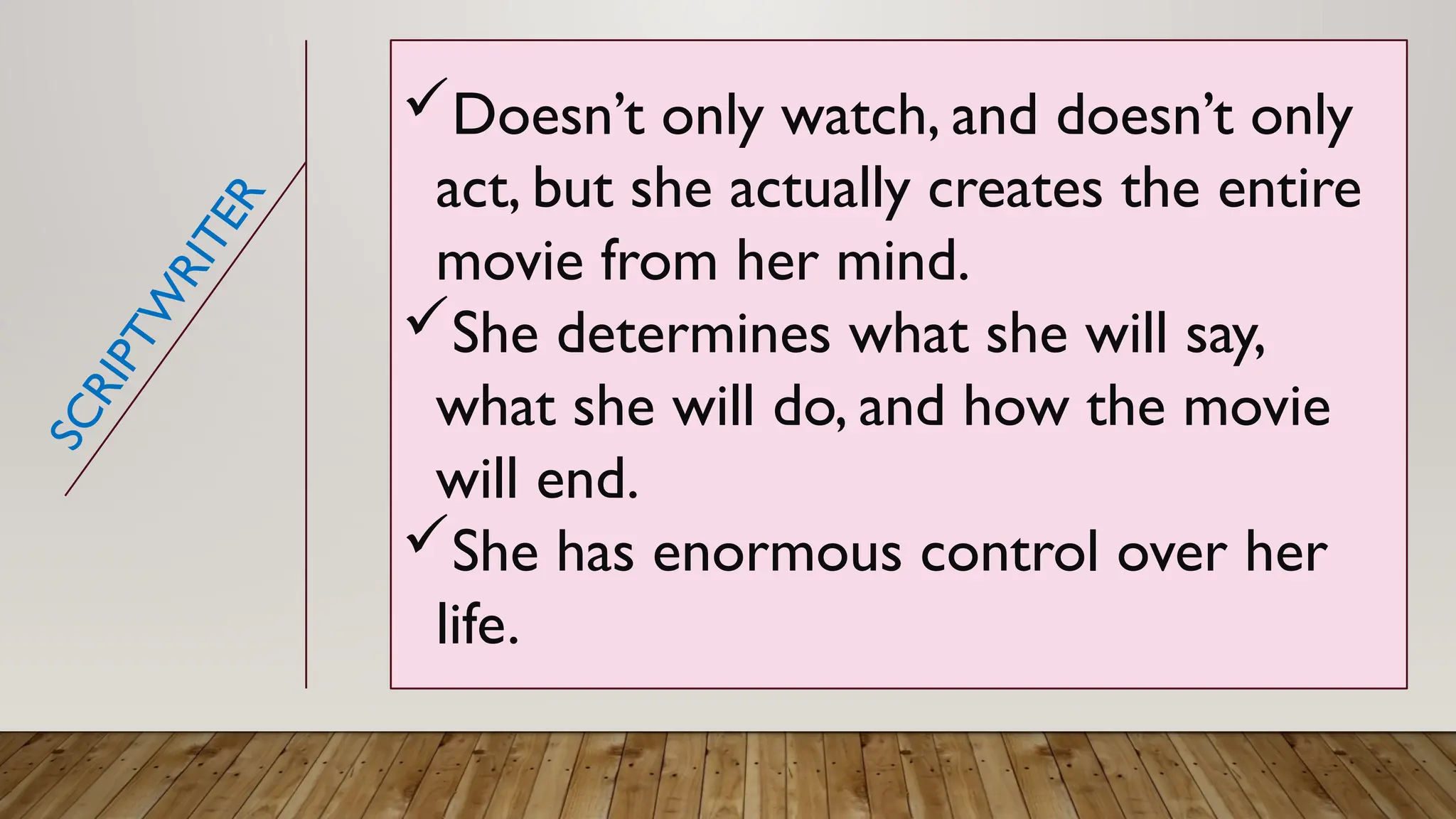
Doesn’t only watch, and doesn’t only
act, but she actually creates the entire
movie from her mind.
She determines what she will say,
what she will do, and how the movie
will end.
She has enormous control over her
life.
S
C
R
I
P
T
W
R
I
T
E
R
Who are you among these three people?
Do you merely watch your life go, why?
Do you act out a script that you feel has
been handed to you?
Do you write the script and make your
life beautiful?
Share your thoughts!!!
THE POWER
OF
JOURNAL WRITING:
UNFOLDING YOUR PERSON AL
JOURNEY
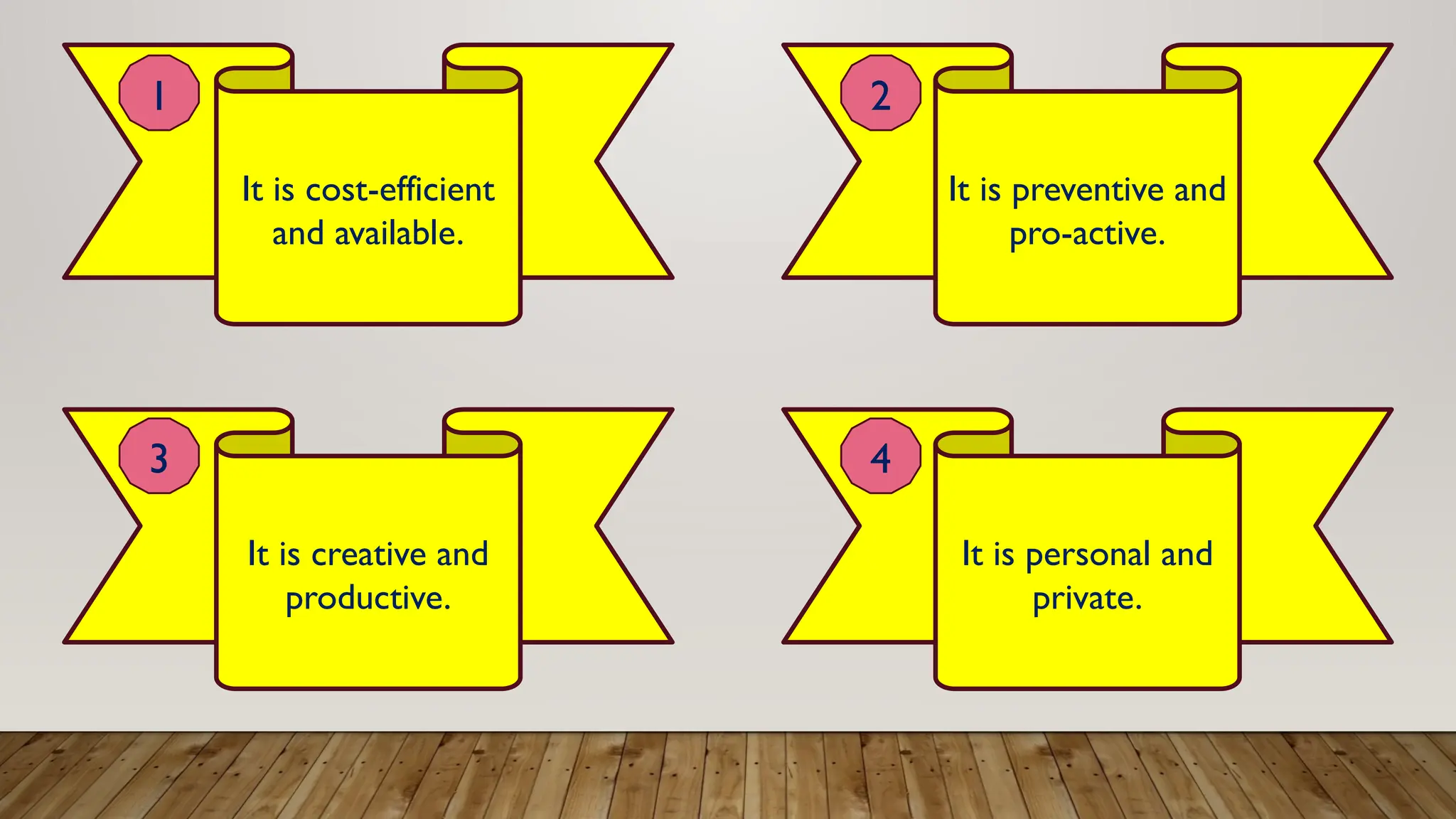
It is cost-efficient
and available.
It is preventive and
pro-active.
It is creative and
productive.
It is personal and
private.
1
3
2
4
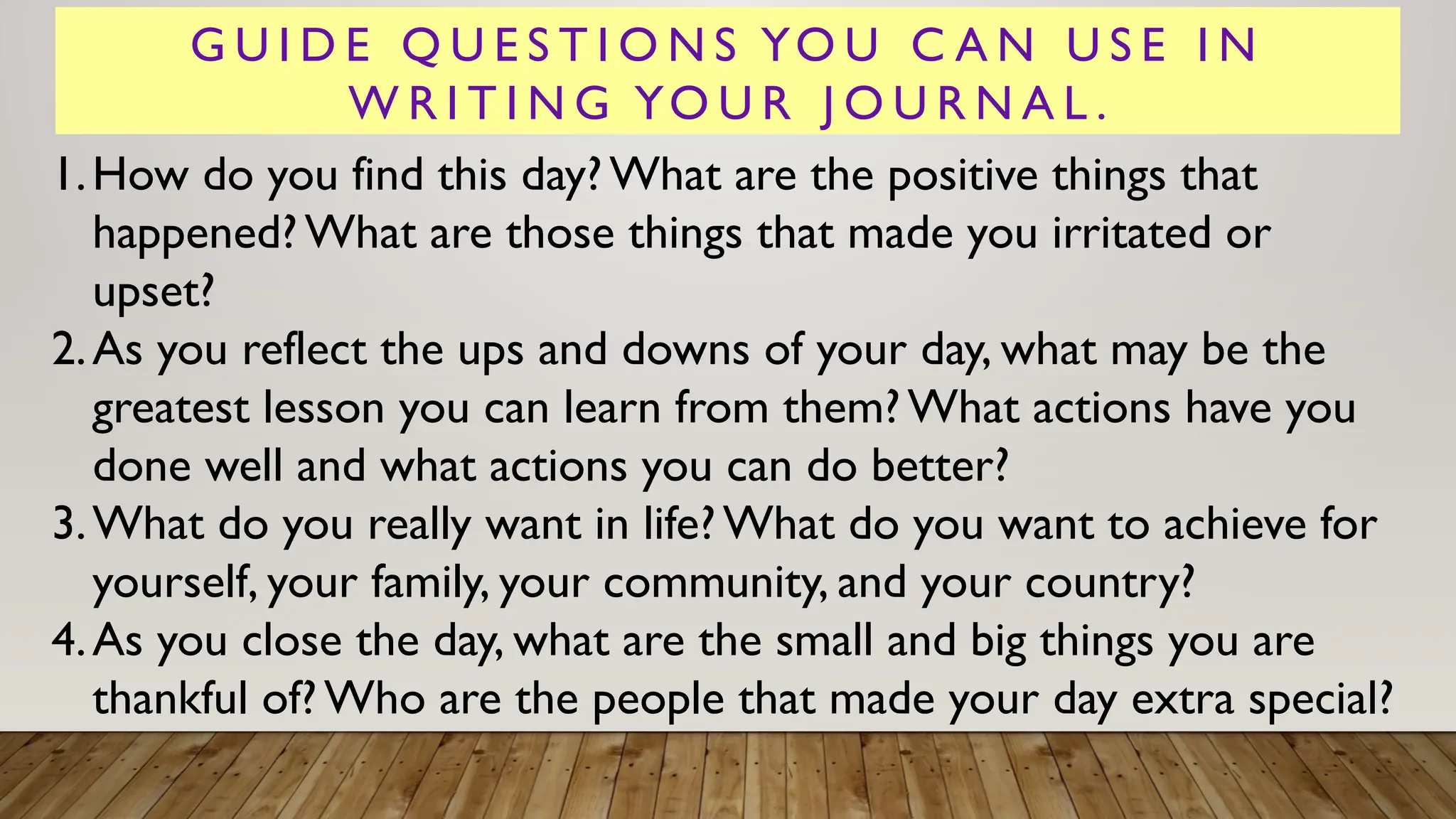
G U I D E Q U E S T I O N S YO U C A N U S E I N
W R I T I N G YO U R J O U R N A L .
1.How do you find this day?What are the positive things that
happened? What are those things that made you irritated or
upset?
2.As you reflect the ups and downs of your day, what may be the
greatest lesson you can learn from them?What actions have you
done well and what actions you can do better?
3.What do you really want in life?What do you want to achieve for
yourself, your family, your community, and your country?
4.As you close the day, what are the small and big things you are
thankful of?Who are the people that made your day extra special?
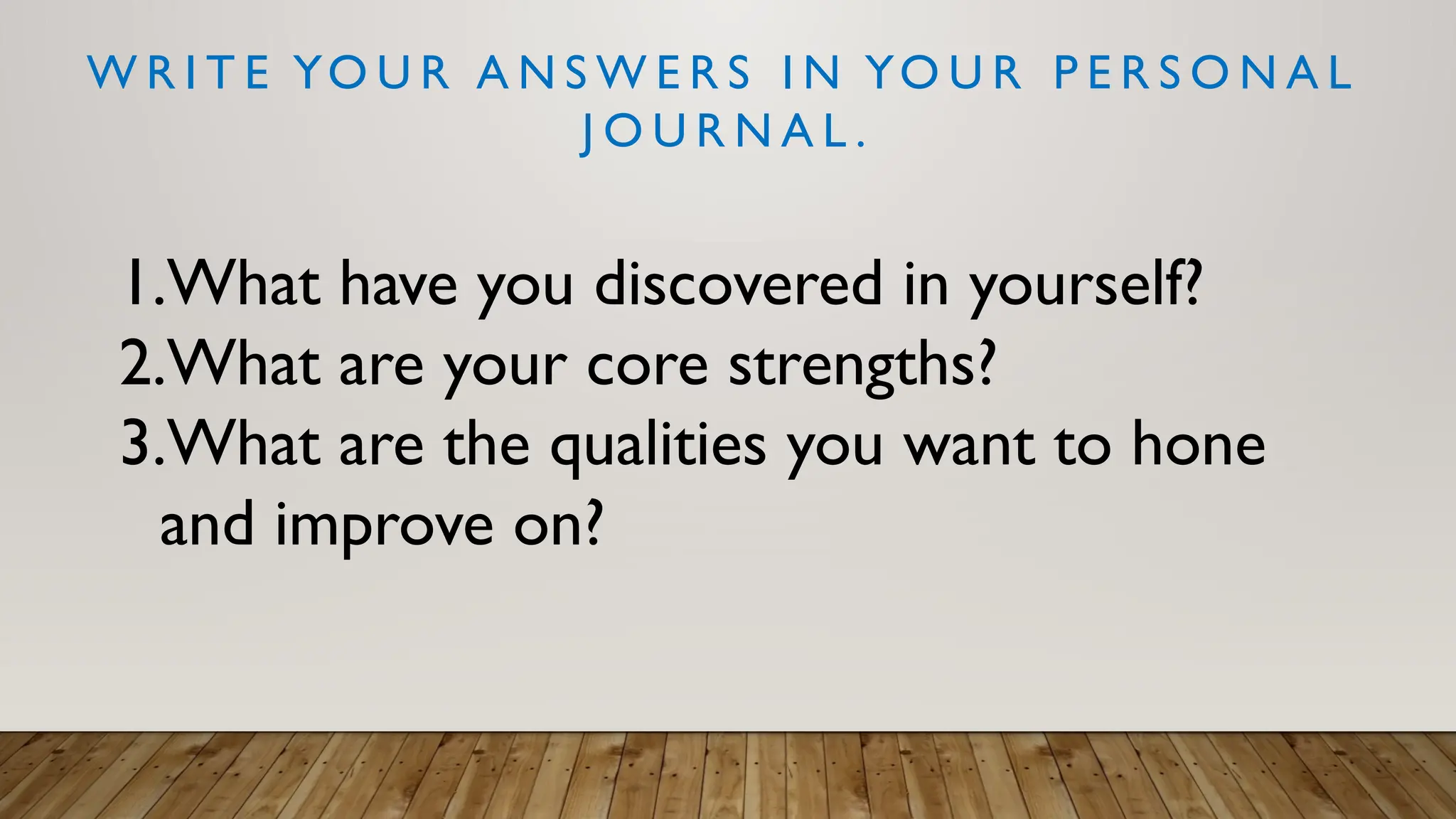
W R I T E YO U R A N S W E R S I N YO U R P E R S O N A L
J O U R N A L .
1.What have you discovered in yourself?
2.What are your core strengths?
3.What are the qualities you want to hone
and improve on?
MODULE 2
D E V E L O P I N G T H E W H O L E P E R S O N
Activity: ASSESS ASPECTS OF YOUR DEVELOPMENT
Draw a large circle on a blank sheet of paper. Divide the circle
into 8 segments. In each segment, write some descriptions of the
different aspects of yourself as follows:
1. Physical Self. Describe yourself.Try not to censor any
thoughts which come to your mind. Include descriptions of your
height, weight, facial appearance, and quality of skin, hair and
descriptions of body areas such as your neck, chest, waist, legs.
2. Intellectual Self. Include here an assessment of how well you
reason and solve problems, your capacity to learn and create, your
general amount of knowledge, your specific areas of knowledge,
wisdom you have acquired, and insights you have.
3. Emotional Self.Write as many words or phrase about typical
feelings you have, feelings you seldom have, feelings you try to avoid,
feelings you especially enjoy, feelings from your past and present, and
feelings which are associated with each other.
4. Sensual Self.Write how you feel as a sensual person.What
sense do you use most – sight, hearing, speaking, smelling, touching?
How do you feel about the different ways you take in information –
through the eyes, ears, mouth, nose, pores, and skin. In what ways do
you let information in and out of your body?
5. Interactional Self. Include descriptions of your strengths and
weaknesses in intimate relationships and relationships to friends,
family, co-students and strangers in social settings. Describe the
strengths and weaknesses which your friend and family have noticed.
Describe what kind of son or daughter, brother or sister you are.
6. Nutritional Self. How do you nourish yourself? What foods do
you like and dislike? What do you like and dislike about these?
7. Contextual Self. Descriptors could be in the areas of
maintenance of your living environment: reaction to light,
temperature, space, weather, colors, sound and seasons and your
impact on the environment.
8. Spiritual Self or Life Force.Write words or phrases which tell
about how you feel in this area.This could include your feelings
about yourself and organized religion, reactions about your spiritual
connections to others, feelings about your spiritual development and
history, and thought about your metaphysical self.Think about your
inner peace and joy.Think about your spiritual regimen or routine.
Per. Dev. Mod. 1 - lesson 1 (module 1).pptx

  • 1.
    UNIT 1: SELF-DEVELOPMENT MODULE1: KNOWING AND UNDERSTANDING ONESELF DURING MIDDLE AND LATE ADOLESCENCE
  • 2.
    Objectives: At the endof this module, you will be able to: 1. Explain that knowing yourself can make you accept your strengths and limitations and dealing with others better; 2. Share your unique characteristics, habits and experiences; and, 3. Start and maintain a journal.
  • 3.
  • 4.
    Self-Concept  refersto your awareness of yourself. The actual self and the ideal self are two broad categories of self- concept.
  • 5.
    Ideal Self is the self that you aspire to be. It is the one that you hope will possess characteristics similar to that of a mentor or some other worldly figure. Actual Self  is the one that you actually see. It is the self that has characteristics that you were nurtured or, in some cases, born to have. Actual self is built on self- knowledge.
  • 6.
    Self-knowledge is derivedfrom social interactions that provide insight into how others react to you. ACTUAL SELF  Who we actually are.  How we think, we feel, look, and act.  Can be seen by others (self-image).
  • 7.
    IDEAL SELF  Howwe want to be.  It is an idealized image that we have developed over time.  Could include components ow what our parents have taught us.  What we admire in others.  Our society promotes.  Our best interest.
  • 8.
  • 9.
    Personal Effectiveness means makinguse of all the personal resources to enable you to achieve life goals.  Talents  Skills  Energy and Time
  • 10.
    TALENT a specialand usually inborn ability. SKILL the ability to use one’s knowledge effectively and reality in execution or performance.
  • 11.
    KNOWLEDGE the factor condition of knowing something with familiarity gained through experience or association.  Being self-aware  Making the most of your strengths  Learning new skills and techniques  Behavioral flexibility
  • 12.
    I N NA T E C H A R A C T E R I S T I C S  Talents first are needed to be identified and then developed to be used in a particular subject area (science, literature, sports, politics, etc.).  Experience includes knowledge and skills that we acquire in the process of cognitive and practical activities.
  • 13.
     Knowledge isrequired for setting goals, defining an action plan to achieve them and risk assessment.  Skills also determine whether real actions are performed in accordance with the plan.
  • 14.
    Skills that willgreatly increase the efficiency of any person who owns the:
  • 15.
  • 16.
    DETERMINATION  Allows youto focus only on achieving a specific goal without being distracted by less important things or spontaneous desires.  It may be developed with the help of self- discipline exercise.
  • 17.
  • 18.
    Self-Confidence  Appears inthe process of personal development, as a result of getting aware of yourself, your actions and their consequences.  It is manifested in speech, appearance, dressing, gait, and physical condition.
  • 19.
  • 20.
    PERSISTENCE It makes youkeep moving forward regardless of emerging obstacles. It can also be developed with the help of self-discipline exercise.
  • 21.
  • 22.
    Managing Stress It helpscombat stress that arise in daily life from the environment and other people.
  • 23.
    Stress arises fromthe uncertainty in an unknown situation when a lack of information creates the risk of negative consequences of your actions.
  • 24.
  • 25.
    Problem – SolvingSkills They help cope with the problems encountered with a lack of experience. It increases efficiency by adopting new ways oh achieving goals when obtaining a new experience.
  • 26.
  • 27.
    Creativity It allows youto find extraordinary ways to carry out a specific action that no one has tried to use.
  • 29.
    Generating Ideas It helpsyou achieve goals using new, original, unconventional ideas.
  • 30.
    ctivity: MY BANNER–THETREASUREWITHIN ME In the spaces indicated by numbers, write down the following: 1 and 2 two things I do very well 3 and 4 my two greatest achievements in life 5 What in myself am I proudest of 6 my happiest moment 7 positive words that my friends use to describe me 8 a personal goal that I have already achieved 9 three blessings for which I am most thankful to God 10 three of my positive qualities 11 difficulties, challenges and problems that I was able to solve and overcome
  • 31.
    BUILD ON YOUR STRENGTHSAND WORK ON YOUR WEAKNESSES
  • 32.
    FAILURE emanate from weaknessesthat are not recognized or probably recognized but not given appropriate attention or remedy.
  • 33.
  • 34.
    Go for speechlessons Get skills upgrading Attend personality development or whatever appropriate remedies
  • 35.
    Recognize your owntalents and abilities build on them, utilize them to your greatest advantage.
  • 36.
  • 37.
    3 KINDS OF PEOPLEIN THIS WORLD
  • 38.
    MOVIEGOER Watches the movieof their lives. Admires some parts and criticizes others. All she says the whole day is,“I like this thing and but I don’t like that thing.” She has absolutely no control of their lives. (just comment) Are the most pathetic, miserable people in the world.
  • 39.
     Doesn’t onlywatch the movie of her life. She actually realizes she’s the actor – can control a big part of her life.  She can actually make or break the movie.  They wish the movie would end in another way – but realize that they have no say in such things.
  • 40.
    Doesn’t only watch,and doesn’t only act, but she actually creates the entire movie from her mind. She determines what she will say, what she will do, and how the movie will end. She has enormous control over her life. S C R I P T W R I T E R
  • 41.
    Who are youamong these three people? Do you merely watch your life go, why? Do you act out a script that you feel has been handed to you? Do you write the script and make your life beautiful? Share your thoughts!!!
  • 42.
  • 43.
    It is cost-efficient andavailable. It is preventive and pro-active. It is creative and productive. It is personal and private. 1 3 2 4
  • 44.
    G U ID E Q U E S T I O N S YO U C A N U S E I N W R I T I N G YO U R J O U R N A L . 1.How do you find this day?What are the positive things that happened? What are those things that made you irritated or upset? 2.As you reflect the ups and downs of your day, what may be the greatest lesson you can learn from them?What actions have you done well and what actions you can do better? 3.What do you really want in life?What do you want to achieve for yourself, your family, your community, and your country? 4.As you close the day, what are the small and big things you are thankful of?Who are the people that made your day extra special?
  • 45.
    W R IT E YO U R A N S W E R S I N YO U R P E R S O N A L J O U R N A L . 1.What have you discovered in yourself? 2.What are your core strengths? 3.What are the qualities you want to hone and improve on?
  • 46.
    MODULE 2 D EV E L O P I N G T H E W H O L E P E R S O N
  • 47.
    Activity: ASSESS ASPECTSOF YOUR DEVELOPMENT Draw a large circle on a blank sheet of paper. Divide the circle into 8 segments. In each segment, write some descriptions of the different aspects of yourself as follows:
  • 48.
    1. Physical Self.Describe yourself.Try not to censor any thoughts which come to your mind. Include descriptions of your height, weight, facial appearance, and quality of skin, hair and descriptions of body areas such as your neck, chest, waist, legs. 2. Intellectual Self. Include here an assessment of how well you reason and solve problems, your capacity to learn and create, your general amount of knowledge, your specific areas of knowledge, wisdom you have acquired, and insights you have.
  • 49.
    3. Emotional Self.Writeas many words or phrase about typical feelings you have, feelings you seldom have, feelings you try to avoid, feelings you especially enjoy, feelings from your past and present, and feelings which are associated with each other. 4. Sensual Self.Write how you feel as a sensual person.What sense do you use most – sight, hearing, speaking, smelling, touching? How do you feel about the different ways you take in information – through the eyes, ears, mouth, nose, pores, and skin. In what ways do you let information in and out of your body?
  • 50.
    5. Interactional Self.Include descriptions of your strengths and weaknesses in intimate relationships and relationships to friends, family, co-students and strangers in social settings. Describe the strengths and weaknesses which your friend and family have noticed. Describe what kind of son or daughter, brother or sister you are. 6. Nutritional Self. How do you nourish yourself? What foods do you like and dislike? What do you like and dislike about these?
  • 51.
    7. Contextual Self.Descriptors could be in the areas of maintenance of your living environment: reaction to light, temperature, space, weather, colors, sound and seasons and your impact on the environment. 8. Spiritual Self or Life Force.Write words or phrases which tell about how you feel in this area.This could include your feelings about yourself and organized religion, reactions about your spiritual connections to others, feelings about your spiritual development and history, and thought about your metaphysical self.Think about your inner peace and joy.Think about your spiritual regimen or routine.