Developing Pricing
Strategies and Programs
Marketing Management, 13th ed
14
Copyright © 2009 Pearson Education, Inc. Publishing as Prentice Hall 14-2
Chapter Questions
• How do consumers process and evaluate
prices?
• How should a company set prices initially for
products or services?
• How should a company adapt prices to meet
varying circumstances and opportunities?
• When should a company initiate a price
change?
• How should a company respond to a
competitor’s price challenge?
Copyright © 2009 Pearson Education, Inc. Publishing as Prentice Hall 14-3
Gillette Commands a
Price Premium
Copyright © 2009 Pearson Education, Inc. Publishing as Prentice Hall 14-4
Synonyms for Price
• Rent
• Tuition
• Fee
• Fare
• Rate
• Toll
• Premium
• Honorarium
• Special assessment
• Bribe
• Dues
• Salary
• Commission
• Wage
• Tax
Copyright © 2009 Pearson Education, Inc. Publishing as Prentice Hall 14-5
How Companies Price?
• Companies do their pricing in a variety of
ways.
• In small companies, the boss often sets
prices.
• In large companies, division and product line
managers do. Even here, top management
sets general pricing objectives and policies
and often approves lower management’s
proposals.
Copyright © 2009 Pearson Education, Inc. Publishing as Prentice Hall 14-6
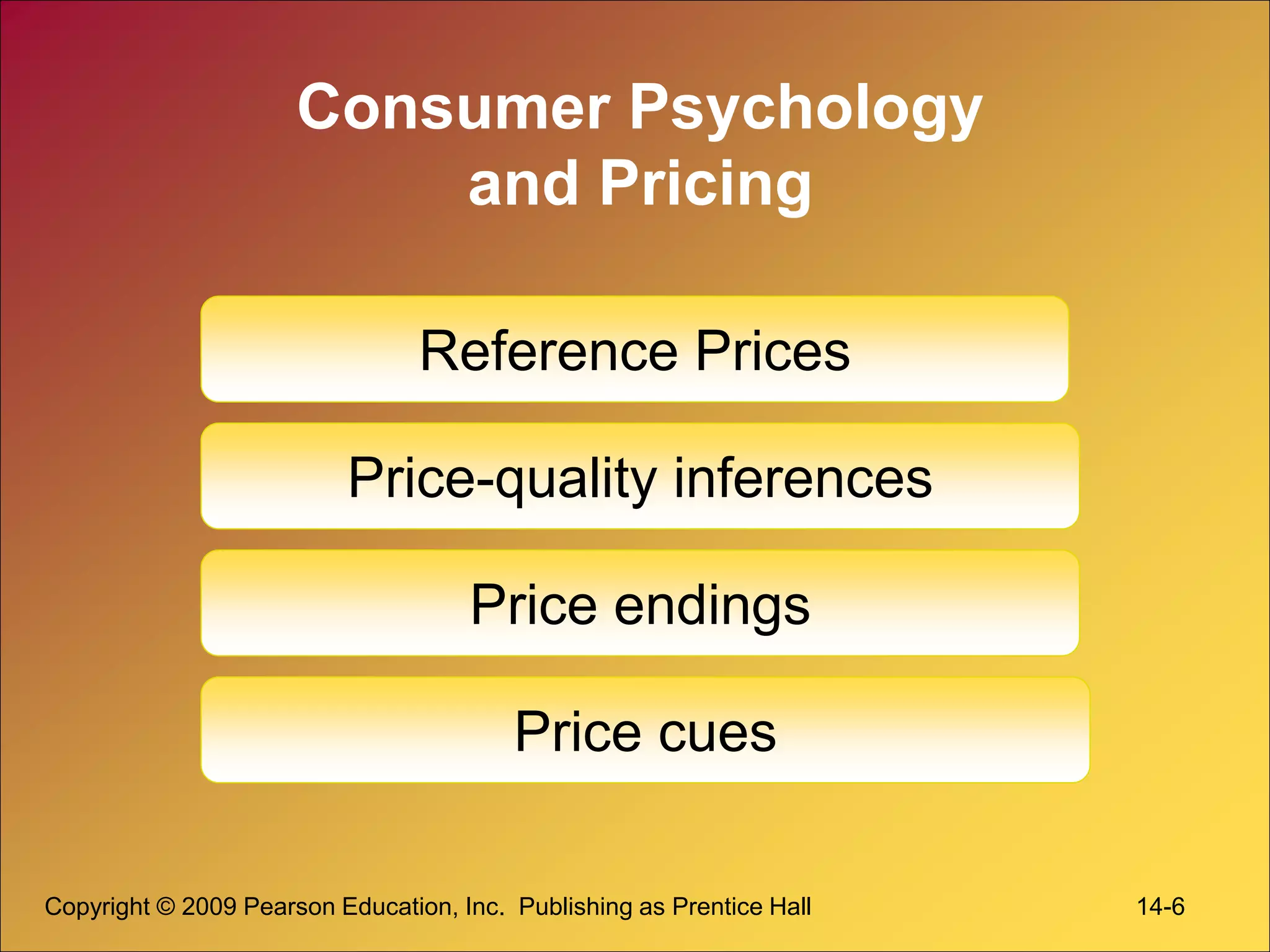
Consumer Psychology
and Pricing
Reference Prices
Price-quality inferences
Price endings
Price cues
Copyright © 2009 Pearson Education, Inc. Publishing as Prentice Hall 14-7
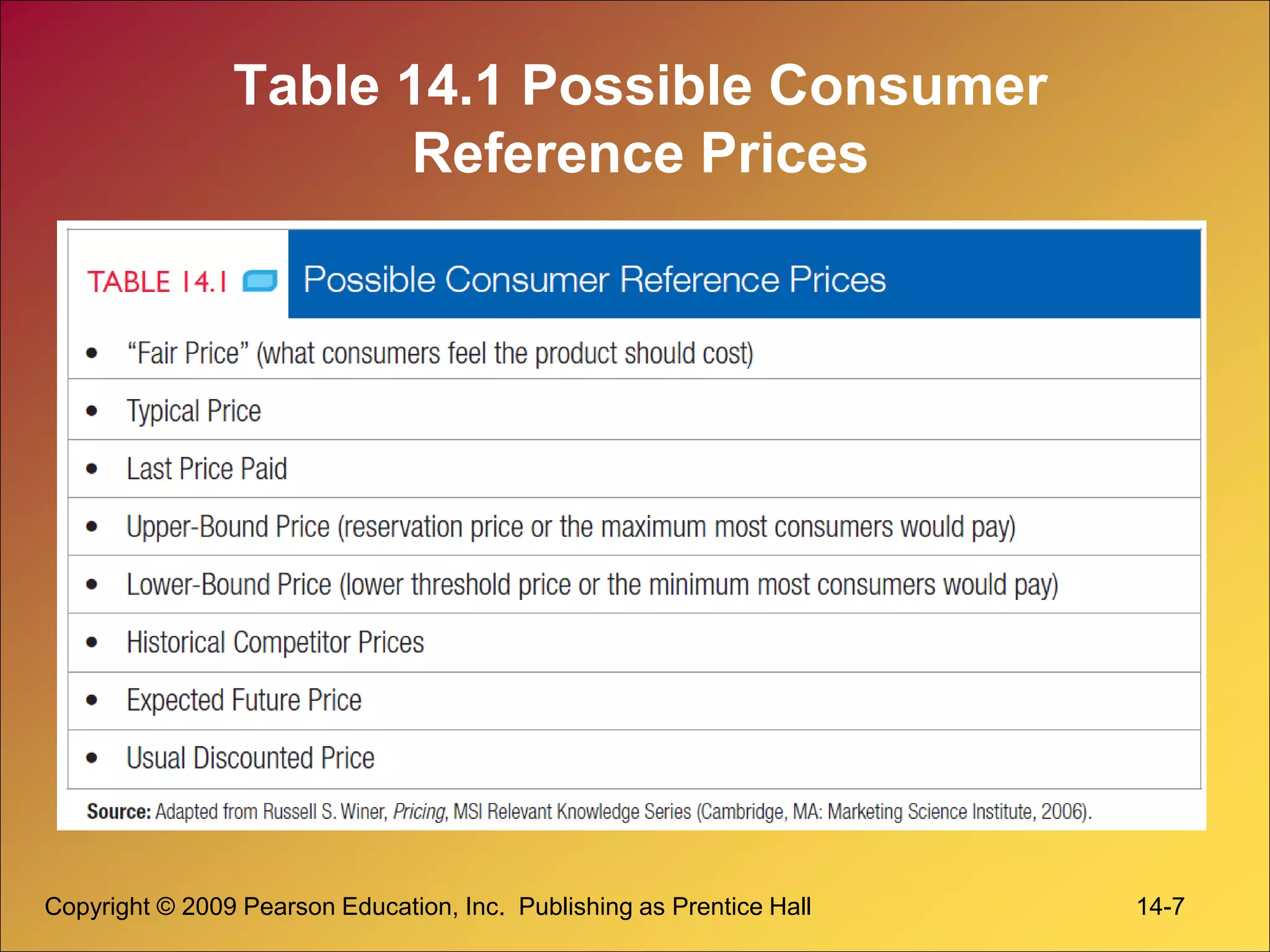
Table 14.1 Possible Consumer
Reference Prices
Copyright © 2009 Pearson Education, Inc. Publishing as Prentice Hall 14-8
Tiffany’s
Price-Quality Relationship
Copyright © 2009 Pearson Education, Inc. Publishing as Prentice Hall 14-9
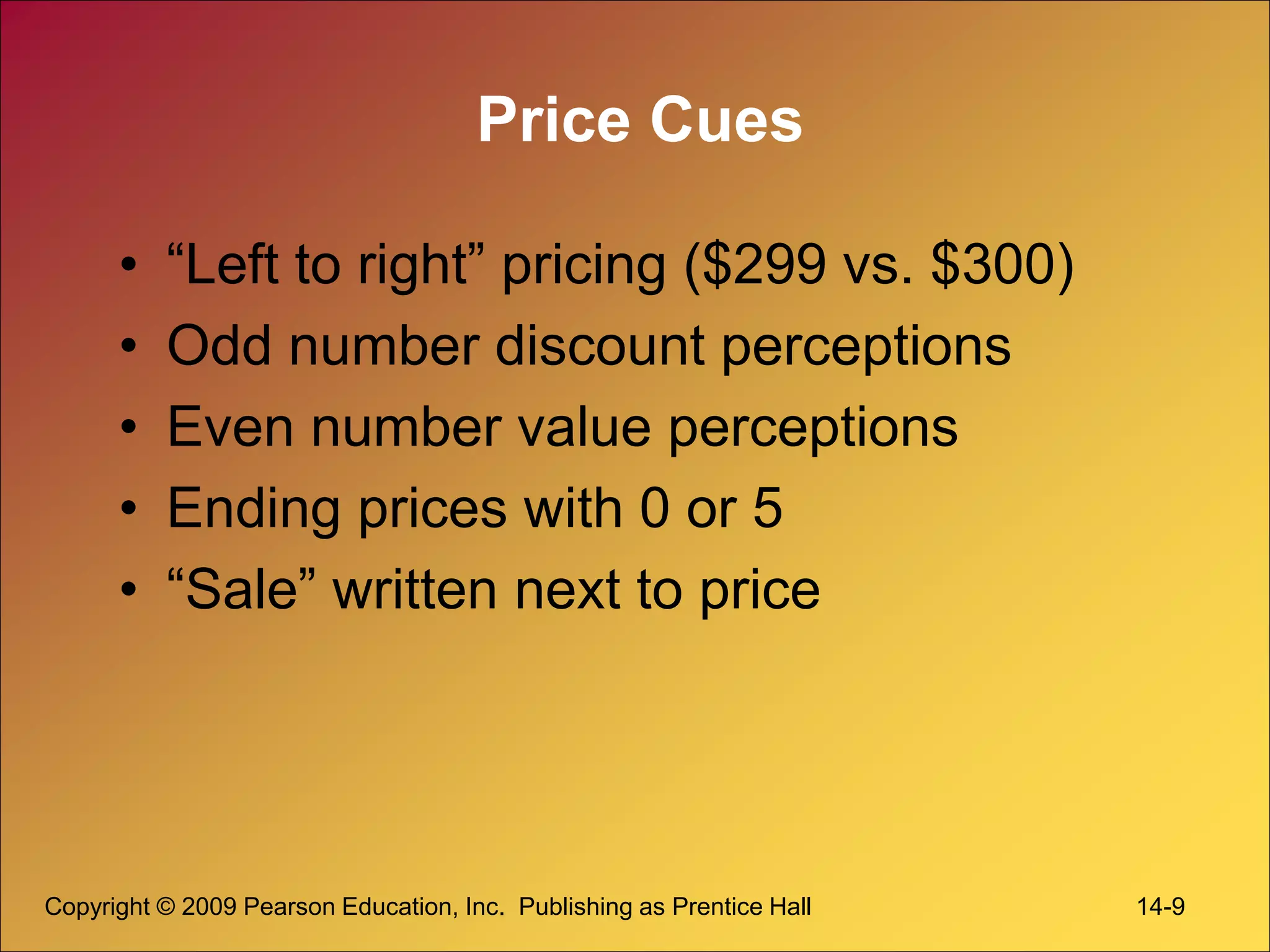
Price Cues
• “Left to right” pricing ($299 vs. $300)
• Odd number discount perceptions
• Even number value perceptions
• Ending prices with 0 or 5
• “Sale” written next to price
Copyright © 2009 Pearson Education, Inc. Publishing as Prentice Hall 14-10
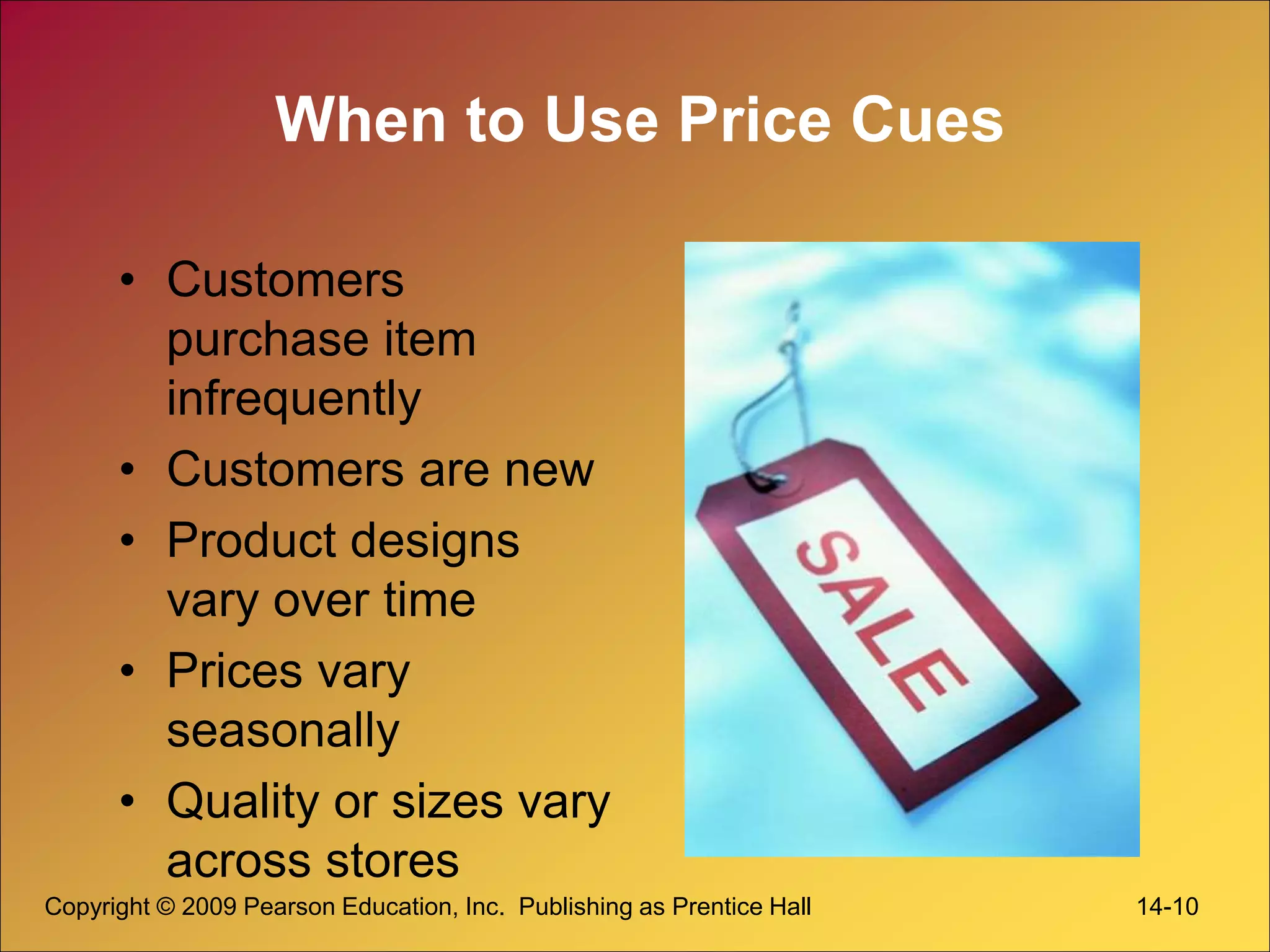
When to Use Price Cues
• Customers
purchase item
infrequently
• Customers are new
• Product designs
vary over time
• Prices vary
seasonally
• Quality or sizes vary
across stores
Copyright © 2009 Pearson Education, Inc. Publishing as Prentice Hall 14-11
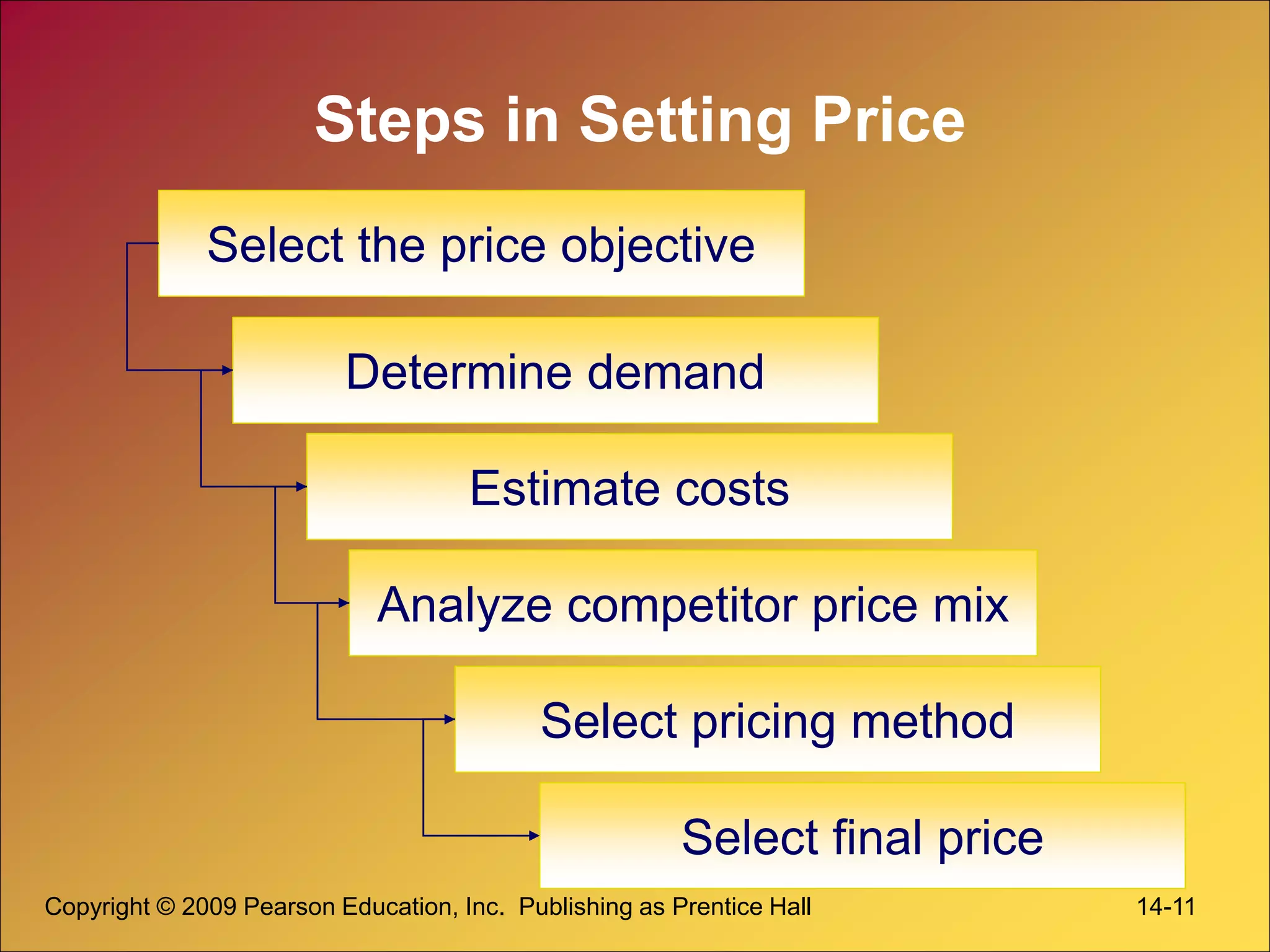
Steps in Setting Price
Select the price objective
Determine demand
Estimate costs
Analyze competitor price mix
Select pricing method
Select final price
Copyright © 2009 Pearson Education, Inc. Publishing as Prentice Hall 14-12
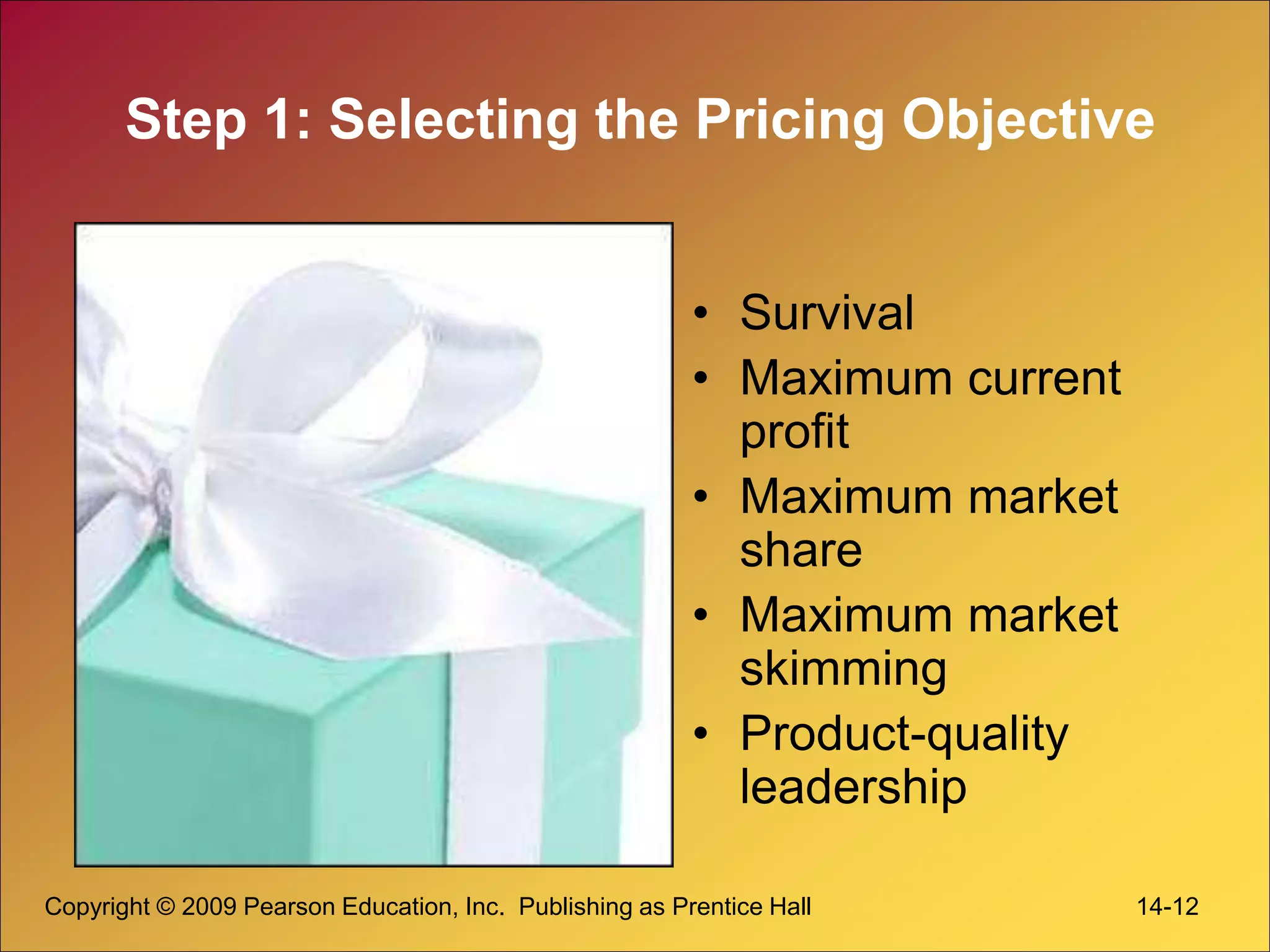
Step 1: Selecting the Pricing Objective
• Survival
• Maximum current
profit
• Maximum market
share
• Maximum market
skimming
• Product-quality
leadership
Copyright © 2009 Pearson Education, Inc. Publishing as Prentice Hall 14-13
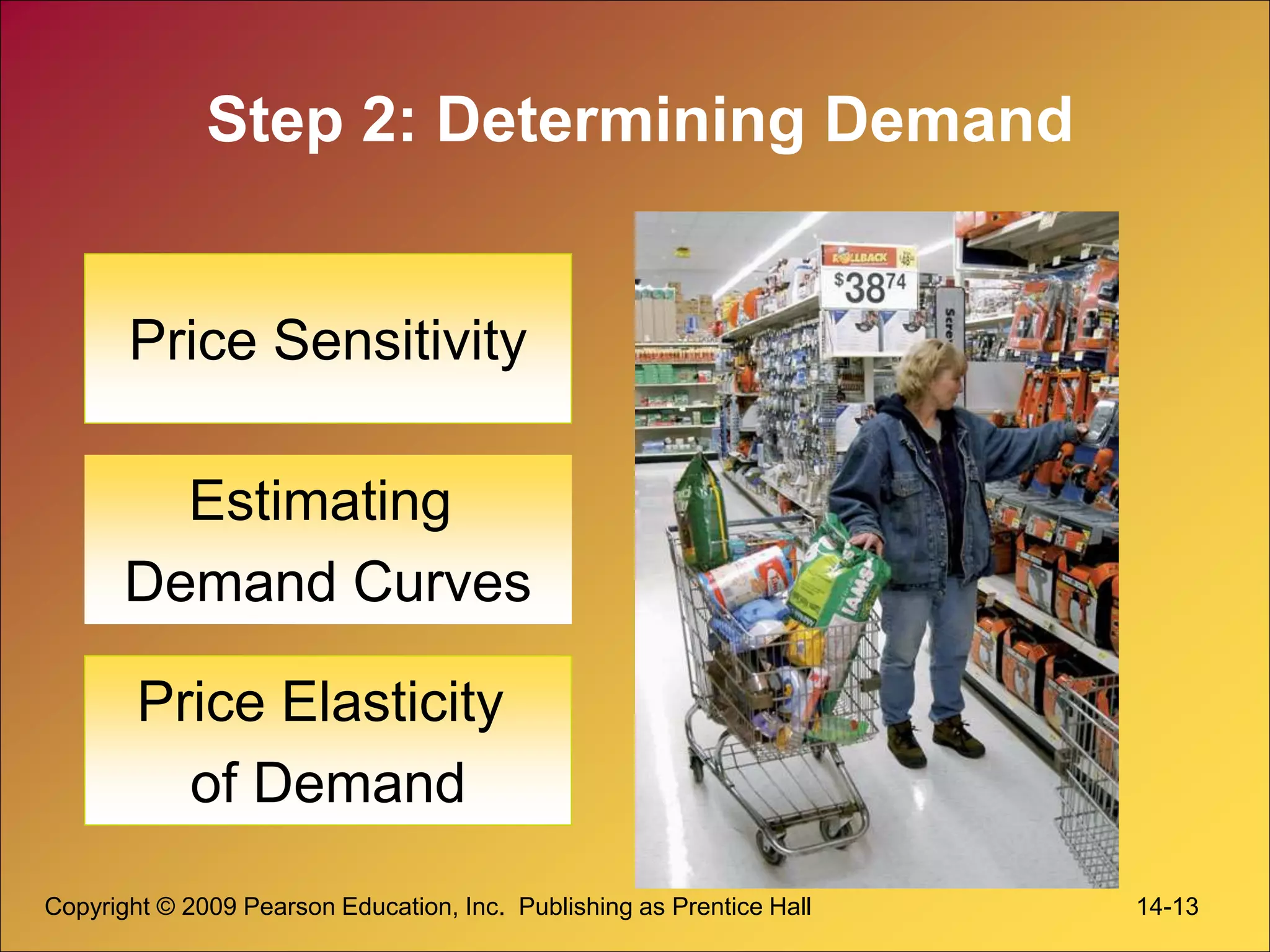
Step 2: Determining Demand
Price Sensitivity
Estimating
Demand Curves
Price Elasticity
of Demand
Copyright © 2009 Pearson Education, Inc. Publishing as Prentice Hall 14-14
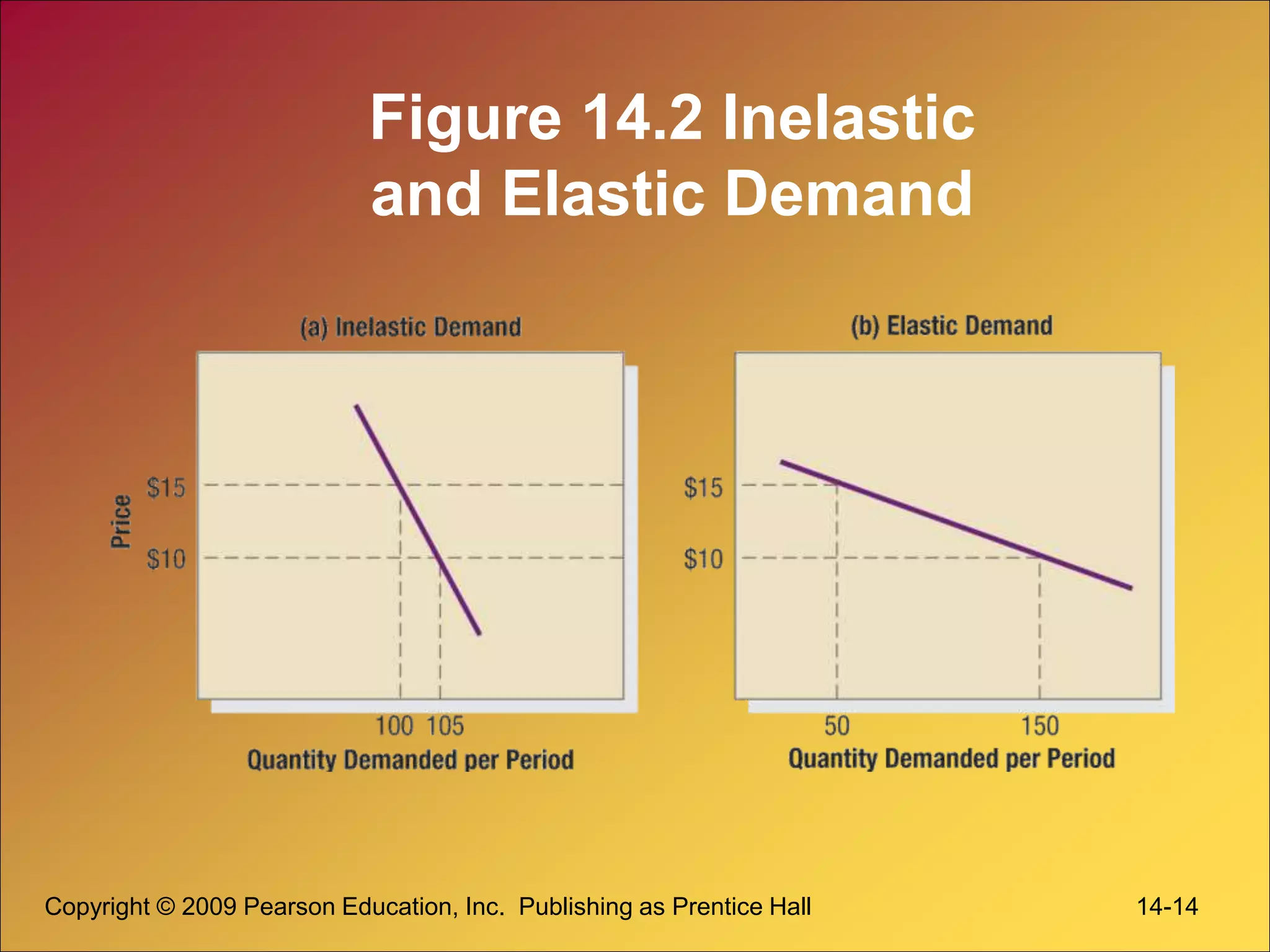
Figure 14.2 Inelastic
and Elastic Demand
Copyright © 2009 Pearson Education, Inc. Publishing as Prentice Hall 14-15
Table 14.3 Factors Leading to Less
Price Sensitivity
• The product is more distinctive
• Buyers are less aware of substitutes
• Buyers cannot easily compare the quality of substitutes
• The expenditure is a smaller part of buyer’s total income
• The expenditure is small compared to the total cost of
the end product
• Part of the cost is paid by another party
• The product is used with previously purchased assets
• The product is assumed to have high quality and
prestige
• Buyers cannot store the product
Copyright © 2009 Pearson Education, Inc. Publishing as Prentice Hall 14-16
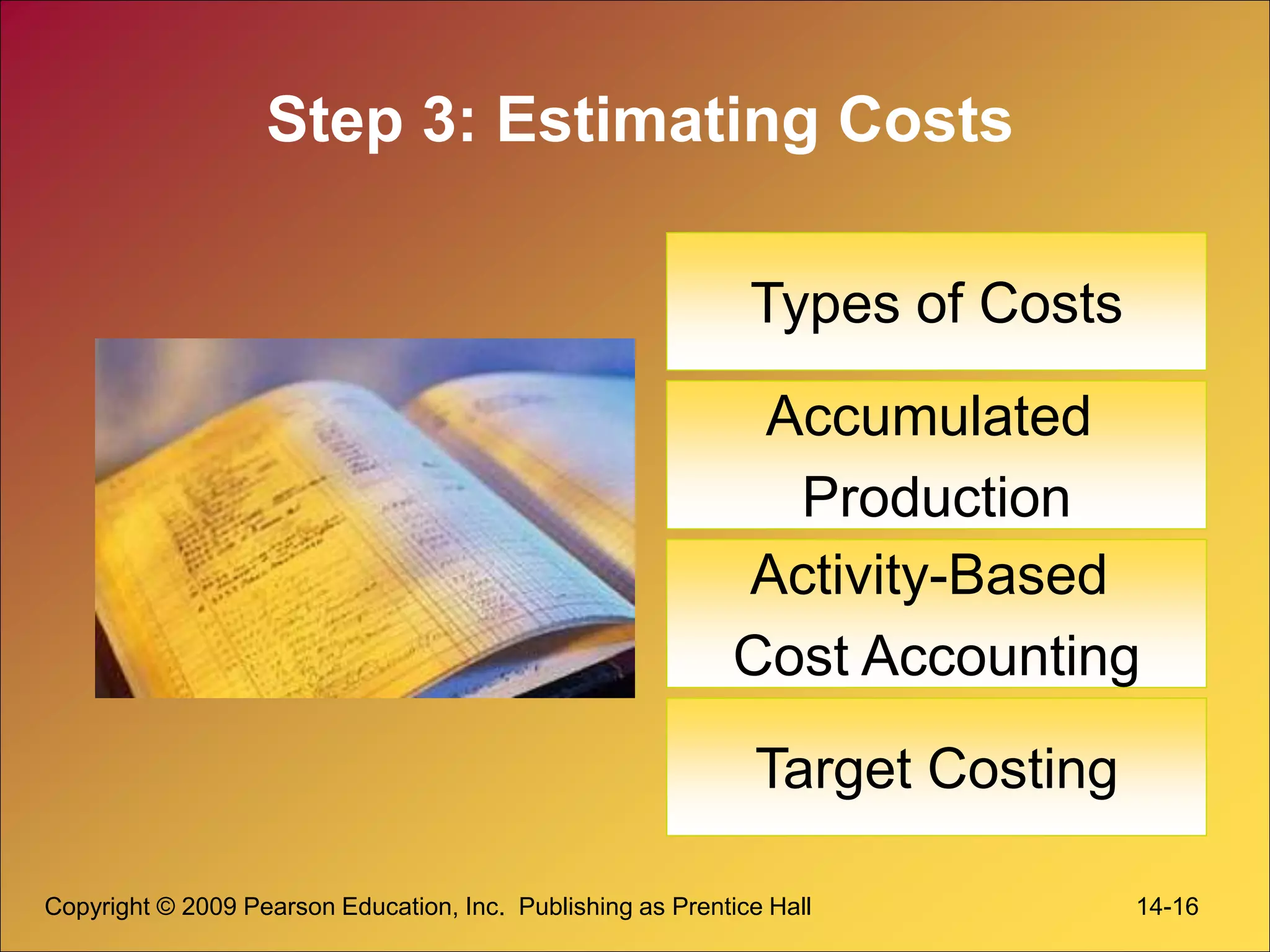
Step 3: Estimating Costs
Types of Costs
Target Costing
Accumulated
Production
Activity-Based
Cost Accounting
Copyright © 2009 Pearson Education, Inc. Publishing as Prentice Hall 14-17
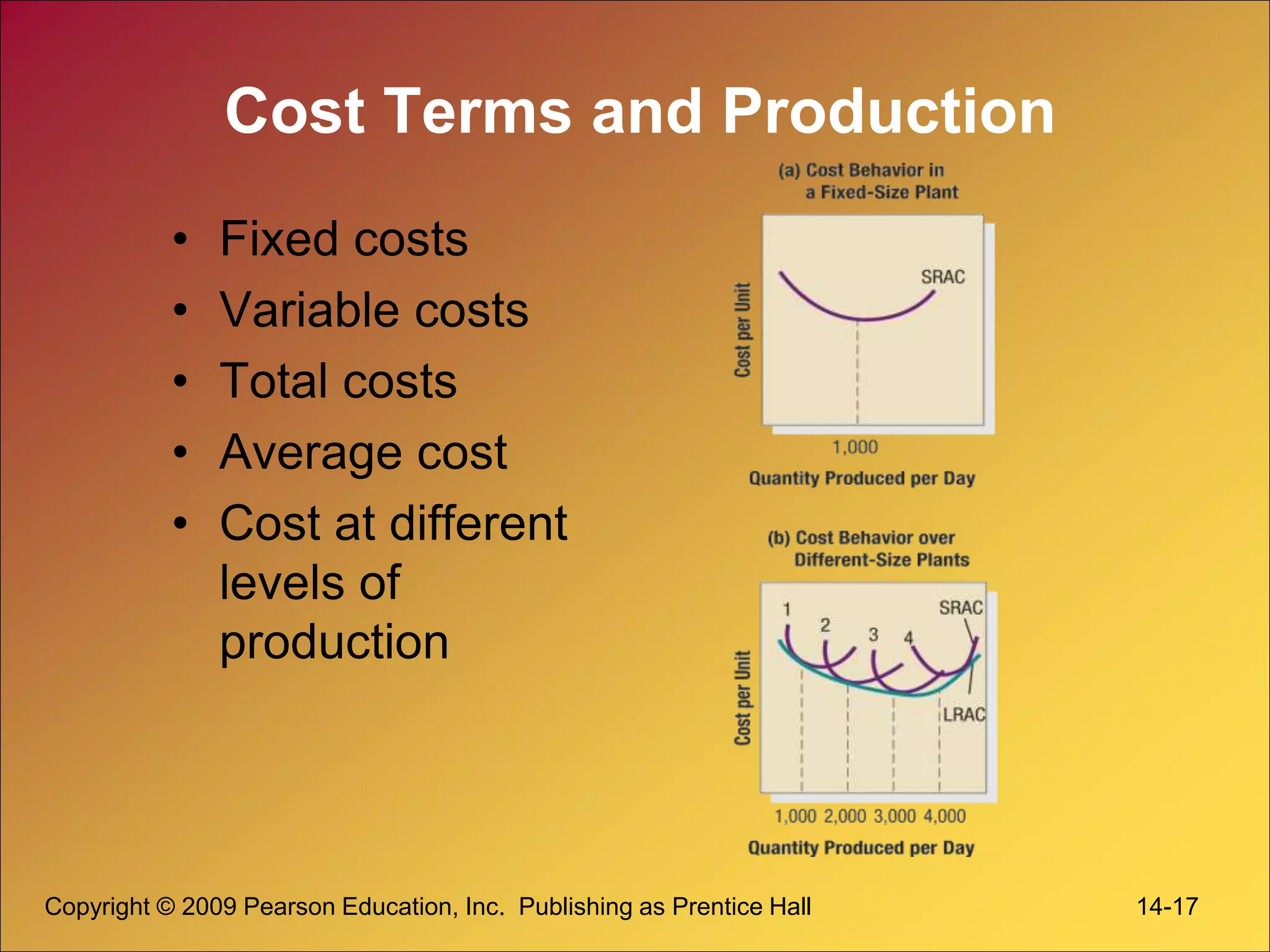
Cost Terms and Production
• Fixed costs
• Variable costs
• Total costs
• Average cost
• Cost at different
levels of
production
Copyright © 2009 Pearson Education, Inc. Publishing as Prentice Hall 14-18
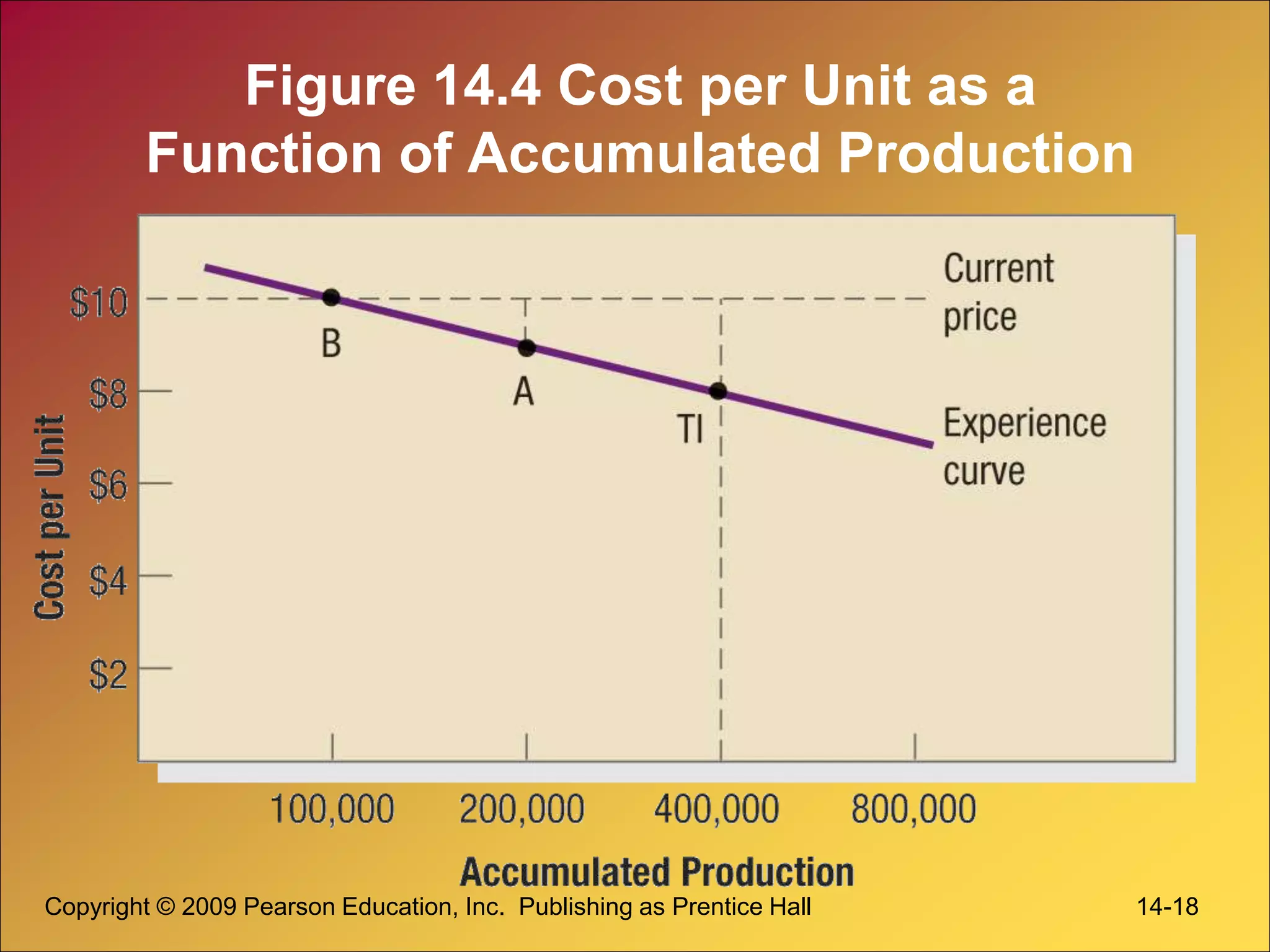
Figure 14.4 Cost per Unit as a
Function of Accumulated Production
Copyright © 2009 Pearson Education, Inc. Publishing as Prentice Hall 14-19
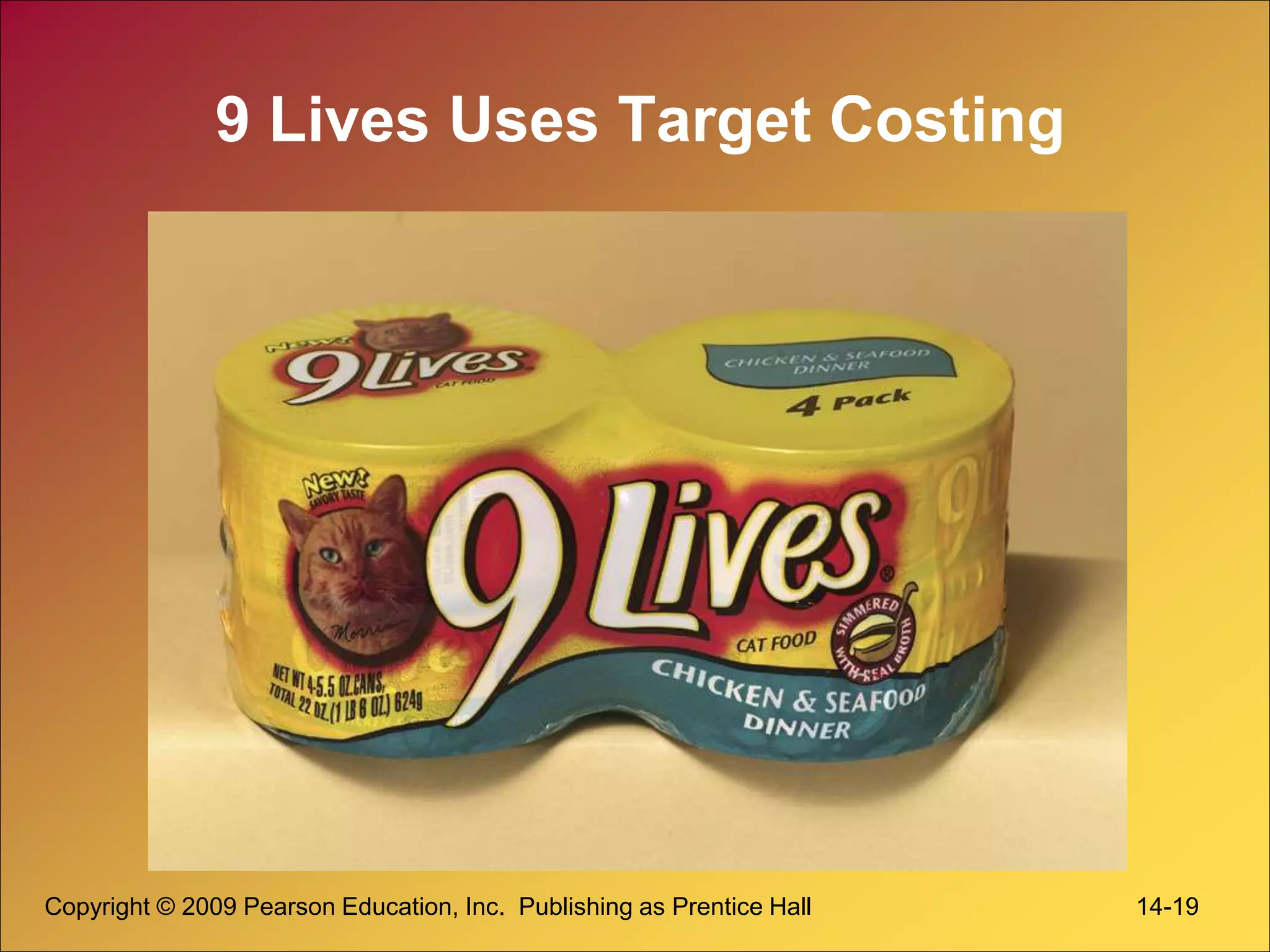
9 Lives Uses Target Costing
Step 4:Analyzing competitor’s
cost, prices and offers
• If the firm’s offer contains features not
offered by the nearest competitor, it
should evaluate their worth to the
customer and add that value to the
competitor’s price.
• If the competitor’s offer contains some
features not offered by the firm, the firm
should subtract their value from its own
price.
Copyright © 2009 Pearson Education, Inc. Publishing as Prentice Hall 14-20
Copyright © 2009 Pearson Education, Inc. Publishing as Prentice Hall 14-21
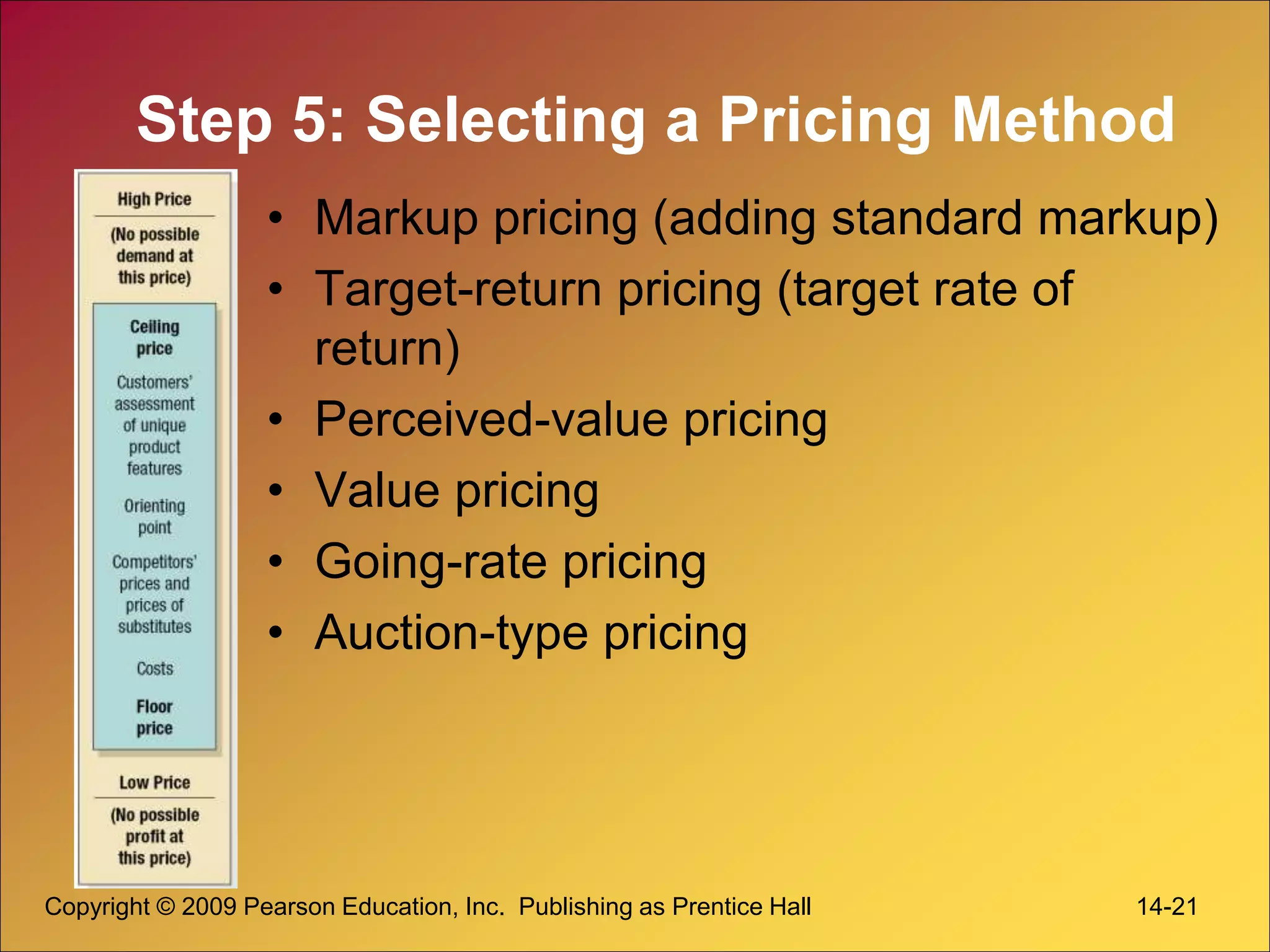
Step 5: Selecting a Pricing Method
• Markup pricing (adding standard markup)
• Target-return pricing (target rate of
return)
• Perceived-value pricing
• Value pricing
• Going-rate pricing
• Auction-type pricing
Copyright © 2009 Pearson Education, Inc. Publishing as Prentice Hall 14-22
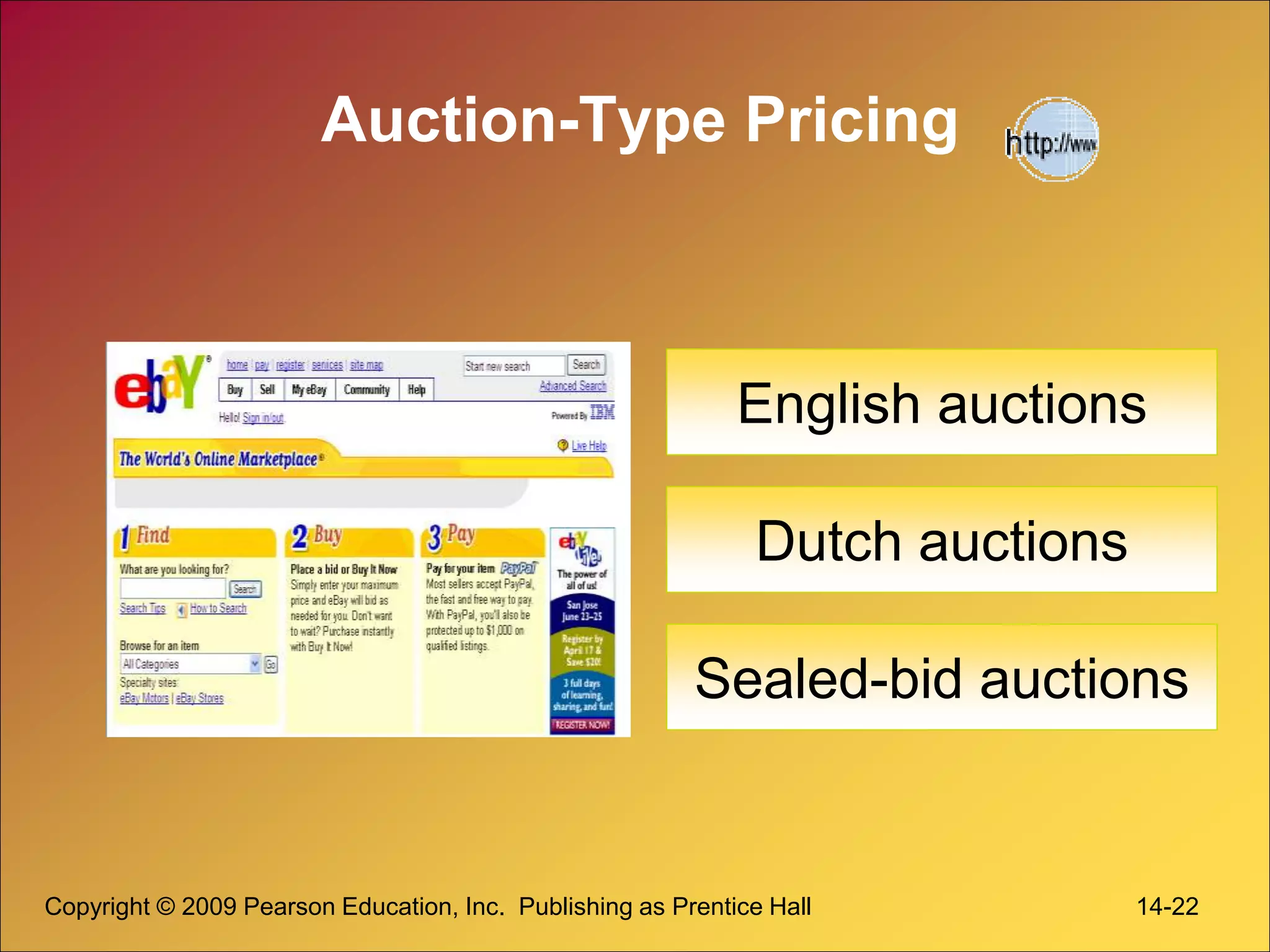
Auction-Type Pricing
English auctions
Dutch auctions
Sealed-bid auctions
Copyright © 2009 Pearson Education, Inc. Publishing as Prentice Hall 14-23
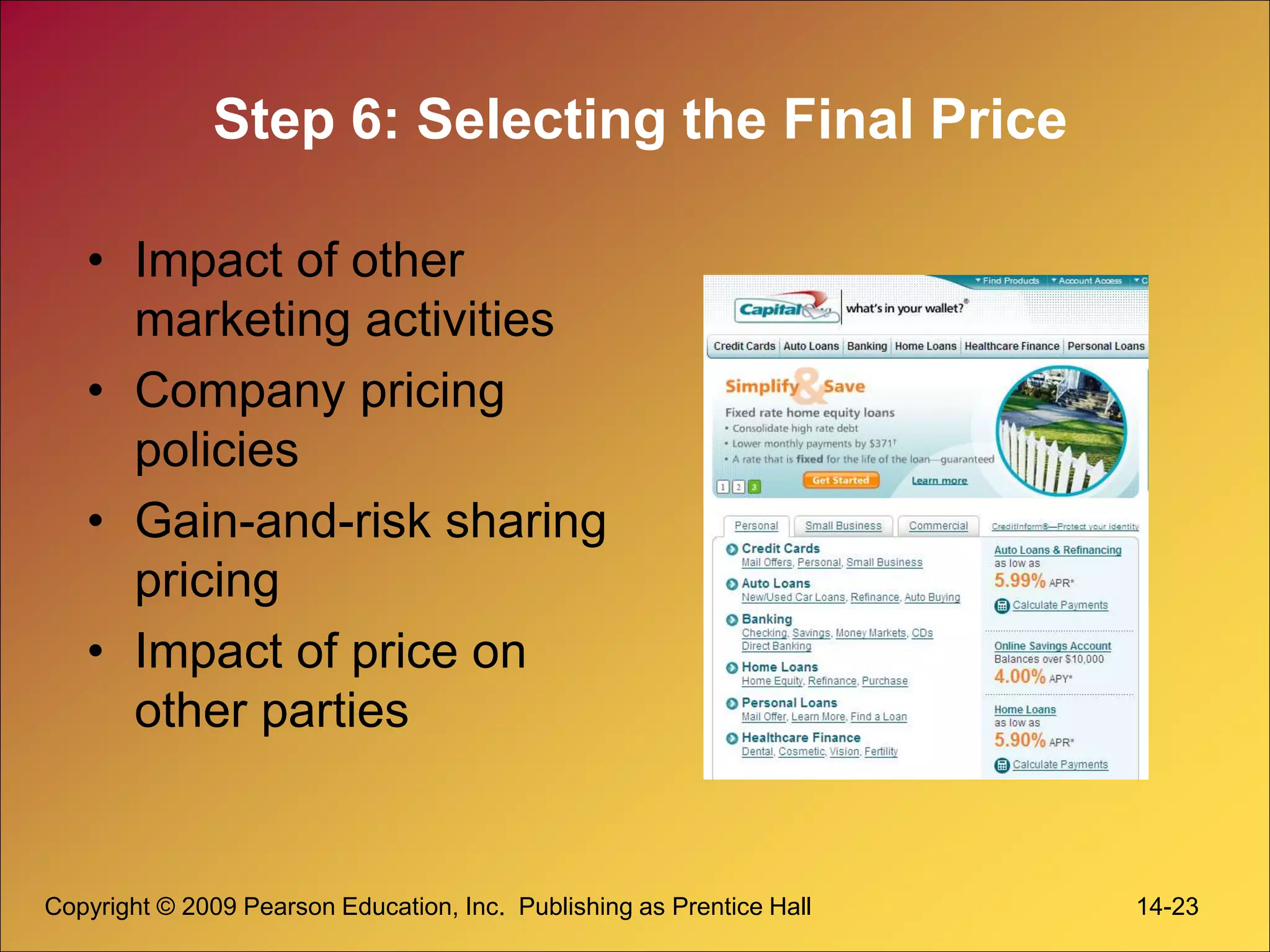
Step 6: Selecting the Final Price
• Impact of other
marketing activities
• Company pricing
policies
• Gain-and-risk sharing
pricing
• Impact of price on
other parties
Copyright © 2009 Pearson Education, Inc. Publishing as Prentice Hall 14-24
Price-Adaptation Strategies
Geographical Pricing
Discounts/Allowances
Differentiated Pricing
Promotional Pricing
Geographical pricing is used for
customers in different parts of the
country or the world
• FOB-origin pricing
• Uniformed-delivered pricing
• Zone pricing
• Basing-point pricing
• Freight-absorption pricing
Pricing Strategies
Price-Adaptation Strategies
• FOB-origin (free on board) pricing
means that the goods are delivered to
the carrier and the title and
responsibility passes to the customer
• Uniformed-delivered pricing means
the company charges the same price
plus freight to all customers,
regardless of location
Pricing Strategies
Price-Adaptation Strategies
• Zone pricing means that the company
sets up two or more zones where
customers within a given zone pay a
single total price
• Basing-point pricing means that a seller
selects a given city as a “basing point”
and charges all customers the freight cost
associated from that city to the customer
location, regardless of the city from which
the goods are actually shipped
Pricing Strategies
Price-Adaptation Strategies
• Freight-absorption pricing means
the seller absorbs all or part of the
actual freight charge as an incentive to
attract business in competitive
markets
Pricing Strategies
Price-Adaptation Strategies
Copyright © 2009 Pearson Education, Inc. Publishing as Prentice Hall 14-29
Price-Adaptation Strategies
Countertrade
• Barter
• Compensation deal
• Buyback
arrangement
• Offset
Discounts/ Allowances
• Cash discount
• Quantity discount
• Functional discount
• Seasonal discount
• Allowance
Copyright © 2009 Pearson Education, Inc. Publishing as Prentice Hall 14-30
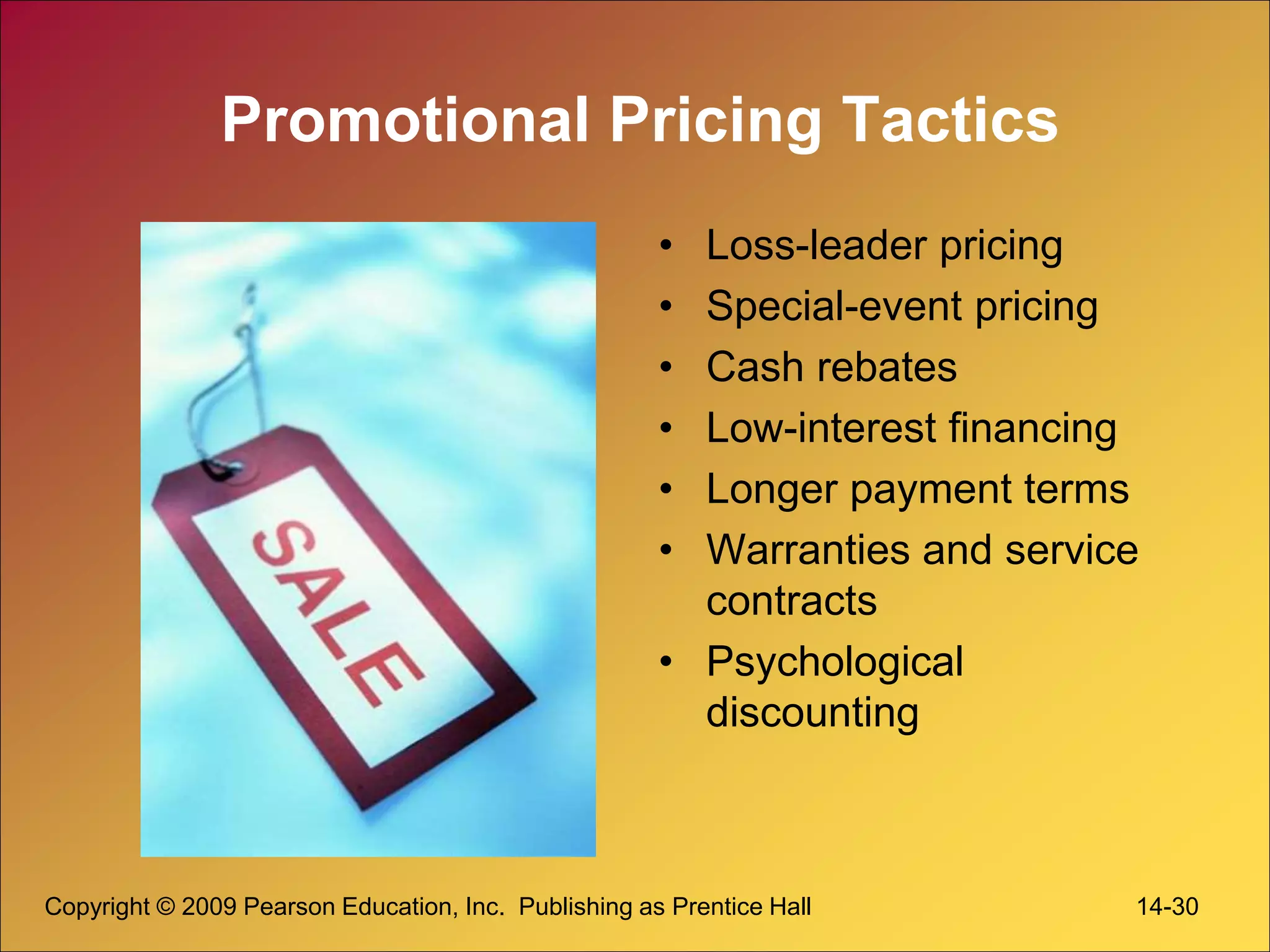
Promotional Pricing Tactics
• Loss-leader pricing
• Special-event pricing
• Cash rebates
• Low-interest financing
• Longer payment terms
• Warranties and service
contracts
• Psychological
discounting
Copyright © 2009 Pearson Education, Inc. Publishing as Prentice Hall 14-31
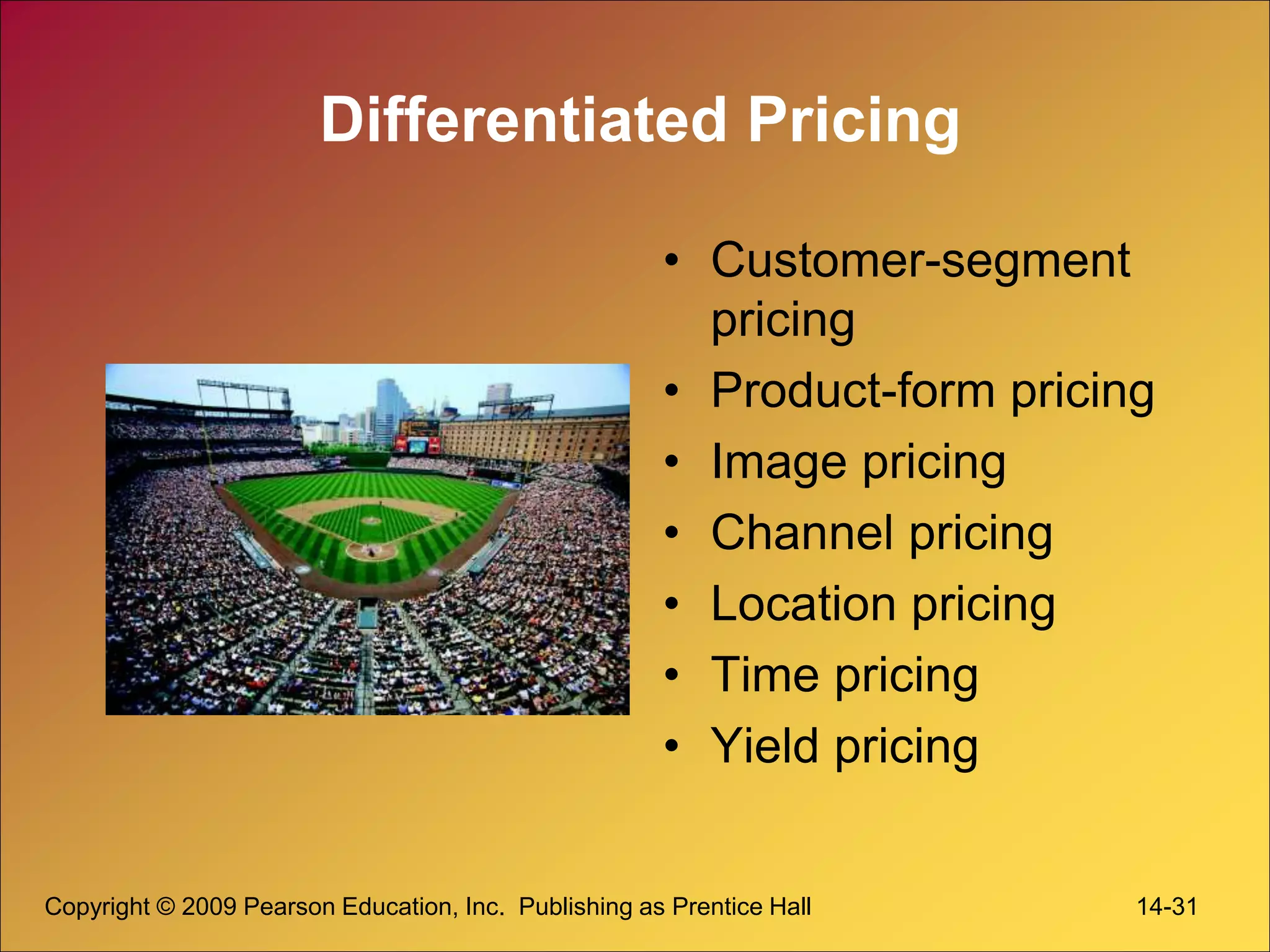
Differentiated Pricing
• Customer-segment
pricing
• Product-form pricing
• Image pricing
• Channel pricing
• Location pricing
• Time pricing
• Yield pricing
Copyright © 2009 Pearson Education, Inc. Publishing as Prentice Hall 14-32
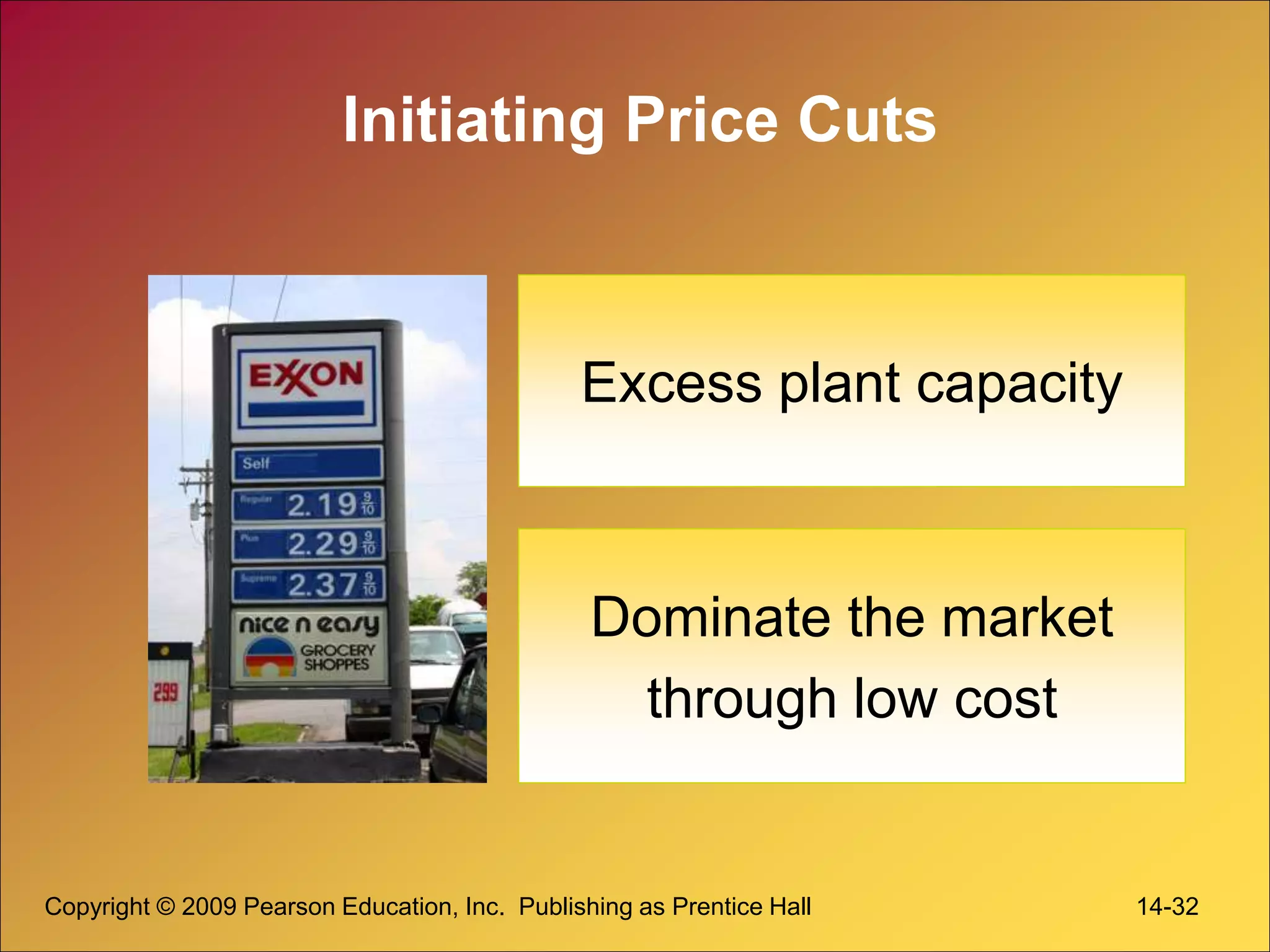
Initiating Price Cuts
Excess plant capacity
Dominate the market
through low cost
Copyright © 2009 Pearson Education, Inc. Publishing as Prentice Hall 14-33
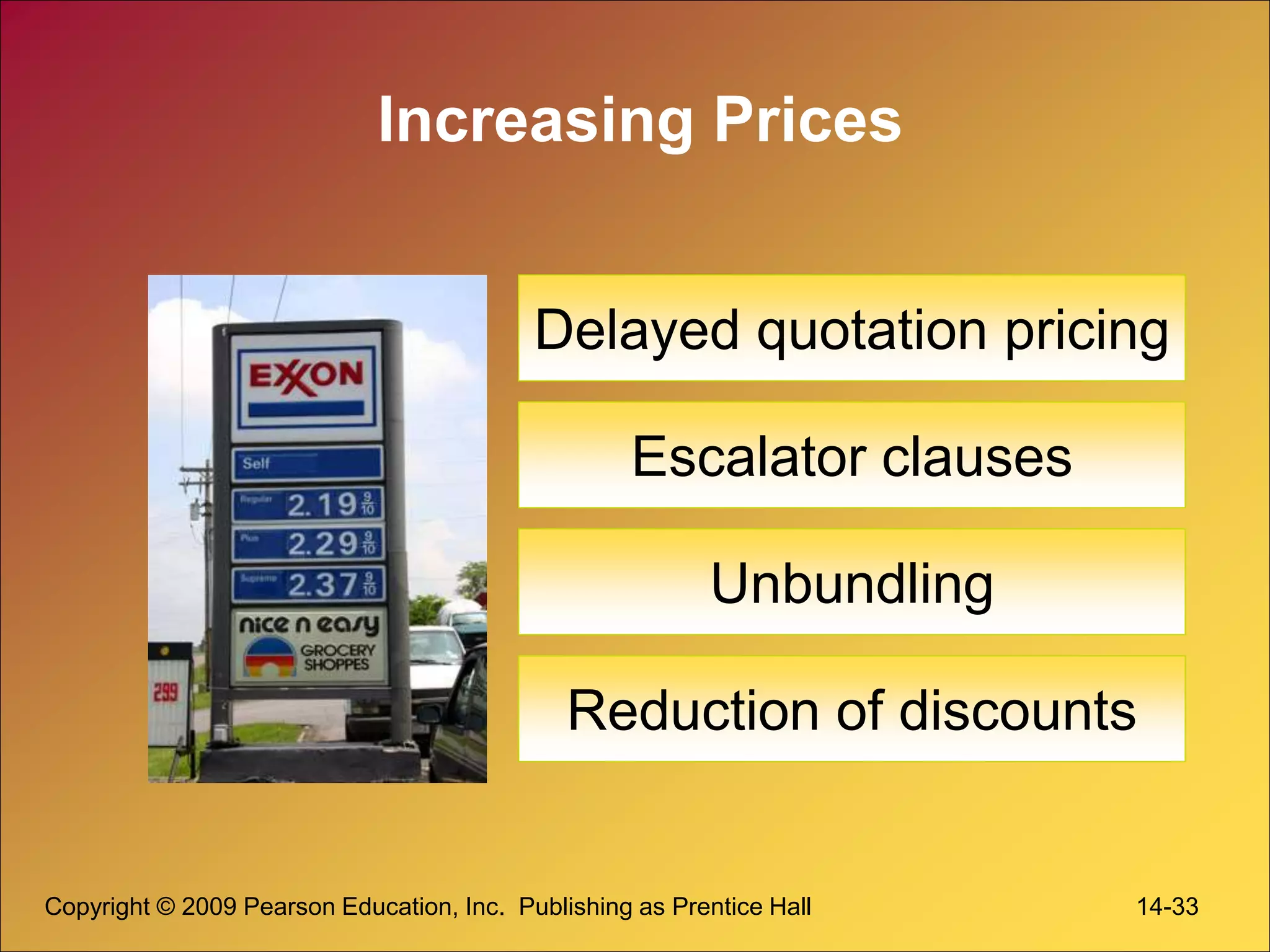
Increasing Prices
Delayed quotation pricing
Escalator clauses
Unbundling
Reduction of discounts

Week 10-11-1.ppt

  • 1.
    Developing Pricing Strategies andPrograms Marketing Management, 13th ed 14
  • 2.
    Copyright © 2009Pearson Education, Inc. Publishing as Prentice Hall 14-2 Chapter Questions • How do consumers process and evaluate prices? • How should a company set prices initially for products or services? • How should a company adapt prices to meet varying circumstances and opportunities? • When should a company initiate a price change? • How should a company respond to a competitor’s price challenge?
  • 3.
    Copyright © 2009Pearson Education, Inc. Publishing as Prentice Hall 14-3 Gillette Commands a Price Premium
  • 4.
    Copyright © 2009Pearson Education, Inc. Publishing as Prentice Hall 14-4 Synonyms for Price • Rent • Tuition • Fee • Fare • Rate • Toll • Premium • Honorarium • Special assessment • Bribe • Dues • Salary • Commission • Wage • Tax
  • 5.
    Copyright © 2009Pearson Education, Inc. Publishing as Prentice Hall 14-5 How Companies Price? • Companies do their pricing in a variety of ways. • In small companies, the boss often sets prices. • In large companies, division and product line managers do. Even here, top management sets general pricing objectives and policies and often approves lower management’s proposals.
  • 6.
    Copyright © 2009Pearson Education, Inc. Publishing as Prentice Hall 14-6 Consumer Psychology and Pricing Reference Prices Price-quality inferences Price endings Price cues
  • 7.
    Copyright © 2009Pearson Education, Inc. Publishing as Prentice Hall 14-7 Table 14.1 Possible Consumer Reference Prices
  • 8.
    Copyright © 2009Pearson Education, Inc. Publishing as Prentice Hall 14-8 Tiffany’s Price-Quality Relationship
  • 9.
    Copyright © 2009Pearson Education, Inc. Publishing as Prentice Hall 14-9 Price Cues • “Left to right” pricing ($299 vs. $300) • Odd number discount perceptions • Even number value perceptions • Ending prices with 0 or 5 • “Sale” written next to price
  • 10.
    Copyright © 2009Pearson Education, Inc. Publishing as Prentice Hall 14-10 When to Use Price Cues • Customers purchase item infrequently • Customers are new • Product designs vary over time • Prices vary seasonally • Quality or sizes vary across stores
  • 11.
    Copyright © 2009Pearson Education, Inc. Publishing as Prentice Hall 14-11 Steps in Setting Price Select the price objective Determine demand Estimate costs Analyze competitor price mix Select pricing method Select final price
  • 12.
    Copyright © 2009Pearson Education, Inc. Publishing as Prentice Hall 14-12 Step 1: Selecting the Pricing Objective • Survival • Maximum current profit • Maximum market share • Maximum market skimming • Product-quality leadership
  • 13.
    Copyright © 2009Pearson Education, Inc. Publishing as Prentice Hall 14-13 Step 2: Determining Demand Price Sensitivity Estimating Demand Curves Price Elasticity of Demand
  • 14.
    Copyright © 2009Pearson Education, Inc. Publishing as Prentice Hall 14-14 Figure 14.2 Inelastic and Elastic Demand
  • 15.
    Copyright © 2009Pearson Education, Inc. Publishing as Prentice Hall 14-15 Table 14.3 Factors Leading to Less Price Sensitivity • The product is more distinctive • Buyers are less aware of substitutes • Buyers cannot easily compare the quality of substitutes • The expenditure is a smaller part of buyer’s total income • The expenditure is small compared to the total cost of the end product • Part of the cost is paid by another party • The product is used with previously purchased assets • The product is assumed to have high quality and prestige • Buyers cannot store the product
  • 16.
    Copyright © 2009Pearson Education, Inc. Publishing as Prentice Hall 14-16 Step 3: Estimating Costs Types of Costs Target Costing Accumulated Production Activity-Based Cost Accounting
  • 17.
    Copyright © 2009Pearson Education, Inc. Publishing as Prentice Hall 14-17 Cost Terms and Production • Fixed costs • Variable costs • Total costs • Average cost • Cost at different levels of production
  • 18.
    Copyright © 2009Pearson Education, Inc. Publishing as Prentice Hall 14-18 Figure 14.4 Cost per Unit as a Function of Accumulated Production
  • 19.
    Copyright © 2009Pearson Education, Inc. Publishing as Prentice Hall 14-19 9 Lives Uses Target Costing
  • 20.
    Step 4:Analyzing competitor’s cost,prices and offers • If the firm’s offer contains features not offered by the nearest competitor, it should evaluate their worth to the customer and add that value to the competitor’s price. • If the competitor’s offer contains some features not offered by the firm, the firm should subtract their value from its own price. Copyright © 2009 Pearson Education, Inc. Publishing as Prentice Hall 14-20
  • 21.
    Copyright © 2009Pearson Education, Inc. Publishing as Prentice Hall 14-21 Step 5: Selecting a Pricing Method • Markup pricing (adding standard markup) • Target-return pricing (target rate of return) • Perceived-value pricing • Value pricing • Going-rate pricing • Auction-type pricing
  • 22.
    Copyright © 2009Pearson Education, Inc. Publishing as Prentice Hall 14-22 Auction-Type Pricing English auctions Dutch auctions Sealed-bid auctions
  • 23.
    Copyright © 2009Pearson Education, Inc. Publishing as Prentice Hall 14-23 Step 6: Selecting the Final Price • Impact of other marketing activities • Company pricing policies • Gain-and-risk sharing pricing • Impact of price on other parties
  • 24.
    Copyright © 2009Pearson Education, Inc. Publishing as Prentice Hall 14-24 Price-Adaptation Strategies Geographical Pricing Discounts/Allowances Differentiated Pricing Promotional Pricing
  • 25.
    Geographical pricing isused for customers in different parts of the country or the world • FOB-origin pricing • Uniformed-delivered pricing • Zone pricing • Basing-point pricing • Freight-absorption pricing Pricing Strategies Price-Adaptation Strategies
  • 26.
    • FOB-origin (freeon board) pricing means that the goods are delivered to the carrier and the title and responsibility passes to the customer • Uniformed-delivered pricing means the company charges the same price plus freight to all customers, regardless of location Pricing Strategies Price-Adaptation Strategies
  • 27.
    • Zone pricingmeans that the company sets up two or more zones where customers within a given zone pay a single total price • Basing-point pricing means that a seller selects a given city as a “basing point” and charges all customers the freight cost associated from that city to the customer location, regardless of the city from which the goods are actually shipped Pricing Strategies Price-Adaptation Strategies
  • 28.
    • Freight-absorption pricingmeans the seller absorbs all or part of the actual freight charge as an incentive to attract business in competitive markets Pricing Strategies Price-Adaptation Strategies
  • 29.
    Copyright © 2009Pearson Education, Inc. Publishing as Prentice Hall 14-29 Price-Adaptation Strategies Countertrade • Barter • Compensation deal • Buyback arrangement • Offset Discounts/ Allowances • Cash discount • Quantity discount • Functional discount • Seasonal discount • Allowance
  • 30.
    Copyright © 2009Pearson Education, Inc. Publishing as Prentice Hall 14-30 Promotional Pricing Tactics • Loss-leader pricing • Special-event pricing • Cash rebates • Low-interest financing • Longer payment terms • Warranties and service contracts • Psychological discounting
  • 31.
    Copyright © 2009Pearson Education, Inc. Publishing as Prentice Hall 14-31 Differentiated Pricing • Customer-segment pricing • Product-form pricing • Image pricing • Channel pricing • Location pricing • Time pricing • Yield pricing
  • 32.
    Copyright © 2009Pearson Education, Inc. Publishing as Prentice Hall 14-32 Initiating Price Cuts Excess plant capacity Dominate the market through low cost
  • 33.
    Copyright © 2009Pearson Education, Inc. Publishing as Prentice Hall 14-33 Increasing Prices Delayed quotation pricing Escalator clauses Unbundling Reduction of discounts