Marketing Management
Chapter 14
Developing Pricing Strategies
and
Programs
Copyright © 2012 Pearson Education 14-3
Chapter Questions
1. How do consumers process and evaluate prices?
2. How should a company set prices initially for products
or services?
3. How should a company adapt prices to meet varying
circumstances and opportunities?
4. When should a company initiate a price change?
5. How should a company respond to a competitor’s price
challenge?
Understanding Pricing
Chapter Question 1:
How do consumers process
and evaluate prices?
Copyright © 2012 Pearson Education 14-4
• Pricing practices have changed significantly in recent years.
• Many companies no longer follow the low-pricing trend, and
have successfully traded consumers up to more expensive
products.
A Changing Pricing Environment
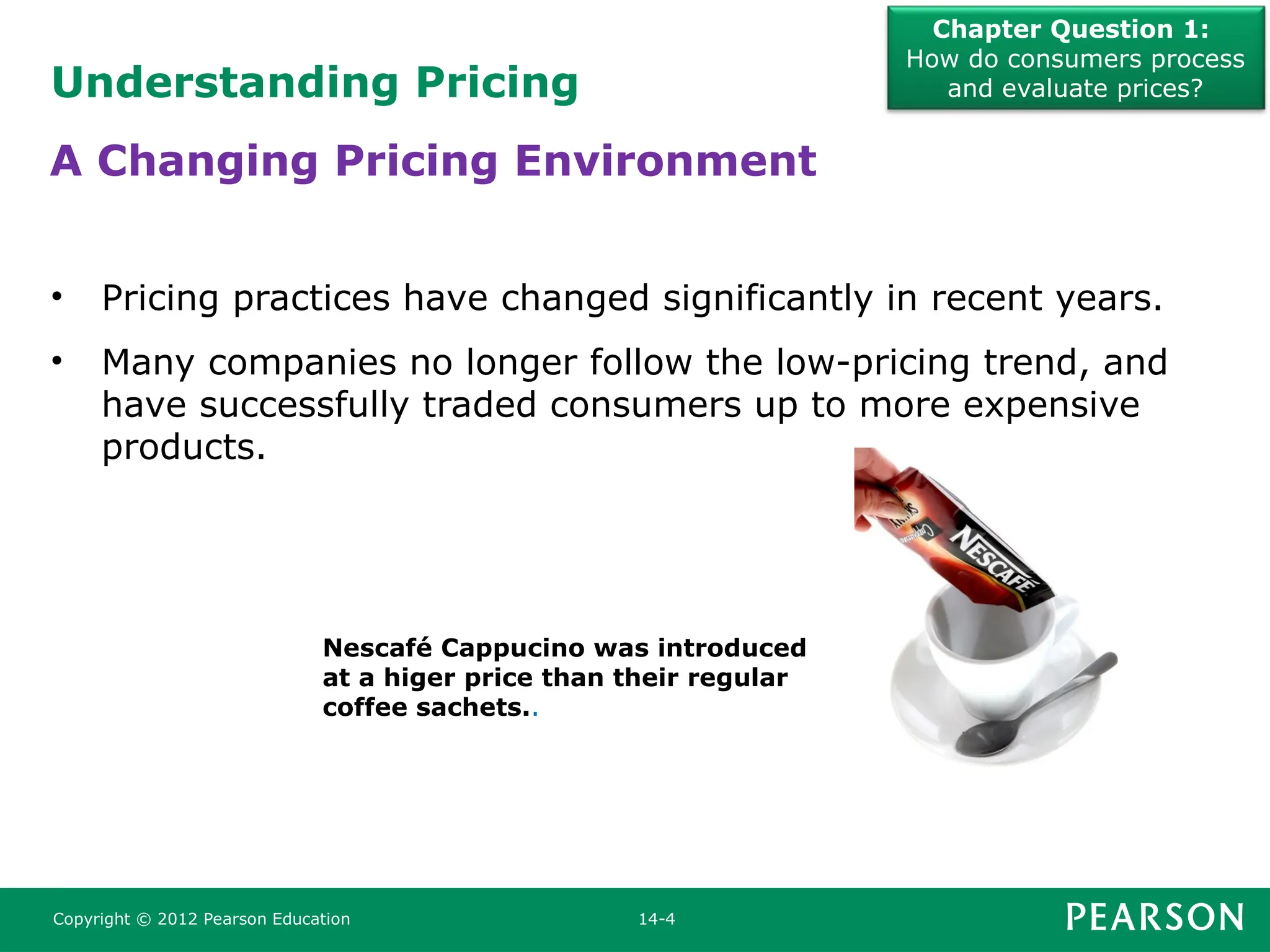
Nescafé Cappucino was introduced
at a higer price than their regular
coffee sachets..
Chapter Question 1:
How do consumers process
and evaluate prices?
Copyright © 2012 Pearson Education 14-5
Companies do their pricing in a variety of ways.
Often it is not done well. Common pricing mistakes include:
• Simplistically determining costs and taking traditional industry margins.
• Failure to revise price to capitalize on market changes.
• Setting price independently of the rest of the marketing mix.
• Failure to vary price by product item, market segment, distribution
channels, and purchase occasion.
Effective pricing strategies must:
• Understand consumer pricing psychology.
• Have a systematic approach to setting, adapting, and changing prices.
How Companies Price
Chapter Question 1:
How do consumers process
and evaluate prices?
Copyright © 2012 Pearson Education 14-6
Understanding how consumers arrive at their perceptions of prices is
an important marketing priority.
Here we consider three key topics:
1.Reference prices
2.Price–quality inferences
3.Price endings
Consumer Psychology and Pricing
Chapter Question 1:
How do consumers process
and evaluate prices?
Copyright © 2012 Pearson Education 14-7
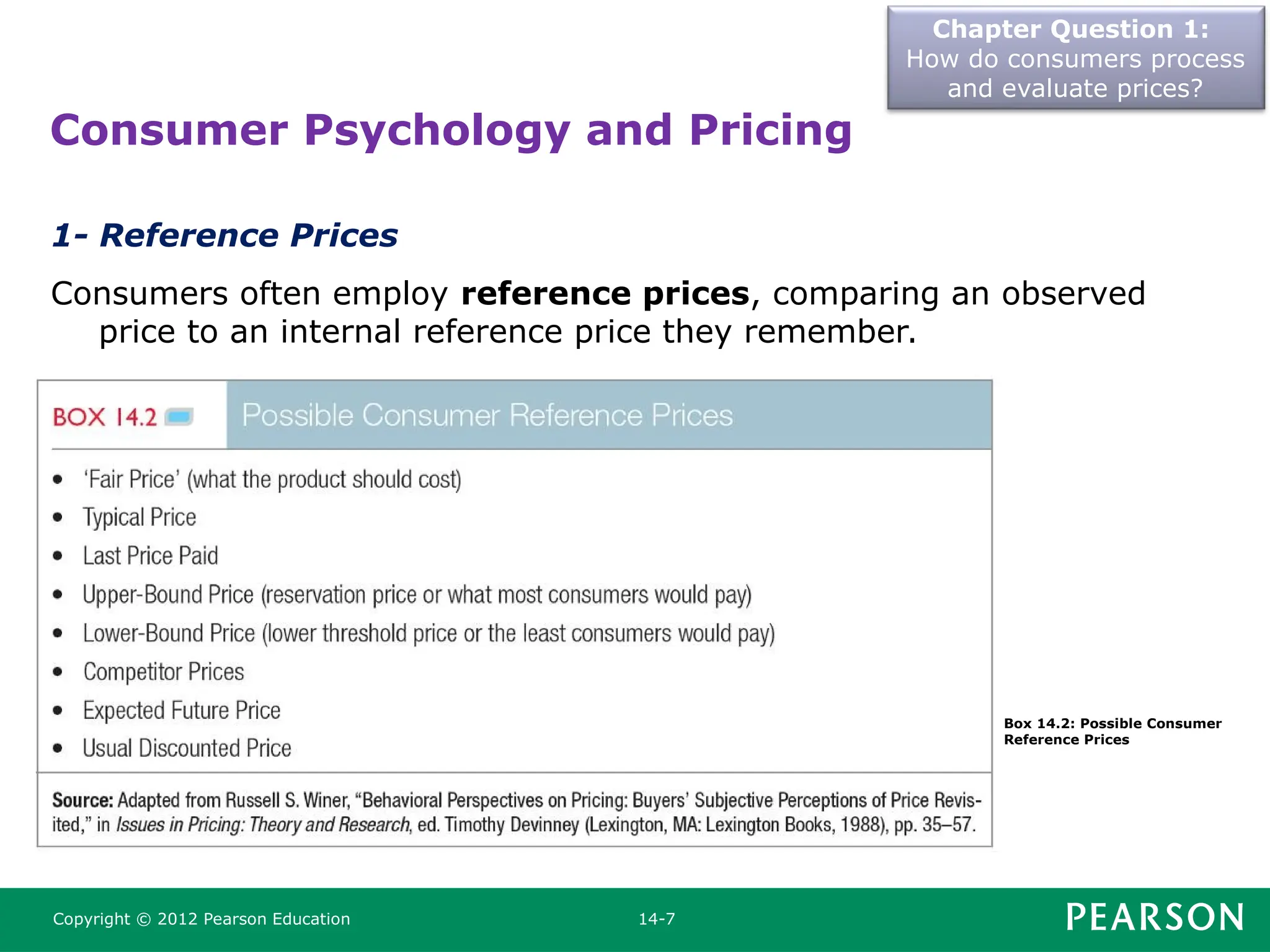
1- Reference Prices
Consumers often employ reference prices, comparing an observed
price to an internal reference price they remember.
Consumer Psychology and Pricing
Box 14.2: Possible Consumer
Reference Prices
Chapter Question 1:
How do consumers process
and evaluate prices?
Copyright © 2012 Pearson Education 14-8
1- Reference Prices
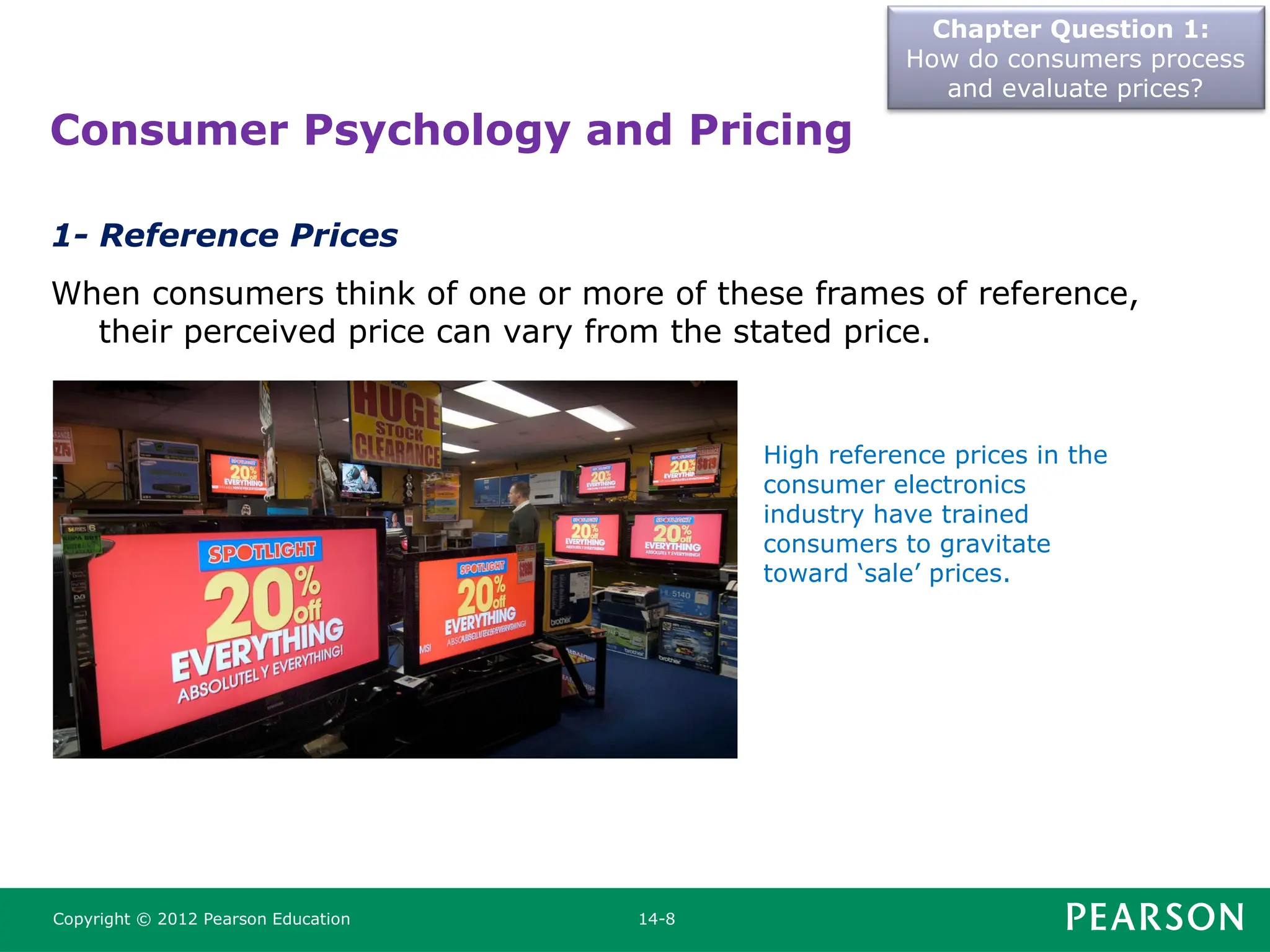
When consumers think of one or more of these frames of reference,
their perceived price can vary from the stated price.
Consumer Psychology and Pricing
High reference prices in the
consumer electronics
industry have trained
consumers to gravitate
toward ‘sale’ prices.
Chapter Question 1:
How do consumers process
and evaluate prices?
Copyright © 2012 Pearson Education 14-9
2- Price-Quality
Inferences
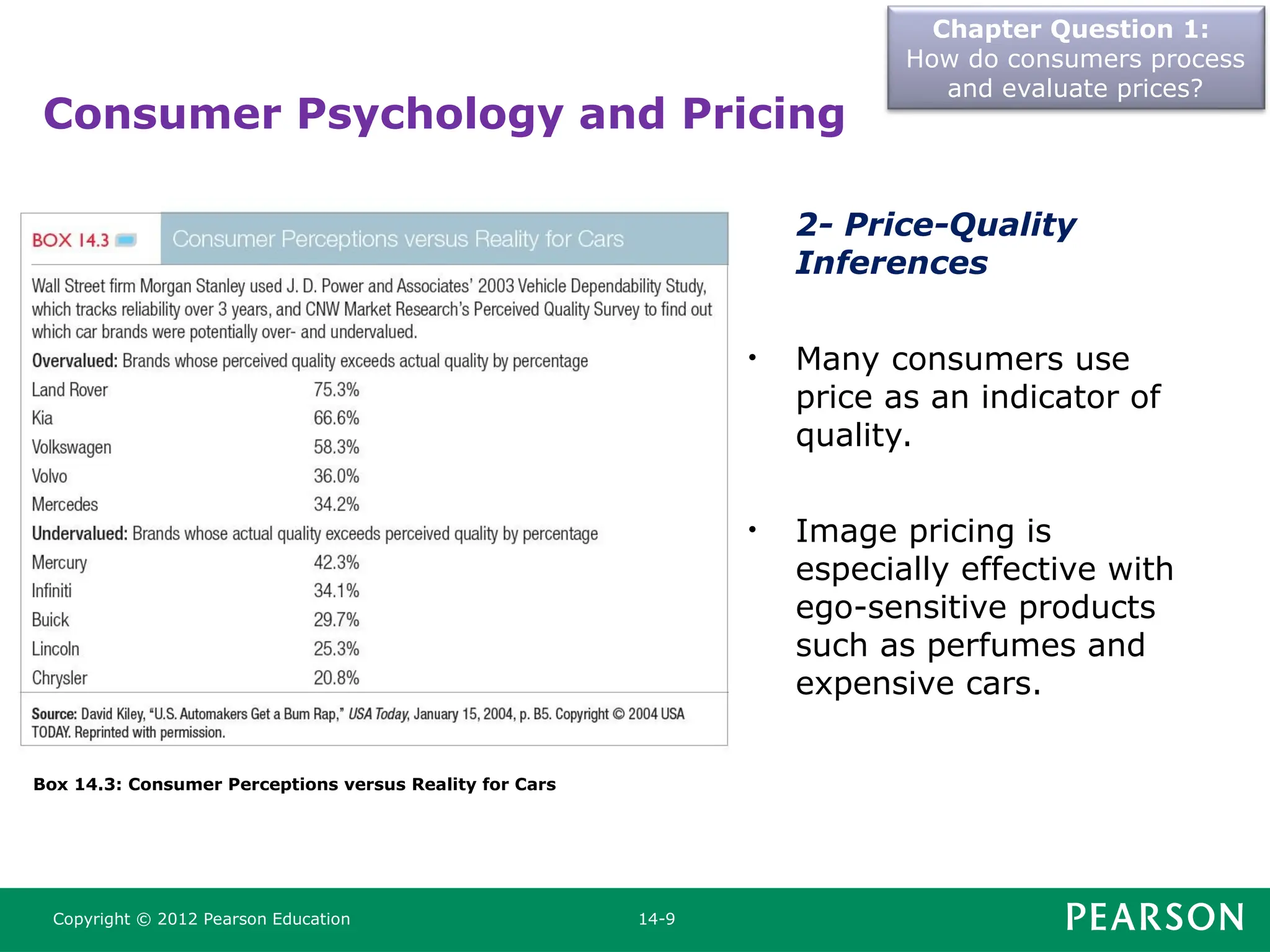
• Many consumers use
price as an indicator of
quality.
• Image pricing is
especially effective with
ego-sensitive products
such as perfumes and
expensive cars.
Consumer Psychology and Pricing
Box 14.3: Consumer Perceptions versus Reality for Cars
Chapter Question 1:
How do consumers process
and evaluate prices?
Copyright © 2012 Pearson Education 14-10
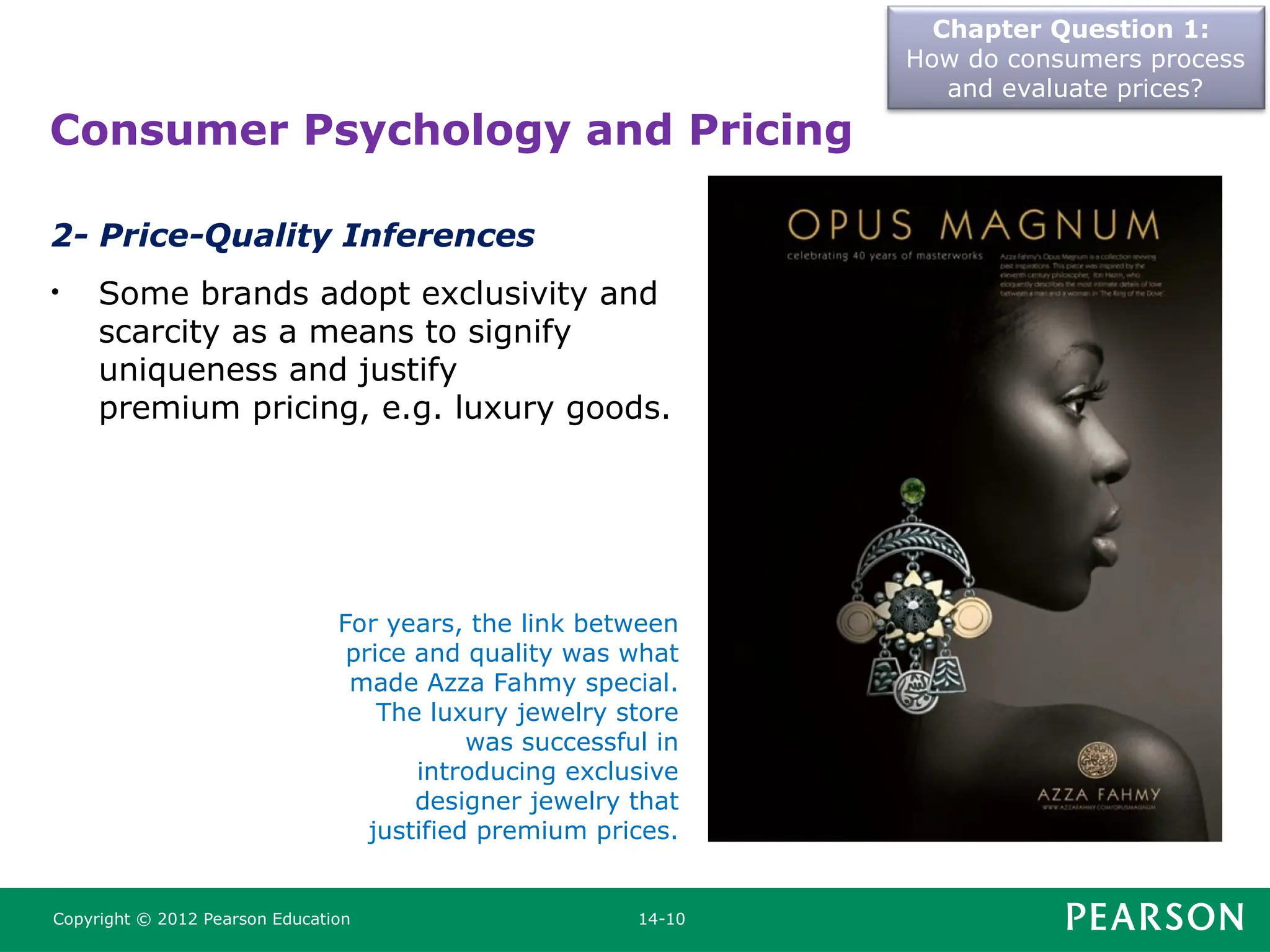
2- Price-Quality Inferences
• Some brands adopt exclusivity and
scarcity as a means to signify
uniqueness and justify
premium pricing, e.g. luxury goods.
Consumer Psychology and Pricing
For years, the link between
price and quality was what
made Azza Fahmy special.
The luxury jewelry store
was successful in
introducing exclusive
designer jewelry that
justified premium prices.
Chapter Question 1:
How do consumers process
and evaluate prices?
Copyright © 2012 Pearson Education 14-11
3- Price Endings
• Many sellers believe prices should end in an odd number.
• Customers see an item priced at US$299 in the $200 rather than
the $300 range.
• Prices that end with 0 and 5 are also common in the marketplace;
they are thought to be easier for consumers to remember.
• ‘Sale’ signs next to prices increase demand, but only if not
overused.
Consumer Psychology and Pricing
Chapter Question 1:
How do consumers process
and evaluate prices?
Copyright © 2012 Pearson Education 14-12
3- Price Endings
When to use price cues:
• Customers purchase item infrequently
• Customers are new
• Product designs vary over time
• Prices vary seasonally
• Quality or sizes vary across stores
Consumer Psychology and Pricing
Setting the Price
Chapter Question 2:
How should a company set
prices initially for products
or services?
Copyright © 2012 Pearson Education 14-13
Six-step procedure for setting a pricing policy:
• Select the price objective
• Determine demand
• Estimate costs
• Analyze competitor price mix
• Select pricing method
• Select final price
Let’s look at each step…
Chapter Question 2:
How should a company set
prices initially for products
or services?
Copyright © 2012 Pearson Education 14-14
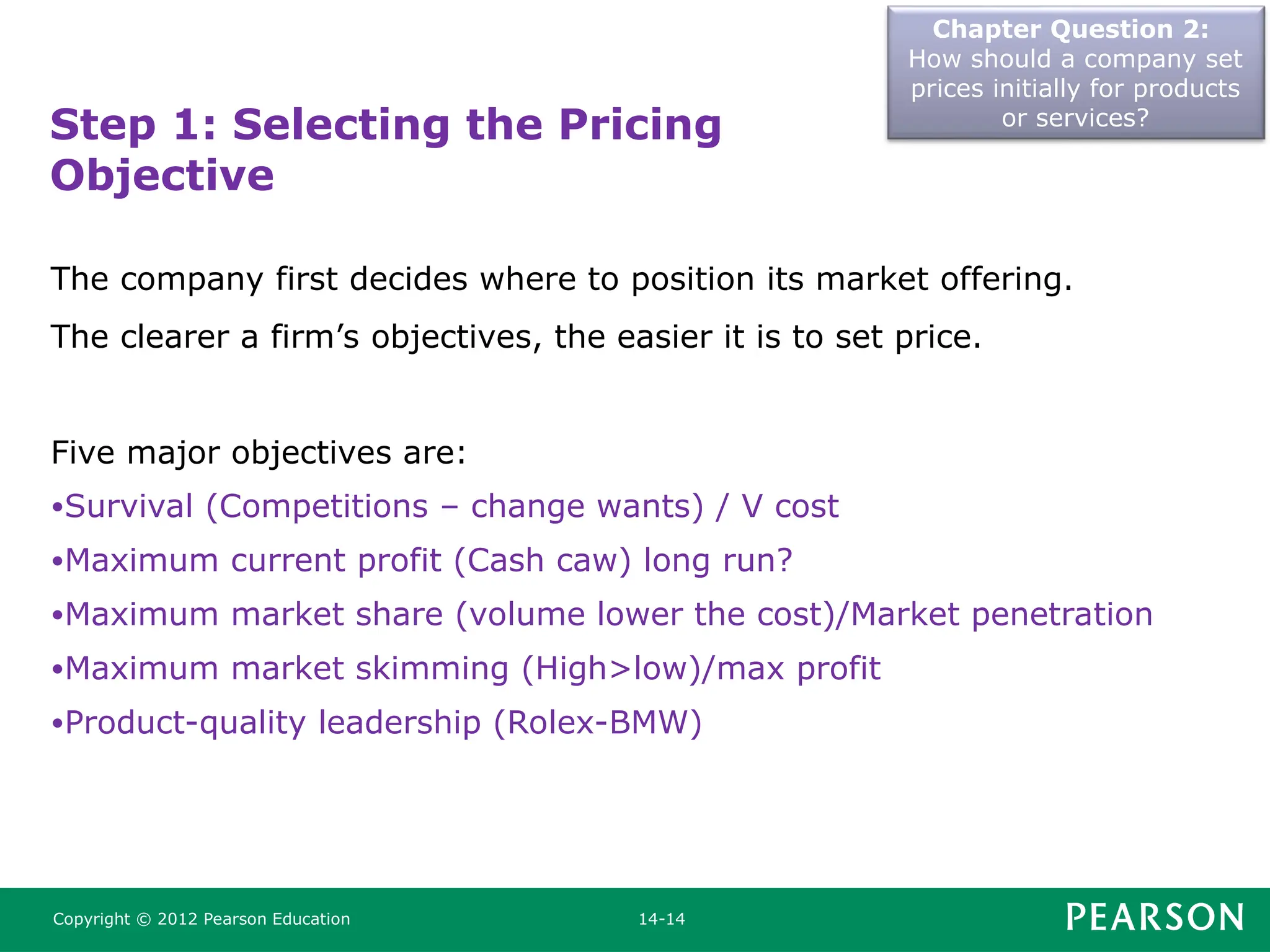
Step 1: Selecting the Pricing
Objective
The company first decides where to position its market offering.
The clearer a firm’s objectives, the easier it is to set price.
Five major objectives are:
•Survival (Competitions – change wants) / V cost
•Maximum current profit (Cash caw) long run?
•Maximum market share (volume lower the cost)/Market penetration
•Maximum market skimming (High>low)/max profit
•Product-quality leadership (Rolex-BMW)
Chapter Question 2:
How should a company set
prices initially for products
or services?
Copyright © 2012 Pearson Education 14-15
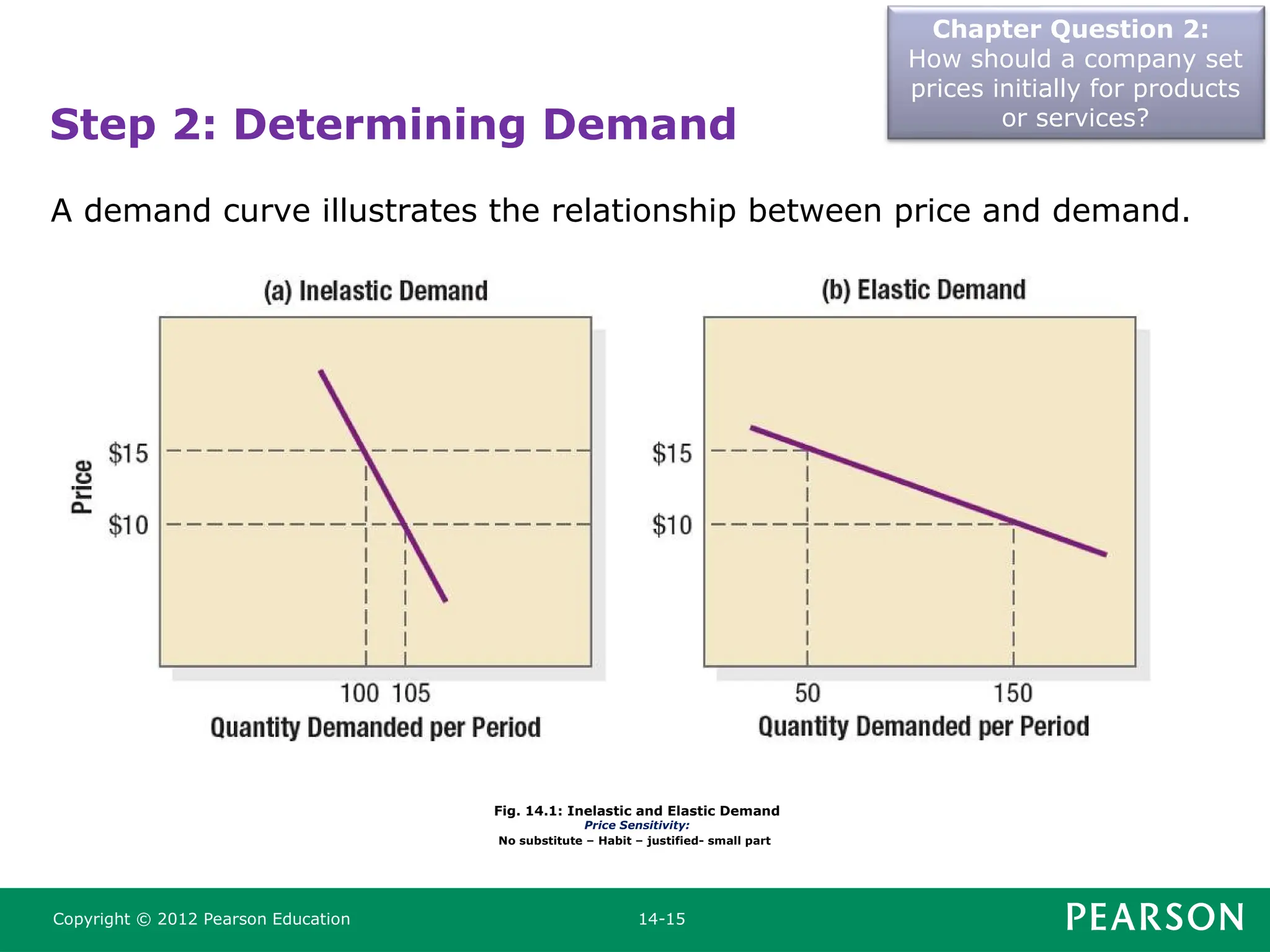
Step 2: Determining Demand
A demand curve illustrates the relationship between price and demand.
Fig. 14.1: Inelastic and Elastic Demand
Price Sensitivity:
No substitute – Habit – justified- small part
Chapter Question 2:
How should a company set
prices initially for products
or services?
Copyright © 2012 Pearson Education 14-16
Step 2: Determining Demand
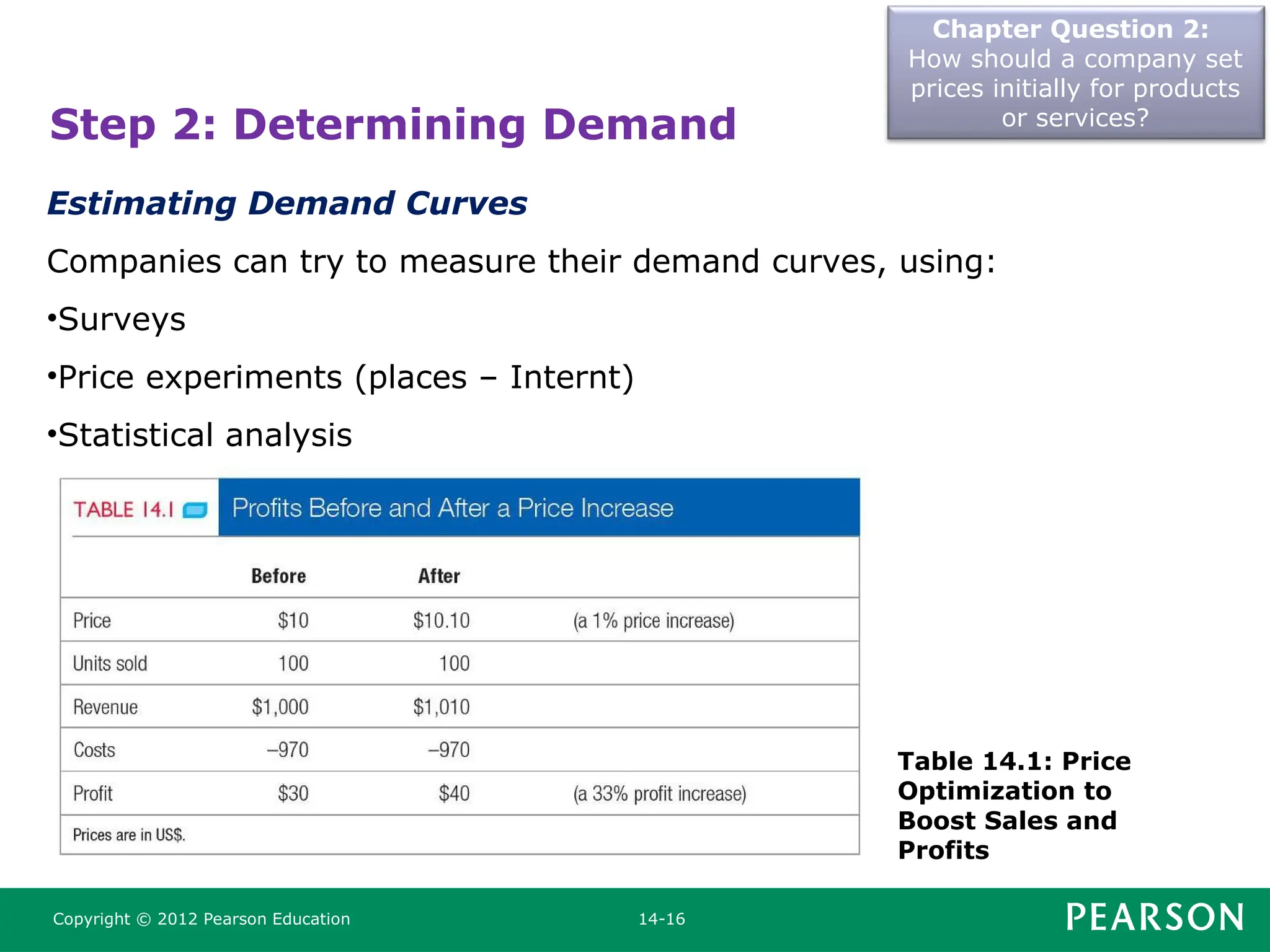
Estimating Demand Curves
Companies can try to measure their demand curves, using:
•Surveys
•Price experiments (places – Internt)
•Statistical analysis
Table 14.1: Price
Optimization to
Boost Sales and
Profits
Chapter Question 2:
How should a company set
prices initially for products
or services?
Copyright © 2012 Pearson Education 14-17
Step 3: Estimating Costs
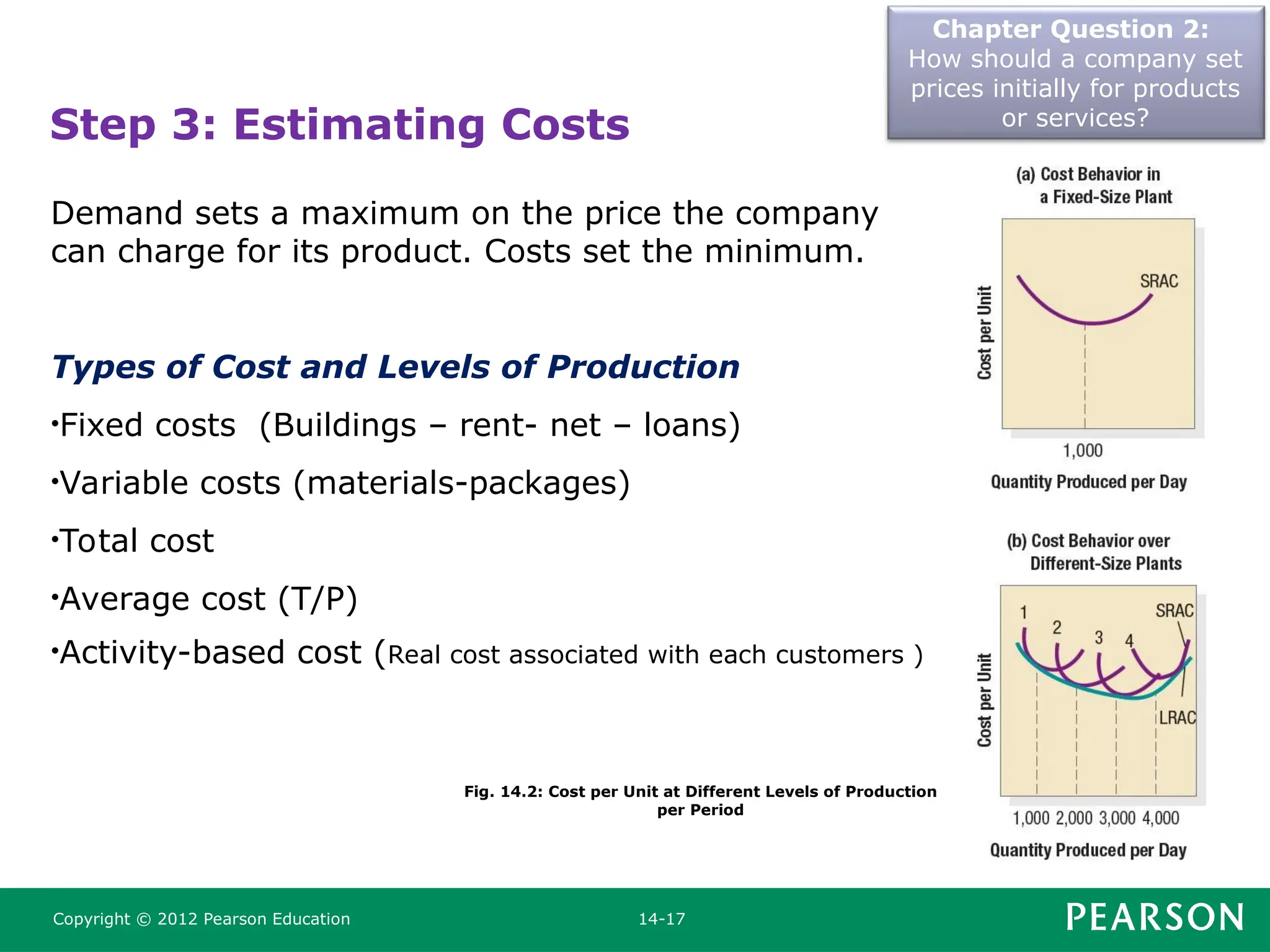
Demand sets a maximum on the price the company
can charge for its product. Costs set the minimum.
Types of Cost and Levels of Production
•Fixed costs (Buildings – rent- net – loans)
•Variable costs (materials-packages)
•Total cost
•Average cost (T/P)
•Activity-based cost (Real cost associated with each customers )
Fig. 14.2: Cost per Unit at Different Levels of Production
per Period
Chapter Question 2:
How should a company set
prices initially for products
or services?
Copyright © 2012 Pearson Education 14-18
Step 3: Estimating Costs
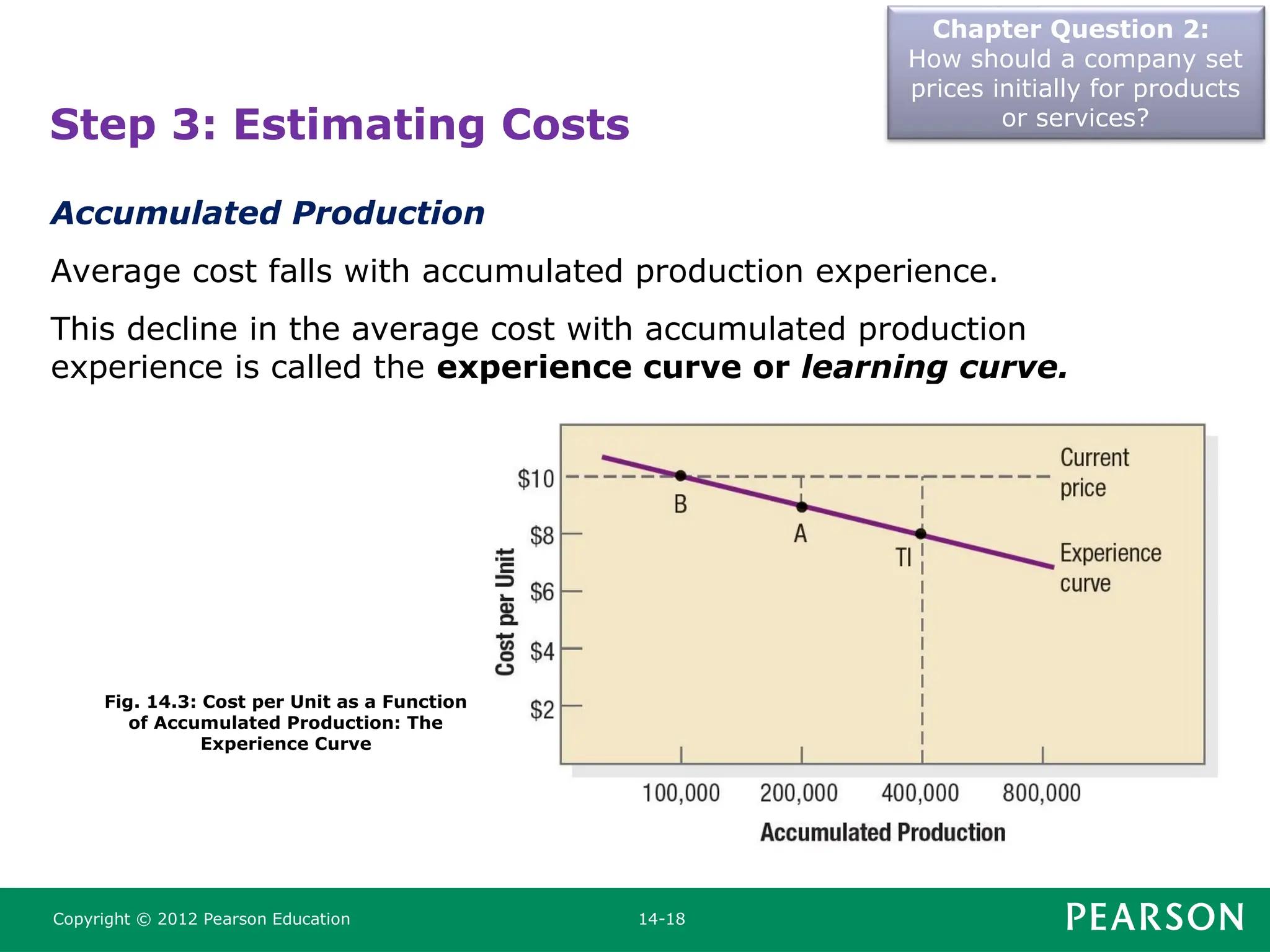
Accumulated Production
Average cost falls with accumulated production experience.
This decline in the average cost with accumulated production
experience is called the experience curve or learning curve.
Fig. 14.3: Cost per Unit as a Function
of Accumulated Production: The
Experience Curve
Chapter Question 2:
How should a company set
prices initially for products
or services?
Copyright © 2012 Pearson Education 14-19
Step 3: Estimating Costs
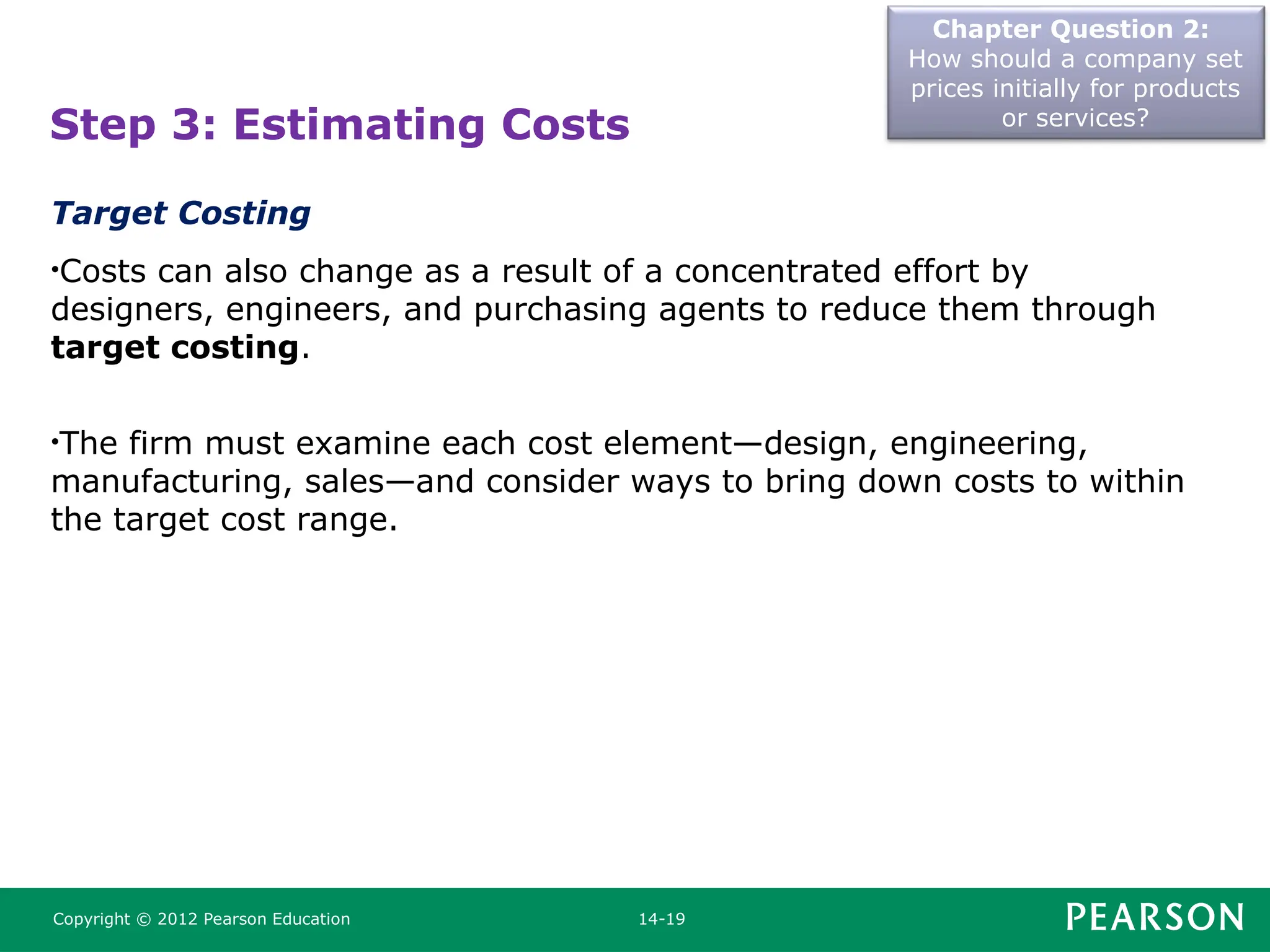
Target Costing
•Costs can also change as a result of a concentrated effort by
designers, engineers, and purchasing agents to reduce them through
target costing.
•The firm must examine each cost element—design, engineering,
manufacturing, sales—and consider ways to bring down costs to within
the target cost range.
Chapter Question 2:
How should a company set
prices initially for products
or services?
Copyright © 2012 Pearson Education 14-20
Step 4: Analyzing Competitors’
Costs, Prices, and Offers
• The company must take competitors’ costs, prices, and possible
price reactions into account.
• The introduction of any price or the change of any existing price can
provoke a response from customers, competitors, distributors,
suppliers, and even government.
Chapter Question 2:
How should a company set
prices initially for products
or services?
Copyright © 2012 Pearson Education 14-21
Step 5: Selecting a Pricing Method
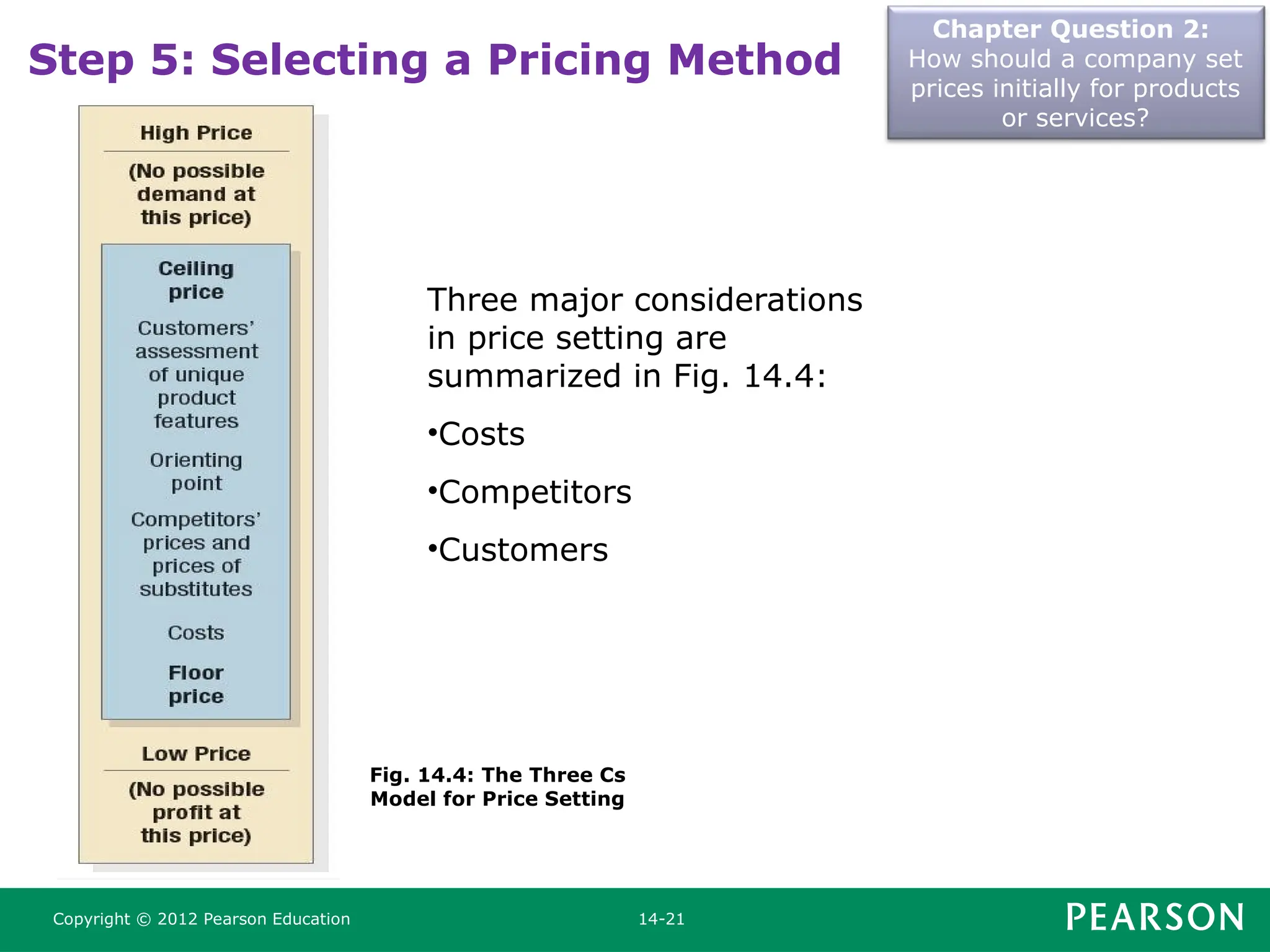
Three major considerations
in price setting are
summarized in Fig. 14.4:
•Costs
•Competitors
•Customers
Fig. 14.4: The Three Cs
Model for Price Setting
Chapter Question 2:
How should a company set
prices initially for products
or services?
Copyright © 2012 Pearson Education 14-22
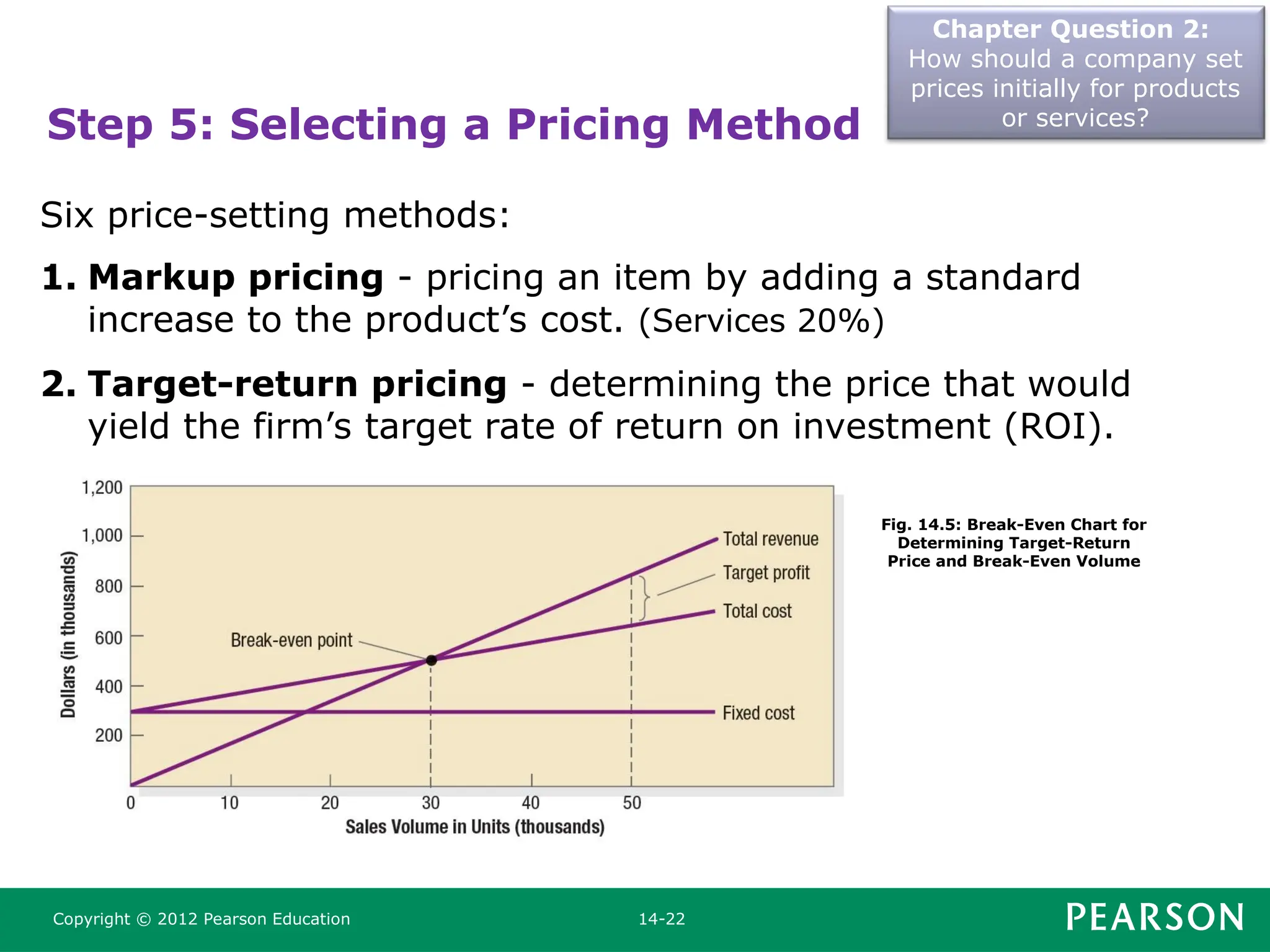
Step 5: Selecting a Pricing Method
Six price-setting methods:
1. Markup pricing - pricing an item by adding a standard
increase to the product’s cost. (Services 20%)
2. Target-return pricing - determining the price that would
yield the firm’s target rate of return on investment (ROI).
Fig. 14.5: Break-Even Chart for
Determining Target-Return
Price and Break-Even Volume
Chapter Question 2:
How should a company set
prices initially for products
or services?
Copyright © 2012 Pearson Education 14-23
Step 5: Selecting a Pricing Method
Six price-setting methods (continued):
3. Perceived-value pricing - the value promised by the
company’s value proposition and perceived by the
customer.
4. Value pricing - winning loyal customers by charging a
fairly low price for a high-quality offering. Ikea, Arabia
Airline
5. Going-rate pricing - price based largely on competitors’
prices. Steel-cement
6. Auction-type pricing – price achieved in an auction.
Different types of auctions include English(ascending bids),
Dutch (descending bids), and sealed-bid auctions.
Chapter Question 2:
How should a company set
prices initially for products
or services?
Copyright © 2012 Pearson Education 14-24
Step 6: Selecting the Final Price
In selecting the price, the company must consider additional
factors, including
•Impact of other marketing activities
•Company pricing policies
•Gain-and-risk sharing pricing
•Impact of price on other parties
Adapting the Price
Chapter Question 3:
How should a company
adapt prices to meet
varying circumstances and
opportunities?
Copyright © 2012 Pearson Education 14-25
Companies usually set a pricing strategy rather than a single
price.
Price adaptation strategies include:
•Geographical pricing
•Discounts/allowances
•Promotional pricing
•Differentiated pricing
Geographical Pricing
Chapter Question 3:
How should a company
adapt prices to meet
varying circumstances and
opportunities?
Copyright © 2012 Pearson Education 14-26
In geographical pricing, the company decides how to price its
products to customers in different locations and countries.
Countertrade is when buyers offer other items in payment. This can
take the form of:
•Barter (no money)
•Compensation deal (Money + product)
•Buyback arrangement (Money + production)
•Offset (spend some to offest)
Price Discounts and Allowances
Chapter Question 3:
How should a company
adapt prices to meet
varying circumstances and
opportunities?
Copyright © 2012 Pearson Education 14-27
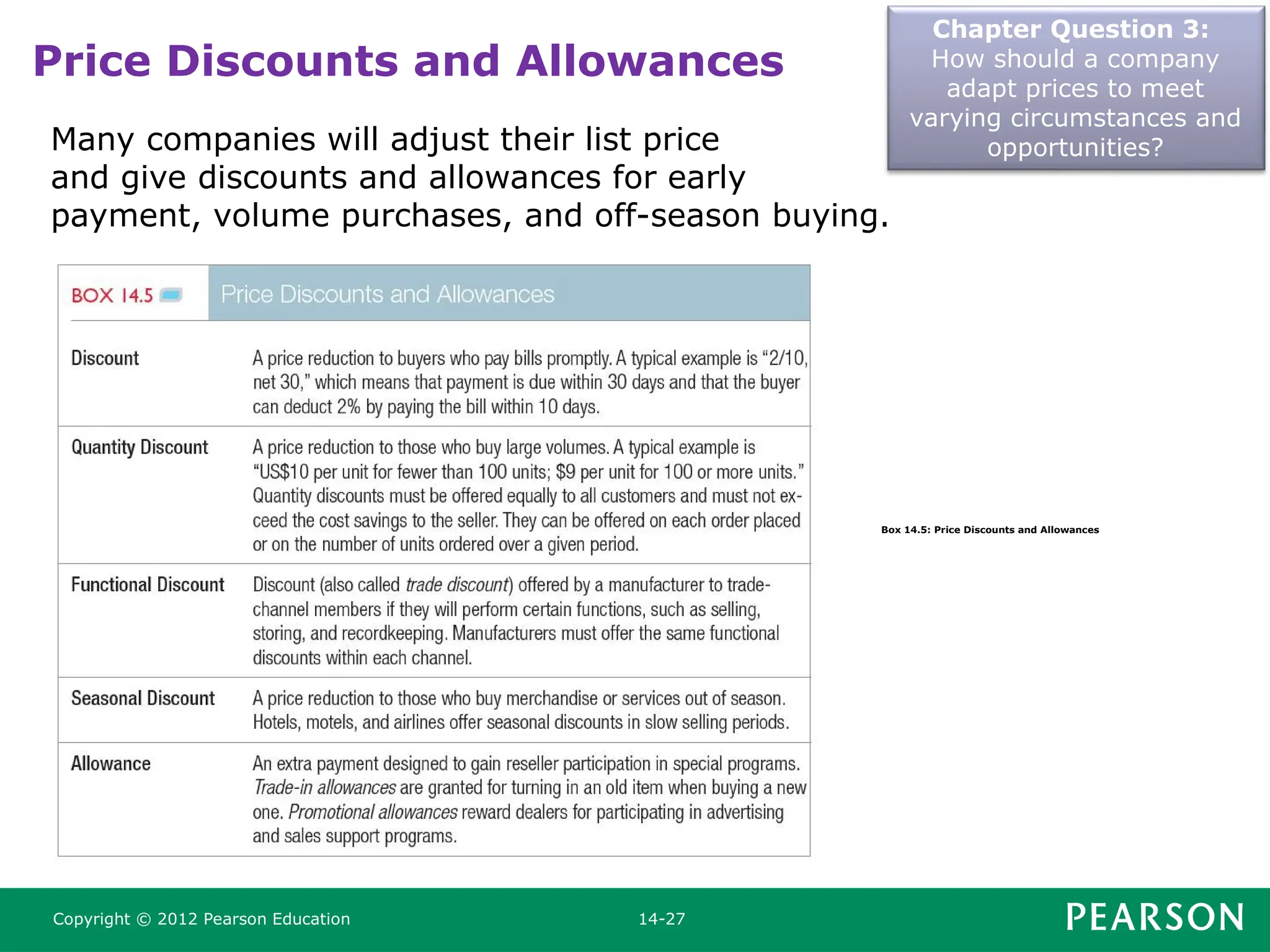
Many companies will adjust their list price
and give discounts and allowances for early
payment, volume purchases, and off-season buying.
Box 14.5: Price Discounts and Allowances
Promotional Pricing
Chapter Question 3:
How should a company
adapt prices to meet
varying circumstances and
opportunities?
Copyright © 2012 Pearson Education 14-28
Companies can use several pricing techniques to stimulate
early purchase:
•Loss-leader pricing
•Special-event pricing
•Cash rebates
•Low-interest financing
•Longer payment terms
•Warranties and service contracts
•Psychological discounting
Differentiated Pricing
Chapter Question 3:
How should a company
adapt prices to meet
varying circumstances and
opportunities?
Copyright © 2012 Pearson Education 14-29
Price discrimination occurs when a company sells a product or service at two
or more prices that do not reflect a difference in costs.
•In first-degree price discrimination, the seller charges a separate price to
each customer depending on the intensity of their demand.
•In second-degree price discrimination, the seller charges less to buyers
who buy a larger volume.
•In third-degree price discrimination, the seller charges different amounts
to different classes of buyers, as in the following cases:
o Customer-segment pricing
o Product-form pricing
o Image pricing
o Channel pricing
o Location pricing
o Time pricing
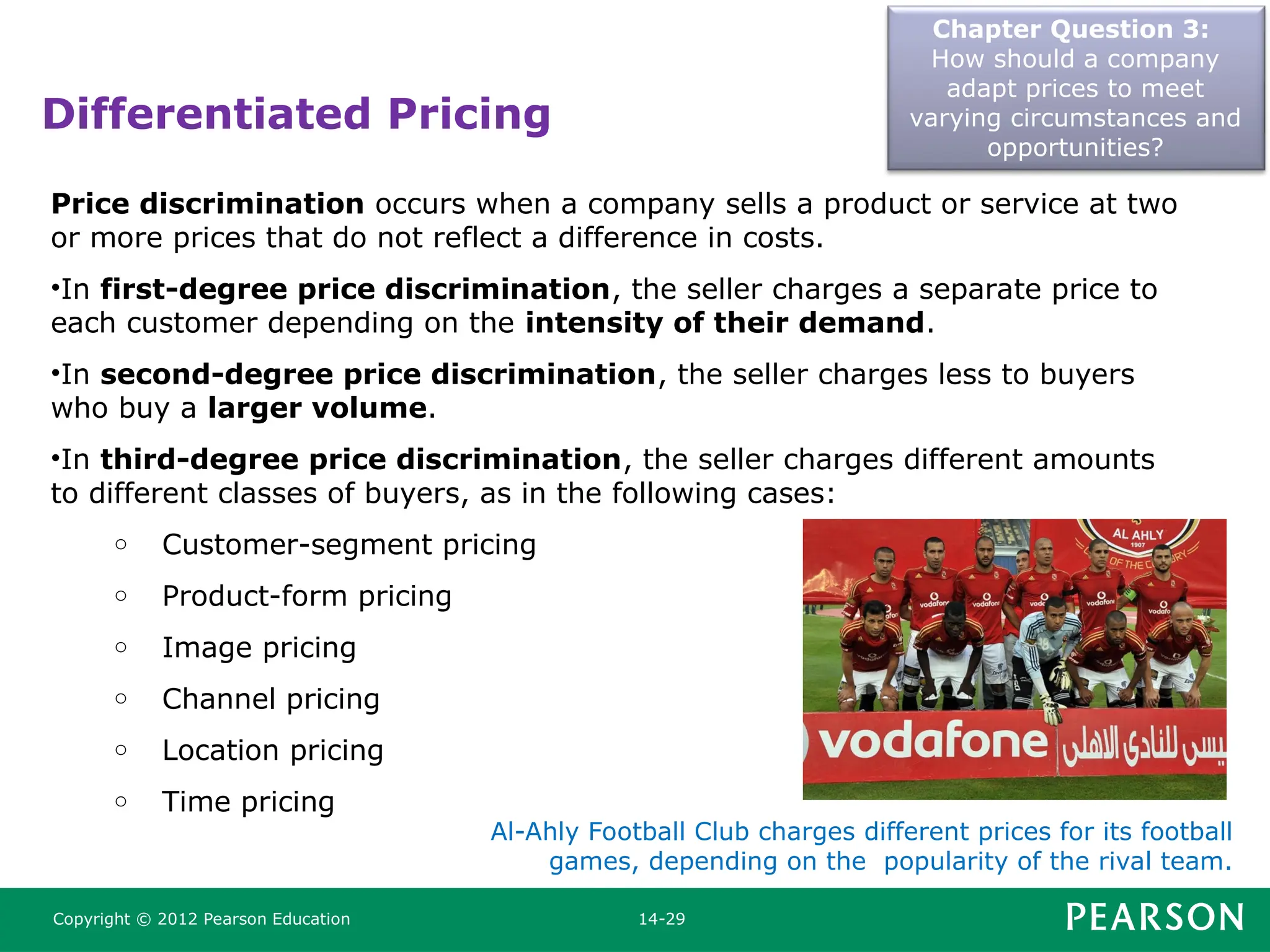
Al-Ahly Football Club charges different prices for its football
games, depending on the popularity of the rival team.
Initiating and Responding to
Price Changes
Chapter Question 4:
When should a company
initiate a price change?
Copyright © 2012 Pearson Education 14-30
Companies might cut prices due to:
•Excess plant capacity
•Drive to dominate the market through lower costs
•Hope of gaining market share
Initiating Price Cuts
Chapter Question 4:
When should a company
initiate a price change?
Copyright © 2012 Pearson Education 14-31
Price-cutting strategy can lead to possible traps:
•Encourages customers to demand price concessions
•Trains salespeople to offer price concessions
•Low-quality trap – consumers assume quality is low
•Fragile market-share trap – buys share but not loyalty
•Shallow-pockets trap – competitors have deeper cash reserves
•Price-war trap
Initiating Price Cuts
Chapter Question 4:
When should a company
initiate a price change?
Copyright © 2012 Pearson Education 14-32
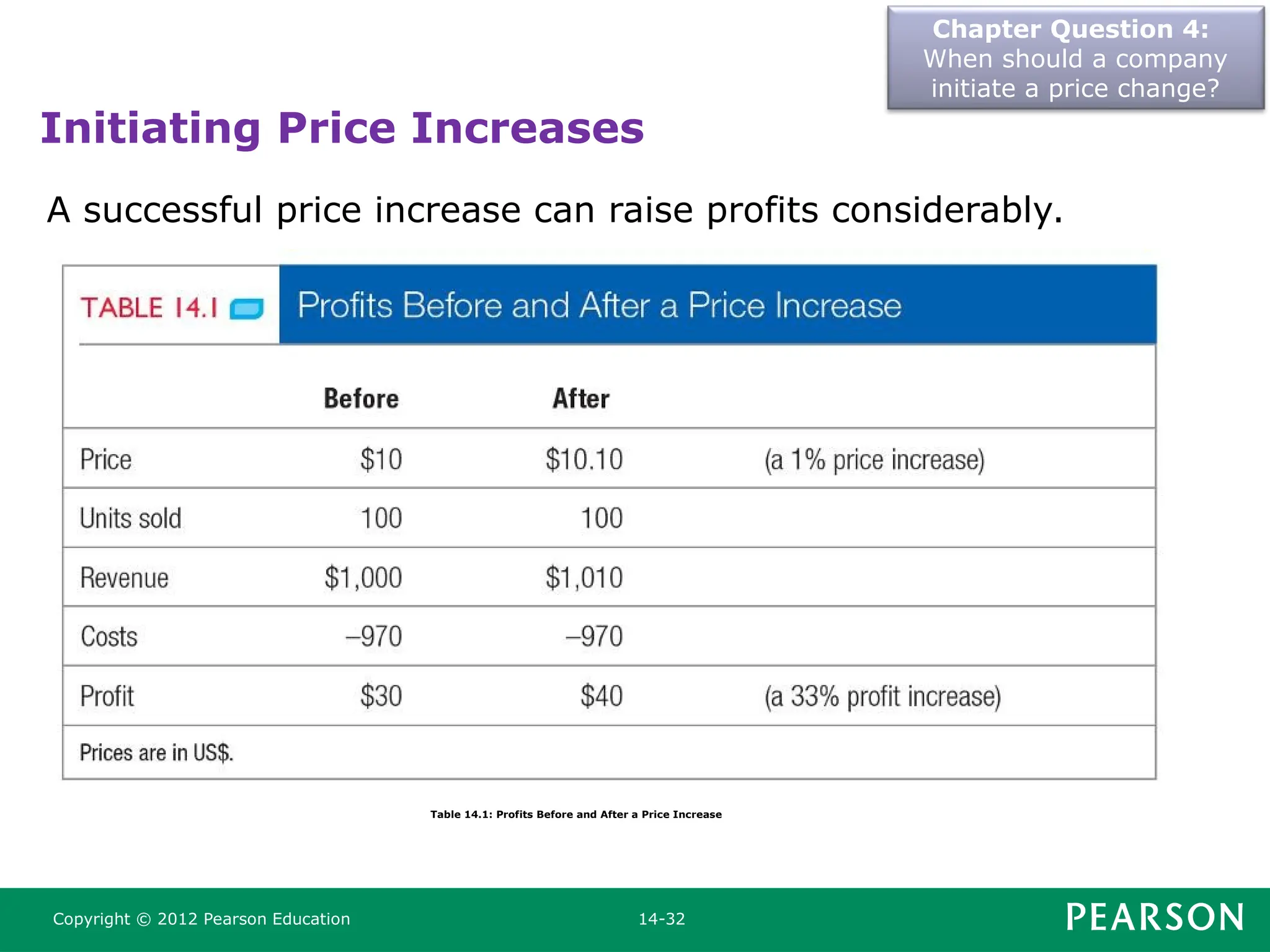
A successful price increase can raise profits considerably.
Initiating Price Increases
Table 14.1: Profits Before and After a Price Increase
Chapter Question 4:
When should a company
initiate a price change?
Copyright © 2012 Pearson Education 14-33
Initiating Price Increases
Price can be increased in the following ways:
• Delayed quotation pricing
• Escalator clauses
• Unbundling
• Reduction of discounts
Chapter Question 4:
When should a company
initiate a price change?
Copyright © 2012 Pearson Education 14-34
Initiating Price Increases
Alternative approaches:
• Shrinking the amount of product instead of raising the price.
• Substituting less-expensive materials or ingredients.
• Reducing or removing product features.
• Removing or reducing product services, such as installation or free
delivery.
• Using less-expensive packaging material or larger package sizes.
• Reducing the number of sizes and models offered.
• Creating new economy brands.
Chapter Question 5:
How should a company
respond to a competitor’s
price change?
Copyright © 2012 Pearson Education 14-35
A company needs to consider the following issues:
1.Why did the competitor change the price?
2.Does the competitor plan to make the price change temporary or
permanent?
3.What will happen to the company’s market share and profits if it
does not respond? Are other companies going to respond?
4.What are the competitors’ and other firms’ responses likely to be to
each possible reaction?
Responding to Competitors’
Price Changes
Chapter Question 5:
How should a company
respond to a competitor’s
price change?
Copyright © 2012 Pearson Education 14-36
Market leaders often face aggressive price cutting by smaller firms
trying to gain market share. Possible responses include:
•Maintain price
•Maintain price and add value
•Reduce price
•Increase price and improve quality
•Launch a low-price fighter line
Responding to Competitors’
Price Changes
Credits
• Slide 1 Press Association Images: DON RYAN / AP
• Slide 3 Alamy Images: mediablitzimages (uk) Limited
• Slide 5 Peter J. Howe, “The Next Pinch: Fees to Check Bags,” Boston Globe,
March 8, 2007; Katherine Heires, “Why It Pays to Give Away the Store,” Business
2.0, October 2006, pp. 36–37; Kerry Capel, “Wal-Mart with Wings,”
BusinessWeek, November 27, 2006, pp.44–45; Matthew Maier, “A Radical Fix for
Airlines: Make Flying Free,” Business 2.0, April 2006, pp.32–34; Gary Stoller,
“Would You Like Some Golf Balls with That Ticket,” USA Today, October 30, 1996
• Slide 8 Adapted from Russell S. Winer, “Behavioral Perspectives on Pricing:
Buyers’ Subjective Perceptions of Price Revisited,” in Issues in Pricing: Theory and
Research, ed. Timothy Devinney (Lexington, MA: Lexington Books, 1988), pp. 35–
57
• Slide 9 Getty Images: Bloomberg 8t
• Slide 10 David Kiley, “U.S. Automakers Get a Bum Rap,” USA Today, January 15,
2004, p. B5. Copyright © 2004 USA TODAY. Reprinted with permission
• Slide 11 Azza Fahmy. Reproduced with permission
• Slide 17 Adapted from Thomas T. Nagle and Reed K. Holden, The Strategy and
Tactics of Pricing, 3rd edn (Upper Saddle River, NJ: Prentice Hall, 2001), Chapter 4
• Slide 32 Corbis: NameerGalal / Demotix 395

ch_14................................ppt

  • 2.
    Marketing Management Chapter 14 DevelopingPricing Strategies and Programs
  • 3.
    Copyright © 2012Pearson Education 14-3 Chapter Questions 1. How do consumers process and evaluate prices? 2. How should a company set prices initially for products or services? 3. How should a company adapt prices to meet varying circumstances and opportunities? 4. When should a company initiate a price change? 5. How should a company respond to a competitor’s price challenge?
  • 4.
    Understanding Pricing Chapter Question1: How do consumers process and evaluate prices? Copyright © 2012 Pearson Education 14-4 • Pricing practices have changed significantly in recent years. • Many companies no longer follow the low-pricing trend, and have successfully traded consumers up to more expensive products. A Changing Pricing Environment Nescafé Cappucino was introduced at a higer price than their regular coffee sachets..
  • 5.
    Chapter Question 1: Howdo consumers process and evaluate prices? Copyright © 2012 Pearson Education 14-5 Companies do their pricing in a variety of ways. Often it is not done well. Common pricing mistakes include: • Simplistically determining costs and taking traditional industry margins. • Failure to revise price to capitalize on market changes. • Setting price independently of the rest of the marketing mix. • Failure to vary price by product item, market segment, distribution channels, and purchase occasion. Effective pricing strategies must: • Understand consumer pricing psychology. • Have a systematic approach to setting, adapting, and changing prices. How Companies Price
  • 6.
    Chapter Question 1: Howdo consumers process and evaluate prices? Copyright © 2012 Pearson Education 14-6 Understanding how consumers arrive at their perceptions of prices is an important marketing priority. Here we consider three key topics: 1.Reference prices 2.Price–quality inferences 3.Price endings Consumer Psychology and Pricing
  • 7.
    Chapter Question 1: Howdo consumers process and evaluate prices? Copyright © 2012 Pearson Education 14-7 1- Reference Prices Consumers often employ reference prices, comparing an observed price to an internal reference price they remember. Consumer Psychology and Pricing Box 14.2: Possible Consumer Reference Prices
  • 8.
    Chapter Question 1: Howdo consumers process and evaluate prices? Copyright © 2012 Pearson Education 14-8 1- Reference Prices When consumers think of one or more of these frames of reference, their perceived price can vary from the stated price. Consumer Psychology and Pricing High reference prices in the consumer electronics industry have trained consumers to gravitate toward ‘sale’ prices.
  • 9.
    Chapter Question 1: Howdo consumers process and evaluate prices? Copyright © 2012 Pearson Education 14-9 2- Price-Quality Inferences • Many consumers use price as an indicator of quality. • Image pricing is especially effective with ego-sensitive products such as perfumes and expensive cars. Consumer Psychology and Pricing Box 14.3: Consumer Perceptions versus Reality for Cars
  • 10.
    Chapter Question 1: Howdo consumers process and evaluate prices? Copyright © 2012 Pearson Education 14-10 2- Price-Quality Inferences • Some brands adopt exclusivity and scarcity as a means to signify uniqueness and justify premium pricing, e.g. luxury goods. Consumer Psychology and Pricing For years, the link between price and quality was what made Azza Fahmy special. The luxury jewelry store was successful in introducing exclusive designer jewelry that justified premium prices.
  • 11.
    Chapter Question 1: Howdo consumers process and evaluate prices? Copyright © 2012 Pearson Education 14-11 3- Price Endings • Many sellers believe prices should end in an odd number. • Customers see an item priced at US$299 in the $200 rather than the $300 range. • Prices that end with 0 and 5 are also common in the marketplace; they are thought to be easier for consumers to remember. • ‘Sale’ signs next to prices increase demand, but only if not overused. Consumer Psychology and Pricing
  • 12.
    Chapter Question 1: Howdo consumers process and evaluate prices? Copyright © 2012 Pearson Education 14-12 3- Price Endings When to use price cues: • Customers purchase item infrequently • Customers are new • Product designs vary over time • Prices vary seasonally • Quality or sizes vary across stores Consumer Psychology and Pricing
  • 13.
    Setting the Price ChapterQuestion 2: How should a company set prices initially for products or services? Copyright © 2012 Pearson Education 14-13 Six-step procedure for setting a pricing policy: • Select the price objective • Determine demand • Estimate costs • Analyze competitor price mix • Select pricing method • Select final price Let’s look at each step…
  • 14.
    Chapter Question 2: Howshould a company set prices initially for products or services? Copyright © 2012 Pearson Education 14-14 Step 1: Selecting the Pricing Objective The company first decides where to position its market offering. The clearer a firm’s objectives, the easier it is to set price. Five major objectives are: •Survival (Competitions – change wants) / V cost •Maximum current profit (Cash caw) long run? •Maximum market share (volume lower the cost)/Market penetration •Maximum market skimming (High>low)/max profit •Product-quality leadership (Rolex-BMW)
  • 15.
    Chapter Question 2: Howshould a company set prices initially for products or services? Copyright © 2012 Pearson Education 14-15 Step 2: Determining Demand A demand curve illustrates the relationship between price and demand. Fig. 14.1: Inelastic and Elastic Demand Price Sensitivity: No substitute – Habit – justified- small part
  • 16.
    Chapter Question 2: Howshould a company set prices initially for products or services? Copyright © 2012 Pearson Education 14-16 Step 2: Determining Demand Estimating Demand Curves Companies can try to measure their demand curves, using: •Surveys •Price experiments (places – Internt) •Statistical analysis Table 14.1: Price Optimization to Boost Sales and Profits
  • 17.
    Chapter Question 2: Howshould a company set prices initially for products or services? Copyright © 2012 Pearson Education 14-17 Step 3: Estimating Costs Demand sets a maximum on the price the company can charge for its product. Costs set the minimum. Types of Cost and Levels of Production •Fixed costs (Buildings – rent- net – loans) •Variable costs (materials-packages) •Total cost •Average cost (T/P) •Activity-based cost (Real cost associated with each customers ) Fig. 14.2: Cost per Unit at Different Levels of Production per Period
  • 18.
    Chapter Question 2: Howshould a company set prices initially for products or services? Copyright © 2012 Pearson Education 14-18 Step 3: Estimating Costs Accumulated Production Average cost falls with accumulated production experience. This decline in the average cost with accumulated production experience is called the experience curve or learning curve. Fig. 14.3: Cost per Unit as a Function of Accumulated Production: The Experience Curve
  • 19.
    Chapter Question 2: Howshould a company set prices initially for products or services? Copyright © 2012 Pearson Education 14-19 Step 3: Estimating Costs Target Costing •Costs can also change as a result of a concentrated effort by designers, engineers, and purchasing agents to reduce them through target costing. •The firm must examine each cost element—design, engineering, manufacturing, sales—and consider ways to bring down costs to within the target cost range.
  • 20.
    Chapter Question 2: Howshould a company set prices initially for products or services? Copyright © 2012 Pearson Education 14-20 Step 4: Analyzing Competitors’ Costs, Prices, and Offers • The company must take competitors’ costs, prices, and possible price reactions into account. • The introduction of any price or the change of any existing price can provoke a response from customers, competitors, distributors, suppliers, and even government.
  • 21.
    Chapter Question 2: Howshould a company set prices initially for products or services? Copyright © 2012 Pearson Education 14-21 Step 5: Selecting a Pricing Method Three major considerations in price setting are summarized in Fig. 14.4: •Costs •Competitors •Customers Fig. 14.4: The Three Cs Model for Price Setting
  • 22.
    Chapter Question 2: Howshould a company set prices initially for products or services? Copyright © 2012 Pearson Education 14-22 Step 5: Selecting a Pricing Method Six price-setting methods: 1. Markup pricing - pricing an item by adding a standard increase to the product’s cost. (Services 20%) 2. Target-return pricing - determining the price that would yield the firm’s target rate of return on investment (ROI). Fig. 14.5: Break-Even Chart for Determining Target-Return Price and Break-Even Volume
  • 23.
    Chapter Question 2: Howshould a company set prices initially for products or services? Copyright © 2012 Pearson Education 14-23 Step 5: Selecting a Pricing Method Six price-setting methods (continued): 3. Perceived-value pricing - the value promised by the company’s value proposition and perceived by the customer. 4. Value pricing - winning loyal customers by charging a fairly low price for a high-quality offering. Ikea, Arabia Airline 5. Going-rate pricing - price based largely on competitors’ prices. Steel-cement 6. Auction-type pricing – price achieved in an auction. Different types of auctions include English(ascending bids), Dutch (descending bids), and sealed-bid auctions.
  • 24.
    Chapter Question 2: Howshould a company set prices initially for products or services? Copyright © 2012 Pearson Education 14-24 Step 6: Selecting the Final Price In selecting the price, the company must consider additional factors, including •Impact of other marketing activities •Company pricing policies •Gain-and-risk sharing pricing •Impact of price on other parties
  • 25.
    Adapting the Price ChapterQuestion 3: How should a company adapt prices to meet varying circumstances and opportunities? Copyright © 2012 Pearson Education 14-25 Companies usually set a pricing strategy rather than a single price. Price adaptation strategies include: •Geographical pricing •Discounts/allowances •Promotional pricing •Differentiated pricing
  • 26.
    Geographical Pricing Chapter Question3: How should a company adapt prices to meet varying circumstances and opportunities? Copyright © 2012 Pearson Education 14-26 In geographical pricing, the company decides how to price its products to customers in different locations and countries. Countertrade is when buyers offer other items in payment. This can take the form of: •Barter (no money) •Compensation deal (Money + product) •Buyback arrangement (Money + production) •Offset (spend some to offest)
  • 27.
    Price Discounts andAllowances Chapter Question 3: How should a company adapt prices to meet varying circumstances and opportunities? Copyright © 2012 Pearson Education 14-27 Many companies will adjust their list price and give discounts and allowances for early payment, volume purchases, and off-season buying. Box 14.5: Price Discounts and Allowances
  • 28.
    Promotional Pricing Chapter Question3: How should a company adapt prices to meet varying circumstances and opportunities? Copyright © 2012 Pearson Education 14-28 Companies can use several pricing techniques to stimulate early purchase: •Loss-leader pricing •Special-event pricing •Cash rebates •Low-interest financing •Longer payment terms •Warranties and service contracts •Psychological discounting
  • 29.
    Differentiated Pricing Chapter Question3: How should a company adapt prices to meet varying circumstances and opportunities? Copyright © 2012 Pearson Education 14-29 Price discrimination occurs when a company sells a product or service at two or more prices that do not reflect a difference in costs. •In first-degree price discrimination, the seller charges a separate price to each customer depending on the intensity of their demand. •In second-degree price discrimination, the seller charges less to buyers who buy a larger volume. •In third-degree price discrimination, the seller charges different amounts to different classes of buyers, as in the following cases: o Customer-segment pricing o Product-form pricing o Image pricing o Channel pricing o Location pricing o Time pricing Al-Ahly Football Club charges different prices for its football games, depending on the popularity of the rival team.
  • 30.
    Initiating and Respondingto Price Changes Chapter Question 4: When should a company initiate a price change? Copyright © 2012 Pearson Education 14-30 Companies might cut prices due to: •Excess plant capacity •Drive to dominate the market through lower costs •Hope of gaining market share Initiating Price Cuts
  • 31.
    Chapter Question 4: Whenshould a company initiate a price change? Copyright © 2012 Pearson Education 14-31 Price-cutting strategy can lead to possible traps: •Encourages customers to demand price concessions •Trains salespeople to offer price concessions •Low-quality trap – consumers assume quality is low •Fragile market-share trap – buys share but not loyalty •Shallow-pockets trap – competitors have deeper cash reserves •Price-war trap Initiating Price Cuts
  • 32.
    Chapter Question 4: Whenshould a company initiate a price change? Copyright © 2012 Pearson Education 14-32 A successful price increase can raise profits considerably. Initiating Price Increases Table 14.1: Profits Before and After a Price Increase
  • 33.
    Chapter Question 4: Whenshould a company initiate a price change? Copyright © 2012 Pearson Education 14-33 Initiating Price Increases Price can be increased in the following ways: • Delayed quotation pricing • Escalator clauses • Unbundling • Reduction of discounts
  • 34.
    Chapter Question 4: Whenshould a company initiate a price change? Copyright © 2012 Pearson Education 14-34 Initiating Price Increases Alternative approaches: • Shrinking the amount of product instead of raising the price. • Substituting less-expensive materials or ingredients. • Reducing or removing product features. • Removing or reducing product services, such as installation or free delivery. • Using less-expensive packaging material or larger package sizes. • Reducing the number of sizes and models offered. • Creating new economy brands.
  • 35.
    Chapter Question 5: Howshould a company respond to a competitor’s price change? Copyright © 2012 Pearson Education 14-35 A company needs to consider the following issues: 1.Why did the competitor change the price? 2.Does the competitor plan to make the price change temporary or permanent? 3.What will happen to the company’s market share and profits if it does not respond? Are other companies going to respond? 4.What are the competitors’ and other firms’ responses likely to be to each possible reaction? Responding to Competitors’ Price Changes
  • 36.
    Chapter Question 5: Howshould a company respond to a competitor’s price change? Copyright © 2012 Pearson Education 14-36 Market leaders often face aggressive price cutting by smaller firms trying to gain market share. Possible responses include: •Maintain price •Maintain price and add value •Reduce price •Increase price and improve quality •Launch a low-price fighter line Responding to Competitors’ Price Changes
  • 37.
    Credits • Slide 1Press Association Images: DON RYAN / AP • Slide 3 Alamy Images: mediablitzimages (uk) Limited • Slide 5 Peter J. Howe, “The Next Pinch: Fees to Check Bags,” Boston Globe, March 8, 2007; Katherine Heires, “Why It Pays to Give Away the Store,” Business 2.0, October 2006, pp. 36–37; Kerry Capel, “Wal-Mart with Wings,” BusinessWeek, November 27, 2006, pp.44–45; Matthew Maier, “A Radical Fix for Airlines: Make Flying Free,” Business 2.0, April 2006, pp.32–34; Gary Stoller, “Would You Like Some Golf Balls with That Ticket,” USA Today, October 30, 1996 • Slide 8 Adapted from Russell S. Winer, “Behavioral Perspectives on Pricing: Buyers’ Subjective Perceptions of Price Revisited,” in Issues in Pricing: Theory and Research, ed. Timothy Devinney (Lexington, MA: Lexington Books, 1988), pp. 35– 57 • Slide 9 Getty Images: Bloomberg 8t • Slide 10 David Kiley, “U.S. Automakers Get a Bum Rap,” USA Today, January 15, 2004, p. B5. Copyright © 2004 USA TODAY. Reprinted with permission • Slide 11 Azza Fahmy. Reproduced with permission • Slide 17 Adapted from Thomas T. Nagle and Reed K. Holden, The Strategy and Tactics of Pricing, 3rd edn (Upper Saddle River, NJ: Prentice Hall, 2001), Chapter 4 • Slide 32 Corbis: NameerGalal / Demotix 395