Defining Marketing
Defining Marketing
Marketingis a societal process by which
individuals and groups obtain what they
need and want through creating, offering,
and exchanging products and value with
others.
OR
Marketing is an organizational function and
set of processes for creating,
communicating and delivering value to
customers and for managing customer
relationships in a way that benefits the
organization and its stakeholders
2
3.
Marketing Management
Marketing Management
Philosophies
Philosophies
3
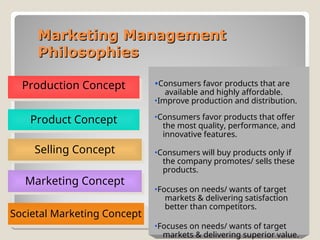
ProductionConcept
Product Concept
Selling Concept
Marketing Concept
Societal Marketing Concept
•Consumers favor products that are
available and highly affordable.
•Improve production and distribution.
•Consumers favor products that offer
the most quality, performance, and
innovative features.
•Consumers will buy products only if
the company promotes/ sells these
products.
•Focuses on needs/ wants of target
markets & delivering satisfaction
better than competitors.
•Focuses on needs/ wants of target
markets & delivering superior value.
4.
Core Marketing Concepts
CoreMarketing Concepts
4
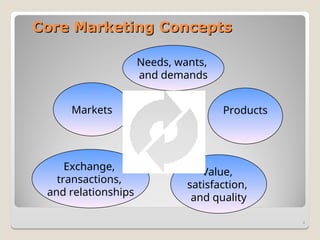
Needs, wants,
and demands
Products
Value,
satisfaction,
and quality
Exchange,
transactions,
and relationships
Markets
5.
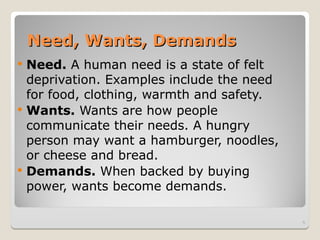
Need, Wants, Demands
Need,Wants, Demands
Need. A human need is a state of felt
deprivation. Examples include the need
for food, clothing, warmth and safety.
Wants. Wants are how people
communicate their needs. A hungry
person may want a hamburger, noodles,
or cheese and bread.
Demands. When backed by buying
power, wants become demands.
5
6.
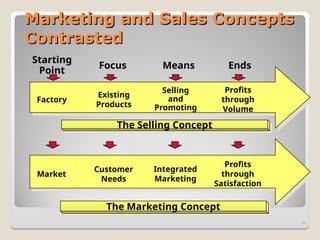
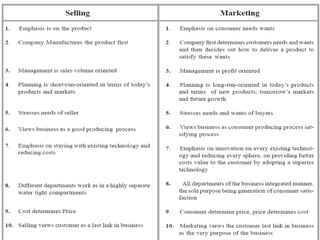
Marketing and SalesConcepts
Marketing and Sales Concepts
Contrasted
Contrasted
6
Factory
Existing
Products
Selling
and
Promoting
Profits
through
Volume
The Selling Concept
Starting
Point
Focus Means Ends
Market
Customer
Needs
Integrated
Marketing
Profits
through
Satisfaction
The Marketing Concept
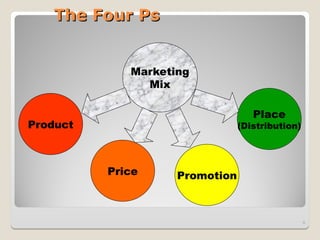
The Four Ps
TheFour Ps
9
Marketing
Mix
Product
Price Promotion
Place
(Distribution)
10.
Marketing mix
Marketing mix
Themarketing mix is the combination of
variables that a business uses to carry out
its marketing strategy and meet customer
needs.
The marketing mix is often called the 4Ps:
Product
Price
Place
Promotion
11.
Product
Product
‘Product’ refersto the functions and
features of a good or service
Should satisfy the needs of the customer
May have a Unique Selling Proposition
(USP)
‘Product’ also includes a range of factors
such as packaging, quality, warranties,
after-sales service and branding
12.
Price
Price
The price ofa product will depend on:
The cost to make it
The amount of profit desired
Other objectives of the business
The price competitors charge
The price customers are willing to pay
◦ Is there a high demand?
◦ Is demand sensitive to changes in price?
13.
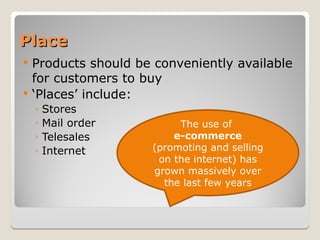
Place
Place
Products shouldbe conveniently available
for customers to buy
‘Places’ include:
◦ Stores
◦ Mail order
◦ Telesales
◦ Internet
The use of
e-commerce
(promoting and selling
on the internet) has
grown massively over
the last few years
14.
Promotion
Promotion
The aims ofpromotion are to:
Raise awareness
Encourage sales
Create or change a brand image
Maintain market share
15.
The Promotional Mix
ThePromotional Mix
Advertising
Sales promotion
Direct Marketing
Personal selling
Public relations
15
Value, Satisfaction, and
Value,Satisfaction, and
Quality
Quality
Customer value is the difference between
the benefits that the customer gains from
owning and/or using a product and the costs
of obtaining the product.
Customer satisfaction depends on a
product’s perceived performance in delivering
value relative to a buyer’s expectations.
Quality begins with customer needs and
ends with customer satisfaction.
17
18.
Exchange, Transactions, and
Exchange,Transactions, and
Relationships
Relationships
Exchange is the act of obtaining a desired
object from someone by offering something
in return.
A transaction is marketing’s unit of
measurement and consists of a trade of
values between two parties.
Relationship marketing builds relationships
with valued customers, distributors, dealers,
and suppliers by promising and consistently
delivering high-quality products, good
service, and fair prices.
18
19.
The Life TimeValue of the
The Life Time Value of the
Customer
Customer
Revenue and profits by average
customer over a lifetime by segment
Increase average purchase, frequency of
visit, life
19
20.
Example
Example
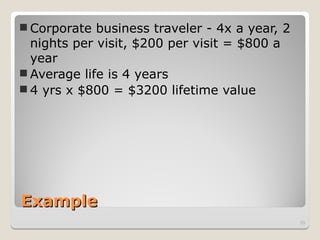
Corporate businesstraveler - 4x a year, 2
nights per visit, $200 per visit = $800 a
year
Average life is 4 years
4 yrs x $800 = $3200 lifetime value
20
Marketing’s Future
Marketing’s Future
“It (marketing) encompasses the entire
business. It is the whole business seen
from the point of view of the final result,
that is, from the customer’s point of view.”
Peter Drucker
Marketing has become the job of
everyone.
22
23.
The Role ofMarketing
The Role of Marketing
in Strategic Planning
in Strategic Planning
23
24.
Strategic Planning
Strategic Planning
24
Strategicplanning is the process of developing
and maintaining a feasible fit between
the organization’s objectives, skills, and resources
and its changing marketing opportunities.
25.
Reasons for Planning
Reasonsfor Planning
If we do not know where we are going
any road will take us there.
The essence of strategic planning is the
consideration of current decision
alternatives in the light of their probable
consequence over time.
The future is unpredictable but it is not
a random walk.
25
26.
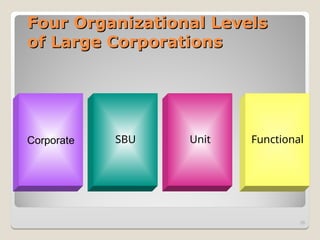
Four Organizational Levels
FourOrganizational Levels
of Large Corporations
of Large Corporations
26
Corporate SBU Unit Functional
Corporate Strategic Planning–
CorporateStrategic Planning–
Four Planning Activities
Four Planning Activities
1. Defining the corporate mission.
2. Establishing strategic business units.
3. Assigning resources to each SBU.
4. Developing growth strategies
28
29.
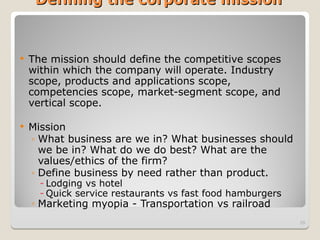
Defining the corporatemission
Defining the corporate mission
The mission should define the competitive scopes
within which the company will operate. Industry
scope, products and applications scope,
competencies scope, market-segment scope, and
vertical scope.
Mission
◦ What business are we in? What businesses should
we be in? What do we do best? What are the
values/ethics of the firm?
◦ Define business by need rather than product.
- Lodging vs hotel
- Quick service restaurants vs fast food hamburgers
◦ Marketing myopia - Transportation vs railroad
29
30.
Corporate Strategic Planning
CorporateStrategic Planning
(cont.)
(cont.)
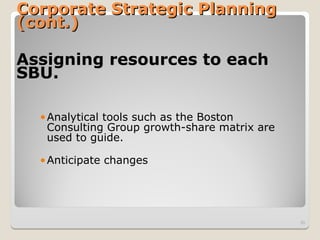
Assigning resources to each
Assigning resources to each
SBU.
SBU.
•Analytical tools such as the Boston
Consulting Group growth-share matrix are
used to guide.
•Anticipate changes
30
31.
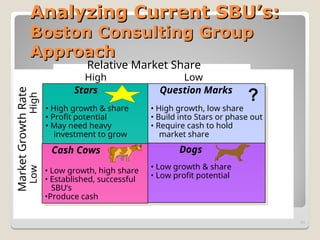
Analyzing Current SBU’s:
AnalyzingCurrent SBU’s:
Boston Consulting Group
Boston Consulting Group
Approach
Approach
31
Question Marks
• High growth, low share
• Build into Stars or phase out
• Require cash to hold
market share
Stars
• High growth & share
• Profit potential
• May need heavy
investment to grow
Cash Cows
• Low growth, high share
• Established, successful
SBU’s
•Produce cash
Dogs
• Low growth & share
• Low profit potential
Relative Market Share
High Low
Market
Growth
Rate
Low
High
?
32.
Corporate Strategic Planning
CorporateStrategic Planning
(cont.)
(cont.)
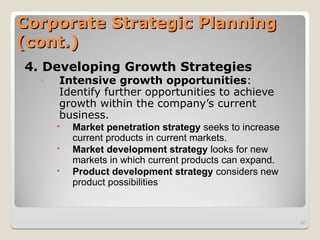
4. Developing Growth Strategies
◦ Intensive growth opportunities:
Identify further opportunities to achieve
growth within the company’s current
business.
Market penetration strategy seeks to increase
current products in current markets.
Market development strategy looks for new
markets in which current products can expand.
Product development strategy considers new
product possibilities
32
33.
Corporate Strategic Planning
CorporateStrategic Planning
(cont.)
(cont.)
- Diversification growth opportunities:
Identify opportunities to add attractive
businesses that are unrelated to the
company’s current businesses.
Concentric diversification strategy:
Company seeks new products that have
technological and/or marketing synergy
with existing product lines, even though
the product may appeal to a new class of
customers
33
34.
Corporate Strategic Planning
CorporateStrategic Planning
(cont.)
(cont.)
- Horizontal diversification strategy:
Company searches for new products that
could appeal to its current customers
though technologically unrelated to its
current product line.
Conglomerate diversification strategy.
34
35.
Corporate Strategic Planning
CorporateStrategic Planning
(cont.)
(cont.)
- Integrative growth opportunities.
Backward integration: A hotel company acquiring one
of its suppliers.
Forward integration: A hotel company acquiring tour
wholesaler or travel agents.
Horizontal integration: A hotel company acquiring one
or more competitors, provided the government does not
bar the move.
35
36.
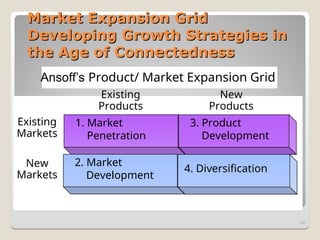
Market Expansion Grid
MarketExpansion Grid
Developing Growth Strategies in
Developing Growth Strategies in
the Age of Connectedness
the Age of Connectedness
36
1. Market
Penetration
2. Market
Development
3. Product
Development
4. Diversification
Existing
Markets
New
Markets
Existing
Products
New
Products
Ansoff’s Product/ Market Expansion Grid
37.
Business Strategy Planning–
Business Strategy Planning –
Planning at the SBU Level
Planning at the SBU Level
1.Business mission
2.External environment analysis–
opportunities and threats
3.Internal environment analysis–
strengths and weaknesses
4.Goal Formulation (What do we want?)–
The vision
37
38.
Business Strategy Planning
BusinessStrategy Planning
(cont.)
(cont.)
5. Strategy Formulation (How do we get
there?)
- Michael Porter’s three generic types of
strategy:
Overall cost leadership
Differentiation
Focus
◦ Strategic Alliances: companies need to form
strategic alliances with domestic or multinational
companies that complement or leverage their
capabilities and resources to achieve leadership
nationally or globally.
38
39.
Business Strategy Planning
BusinessStrategy Planning
(cont.)
(cont.)
6. Program formulation. A company
must develop hiring, training,
advertising, and other programs to
support its strategy.
7. Implementation. A firm must
communicate its strategy to its
employees and it must have the
resources to carry out its strategy.
39
40.
Business Strategy Planning
BusinessStrategy Planning
(cont.)
(cont.)
8. Feedback and control are absolutely
necessary to track results and monitor
new developments in the environment.
40
The Marketing Information
TheMarketing Information
System
System
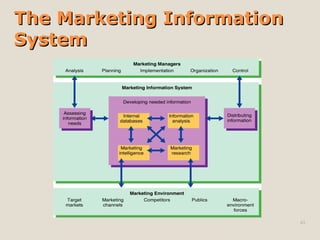
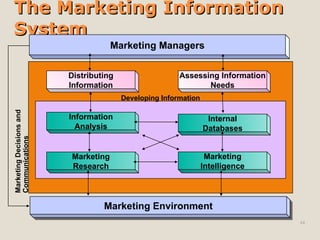
44
Marketing Information System
Developing Information
Information
Analysis
Internal
Databases
Marketing
Research
Marketing
Intelligence
Distributing
Information
Assessing Information
Needs
Marketing Managers
Marketing Environment
Marketing
Decisions
and
Communications
45.
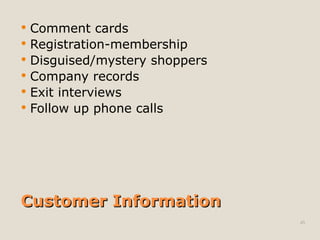
Customer Information
Customer Information
Comment cards
Registration-membership
Disguised/mystery shoppers
Company records
Exit interviews
Follow up phone calls
45
46.
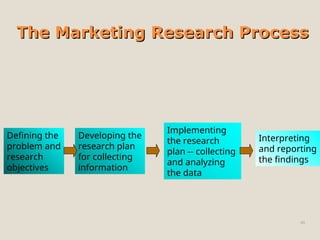
The Marketing ResearchProcess
The Marketing Research Process
46
Defining the
problem and
research
objectives
Developing the
research plan
for collecting
information
Implementing
the research
plan -- collecting
and analyzing
the data
Interpreting
and reporting
the findings
47.
Process
Process
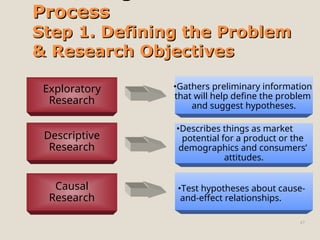
Step 1. Definingthe Problem
Step 1. Defining the Problem
& Research Objectives
& Research Objectives
47
Exploratory
Research
Descriptive
Research
Causal
Research
•Test hypotheses about cause-
and-effect relationships.
•Gathers preliminary information
that will help define the problem
and suggest hypotheses.
•Describes things as market
potential for a product or the
demographics and consumers’
attitudes.
48.
Marketing Research
Marketing Research
Process
Process
Step2. Develop the Research
Step 2. Develop the Research
Plan
Plan
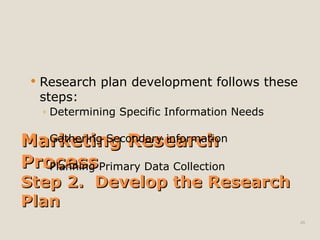
Research plan development follows these
steps:
◦ Determining Specific Information Needs
◦ Gathering Secondary information
◦ Planning Primary Data Collection
48
49.
Develop the ResearchPlan
Develop the Research Plan
Gathering Secondary
Gathering Secondary
Information
Information
49
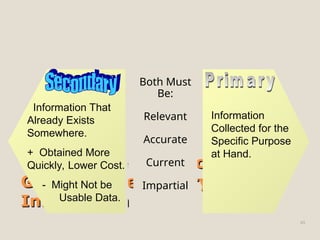
Information That
Already Exists
Somewhere.
+ Obtained More
Quickly, Lower Cost.
- Might Not be
Usable Data.
Both Must
Be:
Relevant
Accurate
Current
Impartial
Information
Collected for the
Specific Purpose
at Hand.
50.
Develop the ResearchPlan
Develop the Research Plan
Planning Primary Data
Planning Primary Data
Collection
Collection
50
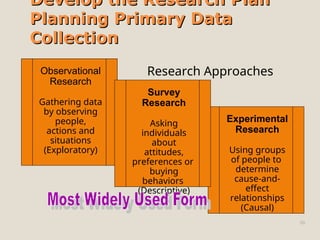
Observational
Research
Gathering data
by observing
people,
actions and
situations
(Exploratory)
Experimental
Research
Using groups
of people to
determine
cause-and-
effect
relationships
(Causal)
Survey
Research
Asking
individuals
about
attitudes,
preferences or
buying
behaviors
(Descriptive)
Research Approaches
51.
Develop the ResearchPlan
Develop the Research Plan
Planning Primary Data
Planning Primary Data
Collection
Collection
51
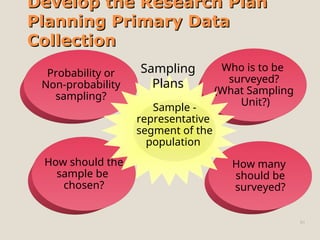
Who is to be
surveyed?
(What Sampling
Unit?)
How many
should be
surveyed?
How should the
sample be
chosen?
Probability or
Non-probability
sampling?
Sample -
representative
segment of the
population
Sampling
Plans
52.
Process
Process
Step 3. Implementingthe
Step 3. Implementing the
Research Plan
Research Plan
52
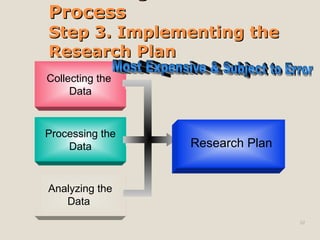
Collecting the
Data
Processing the
Data
Analyzing the
Data
Research Plan
53.
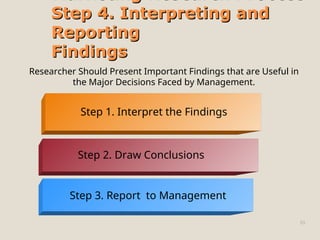
Marketing Research Process
Step4. Interpreting and
Step 4. Interpreting and
Reporting
Reporting
Findings
Findings
53
Researcher Should Present Important Findings that are Useful in
the Major Decisions Faced by Management.
Step 1. Interpret the Findings
Step 2. Draw Conclusions
Step 3. Report to Management
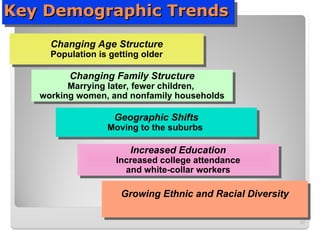
Key Demographic Trends
KeyDemographic Trends
57
Changing Age Structure
Population is getting older
Changing Family Structure
Marrying later, fewer children,
working women, and nonfamily households
Geographic Shifts
Moving to the suburbs
Increased Education
Increased college attendance
and white-collar workers
Growing Ethnic and Racial Diversity
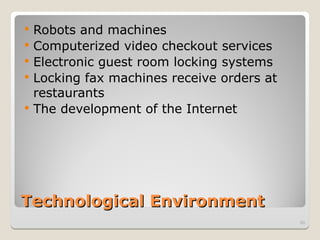
Technological Environment
Technological Environment
Robots and machines
Computerized video checkout services
Electronic guest room locking systems
Locking fax machines receive orders at
restaurants
The development of the Internet
60
Responding to the
Respondingto the
Marketing
Marketing
Environment
Environment
Environmental management
perspective
Environmental Scanning
Using information about the
marketing environment
63