Marketing
Management
DR. SALMA AKTER
Assistant Professor: East West University
PhD.: Cardiff Metropolitan University, UK.
MSc.: (International Business Management): University
of Gloucestershire, UK,
MBA, BBA: University of Dhaka
Chapter 2
Developing Marketing
Strategies and Plans
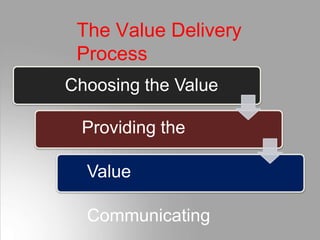
The Value Delivery
Process
Choosing the Value
Providing the
Value
Communicating
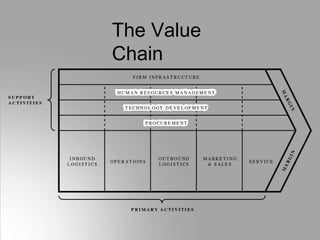
The Value
Chain
Michael Porter of Harvard
University has proposed the
value chain as a “tool for
identifying ways to create
more customer value”
The Value
Chain
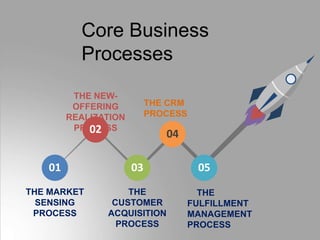
Core Business
Processes
THE MARKET
SENSING
PROCESS
THE
CUSTOMER
ACQUISITION
PROCESS
THE
FULFILLMENT
MANAGEMENT
PROCESS
THE NEW-
OFFERING
REALIZATION
PROCESS
THE CRM
PROCESS
01
02
05
03
04
Core
Competencie
s
Core competencies are the main strengths
or strategic advantages of a business.
Core competencies are the combination of
pooled knowledge and technical capacities
that allow a business to be competitive in
the marketplace.
Source:
www.investopedia.co
m
Core
Competencie
s
A core competency has three
characteristics:
1. It is a source of competitive
advantage and makes a significant
contribution to perceived customer
benefits.
2. It has applications in a wide variety of
The
Marketing
Plan
The Marketing Plan is the
central instrument for
directing and coordinating
the marketing effort.
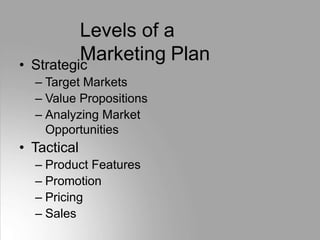
Levels of a
Marketing Plan
• Strategic
– Target Markets
– Value Propositions
– Analyzing Market
Opportunities
• Tactical
– Product Features
– Promotion
– Pricing
– Sales
CORPORATE AND
DIVISION STRATEGIC
PLANNING
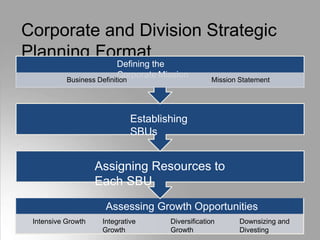
Corporate and Division Strategic
Planning Format
Assessing Growth Opportunities
Intensive Growth Integrative
Growth
Diversification
Growth
Downsizing and
Divesting
Assigning Resources to
Each SBU
Establishing
SBUs
Defining the
Corporate Mission
Business Definition Mission Statement
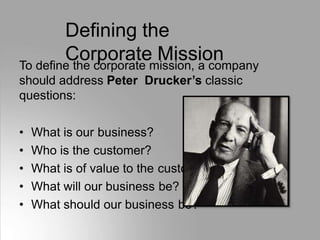
Defining the
Corporate Mission
To define the corporate mission, a company
should address Peter Drucker’s classic
questions:
• What is our business?
• Who is the customer?
• What is of value to the customer?
• What will our business be?
• What should our business be?
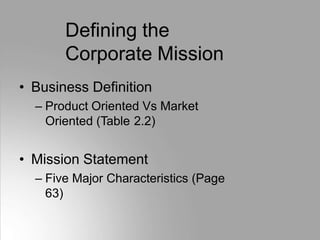
Defining the
Corporate Mission
• Business Definition
– Product Oriented Vs Market
Oriented (Table 2.2)
• Mission Statement
– Five Major Characteristics (Page
63)
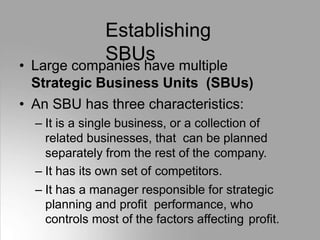
Establishing
SBUs
• Large companies have multiple
Strategic Business Units (SBUs)
• An SBU has three characteristics:
– It is a single business, or a collection of
related businesses, that can be planned
separately from the rest of the company.
– It has its own set of competitors.
– It has a manager responsible for strategic
planning and profit performance, who
controls most of the factors affecting profit.
Assigning Resources to
Each SBU
Once it has defined SBUs, the management
must decide how to allocated
corporate resources to each.
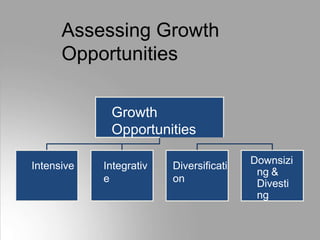
Assessing Growth
Opportunities
Growth
Opportunities
Intensive Integrativ
e
Diversificati
on
Downsizi
ng &
Divesti
ng
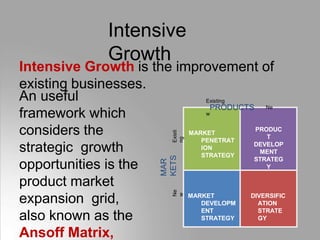
Intensive
Growth
An useful
framework which
considers the
strategic growth
opportunities is the
product market
expansion grid,
also known as the
Ansoff Matrix,
MARKET
PENETRAT
ION
STRATEGY
PRODUC
T
DEVELOP
MENT
STRATEG
Y
MARKET
DEVELOPM
ENT
STRATEGY
DIVERSIFIC
ATION
STRATE
GY
Intensive Growth is the improvement of
existing businesses.
PRODUCTS
MAR
KETS
Existing
Ne
w
Ne
w
Existi
ng
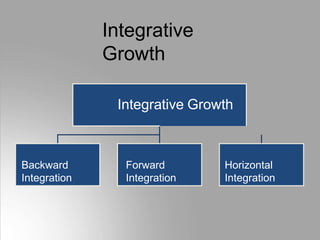
Integrative
Growth
Integrative Growth
Backward
Integration
Forward
Integration
Horizontal
Integration
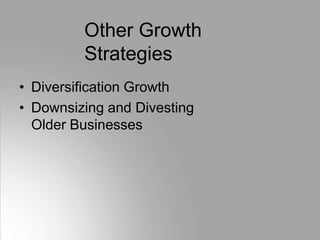
Other Growth
Strategies
• Diversification Growth
• Downsizing and Divesting
Older Businesses
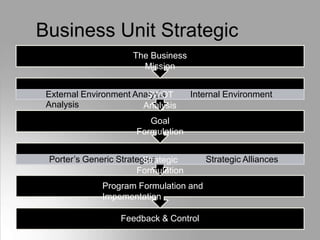
BUSINESS UNIT
STRATEGIC PLANNING
Business Unit Strategic
Planning Format
Feedback & Control
Program Formulation and
Impementation
Porter’s Generic Strategies Strategic Alliances
Goal
Formulation
Strategic
Formulation
External Environment Analysis Internal Environment
Analysis
The Business
Mission
SWOT
Analysis
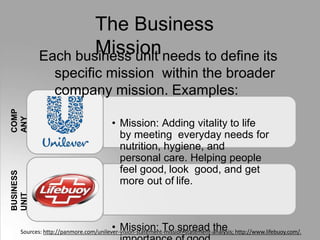
The Business
Mission
Sources: http://panmore.com/unilever-vision-statement-mission-statement-analysis; http://www.lifebuoy.com/.
Each business unit needs to define its
specific mission within the broader
company mission. Examples:
• Mission: Adding vitality to life
by meeting everyday needs for
nutrition, hygiene, and
personal care. Helping people
feel good, look good, and get
more out of life.
• Mission: To spread the
COMP
ANY
BUSINESS
UNIT
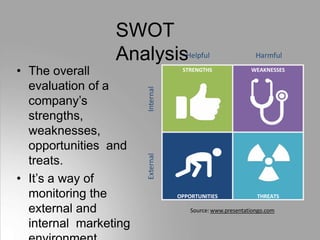
SWOT
Analysis
• The overall
evaluation of a
company’s
strengths,
weaknesses,
opportunities and
treats.
• It’s a way of
monitoring the
external and
internal marketing
STRENGTHS WEAKNESSES
OPPORTUNITIES THREATS
External
Internal
Helpful Harmful
Source: www.presentationgo.com
SWOT
Analysis
EXTERNAL ENVIRONMENT
• A marketing opportunity is an area of
buyer need and interest that a company
has a high probability of profitably
satisfying.
• An environmental threat is a challenge
posed by an unfavorable trend or
development that, in the absence of a
defensive marketing action, would lead to
lower sales or profit.
SWOT
Analysis
INTERNAL ENVIRONMENT
• A companies internal strengths &
weaknesses can be measured using a
form, such as the ‘marketing memo –
provided in the textbook (page 73)’
SWOT
Analysis
REAL
EXAMPL
E:
Go through the SWOT Analysis of
Dell (Page 72-73)
Goal
Formulation
• Once the company has performed a
SWOT Analysis, it can proceed to goal
formulation.
• Goals are objectives that are specific
with respect to magnitude and time.
• These objectives must meet four criteria:
– They must be arranged hierarchically
– They should be quantitative whenever
possible
– They should be realistic
– They must be consistent
Strategic
Formulation
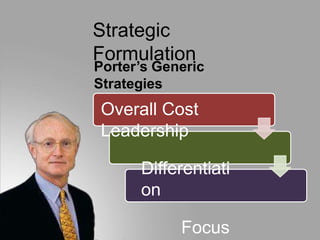
Porter’s Generic
Strategies
Overall Cost
Leadership
Differentiati
on
Focus
Strategic
Alliances
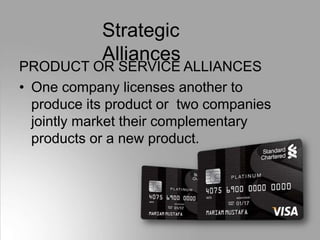
PRODUCT OR SERVICE ALLIANCES
• One company licenses another to
produce its product or two companies
jointly market their complementary
products or a new product.
Strategic
Alliances
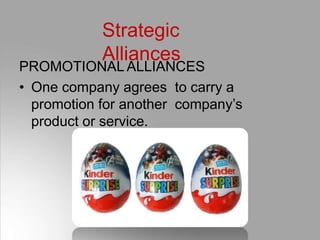
PROMOTIONAL ALLIANCES
• One company agrees to carry a
promotion for another company’s
product or service.
Strategic
Alliances
LOGISTICS ALLIANCES
• One company offers logistical
services for another company’s
product.
PRICING COLLABOLRATIONS
• One or more companies join in a
special pricing collaboration.
Program Formulation and
Implementation
Feedback and
Control
THE NATURE AND
CONTENTS OF A
MARKETING PLAN
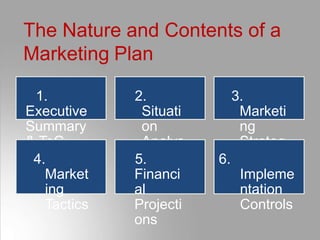
The Nature and Contents of a
Marketing Plan
1.
Executive
Summary
& ToC
2.
Situati
on
Analys
is
3.
Marketi
ng
Strateg
y
4.
Market
ing
Tactics
5.
Financi
al
Projecti
ons
6.
Impleme
ntation
Controls

Mkt201 chapter 2