Developing Marketing
Strategies and Plans
Chapter 2
Chapter Outline
 Marketing and Customer Value
 The Value Delivery Process
 Phases of Value Creation and Delivery
 The Value Chain
 Core Business Processes/Essential Activities
 Characteristics of Core Competencies
 What is a Marketing Plan?
 Corporate Headquarters’ Planning Activities
 Business Unit Strategic Planning
 Product Planning: The Nature and Contents of a Marketing Plan
 Marketing Plan Contents
Marketing and Customer Value
 The task of a business is to deliver customer
value at a profit.
 In a hypercompetitive economy with
increasingly informed buyers faced with many
choices, a company can only win by fine-tuning
the value delivery process and choosing,
providing, and communicating superior value.
The Value Delivery Process
Traditional view: The value
delivery process takes place
during the selling process.
New view: The value delivery
process begins at the beginning
of planning.
Phases of Value Creation and
Delivery
 Choosing the value-Segment the market,
select target markets, develop the offering's
value positioning. (before the product exists)
 Providing the value-Determine specific
product features, prices, and distribution.
 Communicating the value-Using the sales
force, Internet, advertising to announce and
promote the product.
 Each phase has cost implications.
The Value Chain
The value chain is a tool for
identifying was to create more
customer value because every firm is
a combination of primary and
support activities performed to
design, produce, market, deliver, and
support its products.
These activities create value and cost.
The Value Chain
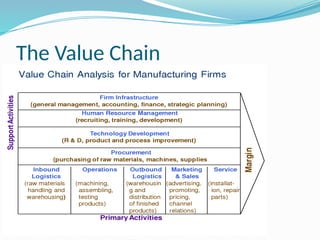
 Primary Activities
1. Inbound Logistics- Bringing the material to the
business
2. Operations- Converting the material into final
products
3. Outbound Logistics- Shipping out the final
product
4. Marketing –Which includes sales
5. Service
The Value Chain
 Support Activities (Specialized departments)
1. Procurement- is the acquisition of goods and
services. (Buying)
2. Technology Development
3. Human Resource Management
4. Firm Infrastructure- Covers the costs of
general management, planning, finance,
accounting, legal, and government affairs.
Core Business Processes/Essential Activities
 1. Market-sensing process-All activities in gathering and acting
upon information about the market.
 2. New-offering realization process-Researching, developing,
and launching new high-quality offerings quickly and within
budget.
 3. Customer acquisition process-Defining target markets and
prospecting for new customers.
 4. Customer relationship management process-Building deeper
understanding, relationships, and offerings to individual
customers.
 5. Fulfillment management process-Receiving and approving
orders, shipping the goods on time, and collecting payment.
 Use cross-functional teams (is a group of people with different functional
expertise working toward a common goal) to manage core processes.
Characteristics of Core Competencies
Core Competencies- The main
strengths or strategic advantages of
a business.
A source of competitive advantage
Applications in a wide variety of markets
Difficult to imitate
 Companies must also posses distinctive abilities or
broader business process such as customer linking,
market-sensing, and channel bonding.
The Strategic Planning, Implementation,
and Control Processes
What is a Marketing Plan?
The Marketing Plan is the
central instrument for
directing and coordinating
the marketing effort.
It operates at strategic and
tactical level.
Levels of a Marketing Plan
 Strategic
 Target
marketing
decisions
 Value
proposition
 Analysis of
marketing
opportunities
 Tactical
 Product
features
 Promotion
 Merchandising
 Pricing
 Sales channels
 Service
Corporate Headquarters’ Planning
Activities
1. Define the corporate mission
2. Establish strategic business units
(SBUs)
3. Assign resources to each SBU
4. Assess growth opportunities
1. Define the corporate mission
Good Mission Statements should:
Focus on a limited number of goals
Stress major policies and values
Define major competitive sphere
where the company will operate
Take a long-term view
Short, memorable, and meaningful
2. Establishing Strategic Business Units (SBUs)
 Market definition of a
business :Customer satisfying process
Products change, needs stay
Target market definition-Focus on
selling product to current market.
Strategic market definition-Focus on
selling product to current and potential
markets.
Characteristics of SBUs
It is a single business or collection
of related business that can be
planned for separately from the
rest of the company.
It has its own set of competitors.
It has a leader responsible for
strategic planning and profitability.
3. Assigning Resources to each SBU
Management must decide how
to allocate resources to each
SBU.
Is the market value of a
company greater with or
without the SBU?
4. Assessing Growth Opportunities
1. Planning new businesses
2. Downsizing businesses
3. Terminating older
business
1. Planning new businesses
If there is a gap between
desired sales and projected
sales
Develop or acquire new
businesses to fill the gap
The Strategic Planning Gap
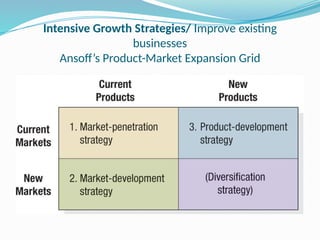
Intensive Growth Strategies/ Improve existing
businesses
Ansoff’s Product-Market Expansion Grid
Intensive Growth/Improve existing
businesses
 Market-penetration strategy- Gain more
market share with current products in current
markets.
 Market-development strategy- Find or develop
new markets for current products.
 Product-development strategy- Develop new
products of potential interest to current markets.
 Diversification strategy - Develop new products
for new markets.
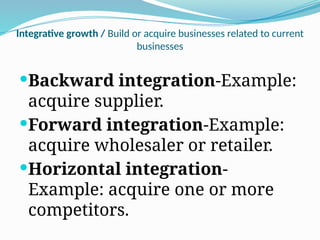
Integrative growth / Build or acquire businesses related to current
businesses
Backward integration-Example:
acquire supplier.
Forward integration-Example:
acquire wholesaler or retailer.
Horizontal integration-
Example: acquire one or more
competitors.
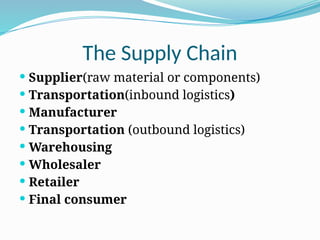
The Supply Chain
 Supplier(raw material or components)
 Transportation(inbound logistics)
 Manufacturer
 Transportation (outbound logistics)
 Warehousing
 Wholesaler
 Retailer
 Final consumer
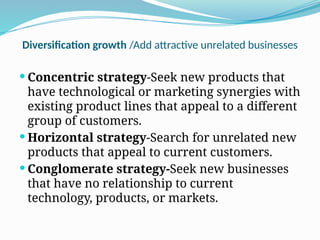
Diversification growth /Add attractive unrelated businesses
 Concentric strategy-Seek new products that
have technological or marketing synergies with
existing product lines that appeal to a different
group of customers.
 Horizontal strategy-Search for unrelated new
products that appeal to current customers.
 Conglomerate strategy-Seek new businesses
that have no relationship to current
technology, products, or markets.
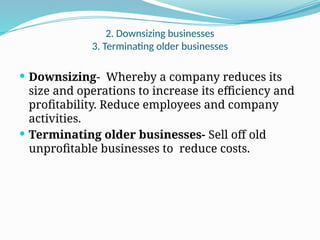
2. Downsizing businesses
3. Terminating older businesses
 Downsizing- Whereby a company reduces its
size and operations to increase its efficiency and
profitability. Reduce employees and company
activities.
 Terminating older businesses- Sell off old
unprofitable businesses to reduce costs.
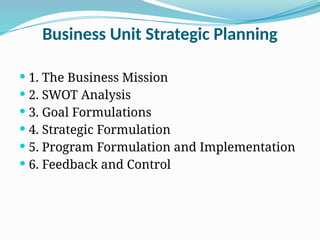
Business Unit Strategic Planning
 1. The Business Mission
 2. SWOT Analysis
 3. Goal Formulations
 4. Strategic Formulation
 5. Program Formulation and Implementation
 6. Feedback and Control
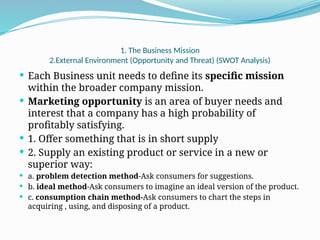
1. The Business Mission
2.External Environment (Opportunity and Threat) (SWOT Analysis)
 Each Business unit needs to define its specific mission
within the broader company mission.
 Marketing opportunity is an area of buyer needs and
interest that a company has a high probability of
profitably satisfying.
 1. Offer something that is in short supply
 2. Supply an existing product or service in a new or
superior way:
 a. problem detection method-Ask consumers for suggestions.
 b. ideal method-Ask consumers to imagine an ideal version of the product.
 c. consumption chain method-Ask consumers to chart the steps in
acquiring , using, and disposing of a product.
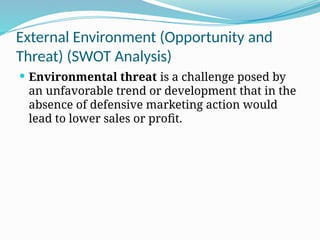
External Environment (Opportunity and
Threat) (SWOT Analysis)
 Environmental threat is a challenge posed by
an unfavorable trend or development that in the
absence of defensive marketing action would
lead to lower sales or profit.
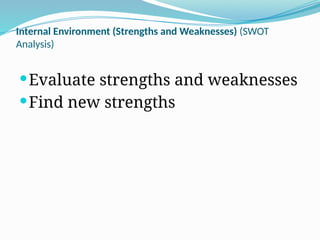
Internal Environment (Strengths and Weaknesses) (SWOT
Analysis)
Evaluate strengths and weaknesses
Find new strengths
3. Goal Formulations
 Develop specific goals for the planning period.
 Businesses units usually pursue a mix of
objectives :
 Profitability
 Sales Growth
 Market share improvement
 Risk containment
 Innovation
 Reputation
4. Strategic Formulation
 A strategy is a game plan for getting there.
Marketing Strategies
 Overall cost leadership-achieve the lowest production
and distribution to underprice competitors and win market
share.
 Differentiation-achieve superior performance in an
important customer benefit area valued by a large part of
the market.
 Focus-Focus on one or more narrow market segments and
pursue either cost leadership or differentiation.
 Firms directing the same strategy to the same target market constitute a
strategic group.
5. Program Formulation and Implementation
6. Feedback and Control
 Program Formulation and
Implementation:
 Estimate cost
 Sufficient results to justify cost
 Feedback and Control:
 It is critical for organizations to examine the
changing environment and adopt new goals
and behaviors.
Product Planning: The nature and contents of a Marketing Plan
 A marketing plan is written document that
summarizes what the marketer has learned
about the marketplace and indicates how the
firm plans to reach its marketing strategies.
Marketing Plan Contents
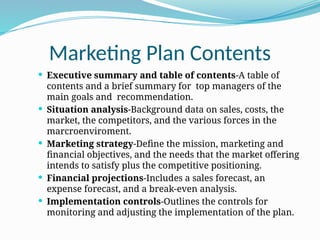
 Executive summary and table of contents-A table of
contents and a brief summary for top managers of the
main goals and recommendation.
 Situation analysis-Background data on sales, costs, the
market, the competitors, and the various forces in the
marcroenviroment.
 Marketing strategy-Define the mission, marketing and
financial objectives, and the needs that the market offering
intends to satisfy plus the competitive positioning.
 Financial projections-Includes a sales forecast, an
expense forecast, and a break-even analysis.
 Implementation controls-Outlines the controls for
monitoring and adjusting the implementation of the plan.
References
 Kotler, Philip and Kevin Lane Keller . Marketing
Management. Pearson Education Limited, 2012.
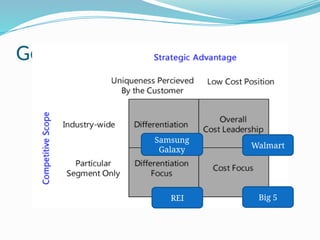
Porter’s Generic Strategies
 Cost: Compete by offering the lowest prices.
 Differentiation: Product or service that offers
unique value.
 Focus: Narrow or Large, focus on an entire
industry or a small market segment.
Generic Strategies
Samsung
Galaxy
Walmart
Big 5
REI
The Value Chain
Value Chain (contd.)
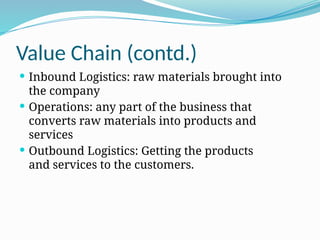
 Inbound Logistics: raw materials brought into
the company
 Operations: any part of the business that
converts raw materials into products and
services
 Outbound Logistics: Getting the products
and services to the customers.
Value Chain (contd.)
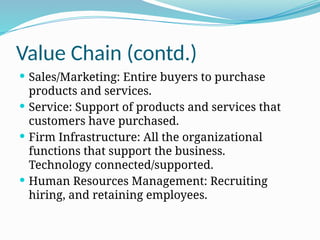
 Sales/Marketing: Entire buyers to purchase
products and services.
 Service: Support of products and services that
customers have purchased.
 Firm Infrastructure: All the organizational
functions that support the business.
Technology connected/supported.
 Human Resources Management: Recruiting
hiring, and retaining employees.
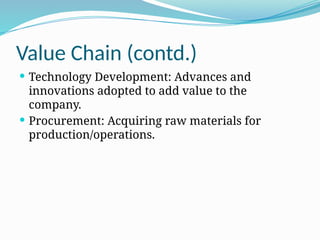
Value Chain (contd.)
 Technology Development: Advances and
innovations adopted to add value to the
company.
 Procurement: Acquiring raw materials for
production/operations.
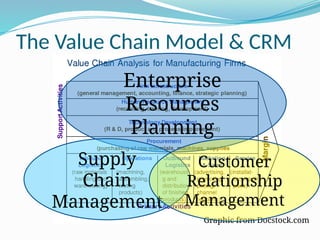
The Value Chain Model & CRM
Graphic from Docstock.com
Enterprise
Resources
Planning
Supply
Chain
Management
Customer
Relationship
Management
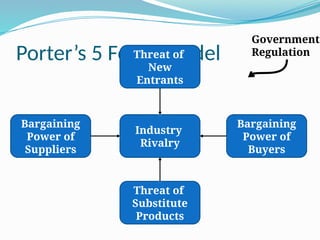
Porter’s 5 Force Model
Industry
Rivalry
Threat of
New
Entrants
Threat of
Substitute
Products
Bargaining
Power of
Suppliers
Bargaining
Power of
Buyers
Government
Regulation
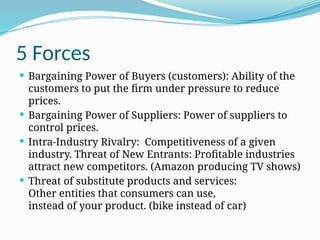
5 Forces
 Bargaining Power of Buyers (customers): Ability of the
customers to put the firm under pressure to reduce
prices.
 Bargaining Power of Suppliers: Power of suppliers to
control prices.
 Intra-Industry Rivalry: Competitiveness of a given
industry. Threat of New Entrants: Profitable industries
attract new competitors. (Amazon producing TV shows)
 Threat of substitute products and services:
Other entities that consumers can use,
instead of your product. (bike instead of car)
Entry Barriers
 Creating a barrier to entry to would be
competitors.
 Southern California Edison
 Utility, captive market
 To open an electric company would require a
massive infrastructure
 Bar
 Liquor license is a cost that might prohibit
entrants
 Online mega-store like Amazon
 New entrants cannot compete with branding,
infrastructure and supply chain
Switching Costs
 Switching Cost – The cost of a customer to switch
to another product or service.
 Used to reduce the threat of new entrants and
substitute products.
 Increasing Switching Costs
 Deals for Staying with You (loyalty programs)
 Memberships
 Contracts
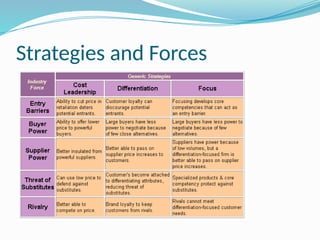
Strategies and Forces
Using Information Systems for Competitive
Advantage
 Business Process Management Systems
 Control of processes gives competitive advantage
because ___.
 Electronic Data Interchange
 Automation of the value chain gets products to
market quicker.
 Allows for integration of partners in the value
chain.
 Allows for flexible value chain because of
automation.
Competitive Advantage (contd.)
 Collaborative Systems – Easier ways for people to
collaborate in work and processes.
 Google Drive
 MS SharePoint
 Cisco WebEx
 Atlassian Confluence
 IBM Lotus Notes
Competitive Advantage (contd.)
 Decision Support Systems
 Assist with decision making at all levels,
particularly semi-structured.
 Data Analytics
 Internally: Having centralized data can give
opportunities to see what the data is telling you.
 Externally: Data sources can inform
strategic decisions about new technologies
and your industry.

2. Developing_Marketing_Strategies_and_Plan.pptx

  • 1.
  • 2.
    Chapter Outline  Marketingand Customer Value  The Value Delivery Process  Phases of Value Creation and Delivery  The Value Chain  Core Business Processes/Essential Activities  Characteristics of Core Competencies  What is a Marketing Plan?  Corporate Headquarters’ Planning Activities  Business Unit Strategic Planning  Product Planning: The Nature and Contents of a Marketing Plan  Marketing Plan Contents
  • 3.
    Marketing and CustomerValue  The task of a business is to deliver customer value at a profit.  In a hypercompetitive economy with increasingly informed buyers faced with many choices, a company can only win by fine-tuning the value delivery process and choosing, providing, and communicating superior value.
  • 4.
    The Value DeliveryProcess Traditional view: The value delivery process takes place during the selling process. New view: The value delivery process begins at the beginning of planning.
  • 5.
    Phases of ValueCreation and Delivery  Choosing the value-Segment the market, select target markets, develop the offering's value positioning. (before the product exists)  Providing the value-Determine specific product features, prices, and distribution.  Communicating the value-Using the sales force, Internet, advertising to announce and promote the product.  Each phase has cost implications.
  • 6.
    The Value Chain Thevalue chain is a tool for identifying was to create more customer value because every firm is a combination of primary and support activities performed to design, produce, market, deliver, and support its products. These activities create value and cost.
  • 7.
    The Value Chain Primary Activities 1. Inbound Logistics- Bringing the material to the business 2. Operations- Converting the material into final products 3. Outbound Logistics- Shipping out the final product 4. Marketing –Which includes sales 5. Service
  • 8.
    The Value Chain Support Activities (Specialized departments) 1. Procurement- is the acquisition of goods and services. (Buying) 2. Technology Development 3. Human Resource Management 4. Firm Infrastructure- Covers the costs of general management, planning, finance, accounting, legal, and government affairs.
  • 9.
    Core Business Processes/EssentialActivities  1. Market-sensing process-All activities in gathering and acting upon information about the market.  2. New-offering realization process-Researching, developing, and launching new high-quality offerings quickly and within budget.  3. Customer acquisition process-Defining target markets and prospecting for new customers.  4. Customer relationship management process-Building deeper understanding, relationships, and offerings to individual customers.  5. Fulfillment management process-Receiving and approving orders, shipping the goods on time, and collecting payment.  Use cross-functional teams (is a group of people with different functional expertise working toward a common goal) to manage core processes.
  • 10.
    Characteristics of CoreCompetencies Core Competencies- The main strengths or strategic advantages of a business. A source of competitive advantage Applications in a wide variety of markets Difficult to imitate  Companies must also posses distinctive abilities or broader business process such as customer linking, market-sensing, and channel bonding.
  • 11.
    The Strategic Planning,Implementation, and Control Processes
  • 12.
    What is aMarketing Plan? The Marketing Plan is the central instrument for directing and coordinating the marketing effort. It operates at strategic and tactical level.
  • 13.
    Levels of aMarketing Plan  Strategic  Target marketing decisions  Value proposition  Analysis of marketing opportunities  Tactical  Product features  Promotion  Merchandising  Pricing  Sales channels  Service
  • 14.
    Corporate Headquarters’ Planning Activities 1.Define the corporate mission 2. Establish strategic business units (SBUs) 3. Assign resources to each SBU 4. Assess growth opportunities
  • 15.
    1. Define thecorporate mission Good Mission Statements should: Focus on a limited number of goals Stress major policies and values Define major competitive sphere where the company will operate Take a long-term view Short, memorable, and meaningful
  • 16.
    2. Establishing StrategicBusiness Units (SBUs)  Market definition of a business :Customer satisfying process Products change, needs stay Target market definition-Focus on selling product to current market. Strategic market definition-Focus on selling product to current and potential markets.
  • 17.
    Characteristics of SBUs Itis a single business or collection of related business that can be planned for separately from the rest of the company. It has its own set of competitors. It has a leader responsible for strategic planning and profitability.
  • 18.
    3. Assigning Resourcesto each SBU Management must decide how to allocate resources to each SBU. Is the market value of a company greater with or without the SBU?
  • 19.
    4. Assessing GrowthOpportunities 1. Planning new businesses 2. Downsizing businesses 3. Terminating older business
  • 20.
    1. Planning newbusinesses If there is a gap between desired sales and projected sales Develop or acquire new businesses to fill the gap
  • 21.
  • 22.
    Intensive Growth Strategies/Improve existing businesses Ansoff’s Product-Market Expansion Grid
  • 23.
    Intensive Growth/Improve existing businesses Market-penetration strategy- Gain more market share with current products in current markets.  Market-development strategy- Find or develop new markets for current products.  Product-development strategy- Develop new products of potential interest to current markets.  Diversification strategy - Develop new products for new markets.
  • 24.
    Integrative growth /Build or acquire businesses related to current businesses Backward integration-Example: acquire supplier. Forward integration-Example: acquire wholesaler or retailer. Horizontal integration- Example: acquire one or more competitors.
  • 25.
    The Supply Chain Supplier(raw material or components)  Transportation(inbound logistics)  Manufacturer  Transportation (outbound logistics)  Warehousing  Wholesaler  Retailer  Final consumer
  • 26.
    Diversification growth /Addattractive unrelated businesses  Concentric strategy-Seek new products that have technological or marketing synergies with existing product lines that appeal to a different group of customers.  Horizontal strategy-Search for unrelated new products that appeal to current customers.  Conglomerate strategy-Seek new businesses that have no relationship to current technology, products, or markets.
  • 27.
    2. Downsizing businesses 3.Terminating older businesses  Downsizing- Whereby a company reduces its size and operations to increase its efficiency and profitability. Reduce employees and company activities.  Terminating older businesses- Sell off old unprofitable businesses to reduce costs.
  • 28.
    Business Unit StrategicPlanning  1. The Business Mission  2. SWOT Analysis  3. Goal Formulations  4. Strategic Formulation  5. Program Formulation and Implementation  6. Feedback and Control
  • 29.
    1. The BusinessMission 2.External Environment (Opportunity and Threat) (SWOT Analysis)  Each Business unit needs to define its specific mission within the broader company mission.  Marketing opportunity is an area of buyer needs and interest that a company has a high probability of profitably satisfying.  1. Offer something that is in short supply  2. Supply an existing product or service in a new or superior way:  a. problem detection method-Ask consumers for suggestions.  b. ideal method-Ask consumers to imagine an ideal version of the product.  c. consumption chain method-Ask consumers to chart the steps in acquiring , using, and disposing of a product.
  • 30.
    External Environment (Opportunityand Threat) (SWOT Analysis)  Environmental threat is a challenge posed by an unfavorable trend or development that in the absence of defensive marketing action would lead to lower sales or profit.
  • 31.
    Internal Environment (Strengthsand Weaknesses) (SWOT Analysis) Evaluate strengths and weaknesses Find new strengths
  • 32.
    3. Goal Formulations Develop specific goals for the planning period.  Businesses units usually pursue a mix of objectives :  Profitability  Sales Growth  Market share improvement  Risk containment  Innovation  Reputation
  • 33.
    4. Strategic Formulation A strategy is a game plan for getting there. Marketing Strategies  Overall cost leadership-achieve the lowest production and distribution to underprice competitors and win market share.  Differentiation-achieve superior performance in an important customer benefit area valued by a large part of the market.  Focus-Focus on one or more narrow market segments and pursue either cost leadership or differentiation.  Firms directing the same strategy to the same target market constitute a strategic group.
  • 34.
    5. Program Formulationand Implementation 6. Feedback and Control  Program Formulation and Implementation:  Estimate cost  Sufficient results to justify cost  Feedback and Control:  It is critical for organizations to examine the changing environment and adopt new goals and behaviors.
  • 35.
    Product Planning: Thenature and contents of a Marketing Plan  A marketing plan is written document that summarizes what the marketer has learned about the marketplace and indicates how the firm plans to reach its marketing strategies.
  • 36.
    Marketing Plan Contents Executive summary and table of contents-A table of contents and a brief summary for top managers of the main goals and recommendation.  Situation analysis-Background data on sales, costs, the market, the competitors, and the various forces in the marcroenviroment.  Marketing strategy-Define the mission, marketing and financial objectives, and the needs that the market offering intends to satisfy plus the competitive positioning.  Financial projections-Includes a sales forecast, an expense forecast, and a break-even analysis.  Implementation controls-Outlines the controls for monitoring and adjusting the implementation of the plan.
  • 37.
    References  Kotler, Philipand Kevin Lane Keller . Marketing Management. Pearson Education Limited, 2012.
  • 38.
    Porter’s Generic Strategies Cost: Compete by offering the lowest prices.  Differentiation: Product or service that offers unique value.  Focus: Narrow or Large, focus on an entire industry or a small market segment.
  • 39.
  • 40.
  • 41.
    Value Chain (contd.) Inbound Logistics: raw materials brought into the company  Operations: any part of the business that converts raw materials into products and services  Outbound Logistics: Getting the products and services to the customers.
  • 42.
    Value Chain (contd.) Sales/Marketing: Entire buyers to purchase products and services.  Service: Support of products and services that customers have purchased.  Firm Infrastructure: All the organizational functions that support the business. Technology connected/supported.  Human Resources Management: Recruiting hiring, and retaining employees.
  • 43.
    Value Chain (contd.) Technology Development: Advances and innovations adopted to add value to the company.  Procurement: Acquiring raw materials for production/operations.
  • 44.
    The Value ChainModel & CRM Graphic from Docstock.com Enterprise Resources Planning Supply Chain Management Customer Relationship Management
  • 45.
    Porter’s 5 ForceModel Industry Rivalry Threat of New Entrants Threat of Substitute Products Bargaining Power of Suppliers Bargaining Power of Buyers Government Regulation
  • 46.
    5 Forces  BargainingPower of Buyers (customers): Ability of the customers to put the firm under pressure to reduce prices.  Bargaining Power of Suppliers: Power of suppliers to control prices.  Intra-Industry Rivalry: Competitiveness of a given industry. Threat of New Entrants: Profitable industries attract new competitors. (Amazon producing TV shows)  Threat of substitute products and services: Other entities that consumers can use, instead of your product. (bike instead of car)
  • 47.
    Entry Barriers  Creatinga barrier to entry to would be competitors.  Southern California Edison  Utility, captive market  To open an electric company would require a massive infrastructure  Bar  Liquor license is a cost that might prohibit entrants  Online mega-store like Amazon  New entrants cannot compete with branding, infrastructure and supply chain
  • 48.
    Switching Costs  SwitchingCost – The cost of a customer to switch to another product or service.  Used to reduce the threat of new entrants and substitute products.  Increasing Switching Costs  Deals for Staying with You (loyalty programs)  Memberships  Contracts
  • 49.
  • 50.
    Using Information Systemsfor Competitive Advantage  Business Process Management Systems  Control of processes gives competitive advantage because ___.  Electronic Data Interchange  Automation of the value chain gets products to market quicker.  Allows for integration of partners in the value chain.  Allows for flexible value chain because of automation.
  • 51.
    Competitive Advantage (contd.) Collaborative Systems – Easier ways for people to collaborate in work and processes.  Google Drive  MS SharePoint  Cisco WebEx  Atlassian Confluence  IBM Lotus Notes
  • 52.
    Competitive Advantage (contd.) Decision Support Systems  Assist with decision making at all levels, particularly semi-structured.  Data Analytics  Internally: Having centralized data can give opportunities to see what the data is telling you.  Externally: Data sources can inform strategic decisions about new technologies and your industry.

Editor's Notes

  • #44 This is a mini-lecture. But, the ideas are powerful. Again Michael Porter came up with a way to describe organizations by their strategic focus in the firm.
  • #45   This is Porter’s model of competitive strategy. At the center of the model is Intra-industry rivalry or competition within the industry.   How competitive is the market? Think about MikeyD’s (McDonalds). How many other fast food chains are in the market competing with you. Burger King, In&Out, Wendy’s, EZOut Burger, Some smaller chains, …Plenty. It is a very competitive marketplace and you have to distinguish yourself with high quality, low cost or service. With Mickey D’s they offer very quick service at a reasonable price. It is great for food on the go and great with the kiddies getting the happy meal.   The next competitive force is the Threat of New Entrants. How many companies are seeking to break into the fast food, chain industry? I doesn’t happen. Not many because the cost to compete with these fast food giants is very prohibitive to competing in that market. The third competitive force is the ‘Threat of Substitute Products’. This means other places your customers might go to get what you offer. So, Panera Bread, Taco Bell, a Pizza place or a regular restaurant would all be substitute products to what MickeyD’s offers. Companies need to consider these competitors too so they can think about competitive pricing and features that make people select fast food over other types of eateries.   The 4th for is the “Bargaining Power of Buyers”. In the case of Mickey D’s, that is you and me. We have a choice of what we eat and there are plenty of other fast food restaurants we could go to. So, our bargaining power is very high. If the line is too long at MickyD’s or DerWeinerschnitzel is giving away free sauerkraut dogs, we can drive across the street and eat there.   The 5th force is “Bargaining Power of Suppliers”. That is the companies supporting the products and services that lead to you getting a Big Mac. Someone sells beef, soda, bread, coffee, uniforms, cleaning supplies, health care…etc. to make the McDonalds organization run. If the companies that sell beef are scarce, like only two companies you can buy beef from, then the supplier power is high. They can raise their price and McDonalds has to pay because they cannot operate without it.   On the other hand, if the uniform manufacturer decides to increase costs, there are a lot of companies that sell uniforms. McDonalds can switch suppliers without losing a lot of business. So, in that case the bargaining power is very low.   Go it? 6th competitive Force – Government Let’s take an example, then you do one. This model is really for understanding the competitive forces that operate in an industry before you develop your own strategy for your company.
  • #47 Another way the 5 force model is used is in thinking about stregegy. Knowing that our company may operate in an industry with low entry barriers, how can we make it harder for new entrants to come into the market? How can we reduce the force of ‘Threat of new entrants?’. To do this, we need to think about adding cost, legislative or quality barriers that new entrants would have no chance of duplicating  Think of So. Cal Edison Edison. Only one, not competition. Though solar and wind might be, still integrated into Edison. Bar. You need a liquor license. Online mega store to compete with Amazon.  
  • #48 Switching Costs   Increasing Switching costs is a way to prevent your customers from going to substitute products. To achieve this, you can offer them deals and memberships or you can have them sign contract agreements so they are stuck with you for an agreed upon period of time.   Being a member of a frequent flyer program (like southwest) means that I’ll earn free miles and rewards every time I fly with them. So, when buying a ticket for a trip, I always go to them first.