
Helping Students on Academic
Probation to Persist and Succeed

 Robert M. Kurland, Ph.D., Associate Dean
 Office of Academic Services, Rutgers University – Newark
 Dijha R. Allen, Ed.M., Academic Advisor/Probation Coordinator
 Office of Academic Services, Rutgers University – Newark
 Shelley C. Kurland, M.A.T., Instructional Designer
 Center for Teaching Excellence, County College of Morris
NACADA 3-2013


                                            Overview
• The Office of Academic Services

• At-risk students

• Previous practices

• Recent practices

• Current initiatives
      – course development

• Future Directions

                                                                    2
Helping Students on Academic Probation to Persist and Succeed
NACADA 3-2013


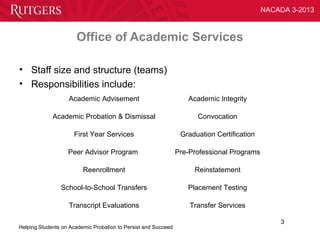
                      Office of Academic Services

• Staff size and structure (teams)
• Responsibilities include:
                   Academic Advisement                             Academic Integrity

             Academic Probation & Dismissal                           Convocation

                     First Year Services                         Graduation Certification

                   Peer Advisor Program                         Pre-Professional Programs

                         Reenrollment                                Reinstatement

                School-to-School Transfers                         Placement Testing

                   Transcript Evaluations                           Transfer Services

                                                                                                3
Helping Students on Academic Probation to Persist and Succeed
NACADA 3-2013


                                         Background
• As the practices in higher education are falling under more
  scrutiny, colleges and universities are finding themselves
  focusing more of their efforts on measurable variables
  including retention and graduation rates.

• Students who end up on probation are less likely to be
  retained and graduate as compared to students who remain in
  good academic standing (Mathies, Gardner, & Bauer, 2006).

• “Low-hanging fruit”


                                                                    4
Helping Students on Academic Probation to Persist and Succeed
NACADA 3-2013


      Probation students within NCAS and UC-N
Prior to 2010:

•Retention rate of 67% (overall student retention rate was 82.7%)

•360 students on probation, we potentially lost 120 students

•@ $12,775 per student (per year, in-state tuition), RU-N lost over $1.5
million dollars

•What could we do with $1.5 million?


                                                                    5
Helping Students on Academic Probation to Persist and Succeed
NACADA 3-2013


                                       Past Practices
• Students on probation have long been an overlooked
  population

• Few efforts and resources were used

• Sent letters

• Students were “required” to attend a “Probation Workshop”

• Not enough flexibility for non-traditional


                                                                    6
Helping Students on Academic Probation to Persist and Succeed
NACADA 3-2013


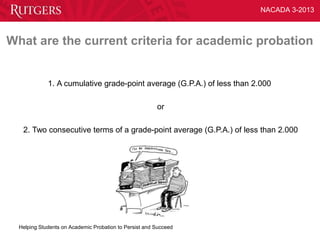
What are the current criteria for academic probation


             1. A cumulative grade-point average (G.P.A.) of less than 2.000

                                                        or

   2. Two consecutive terms of a grade-point average (G.P.A.) of less than 2.000


  Helping Students on Academic Probation to Persist and Succeed
NACADA 3-2013


 Additions to academic probation criteria

3. failure to complete 60% of attempted credits

4. failure to enroll in a composition or mathematics course, as
   prescribed by the placement standards at the college and prior
   course history, and continue to enroll each and every term until the
   requirement is satisfied

5. failure to complete successfully any course after three attempts,
   including those for which W grades are received.


Helping Students on Academic Probation to Persist and Succeed
NACADA 3-2013


                                         Spring 2010
• Given the task of working on probation

• Assessed the challenges
      – Identification - technology
      – Accuracy of data – 88% accurate - time frame for data uploads,
        repeat policies and procedures, temporary grades, and late
        rosters
      – Enforcement
      – Student body – commuters, jobs
      – Office priority


• Work more closely with IR to better identify these students
                                                                    9
Helping Students on Academic Probation to Persist and Succeed
NACADA 3-2013


                                             Fall 2010
•   Established a Probation Student taskforce

•   “Probation Workshop” to “Academic Success Workshops”

•   Changed the format so that each workshop consisted of academic and non-
    academic components in collaboration with other departments (Learning
    Center, Psychological Services, Career Development Center)
      – Topics include Time Management, Note-taking skills, etc.


•   Survey:
      – evaluation of the workshop
      – evaluate all and any areas that may be of particular need for the students


                                                                                     10
Helping Students on Academic Probation to Persist and Succeed
NACADA 3-2013


                                          Spring 2011

•   Piloted an intervention aimed at students on probation following their
    first semester of enrollment (freshmen and transfer).

•   170 students second semester freshman and transfer on probation

•   Selected a group of 54 (32%) were placed on an “academic success
    agreement”.


                                                                    11
Helping Students on Academic Probation to Persist and Succeed
NACADA 3-2013


                    Academic Success Agreement
•   Must meet with advisor 3 times
     – Prior to the start of the semester
     – The week after add/drop
     – Prior to next semester’s registration (before last W date)

•   Must meet with each professor during the semester

•   Must complete questionnaire

•   May not register for more than 13 credits

•   Must attend a workshop

•   Agreement must be turned in prior to the end of the semester (before finals)

•   Failure to complete the agreement may result in further academic restraints (e.g.
    academic contract, reduced credit load)


Helping Students on Academic Probation to Persist and Succeed
NACADA 3-2013


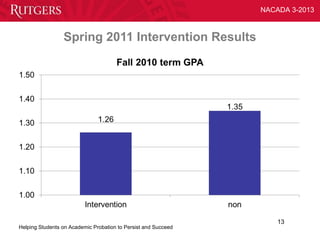
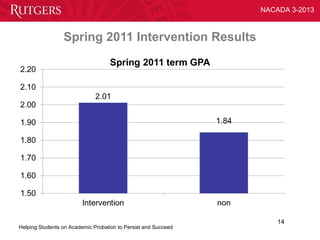
                 Spring 2011 Intervention Results


                                                                    13
Helping Students on Academic Probation to Persist and Succeed
NACADA 3-2013


                 Spring 2011 Intervention Results


                                                                    14
Helping Students on Academic Probation to Persist and Succeed
NACADA 3-2013


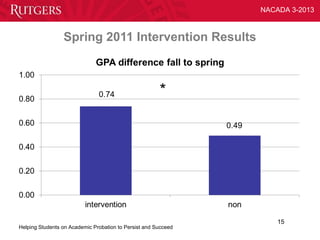
                 Spring 2011 Intervention Results


                                                                    15
Helping Students on Academic Probation to Persist and Succeed
NACADA 3-2013


                                            Feedback
• Intervention is good!

• 3 meetings for 54 students was a lot… maybe scale back
      – Less intervention for more students


• Mandatory meeting with faculty member did not go over well

• Need a point person for probation initiatives


                                                                    16
Helping Students on Academic Probation to Persist and Succeed
NACADA 3-2013


                                         Fall 2011
Academic Probation
Requirements                                              Developments
• 13 credit limitation                                    • Launched online version
• 1 mandatory meeting with                                  of academic probation
  academic advisor                                          workshop using Camtasia
      o prior to Spring 2012                                Studio Video Editing
        registration                                        Software
• 1 academic probation                                    • Developed online quiz
  workshop
      o academic and non-
        academic components
• Continued academic
  agreements
Helping Students on Academic Probation to Persist and Succeed                      17
NACADA 3-2013


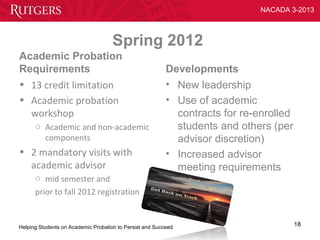
                                     Spring 2012
Academic Probation
Requirements                                              Developments
• 13 credit limitation                                    • New leadership
• Academic probation                                      • Use of academic
  workshop                                                  contracts for re-enrolled
      o Academic and non-academic                           students and others (per
        components                                          advisor discretion)
• 2 mandatory visits with                                 • Increased advisor
  academic advisor                                          meeting requirements
      o mid semester and
      prior to fall 2012 registration


Helping Students on Academic Probation to Persist and Succeed                           18
NACADA 3-2013


                                                                    19
Helping Students on Academic Probation to Persist and Succeed
NACADA 3-2013


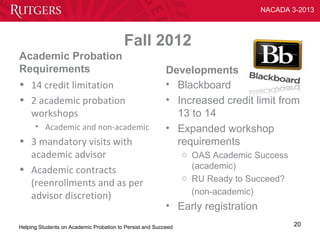
                                         Fall 2012
Academic Probation
Requirements                                              Developments
• 14 credit limitation                                    • Blackboard
• 2 academic probation                                    • Increased credit limit from
  workshops                                                 13 to 14
      • Academic and non-academic                         • Expanded workshop
• 3 mandatory visits with                                   requirements
  academic advisor                                              o OAS Academic Success
• Academic contracts                                              (academic)
                                                                o RU Ready to Succeed?
  (reenrollments and as per
  advisor discretion)                                             (non-academic)
                                                          • Early registration
Helping Students on Academic Probation to Persist and Succeed                            20
NACADA 3-2013


                                                                    21
Helping Students on Academic Probation to Persist and Succeed
NACADA 3-2013


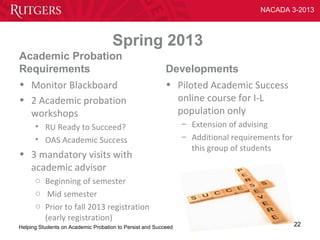
                                     Spring 2013
Academic Probation
Requirements                                              Developments
• Monitor Blackboard                                      • Piloted Academic Success
• 2 Academic probation                                      online course for I-L
  workshops                                                 population only
      • RU Ready to Succeed?                                    – Extension of advising
      • OAS Academic Success                                    – Additional requirements for
                                                                  this group of students
• 3 mandatory visits with
  academic advisor
      o Beginning of semester
      o Mid semester
      o Prior to fall 2013 registration
        (early registration)
Helping Students on Academic Probation to Persist and Succeed                                   22
NACADA 3-2013


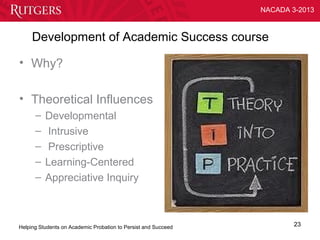
     Development of Academic Success course

• Why?

• Theoretical Influences
      –   Developmental
      –    Intrusive
      –    Prescriptive
      –   Learning-Centered
      –   Appreciative Inquiry


Helping Students on Academic Probation to Persist and Succeed           23
NACADA 3-2013


    Development of Academic Success (online)
                   course


•Why online?
  – Scheduling
  – Technology
  – Groups

•How did we develop an academically sound pedagogically
appropriate online course?


                                                                    24
Helping Students on Academic Probation to Persist and Succeed
NACADA 3-2013


CONSIDERATIONS:

1.Student
2.Interaction
3.Content


                                                                Retrieve from Flickr by ted_major


Helping Students on Academic Probation to Persist and Succeed                                  25
NACADA 3-2013


                                                                Retrieved from Flickr by Larry Miller


                                    Unique
                                  Advising Tool
Helping Students on Academic Probation to Persist and Succeed                                                   26
NACADA 3-2013


      Design


                                                                Retrieved from Flickr by Will Scullin


Helping Students on Academic Probation to Persist and Succeed                                27
NACADA 3-2013


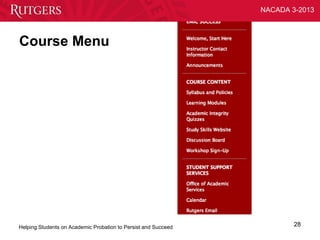
Course Menu


Helping Students on Academic Probation to Persist and Succeed           28
NACADA 3-2013


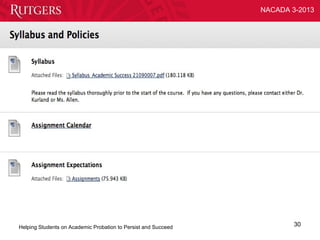
Helping Students on Academic Probation to Persist and Succeed           29
NACADA 3-2013


Helping Students on Academic Probation to Persist and Succeed           30
NACADA 3-2013


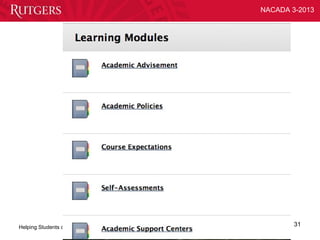
Helping Students on Academic Probation to Persist and Succeed           31
NACADA 3-2013


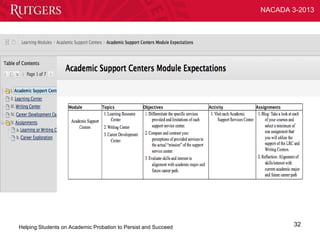
Helping Students on Academic Probation to Persist and Succeed           32
NACADA 3-2013


                                   Results (so far…)


• Better interaction with students

• More in-depth information

• Advisor meetings are more productive


                                                                    33
Helping Students on Academic Probation to Persist and Succeed
NACADA 3-2013


           Student Assignment: Advisor Meeting
                    Summary & Plan 1
“I met with my advisor…I explained to her that the reason why I am on
probation is because last semester I was under a lot of stress. I was working
full time along with volunteering at the local hospital and then also trying to do
good in school…After having this meeting with her all of my questions are
now answered and I'm glad she made everything very clear to me and
now i can go on and fix my mistakes i have made last semester….The
reason I was not able to excel was because my work hours were not going well
with my college course hours…I would either not make it to class and if i did
then i wasnt able to concentrate because i would be so tired. Also i do live 45
minutes away from the university so the commuting was difficult as well…i am
working less…now i made my work schedule and college schedule much
easier. I gave myself time to get enough sleep and be able to wake up in the
mornings and make it to my early 8:30 class. Also I only work part time now…
Hopefully things will be different this semester and with this change i can do
much better and get off probation.”
- K.K.
                                                                            34
Helping Students on Academic Probation to Persist and Succeed
NACADA 3-2013


           Student Assignment: Advisor Meeting
                    Summary & Plan 2
“Today I met with my assigned adviser for my second meeting…I was
well prepared before walking into the office. My three main
concerns were that how I can raise my GPA, questions about the
academic success class online, and about changing my major…She
help me calculate my minimum GPA that I would need for the semester
to raise my GPA and to get off probation. Then she told me about how I
need to do the academic success class… After she finished explaining
to me about the course, she asked me what I thought about the course.
I told her that I really liked the course and that I felt it was
motivating me to do better…Overall my experience with her was
great. I loved talking to her and I loved that she really helped me
out…She motivated me and made me gather faith in myself that I
can do better in the subjects I want.”
- S.K.

                                                                    35
Helping Students on Academic Probation to Persist and Succeed
NACADA 3-2013


           Student Assignment: Advisor Meeting
                    Summary & Plan 2
“…I just met with Ms. Allen...She didn't seem too thrilled because of the e-mail that Dean
Sanders sent to me a few days ago. The e-mail basically said that I have failed to meet
all requirements of the Probation class up until now…I have nobody else to blame but
myself because I never read the syllabus for the course. I didn't know that there were
journal entries and other assignments that were due for this class, simply because I did
not read the instructions. There are no excuses for my actions…I have really
disciplined myself, and I don't feel lazy or weak minded like I did last semester. I
feel like a whole new individual and it feels good. The action plan is so far still the
same. Keep going to class, manage my time properly, study well and overall just stay on
top of everything. I feel like I am maturing already because I already passed a "hard
week" in the semester. A week that I would have normally just given up on all my
schoolwork, but instead this time I buckled down and hit the books. I realized that I
haven't dug myself into a hole, I just hit a speed bump last semester on the long and
winding road of my life. So there's no reason for me to feel depressed or upset about
where I currently stand. I CAN turn things around and it won't be easy but if I just
surround myself with people who provide me with the support to instill that
motivation within myself, I can keep climbing higher…”
- A.K.

                                                                                   36
Helping Students on Academic Probation to Persist and Succeed
NACADA 3-2013


   Student Assignment: RU Ready to Succeed?
          Workshop Reflective Journal
“The things I learned…are things that I was missing when it
came to my school work. I learned that I need to believe in
myself in order to be successful. My reason for being in school
and wanting a degree should be something that I want, not what
my parents want for me…The one thing that I took from the
workshop is that I have to know what I want regarding my
education. My reasons for being in school have to be my own
personal reasons. I have to be motivated in succeeding so I
don't fail. But if I do fail, then I am motivated to keep
pushing towards to my goal. The overall thing that I learned
is that I have to believe in myself in order to see myself
succeed.”
- D.J.
                                                                    37
Helping Students on Academic Probation to Persist and Succeed
NACADA 3-2013


                             Current probation data
• 98% of the students are compliant

• 13% reduction for students on probation

• 21% reduction in dismissed students (approximately 30
  students)
      – 30 students x $12,755 (yearly in state tuition) = $382,650


                                                                     38
Helping Students on Academic Probation to Persist and Succeed
NACADA 3-2013


                                           Next Steps

•   If continued success, the course could become a
    mandated requirement for all students on probation.

•   Revenue from the increase in student retention could then be used to
    increase staff, resources, programs, etc.

•   This course (content, design, resources, and modality) can be used by other
    colleges and universities.

•   Use this model for other purposes (freshman seminar, transfers, senior
    seminar)

•   Examine other at-risk populations (“high hanging fruit”)

                                                                           39
Helping Students on Academic Probation to Persist and Succeed
Questions


            40
THANKS
                          Robert M. Kurland
                rkurland@rutgers.edu     (973)353-5099

                             Dijha R. Allen
            Dijha@rutgers.edu                 (973)353-5132

                         Shelley C. Kurland
            skurland@ccm.edu                (973)328-5538

You can access this presentation at:
    http://www.slideshare.net/skurland/nacada-conference-320132

Helping Students on Academic Probation to Persist and Succeed

  • 1.
    Helping Students onAcademic Probation to Persist and Succeed Robert M. Kurland, Ph.D., Associate Dean Office of Academic Services, Rutgers University – Newark Dijha R. Allen, Ed.M., Academic Advisor/Probation Coordinator Office of Academic Services, Rutgers University – Newark Shelley C. Kurland, M.A.T., Instructional Designer Center for Teaching Excellence, County College of Morris
  • 2.
    NACADA 3-2013 Overview • The Office of Academic Services • At-risk students • Previous practices • Recent practices • Current initiatives – course development • Future Directions 2 Helping Students on Academic Probation to Persist and Succeed
  • 3.
    NACADA 3-2013 Office of Academic Services • Staff size and structure (teams) • Responsibilities include: Academic Advisement Academic Integrity Academic Probation & Dismissal Convocation First Year Services Graduation Certification Peer Advisor Program Pre-Professional Programs Reenrollment Reinstatement School-to-School Transfers Placement Testing Transcript Evaluations Transfer Services 3 Helping Students on Academic Probation to Persist and Succeed
  • 4.
    NACADA 3-2013 Background • As the practices in higher education are falling under more scrutiny, colleges and universities are finding themselves focusing more of their efforts on measurable variables including retention and graduation rates. • Students who end up on probation are less likely to be retained and graduate as compared to students who remain in good academic standing (Mathies, Gardner, & Bauer, 2006). • “Low-hanging fruit” 4 Helping Students on Academic Probation to Persist and Succeed
  • 5.
    NACADA 3-2013 Probation students within NCAS and UC-N Prior to 2010: •Retention rate of 67% (overall student retention rate was 82.7%) •360 students on probation, we potentially lost 120 students •@ $12,775 per student (per year, in-state tuition), RU-N lost over $1.5 million dollars •What could we do with $1.5 million? 5 Helping Students on Academic Probation to Persist and Succeed
  • 6.
    NACADA 3-2013 Past Practices • Students on probation have long been an overlooked population • Few efforts and resources were used • Sent letters • Students were “required” to attend a “Probation Workshop” • Not enough flexibility for non-traditional 6 Helping Students on Academic Probation to Persist and Succeed
  • 7.
    NACADA 3-2013 What arethe current criteria for academic probation 1. A cumulative grade-point average (G.P.A.) of less than 2.000 or 2. Two consecutive terms of a grade-point average (G.P.A.) of less than 2.000 Helping Students on Academic Probation to Persist and Succeed
  • 8.
    NACADA 3-2013 Additionsto academic probation criteria 3. failure to complete 60% of attempted credits 4. failure to enroll in a composition or mathematics course, as prescribed by the placement standards at the college and prior course history, and continue to enroll each and every term until the requirement is satisfied 5. failure to complete successfully any course after three attempts, including those for which W grades are received. Helping Students on Academic Probation to Persist and Succeed
  • 9.
    NACADA 3-2013 Spring 2010 • Given the task of working on probation • Assessed the challenges – Identification - technology – Accuracy of data – 88% accurate - time frame for data uploads, repeat policies and procedures, temporary grades, and late rosters – Enforcement – Student body – commuters, jobs – Office priority • Work more closely with IR to better identify these students 9 Helping Students on Academic Probation to Persist and Succeed
  • 10.
    NACADA 3-2013 Fall 2010 • Established a Probation Student taskforce • “Probation Workshop” to “Academic Success Workshops” • Changed the format so that each workshop consisted of academic and non- academic components in collaboration with other departments (Learning Center, Psychological Services, Career Development Center) – Topics include Time Management, Note-taking skills, etc. • Survey: – evaluation of the workshop – evaluate all and any areas that may be of particular need for the students 10 Helping Students on Academic Probation to Persist and Succeed
  • 11.
    NACADA 3-2013 Spring 2011 • Piloted an intervention aimed at students on probation following their first semester of enrollment (freshmen and transfer). • 170 students second semester freshman and transfer on probation • Selected a group of 54 (32%) were placed on an “academic success agreement”. 11 Helping Students on Academic Probation to Persist and Succeed
  • 12.
    NACADA 3-2013 Academic Success Agreement • Must meet with advisor 3 times – Prior to the start of the semester – The week after add/drop – Prior to next semester’s registration (before last W date) • Must meet with each professor during the semester • Must complete questionnaire • May not register for more than 13 credits • Must attend a workshop • Agreement must be turned in prior to the end of the semester (before finals) • Failure to complete the agreement may result in further academic restraints (e.g. academic contract, reduced credit load) Helping Students on Academic Probation to Persist and Succeed
  • 13.
    NACADA 3-2013 Spring 2011 Intervention Results 13 Helping Students on Academic Probation to Persist and Succeed
  • 14.
    NACADA 3-2013 Spring 2011 Intervention Results 14 Helping Students on Academic Probation to Persist and Succeed
  • 15.
    NACADA 3-2013 Spring 2011 Intervention Results 15 Helping Students on Academic Probation to Persist and Succeed
  • 16.
    NACADA 3-2013 Feedback • Intervention is good! • 3 meetings for 54 students was a lot… maybe scale back – Less intervention for more students • Mandatory meeting with faculty member did not go over well • Need a point person for probation initiatives 16 Helping Students on Academic Probation to Persist and Succeed
  • 17.
    NACADA 3-2013 Fall 2011 Academic Probation Requirements Developments • 13 credit limitation • Launched online version • 1 mandatory meeting with of academic probation academic advisor workshop using Camtasia o prior to Spring 2012 Studio Video Editing registration Software • 1 academic probation • Developed online quiz workshop o academic and non- academic components • Continued academic agreements Helping Students on Academic Probation to Persist and Succeed 17
  • 18.
    NACADA 3-2013 Spring 2012 Academic Probation Requirements Developments • 13 credit limitation • New leadership • Academic probation • Use of academic workshop contracts for re-enrolled o Academic and non-academic students and others (per components advisor discretion) • 2 mandatory visits with • Increased advisor academic advisor meeting requirements o mid semester and prior to fall 2012 registration Helping Students on Academic Probation to Persist and Succeed 18
  • 19.
    NACADA 3-2013 19 Helping Students on Academic Probation to Persist and Succeed
  • 20.
    NACADA 3-2013 Fall 2012 Academic Probation Requirements Developments • 14 credit limitation • Blackboard • 2 academic probation • Increased credit limit from workshops 13 to 14 • Academic and non-academic • Expanded workshop • 3 mandatory visits with requirements academic advisor o OAS Academic Success • Academic contracts (academic) o RU Ready to Succeed? (reenrollments and as per advisor discretion) (non-academic) • Early registration Helping Students on Academic Probation to Persist and Succeed 20
  • 21.
    NACADA 3-2013 21 Helping Students on Academic Probation to Persist and Succeed
  • 22.
    NACADA 3-2013 Spring 2013 Academic Probation Requirements Developments • Monitor Blackboard • Piloted Academic Success • 2 Academic probation online course for I-L workshops population only • RU Ready to Succeed? – Extension of advising • OAS Academic Success – Additional requirements for this group of students • 3 mandatory visits with academic advisor o Beginning of semester o Mid semester o Prior to fall 2013 registration (early registration) Helping Students on Academic Probation to Persist and Succeed 22
  • 23.
    NACADA 3-2013 Development of Academic Success course • Why? • Theoretical Influences – Developmental – Intrusive – Prescriptive – Learning-Centered – Appreciative Inquiry Helping Students on Academic Probation to Persist and Succeed 23
  • 24.
    NACADA 3-2013 Development of Academic Success (online) course •Why online? – Scheduling – Technology – Groups •How did we develop an academically sound pedagogically appropriate online course? 24 Helping Students on Academic Probation to Persist and Succeed
  • 25.
    NACADA 3-2013 CONSIDERATIONS: 1.Student 2.Interaction 3.Content Retrieve from Flickr by ted_major Helping Students on Academic Probation to Persist and Succeed 25
  • 26.
    NACADA 3-2013 Retrieved from Flickr by Larry Miller Unique Advising Tool Helping Students on Academic Probation to Persist and Succeed 26
  • 27.
    NACADA 3-2013 Design Retrieved from Flickr by Will Scullin Helping Students on Academic Probation to Persist and Succeed 27
  • 28.
    NACADA 3-2013 Course Menu HelpingStudents on Academic Probation to Persist and Succeed 28
  • 29.
    NACADA 3-2013 Helping Studentson Academic Probation to Persist and Succeed 29
  • 30.
    NACADA 3-2013 Helping Studentson Academic Probation to Persist and Succeed 30
  • 31.
    NACADA 3-2013 Helping Studentson Academic Probation to Persist and Succeed 31
  • 32.
    NACADA 3-2013 Helping Studentson Academic Probation to Persist and Succeed 32
  • 33.
    NACADA 3-2013 Results (so far…) • Better interaction with students • More in-depth information • Advisor meetings are more productive 33 Helping Students on Academic Probation to Persist and Succeed
  • 34.
    NACADA 3-2013 Student Assignment: Advisor Meeting Summary & Plan 1 “I met with my advisor…I explained to her that the reason why I am on probation is because last semester I was under a lot of stress. I was working full time along with volunteering at the local hospital and then also trying to do good in school…After having this meeting with her all of my questions are now answered and I'm glad she made everything very clear to me and now i can go on and fix my mistakes i have made last semester….The reason I was not able to excel was because my work hours were not going well with my college course hours…I would either not make it to class and if i did then i wasnt able to concentrate because i would be so tired. Also i do live 45 minutes away from the university so the commuting was difficult as well…i am working less…now i made my work schedule and college schedule much easier. I gave myself time to get enough sleep and be able to wake up in the mornings and make it to my early 8:30 class. Also I only work part time now… Hopefully things will be different this semester and with this change i can do much better and get off probation.” - K.K. 34 Helping Students on Academic Probation to Persist and Succeed
  • 35.
    NACADA 3-2013 Student Assignment: Advisor Meeting Summary & Plan 2 “Today I met with my assigned adviser for my second meeting…I was well prepared before walking into the office. My three main concerns were that how I can raise my GPA, questions about the academic success class online, and about changing my major…She help me calculate my minimum GPA that I would need for the semester to raise my GPA and to get off probation. Then she told me about how I need to do the academic success class… After she finished explaining to me about the course, she asked me what I thought about the course. I told her that I really liked the course and that I felt it was motivating me to do better…Overall my experience with her was great. I loved talking to her and I loved that she really helped me out…She motivated me and made me gather faith in myself that I can do better in the subjects I want.” - S.K. 35 Helping Students on Academic Probation to Persist and Succeed
  • 36.
    NACADA 3-2013 Student Assignment: Advisor Meeting Summary & Plan 2 “…I just met with Ms. Allen...She didn't seem too thrilled because of the e-mail that Dean Sanders sent to me a few days ago. The e-mail basically said that I have failed to meet all requirements of the Probation class up until now…I have nobody else to blame but myself because I never read the syllabus for the course. I didn't know that there were journal entries and other assignments that were due for this class, simply because I did not read the instructions. There are no excuses for my actions…I have really disciplined myself, and I don't feel lazy or weak minded like I did last semester. I feel like a whole new individual and it feels good. The action plan is so far still the same. Keep going to class, manage my time properly, study well and overall just stay on top of everything. I feel like I am maturing already because I already passed a "hard week" in the semester. A week that I would have normally just given up on all my schoolwork, but instead this time I buckled down and hit the books. I realized that I haven't dug myself into a hole, I just hit a speed bump last semester on the long and winding road of my life. So there's no reason for me to feel depressed or upset about where I currently stand. I CAN turn things around and it won't be easy but if I just surround myself with people who provide me with the support to instill that motivation within myself, I can keep climbing higher…” - A.K. 36 Helping Students on Academic Probation to Persist and Succeed
  • 37.
    NACADA 3-2013 Student Assignment: RU Ready to Succeed? Workshop Reflective Journal “The things I learned…are things that I was missing when it came to my school work. I learned that I need to believe in myself in order to be successful. My reason for being in school and wanting a degree should be something that I want, not what my parents want for me…The one thing that I took from the workshop is that I have to know what I want regarding my education. My reasons for being in school have to be my own personal reasons. I have to be motivated in succeeding so I don't fail. But if I do fail, then I am motivated to keep pushing towards to my goal. The overall thing that I learned is that I have to believe in myself in order to see myself succeed.” - D.J. 37 Helping Students on Academic Probation to Persist and Succeed
  • 38.
    NACADA 3-2013 Current probation data • 98% of the students are compliant • 13% reduction for students on probation • 21% reduction in dismissed students (approximately 30 students) – 30 students x $12,755 (yearly in state tuition) = $382,650 38 Helping Students on Academic Probation to Persist and Succeed
  • 39.
    NACADA 3-2013 Next Steps • If continued success, the course could become a mandated requirement for all students on probation. • Revenue from the increase in student retention could then be used to increase staff, resources, programs, etc. • This course (content, design, resources, and modality) can be used by other colleges and universities. • Use this model for other purposes (freshman seminar, transfers, senior seminar) • Examine other at-risk populations (“high hanging fruit”) 39 Helping Students on Academic Probation to Persist and Succeed
  • 40.
  • 41.
    THANKS Robert M. Kurland rkurland@rutgers.edu (973)353-5099 Dijha R. Allen Dijha@rutgers.edu (973)353-5132 Shelley C. Kurland skurland@ccm.edu (973)328-5538 You can access this presentation at: http://www.slideshare.net/skurland/nacada-conference-320132

Editor's Notes

  • #18 -Explain what Camtasia is: Video editing software; can use to make and edit your own videos. It can record your screen to capture PowerPoint slides, demos, webpages, and more. -Why online workshop developed?: -Online workshop developed to allow more flexibility for non-traditional students that take evening courses and cannot attend during the day; the information being presented was very important and we wanted to provide another way for students to be informed
  • #19 New Dean of Academic Services Academic probation became an office priority; supported and expanded initiatives Started dedicating more time/resources
  • #21 Why 14 credits?: many students take developmental courses in English and math that are between 4 – 6 credits. This increase allowed room for these courses.
  • #23 Now we will discuss the academic success course in detail
  • #24 Our approach to advising students on probation is based upon several theories of advising: Not an either/or approach but a and/or philosophy. Developmental theories such as: -Prescriptive advising: based on authority between advisor and student
  • #26 Student: population, academic tendencies, academic behaviors Interaction within the course: peer-peer; instructor-student; student-content Content: what is? How to present it? What components do you have? Outcomes? How are you going to assess those outcomes?
  • #28 When considering design the most important thing is to make your learning outcomes explicit at the course and module (weeks, topic, etc.) level. Ask: What do I want the students to know at the end of the course. Ask: What do I want the students to know at the end of the week, topic, etc. Handout worksheet
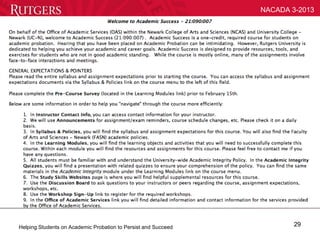
  • #29 Handout: Course Menu/Start Here
  • #31 Handout: Assignment Calendar/Assignment Expectations
  • #38 Attended workshop on self-efficacy and motivation