DEUTERIUM
COUPLING
Nandhakumar.M
M.Sc Chemistry
Deuterium coupling
■ Deuterium coupling, also known as H/D exchange,
refers to the phenomenon where a hydrogen atom
(H) in a molecule is replaced by a deuterium atom
(D). Deuterium is a stable isotope of hydrogen with a
nucleus containing one proton and one neutron,
compared to the one proton in a normal hydrogen
atom.
■ This exchange can be observed in Nuclear Magnetic
Resonance (NMR) spectroscopy, a technique used
to study the properties of molecules by analyzing
the magnetic properties of their nuclei. In an NMR
spectrum, protons in a molecule will produce
signals at specific frequencies. When some of these
protons are replaced by deuterium, the
corresponding signals in the spectrum will be
reduced in intensity or disappear altogether.
There are two main types of deuterium
coupling
■ Intramolecular coupling: This occurs when a
deuterium atom replaces a hydrogen atom within
the same molecule. This can affect the chemical
shifts and coupling constants of neighboring
protons in the NMR spectrum.
■ Intermolecular coupling: This occurs when a
deuterium atom from a solvent molecule
exchanges with a hydrogen atom in the molecule of
interest. This is most commonly observed when
using deuterated solvents (such as D2O) in NMR
spectroscopy. Intermolecular coupling can be used
to study the dynamics of molecules, such as the
rate at which different parts of a molecule are
moving.
Off-resonance decoupling
■ Off-resonance decoupling is a technique used in
Carbon-13 Nuclear Magnetic Resonance (C-13 NMR)
spectroscopy that provides additional structural
information by allowing partial coupling between
carbon atoms and the hydrogens attached to them.
■ In off-resonance decoupling, the decoupling of
protons is done in a way that only partially cancels
the coupling between the C-13 nucleus and its
attached protons. This results in the carbon atoms
showing a reduced multiplicity, revealing how
many protons are attached to each carbon atom.
Resulting Multiplicities
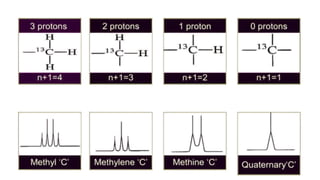
■ CH₃ (Methyl group): The signal will appear as a
quartet due to coupling with three protons (J-
coupling).
■ CH₂ (Methylene group): The signal will appear as a
triplet due to coupling with two protons.
■ CH (Methine group): The signal will appear as a
doublet due to coupling with one proton.
■ C (Quaternary carbon): The signal remains a
singlet because there are no protons attached.
Benefits of Off-Resonance
Decoupling:
■ Structural Information: It provides more detailed
structural information by showing the number of
hydrogens attached to each carbon atom.
■ Simplified Spectra: It still simplifies the spectrum
compared to fully coupled C-13 spectra but retains
some coupling information that is lost in fully
decoupled spectra.
Thank you

DEUTERIUM COUPLING , INTRAMOLECULAR COUPLING , INTERMOLECULAR COUPLING

  • 1.
  • 2.
    Deuterium coupling ■ Deuteriumcoupling, also known as H/D exchange, refers to the phenomenon where a hydrogen atom (H) in a molecule is replaced by a deuterium atom (D). Deuterium is a stable isotope of hydrogen with a nucleus containing one proton and one neutron, compared to the one proton in a normal hydrogen atom.
  • 3.
    ■ This exchangecan be observed in Nuclear Magnetic Resonance (NMR) spectroscopy, a technique used to study the properties of molecules by analyzing the magnetic properties of their nuclei. In an NMR spectrum, protons in a molecule will produce signals at specific frequencies. When some of these protons are replaced by deuterium, the corresponding signals in the spectrum will be reduced in intensity or disappear altogether.
  • 4.
    There are twomain types of deuterium coupling ■ Intramolecular coupling: This occurs when a deuterium atom replaces a hydrogen atom within the same molecule. This can affect the chemical shifts and coupling constants of neighboring protons in the NMR spectrum.
  • 5.
    ■ Intermolecular coupling:This occurs when a deuterium atom from a solvent molecule exchanges with a hydrogen atom in the molecule of interest. This is most commonly observed when using deuterated solvents (such as D2O) in NMR spectroscopy. Intermolecular coupling can be used to study the dynamics of molecules, such as the rate at which different parts of a molecule are moving.
  • 6.
    Off-resonance decoupling ■ Off-resonancedecoupling is a technique used in Carbon-13 Nuclear Magnetic Resonance (C-13 NMR) spectroscopy that provides additional structural information by allowing partial coupling between carbon atoms and the hydrogens attached to them.
  • 7.
    ■ In off-resonancedecoupling, the decoupling of protons is done in a way that only partially cancels the coupling between the C-13 nucleus and its attached protons. This results in the carbon atoms showing a reduced multiplicity, revealing how many protons are attached to each carbon atom.
  • 8.
    Resulting Multiplicities ■ CH₃(Methyl group): The signal will appear as a quartet due to coupling with three protons (J- coupling). ■ CH₂ (Methylene group): The signal will appear as a triplet due to coupling with two protons. ■ CH (Methine group): The signal will appear as a doublet due to coupling with one proton. ■ C (Quaternary carbon): The signal remains a singlet because there are no protons attached.
  • 10.
    Benefits of Off-Resonance Decoupling: ■Structural Information: It provides more detailed structural information by showing the number of hydrogens attached to each carbon atom. ■ Simplified Spectra: It still simplifies the spectrum compared to fully coupled C-13 spectra but retains some coupling information that is lost in fully decoupled spectra.
  • 11.