Parallelism-Aware Memory Interference
Delay Analysis for COTS Multicore Systems
Heechul Yun +, Rodolfo Pellizzoni*, Prathap Kumar Valsan+
+University of Kansas
*University of Waterloo
1
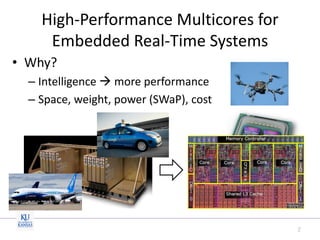
High-Performance Multicores for
Embedded Real-Time Systems
• Why?
– Intelligence  more performance
– Space, weight, power (SWaP), cost
2
Challenge: Shared Memory Hierarchy
3
Core1 Core2 Core3 Core4
Memory Controller (MC)
Shared Cache
• Hardware resources are contented among the cores
• Tasks can suffer significant memory interference
delays
DRAM
Memory Interference Delay
• Can be extremely high in the worst-case
4
8.0
33.5
45.8
0
5
10
15
20
25
30
35
40
45
50
ARM
Cortex A15
Intel
Nahelem
Intel
Haswell
solo
+ 1 co-runner
+ 2 co-runners
+ 3 co-runners
Normalizedexecutiontime
45.8X
slowdown
DRAM
LLC
Core1 Core2 Core3 Core4
bench co-runner(s)
banks
Modeling Memory Interference
• Common (false) assumptions on COTS systems
– A single resource
• Reality: multiple parallel resources (banks)
– A constant memory service cost
• Reality: it varies depending on the DRAM bank state
– Round-robin arbitration, in-order processing
• Reality: FR-FCFS can re-order requests
– Both read and write requests are treated equally
• Reality: writes are buffered and processed opportunistically
– One outstanding request per core
• Reality: an out-of-order core can generate parallel reqs.
5
Addressed in This Work
Addressed in [Kim’14]
[Kim’14] H. Kim, D. de Niz, B. Andersson, M. Klein, O. Mutlu, and R. R.Rajkumar. “Bounding Memory Interference
Delay in COTS-based Multi-Core Systems,” RTAS’14
Our Approach
• Realistic memory interference model for COTS systems
– Memory-level parallelism (MLP) in COTS architecture
– Write-buffering and opportunistic batch processing in MC
• DRAM bank-partitioning
– Reduce interference
• Delay analysis
– Compute worst-case memory interference delay of the
task under analysis
6
Outline
• Motivation
• Background
– COTS multicore architecture
– DRAM organization
– Memory controller
• Our approach
• Evaluation
• Conclusion
7
Memory-Level Parallelism (MLP)
• Broadly defined as the number of concurrent
memory requests that a given architecture
can handle at a time
8
Last Level Cache (LLC)
DRAM DIMM
Memory Controller (MC)
Core1 Core2 Core3 Core4
Request buffers
Read Write
Scheduler
MSHRs
CMD/ADDR DATA
COTS Multicore Architecture
Out-of-order core:
Multiple memory requests
Non-blocking caches:
Multiple cache-misses
MC and DRAM:
Multiple banks
Bank
4
Bank
3
Bank
2
Bank
1
MSHRs MSHRs MSHRs MSHRs
9
DRAM Organization
LLC
DRAM DIMM
Memory Controller (MC)
Bank
4
Bank
3
Bank
2
Bank
1
Core1 Core2 Core3 Core4
Mess
• intra-bank conflicts
• Inter-bank conflicts
10
DRAM Bank Partitioning
L3
DRAM DIMM
Memory Controller (MC)
Bank
4
Bank
3
Bank
2
Bank
1
Core1 Core2 Core3 Core4 • Private banking
– OS kernel allocates
pages from
dedicated banks for
each core
Eliminate
intra bank
conflicts
11
Bank Access Cost
Row 1
Row 2
Row 3
Row 4
Row 5
A DRAM Bank
Row Bufferactivate
precharge
Read/write
• State dependent access cost
– Row hit: fast
– Row miss: slow
READ (Bank 1, Row 3, Col 7)
Col7
12
Memory Controller
13
Read request
buffer
Write request
buffer
Bank 1
scheduler
Channel scheduler
Bank 2
scheduler
Bank N
scheduler
DRAM chip
Memory requests from cores
Writes are buffered and processed opportunistically
“Intelligent” Read/Write Switching
• Intuition
– Writes are not in the critical path. So buffer and
process them opportunistically
• Algorithm [Hansson’14]
– If there are reads, process them unless the write
buffer is almost full (high watermark)
– If there’s no reads and there is enough buffered
writes (low watermark), process the writes until
reads arrive
14
[Hansson’14] Hansson et al., “Simulating DRAM controllers for future syste
m architecture exploration,” ISPASS’14
FR-FCFS Scheduling[Rixner’00]
• Priority order
1. Row hit request
2. Older request
• Maximize memory throughput
15
Bank 1
scheduler
Channel scheduler
Bank 2
scheduler
Bank N
scheduler
[Rixner’00] S. Rixner, W. J. Dally, U. J. Kapasi, P. Mattson, and J. Owens. Memo
ry access scheduling. ACM SIGARCH Computer Architecture News. 2000
Outline
• Motivation
• Background
• Our approach
– System model
– Delay analysis
• Evaluation
• Conclusion
16
System Model
• Task
– Solo execution time C
– Memory demand (#of LLC misses): H
• Core
– Can generate multiple, but bounded, parallel requests
• Upper-bounded by L1 cache’s MSHR size
• Cache (LLC)
– Assume no cache-level interference
• Core-private or partitioned LLC
• No MSHR contention
• DRAM controller
– Efficient FR-FCFS scheduler, open-page pollicy
– Separate read and write request buffer
• Watermark scheme on processing writes
17
Delay Analysis
• Goal
– Compute the worst-case memory interference delay of a
task under analysis
• Request driven analysis
– Based on the task’s own memory demand: H
– Compute worst-case per request delay: RD
– Memory interference delay = RD x H
• Job driven analysis
– Based on the other tasks’ memory requests over time
– See paper
18
Key Intuition #1
• The #of competing requests Nrq is bounded
– Because the # of per-core parallel requests is bounded.
– Example
• Cortex-A15’s per-core bound = 6
• Nrq = 6 x 3 (cores) = 18
19
Key Intuition #2
• DRAM sub-commands of the competing
memory requests are overlapped
– Much less pessimistic than [Kim’14], which simply
sums up each sub-command’s maximum delay
– See paper for the proof
20
Key Intuition #3
• The worst-case delay happens when
– The read buffer has Nrq requests
– And the write request buffer just becomes full
• Start a write batch
– Then the read request under analysis arrives
21
RD = read batch delay + write batch delay
Outline
• Motivation
• Background
• Our approach
• Evaluation
• Conclusion
22
Evaluation Setup
• Gem5 simulator
– 4 out-of-order cores (based on Cortex-A15)
• L2 MSHR size is increased to eliminate MSHR contention
– DRAM controller model [Hansson’14]
– LPDDR2 @ 533Mhz
• Linux 3.14
– Use PALLOC[Yun’14] to partition
DRAM banks and LLC
• Workload
– Subject: Latency, SPEC2006
– Co-runners: Bandwidth (write)
23
DRAM
LLC
Core1 Core2 Core3 Core4
subject co-runner(s)
Results with the Latency benchmark
• Ours(ideal): Read only delay analysis (ignore writes)
• Ours(opt): assume writes are balanced over multiple banks
• Ours(worst): all writes are targeting one bank & all row misses
24
0
5
10
15
20
25
30
Measured [Kim'14] Ours(ideal) Ours(opt) Ours(worst)
NormalizedResponseTime
underestimate
overestimate
[Kim’14] H. Kim, D. de Niz, B. Andersson, M. Klein, O. Mutlu, and R. R.Rajkumar. “Bounding Memory Interference
Delay in COTS-based Multi-Core Systems,” RTAS’14
Results with SPEC2006 Benchmarks
• Main source of pessimism:
– The pathological case of write (LLC write-backs) processing
25
Conclusion
• Memory interference delay on COTS multicore
– Existing analysis methods rely on strong assumptions
• Our approach
– A realistic model of COTS memory system
• Parallel memory requests
• Read prioritization and opportunistic write processing
– Request and job-driven delay analysis methods
• Pessimistic but still can be useful for low memory intensive tasks
• Future work
– Reduce pessimism in the analysis
26
Thank You
27

Parallelism-Aware Memory Interference Delay Analysis for COTS Multicore Systems

  • 1.
    Parallelism-Aware Memory Interference DelayAnalysis for COTS Multicore Systems Heechul Yun +, Rodolfo Pellizzoni*, Prathap Kumar Valsan+ +University of Kansas *University of Waterloo 1
  • 2.
    High-Performance Multicores for EmbeddedReal-Time Systems • Why? – Intelligence  more performance – Space, weight, power (SWaP), cost 2
  • 3.
    Challenge: Shared MemoryHierarchy 3 Core1 Core2 Core3 Core4 Memory Controller (MC) Shared Cache • Hardware resources are contented among the cores • Tasks can suffer significant memory interference delays DRAM
  • 4.
    Memory Interference Delay •Can be extremely high in the worst-case 4 8.0 33.5 45.8 0 5 10 15 20 25 30 35 40 45 50 ARM Cortex A15 Intel Nahelem Intel Haswell solo + 1 co-runner + 2 co-runners + 3 co-runners Normalizedexecutiontime 45.8X slowdown DRAM LLC Core1 Core2 Core3 Core4 bench co-runner(s) banks
  • 5.
    Modeling Memory Interference •Common (false) assumptions on COTS systems – A single resource • Reality: multiple parallel resources (banks) – A constant memory service cost • Reality: it varies depending on the DRAM bank state – Round-robin arbitration, in-order processing • Reality: FR-FCFS can re-order requests – Both read and write requests are treated equally • Reality: writes are buffered and processed opportunistically – One outstanding request per core • Reality: an out-of-order core can generate parallel reqs. 5 Addressed in This Work Addressed in [Kim’14] [Kim’14] H. Kim, D. de Niz, B. Andersson, M. Klein, O. Mutlu, and R. R.Rajkumar. “Bounding Memory Interference Delay in COTS-based Multi-Core Systems,” RTAS’14
  • 6.
    Our Approach • Realisticmemory interference model for COTS systems – Memory-level parallelism (MLP) in COTS architecture – Write-buffering and opportunistic batch processing in MC • DRAM bank-partitioning – Reduce interference • Delay analysis – Compute worst-case memory interference delay of the task under analysis 6
  • 7.
    Outline • Motivation • Background –COTS multicore architecture – DRAM organization – Memory controller • Our approach • Evaluation • Conclusion 7
  • 8.
    Memory-Level Parallelism (MLP) •Broadly defined as the number of concurrent memory requests that a given architecture can handle at a time 8
  • 9.
    Last Level Cache(LLC) DRAM DIMM Memory Controller (MC) Core1 Core2 Core3 Core4 Request buffers Read Write Scheduler MSHRs CMD/ADDR DATA COTS Multicore Architecture Out-of-order core: Multiple memory requests Non-blocking caches: Multiple cache-misses MC and DRAM: Multiple banks Bank 4 Bank 3 Bank 2 Bank 1 MSHRs MSHRs MSHRs MSHRs 9
  • 10.
    DRAM Organization LLC DRAM DIMM MemoryController (MC) Bank 4 Bank 3 Bank 2 Bank 1 Core1 Core2 Core3 Core4 Mess • intra-bank conflicts • Inter-bank conflicts 10
  • 11.
    DRAM Bank Partitioning L3 DRAMDIMM Memory Controller (MC) Bank 4 Bank 3 Bank 2 Bank 1 Core1 Core2 Core3 Core4 • Private banking – OS kernel allocates pages from dedicated banks for each core Eliminate intra bank conflicts 11
  • 12.
    Bank Access Cost Row1 Row 2 Row 3 Row 4 Row 5 A DRAM Bank Row Bufferactivate precharge Read/write • State dependent access cost – Row hit: fast – Row miss: slow READ (Bank 1, Row 3, Col 7) Col7 12
  • 13.
    Memory Controller 13 Read request buffer Writerequest buffer Bank 1 scheduler Channel scheduler Bank 2 scheduler Bank N scheduler DRAM chip Memory requests from cores Writes are buffered and processed opportunistically
  • 14.
    “Intelligent” Read/Write Switching •Intuition – Writes are not in the critical path. So buffer and process them opportunistically • Algorithm [Hansson’14] – If there are reads, process them unless the write buffer is almost full (high watermark) – If there’s no reads and there is enough buffered writes (low watermark), process the writes until reads arrive 14 [Hansson’14] Hansson et al., “Simulating DRAM controllers for future syste m architecture exploration,” ISPASS’14
  • 15.
    FR-FCFS Scheduling[Rixner’00] • Priorityorder 1. Row hit request 2. Older request • Maximize memory throughput 15 Bank 1 scheduler Channel scheduler Bank 2 scheduler Bank N scheduler [Rixner’00] S. Rixner, W. J. Dally, U. J. Kapasi, P. Mattson, and J. Owens. Memo ry access scheduling. ACM SIGARCH Computer Architecture News. 2000
  • 16.
    Outline • Motivation • Background •Our approach – System model – Delay analysis • Evaluation • Conclusion 16
  • 17.
    System Model • Task –Solo execution time C – Memory demand (#of LLC misses): H • Core – Can generate multiple, but bounded, parallel requests • Upper-bounded by L1 cache’s MSHR size • Cache (LLC) – Assume no cache-level interference • Core-private or partitioned LLC • No MSHR contention • DRAM controller – Efficient FR-FCFS scheduler, open-page pollicy – Separate read and write request buffer • Watermark scheme on processing writes 17
  • 18.
    Delay Analysis • Goal –Compute the worst-case memory interference delay of a task under analysis • Request driven analysis – Based on the task’s own memory demand: H – Compute worst-case per request delay: RD – Memory interference delay = RD x H • Job driven analysis – Based on the other tasks’ memory requests over time – See paper 18
  • 19.
    Key Intuition #1 •The #of competing requests Nrq is bounded – Because the # of per-core parallel requests is bounded. – Example • Cortex-A15’s per-core bound = 6 • Nrq = 6 x 3 (cores) = 18 19
  • 20.
    Key Intuition #2 •DRAM sub-commands of the competing memory requests are overlapped – Much less pessimistic than [Kim’14], which simply sums up each sub-command’s maximum delay – See paper for the proof 20
  • 21.
    Key Intuition #3 •The worst-case delay happens when – The read buffer has Nrq requests – And the write request buffer just becomes full • Start a write batch – Then the read request under analysis arrives 21 RD = read batch delay + write batch delay
  • 22.
    Outline • Motivation • Background •Our approach • Evaluation • Conclusion 22
  • 23.
    Evaluation Setup • Gem5simulator – 4 out-of-order cores (based on Cortex-A15) • L2 MSHR size is increased to eliminate MSHR contention – DRAM controller model [Hansson’14] – LPDDR2 @ 533Mhz • Linux 3.14 – Use PALLOC[Yun’14] to partition DRAM banks and LLC • Workload – Subject: Latency, SPEC2006 – Co-runners: Bandwidth (write) 23 DRAM LLC Core1 Core2 Core3 Core4 subject co-runner(s)
  • 24.
    Results with theLatency benchmark • Ours(ideal): Read only delay analysis (ignore writes) • Ours(opt): assume writes are balanced over multiple banks • Ours(worst): all writes are targeting one bank & all row misses 24 0 5 10 15 20 25 30 Measured [Kim'14] Ours(ideal) Ours(opt) Ours(worst) NormalizedResponseTime underestimate overestimate [Kim’14] H. Kim, D. de Niz, B. Andersson, M. Klein, O. Mutlu, and R. R.Rajkumar. “Bounding Memory Interference Delay in COTS-based Multi-Core Systems,” RTAS’14
  • 25.
    Results with SPEC2006Benchmarks • Main source of pessimism: – The pathological case of write (LLC write-backs) processing 25
  • 26.
    Conclusion • Memory interferencedelay on COTS multicore – Existing analysis methods rely on strong assumptions • Our approach – A realistic model of COTS memory system • Parallel memory requests • Read prioritization and opportunistic write processing – Request and job-driven delay analysis methods • Pessimistic but still can be useful for low memory intensive tasks • Future work – Reduce pessimism in the analysis 26
  • 27.