Determining and Formulating
Goals/Objectives
Begin With The End in Mind
• plan ahead and set goals.
• do things that have meaning and make a
difference.
• Make an important part in the classroom.
• look for ways to be a good citizen.
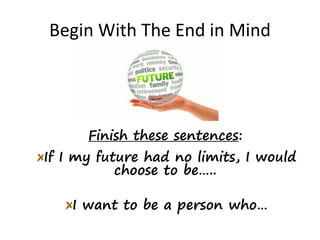
Begin With The End in Mind
Finish these sentences:
If I my future had no limits, I would
choose to be…..
I want to be a person who…
Share Lesson Objectives to Students
• challenging and enable students to make good
progress.
• articulated in context of what has been
learned before
• differentiated eg what all students, most
students and some students to have been
achieved
Objective of our Topic
• Relating the educational System in
Determining the Goals and Objectives
• How the Principle in teaching-learning process
affected by our topic
• To illustrate and understand the essence of
objectives
Objectives must be in three Domain
• Cognitive: mental skills (Knowledge)
• Affective: growth in feelings or emotional
areas (Attitude)
• Psychomotor: manual or physical skills (Skills)
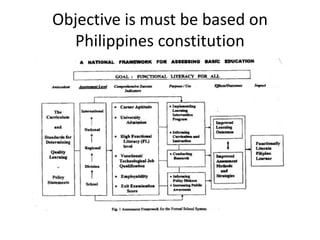
Objective is must be based on
Philippines constitution
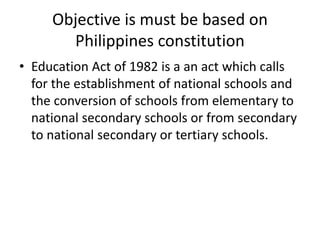
Objective is must be based on
Philippines constitution
• Education Act of 1982 is a an act which calls
for the establishment of national schools and
the conversion of schools from elementary to
national secondary schools or from secondary
to national secondary or tertiary schools.
Critical and creative thinking
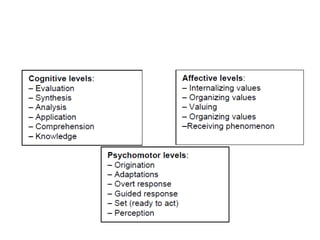
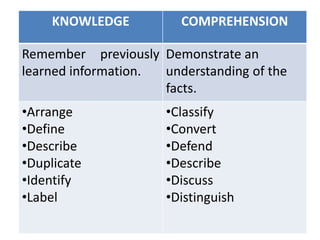
• Benjamin Bloom (1956) developed a classification
of levels of intellectual behavior in learning. This
taxonomy contained three overlapping domains:
the cognitive, psychomotor, and affective. Within
the cognitive domain, he identified six levels:
knowledge, comprehension, application, analysis,
synthesis, and evaluation. These domains and
levels are still useful today as you develop the
critical thinking skills of your students.
S.M.A.R.T.
• Specific
• Measurable
• Attainable
• Result-Oriented
• Time Bound
KNOWLEDGE COMPREHENSION
Remember previously
learned information.
Demonstrate an
understanding of the
facts.
•Arrange
•Define
•Describe
•Duplicate
•Identify
•Label
•Classify
•Convert
•Defend
•Describe
•Discuss
•Distinguish
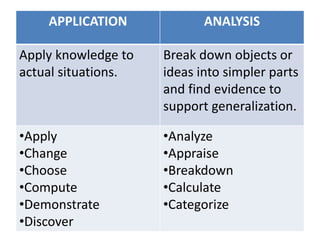
APPLICATION ANALYSIS
Apply knowledge to
actual situations.
Break down objects or
ideas into simpler parts
and find evidence to
support generalization.
•Apply
•Change
•Choose
•Compute
•Demonstrate
•Discover
•Analyze
•Appraise
•Breakdown
•Calculate
•Categorize
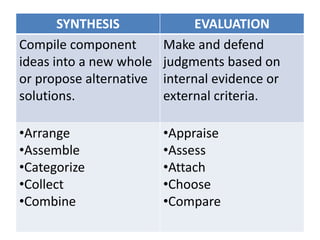
SYNTHESIS EVALUATION
Compile component
ideas into a new whole
or propose alternative
solutions.
Make and defend
judgments based on
internal evidence or
external criteria.
•Arrange
•Assemble
•Categorize
•Collect
•Combine
•Appraise
•Assess
•Attach
•Choose
•Compare
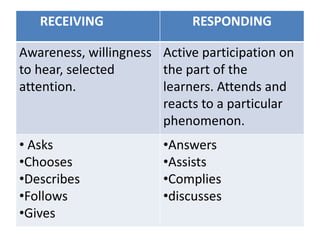
RECEIVING RESPONDING
Awareness, willingness
to hear, selected
attention.
Active participation on
the part of the
learners. Attends and
reacts to a particular
phenomenon.
• Asks
•Chooses
•Describes
•Follows
•Gives
•Answers
•Assists
•Complies
•discusses
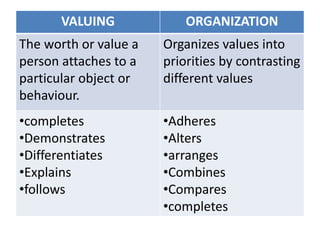
VALUING ORGANIZATION
The worth or value a
person attaches to a
particular object or
behaviour.
Organizes values into
priorities by contrasting
different values
•completes
•Demonstrates
•Differentiates
•Explains
•follows
•Adheres
•Alters
•arranges
•Combines
•Compares
•completes
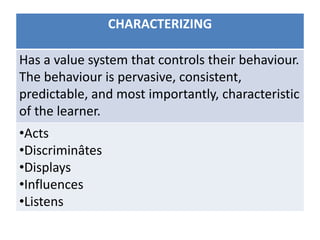
CHARACTERIZING
Has a value system that controls their behaviour.
The behaviour is pervasive, consistent,
predictable, and most importantly, characteristic
of the learner.
•Acts
•Discriminâtes
•Displays
•Influences
•Listens
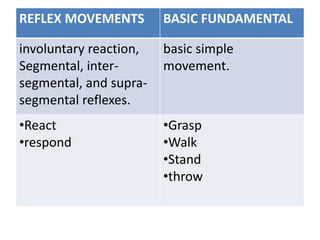
REFLEX MOVEMENTS BASIC FUNDAMENTAL
involuntary reaction,
Segmental, inter-
segmental, and supra-
segmental reflexes.
basic simple
movement.
•React
•respond
•Grasp
•Walk
•Stand
•throw
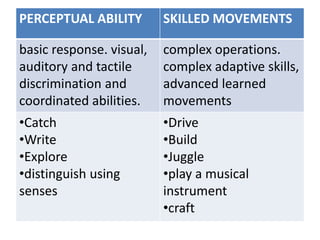
PERCEPTUAL ABILITY SKILLED MOVEMENTS
basic response. visual,
auditory and tactile
discrimination and
coordinated abilities.
complex operations.
complex adaptive skills,
advanced learned
movements
•Catch
•Write
•Explore
•distinguish using
senses
•Drive
•Build
•Juggle
•play a musical
instrument
•craft
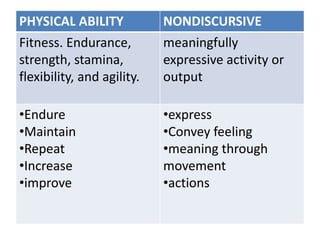
PHYSICAL ABILITY NONDISCURSIVE
Fitness. Endurance,
strength, stamina,
flexibility, and agility.
meaningfully
expressive activity or
output
•Endure
•Maintain
•Repeat
•Increase
•improve
•express
•Convey feeling
•meaning through
movement
•actions

Determining and formulating goals/objectives

  • 1.
  • 2.
    Begin With TheEnd in Mind • plan ahead and set goals. • do things that have meaning and make a difference. • Make an important part in the classroom. • look for ways to be a good citizen.
  • 3.
    Begin With TheEnd in Mind Finish these sentences: If I my future had no limits, I would choose to be….. I want to be a person who…
  • 4.
    Share Lesson Objectivesto Students • challenging and enable students to make good progress. • articulated in context of what has been learned before • differentiated eg what all students, most students and some students to have been achieved
  • 5.
    Objective of ourTopic • Relating the educational System in Determining the Goals and Objectives • How the Principle in teaching-learning process affected by our topic • To illustrate and understand the essence of objectives
  • 6.
    Objectives must bein three Domain • Cognitive: mental skills (Knowledge) • Affective: growth in feelings or emotional areas (Attitude) • Psychomotor: manual or physical skills (Skills)
  • 8.
    Objective is mustbe based on Philippines constitution
  • 9.
    Objective is mustbe based on Philippines constitution • Education Act of 1982 is a an act which calls for the establishment of national schools and the conversion of schools from elementary to national secondary schools or from secondary to national secondary or tertiary schools.
  • 10.
    Critical and creativethinking • Benjamin Bloom (1956) developed a classification of levels of intellectual behavior in learning. This taxonomy contained three overlapping domains: the cognitive, psychomotor, and affective. Within the cognitive domain, he identified six levels: knowledge, comprehension, application, analysis, synthesis, and evaluation. These domains and levels are still useful today as you develop the critical thinking skills of your students.
  • 11.
    S.M.A.R.T. • Specific • Measurable •Attainable • Result-Oriented • Time Bound
  • 12.
    KNOWLEDGE COMPREHENSION Remember previously learnedinformation. Demonstrate an understanding of the facts. •Arrange •Define •Describe •Duplicate •Identify •Label •Classify •Convert •Defend •Describe •Discuss •Distinguish
  • 13.
    APPLICATION ANALYSIS Apply knowledgeto actual situations. Break down objects or ideas into simpler parts and find evidence to support generalization. •Apply •Change •Choose •Compute •Demonstrate •Discover •Analyze •Appraise •Breakdown •Calculate •Categorize
  • 14.
    SYNTHESIS EVALUATION Compile component ideasinto a new whole or propose alternative solutions. Make and defend judgments based on internal evidence or external criteria. •Arrange •Assemble •Categorize •Collect •Combine •Appraise •Assess •Attach •Choose •Compare
  • 15.
    RECEIVING RESPONDING Awareness, willingness tohear, selected attention. Active participation on the part of the learners. Attends and reacts to a particular phenomenon. • Asks •Chooses •Describes •Follows •Gives •Answers •Assists •Complies •discusses
  • 16.
    VALUING ORGANIZATION The worthor value a person attaches to a particular object or behaviour. Organizes values into priorities by contrasting different values •completes •Demonstrates •Differentiates •Explains •follows •Adheres •Alters •arranges •Combines •Compares •completes
  • 17.
    CHARACTERIZING Has a valuesystem that controls their behaviour. The behaviour is pervasive, consistent, predictable, and most importantly, characteristic of the learner. •Acts •Discriminâtes •Displays •Influences •Listens
  • 18.
    REFLEX MOVEMENTS BASICFUNDAMENTAL involuntary reaction, Segmental, inter- segmental, and supra- segmental reflexes. basic simple movement. •React •respond •Grasp •Walk •Stand •throw
  • 19.
    PERCEPTUAL ABILITY SKILLEDMOVEMENTS basic response. visual, auditory and tactile discrimination and coordinated abilities. complex operations. complex adaptive skills, advanced learned movements •Catch •Write •Explore •distinguish using senses •Drive •Build •Juggle •play a musical instrument •craft
  • 20.
    PHYSICAL ABILITY NONDISCURSIVE Fitness.Endurance, strength, stamina, flexibility, and agility. meaningfully expressive activity or output •Endure •Maintain •Repeat •Increase •improve •express •Convey feeling •meaning through movement •actions