
Detecting Discounts
Prepared By
Manu Melwin Joy
Research Scholar
School of Management Studies
CUSAT, Kerala, India.
Phone – 9744551114
Mail – manu_melwinjoy@yahoo.com
Kindly restrict the use of slides for personal purpose.
Please seek permission to reproduce the same in public
forms and presentations.
Detecting discounts
• The discounting, not
observable in itself, can be
inferred by the person’s
showing any of the four
passive behavior.
• There are many other ways
of detecting discounts.
Detecting discounts
• Driver behavior always
indicates a discount.
• Remember that when I show a
driver, I am internally replaying
the script belief : “ I am only OK
if I try hard / please others etc.
• The reality is that I am OK
whether or not I follow these
driver messages.
Detecting discounts
• Schiff specify certain thinking
disorders as clues to
discounting.
• One of these is over detailing.
• Asked a simple question , the
person showing this disorder
will reply with a long tirade of
minute details.
Detecting discounts
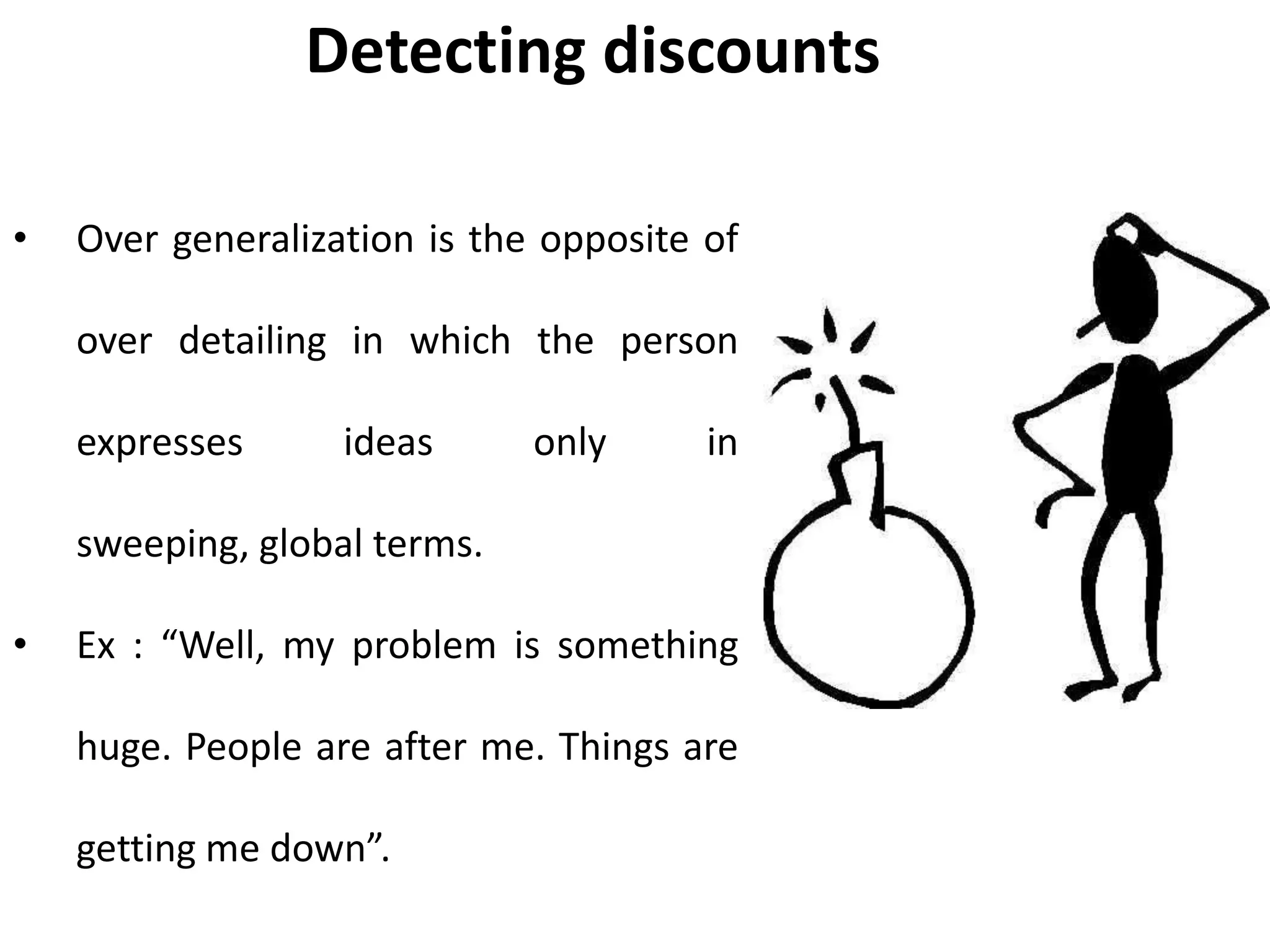
• Over generalization is the opposite of
over detailing in which the person
expresses ideas only in
sweeping, global terms.
• Ex : “Well, my problem is something
huge. People are after me. Things are
getting me down”.
Verbal Clues
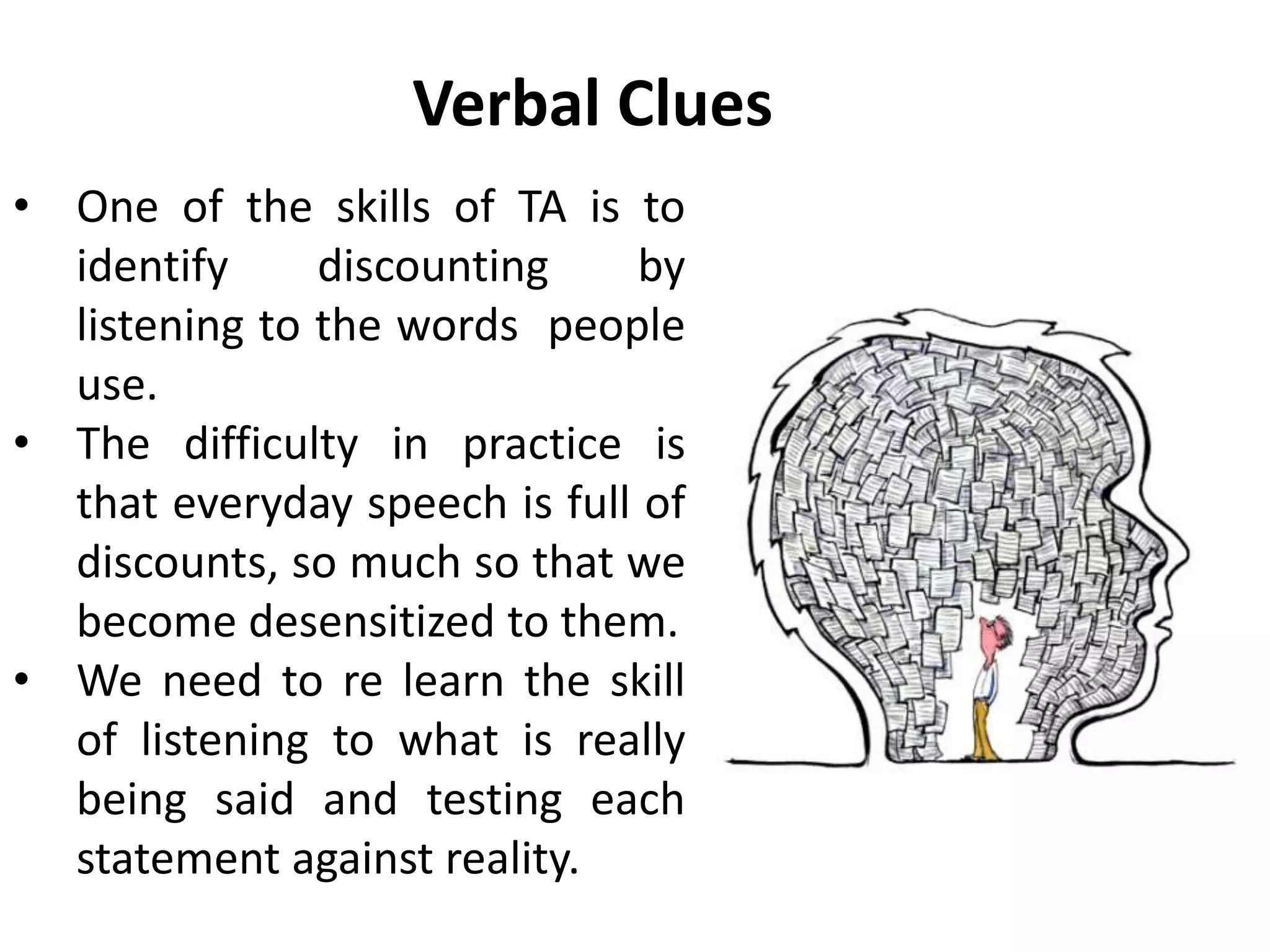
• One of the skills of TA is to
identify discounting by
listening to the words people
use.
• The difficulty in practice is
that everyday speech is full of
discounts, so much so that we
become desensitized to them.
• We need to re learn the skill
of listening to what is really
being said and testing each
statement against reality.
Verbal Clues
• When someone says “ I
can’t..”, he will most often be
discounting.
• “I will try to…” is usually a
discount, since what it implies
is usually “ I will try to, but I
won’t do it”.
• The same is true will all driver
wordings. Be strong discounts
are particularly common. Ex:
“What you say is boring to
me.”
Verbal Clues
• Sometimes, a discount is
signaled by leaving out a part
of the sentence.
• For instance, a member of the
TA group may ask “I want a
hug”.
• She doesn’t say from whom
she wants hug from.
• She is omitting information
relevant to the solution of the
problem.
Non verbal Clues
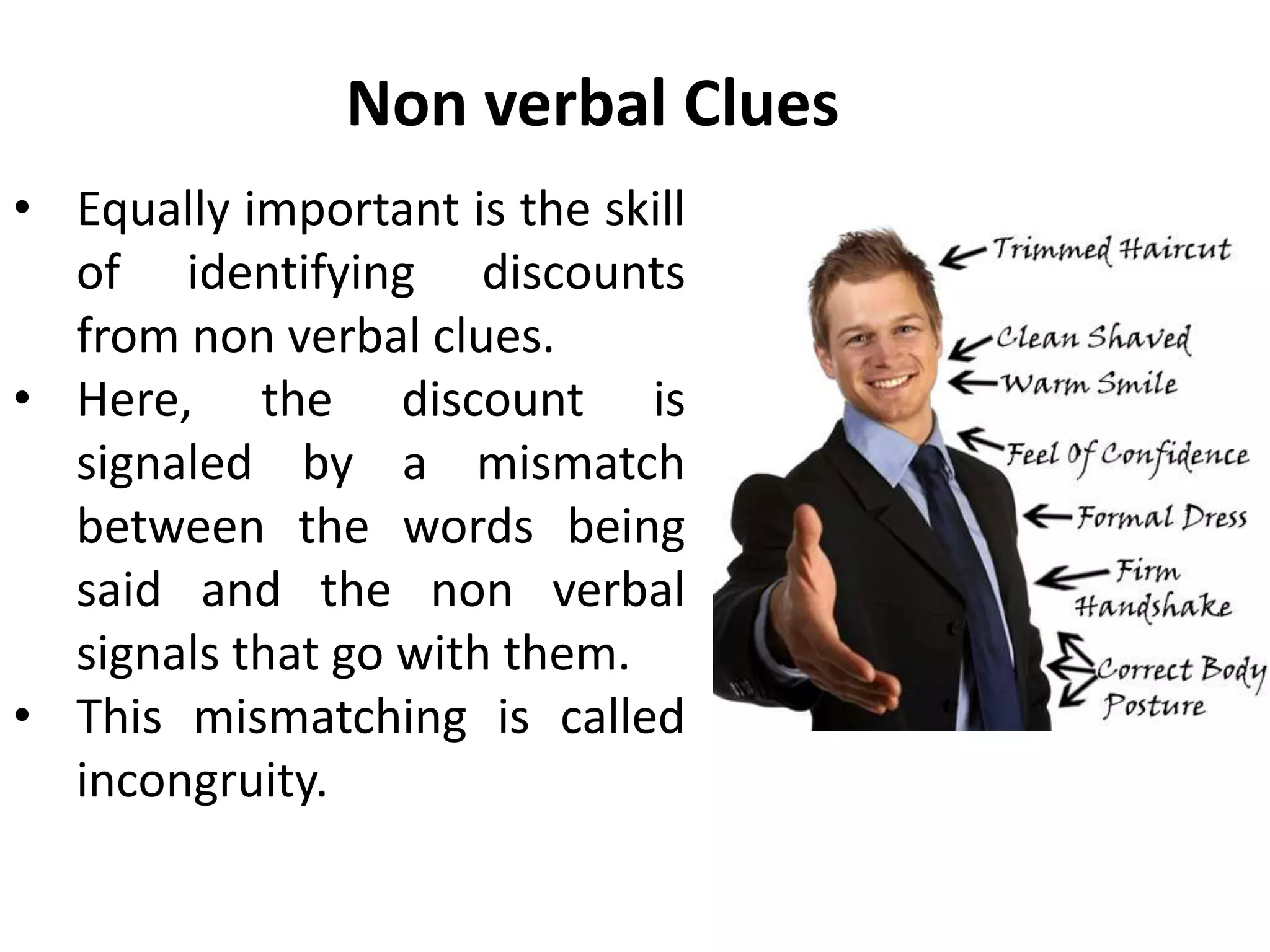
• Equally important is the skill
of identifying discounts
from non verbal clues.
• Here, the discount is
signaled by a mismatch
between the words being
said and the non verbal
signals that go with them.
• This mismatching is called
incongruity.
Non verbal Clues
• For example, teacher asks his
pupil : “Do you understand the
assignment I have set you?”.
• The pupil replies : “Sure”.
• But at the same time, he
puckers his brow and scratches
his head.
• If teacher is aware about the
thinking martian, he will ask
more questions to check
whether his pupil is
discounting.
Gallows
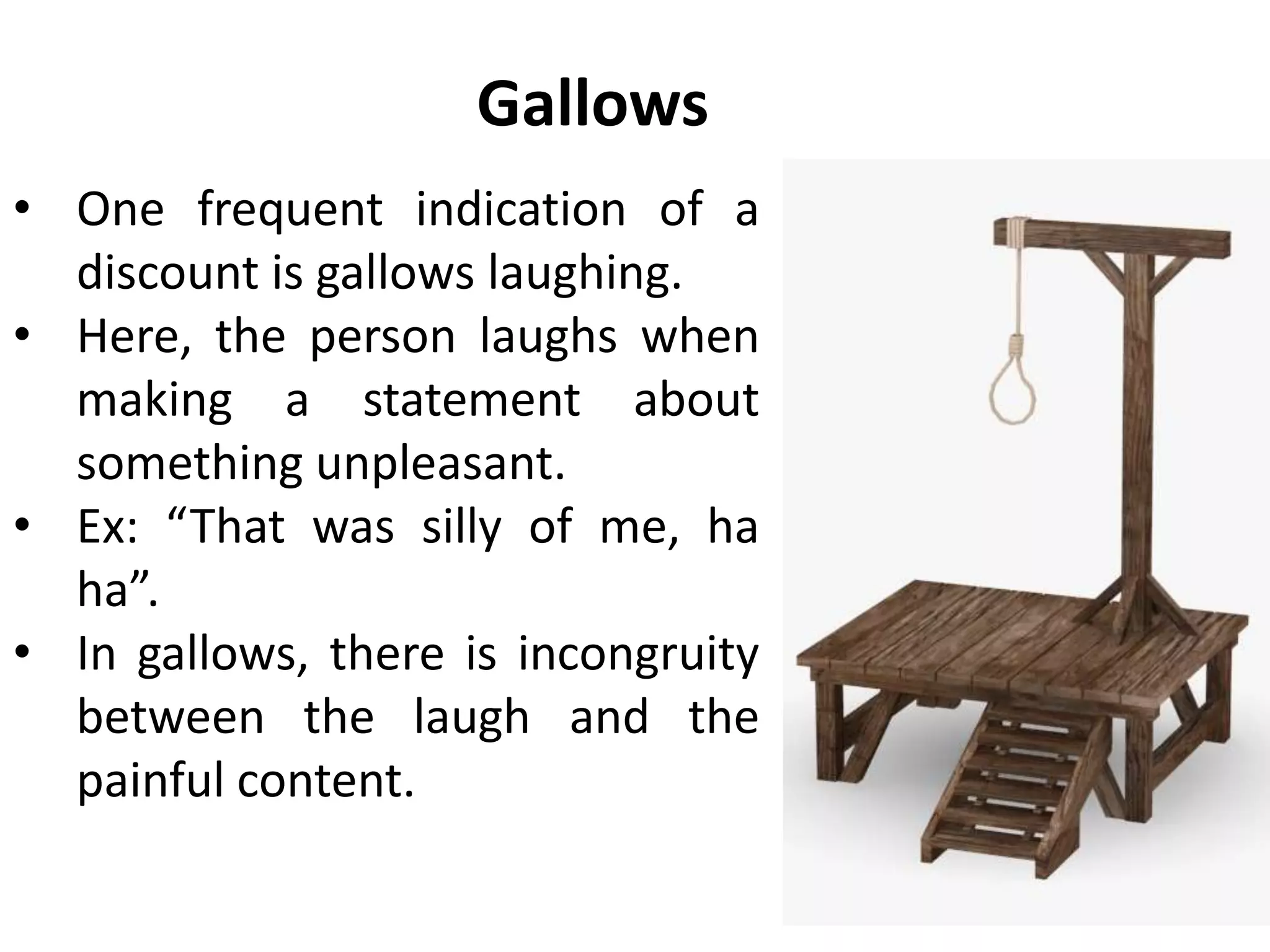
• One frequent indication of a
discount is gallows laughing.
• Here, the person laughs when
making a statement about
something unpleasant.
• Ex: “That was silly of me, ha
ha”.
• In gallows, there is incongruity
between the laugh and the
painful content.
Gallows
• When someone gives a gallows
laugh, he is making a non
verbal invitation to the listener
to reinforce once of his script
belief.
• The straight response to
gallows is to refuse to join in
the laughing.
• You may also say : “That is not
funny”, if you are in a situation
where it is socially appropriate
to do so.
Stroke Filter / Discount
• When someone gets a stroke that
doesn’t fit in with her preferred
stroke quotient, she is likely to
ignore it or belittle it.
• Discounts are an internal
mechanism by which people
minimize or maximize
(grandiosity) an aspect of
reality, themselves or others.
• In other words they are not
accounting for the reality of
themselves or others or the
situation.
Activity
• Think about the strokes you gave and received.
• Was it counterfeit, marshmallows, straight?
• Who received it openly, who discounted it?
• Which strokes you received and which one you discounted?
Strokes Vs Discounts
• A discount always entails some distortion of reality unlike a straight negative
stroke.
• NCS – You spelled the word wrong.
• Discount – I see you can’t spell
• NUCS – I hate you.
• Discount – You are hateful.
• Unlike a straight negative stroke, a discount gives me no signal on which I
can base constructive action.
Thank you
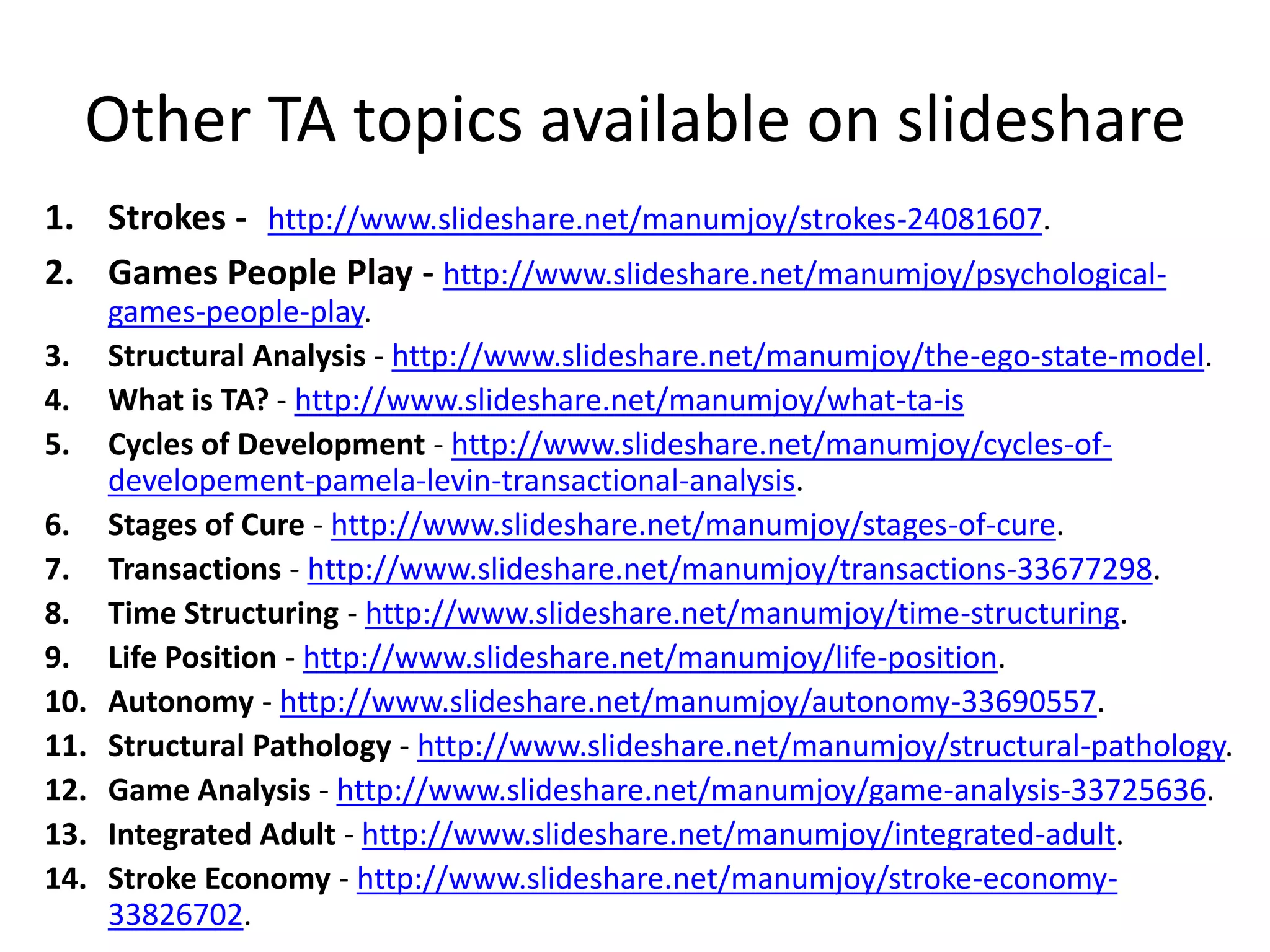
Other TA topics available on slideshare
1. Strokes - http://www.slideshare.net/manumjoy/strokes-24081607.
2. Games People Play - http://www.slideshare.net/manumjoy/psychological-
games-people-play.
3. Structural Analysis - http://www.slideshare.net/manumjoy/the-ego-state-model.
4. What is TA? - http://www.slideshare.net/manumjoy/what-ta-is
5. Cycles of Development - http://www.slideshare.net/manumjoy/cycles-of-
developement-pamela-levin-transactional-analysis.
6. Stages of Cure - http://www.slideshare.net/manumjoy/stages-of-cure.
7. Transactions - http://www.slideshare.net/manumjoy/transactions-33677298.
8. Time Structuring - http://www.slideshare.net/manumjoy/time-structuring.
9. Life Position - http://www.slideshare.net/manumjoy/life-position.
10. Autonomy - http://www.slideshare.net/manumjoy/autonomy-33690557.
11. Structural Pathology - http://www.slideshare.net/manumjoy/structural-pathology.
12. Game Analysis - http://www.slideshare.net/manumjoy/game-analysis-33725636.
13. Integrated Adult - http://www.slideshare.net/manumjoy/integrated-adult.
14. Stroke Economy - http://www.slideshare.net/manumjoy/stroke-economy-
33826702.

Detecting discounts (Transactional analysis / TA is an integrative approach to the theory of psychology and psychotherapy).

  • 1.
  • 2.
    Prepared By Manu MelwinJoy Research Scholar School of Management Studies CUSAT, Kerala, India. Phone – 9744551114 Mail – manu_melwinjoy@yahoo.com Kindly restrict the use of slides for personal purpose. Please seek permission to reproduce the same in public forms and presentations.
  • 3.
    Detecting discounts • Thediscounting, not observable in itself, can be inferred by the person’s showing any of the four passive behavior. • There are many other ways of detecting discounts.
  • 4.
    Detecting discounts • Driverbehavior always indicates a discount. • Remember that when I show a driver, I am internally replaying the script belief : “ I am only OK if I try hard / please others etc. • The reality is that I am OK whether or not I follow these driver messages.
  • 5.
    Detecting discounts • Schiffspecify certain thinking disorders as clues to discounting. • One of these is over detailing. • Asked a simple question , the person showing this disorder will reply with a long tirade of minute details.
  • 6.
    Detecting discounts • Overgeneralization is the opposite of over detailing in which the person expresses ideas only in sweeping, global terms. • Ex : “Well, my problem is something huge. People are after me. Things are getting me down”.
  • 7.
    Verbal Clues • Oneof the skills of TA is to identify discounting by listening to the words people use. • The difficulty in practice is that everyday speech is full of discounts, so much so that we become desensitized to them. • We need to re learn the skill of listening to what is really being said and testing each statement against reality.
  • 8.
    Verbal Clues • Whensomeone says “ I can’t..”, he will most often be discounting. • “I will try to…” is usually a discount, since what it implies is usually “ I will try to, but I won’t do it”. • The same is true will all driver wordings. Be strong discounts are particularly common. Ex: “What you say is boring to me.”
  • 9.
    Verbal Clues • Sometimes,a discount is signaled by leaving out a part of the sentence. • For instance, a member of the TA group may ask “I want a hug”. • She doesn’t say from whom she wants hug from. • She is omitting information relevant to the solution of the problem.
  • 10.
    Non verbal Clues •Equally important is the skill of identifying discounts from non verbal clues. • Here, the discount is signaled by a mismatch between the words being said and the non verbal signals that go with them. • This mismatching is called incongruity.
  • 11.
    Non verbal Clues •For example, teacher asks his pupil : “Do you understand the assignment I have set you?”. • The pupil replies : “Sure”. • But at the same time, he puckers his brow and scratches his head. • If teacher is aware about the thinking martian, he will ask more questions to check whether his pupil is discounting.
  • 12.
    Gallows • One frequentindication of a discount is gallows laughing. • Here, the person laughs when making a statement about something unpleasant. • Ex: “That was silly of me, ha ha”. • In gallows, there is incongruity between the laugh and the painful content.
  • 13.
    Gallows • When someonegives a gallows laugh, he is making a non verbal invitation to the listener to reinforce once of his script belief. • The straight response to gallows is to refuse to join in the laughing. • You may also say : “That is not funny”, if you are in a situation where it is socially appropriate to do so.
  • 14.
    Stroke Filter /Discount • When someone gets a stroke that doesn’t fit in with her preferred stroke quotient, she is likely to ignore it or belittle it. • Discounts are an internal mechanism by which people minimize or maximize (grandiosity) an aspect of reality, themselves or others. • In other words they are not accounting for the reality of themselves or others or the situation.
  • 15.
    Activity • Think aboutthe strokes you gave and received. • Was it counterfeit, marshmallows, straight? • Who received it openly, who discounted it? • Which strokes you received and which one you discounted?
  • 16.
    Strokes Vs Discounts •A discount always entails some distortion of reality unlike a straight negative stroke. • NCS – You spelled the word wrong. • Discount – I see you can’t spell • NUCS – I hate you. • Discount – You are hateful. • Unlike a straight negative stroke, a discount gives me no signal on which I can base constructive action.
  • 17.
  • 18.
    Other TA topicsavailable on slideshare 1. Strokes - http://www.slideshare.net/manumjoy/strokes-24081607. 2. Games People Play - http://www.slideshare.net/manumjoy/psychological- games-people-play. 3. Structural Analysis - http://www.slideshare.net/manumjoy/the-ego-state-model. 4. What is TA? - http://www.slideshare.net/manumjoy/what-ta-is 5. Cycles of Development - http://www.slideshare.net/manumjoy/cycles-of- developement-pamela-levin-transactional-analysis. 6. Stages of Cure - http://www.slideshare.net/manumjoy/stages-of-cure. 7. Transactions - http://www.slideshare.net/manumjoy/transactions-33677298. 8. Time Structuring - http://www.slideshare.net/manumjoy/time-structuring. 9. Life Position - http://www.slideshare.net/manumjoy/life-position. 10. Autonomy - http://www.slideshare.net/manumjoy/autonomy-33690557. 11. Structural Pathology - http://www.slideshare.net/manumjoy/structural-pathology. 12. Game Analysis - http://www.slideshare.net/manumjoy/game-analysis-33725636. 13. Integrated Adult - http://www.slideshare.net/manumjoy/integrated-adult. 14. Stroke Economy - http://www.slideshare.net/manumjoy/stroke-economy- 33826702.