How to research Primary Secondary Question Types
Primary research Questionnaires Interviews- individuals and focus groups Questions on message boards Observations Your own analysis
Secondary Research Books -order from Central library The internet -keep all URLs Magazines Journals Documentaries Articles.
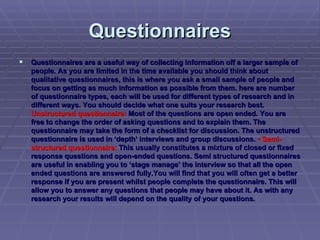
Questionnaires Questionnaires are a useful way of collecting information off a larger sample of people. As you are limited in the time available you should think about qualitative questionnaires, this is where you ask a small sample of people and focus on getting as much information as possible from them. 

here are number of questionnaire types, each will be used for different types of research and in different ways. You should decide what one suits your research best.  Unstructured questionnaire:  
Most of the questions are open ended. You are free to change the order of asking questions and to explain them. The questionnaire may take the form of a checklist for discussion. The unstructured questionnaire is used in ‘depth’ interviews and group discussions.  • Semi-structured questionnaire:  This usually constitutes a mixture of closed or fixed response questions and open-ended questions. Semi structured questionnaires are useful in enabling you to ‘stage manage’ the interview so that all the open ended questions are answered fully.

You will find that you will often get a better response if you are present whilst people complete the questionnaire. This will allow you to answer any questions that people may have about it. As with any research your results will depend on the quality of your questions.
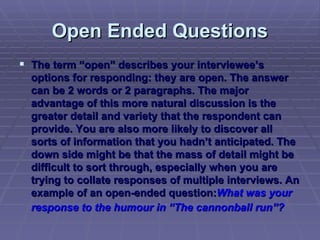
Open Ended Questions The term “open” describes your interviewee’s options for responding: they are open. The answer can be 2 words or 2 paragraphs. The major advantage of this more natural discussion is the greater detail and variety that the respondent can provide. You are also more likely to discover all sorts of information that you hadn’t anticipated. The down side might be that the mass of detail might be difficult to sort through, especially when you are trying to collate responses of multiple interviews. An example of an open-ended question: What was your response to the humour in “The cannonball run”?
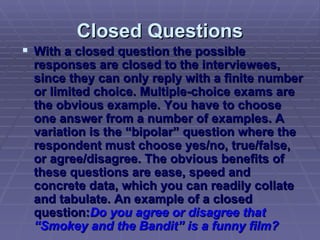
Closed Questions With a closed question the possible responses are closed to the interviewees, since they can only reply with a finite number or limited choice. Multiple-choice exams are the obvious example. You have to choose one answer from a number of examples. A variation is the “bipolar” question where the respondent must choose yes/no, true/false, or agree/disagree. The obvious benefits of these questions are ease, speed and concrete data, which you can readily collate and tabulate. An example of a closed question: Do you agree or disagree that “Smokey and the Bandit” is a funny film?
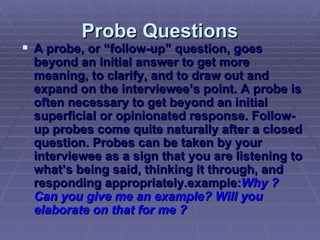
Probe Questions A probe, or “follow-up” question, goes beyond an initial answer to get more meaning, to clarify, and to draw out and expand on the interviewee’s point. A probe is often necessary to get beyond an initial superficial or opinionated response. Follow-up probes come quite naturally after a closed question. Probes can be taken by your interviewee as a sign that you are listening to what’s being said, thinking it through, and responding appropriately.example: Why ? Can you give me an example? Will you elaborate on that for me ?
Interviews •  Individual:  Interviews are likely to be in-depth conversations with individuals concerning a particular topic. The individual that you interview will depend on what you wish to find out. You will need to make contact with the individual that you wish to interview; you may do this through a letter or by e-mail. We would strongly recommend that you follow this up with a phone call should it be appropriate. It is possible that the interviewee could ask for a copy of the questions or conduct the interview via e-mail. This is why it is worth preparing questions beforehand. An interview is a really effective method of getting lots of information as it is likely that open-ended questions will generate a lot of conversation. Should you be interviewing someone from an institution it is worth carrying out some brief research on him or her first if you have not already.
•  Group:  Another type of interview involves putting together a group of people to discuss a particular topic. This is often known as a focus group, where the group is selected because of a common interest or because the people in it represent a particular 'type'. For instance, you might put together a group of female viewers to discuss their responses to films directed by women or a group of Primary school children to discuss their television consumption.This sort of focus group needs careful selection and handling; obviously, being with other people will have some impact on how they respond to questions compared to an individual interview. In addition when there are several people present it will be hard for you as the interviewer to keep track of what is said. It might be useful to tape record the interview or even to video it and transcribe it for analysis later.
Message Boards In some cases one of the most effective way of getting information from a diverse range of sources is by posting questions on an Internet message board. This can often generate a range of responses from readers of the message board who may have a detailed understanding of your topic area.  As with the two previous methods the quality of responses will depend upon the quality of your questions. This method of research can be a quick and effective way of gathering primary information
Observations Another form of primary research is your own observations; this could include watching how people react to a media product. You need to plan carefully how this would fit into your research and what you wanted to achieve before you organised an observation. This is more suitable for certain topics than for others, it would often be supported by a series of questions with the individuals or group who have been observed.
Own Analysis of a Media Text For a number of topics it may be appropriate to undertake your own analysis of a media text. This would include analysing a text that is closely related to your research topic. It would require you to trust your academic skills as you would have to make comments about your chosen text and how it links to your topic and is relevant. It would be advisable to undertake more than one type of primary research, as this is likely to generate the most information. It will also mean that you improve your chances of collecting the necessary information.
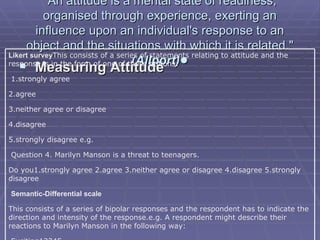
"An attitude is a mental state of readiness, organised through experience, exerting an influence upon an individual's response to an object and the situations with which it is related."  (Allport) •   Measuring Attitude Likert survey This consists of a series of statements relating to attitude and the response is in the form of one of these options:   1.strongly agree 2.agree 3.neither agree or disagree 4.disagree 5.strongly disagree e.g. Question 4. Marilyn Manson is a threat to teenagers. Do you1.strongly agree 2.agree 3.neither agree or disagree 4.disagree 5.strongly disagree    Semantic-Differential scale This consists of a series of bipolar responses and the respondent has to indicate the direction and intensity of the response.e.g. A respondent might describe their reactions to Marilyn Manson in the following way:   Exciting12345 Unexciting Threatening12345 Non-threatening Want to dress like him12345 Do not want to dress like him
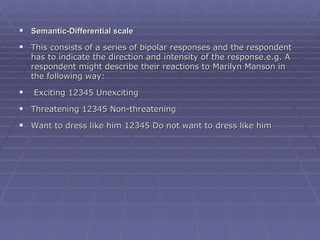
Semantic-Differential scale This consists of a series of bipolar responses and the respondent has to indicate the direction and intensity of the response.e.g. A respondent might describe their reactions to Marilyn Manson in the following way:   Exciting 12345 Unexciting Threatening 12345 Non-threatening Want to dress like him 12345 Do not want to dress like him

Detailedresearchtechniques

  • 1.
    How to researchPrimary Secondary Question Types
  • 2.
    Primary research QuestionnairesInterviews- individuals and focus groups Questions on message boards Observations Your own analysis
  • 3.
    Secondary Research Books-order from Central library The internet -keep all URLs Magazines Journals Documentaries Articles.
  • 4.
    Questionnaires Questionnaires area useful way of collecting information off a larger sample of people. As you are limited in the time available you should think about qualitative questionnaires, this is where you ask a small sample of people and focus on getting as much information as possible from them. 

here are number of questionnaire types, each will be used for different types of research and in different ways. You should decide what one suits your research best. Unstructured questionnaire: 
Most of the questions are open ended. You are free to change the order of asking questions and to explain them. The questionnaire may take the form of a checklist for discussion. The unstructured questionnaire is used in ‘depth’ interviews and group discussions. • Semi-structured questionnaire: This usually constitutes a mixture of closed or fixed response questions and open-ended questions. Semi structured questionnaires are useful in enabling you to ‘stage manage’ the interview so that all the open ended questions are answered fully.

You will find that you will often get a better response if you are present whilst people complete the questionnaire. This will allow you to answer any questions that people may have about it. As with any research your results will depend on the quality of your questions.
  • 5.
    Open Ended QuestionsThe term “open” describes your interviewee’s options for responding: they are open. The answer can be 2 words or 2 paragraphs. The major advantage of this more natural discussion is the greater detail and variety that the respondent can provide. You are also more likely to discover all sorts of information that you hadn’t anticipated. The down side might be that the mass of detail might be difficult to sort through, especially when you are trying to collate responses of multiple interviews. An example of an open-ended question: What was your response to the humour in “The cannonball run”?
  • 6.
    Closed Questions Witha closed question the possible responses are closed to the interviewees, since they can only reply with a finite number or limited choice. Multiple-choice exams are the obvious example. You have to choose one answer from a number of examples. A variation is the “bipolar” question where the respondent must choose yes/no, true/false, or agree/disagree. The obvious benefits of these questions are ease, speed and concrete data, which you can readily collate and tabulate. An example of a closed question: Do you agree or disagree that “Smokey and the Bandit” is a funny film?
  • 7.
    Probe Questions Aprobe, or “follow-up” question, goes beyond an initial answer to get more meaning, to clarify, and to draw out and expand on the interviewee’s point. A probe is often necessary to get beyond an initial superficial or opinionated response. Follow-up probes come quite naturally after a closed question. Probes can be taken by your interviewee as a sign that you are listening to what’s being said, thinking it through, and responding appropriately.example: Why ? Can you give me an example? Will you elaborate on that for me ?
  • 8.
    Interviews • Individual: Interviews are likely to be in-depth conversations with individuals concerning a particular topic. The individual that you interview will depend on what you wish to find out. You will need to make contact with the individual that you wish to interview; you may do this through a letter or by e-mail. We would strongly recommend that you follow this up with a phone call should it be appropriate. It is possible that the interviewee could ask for a copy of the questions or conduct the interview via e-mail. This is why it is worth preparing questions beforehand. An interview is a really effective method of getting lots of information as it is likely that open-ended questions will generate a lot of conversation. Should you be interviewing someone from an institution it is worth carrying out some brief research on him or her first if you have not already.
  • 9.
    • Group: Another type of interview involves putting together a group of people to discuss a particular topic. This is often known as a focus group, where the group is selected because of a common interest or because the people in it represent a particular 'type'. For instance, you might put together a group of female viewers to discuss their responses to films directed by women or a group of Primary school children to discuss their television consumption.This sort of focus group needs careful selection and handling; obviously, being with other people will have some impact on how they respond to questions compared to an individual interview. In addition when there are several people present it will be hard for you as the interviewer to keep track of what is said. It might be useful to tape record the interview or even to video it and transcribe it for analysis later.
  • 10.
    Message Boards Insome cases one of the most effective way of getting information from a diverse range of sources is by posting questions on an Internet message board. This can often generate a range of responses from readers of the message board who may have a detailed understanding of your topic area. As with the two previous methods the quality of responses will depend upon the quality of your questions. This method of research can be a quick and effective way of gathering primary information
  • 11.
    Observations Another formof primary research is your own observations; this could include watching how people react to a media product. You need to plan carefully how this would fit into your research and what you wanted to achieve before you organised an observation. This is more suitable for certain topics than for others, it would often be supported by a series of questions with the individuals or group who have been observed.
  • 12.
    Own Analysis ofa Media Text For a number of topics it may be appropriate to undertake your own analysis of a media text. This would include analysing a text that is closely related to your research topic. It would require you to trust your academic skills as you would have to make comments about your chosen text and how it links to your topic and is relevant. It would be advisable to undertake more than one type of primary research, as this is likely to generate the most information. It will also mean that you improve your chances of collecting the necessary information.
  • 13.
    "An attitude isa mental state of readiness, organised through experience, exerting an influence upon an individual's response to an object and the situations with which it is related." (Allport) •   Measuring Attitude Likert survey This consists of a series of statements relating to attitude and the response is in the form of one of these options:   1.strongly agree 2.agree 3.neither agree or disagree 4.disagree 5.strongly disagree e.g. Question 4. Marilyn Manson is a threat to teenagers. Do you1.strongly agree 2.agree 3.neither agree or disagree 4.disagree 5.strongly disagree   Semantic-Differential scale This consists of a series of bipolar responses and the respondent has to indicate the direction and intensity of the response.e.g. A respondent might describe their reactions to Marilyn Manson in the following way:   Exciting12345 Unexciting Threatening12345 Non-threatening Want to dress like him12345 Do not want to dress like him
  • 14.
    Semantic-Differential scale Thisconsists of a series of bipolar responses and the respondent has to indicate the direction and intensity of the response.e.g. A respondent might describe their reactions to Marilyn Manson in the following way:   Exciting 12345 Unexciting Threatening 12345 Non-threatening Want to dress like him 12345 Do not want to dress like him