1
Destructive Leadership
and the
Millennial Workforce
Rhonda M. Martin, Ph.D.
© Dr. R. Martin Designs. All rights reserved. May not be scanned, copied or duplicated, or posted to a publicly accessible Web site,
in whole or in part.
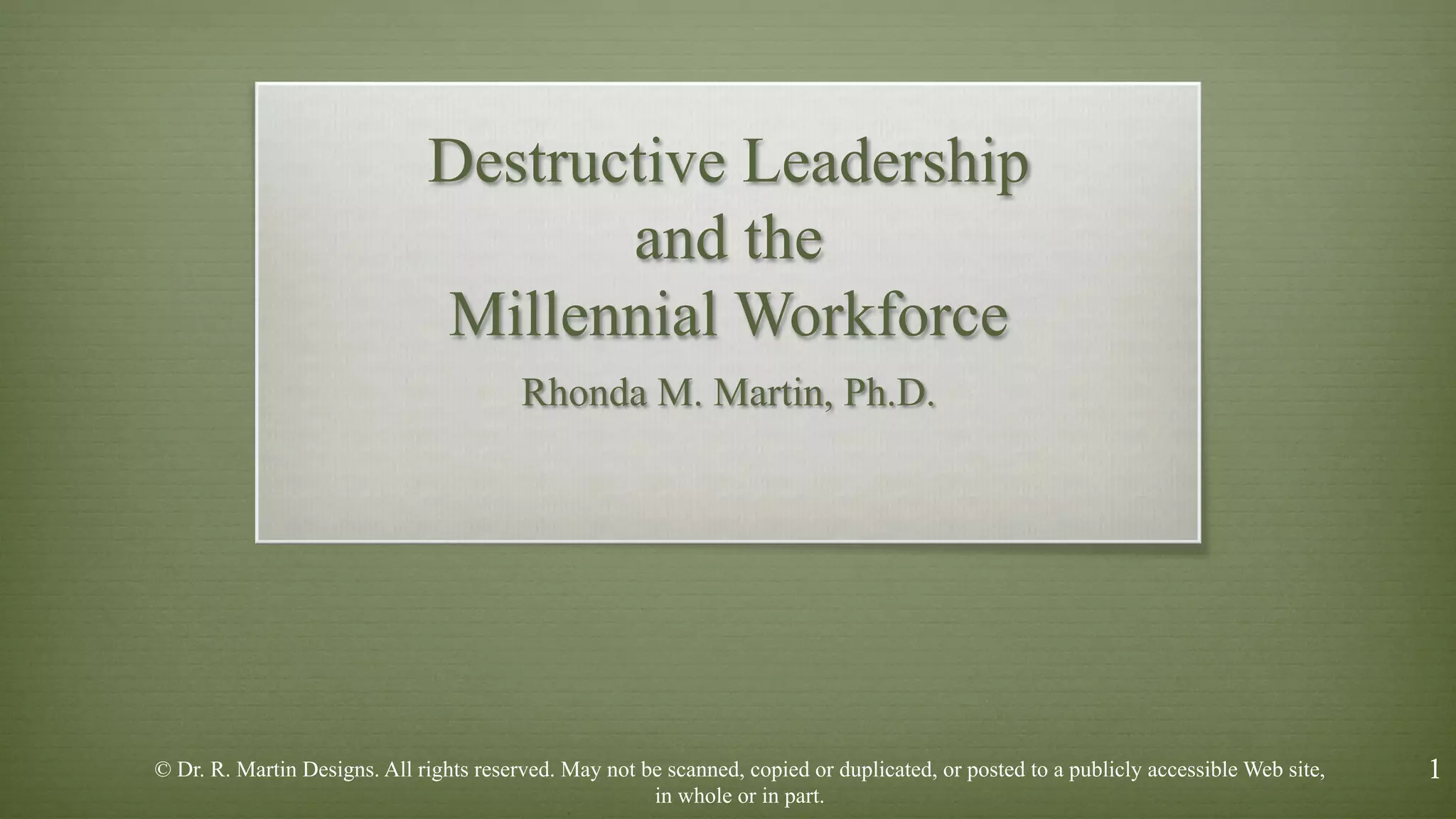
Leadership Research
2
Constructive
Leaders inspire, have integrity, ethical, and
empower followers. $50 billion annually to
develop leaders (Fulmer & Conger, 2004 )
Destructive
Leaders violate and sabotage organizations
goals, tasks, resources, effectiveness, and
well being of employees. $25 billion
annually for healthcare costs and legal fees
related to destructive leadership (Tepper,
2007)
© Dr. R. Martin Designs. All rights reserved. May not be scanned, copied or duplicated, or posted to a publicly accessible Web
site, in whole or in part.
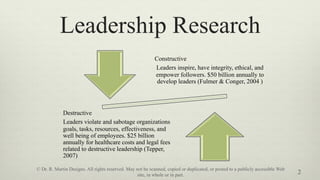
Shockingly, today destructive
leaders will victimize 40-50% of
employees
(Samnami & Singh 2013)
3
© Dr. R. Martin Designs. All rights reserved. May not be scanned, copied or duplicated, or posted to a publicly accessible
Web site, in whole or in part.
Destructive Leadership
“A systematic and repeated behavior by a leader, supervisor,
or manager that violates the legitimate interest of the
organization by undermining and/or sabotaging the
organizations goals, tasks, resources, and effectiveness and/
or the motivation, well-being or job satisfaction of
subordinates” (Einarsen, Aasland, & Skogstad, 2007).
4
© Dr. R. Martin Designs. All rights reserved. May not be scanned, copied or duplicated, or posted to a publicly accessible Web
site, in whole or in part.
Why Research
5
Millennials prefer to follow the rules, strive to please others, deliver work
of high quality, have little trust in leadership, and demonstrate low self-
efficacy (Trickey & Hyde, 2009).
According to Padilla, Hogan, and Kaiser (2007) destructive leadership is a
practical and theoretical problem where the destructive leader negatively
affects the followers in the workforce creating financial losses.
© Dr. R. Martin Designs. All rights reserved. May not be scanned, copied or duplicated, or posted to a publicly accessible Web
site, in whole or in part.
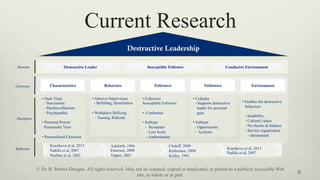
• Abusive Supervision
- Belittling, Humiliation
• Workplace Bullying
- Teasing, Ridicule
• Followers
Susceptible Follower:
•  Conformer
• Subtype
- Bystander
- Lost Souls
- Authoritarian
• Enables the destructive
behaviors
- Instability
- Cultural values
- No checks & balance
- Service organization
- detrimental
Current Research
• Dark Triad
- Narcissistic
- Machiavellianism
- Psychopathic
• Personal Power/
Pessimistic View
• Personalized Charisma
Destructive Leadership
Descriptors
Elements Destructive Leader Susceptible Follower Conducive Environment
Characteristics EnvironmentBehaviors FollowersFollowers
Krasikova et al, 2013
Padilla et al, 2007
Paulhus et al, 2002
Ashforth, 1994
Einarsen, 2000
Tepper, 2007
Chaleff, 2009
Kellerman, 2004
Kelley, 1992
Krasikova et al, 2013
Padilla et al, 2007
References
• Colluder
- Supports destructive
leader for personal
gain
• Subtype
- Opportunists
- Acolytes
Constructs
© Dr. R. Martin Designs. All rights reserved. May not be scanned, copied or duplicated, or posted to a publicly accessible Web
site, in whole or in part. 6
Toxic Triangle
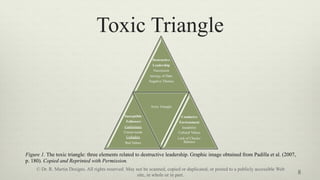
v  The toxic triangle theoretical model points out that
destructive leadership does not exist in isolation.
v  There are three elements:
v  Destructive Leader
v  Susceptible Follower
v  Conducive Environment
7
© Dr. R. Martin Designs. All rights reserved. May not be scanned, copied or duplicated, or posted to a publicly accessible Web
site, in whole or in part.
Toxic Triangle
8
Figure 1. The toxic triangle: three elements related to destructive leadership. Graphic image obtained from Padilla et al. (2007,
p. 180). Copied and Reprinted with Permission.
Destructive
Leadership
Narcissism
Ideology of Hate
Negative Themes
Themes
Susceptible
Followers
Conformers
Unmet needs
Colluders
Bad Values
Toxic Triangle
Conducive
Environment
Instability
Cultural Values
Lack of Checks/
Balance
© Dr. R. Martin Designs. All rights reserved. May not be scanned, copied or duplicated, or posted to a publicly accessible Web
site, in whole or in part.
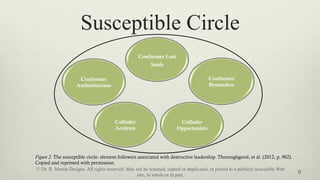
Susceptible Circle
9
Figure 2. The susceptible circle: element followers associated with destructive leadership. Thoroughgood, et al. (2012, p. 902).
Copied and reprinted with permission.
Conformer Lost
Souls
Conformer
Bystanders
Colluder
Opportunists
Colluder
Acolytes
Conformer
Authoritarians
© Dr. R. Martin Designs. All rights reserved. May not be scanned, copied or duplicated, or posted to a publicly accessible Web
site, in whole or in part.
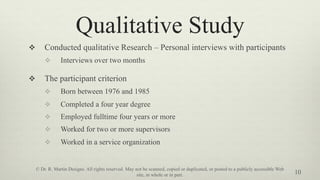
Qualitative Study
v  Conducted qualitative Research – Personal interviews with participants
v  Interviews over two months
v  The participant criterion
v  Born between 1976 and 1985
v  Completed a four year degree
v  Employed fulltime four years or more
v  Worked for two or more supervisors
v  Worked in a service organization
10
© Dr. R. Martin Designs. All rights reserved. May not be scanned, copied or duplicated, or posted to a publicly accessible Web
site, in whole or in part.
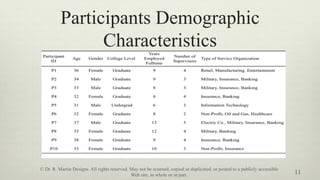
Participants Demographic
Characteristics
11
© Dr. R. Martin Designs. All rights reserved. May not be scanned, copied or duplicated, or posted to a publicly accessible
Web site, in whole or in part.
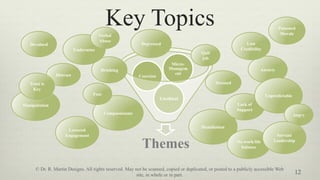
Key Topics
12
Themes
Unethical
Coercion
Micro-
Managem
ent
Manipulation
Stressed
Anxiety
Humiliation
Lack of
Support
Lost
Credibility
Quit
job
Depressed
Drinking
Compassionate
Fear
Devalued
Unpredictable
Poisoned
Morale
No work/life
balance
Lowered
Engagement
Undermine
Verbal
Abuse
Angry
Distrust
Servant
Leadership
Trust is
Key
© Dr. R. Martin Designs. All rights reserved. May not be scanned, copied or duplicated, or posted to a publicly accessible Web
site, in whole or in part.
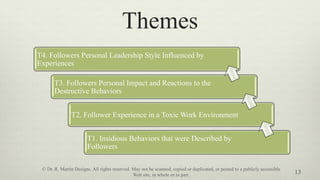
Themes
13
T4. Followers Personal Leadership Style Influenced by
Experiences
T3. Followers Personal Impact and Reactions to the
Destructive Behaviors
T2. Follower Experience in a Toxic Work Environment
T1. Insidious Behaviors that were Described by
Followers
© Dr. R. Martin Designs. All rights reserved. May not be scanned, copied or duplicated, or posted to a publicly accessible
Web site, in whole or in part.
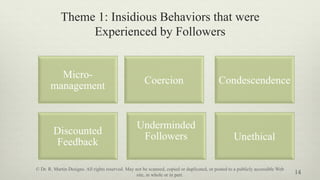
Theme 1: Insidious Behaviors that were
Experienced by Followers
14
Micro-
management
Coercion Condescendence
Discounted
Feedback
Underminded
Followers Unethical
© Dr. R. Martin Designs. All rights reserved. May not be scanned, copied or duplicated, or posted to a publicly accessible Web
site, in whole or in part.
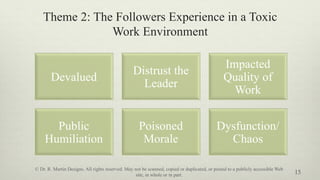
Theme 2: The Followers Experience in a Toxic
Work Environment
15
Devalued
Distrust the
Leader
Impacted
Quality of
Work
Public
Humiliation
Poisoned
Morale
Dysfunction/
Chaos
© Dr. R. Martin Designs. All rights reserved. May not be scanned, copied or duplicated, or posted to a publicly accessible Web
site, in whole or in part.
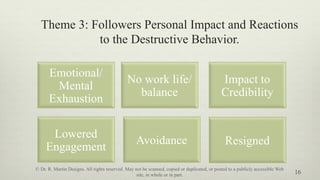
Theme 3: Followers Personal Impact and Reactions
to the Destructive Behavior.
16
Emotional/
Mental
Exhaustion
No work life/
balance
Impact to
Credibility
Lowered
Engagement
Avoidance Resigned
© Dr. R. Martin Designs. All rights reserved. May not be scanned, copied or duplicated, or posted to a publicly accessible Web
site, in whole or in part.
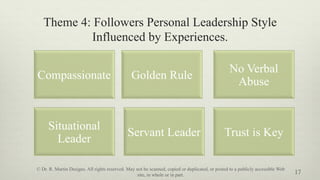
Theme 4: Followers Personal Leadership Style
Influenced by Experiences.
17
Compassionate Golden Rule
No Verbal
Abuse
Situational
Leader
Servant Leader Trust is Key
© Dr. R. Martin Designs. All rights reserved. May not be scanned, copied or duplicated, or posted to a publicly accessible Web
site, in whole or in part.
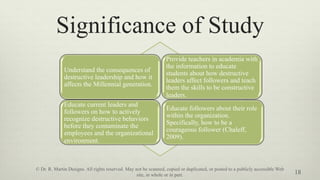
Significance of Study
Understand the consequences of
destructive leadership and how it
affects the Millennial generation.
Educate current leaders and
followers on how to actively
recognize destructive behaviors
before they contaminate the
employees and the organizational
environment.
Provide teachers in academia with
the information to educate
students about how destructive
leaders affect followers and teach
them the skills to be constructive
leaders.
Educate followers about their role
within the organization.
Specifically, how to be a
courageous follower (Chaleff,
2009).
18
© Dr. R. Martin Designs. All rights reserved. May not be scanned, copied or duplicated, or posted to a publicly accessible Web
site, in whole or in part.
Courageous Follower
v  The courage to serve
v  The courage to challenge
v  The courage to participate in transformation
v  The courage to take moral action
v  The courage to speak up to leadership
Chaleff, I. (1995). The courageous follower: Standing up to and for our leaders. San Francisco, CA: Berrett‐Koehler.
19
© Dr. R. Martin Designs. All rights reserved. May not be scanned, copied or duplicated, or posted to a publicly accessible Web
site, in whole or in part.
Conclusion
v  The Millennial generation of followers are greatly impacted by destructive leaders because as a society we are inundated with
news about leaders who are unethical. Who lie, steal, and cheat with little to no consequences.
v  Destructive leaders are not successful on their own. In fact they are successful when the followers and the organizations enable
the destructive behaviors.
v  Challenges
v  Educated employees on the types of destructive behaviors and determine how to address the issue.
v  Followers need to take responsibility in their role as a follower, and choose to be great followers who will minimize the
number of destructive leaders in organizations today and in the future
v  Those in leadership roles today, do not be a bystander and enable peers who are destructive. Also, take followership
seriously and educate people on how to be successful in this role. Followers are not here to serve the leader, but both are
to serve the common purpose.
20
© Dr. R. Martin Designs. All rights reserved. May not be scanned, copied or duplicated, or posted to a publicly accessible Web
site, in whole or in part.
References
v  Aryee, S., Chen, Z. X., Sun, L. Y., & Debrah, Y. A. (2007). Antecedents and outcomes of abusive supervision: Test of a
trickle-down model. Journal of Applied Psychology, 92, 191-200.
v  Bandura, A. (1986). Social foundations of thought and action: A social cognitive theory. Englewood Cliffs, NJ: Prentice Hall.
v  Chaleff, I. (1995). The courageous follower: Standing up to and for our leaders. San Francisco, CA: Berrett‐Koehler.
v  Chaleff, I. (2008). Creating new ways of following. In R. Riggio, I. Chaleff, & J. Lipman-Blumen (Eds.), The art of
followership: How great followers create great leaders and organizations (pp. 67–87). San Francisco: Jossey-Bass.
v  Creswell, J. W. (2014). Research design: Qualitative, quantitative, and mixed methods approaches (4th ed.). Thousand Oaks,
CA: Sage Publications.
v  Duffy, M. K., Ganster, D., & Pagon, M. (2002). Social undermining in the workplace. Academy of Management Journal,
45(2), 331-351. doi:10.2307/3069350
21
© Dr. R. Martin Designs. All rights reserved. May not be scanned, copied or duplicated, or posted to a publicly accessible Web
site, in whole or in part.
References - continued
v  Einarsen, S., Aasland, M. S., & Skogstad, A. (2007). Destructive leadership behavior: A definition and conceptual model. The
Leadership Quarterly, 18, 207-216. doi:10.1016/j.leaqua.2007.03.002
v  Giorgi, A. (1997). The theory, practice and evaluation of the phenomenological method as a qualitative research procedure. Journal
of Phenomenological Psychology, 28, 235-60.
v  Kellerman, B. (2004). Bad leadership: What it is, how it happens, why it matters. Boston, MA: Harvard Business School Press.
v  Kellerman, B. (2008). Followership: How followers are creating change and changing leaders. Boston: Harvard Business Press.
v  Kelley, R. E. (1992). The power of followership: How to create leaders people want to follower and followers who lead themselves.
New York, NY: Doubleday.
v  Kelley, R. E. (2008). Rethinking followership. In R. Riggio, I. Chaleff, & J. Lipman-Blumen (Eds.), The art of followership: How
great followers create great leaders and organizations (pp. 5–16). San Francisco, CA: Jossey-Bass.
22
© Dr. R. Martin Designs. All rights reserved. May not be scanned, copied or duplicated, or posted to a publicly accessible Web
site, in whole or in part.
References - continued
v  Lincoln, Y. S., & Guba E. G. (2000). Paradigmatic controversies, contradictions, and emerging confluences. In N. K. Denzin
& Y. S. Lincoln (Eds.), Handbook of Qualitative Research (2nd ed., 163-188). Thousand Oaks, CA: Sage.
v  Lipman-Blumen, J. (2005). The allure of toxic leaders. New York: Oxford University Press.
v  Lipman-Blumen, J. (2006). The allure of toxic leadership: Why we follow destructive bosses and corrupt politicians – and
how we can survive them. New York: Oxford University Press. Padilla, A., Hogan, R., & Kaiser, R. B. (2007). The toxic
triangle: Destructive leaders, susceptible followers, and conducive environments. The Leadership Quarterly, 18, 176-194.
doi: 10.1016/j.leaqua.2007.03.001
v  Paulhus, D. L., & Williams, K. M. (2002). The dark triad of personality: Narcissism, Machiavellianism, and psychopathy.
Journal of Research in Personality, 36(6), 556−563.
v  Tepper, B. J. (2007). Abusive supervision in work organizations: Review, synthesis, and research agenda. Journal of
Management, 33, 261-289. doi:10.1177/0149206307300812
23
© Dr. R. Martin Designs. All rights reserved. May not be scanned, copied or duplicated, or posted to a publicly accessible Web
site, in whole or in part.
References - continued
v  Thoroughgood, C. N., Tate, B. W., Sawyer, K. B., & Jacobs, R. (2012). Bad to the bone: Empirically defining and measuring
destructive leader behavior. Journal of Leadership & Organizational Studies, 19, 230-250. doi:10.1177/15480521811436327
v  Trickey, G., & Hyde, G. (1992). A decade of the darkside: Fighting our demons at work. Psychological Consultancy Limited.
v  U.S. Bureau of Labor Statistics. (2009). Employment outlook: 2008-18. Retrieved from
http://www.bls.gov/opub/mlr/2009/11/art3full.pdf
v  Weierter, S. J. (1997). Who wants to play “follow the leader”? A theory of charismatic relationships based on routinized
charisma and follower characteristics. The Leadership Quarterly, 8(2), 171–194.
v  Xie, L., & Schaubroeck, J. (2001). Bridging approaches and findings across diverse disciplines to improve job stress research.
In P. L. Perrewé, & D. C. Ganster (Eds.), Research in occupational stress and well being (pp. 1−53). Oxford, UK: Elsevier
Science.
24
© Dr. R. Martin Designs. All rights reserved. May not be scanned, copied or duplicated, or posted to a publicly accessible Web
site, in whole or in part.

Destructive Leadership and the Millennial Workforce

  • 1.
    1 Destructive Leadership and the MillennialWorkforce Rhonda M. Martin, Ph.D. © Dr. R. Martin Designs. All rights reserved. May not be scanned, copied or duplicated, or posted to a publicly accessible Web site, in whole or in part.
  • 2.
    Leadership Research 2 Constructive Leaders inspire,have integrity, ethical, and empower followers. $50 billion annually to develop leaders (Fulmer & Conger, 2004 ) Destructive Leaders violate and sabotage organizations goals, tasks, resources, effectiveness, and well being of employees. $25 billion annually for healthcare costs and legal fees related to destructive leadership (Tepper, 2007) © Dr. R. Martin Designs. All rights reserved. May not be scanned, copied or duplicated, or posted to a publicly accessible Web site, in whole or in part.
  • 3.
    Shockingly, today destructive leaderswill victimize 40-50% of employees (Samnami & Singh 2013) 3 © Dr. R. Martin Designs. All rights reserved. May not be scanned, copied or duplicated, or posted to a publicly accessible Web site, in whole or in part.
  • 4.
    Destructive Leadership “A systematicand repeated behavior by a leader, supervisor, or manager that violates the legitimate interest of the organization by undermining and/or sabotaging the organizations goals, tasks, resources, and effectiveness and/ or the motivation, well-being or job satisfaction of subordinates” (Einarsen, Aasland, & Skogstad, 2007). 4 © Dr. R. Martin Designs. All rights reserved. May not be scanned, copied or duplicated, or posted to a publicly accessible Web site, in whole or in part.
  • 5.
    Why Research 5 Millennials preferto follow the rules, strive to please others, deliver work of high quality, have little trust in leadership, and demonstrate low self- efficacy (Trickey & Hyde, 2009). According to Padilla, Hogan, and Kaiser (2007) destructive leadership is a practical and theoretical problem where the destructive leader negatively affects the followers in the workforce creating financial losses. © Dr. R. Martin Designs. All rights reserved. May not be scanned, copied or duplicated, or posted to a publicly accessible Web site, in whole or in part.
  • 6.
    • Abusive Supervision - Belittling,Humiliation • Workplace Bullying - Teasing, Ridicule • Followers Susceptible Follower: •  Conformer • Subtype - Bystander - Lost Souls - Authoritarian • Enables the destructive behaviors - Instability - Cultural values - No checks & balance - Service organization - detrimental Current Research • Dark Triad - Narcissistic - Machiavellianism - Psychopathic • Personal Power/ Pessimistic View • Personalized Charisma Destructive Leadership Descriptors Elements Destructive Leader Susceptible Follower Conducive Environment Characteristics EnvironmentBehaviors FollowersFollowers Krasikova et al, 2013 Padilla et al, 2007 Paulhus et al, 2002 Ashforth, 1994 Einarsen, 2000 Tepper, 2007 Chaleff, 2009 Kellerman, 2004 Kelley, 1992 Krasikova et al, 2013 Padilla et al, 2007 References • Colluder - Supports destructive leader for personal gain • Subtype - Opportunists - Acolytes Constructs © Dr. R. Martin Designs. All rights reserved. May not be scanned, copied or duplicated, or posted to a publicly accessible Web site, in whole or in part. 6
  • 7.
    Toxic Triangle v  Thetoxic triangle theoretical model points out that destructive leadership does not exist in isolation. v  There are three elements: v  Destructive Leader v  Susceptible Follower v  Conducive Environment 7 © Dr. R. Martin Designs. All rights reserved. May not be scanned, copied or duplicated, or posted to a publicly accessible Web site, in whole or in part.
  • 8.
    Toxic Triangle 8 Figure 1.The toxic triangle: three elements related to destructive leadership. Graphic image obtained from Padilla et al. (2007, p. 180). Copied and Reprinted with Permission. Destructive Leadership Narcissism Ideology of Hate Negative Themes Themes Susceptible Followers Conformers Unmet needs Colluders Bad Values Toxic Triangle Conducive Environment Instability Cultural Values Lack of Checks/ Balance © Dr. R. Martin Designs. All rights reserved. May not be scanned, copied or duplicated, or posted to a publicly accessible Web site, in whole or in part.
  • 9.
    Susceptible Circle 9 Figure 2.The susceptible circle: element followers associated with destructive leadership. Thoroughgood, et al. (2012, p. 902). Copied and reprinted with permission. Conformer Lost Souls Conformer Bystanders Colluder Opportunists Colluder Acolytes Conformer Authoritarians © Dr. R. Martin Designs. All rights reserved. May not be scanned, copied or duplicated, or posted to a publicly accessible Web site, in whole or in part.
  • 10.
    Qualitative Study v  Conductedqualitative Research – Personal interviews with participants v  Interviews over two months v  The participant criterion v  Born between 1976 and 1985 v  Completed a four year degree v  Employed fulltime four years or more v  Worked for two or more supervisors v  Worked in a service organization 10 © Dr. R. Martin Designs. All rights reserved. May not be scanned, copied or duplicated, or posted to a publicly accessible Web site, in whole or in part.
  • 11.
    Participants Demographic Characteristics 11 © Dr.R. Martin Designs. All rights reserved. May not be scanned, copied or duplicated, or posted to a publicly accessible Web site, in whole or in part.
  • 12.
    Key Topics 12 Themes Unethical Coercion Micro- Managem ent Manipulation Stressed Anxiety Humiliation Lack of Support Lost Credibility Quit job Depressed Drinking Compassionate Fear Devalued Unpredictable Poisoned Morale Nowork/life balance Lowered Engagement Undermine Verbal Abuse Angry Distrust Servant Leadership Trust is Key © Dr. R. Martin Designs. All rights reserved. May not be scanned, copied or duplicated, or posted to a publicly accessible Web site, in whole or in part.
  • 13.
    Themes 13 T4. Followers PersonalLeadership Style Influenced by Experiences T3. Followers Personal Impact and Reactions to the Destructive Behaviors T2. Follower Experience in a Toxic Work Environment T1. Insidious Behaviors that were Described by Followers © Dr. R. Martin Designs. All rights reserved. May not be scanned, copied or duplicated, or posted to a publicly accessible Web site, in whole or in part.
  • 14.
    Theme 1: InsidiousBehaviors that were Experienced by Followers 14 Micro- management Coercion Condescendence Discounted Feedback Underminded Followers Unethical © Dr. R. Martin Designs. All rights reserved. May not be scanned, copied or duplicated, or posted to a publicly accessible Web site, in whole or in part.
  • 15.
    Theme 2: TheFollowers Experience in a Toxic Work Environment 15 Devalued Distrust the Leader Impacted Quality of Work Public Humiliation Poisoned Morale Dysfunction/ Chaos © Dr. R. Martin Designs. All rights reserved. May not be scanned, copied or duplicated, or posted to a publicly accessible Web site, in whole or in part.
  • 16.
    Theme 3: FollowersPersonal Impact and Reactions to the Destructive Behavior. 16 Emotional/ Mental Exhaustion No work life/ balance Impact to Credibility Lowered Engagement Avoidance Resigned © Dr. R. Martin Designs. All rights reserved. May not be scanned, copied or duplicated, or posted to a publicly accessible Web site, in whole or in part.
  • 17.
    Theme 4: FollowersPersonal Leadership Style Influenced by Experiences. 17 Compassionate Golden Rule No Verbal Abuse Situational Leader Servant Leader Trust is Key © Dr. R. Martin Designs. All rights reserved. May not be scanned, copied or duplicated, or posted to a publicly accessible Web site, in whole or in part.
  • 18.
    Significance of Study Understandthe consequences of destructive leadership and how it affects the Millennial generation. Educate current leaders and followers on how to actively recognize destructive behaviors before they contaminate the employees and the organizational environment. Provide teachers in academia with the information to educate students about how destructive leaders affect followers and teach them the skills to be constructive leaders. Educate followers about their role within the organization. Specifically, how to be a courageous follower (Chaleff, 2009). 18 © Dr. R. Martin Designs. All rights reserved. May not be scanned, copied or duplicated, or posted to a publicly accessible Web site, in whole or in part.
  • 19.
    Courageous Follower v  Thecourage to serve v  The courage to challenge v  The courage to participate in transformation v  The courage to take moral action v  The courage to speak up to leadership Chaleff, I. (1995). The courageous follower: Standing up to and for our leaders. San Francisco, CA: Berrett‐Koehler. 19 © Dr. R. Martin Designs. All rights reserved. May not be scanned, copied or duplicated, or posted to a publicly accessible Web site, in whole or in part.
  • 20.
    Conclusion v  The Millennialgeneration of followers are greatly impacted by destructive leaders because as a society we are inundated with news about leaders who are unethical. Who lie, steal, and cheat with little to no consequences. v  Destructive leaders are not successful on their own. In fact they are successful when the followers and the organizations enable the destructive behaviors. v  Challenges v  Educated employees on the types of destructive behaviors and determine how to address the issue. v  Followers need to take responsibility in their role as a follower, and choose to be great followers who will minimize the number of destructive leaders in organizations today and in the future v  Those in leadership roles today, do not be a bystander and enable peers who are destructive. Also, take followership seriously and educate people on how to be successful in this role. Followers are not here to serve the leader, but both are to serve the common purpose. 20 © Dr. R. Martin Designs. All rights reserved. May not be scanned, copied or duplicated, or posted to a publicly accessible Web site, in whole or in part.
  • 21.
    References v  Aryee, S.,Chen, Z. X., Sun, L. Y., & Debrah, Y. A. (2007). Antecedents and outcomes of abusive supervision: Test of a trickle-down model. Journal of Applied Psychology, 92, 191-200. v  Bandura, A. (1986). Social foundations of thought and action: A social cognitive theory. Englewood Cliffs, NJ: Prentice Hall. v  Chaleff, I. (1995). The courageous follower: Standing up to and for our leaders. San Francisco, CA: Berrett‐Koehler. v  Chaleff, I. (2008). Creating new ways of following. In R. Riggio, I. Chaleff, & J. Lipman-Blumen (Eds.), The art of followership: How great followers create great leaders and organizations (pp. 67–87). San Francisco: Jossey-Bass. v  Creswell, J. W. (2014). Research design: Qualitative, quantitative, and mixed methods approaches (4th ed.). Thousand Oaks, CA: Sage Publications. v  Duffy, M. K., Ganster, D., & Pagon, M. (2002). Social undermining in the workplace. Academy of Management Journal, 45(2), 331-351. doi:10.2307/3069350 21 © Dr. R. Martin Designs. All rights reserved. May not be scanned, copied or duplicated, or posted to a publicly accessible Web site, in whole or in part.
  • 22.
    References - continued v Einarsen, S., Aasland, M. S., & Skogstad, A. (2007). Destructive leadership behavior: A definition and conceptual model. The Leadership Quarterly, 18, 207-216. doi:10.1016/j.leaqua.2007.03.002 v  Giorgi, A. (1997). The theory, practice and evaluation of the phenomenological method as a qualitative research procedure. Journal of Phenomenological Psychology, 28, 235-60. v  Kellerman, B. (2004). Bad leadership: What it is, how it happens, why it matters. Boston, MA: Harvard Business School Press. v  Kellerman, B. (2008). Followership: How followers are creating change and changing leaders. Boston: Harvard Business Press. v  Kelley, R. E. (1992). The power of followership: How to create leaders people want to follower and followers who lead themselves. New York, NY: Doubleday. v  Kelley, R. E. (2008). Rethinking followership. In R. Riggio, I. Chaleff, & J. Lipman-Blumen (Eds.), The art of followership: How great followers create great leaders and organizations (pp. 5–16). San Francisco, CA: Jossey-Bass. 22 © Dr. R. Martin Designs. All rights reserved. May not be scanned, copied or duplicated, or posted to a publicly accessible Web site, in whole or in part.
  • 23.
    References - continued v Lincoln, Y. S., & Guba E. G. (2000). Paradigmatic controversies, contradictions, and emerging confluences. In N. K. Denzin & Y. S. Lincoln (Eds.), Handbook of Qualitative Research (2nd ed., 163-188). Thousand Oaks, CA: Sage. v  Lipman-Blumen, J. (2005). The allure of toxic leaders. New York: Oxford University Press. v  Lipman-Blumen, J. (2006). The allure of toxic leadership: Why we follow destructive bosses and corrupt politicians – and how we can survive them. New York: Oxford University Press. Padilla, A., Hogan, R., & Kaiser, R. B. (2007). The toxic triangle: Destructive leaders, susceptible followers, and conducive environments. The Leadership Quarterly, 18, 176-194. doi: 10.1016/j.leaqua.2007.03.001 v  Paulhus, D. L., & Williams, K. M. (2002). The dark triad of personality: Narcissism, Machiavellianism, and psychopathy. Journal of Research in Personality, 36(6), 556−563. v  Tepper, B. J. (2007). Abusive supervision in work organizations: Review, synthesis, and research agenda. Journal of Management, 33, 261-289. doi:10.1177/0149206307300812 23 © Dr. R. Martin Designs. All rights reserved. May not be scanned, copied or duplicated, or posted to a publicly accessible Web site, in whole or in part.
  • 24.
    References - continued v Thoroughgood, C. N., Tate, B. W., Sawyer, K. B., & Jacobs, R. (2012). Bad to the bone: Empirically defining and measuring destructive leader behavior. Journal of Leadership & Organizational Studies, 19, 230-250. doi:10.1177/15480521811436327 v  Trickey, G., & Hyde, G. (1992). A decade of the darkside: Fighting our demons at work. Psychological Consultancy Limited. v  U.S. Bureau of Labor Statistics. (2009). Employment outlook: 2008-18. Retrieved from http://www.bls.gov/opub/mlr/2009/11/art3full.pdf v  Weierter, S. J. (1997). Who wants to play “follow the leader”? A theory of charismatic relationships based on routinized charisma and follower characteristics. The Leadership Quarterly, 8(2), 171–194. v  Xie, L., & Schaubroeck, J. (2001). Bridging approaches and findings across diverse disciplines to improve job stress research. In P. L. Perrewé, & D. C. Ganster (Eds.), Research in occupational stress and well being (pp. 1−53). Oxford, UK: Elsevier Science. 24 © Dr. R. Martin Designs. All rights reserved. May not be scanned, copied or duplicated, or posted to a publicly accessible Web site, in whole or in part.