Link: http://www.traveller.com.au/how-the-qantas-crisis-unfolded-1mpv6
THE MEANING OF POWER
Power is the capacity of a
person, team or
organisation to influence
others
• Potential, not actual use
• People have power they
don’t use and they may not
know they possess it
• A perception
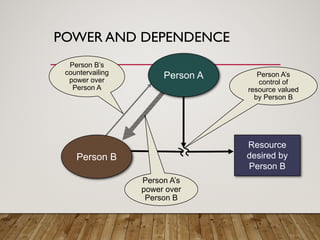
POWER AND DEPENDENCE
Resource
desired by
Person B
Person B’s
countervailing
power over
Person A
Person A Person A’s
control of
resource valued
by Person B
Person B
Person A’s
power over
Person B
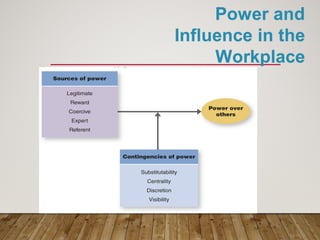
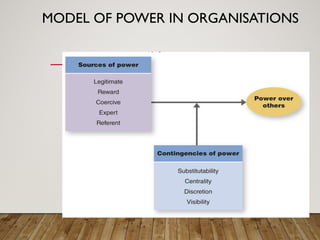
MODEL OF POWER IN ORGANISATIONS
SOURCES OF POWER
• Agreement that people in certain roles can
request certain behaviours of others
• Based on job descriptions and mutual
agreement
• Legitimate power range (zone of indifference)
varies across national and organisational
cultures
Legitimate
SOURCES OF POWER CONTINUED
• Ability to control the allocation of rewards
valued by others and to remove negative
sanctions
• Operates upward as well as downward
Legitimate
Reward
SOURCES OF POWER CONTINUED
• Ability to apply punishment
• Exists upward as well as downward
• Peer pressure is a form of coercive power
Legitimate
Reward
Coercive
SOURCES OF POWER CONTINUED
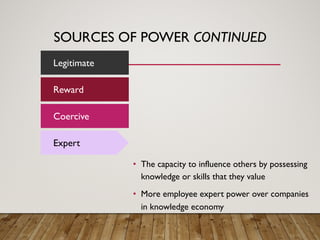
• The capacity to influence others by possessing
knowledge or skills that they value
• More employee expert power over companies
in knowledge economy
Legitimate
Reward
Coercive
Expert
SOURCES OF POWER CONTINUED
• Occurs when others identify with, like or
otherwise respect the person
• Associated with charismatic leadership
Legitimate
Referent
Reward
Coercive
Expert
CONTINGENCIES OF POWER
INCREASING NON-
SUBSTITUTABILITY
• Few or no alternatives to the resource
• Increase non-substitutability by controlling the resource
• Exclusive right to perform medical procedures
• Control over skilled labour
• Exclusive knowledge to repair equipment
• Differentiate resource from others
CENTRALITY
• Degree and nature of interdependence between
powerholder and others
• Centrality is a function of:
• How many others are affected by you
• How quickly others are affected by you
DISCRETION ANDVISIBILITY
• Discretion
• The freedom to exercise judgment
• Rules limit discretion, limit power
• Also a perception—acting as if you have discretion
• Visibility
• Symbols communicate your power source(s)
• Educational diplomas
• Clothing, etc. (stethoscope around neck)
• Salience
• Location—others are more aware of your presence
INFLUENCING OTHERS
• Influence—any behaviour that attempts to alter someone’s
attitudes or behaviour
• Applies one or more power bases
• Process through which people achieve organisational objectives
• Operates up, down and across the organisational hierarchy
Assertiveness • Actively applying legitimate and coercive
power (‘vocal authority’)
• Reminding, confronting, checking,
threatening
Silent
authority
• Following requests without overt influence
• Based on legitimate power, role modelling
• Common in high power distance cultures
TYPES OF INFLUENCE
TYPES OF INFLUENCE CONTINUED
Coalition
formation
• Group forms to gain more power than
individuals alone
1. Pools resources/power
2. Legitimises the issue
3. Power through social identity
Information • Manipulating others’ access to information
• Withholding, filtering, re-arranging
information
• Reduces uncertainty
TYPES OF INFLUENCE CONTINUED
Upward
appeal
• Appealing to higher authority
• Includes appealing to firm’s goals
• Alliance or perceived alliance with higher
status person
Persuasion • Logic, facts, emotional appeals
• Depends on persuader, message content,
message medium, audience
TYPES OF INFLUENCE CONTINUED
Exchange • Promising or reminding of past benefits in
exchange for compliance
• Includes negotiation and networking
Ingratiation/
impression
management
• Increase liking by, or perceived similarity to,
the target person
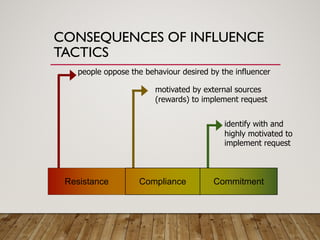
CONSEQUENCES OF INFLUENCE
TACTICS
people oppose the behaviour desired by the influencer
motivated by external sources
(rewards) to implement request
identify with and
highly motivated to
implement request
Resistance Compliance Commitment
MINIMISING POLITICAL
BEHAVIOUR
• Introduce clear rules for scarce resources
• Effective organisational change practices
• Suppress norms that support or tolerate self-serving
behaviour
• Leaders role model organisational citizenship
• Give employees more control over their work
• Keep employees informed

Power influence slideshare

  • 3.
  • 4.
    THE MEANING OFPOWER Power is the capacity of a person, team or organisation to influence others • Potential, not actual use • People have power they don’t use and they may not know they possess it • A perception
  • 5.
    POWER AND DEPENDENCE Resource desiredby Person B Person B’s countervailing power over Person A Person A Person A’s control of resource valued by Person B Person B Person A’s power over Person B
  • 6.
    MODEL OF POWERIN ORGANISATIONS
  • 7.
    SOURCES OF POWER •Agreement that people in certain roles can request certain behaviours of others • Based on job descriptions and mutual agreement • Legitimate power range (zone of indifference) varies across national and organisational cultures Legitimate
  • 8.
    SOURCES OF POWERCONTINUED • Ability to control the allocation of rewards valued by others and to remove negative sanctions • Operates upward as well as downward Legitimate Reward
  • 9.
    SOURCES OF POWERCONTINUED • Ability to apply punishment • Exists upward as well as downward • Peer pressure is a form of coercive power Legitimate Reward Coercive
  • 10.
    SOURCES OF POWERCONTINUED • The capacity to influence others by possessing knowledge or skills that they value • More employee expert power over companies in knowledge economy Legitimate Reward Coercive Expert
  • 11.
    SOURCES OF POWERCONTINUED • Occurs when others identify with, like or otherwise respect the person • Associated with charismatic leadership Legitimate Referent Reward Coercive Expert
  • 12.
  • 13.
    INCREASING NON- SUBSTITUTABILITY • Fewor no alternatives to the resource • Increase non-substitutability by controlling the resource • Exclusive right to perform medical procedures • Control over skilled labour • Exclusive knowledge to repair equipment • Differentiate resource from others
  • 14.
    CENTRALITY • Degree andnature of interdependence between powerholder and others • Centrality is a function of: • How many others are affected by you • How quickly others are affected by you
  • 15.
    DISCRETION ANDVISIBILITY • Discretion •The freedom to exercise judgment • Rules limit discretion, limit power • Also a perception—acting as if you have discretion • Visibility • Symbols communicate your power source(s) • Educational diplomas • Clothing, etc. (stethoscope around neck) • Salience • Location—others are more aware of your presence
  • 16.
    INFLUENCING OTHERS • Influence—anybehaviour that attempts to alter someone’s attitudes or behaviour • Applies one or more power bases • Process through which people achieve organisational objectives • Operates up, down and across the organisational hierarchy
  • 17.
    Assertiveness • Activelyapplying legitimate and coercive power (‘vocal authority’) • Reminding, confronting, checking, threatening Silent authority • Following requests without overt influence • Based on legitimate power, role modelling • Common in high power distance cultures TYPES OF INFLUENCE
  • 18.
    TYPES OF INFLUENCECONTINUED Coalition formation • Group forms to gain more power than individuals alone 1. Pools resources/power 2. Legitimises the issue 3. Power through social identity Information • Manipulating others’ access to information • Withholding, filtering, re-arranging information • Reduces uncertainty
  • 19.
    TYPES OF INFLUENCECONTINUED Upward appeal • Appealing to higher authority • Includes appealing to firm’s goals • Alliance or perceived alliance with higher status person Persuasion • Logic, facts, emotional appeals • Depends on persuader, message content, message medium, audience
  • 20.
    TYPES OF INFLUENCECONTINUED Exchange • Promising or reminding of past benefits in exchange for compliance • Includes negotiation and networking Ingratiation/ impression management • Increase liking by, or perceived similarity to, the target person
  • 21.
    CONSEQUENCES OF INFLUENCE TACTICS peopleoppose the behaviour desired by the influencer motivated by external sources (rewards) to implement request identify with and highly motivated to implement request Resistance Compliance Commitment
  • 22.
    MINIMISING POLITICAL BEHAVIOUR • Introduceclear rules for scarce resources • Effective organisational change practices • Suppress norms that support or tolerate self-serving behaviour • Leaders role model organisational citizenship • Give employees more control over their work • Keep employees informed