LEADERS AND LEADERSHIP Group 2 MBA(M) , Section A Self Management Skills
Group Members Ebadullah Ghazanfar Bari Imtiaz Ali Khawar Ali Irfan Khan Kashif Bhutto Iqbal Yasir Hassan
Contents Leadership vs Mangement Theories of Leadership Leadership and Qualities of Leaders Leadership Styles Leadership Cycles Leadership and Vision Group Leadership
LEADERSHIP  AND  QUALITIES OF LEADERS Group 2 MBA(M) , Section A By Ebadullah
Leading / Leadership / Leaders Leading is the process of influencing others to act to accomplish specified goals and objectives.  The effectiveness of leadership depends on the leadership style, followers, expectations, leader-group relations, organizational climate, task structure and power position of a leader.
Who are leaders? Qualities of Leaders A Leader must posses the following Qualities: Dedication Magnanimity Humbleness Openness Creativity Fairness Assertiveness Sense of Humor
LEADERSHIP STYLES Group 2 MBA(M) , Section A By Ghazanfar Bari
Leadership Styles Three Basic Styles of Leadership are: Autocratic or Authoritarian (Do as I say, because I am the boss.) Democratic or Participative   (What do you think?) Free reign Leaders   This style is unengaged in leadership, and simply lets people do their own thing with the leader exerting few controls
Leadership Styles Some Authorities Say Leadership Can Be Categorized Into Two Styles: Transactional (Focused on operations or the “business” of the organization.) Transformational   (Focused on creating a new and shared vision of the future)
Leadership Styles Other Common Leadership Styles: Servant Leadership (This refers to anyone (whether having a formal leadership title or not) who leads by meeting the needs of others or of his or her team.) Bureaucratic Leadership   This type can be defined as “by the book” leadership. This leader focuses on policy and procedures and seeks to keep things fair and well-organized.
LEADERSHIP CYCLES Group 2 MBA(M) , Section A By Imtiaz Ali
Leadership Cycles If a group or an organization wants or expects identifiable leadership, it will require processes for appointing/acquiring and replacing leaders. Traditional closed groups rely on  bloodlines  or  seniority  to select leaders and/or leadership candidates:  monarchies ,  tribal   chiefdoms ,  oligarchies  and  aristocratic  societies rely on (and often define their  institutions  by) such methods. Competence or perceived competence provides a possible basis for selecting leadership  elites  from a broader pool of potential talent. Political  lobbying  may prove necessary in  electoral systems , but immediately demonstrated  skill  and  character  may secure leadership in smaller groups such as  gangs .
Leadership as a Phase  in Human Life-Cyle Some cultures, especially those with a reverence for age and wisdom, see leadership as a standard part of the life-cycle of a person. Just as a youth becomes initiated into adulthood, so an adult may gain initiation as a leader. Such societies may require special reinforcement of the respect and kudos due to such senior members in order to maintain their position. If aged adults can no longer hunt or fight or play a full part in physical labor, for example, those adults' positions in society must rest on respect and implied wisdom and teaching roles, whether or not they show identified "leadership traits".
UNDERSTANDING LEADERSHIP Group 2 MBA(M) , Section A By Khawar Ali
LEADERSHIP AND VISION Group 2 MBA(M) , Section A By Irfan Khan
Leadership and Vision Many definitions of leadership involve an element of vision — except in cases of involuntary leadership and often in cases of traditional leadership. A vision provides direction to the influence process. A leader (or group of leaders) can have one or more visions of the future to aid them to move a group successfully towards this goal. A vision, for effectiveness, should allegedly: appear as a simple, yet vibrant, image in the mind of the leader  describe a future state, credible and preferable to the present state  act as a bridge between the current state and a future optimum state  appear desirable enough to energize followers  succeed in speaking to followers at an emotional or spiritual level (logical appeals by themselves seldom muster a following)
Leadership and Vision For leadership to occur, according to this theory, some people ("leaders") must communicate the vision to others ("followers") in such a way that the followers adopt the vision as their own. Leaders must not just see the vision themselves, they must have the ability to get others to see it also. Numerous techniques aid in this process, including: narratives, metaphors, symbolic actions, leading by example, incentives, and penalties.
Leadership as A VanGuard Sometimes followership can occur without intentional leadership. Despite (or because of) its mythical origin, the image of swarms of lemmings which follow the first lemming off a cliff appears frequently in characterizing followers. The animal kingdom also provides the actual model of the bellwether function in a mob of sheep. And human society also offers many examples of emulation. The fashion industry, for example, depends on it. Fashion marketers design clothing for celebrities, then offer less expensive variations/imitations for those who emulate the celebrities. Unintentional leadership can also occur from more pro-active forms followership. For example, in organizations which punish both leadership inaction and mistakes, and in which a predicament has no good solution, a common tendency involves declaring oneself a follower of someone else — metaphorically passing the buck.
GROUP LEADERSHIP Group 2 MBA(M) , Section A By Kashif Bhutto
Group Leadership Leadership is concerned with control and power in a group. Groups will sometimes have two leaders: one for the social dimension and one for the task dimension. In this situation, more than one person provides direction to the group as a whole. Some organizations have taken this approach in hopes of increasing creativity, reducing costs, or downsizing
Co-Leadership A compromise between individual leadership and an open group, leadership structures of two or three people or entities occur commonly. , beliefs and practice of co-leaders becomes essential to improving our understanding of this form of leadership – both its potential capacity and constraints. … we all share the jobs and make sure the tasks get finished, make sure that we are moving on, make sure that we’re grounded and it's those things, those skills between us.” (Co-leader)
Relations of Leaders  and Followers Most followers at some point complain about the leader’s deficiencies, such as the leader’s failure to listen, to encourage or to organize follower’s efforts. Relationships between leaders and followers are characterized by some emotion and behavior based on authority and submission. Effective followers work toward genuine relationships with their leader, which includes developing trust and speaking honestly on the basis of that trust. By building a relationship with a leader, follower makes every interaction more meaningful to the organization. Furthermore the relationship is imbued with mutual respect rather than authority and submission.
MANAGERS VS LEADERS Group 2 MBA(M) , Section A By IQBAL
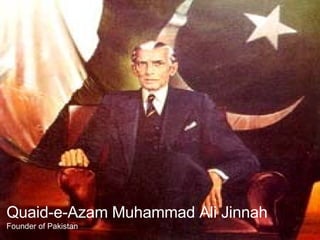
Quaid-e-Azam Muhammad Ali Jinnah Founder of Pakistan
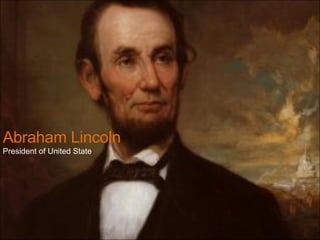
Abraham Lincoln President of United State
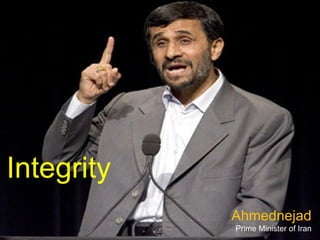
Integrity  Ahmednejad Prime Minister of Iran
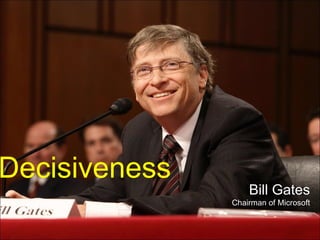
Decisiveness Bill Gates Chairman of Microsoft
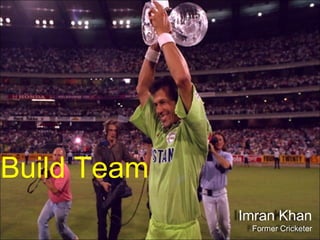
Build Team Imran Khan Former Cricketer
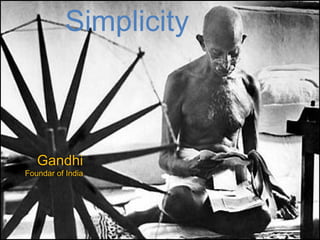
Simplicity Gandhi Foundar of India
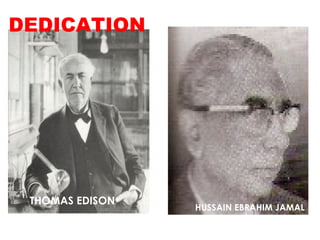
DEDICATION THOMAS EDISON HUSSAIN EBRAHIM JAMAL
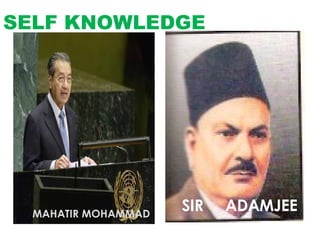
SELF KNOWLEDGE MAHATIR MOHAMMAD SIR  ADAMJEE
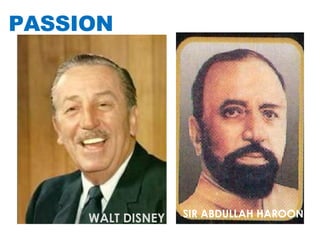
PASSION WALT DISNEY SIR ABDULLAH HAROON
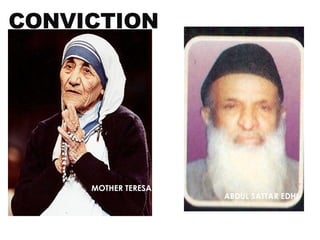
MOTHER TERESA ABDUL SATTAR EDHI CONVICTION
Leadership vs Management Some Commentators believe that leadership and management are the same, while some believe that management is a subset of leadership. Leader is someone who knows where to go. Management skills are how they actually get there. “ Management is a kind of leadership in which the achievement of organizational goals is paramount.” ( Hersey, P. and Blanchard, K.)
Leadership vs Management However There is a Clear distinction b/w them. Management involves power by position.  Leadership involves power by influence.  Abraham Zaleznik (1977), for example, showed differences between leadership and management. He saw leaders as inspiring visionaries, concerned about substance; while managers he views as planners who have concerns with process.
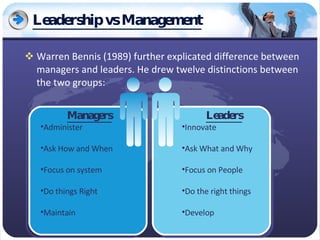
Leadership vs Management Warren Bennis (1989) further explicated difference between managers and leaders. He drew twelve distinctions between the two groups: Managers Administer Ask How and When Focus on system Do things Right Maintain Leaders Innovate Ask What and Why Focus on People Do the right things Develop
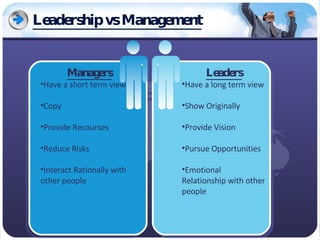
Leadership vs Management Managers Have a short term view Copy Provide Recourses Reduce Risks Interact Rationally with other people Leaders Have a long term view Show Originally Provide Vision Pursue Opportunities Emotional Relationship with other people
LEADERSHIP THEORIES Group 2 MBA(M) , Section A By Yasir Hasan
Leadership Theories Great Man Theory Assumptions:  Leaders are born and not made. Great leaders will arise when there is a great need Description:  Early research on leadership was based on the the study of people who were already great leaders. They said that in times of need, a Great Man would arise, almost by magic. These theories often portray great leaders as heroic, mythic, and destined to rise to leadership when needed. The term “Great Man” was used because, at the time, leadership was thought of primarily as a male quality, especially in terms of military leadership
Leadership Theories Trait Theory Assumptions:  People are born with inherited traits. Some traits are particularly suited to leadership. People who make good leaders have the right (or sufficient) combination of trait Description:  Early research on leadership was based on the psychological focus of the day, which was of people having inherited characteristics or traits. Attention was thus put on discovering these traits, often by studying successful leaders, but with the underlying assumption that if other people could also be found with these traits, then they, too, could also become great leaders.
Leadership Theories Behavioral Theory Assumptions:  Leaders can be made, rather than are born. Description:  Behavioral theories of leadership do not seek inborn traits or capabilities. Rather, they look at what leaders actually do. This theory focuses on the actions of leaders, not on mental qualities or internal states. According to this theory, people can learn to become leaders through teaching and observation.
Leadership Theories Participative Theory Assumptions:  The ideal leadership style is one that takes the input of others into account. Description:  These leaders encourage participation and contributions from group members and help group members feel more relevant and committed to the decision making process. In participative theories, however, the leader retains the right to allow the input of others.
Leadership Theories Situational Theory Assumptions:  The best action of the leader depends on a range of situational factors Description:  When a decision is needed, an effective leader does not just fall into a single preferred style, such as using transactional or transformational methods. In practice, as they say, things are not that simple. Different styles of leadership may be more appropriate for certain types of decision making.
Leadership Theories Contingency Theory Assumptions:  Focus on particular variables related to the environment that might determine which particular style of leadership is best suited for the situation. According to this theory, no leadership style is best in all situations Description:  Contingency theory is similar to situational theory in that there is an assumption of no simple one right way. The main difference is that situational theory tends to focus more on the behaviors that the leader should adopt, given situational factors (often about follower behavior), whereas contingency theory takes a broader view that includes contingent factors about leader capability and other variables within the situation.
Leadership Theories Transactional Theory Assumptions:  Focus on the role of supervision, organization, and group performance. People are motivated by reward and punishment Description:  Transactional Theories are often used in business; when employees are successful, they are rewarded; when they fail, they are reprimanded or punished.
Leadership Theories Transformational Theory Assumptions:  Focus upon the connections formed between leaders and followers. People will follow a person who inspires them Description:  Transformational leaders are focused on the performance of group members, but also want each person to fulfill his or her potential. These leaders often have high ethical and moral standards.
Thank You ! Group 2 MBA(M) , Section A

Leadership by Iqbal

  • 1.
    LEADERS AND LEADERSHIPGroup 2 MBA(M) , Section A Self Management Skills
  • 2.
    Group Members EbadullahGhazanfar Bari Imtiaz Ali Khawar Ali Irfan Khan Kashif Bhutto Iqbal Yasir Hassan
  • 3.
    Contents Leadership vsMangement Theories of Leadership Leadership and Qualities of Leaders Leadership Styles Leadership Cycles Leadership and Vision Group Leadership
  • 4.
    LEADERSHIP AND QUALITIES OF LEADERS Group 2 MBA(M) , Section A By Ebadullah
  • 5.
    Leading / Leadership/ Leaders Leading is the process of influencing others to act to accomplish specified goals and objectives. The effectiveness of leadership depends on the leadership style, followers, expectations, leader-group relations, organizational climate, task structure and power position of a leader.
  • 6.
    Who are leaders?Qualities of Leaders A Leader must posses the following Qualities: Dedication Magnanimity Humbleness Openness Creativity Fairness Assertiveness Sense of Humor
  • 7.
    LEADERSHIP STYLES Group2 MBA(M) , Section A By Ghazanfar Bari
  • 8.
    Leadership Styles ThreeBasic Styles of Leadership are: Autocratic or Authoritarian (Do as I say, because I am the boss.) Democratic or Participative (What do you think?) Free reign Leaders This style is unengaged in leadership, and simply lets people do their own thing with the leader exerting few controls
  • 9.
    Leadership Styles SomeAuthorities Say Leadership Can Be Categorized Into Two Styles: Transactional (Focused on operations or the “business” of the organization.) Transformational (Focused on creating a new and shared vision of the future)
  • 10.
    Leadership Styles OtherCommon Leadership Styles: Servant Leadership (This refers to anyone (whether having a formal leadership title or not) who leads by meeting the needs of others or of his or her team.) Bureaucratic Leadership This type can be defined as “by the book” leadership. This leader focuses on policy and procedures and seeks to keep things fair and well-organized.
  • 11.
    LEADERSHIP CYCLES Group2 MBA(M) , Section A By Imtiaz Ali
  • 12.
    Leadership Cycles Ifa group or an organization wants or expects identifiable leadership, it will require processes for appointing/acquiring and replacing leaders. Traditional closed groups rely on bloodlines or seniority to select leaders and/or leadership candidates: monarchies , tribal chiefdoms , oligarchies and aristocratic societies rely on (and often define their institutions by) such methods. Competence or perceived competence provides a possible basis for selecting leadership elites from a broader pool of potential talent. Political lobbying may prove necessary in electoral systems , but immediately demonstrated skill and character may secure leadership in smaller groups such as gangs .
  • 13.
    Leadership as aPhase in Human Life-Cyle Some cultures, especially those with a reverence for age and wisdom, see leadership as a standard part of the life-cycle of a person. Just as a youth becomes initiated into adulthood, so an adult may gain initiation as a leader. Such societies may require special reinforcement of the respect and kudos due to such senior members in order to maintain their position. If aged adults can no longer hunt or fight or play a full part in physical labor, for example, those adults' positions in society must rest on respect and implied wisdom and teaching roles, whether or not they show identified "leadership traits".
  • 14.
    UNDERSTANDING LEADERSHIP Group2 MBA(M) , Section A By Khawar Ali
  • 15.
    LEADERSHIP AND VISIONGroup 2 MBA(M) , Section A By Irfan Khan
  • 16.
    Leadership and VisionMany definitions of leadership involve an element of vision — except in cases of involuntary leadership and often in cases of traditional leadership. A vision provides direction to the influence process. A leader (or group of leaders) can have one or more visions of the future to aid them to move a group successfully towards this goal. A vision, for effectiveness, should allegedly: appear as a simple, yet vibrant, image in the mind of the leader describe a future state, credible and preferable to the present state act as a bridge between the current state and a future optimum state appear desirable enough to energize followers succeed in speaking to followers at an emotional or spiritual level (logical appeals by themselves seldom muster a following)
  • 17.
    Leadership and VisionFor leadership to occur, according to this theory, some people ("leaders") must communicate the vision to others ("followers") in such a way that the followers adopt the vision as their own. Leaders must not just see the vision themselves, they must have the ability to get others to see it also. Numerous techniques aid in this process, including: narratives, metaphors, symbolic actions, leading by example, incentives, and penalties.
  • 18.
    Leadership as AVanGuard Sometimes followership can occur without intentional leadership. Despite (or because of) its mythical origin, the image of swarms of lemmings which follow the first lemming off a cliff appears frequently in characterizing followers. The animal kingdom also provides the actual model of the bellwether function in a mob of sheep. And human society also offers many examples of emulation. The fashion industry, for example, depends on it. Fashion marketers design clothing for celebrities, then offer less expensive variations/imitations for those who emulate the celebrities. Unintentional leadership can also occur from more pro-active forms followership. For example, in organizations which punish both leadership inaction and mistakes, and in which a predicament has no good solution, a common tendency involves declaring oneself a follower of someone else — metaphorically passing the buck.
  • 19.
    GROUP LEADERSHIP Group2 MBA(M) , Section A By Kashif Bhutto
  • 20.
    Group Leadership Leadershipis concerned with control and power in a group. Groups will sometimes have two leaders: one for the social dimension and one for the task dimension. In this situation, more than one person provides direction to the group as a whole. Some organizations have taken this approach in hopes of increasing creativity, reducing costs, or downsizing
  • 21.
    Co-Leadership A compromisebetween individual leadership and an open group, leadership structures of two or three people or entities occur commonly. , beliefs and practice of co-leaders becomes essential to improving our understanding of this form of leadership – both its potential capacity and constraints. … we all share the jobs and make sure the tasks get finished, make sure that we are moving on, make sure that we’re grounded and it's those things, those skills between us.” (Co-leader)
  • 22.
    Relations of Leaders and Followers Most followers at some point complain about the leader’s deficiencies, such as the leader’s failure to listen, to encourage or to organize follower’s efforts. Relationships between leaders and followers are characterized by some emotion and behavior based on authority and submission. Effective followers work toward genuine relationships with their leader, which includes developing trust and speaking honestly on the basis of that trust. By building a relationship with a leader, follower makes every interaction more meaningful to the organization. Furthermore the relationship is imbued with mutual respect rather than authority and submission.
  • 23.
    MANAGERS VS LEADERSGroup 2 MBA(M) , Section A By IQBAL
  • 24.
    Quaid-e-Azam Muhammad AliJinnah Founder of Pakistan
  • 25.
  • 26.
    Integrity AhmednejadPrime Minister of Iran
  • 27.
    Decisiveness Bill GatesChairman of Microsoft
  • 28.
    Build Team ImranKhan Former Cricketer
  • 29.
  • 30.
    DEDICATION THOMAS EDISONHUSSAIN EBRAHIM JAMAL
  • 31.
    SELF KNOWLEDGE MAHATIRMOHAMMAD SIR ADAMJEE
  • 32.
    PASSION WALT DISNEYSIR ABDULLAH HAROON
  • 33.
    MOTHER TERESA ABDULSATTAR EDHI CONVICTION
  • 34.
    Leadership vs ManagementSome Commentators believe that leadership and management are the same, while some believe that management is a subset of leadership. Leader is someone who knows where to go. Management skills are how they actually get there. “ Management is a kind of leadership in which the achievement of organizational goals is paramount.” ( Hersey, P. and Blanchard, K.)
  • 35.
    Leadership vs ManagementHowever There is a Clear distinction b/w them. Management involves power by position. Leadership involves power by influence. Abraham Zaleznik (1977), for example, showed differences between leadership and management. He saw leaders as inspiring visionaries, concerned about substance; while managers he views as planners who have concerns with process.
  • 36.
    Leadership vs ManagementWarren Bennis (1989) further explicated difference between managers and leaders. He drew twelve distinctions between the two groups: Managers Administer Ask How and When Focus on system Do things Right Maintain Leaders Innovate Ask What and Why Focus on People Do the right things Develop
  • 37.
    Leadership vs ManagementManagers Have a short term view Copy Provide Recourses Reduce Risks Interact Rationally with other people Leaders Have a long term view Show Originally Provide Vision Pursue Opportunities Emotional Relationship with other people
  • 38.
    LEADERSHIP THEORIES Group2 MBA(M) , Section A By Yasir Hasan
  • 39.
    Leadership Theories GreatMan Theory Assumptions: Leaders are born and not made. Great leaders will arise when there is a great need Description: Early research on leadership was based on the the study of people who were already great leaders. They said that in times of need, a Great Man would arise, almost by magic. These theories often portray great leaders as heroic, mythic, and destined to rise to leadership when needed. The term “Great Man” was used because, at the time, leadership was thought of primarily as a male quality, especially in terms of military leadership
  • 40.
    Leadership Theories TraitTheory Assumptions: People are born with inherited traits. Some traits are particularly suited to leadership. People who make good leaders have the right (or sufficient) combination of trait Description: Early research on leadership was based on the psychological focus of the day, which was of people having inherited characteristics or traits. Attention was thus put on discovering these traits, often by studying successful leaders, but with the underlying assumption that if other people could also be found with these traits, then they, too, could also become great leaders.
  • 41.
    Leadership Theories BehavioralTheory Assumptions: Leaders can be made, rather than are born. Description: Behavioral theories of leadership do not seek inborn traits or capabilities. Rather, they look at what leaders actually do. This theory focuses on the actions of leaders, not on mental qualities or internal states. According to this theory, people can learn to become leaders through teaching and observation.
  • 42.
    Leadership Theories ParticipativeTheory Assumptions: The ideal leadership style is one that takes the input of others into account. Description: These leaders encourage participation and contributions from group members and help group members feel more relevant and committed to the decision making process. In participative theories, however, the leader retains the right to allow the input of others.
  • 43.
    Leadership Theories SituationalTheory Assumptions: The best action of the leader depends on a range of situational factors Description: When a decision is needed, an effective leader does not just fall into a single preferred style, such as using transactional or transformational methods. In practice, as they say, things are not that simple. Different styles of leadership may be more appropriate for certain types of decision making.
  • 44.
    Leadership Theories ContingencyTheory Assumptions: Focus on particular variables related to the environment that might determine which particular style of leadership is best suited for the situation. According to this theory, no leadership style is best in all situations Description: Contingency theory is similar to situational theory in that there is an assumption of no simple one right way. The main difference is that situational theory tends to focus more on the behaviors that the leader should adopt, given situational factors (often about follower behavior), whereas contingency theory takes a broader view that includes contingent factors about leader capability and other variables within the situation.
  • 45.
    Leadership Theories TransactionalTheory Assumptions: Focus on the role of supervision, organization, and group performance. People are motivated by reward and punishment Description: Transactional Theories are often used in business; when employees are successful, they are rewarded; when they fail, they are reprimanded or punished.
  • 46.
    Leadership Theories TransformationalTheory Assumptions: Focus upon the connections formed between leaders and followers. People will follow a person who inspires them Description: Transformational leaders are focused on the performance of group members, but also want each person to fulfill his or her potential. These leaders often have high ethical and moral standards.
  • 47.
    Thank You !Group 2 MBA(M) , Section A