Dimensions of usability as a base for improving
distance eduction
A work-in-progress design study
Annika Wiklund-Engblom
Johanna Björkell, Luzilla Backa, Margareta Wihersaari
Designs for Learning conference
Copenhagen, 18-20 May 2016
My background
• MA Developmental psychology (Åbo Akademi University)
• IT-pedagogue (Kalmar University)
• Educational doctor (Åbo Akademi University)
Research interests:
Digital design for learning and self-regulation
Design from a human needs perspective
Twitter: @awengblom
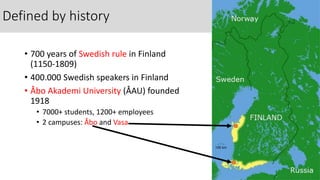
Defined by history
• 700 years of Swedish rule in Finland
(1150-1809)
• 400.000 Swedish speakers in Finland
• Åbo Akademi University (ÅAU) founded
1918
• 7000+ students, 1200+ employees
• 2 campuses: Åbo and Vasa
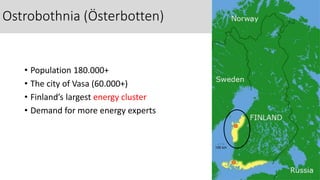
• Population 180.000+
• The city of Vasa (60.000+)
• Finland’s largest energy cluster
• Demand for more energy experts
Ostrobothnia (Österbotten)
Finland’s largest energy cluster
http://energyvaasa.vaasanseutu.fi/
Strategic funding for educating
energy experts in Vasa
• M.Sc. programme in Energy and Environmental
Technology
• Under the Faculty of Science and Engineering at
ÅAU in Åbo (Turku)
• The programme is carried out in partnership with
Novia (University of Applied Sciences)
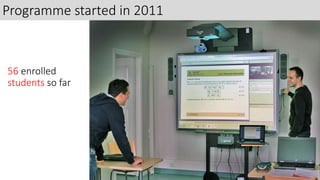
56 enrolled
students so far
Programme started in 2011
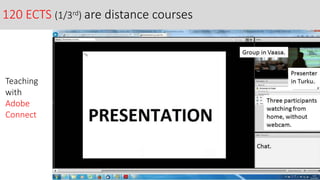
120 ECTS (1/3rd) are distance courses
Teaching
with
Adobe
Connect
Research question
How does the design of the distance courses meet the needs
of students and teachers?
-> how is the design usable for teaching and learning?
-> how can we improve the design?
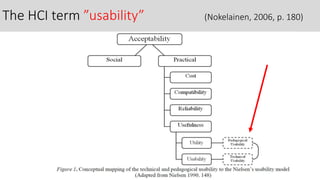
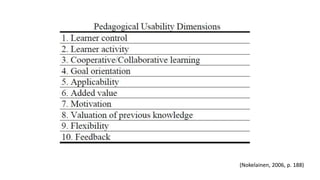
The HCI term ”usability” (Nokelainen, 2006, p. 180)
(Nokelainen, 2006, p. 188)
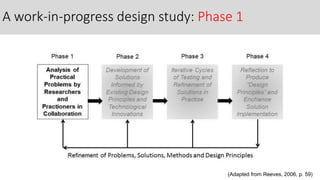
(Adapted from Reeves, 2006, p. 59)
A work-in-progress design study: Phase 1
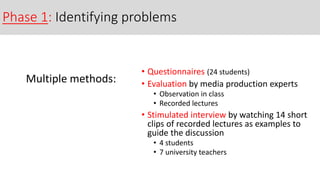
Phase 1: Identifying problems
Multiple methods:
• Questionnaires (24 students)
• Evaluation by media production experts
• Observation in class
• Recorded lectures
• Stimulated interview by watching 14 short
clips of recorded lectures as examples to
guide the discussion
• 4 students
• 7 university teachers
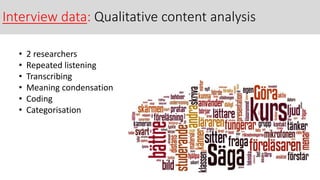
Interview data: Qualitative content analysis
• 2 researchers
• Repeated listening
• Transcribing
• Meaning condensation
• Coding
• Categorisation
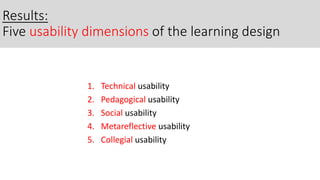
Results:
Five usability dimensions of the learning design
1. Technical usability
2. Pedagogical usability
3. Social usability
4. Metareflective usability
5. Collegial usability
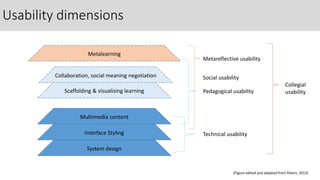
Usability dimensions
Multimedia content
Interface Styling
System design
Scaffolding & visualising learning
(Figure edited and adapted from Peters, 2013)
Collaboration, social meaning negotiation
Metalearning
Metareflective usability
Social usability
Pedagogical usability
Technical usability
Collegial
usability
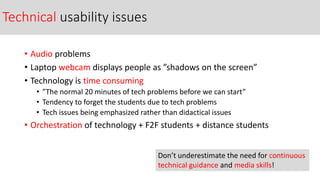
Technical usability issues
• Audio problems
• Laptop webcam displays people as ”shadows on the screen”
• Technology is time consuming
• ”The normal 20 minutes of tech problems before we can start”
• Tendency to forget the students due to tech problems
• Tech issues being emphasized rather than didactical issues
• Orchestration of technology + F2F students + distance students
Don’t underestimate the need for continuous
technical guidance and media skills!
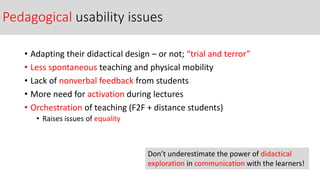
Pedagogical usability issues
• Adapting their didactical design – or not; “trial and terror”
• Less spontaneous teaching and physical mobility
• Lack of nonverbal feedback from students
• More need for activation during lectures
• Orchestration of teaching (F2F + distance students)
• Raises issues of equality
Don’t underestimate the power of didactical
exploration in communication with the learners!
Social usability issues
• AC-based classes often creates anonymity
• No feelings of community between the groups
• The distance group have created a tight bonding
• F2F students exclude distance group from shared information
• The traditional (passive) learning culture does not transfer well
• Hesitance towards demanding interactivity of students during lectures
• Treshold to participate in discussions
• The presence of interactive students benefits all
Don’t underestimate the power of
creating dialogue and relationships!
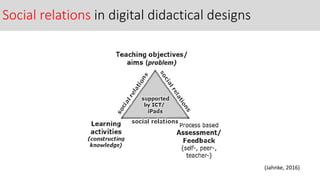
Social relations in digital didactical designs
(Jahnke, 2016)
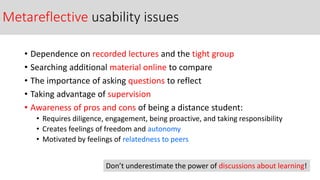
Metareflective usability issues
• Dependence on recorded lectures and the tight group
• Searching additional material online to compare
• The importance of asking questions to reflect
• Taking advantage of supervision
• Awareness of pros and cons of being a distance student:
• Requires diligence, engagement, being proactive, and taking responsibility
• Creates feelings of freedom and autonomy
• Motivated by feelings of relatedness to peers
Don’t underestimate the power of discussions about learning!
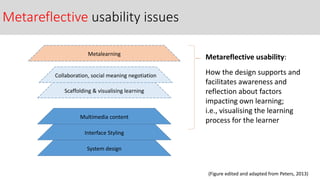
Multimedia content
Interface Styling
System design
Scaffolding & visualising learning
(Figure edited and adapted from Peters, 2013)
Collaboration, social meaning negotiation
Metalearning
Metareflective usability:
How the design supports and
facilitates awareness and
reflection about factors
impacting own learning;
i.e., visualising the learning
process for the learner
Metareflective usability issues
Collegial usability issues
• A few teachers collaborate, but many struggle alone
• Need for developing the didactical design for distance courses
• Need for discussions about distance teaching, sharing ideas
• Need for discussions about content overlap
• Need for creating a shared learning culture
Don’t underestimate the need for
didactical discussions and support!
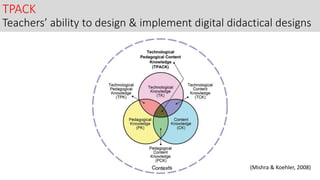
TPACK
Teachers’ ability to design & implement digital didactical designs
(Mishra & Koehler, 2008)
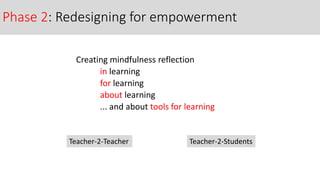
Phase 2: Redesigning for empowerment
Creating mindfulness reflection
in learning
for learning
about learning
... and about tools for learning
Teacher-2-Teacher Teacher-2-Students
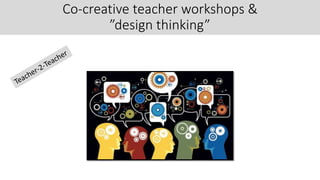
Co-creative teacher workshops &
”design thinking”
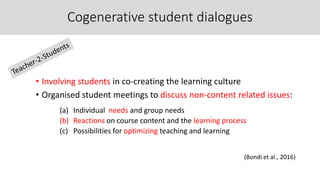
Cogenerative student dialogues
• Involving students in co-creating the learning culture
• Organised student meetings to discuss non-content related issues:
(a) Individual needs and group needs
(b) Reactions on course content and the learning process
(c) Possibilities for optimizing teaching and learning
(Bondi et al., 2016)
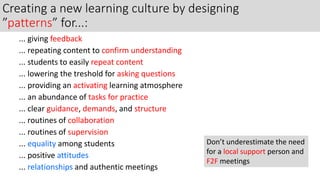
Creating a new learning culture by designing
”patterns” for...:
... giving feedback
... repeating content to confirm understanding
... students to easily repeat content
... lowering the treshold for asking questions
... providing an activating learning atmosphere
... an abundance of tasks for practice
... clear guidance, demands, and structure
... routines of collaboration
... routines of supervision
... equality among students
... positive attitudes
... relationships and authentic meetings
Don’t underestimate the need
for a local support person and
F2F meetings
Sustainable design thinking
“Good design acknowledges the fact that redesign is the
norm, not the exception, and that it is a correlate of
sustainability, not of failure.” (Goodyear & Dimitriadis, 2013)
Therefore, all teachers ought to be action researchers!
Thank you!
Annika Wiklund-Engblom, Ed.D., M.A. dev.psychology
University teacher in pedagogics of higher education
Faculty of Education and Welfare Studies
Åbo Akademi University
Vasa, Finland
Email: awiklund@abo.fi
Twitter: @awengblom
Blog: mediasolutionsblog.wordpress.com/
Publications: researchgate.net/profile/Annika_Wiklund-Engblom
Profile: linkedin.com/in/annikawiklundengblom

Designs For Learning Conference 2016

  • 1.
    Dimensions of usabilityas a base for improving distance eduction A work-in-progress design study Annika Wiklund-Engblom Johanna Björkell, Luzilla Backa, Margareta Wihersaari Designs for Learning conference Copenhagen, 18-20 May 2016
  • 2.
    My background • MADevelopmental psychology (Åbo Akademi University) • IT-pedagogue (Kalmar University) • Educational doctor (Åbo Akademi University) Research interests: Digital design for learning and self-regulation Design from a human needs perspective Twitter: @awengblom
  • 3.
    Defined by history •700 years of Swedish rule in Finland (1150-1809) • 400.000 Swedish speakers in Finland • Åbo Akademi University (ÅAU) founded 1918 • 7000+ students, 1200+ employees • 2 campuses: Åbo and Vasa
  • 4.
    • Population 180.000+ •The city of Vasa (60.000+) • Finland’s largest energy cluster • Demand for more energy experts Ostrobothnia (Österbotten)
  • 5.
    Finland’s largest energycluster http://energyvaasa.vaasanseutu.fi/
  • 6.
    Strategic funding foreducating energy experts in Vasa • M.Sc. programme in Energy and Environmental Technology • Under the Faculty of Science and Engineering at ÅAU in Åbo (Turku) • The programme is carried out in partnership with Novia (University of Applied Sciences)
  • 7.
    56 enrolled students sofar Programme started in 2011
  • 8.
    120 ECTS (1/3rd)are distance courses Teaching with Adobe Connect
  • 9.
    Research question How doesthe design of the distance courses meet the needs of students and teachers? -> how is the design usable for teaching and learning? -> how can we improve the design?
  • 10.
    The HCI term”usability” (Nokelainen, 2006, p. 180)
  • 11.
  • 12.
    (Adapted from Reeves,2006, p. 59) A work-in-progress design study: Phase 1
  • 13.
    Phase 1: Identifyingproblems Multiple methods: • Questionnaires (24 students) • Evaluation by media production experts • Observation in class • Recorded lectures • Stimulated interview by watching 14 short clips of recorded lectures as examples to guide the discussion • 4 students • 7 university teachers
  • 14.
    Interview data: Qualitativecontent analysis • 2 researchers • Repeated listening • Transcribing • Meaning condensation • Coding • Categorisation
  • 15.
    Results: Five usability dimensionsof the learning design 1. Technical usability 2. Pedagogical usability 3. Social usability 4. Metareflective usability 5. Collegial usability
  • 16.
    Usability dimensions Multimedia content InterfaceStyling System design Scaffolding & visualising learning (Figure edited and adapted from Peters, 2013) Collaboration, social meaning negotiation Metalearning Metareflective usability Social usability Pedagogical usability Technical usability Collegial usability
  • 17.
    Technical usability issues •Audio problems • Laptop webcam displays people as ”shadows on the screen” • Technology is time consuming • ”The normal 20 minutes of tech problems before we can start” • Tendency to forget the students due to tech problems • Tech issues being emphasized rather than didactical issues • Orchestration of technology + F2F students + distance students Don’t underestimate the need for continuous technical guidance and media skills!
  • 18.
    Pedagogical usability issues •Adapting their didactical design – or not; “trial and terror” • Less spontaneous teaching and physical mobility • Lack of nonverbal feedback from students • More need for activation during lectures • Orchestration of teaching (F2F + distance students) • Raises issues of equality Don’t underestimate the power of didactical exploration in communication with the learners!
  • 19.
    Social usability issues •AC-based classes often creates anonymity • No feelings of community between the groups • The distance group have created a tight bonding • F2F students exclude distance group from shared information • The traditional (passive) learning culture does not transfer well • Hesitance towards demanding interactivity of students during lectures • Treshold to participate in discussions • The presence of interactive students benefits all Don’t underestimate the power of creating dialogue and relationships!
  • 20.
    Social relations indigital didactical designs (Jahnke, 2016)
  • 21.
    Metareflective usability issues •Dependence on recorded lectures and the tight group • Searching additional material online to compare • The importance of asking questions to reflect • Taking advantage of supervision • Awareness of pros and cons of being a distance student: • Requires diligence, engagement, being proactive, and taking responsibility • Creates feelings of freedom and autonomy • Motivated by feelings of relatedness to peers Don’t underestimate the power of discussions about learning!
  • 22.
    Multimedia content Interface Styling Systemdesign Scaffolding & visualising learning (Figure edited and adapted from Peters, 2013) Collaboration, social meaning negotiation Metalearning Metareflective usability: How the design supports and facilitates awareness and reflection about factors impacting own learning; i.e., visualising the learning process for the learner Metareflective usability issues
  • 23.
    Collegial usability issues •A few teachers collaborate, but many struggle alone • Need for developing the didactical design for distance courses • Need for discussions about distance teaching, sharing ideas • Need for discussions about content overlap • Need for creating a shared learning culture Don’t underestimate the need for didactical discussions and support!
  • 24.
    TPACK Teachers’ ability todesign & implement digital didactical designs (Mishra & Koehler, 2008)
  • 25.
    Phase 2: Redesigningfor empowerment Creating mindfulness reflection in learning for learning about learning ... and about tools for learning Teacher-2-Teacher Teacher-2-Students
  • 26.
    Co-creative teacher workshops& ”design thinking”
  • 27.
    Cogenerative student dialogues •Involving students in co-creating the learning culture • Organised student meetings to discuss non-content related issues: (a) Individual needs and group needs (b) Reactions on course content and the learning process (c) Possibilities for optimizing teaching and learning (Bondi et al., 2016)
  • 28.
    Creating a newlearning culture by designing ”patterns” for...: ... giving feedback ... repeating content to confirm understanding ... students to easily repeat content ... lowering the treshold for asking questions ... providing an activating learning atmosphere ... an abundance of tasks for practice ... clear guidance, demands, and structure ... routines of collaboration ... routines of supervision ... equality among students ... positive attitudes ... relationships and authentic meetings Don’t underestimate the need for a local support person and F2F meetings
  • 29.
    Sustainable design thinking “Gooddesign acknowledges the fact that redesign is the norm, not the exception, and that it is a correlate of sustainability, not of failure.” (Goodyear & Dimitriadis, 2013) Therefore, all teachers ought to be action researchers!
  • 30.
    Thank you! Annika Wiklund-Engblom,Ed.D., M.A. dev.psychology University teacher in pedagogics of higher education Faculty of Education and Welfare Studies Åbo Akademi University Vasa, Finland Email: awiklund@abo.fi Twitter: @awengblom Blog: mediasolutionsblog.wordpress.com/ Publications: researchgate.net/profile/Annika_Wiklund-Engblom Profile: linkedin.com/in/annikawiklundengblom

Editor's Notes