Name – Sumit
Roll no. 2250981548
*Defination
*Result of cooperative effort between CIOMS (Council for
International Organizations of Medical Sciences) and ICH (MSSO)
*Groupings of terms from one or more MedDRA Preferred Terms
(PTs) related to defined medical condition or area of interest
*Included terms may relate to signs, symptoms, diagnoses,
syndromes, physical findings, laboratory and other physiologic test
data, etc., related to medical condition or area of interest
*To assist in the identification and retrieval of MedDRA coded
ICSRs that are potentially relevant to specific condition of interest.
*SMQs are comprised of MedDRA PTs focus on a defined medical
condition.
*Standardised MedDRA Queries (SMQs)
*Groupings of terms from one or more MedDRA SOCs related to
medical condition or area of interest
*Terms relate to
•Signs/symptoms,
•Diagnoses,
•Syndromes,
•Physical findings,
•Laboratory and other test data, etc.
*Intended to aid in case identification
SMQ Benefits and Limitations
*Benefits
• Application across multiple therapeutic areas
• Validated reusable search logic
• Standardized communication of safety information
• Consistent data retrieval
• Maintenance by MSSO/JMO
*Limitations
• Do not cover all medical topics or safety issues
• Will evolve and undergo further refinement in the production phase
SMQ Data Characteristics
•MedDRA term inclusion
•Broad/narrow
•Algorithms
•Hierarchy
•SMQ status/term status within an SMQ
•Term versioning in an SMQ
Hierarchical SMQs
*Some SMQs may develop as set of queries related to one another
in a hierarchical relationship
*Not related to MedDRA standard hierarchy
*One or more subordinate SMQs combined to create a
superordinate, more inclusive SMQ
*SMQ Status/Term Status
*Each SMQ has a status (Active/Inactive)
*Similar in concept to MedDRA currency
*Terms assigned to an SMQ also have a status flag
•Once a term is added to an SMQ, it will always be included in
the SMQ but the status may be inactive
SMQ Files and Documents
*MedDRA distributed files unchanged by inclusion of SMQ files
*SMQ Introductory Guide
•Recommended reading for optimal use of SMQs
•Details of individual SMQs
•Notes for implementation and/or expectation of result
*Production SMQ Spreadsheet
•SMQs and included terms, SMQ summary
*SMQ changes: “What’s New” document, Version Report,
MVAT
*Original CIOMS Working Group documentation
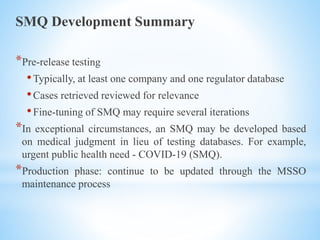
SMQ Development Summary
*Pre-release testing
•Typically, at least one company and one regulator database
•Cases retrieved reviewed for relevance
•Fine-tuning of SMQ may require several iterations
*In exceptional circumstances, an SMQ may be developed based
on medical judgment in lieu of testing databases. For example,
urgent public health need - COVID-19 (SMQ).
*Production phase: continue to be updated through the MSSO
maintenance process
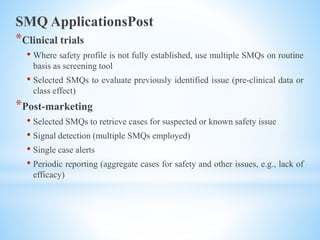
SMQ ApplicationsPost
*Clinical trials
• Where safety profile is not fully established, use multiple SMQs on routine
basis as screening tool
• Selected SMQs to evaluate previously identified issue (pre-clinical data or
class effect)
*Post-marketing
• Selected SMQs to retrieve cases for suspected or known safety issue
• Signal detection (multiple SMQs employed)
• Single case alerts
• Periodic reporting (aggregate cases for safety and other issues, e.g., lack of
efficacy)
medDRA SMQ TOPIC.pptx

medDRA SMQ TOPIC.pptx

  • 1.
    Name – Sumit Rollno. 2250981548
  • 2.
    *Defination *Result of cooperativeeffort between CIOMS (Council for International Organizations of Medical Sciences) and ICH (MSSO) *Groupings of terms from one or more MedDRA Preferred Terms (PTs) related to defined medical condition or area of interest *Included terms may relate to signs, symptoms, diagnoses, syndromes, physical findings, laboratory and other physiologic test data, etc., related to medical condition or area of interest *To assist in the identification and retrieval of MedDRA coded ICSRs that are potentially relevant to specific condition of interest. *SMQs are comprised of MedDRA PTs focus on a defined medical condition.
  • 3.
    *Standardised MedDRA Queries(SMQs) *Groupings of terms from one or more MedDRA SOCs related to medical condition or area of interest *Terms relate to •Signs/symptoms, •Diagnoses, •Syndromes, •Physical findings, •Laboratory and other test data, etc. *Intended to aid in case identification
  • 4.
    SMQ Benefits andLimitations *Benefits • Application across multiple therapeutic areas • Validated reusable search logic • Standardized communication of safety information • Consistent data retrieval • Maintenance by MSSO/JMO *Limitations • Do not cover all medical topics or safety issues • Will evolve and undergo further refinement in the production phase
  • 5.
    SMQ Data Characteristics •MedDRAterm inclusion •Broad/narrow •Algorithms •Hierarchy •SMQ status/term status within an SMQ •Term versioning in an SMQ
  • 6.
    Hierarchical SMQs *Some SMQsmay develop as set of queries related to one another in a hierarchical relationship *Not related to MedDRA standard hierarchy *One or more subordinate SMQs combined to create a superordinate, more inclusive SMQ
  • 7.
    *SMQ Status/Term Status *EachSMQ has a status (Active/Inactive) *Similar in concept to MedDRA currency *Terms assigned to an SMQ also have a status flag •Once a term is added to an SMQ, it will always be included in the SMQ but the status may be inactive
  • 8.
    SMQ Files andDocuments *MedDRA distributed files unchanged by inclusion of SMQ files *SMQ Introductory Guide •Recommended reading for optimal use of SMQs •Details of individual SMQs •Notes for implementation and/or expectation of result *Production SMQ Spreadsheet •SMQs and included terms, SMQ summary *SMQ changes: “What’s New” document, Version Report, MVAT *Original CIOMS Working Group documentation
  • 9.
    SMQ Development Summary *Pre-releasetesting •Typically, at least one company and one regulator database •Cases retrieved reviewed for relevance •Fine-tuning of SMQ may require several iterations *In exceptional circumstances, an SMQ may be developed based on medical judgment in lieu of testing databases. For example, urgent public health need - COVID-19 (SMQ). *Production phase: continue to be updated through the MSSO maintenance process
  • 10.
    SMQ ApplicationsPost *Clinical trials •Where safety profile is not fully established, use multiple SMQs on routine basis as screening tool • Selected SMQs to evaluate previously identified issue (pre-clinical data or class effect) *Post-marketing • Selected SMQs to retrieve cases for suspected or known safety issue • Signal detection (multiple SMQs employed) • Single case alerts • Periodic reporting (aggregate cases for safety and other issues, e.g., lack of efficacy)