definition
 Advanced reproductive technologies ,IVF allow
parents and doctors to screen embryos for
genetic disorders and select healthy embryos.

In the future we may be able to use genetic
technologies to modify embryos and choose
desirable or cosmetic characteristics. Designer
babies is a term used by journalists to describe
this scenario
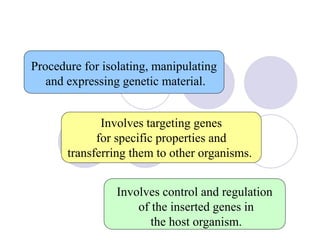
Procedure for isolating, manipulating
and expressing genetic material.
Involves targeting genes
for specific properties and
transferring them to other organisms.
Involves control and regulation
of the inserted genes in
the host organism.
What is biotechnology?
possible uses in humans
Definitive treatment for a variety of genetic
conditions
Cure for inherited metabolic conditions
Potential of providing one treatment with a
lifetime impact
Criteria
Normal gene can be inserted into target
cell and remains there for desired effect
Level of gene expression will be
appropriate
New gene will not harm the cell or
individual- on long and short term basis
Gene therapy
Researchers believe that a gene can
be transplanted into human beings who
suffer from certain diseases
Such gene transplants may alleviate or
perhaps even cure diseases for which
no adequate treatment now exists
Treatment for Parkinson’s Disease,
Cystic Fibrosis, Hemophilia…
technique
 Advanced reproductive techniques involve using InVitro
Fertilisation or IVF. These techniques allow doctors and
parents to reduce the chance that a child will be born
with a genetic disorder.
 At the moment it is only legally possible to carry out two
types of advanced reproductive technologies on
humans. The first involves choosing the type of sperm
that will fertilize an egg: this is used to determine the sex
and the genes of the baby.
 The second technique screens embryos for a genetic
disease: only selected embryos are implanted back into
the mother's womb. This is called Pre-implantation
Genetic Diagnosis (PGD).
The expansion of IVF
 To begin with IVF was used to help
couples with fertility problems to have a
child.
Now….
‘Second test tube baby for woman who is
56’
‘Women pleas to save frozen embryos’
‘Lesbian has brother’s IVF baby’
‘Clinic to export sperm abroad’
‘Bachelor father’s £50,000 triplets’
Should we be worried?
No!
‘If you must make babies then make
the best babies you can’
Professor Matti Hayry
 Leave it to parents to choose
But..
Can we be sure what is best?
Different people have different ideas
Do parents always act in the best
interests of their child?
Individual choices can affect society
Ethical issues
Should parents be allowed to custom
build their children?
Will it lead to happier parents and
children?
Will it lead to healthier people?
Will it lead to more beautiful people?
Will it lead to there being more differences
between rich and poor people?
Arguments for creating designer
babies
 Some couples are not able to have children because their children
will have a genetic disease and die. Techniques to change the
genetic make-up of the embryo allow them to have a child.
 If we want the best for our children why shouldn't we design our own
babies? Prevention of certain genetic diseases, both saves the
children from suffering and reduces the cost and emotional strain of
looking after an ill child on the family and society.
 Spare part children? In a few cases where parents have had one
child with a serious blood disease, they have used IVF to select
embryos so that they can have a second child that can act as a
future, tailor-made blood or bone marrow donor. In these cases
when the child is born he or she will be healthy and can help their
older brother or sister stay well.
Arguments against creating
designer babies
 But is this right? In these cases, parents and doctors are creating a child to act as an
organ-donating factory. How will the child feel? The child may feel that they were only
born to be a help to their older brother or sister.
 These genetic techniques are very expensive available only to the rich. This could
lead to imbalances between rich and poor people.
 Will we breed a race of super-humans who look down on those without genetic
enhancements? Even today people who are born with disabilities face intolerance.
Will discrimination against people with disabilities increase?
 We could get carried away 'correcting' perfectly healthy babies. What is to stop us
from picking babies for their physical or psychological traits?
 Is it right to add new artificial genes, or take away other genes? These genetic
changes will be permanent and be contained in every single cell of the baby.
 Alterations made by genetic engineering would be passed on from one generation to
the next. What right have parents to choose what genetic characteristics are best for
their children, and their children's children. Will the children react against the genetic
changes that their parents have chosen for them?
 Who is responsible for genetic modification of a child? The parents? The doctors? Or
the Government?
What might the effects be..
On children..
Selected for particular traits does
this deny them control over their
future?
If parents have designed a baby will
they tolerate a child who fails?
Is this turning children into
commodities?
What might the effects be..
On society …
 Reduce genetic variation
 Affect family life
 Change the sex ratio
 Increase discrimination against the
disabled
Damage to self-worth & identity of disabled/deaf
person etc
 Create super-human?
Commercialisation
Gene tests will become market
driven
Technologies will be marketed for
trivial uses
Harm to society will be ignored
Human life, health and (in the future)
even behavioural traits are treated
as commodities
Should the use of PGD be
restricted?
To serious disease?
And diseases that shorten life?
And risk of a disease?
And short sight?
And to select for sex?
And to avoid short stature?
And (in the future) for high IQ etc etc.
Would you draw a line anywhere?
Risks
There is much that we do not
understand about human genes
Altering genes may result in changes that we
do not expect.
If these changes can be passed down to
future generations, there is a possibility of
catastrophic results
We may create pressure for people to
use these techniques
Scenario #1
 Imagine that it is possible to decide height,
skin color, hair color, eye color, sex and other
physical characteristics of a newly-conceived
child
 Should parents be allowed to change these
characteristics if they choose?
 Will this lead to designer babies? To
uniformity? Will this deplete the gene pool?
Scenario #2
 Imagine that:
 Scientists have isolated the genes that predispose sexual
orientation;
 You are going to have a child;
 Tests have determined that your child will probably be gay.
 Your doctor asks you: would you like us to alter the
genes that predispose toward sexual orientation so
that the child will not be gay?
 Further assume that you “have nothing against gays,”
but know that overall a gay person will face more
discrimination and suffering—all other things being
equal—than someone who is heterosexual.
 What should you do?
Scenario #4
You are pregnant, and a routine test
reveals that your child has a particular
gene that results in acondroplegia, a
form of dwarfism. The doctor asks you
whether you want to have the gene
altered so that the child’s height is
“normal.”
What should you do?
Pregnant women are routinely offered screening for genetic
disorders such as Down's syndrome, but there is concern about the
growing number of tests.
Last year doctors aborted a foetus beyond 24 weeks' gestation
because the mother, taking advice from doctors, did not want a
baby with a cleft palate.
A cleft palate is not life threatening and usually is only a
cosmetic concern. So should a foetus be aborted because they may
look slightly different from other children even though they are
healthy? Or are we saving the child from the torment of bullying
due to its differing looks?
By choosing the partner you
produce a child with, you are
already beginning to select what
characteristics your child will have.
So how is designer babies any
different?
CASE STUDY
 Helen wants a child. She isn't aiming to create a perfect child but she wants
to undergo genetic selection treatment. Helen has a problem with her DNA.
It doesn’t affect her health, but it means that most of her eggs don't carry all
the genes needed for a baby to grow healthily. The result is that each time
she becomes pregnant, she miscarries.
 Doctors suggest that Helen try a technique called pre-implantation genetic
diagnosis (PGD). Using PGD scientists can screen embryos outside the
womb, long before they develop into babies. They can select just those
embryos that carry healthy genes. This ensures the baby is free from
genetic abnormalities. Genetic technology seems the only way she can
have a baby at all.
 If Helen has a child this way, it's not really a designer baby at all. The
embryo will be created from one of Helen's eggs and her husband's sperm,
just as in IVF. The genes will not be altered, or enhanced in any way. The
doctors simply choose an embryo that doesn't carry Helen's genetic
disorder
CASE STUDY
 James was born on October 25th, 1992.
 By the time he was 5 years old his parents noticed he was having
problems with his running and walking.
 After several medical consultations, James was diagnosed with
‘Duchenne Muscular Dystrophy’.
 Duchenne is a genetically inherited disease that causes the slow yet
progressive breakdown of muscle tissue.
 James’ parents would love another child but are aware that any
other children they do have will have a chance of developing
Duchenne.
 PGD (Pre-implantation Genetic Diagnosis) would allow James’
parents to select specific embryos.
 Should James’ parents be allowed PGD?
CASE STUDY
 Phil and Sian have four daughters, but they wish to have
a fifth child and would really like to have a son. To
ensure their next child is a boy they wish to undergo
genetic selection treatment.
 Doctors can now check using PGD whether an embryo
produced by IVF is a boy or a girl depending on whether
it contains an XX or XY pair of chromosomes and then
implant the chosen embryo into Sian. There is no
medical reason for the couple to have a male child but
they both strongly believe a boy is needed to complete
their family and to carry on their family name.

Designer Babies

  • 1.
    definition  Advanced reproductivetechnologies ,IVF allow parents and doctors to screen embryos for genetic disorders and select healthy embryos.  In the future we may be able to use genetic technologies to modify embryos and choose desirable or cosmetic characteristics. Designer babies is a term used by journalists to describe this scenario
  • 2.
    Procedure for isolating,manipulating and expressing genetic material. Involves targeting genes for specific properties and transferring them to other organisms. Involves control and regulation of the inserted genes in the host organism. What is biotechnology?
  • 3.
    possible uses inhumans Definitive treatment for a variety of genetic conditions Cure for inherited metabolic conditions Potential of providing one treatment with a lifetime impact
  • 4.
    Criteria Normal gene canbe inserted into target cell and remains there for desired effect Level of gene expression will be appropriate New gene will not harm the cell or individual- on long and short term basis
  • 5.
    Gene therapy Researchers believethat a gene can be transplanted into human beings who suffer from certain diseases Such gene transplants may alleviate or perhaps even cure diseases for which no adequate treatment now exists Treatment for Parkinson’s Disease, Cystic Fibrosis, Hemophilia…
  • 6.
    technique  Advanced reproductivetechniques involve using InVitro Fertilisation or IVF. These techniques allow doctors and parents to reduce the chance that a child will be born with a genetic disorder.  At the moment it is only legally possible to carry out two types of advanced reproductive technologies on humans. The first involves choosing the type of sperm that will fertilize an egg: this is used to determine the sex and the genes of the baby.  The second technique screens embryos for a genetic disease: only selected embryos are implanted back into the mother's womb. This is called Pre-implantation Genetic Diagnosis (PGD).
  • 7.
    The expansion ofIVF  To begin with IVF was used to help couples with fertility problems to have a child. Now…. ‘Second test tube baby for woman who is 56’ ‘Women pleas to save frozen embryos’ ‘Lesbian has brother’s IVF baby’ ‘Clinic to export sperm abroad’ ‘Bachelor father’s £50,000 triplets’
  • 8.
    Should we beworried?
  • 9.
    Should we beworried? No! ‘If you must make babies then make the best babies you can’ Professor Matti Hayry  Leave it to parents to choose
  • 10.
    But.. Can we besure what is best? Different people have different ideas Do parents always act in the best interests of their child? Individual choices can affect society
  • 11.
    Ethical issues Should parentsbe allowed to custom build their children? Will it lead to happier parents and children? Will it lead to healthier people? Will it lead to more beautiful people? Will it lead to there being more differences between rich and poor people?
  • 12.
    Arguments for creatingdesigner babies  Some couples are not able to have children because their children will have a genetic disease and die. Techniques to change the genetic make-up of the embryo allow them to have a child.  If we want the best for our children why shouldn't we design our own babies? Prevention of certain genetic diseases, both saves the children from suffering and reduces the cost and emotional strain of looking after an ill child on the family and society.  Spare part children? In a few cases where parents have had one child with a serious blood disease, they have used IVF to select embryos so that they can have a second child that can act as a future, tailor-made blood or bone marrow donor. In these cases when the child is born he or she will be healthy and can help their older brother or sister stay well.
  • 13.
    Arguments against creating designerbabies  But is this right? In these cases, parents and doctors are creating a child to act as an organ-donating factory. How will the child feel? The child may feel that they were only born to be a help to their older brother or sister.  These genetic techniques are very expensive available only to the rich. This could lead to imbalances between rich and poor people.  Will we breed a race of super-humans who look down on those without genetic enhancements? Even today people who are born with disabilities face intolerance. Will discrimination against people with disabilities increase?  We could get carried away 'correcting' perfectly healthy babies. What is to stop us from picking babies for their physical or psychological traits?  Is it right to add new artificial genes, or take away other genes? These genetic changes will be permanent and be contained in every single cell of the baby.  Alterations made by genetic engineering would be passed on from one generation to the next. What right have parents to choose what genetic characteristics are best for their children, and their children's children. Will the children react against the genetic changes that their parents have chosen for them?  Who is responsible for genetic modification of a child? The parents? The doctors? Or the Government?
  • 14.
    What might theeffects be.. On children.. Selected for particular traits does this deny them control over their future? If parents have designed a baby will they tolerate a child who fails? Is this turning children into commodities?
  • 15.
    What might theeffects be.. On society …  Reduce genetic variation  Affect family life  Change the sex ratio  Increase discrimination against the disabled Damage to self-worth & identity of disabled/deaf person etc  Create super-human?
  • 16.
    Commercialisation Gene tests willbecome market driven Technologies will be marketed for trivial uses Harm to society will be ignored Human life, health and (in the future) even behavioural traits are treated as commodities
  • 17.
    Should the useof PGD be restricted? To serious disease? And diseases that shorten life? And risk of a disease? And short sight? And to select for sex? And to avoid short stature? And (in the future) for high IQ etc etc. Would you draw a line anywhere?
  • 18.
    Risks There is muchthat we do not understand about human genes Altering genes may result in changes that we do not expect. If these changes can be passed down to future generations, there is a possibility of catastrophic results We may create pressure for people to use these techniques
  • 19.
    Scenario #1  Imaginethat it is possible to decide height, skin color, hair color, eye color, sex and other physical characteristics of a newly-conceived child  Should parents be allowed to change these characteristics if they choose?  Will this lead to designer babies? To uniformity? Will this deplete the gene pool?
  • 20.
    Scenario #2  Imaginethat:  Scientists have isolated the genes that predispose sexual orientation;  You are going to have a child;  Tests have determined that your child will probably be gay.  Your doctor asks you: would you like us to alter the genes that predispose toward sexual orientation so that the child will not be gay?  Further assume that you “have nothing against gays,” but know that overall a gay person will face more discrimination and suffering—all other things being equal—than someone who is heterosexual.  What should you do?
  • 21.
    Scenario #4 You arepregnant, and a routine test reveals that your child has a particular gene that results in acondroplegia, a form of dwarfism. The doctor asks you whether you want to have the gene altered so that the child’s height is “normal.” What should you do?
  • 22.
    Pregnant women areroutinely offered screening for genetic disorders such as Down's syndrome, but there is concern about the growing number of tests. Last year doctors aborted a foetus beyond 24 weeks' gestation because the mother, taking advice from doctors, did not want a baby with a cleft palate. A cleft palate is not life threatening and usually is only a cosmetic concern. So should a foetus be aborted because they may look slightly different from other children even though they are healthy? Or are we saving the child from the torment of bullying due to its differing looks?
  • 23.
    By choosing thepartner you produce a child with, you are already beginning to select what characteristics your child will have. So how is designer babies any different?
  • 24.
    CASE STUDY  Helenwants a child. She isn't aiming to create a perfect child but she wants to undergo genetic selection treatment. Helen has a problem with her DNA. It doesn’t affect her health, but it means that most of her eggs don't carry all the genes needed for a baby to grow healthily. The result is that each time she becomes pregnant, she miscarries.  Doctors suggest that Helen try a technique called pre-implantation genetic diagnosis (PGD). Using PGD scientists can screen embryos outside the womb, long before they develop into babies. They can select just those embryos that carry healthy genes. This ensures the baby is free from genetic abnormalities. Genetic technology seems the only way she can have a baby at all.  If Helen has a child this way, it's not really a designer baby at all. The embryo will be created from one of Helen's eggs and her husband's sperm, just as in IVF. The genes will not be altered, or enhanced in any way. The doctors simply choose an embryo that doesn't carry Helen's genetic disorder
  • 25.
    CASE STUDY  Jameswas born on October 25th, 1992.  By the time he was 5 years old his parents noticed he was having problems with his running and walking.  After several medical consultations, James was diagnosed with ‘Duchenne Muscular Dystrophy’.  Duchenne is a genetically inherited disease that causes the slow yet progressive breakdown of muscle tissue.  James’ parents would love another child but are aware that any other children they do have will have a chance of developing Duchenne.  PGD (Pre-implantation Genetic Diagnosis) would allow James’ parents to select specific embryos.  Should James’ parents be allowed PGD?
  • 26.
    CASE STUDY  Philand Sian have four daughters, but they wish to have a fifth child and would really like to have a son. To ensure their next child is a boy they wish to undergo genetic selection treatment.  Doctors can now check using PGD whether an embryo produced by IVF is a boy or a girl depending on whether it contains an XX or XY pair of chromosomes and then implant the chosen embryo into Sian. There is no medical reason for the couple to have a male child but they both strongly believe a boy is needed to complete their family and to carry on their family name.