Obstetrics
emergency
Dr. Mini Sood
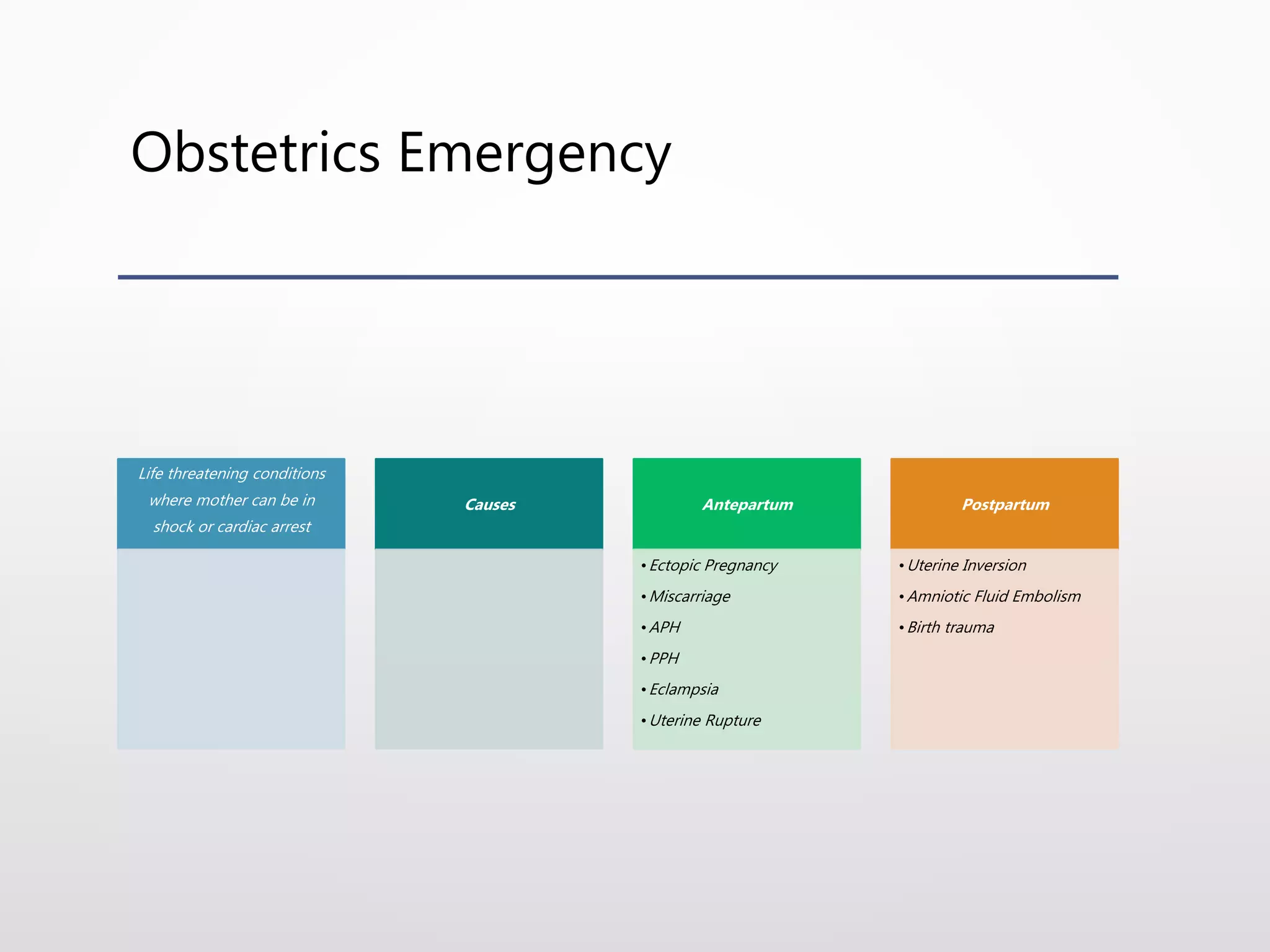
Obstetrics Emergency
Life threatening conditions
where mother can be in
shock or cardiac arrest
Causes Antepartum
•Ectopic Pregnancy
•Miscarriage
•APH
•PPH
•Eclampsia
•Uterine Rupture
Postpartum
•Uterine Inversion
•Amniotic Fluid Embolism
•Birth trauma
Obstetrics emergency- “Lots of people
confuse destiny with bad management.”
To avoid “bad
management”, we should
know, how to avoid a
Rapid deterioration
Rapid response of treating
team
Risk factors -Knowledge
and skills required
Diagnostic criteria-
knowledge and availability
Obstetric management-
Proper and aggressive
management ,Basis
resuscitation – ABC
Anaesthetics
management- Training and
drills
RISK FACTORS FOR
ABNORMAL PLACENTATION
Uterine fibroids
Prior caesarean section
History of postpartum haemorrhage
Multiparity
Obstetric
Management
• Placenta Previa
 Caesarean delivery: elective (if stable) or
 urgent (if haemorrhaging)
• Accreta/Percreta
 Recognition and (probably) hysterectomy
 May need surgeons with experience in
 bowel or urological surgery for per-creta
ANESTHETIC
MANAGEMENT
FOR PREVIA
 Examine the airway and provide aspiration prophylaxis.
 Ask OB about previous caesarean scar on ultrasound (risk of
accreta).
 Place two large-bore IV lines and have warmers
 available.
 BLOOD Should be typed and cross-matched.
 decide on the type of anaesthetic?
• A review of 514 women with placenta previa found:
• No differences between general or regional anaesthesia
• Am J Obstetric Gynecology 1999;180:1432
USE OF CELL SALVAGE-
Autotransfusion
A multicenter review of 139
patients who were
auto-transfused during
caesarean delivery compared
them to a control group
receiving banked blood.
There was no difference in:
Length of hospitalization
Need for ventilatory support /
A.R.D.S.
Coagulopathy or amniotic fluid
embolism
Infectious morbidity
Am J Obstetric Gyn
1998;179:715
USE OF
CELL
SALVAGE
• Cell salvage combined with blood filtration
• produced blood samples equivalent to
• maternal central venous blood.
• Editorial: Until a large prospective
• randomized study is done, cell salvage
• during C/S should only be used when
• necessary to preserve life – e.g., Jehovah’s
• Witness, difficult cross-match.
• Anaesthesiology 2000;92:1519 and 1531
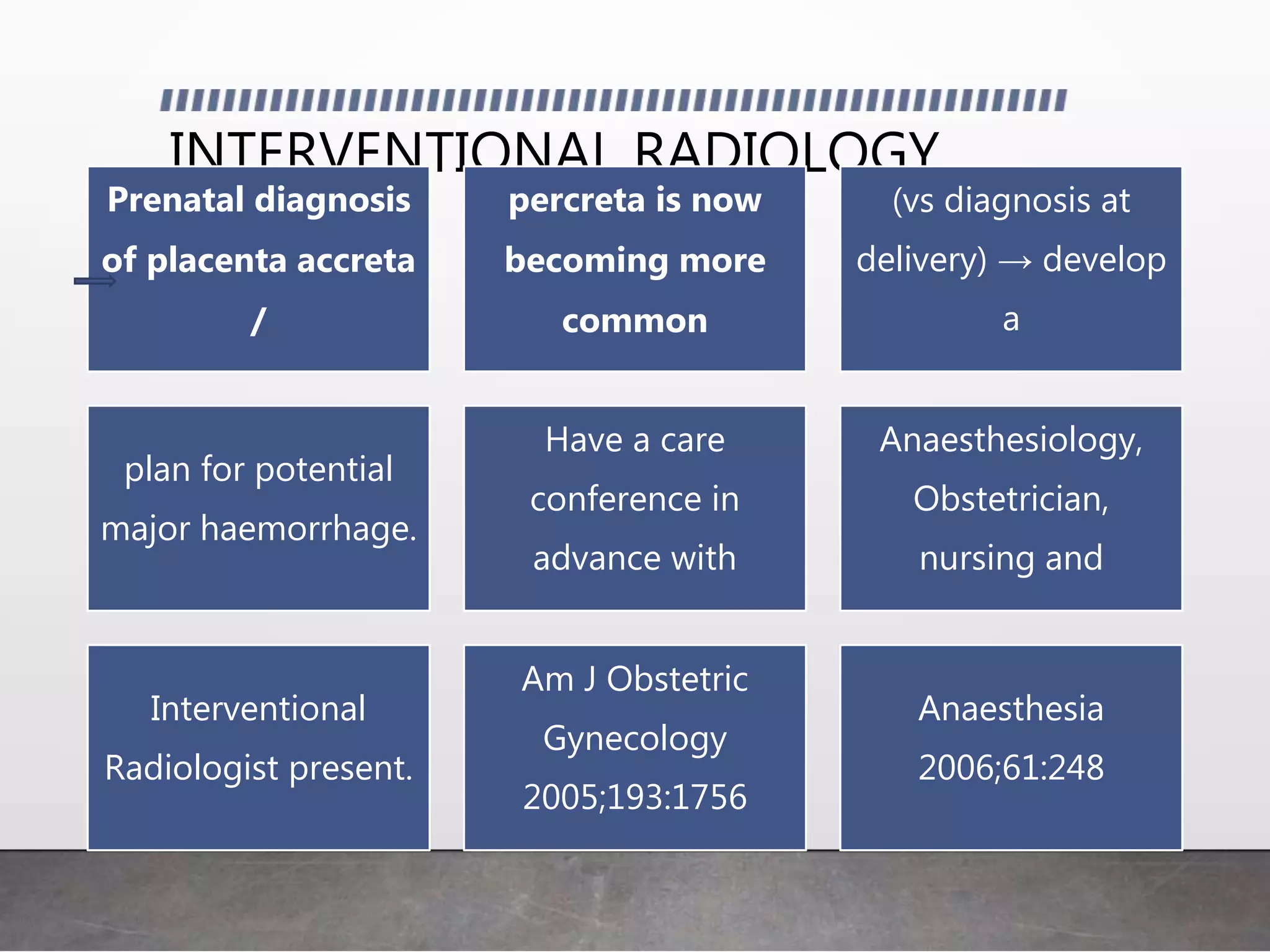
INTERVENTIONAL RADIOLOGY
Prenatal diagnosis
of placenta accreta
/
percreta is now
becoming more
common
(vs diagnosis at
delivery) → develop
a
plan for potential
major haemorrhage.
Have a care
conference in
advance with
Anaesthesiology,
Obstetrician,
nursing and
Interventional
Radiologist present.
Am J Obstetric
Gynecology
2005;193:1756
Anaesthesia
2006;61:248
INTERVENTIONAL RADIOLOGY
Case report: A Jehovah’s Witness
patient
presented with placenta per-creta
invading the bladder. After uterine
and iliac catheters were placed in
IR, caesarean was performed.
Placenta was extensively adherent
to uterus and
penetrating the bladder wall.
Uterine artery embolization was
performed and the placenta left in
place. At 3 months the uterus was
empty
by ultrasound.
Methotrexate was considered, but
was unnecessary.
Obstetric Gynecology
2005;105:1247
Amniotic Fluid Embolism
Definition:
Amniotic fluid embolism is when
the amniotic fluid enters the
maternal circulation in cases of
tetanic uterine contractions
Especially in cases of IUD
Twin pregnancy Macrosomia Antepartum hemorrahge Multiparity
Hydramnios
Precipitate Labor
• Incidence
Rare 1 in 80000 Mortality rate 80%
Clinical features
Suspect when
Sudden onset of maternal
respiratory distress.
Cardiovascular collapse –
tachycardia, hypotension,
pulmonary hypertension,( right
heart failure and cardiac arrest).
Convulsions Hemorrhage DIVC.
differential diagnosis
• Pulmonary embolism
• Myocardial infarction
• Anaphylactic reaction
• Stroke
• Aspiration pneumonia
Management
Red Alert ABC resuscitation
Supportive therapy i.e.
• -ICU care
• -Ventilate and oxygenate
• -fluid management
• -CVP – monitoring
• -maintain cardiac output –inotropes
• -correct DIVC
Uterine inversion-Definition
Uterine inversion.
Fundus falls into the uterine cavity and the inside of the uterus is
turned outward with the placenta attached to the uterine wall.
Uterus is partly or completely turned inside out.
Uterine Inversion
Rare, 1 in 2000 deliveries
Types -Degree
• Inverted fundus extended to level of os
• Inverted fundus gone through os but not at introitus level
• Inverted fundus extended to introitus
• Uterus and cervix extended below introitus, associated with vaginal inversion
Completeness of inversion
• Complete – fundus has passed through the os
• Incomplete - inverted fundus still inside os
Uterine Inversion- Clinical features
Pain, haemorrhage or shock in
the presence of an inverted
(vaginally) or indented
(abdominally) uterus
Degree of shock more maybe
out of proportion of bleeding -
vasovagal shock!
90% will have PPH
40% will be in shock
96% occurs in first 24 hours
post partum
Chronic inversion can occur at
> 4weeks (very rare).
Complications
Neurogenic shock,
operation,
infection,
hemorrhage
maternal mortality.
Uterine Inversion -
Management
• ABC resuscitation, Red Alert
• IV fluids, blood transfusion
• Replace uterus soon, but do not
remove placenta until uterus is
contracted
• Manually replace it, 30% successful
without tocolytics
• If unsuccessful, do under tocolytics
• If unsuccessful do under GA
Uterine
Inversion-
management
• Once replaced, hand in uterus until
contracted.
• Give Oxytocin IV infusion or
Syntometrine IM
• Remove placenta only after uterus
contracted
• O’Sullivan Method – hydrostatic
pressure to replace uterus
• Check for trauma once replaced
• If all fail, Laparotomy, hysterectomy
ANESTHETIC MANAGEMENT
OF INVERSION
Uterine relaxation:
NTG (50-500 µg),
terbutaline, GETA
• Analgesia:
Pre-existing
epidural, ketamine,
GETA
Volume
resuscitation
Uterine contraction
with oxytocic's once
the
uterus is replaced
Uterine Rupture
Definition – complete separation of wall of pregnant uterus, before or during
labour
Risk Factors
• Previous one scar – risk of 0.5%
• Previous two scar – 2%
• Previous classical scar – 3-4%
• Previous ruptured lower segment – 4-10%
• Others – Myomectomy, Instrumental delivery, Trauma, High Parity, Prostin, oxytocin, obstructed
labour e.g.. Transverse lie
Uterine Rupture
• Maternal tachycardia
• Fetal distress –most common
• Abdominal pain – mild to severe (scar tenderness)
• Disappearance of presenting part from pelvis
• Shock, Per vaginal bleed
• Cessation of contractions
• haematuria
Suspect when
Can be asymptomatic
Weak
uterine scar
• Predisposing factors:
- Impaired healing of the uterine scar
- Over-distended uterus
- Obstructed labor
- Improper oxytocin use
- Uterine manipulation- MRP, Internal
podalic version, uterine inversion, previous
uterine surgery, after-coming head of fetus,
difficult forceps
- Multi-parity
- CPD
Types of rupture
Violent rupture
Usually associated with
causes such as obstructed
labor or the misuse of
oxytocic drugs.
The onset is dramatic and
occur during labor.
Silent rupture
Mild pain and collapse Impending rupture Signs of obstructed labor Tonic uterine contraction
Band's ring
Tenderness in the lower
abdomen
Laparotomy if uterine rupture is suspected.
Resuscitate mother, treat shock, transfuse blood
Antibiotic cover
Minor tear- repair and bilateral tubal ligation
Major tear- hysterectomy
Resuscitate baby
Uterine
Rupture
• Management
• ABC resuscitation, red alert if in shock
• IV line x2 large bore,
• Laparotomy
• Repair of rupture, CS in next
pregnancy
• Hysterectomy
DIAGNOSIS OF UTERINE
RUPTURE
Fatal distress (#1)
Cessation of uterine contractions (in labour)
Vaginal bleeding
Abdominal pain
MANAGEMENT OF
UTERINE RUPTURE
Uterine repair vs. Hysterectomy
Uterine rupture occurs in 1% of Lower segment uterine scars and 4-9% of classical incisions.
ACOG has practice guidelines for
management of VBAC.
Obstetric Gynecology 2004;104:203
RISK
FACTORS
FOR
UTERINE
ATONY
• Multiple gestation
• Precipitous labour
• Macrosomia
• Prolonged labour
• Polyhydramnios
• Augmented labor
• Grand multiparity (>5)
• Chorio-amnionitis
• Maternal age > 40
• Tocolytic agents
• Halogenated
• anaesthetics
MANAGEMENT OF
UTERINE ATONY
Bimanual uterine
compression and
Massage
Infusion of
oxytocin
Evaluation for
retained placenta
Use of other
oxytocic's
OXYTOCIC
DRUGS
• Drug/Dose Side Effects
• A. Oxytocin vasodilation with IV bolus,
hyponatremia
• diffuse vasoconstriction,
• 20-80 U/L
• B. Methergine® pulmonary and systemic
vasospasm, nausea
• bronchospasm, pulmonary
• (methylergonovine) hypertension, hypoxia,
• C. (prostaglandin F2α) nausea, diarrhoea,
hypertension, coronary
• 250 μg IM
• D. Hemabate®
• 0.2 mg IM
OXYTOCIN REGIMENS
The “Confidential
Enquiries into
Maternal
Deaths, 1997-1999”
describes two
deaths in
which the
anaesthesiologist
gave an IV bolus
of oxytocin after
delivery with
subsequent
maternal cardiac
arrest and death.
The
associated maternal
conditions were:
Postpartum
haemorrhage with
hypotension
Pulmonary
hypertension
OXYTOCIN
Two abstracts evaluated hemodynamic after 5 units
IV bolus oxytocin in healthy women with spinal
anaesthesia for caesarean.
MAP ↓ 27%, HR ↑ 17 beats per minute
Cardiac index ↑ 61% above baseline
Systemic vascular index ↓ 39%
No ↑ blood loss when given over 5 minutes
IJOA 2006;15:A-P01 and Anaesthesiology 2006;105:A11
ANESTHETIC
MANAGEMENT
OF ATONY
Volume Resuscitation
Large bore IVs, T&C, warmers, monitors
Analgesia
Pre-existing epidural, ketamine, GETA
Oxytocic's
Know side effects!
Move to O.R. sooner rather than later.
Consider notifying Interventional Radiology.
ANESTHETIC
MANAGEMENT
• The authors present a series of 12 cases using
• recombinant factor VIIa for life-threatening
• postpartum haemorrhage. They recommend its
• use before resorting to hysterectomy in cases of
• intractable PPH.
• At their hospital, the cost of one dose of Ravia =
• 50 units PRBC = an embolization procedure = 2
• days of ICU treatment. Cost effective??
• Br J Anaesth 2005;94:592
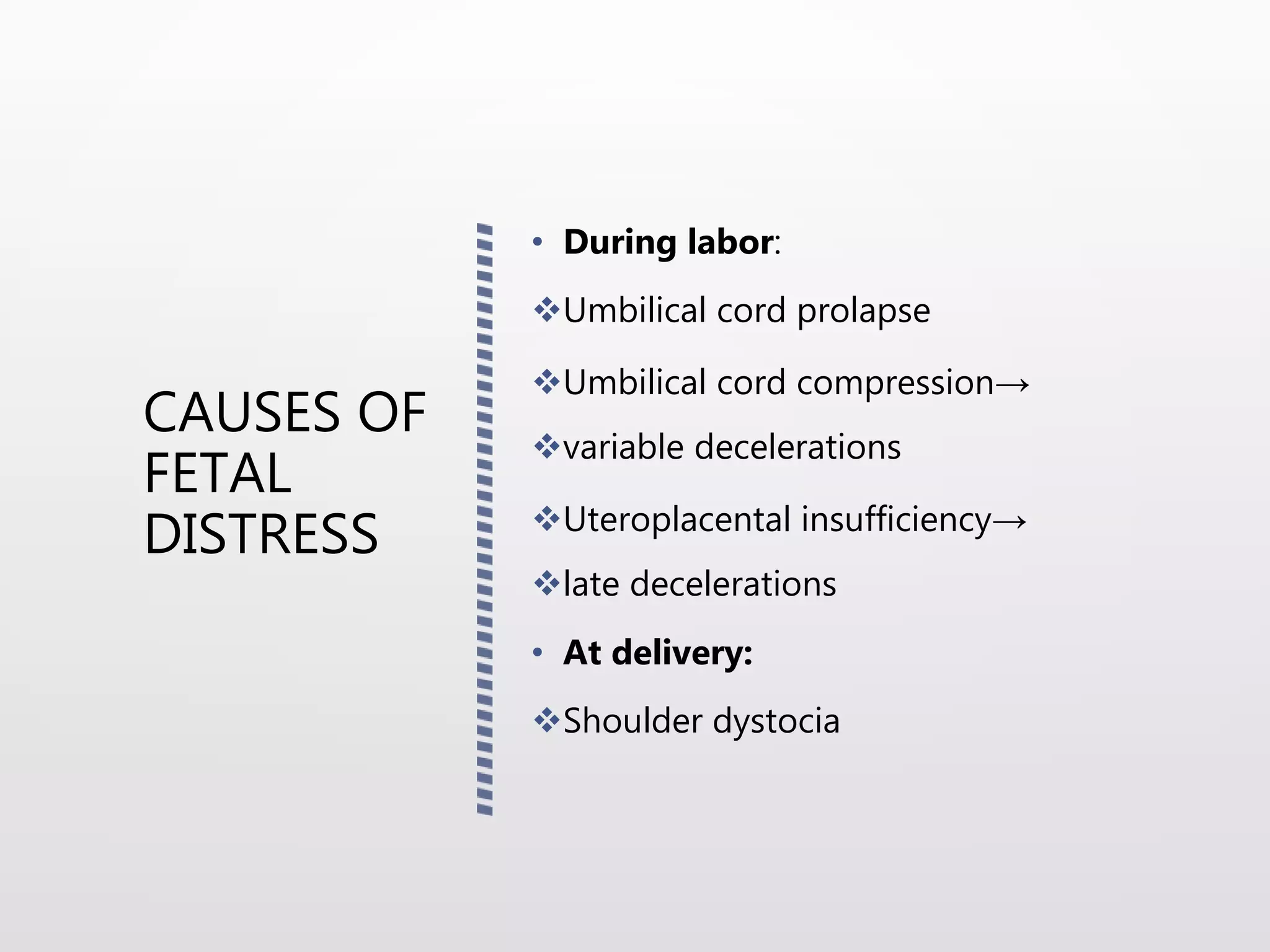
CAUSES OF
FETAL
DISTRESS
• During labor:
Umbilical cord prolapse
Umbilical cord compression→
variable decelerations
Uteroplacental insufficiency→
late decelerations
• At delivery:
Shoulder dystocia
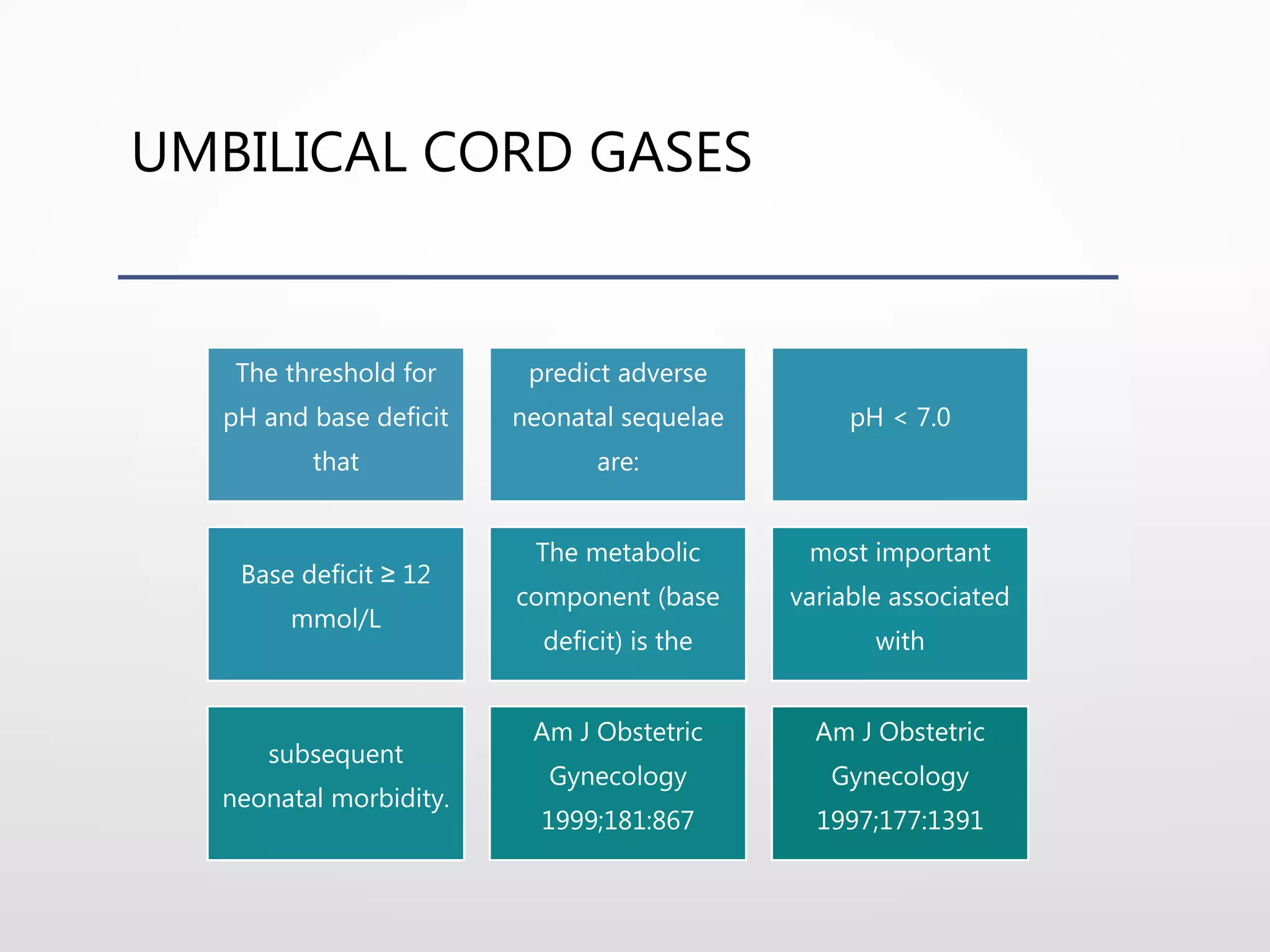
UMBILICAL CORD GASES
The threshold for
pH and base deficit
that
predict adverse
neonatal sequelae
are:
pH < 7.0
Base deficit ≥ 12
mmol/L
The metabolic
component (base
deficit) is the
most important
variable associated
with
subsequent
neonatal morbidity.
Am J Obstetric
Gynecology
1999;181:867
Am J Obstetric
Gynecology
1997;177:1391
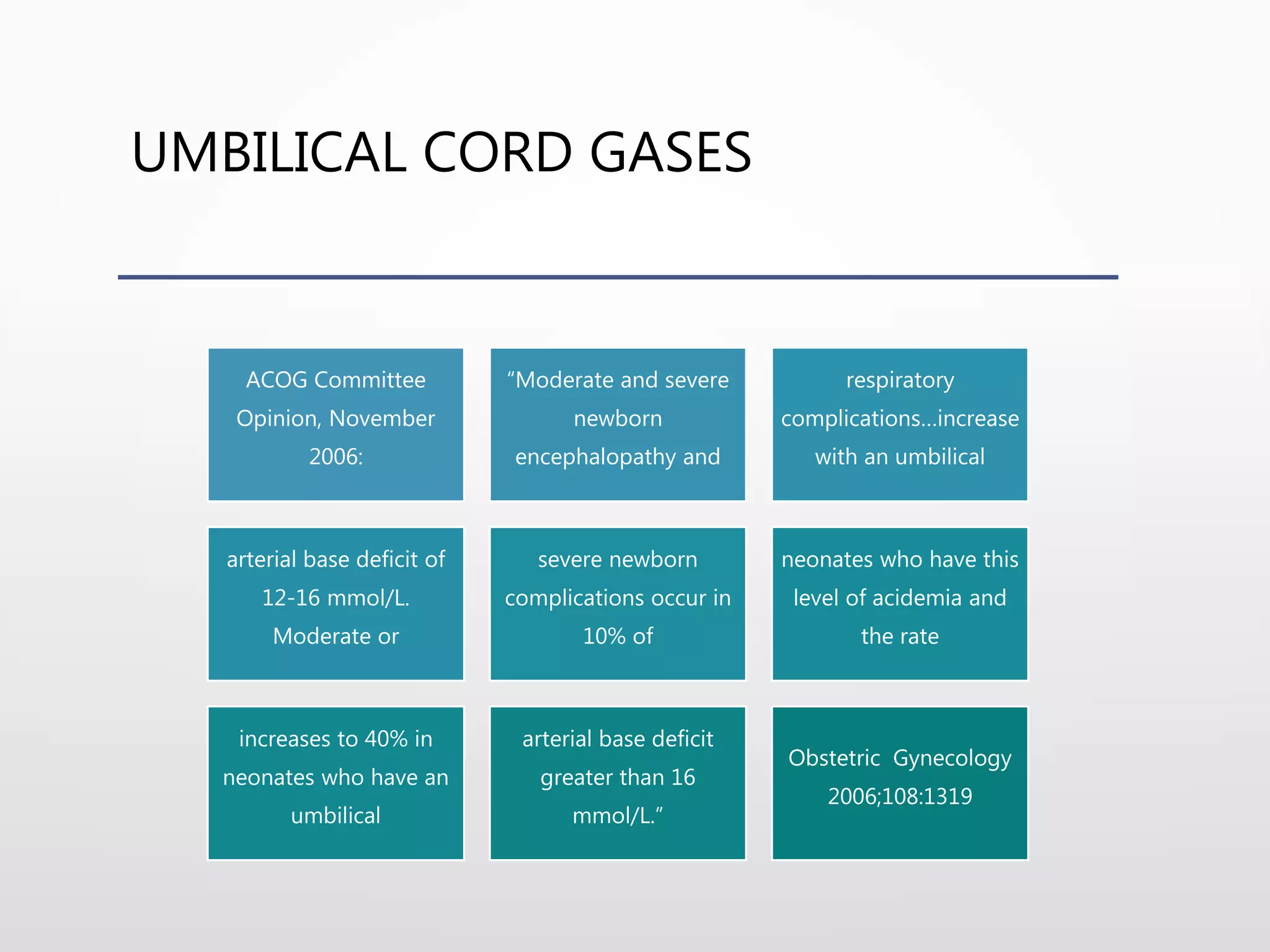
UMBILICAL CORD GASES
ACOG Committee
Opinion, November
2006:
“Moderate and severe
newborn
encephalopathy and
respiratory
complications…increase
with an umbilical
arterial base deficit of
12-16 mmol/L.
Moderate or
severe newborn
complications occur in
10% of
neonates who have this
level of acidemia and
the rate
increases to 40% in
neonates who have an
umbilical
arterial base deficit
greater than 16
mmol/L.”
Obstetric Gynecology
2006;108:1319
Thank you

21 07-30 obstetric emergencies

  • 1.
  • 2.
    Obstetrics Emergency Life threateningconditions where mother can be in shock or cardiac arrest Causes Antepartum •Ectopic Pregnancy •Miscarriage •APH •PPH •Eclampsia •Uterine Rupture Postpartum •Uterine Inversion •Amniotic Fluid Embolism •Birth trauma
  • 3.
    Obstetrics emergency- “Lotsof people confuse destiny with bad management.” To avoid “bad management”, we should know, how to avoid a Rapid deterioration Rapid response of treating team Risk factors -Knowledge and skills required Diagnostic criteria- knowledge and availability Obstetric management- Proper and aggressive management ,Basis resuscitation – ABC Anaesthetics management- Training and drills
  • 4.
    RISK FACTORS FOR ABNORMALPLACENTATION Uterine fibroids Prior caesarean section History of postpartum haemorrhage Multiparity
  • 5.
    Obstetric Management • Placenta Previa Caesarean delivery: elective (if stable) or  urgent (if haemorrhaging) • Accreta/Percreta  Recognition and (probably) hysterectomy  May need surgeons with experience in  bowel or urological surgery for per-creta
  • 6.
    ANESTHETIC MANAGEMENT FOR PREVIA  Examinethe airway and provide aspiration prophylaxis.  Ask OB about previous caesarean scar on ultrasound (risk of accreta).  Place two large-bore IV lines and have warmers  available.  BLOOD Should be typed and cross-matched.  decide on the type of anaesthetic? • A review of 514 women with placenta previa found: • No differences between general or regional anaesthesia • Am J Obstetric Gynecology 1999;180:1432
  • 7.
    USE OF CELLSALVAGE- Autotransfusion A multicenter review of 139 patients who were auto-transfused during caesarean delivery compared them to a control group receiving banked blood. There was no difference in: Length of hospitalization Need for ventilatory support / A.R.D.S. Coagulopathy or amniotic fluid embolism Infectious morbidity Am J Obstetric Gyn 1998;179:715
  • 8.
    USE OF CELL SALVAGE • Cellsalvage combined with blood filtration • produced blood samples equivalent to • maternal central venous blood. • Editorial: Until a large prospective • randomized study is done, cell salvage • during C/S should only be used when • necessary to preserve life – e.g., Jehovah’s • Witness, difficult cross-match. • Anaesthesiology 2000;92:1519 and 1531
  • 9.
    INTERVENTIONAL RADIOLOGY Prenatal diagnosis ofplacenta accreta / percreta is now becoming more common (vs diagnosis at delivery) → develop a plan for potential major haemorrhage. Have a care conference in advance with Anaesthesiology, Obstetrician, nursing and Interventional Radiologist present. Am J Obstetric Gynecology 2005;193:1756 Anaesthesia 2006;61:248
  • 10.
    INTERVENTIONAL RADIOLOGY Case report:A Jehovah’s Witness patient presented with placenta per-creta invading the bladder. After uterine and iliac catheters were placed in IR, caesarean was performed. Placenta was extensively adherent to uterus and penetrating the bladder wall. Uterine artery embolization was performed and the placenta left in place. At 3 months the uterus was empty by ultrasound. Methotrexate was considered, but was unnecessary. Obstetric Gynecology 2005;105:1247
  • 11.
    Amniotic Fluid Embolism Definition: Amnioticfluid embolism is when the amniotic fluid enters the maternal circulation in cases of tetanic uterine contractions Especially in cases of IUD Twin pregnancy Macrosomia Antepartum hemorrahge Multiparity Hydramnios Precipitate Labor • Incidence Rare 1 in 80000 Mortality rate 80%
  • 12.
    Clinical features Suspect when Suddenonset of maternal respiratory distress. Cardiovascular collapse – tachycardia, hypotension, pulmonary hypertension,( right heart failure and cardiac arrest). Convulsions Hemorrhage DIVC.
  • 13.
    differential diagnosis • Pulmonaryembolism • Myocardial infarction • Anaphylactic reaction • Stroke • Aspiration pneumonia
  • 14.
    Management Red Alert ABCresuscitation Supportive therapy i.e. • -ICU care • -Ventilate and oxygenate • -fluid management • -CVP – monitoring • -maintain cardiac output –inotropes • -correct DIVC
  • 15.
    Uterine inversion-Definition Uterine inversion. Fundusfalls into the uterine cavity and the inside of the uterus is turned outward with the placenta attached to the uterine wall. Uterus is partly or completely turned inside out.
  • 16.
    Uterine Inversion Rare, 1in 2000 deliveries Types -Degree • Inverted fundus extended to level of os • Inverted fundus gone through os but not at introitus level • Inverted fundus extended to introitus • Uterus and cervix extended below introitus, associated with vaginal inversion Completeness of inversion • Complete – fundus has passed through the os • Incomplete - inverted fundus still inside os
  • 17.
    Uterine Inversion- Clinicalfeatures Pain, haemorrhage or shock in the presence of an inverted (vaginally) or indented (abdominally) uterus Degree of shock more maybe out of proportion of bleeding - vasovagal shock! 90% will have PPH 40% will be in shock 96% occurs in first 24 hours post partum Chronic inversion can occur at > 4weeks (very rare).
  • 18.
  • 19.
    Uterine Inversion - Management •ABC resuscitation, Red Alert • IV fluids, blood transfusion • Replace uterus soon, but do not remove placenta until uterus is contracted • Manually replace it, 30% successful without tocolytics • If unsuccessful, do under tocolytics • If unsuccessful do under GA
  • 20.
    Uterine Inversion- management • Once replaced,hand in uterus until contracted. • Give Oxytocin IV infusion or Syntometrine IM • Remove placenta only after uterus contracted • O’Sullivan Method – hydrostatic pressure to replace uterus • Check for trauma once replaced • If all fail, Laparotomy, hysterectomy
  • 21.
    ANESTHETIC MANAGEMENT OF INVERSION Uterinerelaxation: NTG (50-500 µg), terbutaline, GETA • Analgesia: Pre-existing epidural, ketamine, GETA Volume resuscitation Uterine contraction with oxytocic's once the uterus is replaced
  • 22.
    Uterine Rupture Definition –complete separation of wall of pregnant uterus, before or during labour Risk Factors • Previous one scar – risk of 0.5% • Previous two scar – 2% • Previous classical scar – 3-4% • Previous ruptured lower segment – 4-10% • Others – Myomectomy, Instrumental delivery, Trauma, High Parity, Prostin, oxytocin, obstructed labour e.g.. Transverse lie
  • 23.
    Uterine Rupture • Maternaltachycardia • Fetal distress –most common • Abdominal pain – mild to severe (scar tenderness) • Disappearance of presenting part from pelvis • Shock, Per vaginal bleed • Cessation of contractions • haematuria Suspect when Can be asymptomatic
  • 24.
    Weak uterine scar • Predisposingfactors: - Impaired healing of the uterine scar - Over-distended uterus - Obstructed labor - Improper oxytocin use - Uterine manipulation- MRP, Internal podalic version, uterine inversion, previous uterine surgery, after-coming head of fetus, difficult forceps - Multi-parity - CPD
  • 25.
    Types of rupture Violentrupture Usually associated with causes such as obstructed labor or the misuse of oxytocic drugs. The onset is dramatic and occur during labor. Silent rupture Mild pain and collapse Impending rupture Signs of obstructed labor Tonic uterine contraction Band's ring Tenderness in the lower abdomen
  • 26.
    Laparotomy if uterinerupture is suspected. Resuscitate mother, treat shock, transfuse blood Antibiotic cover Minor tear- repair and bilateral tubal ligation Major tear- hysterectomy Resuscitate baby
  • 27.
    Uterine Rupture • Management • ABCresuscitation, red alert if in shock • IV line x2 large bore, • Laparotomy • Repair of rupture, CS in next pregnancy • Hysterectomy
  • 28.
    DIAGNOSIS OF UTERINE RUPTURE Fataldistress (#1) Cessation of uterine contractions (in labour) Vaginal bleeding Abdominal pain
  • 29.
    MANAGEMENT OF UTERINE RUPTURE Uterinerepair vs. Hysterectomy Uterine rupture occurs in 1% of Lower segment uterine scars and 4-9% of classical incisions. ACOG has practice guidelines for management of VBAC. Obstetric Gynecology 2004;104:203
  • 30.
    RISK FACTORS FOR UTERINE ATONY • Multiple gestation •Precipitous labour • Macrosomia • Prolonged labour • Polyhydramnios • Augmented labor • Grand multiparity (>5) • Chorio-amnionitis • Maternal age > 40 • Tocolytic agents • Halogenated • anaesthetics
  • 31.
    MANAGEMENT OF UTERINE ATONY Bimanualuterine compression and Massage Infusion of oxytocin Evaluation for retained placenta Use of other oxytocic's
  • 32.
    OXYTOCIC DRUGS • Drug/Dose SideEffects • A. Oxytocin vasodilation with IV bolus, hyponatremia • diffuse vasoconstriction, • 20-80 U/L • B. Methergine® pulmonary and systemic vasospasm, nausea • bronchospasm, pulmonary • (methylergonovine) hypertension, hypoxia, • C. (prostaglandin F2α) nausea, diarrhoea, hypertension, coronary • 250 μg IM • D. Hemabate® • 0.2 mg IM
  • 33.
    OXYTOCIN REGIMENS The “Confidential Enquiriesinto Maternal Deaths, 1997-1999” describes two deaths in which the anaesthesiologist gave an IV bolus of oxytocin after delivery with subsequent maternal cardiac arrest and death. The associated maternal conditions were: Postpartum haemorrhage with hypotension Pulmonary hypertension
  • 34.
    OXYTOCIN Two abstracts evaluatedhemodynamic after 5 units IV bolus oxytocin in healthy women with spinal anaesthesia for caesarean. MAP ↓ 27%, HR ↑ 17 beats per minute Cardiac index ↑ 61% above baseline Systemic vascular index ↓ 39% No ↑ blood loss when given over 5 minutes IJOA 2006;15:A-P01 and Anaesthesiology 2006;105:A11
  • 35.
    ANESTHETIC MANAGEMENT OF ATONY Volume Resuscitation Largebore IVs, T&C, warmers, monitors Analgesia Pre-existing epidural, ketamine, GETA Oxytocic's Know side effects! Move to O.R. sooner rather than later. Consider notifying Interventional Radiology.
  • 36.
    ANESTHETIC MANAGEMENT • The authorspresent a series of 12 cases using • recombinant factor VIIa for life-threatening • postpartum haemorrhage. They recommend its • use before resorting to hysterectomy in cases of • intractable PPH. • At their hospital, the cost of one dose of Ravia = • 50 units PRBC = an embolization procedure = 2 • days of ICU treatment. Cost effective?? • Br J Anaesth 2005;94:592
  • 37.
    CAUSES OF FETAL DISTRESS • Duringlabor: Umbilical cord prolapse Umbilical cord compression→ variable decelerations Uteroplacental insufficiency→ late decelerations • At delivery: Shoulder dystocia
  • 38.
    UMBILICAL CORD GASES Thethreshold for pH and base deficit that predict adverse neonatal sequelae are: pH < 7.0 Base deficit ≥ 12 mmol/L The metabolic component (base deficit) is the most important variable associated with subsequent neonatal morbidity. Am J Obstetric Gynecology 1999;181:867 Am J Obstetric Gynecology 1997;177:1391
  • 39.
    UMBILICAL CORD GASES ACOGCommittee Opinion, November 2006: “Moderate and severe newborn encephalopathy and respiratory complications…increase with an umbilical arterial base deficit of 12-16 mmol/L. Moderate or severe newborn complications occur in 10% of neonates who have this level of acidemia and the rate increases to 40% in neonates who have an umbilical arterial base deficit greater than 16 mmol/L.” Obstetric Gynecology 2006;108:1319
  • 40.