Claire Brawdy, Rebecca Wyatt
March 26, 2018
DESIGN THINKING TO
CO-DESIGN SOLUTIONS
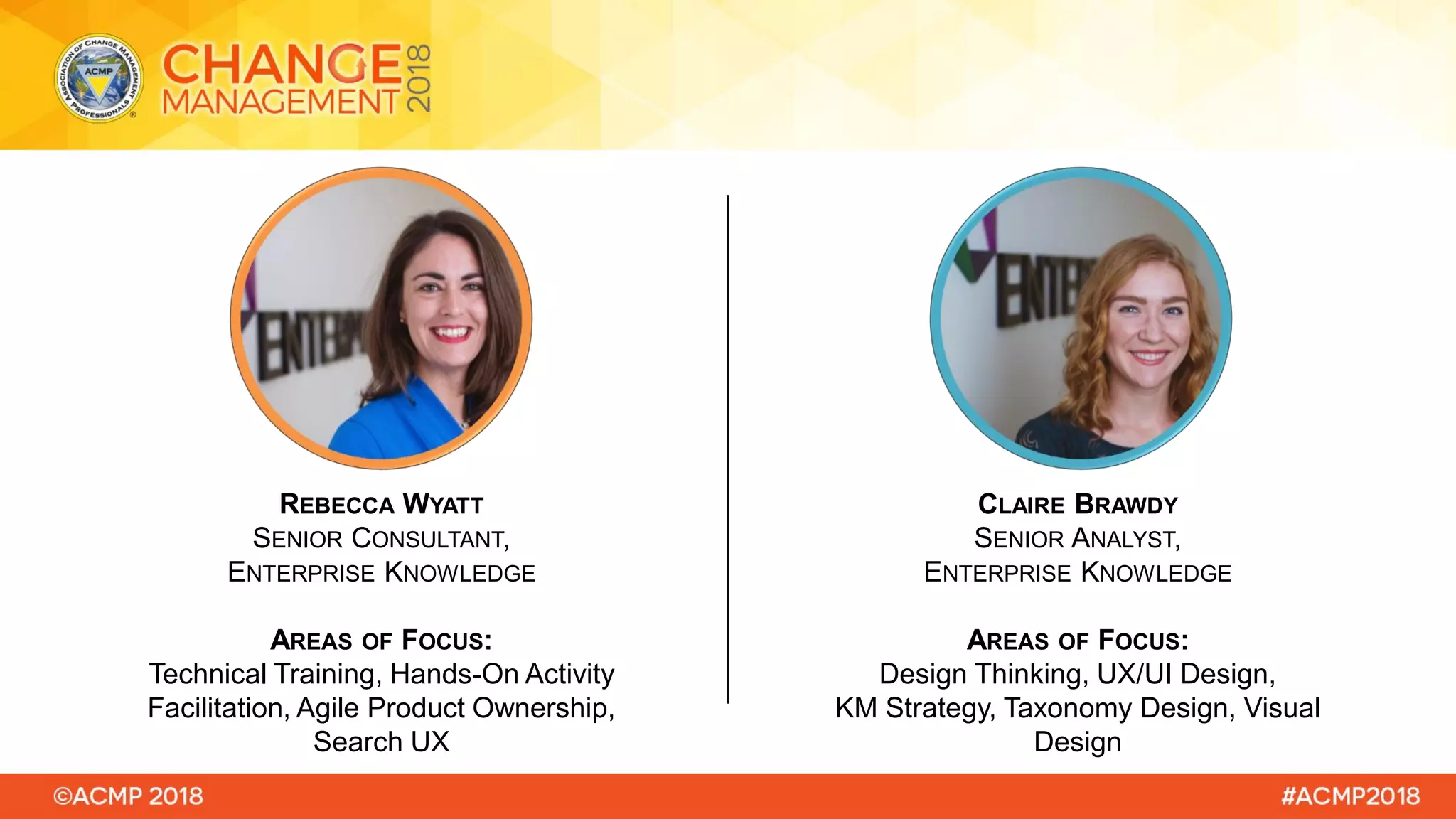
REBECCA WYATT
SENIOR CONSULTANT,
ENTERPRISE KNOWLEDGE
AREAS OF FOCUS:
Technical Training, Hands-On Activity
Facilitation, Agile Product Ownership,
Search UX
CLAIRE BRAWDY
SENIOR ANALYST,
ENTERPRISE KNOWLEDGE
AREAS OF FOCUS:
Design Thinking, UX/UI Design,
KM Strategy, Taxonomy Design, Visual
Design
By the conclusion of this workshop, participants will be
able to:
1. Articulate the phases of Design Thinking.
2. Apply the Design Thinking framework to co-design
an example workshop solution.
3. Utilize the Design Thinking framework when co-
designing solutions in change initiatives.
WORKSHOP OBJECTIVES
• A human-centered approach to problem solving that
brings together the needs of people, technology, and
business to solve complex problems with innovative
solutions.
• In practice, this process is carried out in a more
flexible and non-linear fashion, with stages being
conducted concurrently.
WHAT IS DESIGN THINKING?
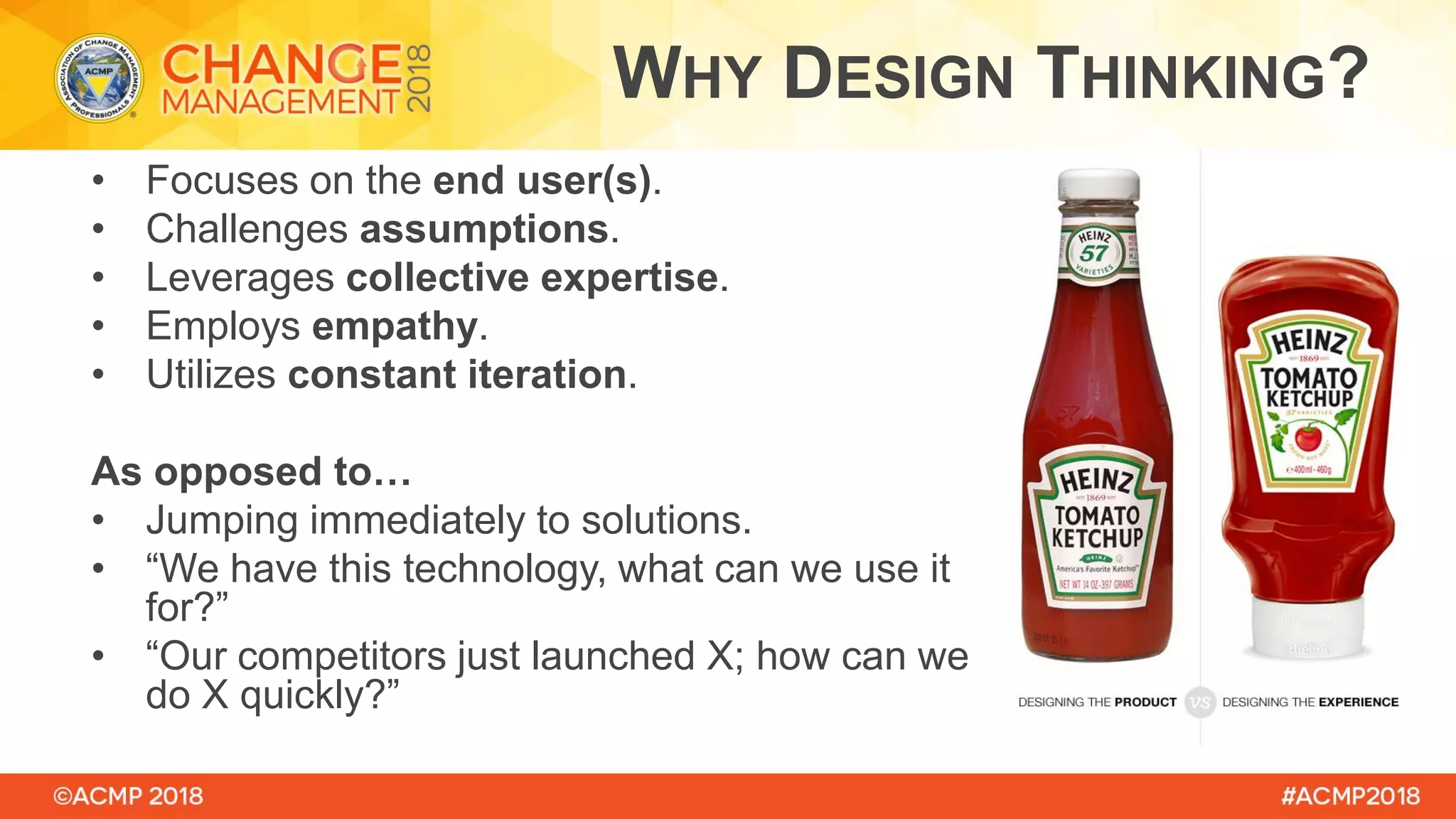
• Focuses on the end user(s).
• Challenges assumptions.
• Leverages collective expertise.
• Employs empathy.
• Utilizes constant iteration.
As opposed to…
• Jumping immediately to solutions.
• “We have this technology, what can we use it
for?”
• “Our competitors just launched X; how can we
do X quickly?”
WHY DESIGN THINKING?
• Active participation is crucial.
– Activities denoted by blue star.
• The process will feel rushed, and that’s purposeful!
• Don’t jump ahead to solutions (until the Ideate phase).
• We’re playing the role of facilitators, not instructors.
• We are learning by doing, therefore the emphasis is on the
process, not the outcomes.
• Have fun and embrace the process!
GROUND RULES
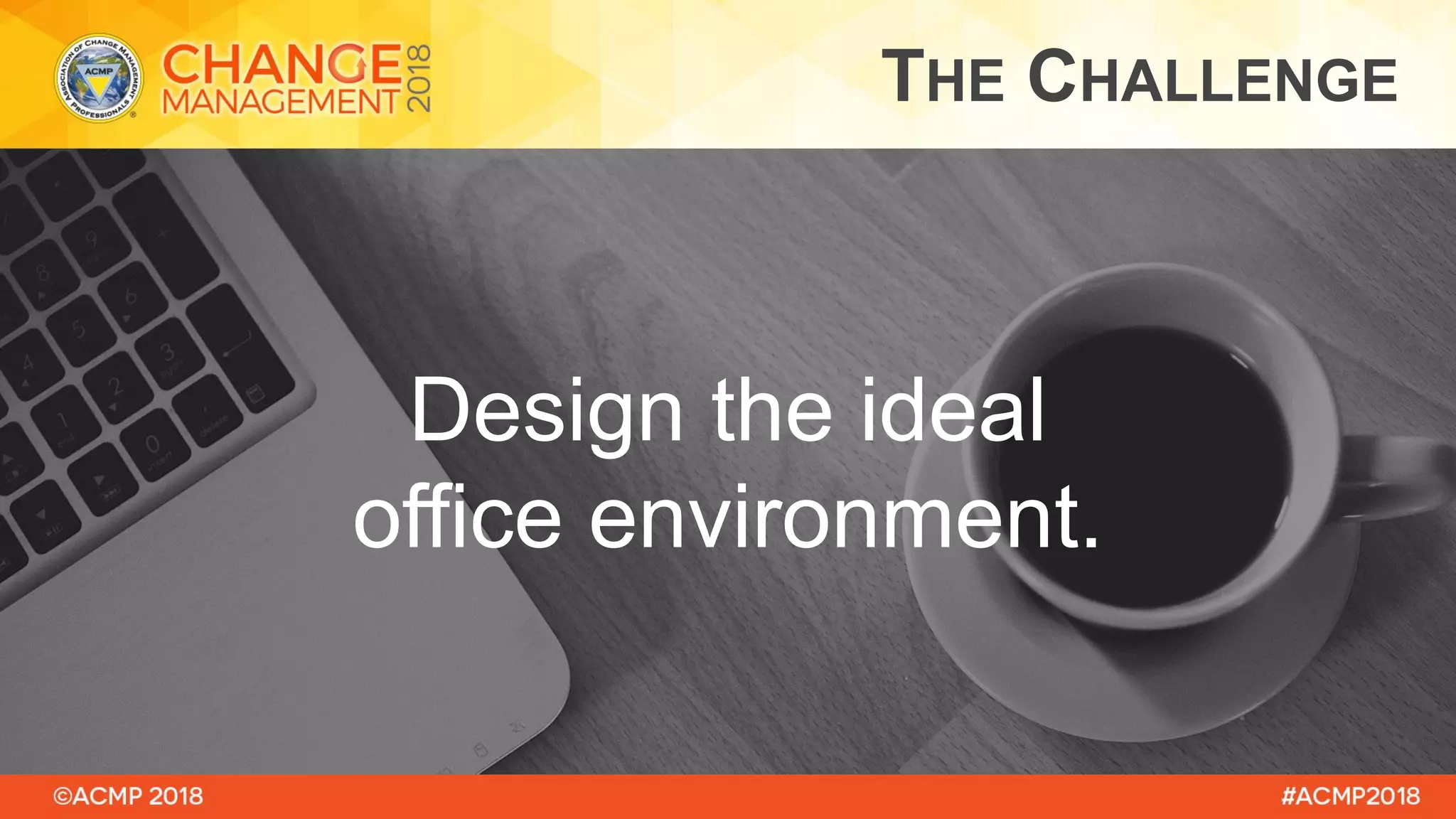
THE CHALLENGE
Design the ideal
office environment.
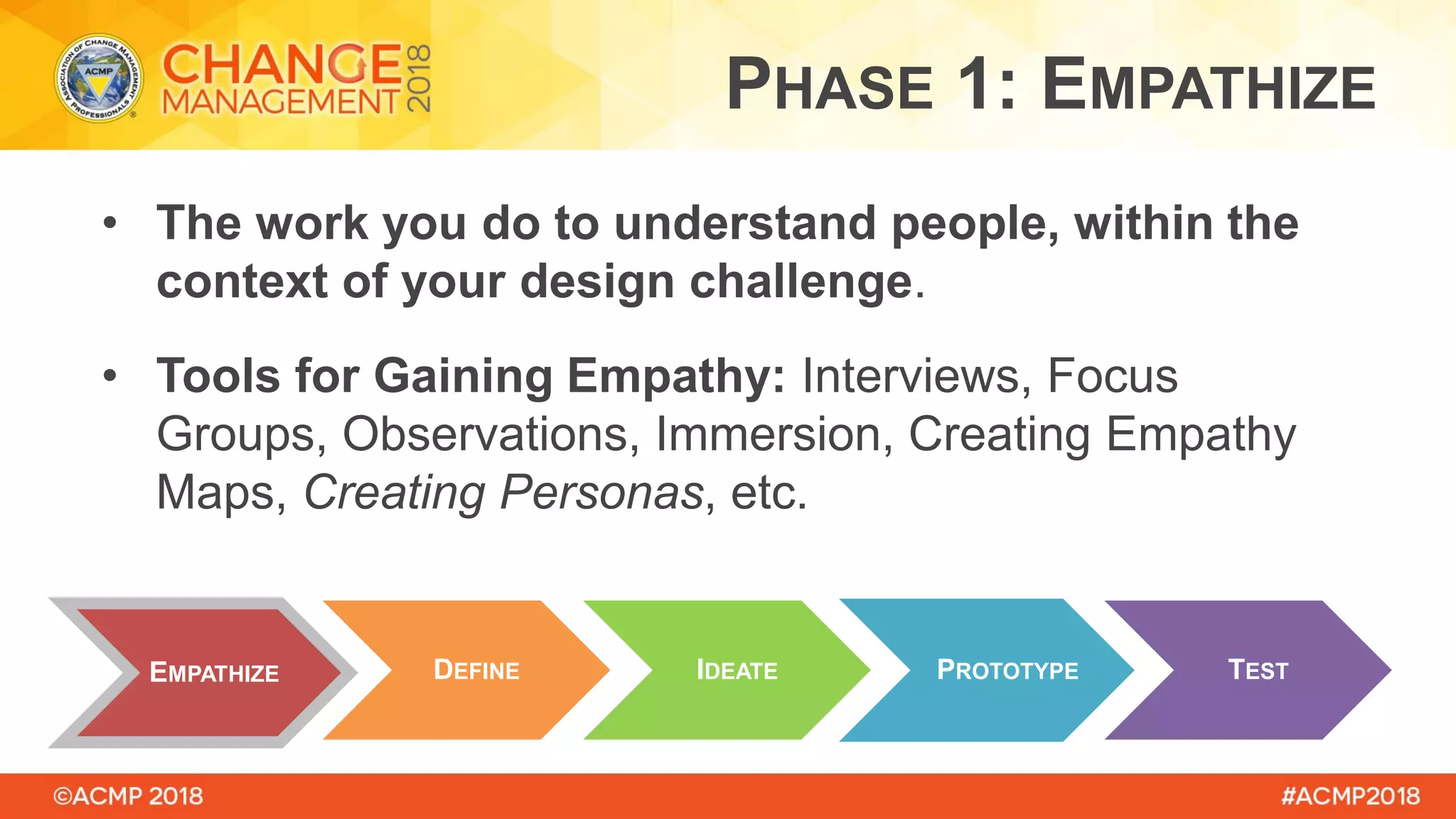
• The work you do to understand people, within the
context of your design challenge.
• Tools for Gaining Empathy: Interviews, Focus
Groups, Observations, Immersion, Creating Empathy
Maps, Creating Personas, etc.
EMPATHIZE DEFINE PROTOTYPEIDEATE TEST
PHASE 1: EMPATHIZE
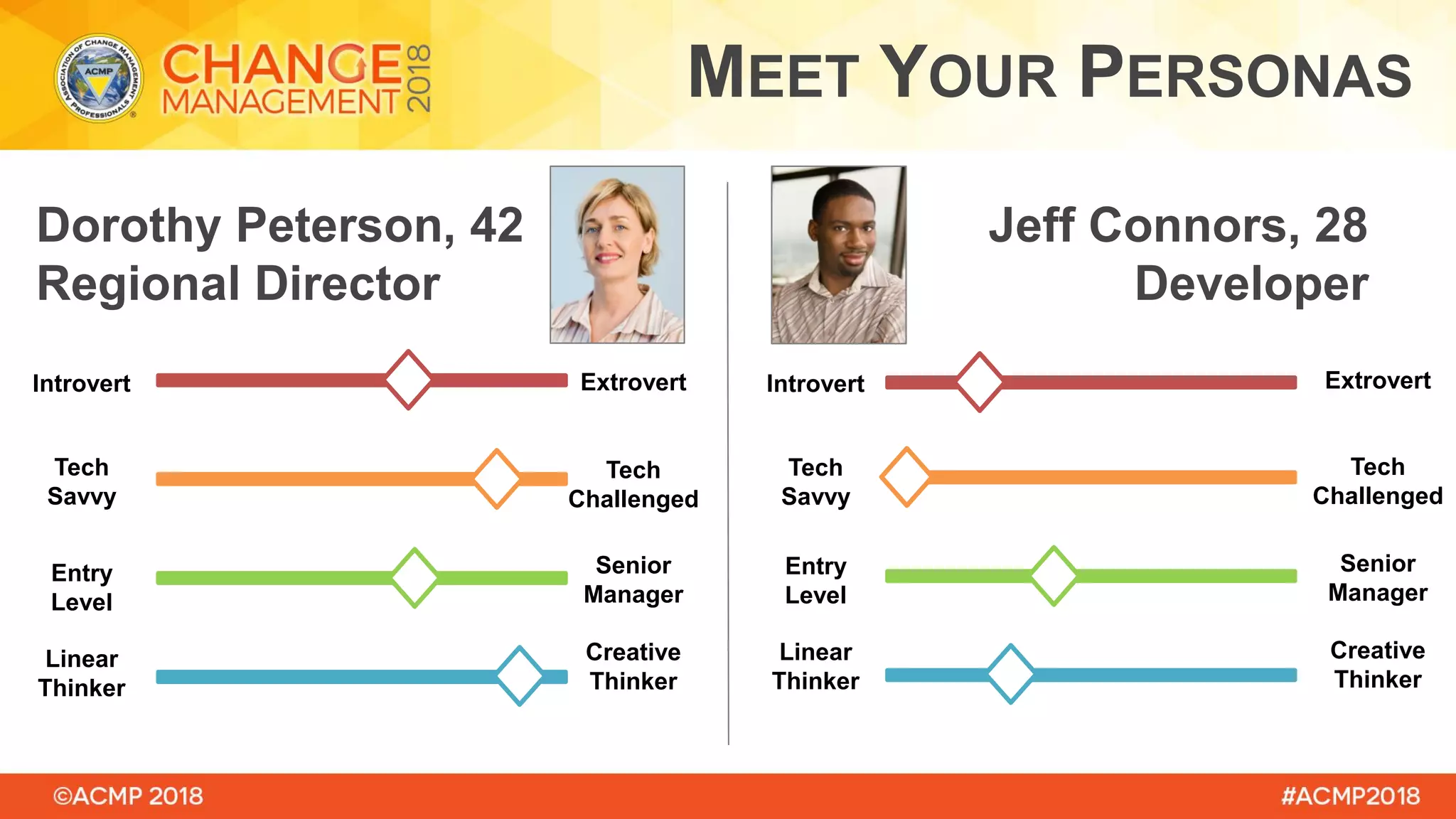
MEET YOUR PERSONAS
Dorothy Peterson, 42
Regional Director
Introvert
Tech
Savvy
Entry
Level
Linear
Thinker
Extrovert
Tech
Challenged
Senior
Manager
Creative
Thinker
Jeff Connors, 28
Developer
Introvert
Tech
Savvy
Entry
Level
Linear
Thinker
Extrovert
Tech
Challenged
Senior
Manager
Creative
Thinker
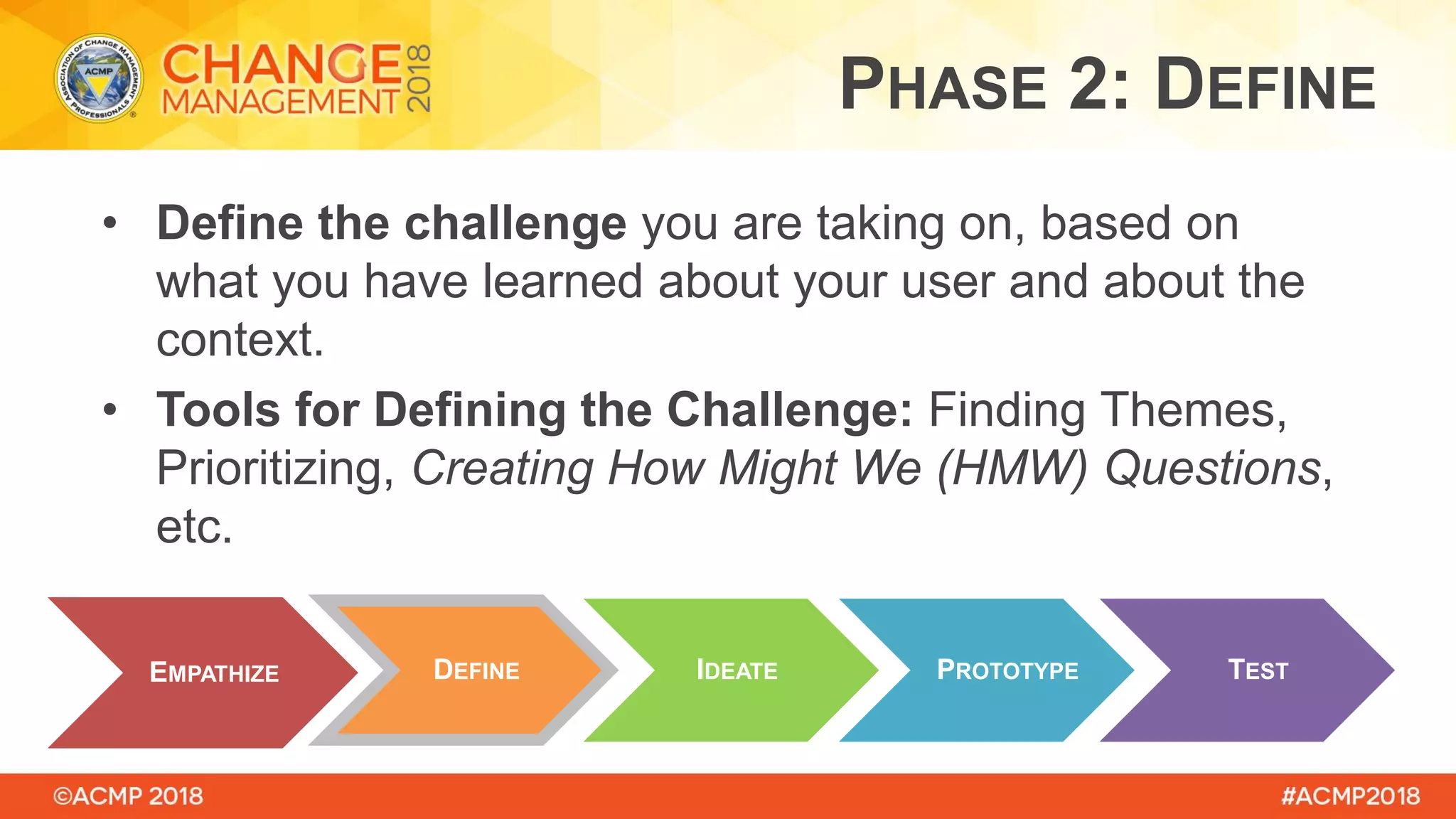
• Define the challenge you are taking on, based on
what you have learned about your user and about the
context.
• Tools for Defining the Challenge: Finding Themes,
Prioritizing, Creating How Might We (HMW) Questions,
etc.
EMPATHIZE DEFINE PROTOTYPEIDEATE TEST
PHASE 2: DEFINE
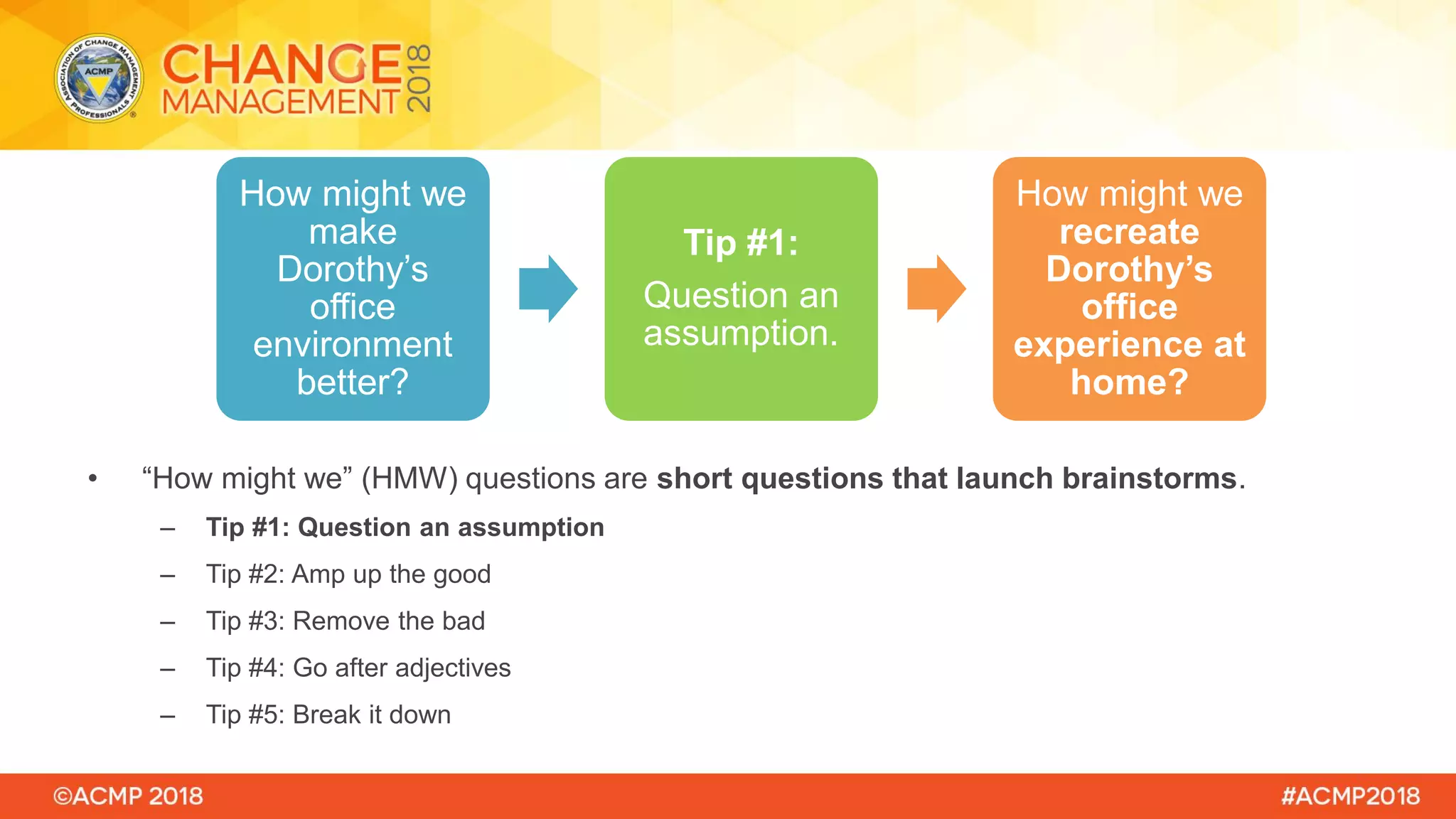
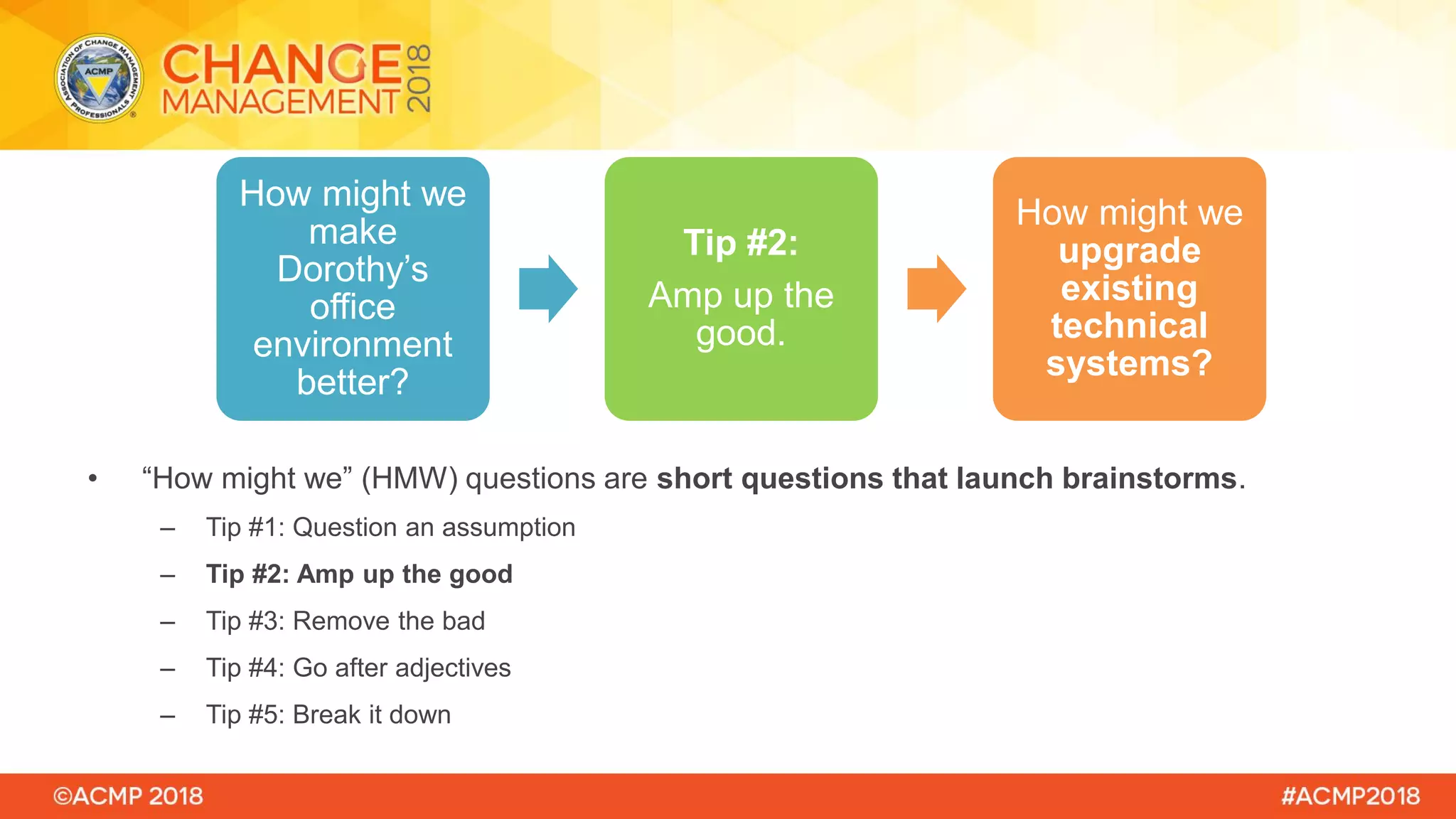
• “How might we” (HMW) questions are short questions that launch brainstorms.
– Tip #1: Question an assumption
– Tip #2: Amp up the good
– Tip #3: Remove the bad
– Tip #4: Go after adjectives
– Tip #5: Break it down
How might we
make
Dorothy’s
office
environment
better?
Tip #1:
Question an
assumption.
How might we
recreate
Dorothy’s
office
experience at
home?
• “How might we” (HMW) questions are short questions that launch brainstorms.
– Tip #1: Question an assumption
– Tip #2: Amp up the good
– Tip #3: Remove the bad
– Tip #4: Go after adjectives
– Tip #5: Break it down
How might we
make
Dorothy’s
office
environment
better?
Tip #2:
Amp up the
good.
How might we
upgrade
existing
technical
systems?
• “How might we” (HMW) questions are short questions that launch brainstorms.
– Tip #1: Question an assumption
– Tip #2: Amp up the good
– Tip #3: Remove the bad
– Tip #4: Go after adjectives
– Tip #5: Break it down
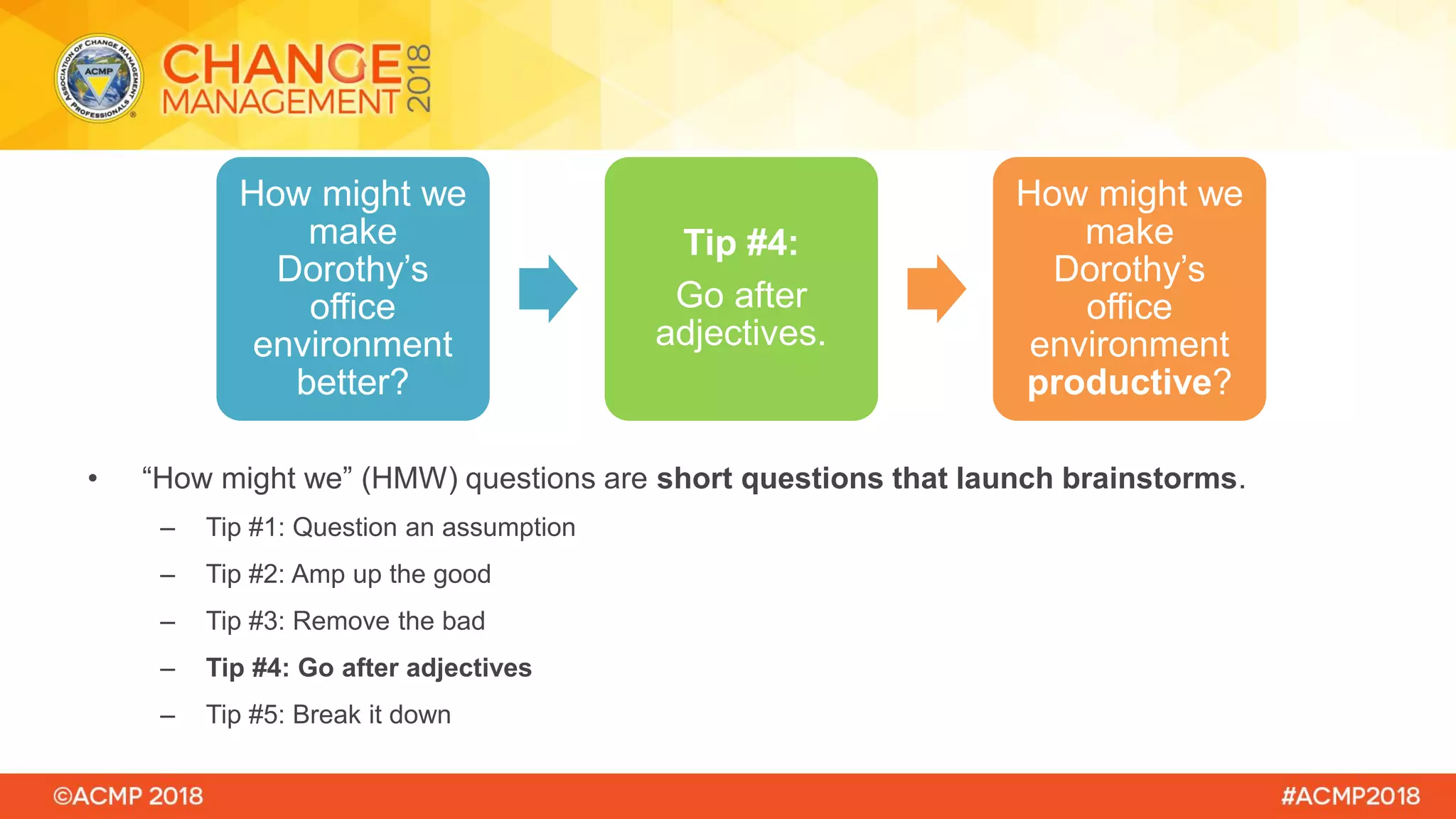
How might we
make
Dorothy’s
office
environment
better?
Tip #4:
Go after
adjectives.
How might we
make
Dorothy’s
office
environment
productive?
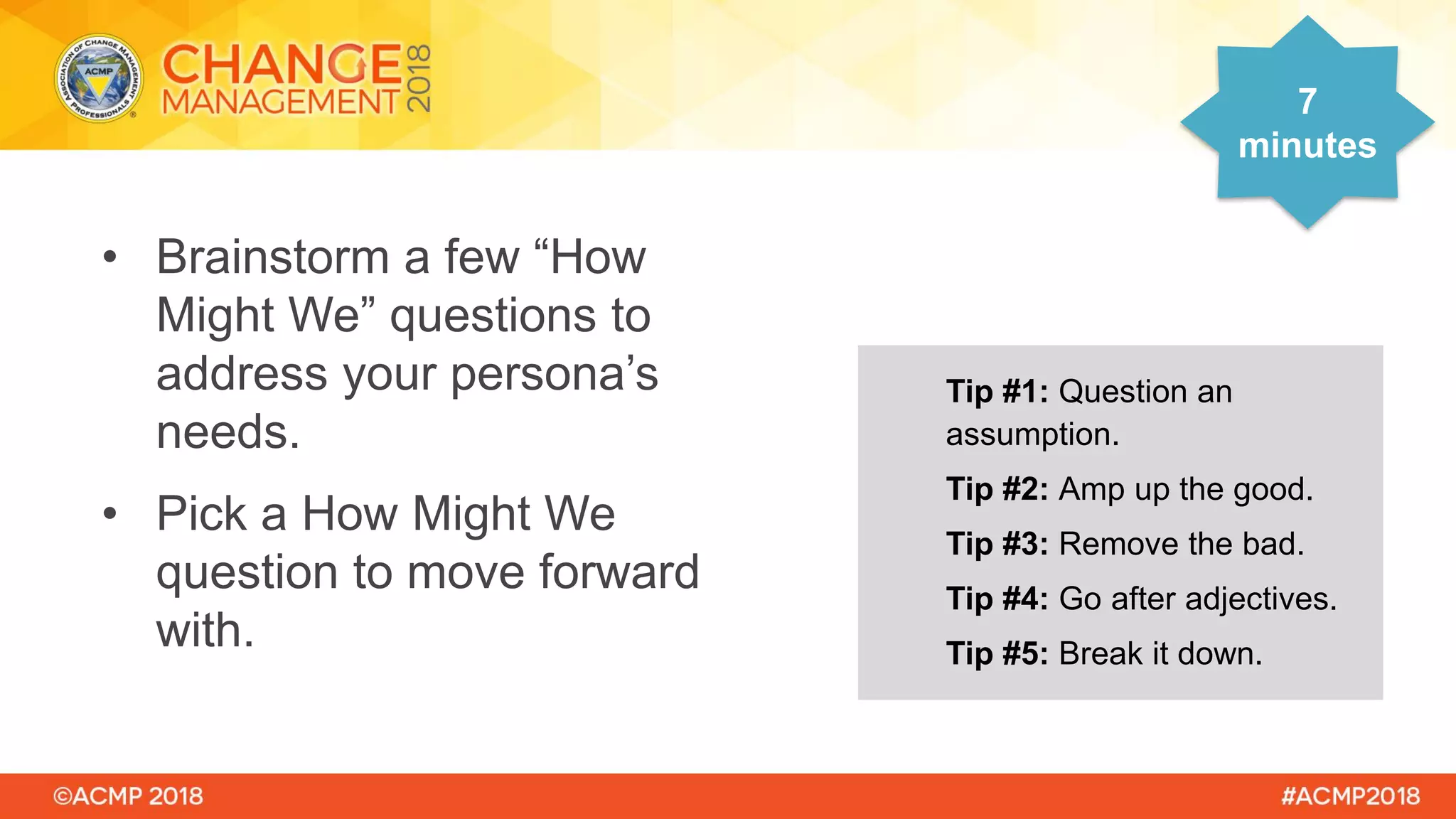
• Brainstorm a few “How
Might We” questions to
address your persona’s
needs.
• Pick a How Might We
question to move forward
with.
7
minutes
Tip #1: Question an
assumption.
Tip #2: Amp up the good.
Tip #3: Remove the bad.
Tip #4: Go after adjectives.
Tip #5: Break it down.
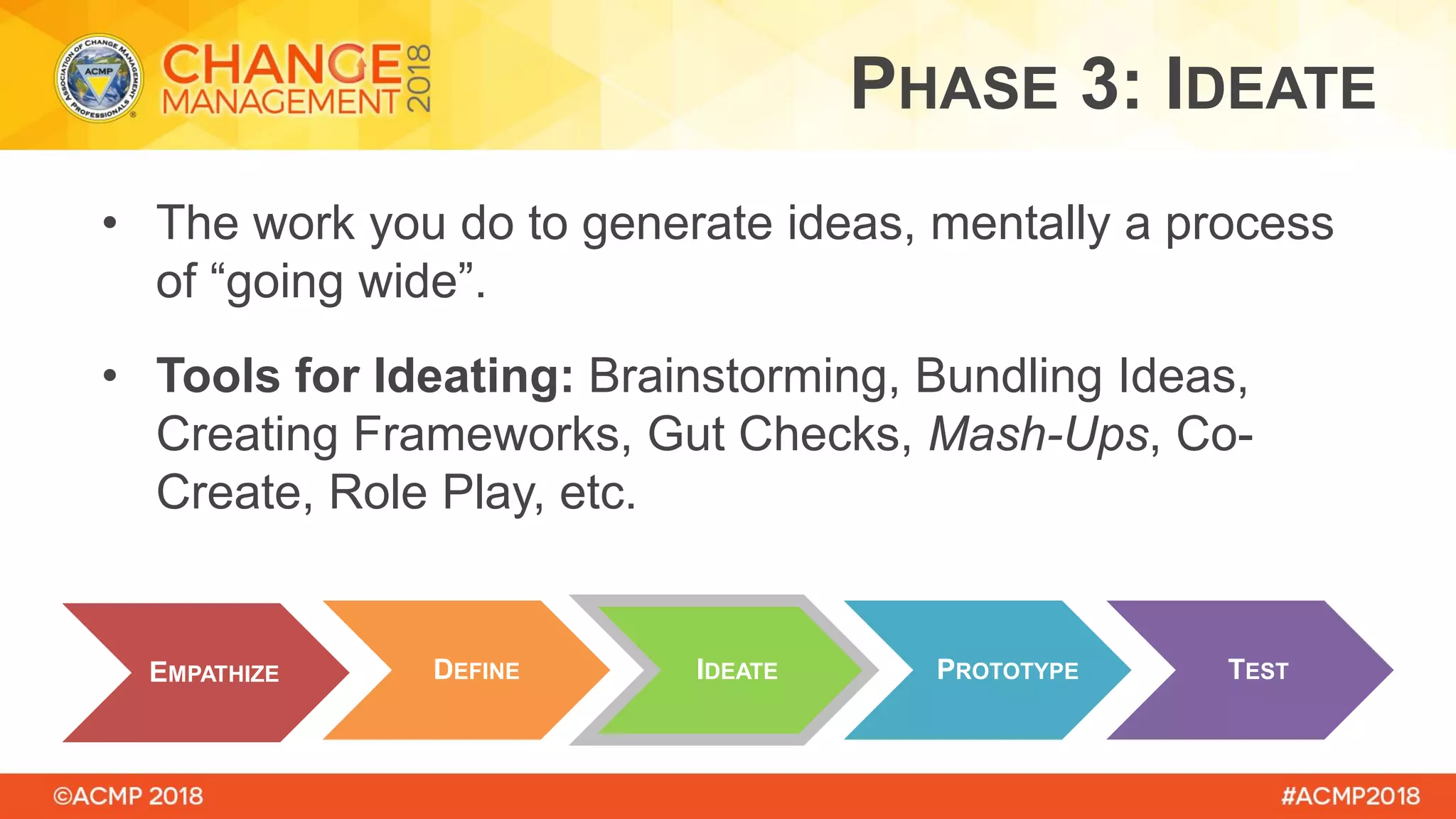
• The work you do to generate ideas, mentally a process
of “going wide”.
• Tools for Ideating: Brainstorming, Bundling Ideas,
Creating Frameworks, Gut Checks, Mash-Ups, Co-
Create, Role Play, etc.
EMPATHIZE DEFINE PROTOTYPEIDEATE TEST
PHASE 3: IDEATE
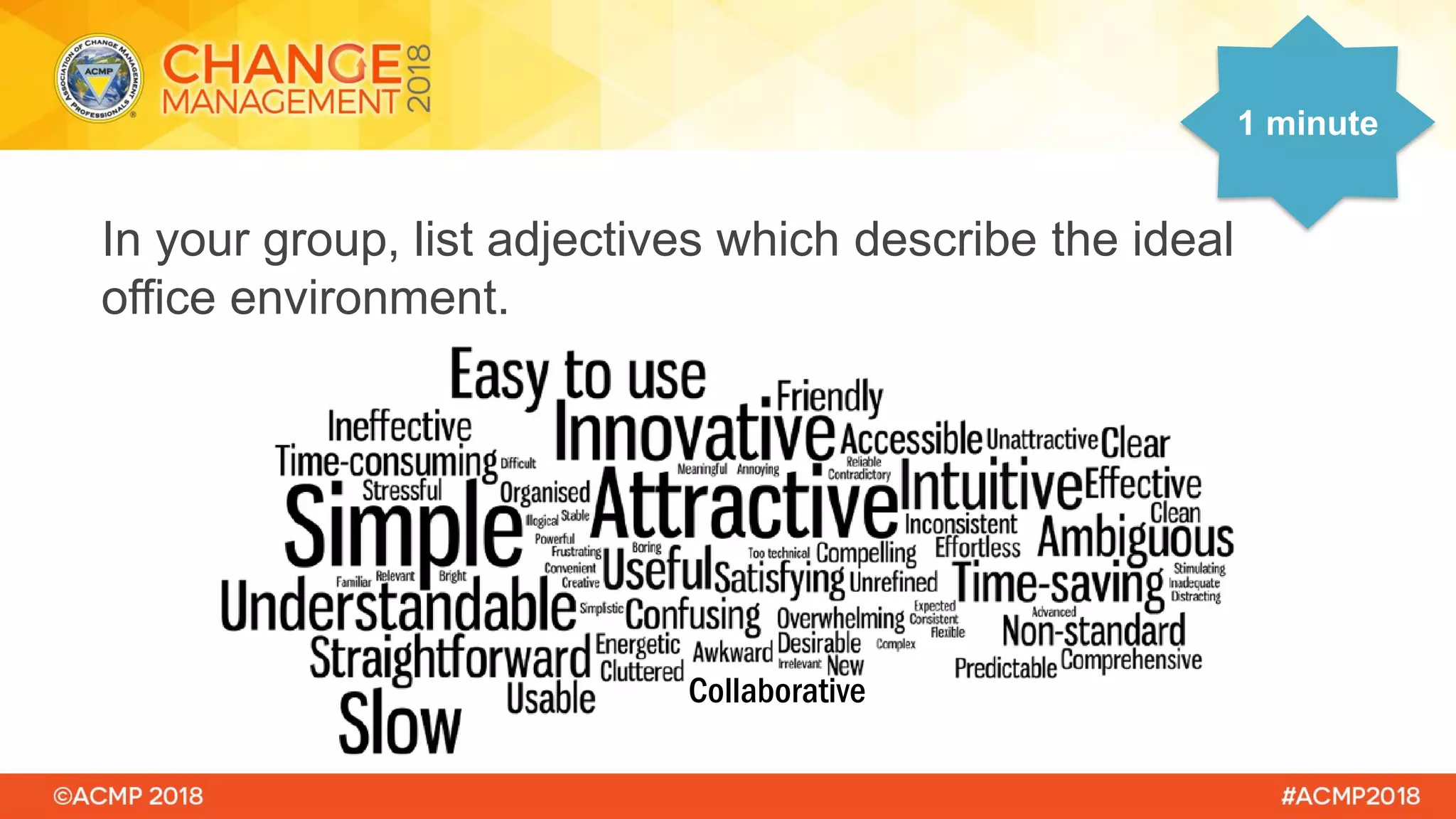
In your group, list adjectives which describe the ideal
office environment.
1 minute
Collaborative
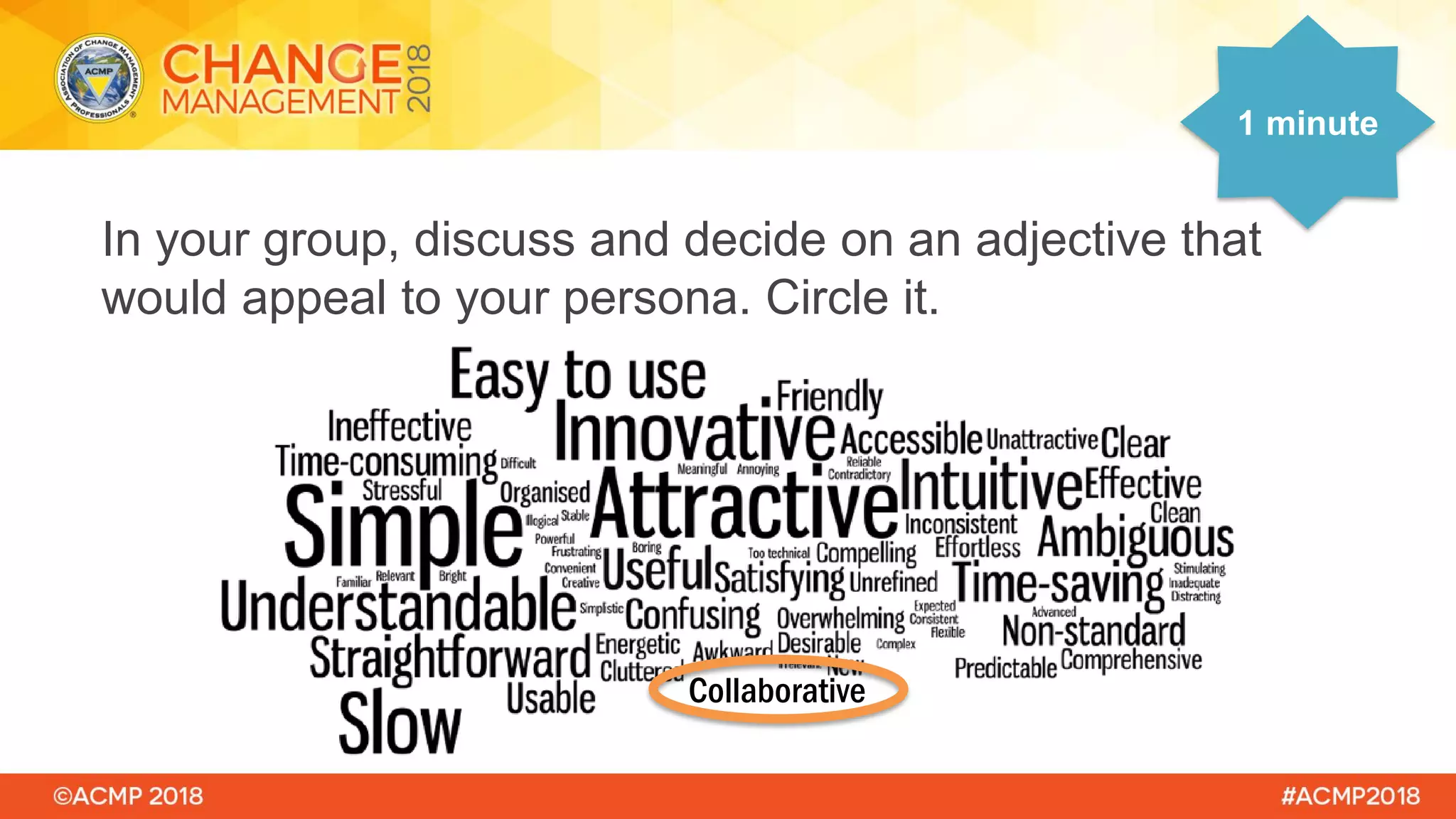
In your group, discuss and decide on an adjective that
would appeal to your persona. Circle it.
1 minute
Collaborative
• Brainstorm different brands,
products, and services
which align with that
adjective.
• e.g. Collaborative –
WordPress; WeWork office
sharing; Lyft
2
minutes
Q: What do we like about [your brands, products, services] that
could be translated to our ideal office environment?
• e.g. Collaborative + WordPress = Open source, developed
and maintained by the community surrounding it
• e.g. Collaborative + WeWork = Communal desks and open
floor plans
• e.g. Collaborative + Lyft = Centralized information sharing
6
minutes
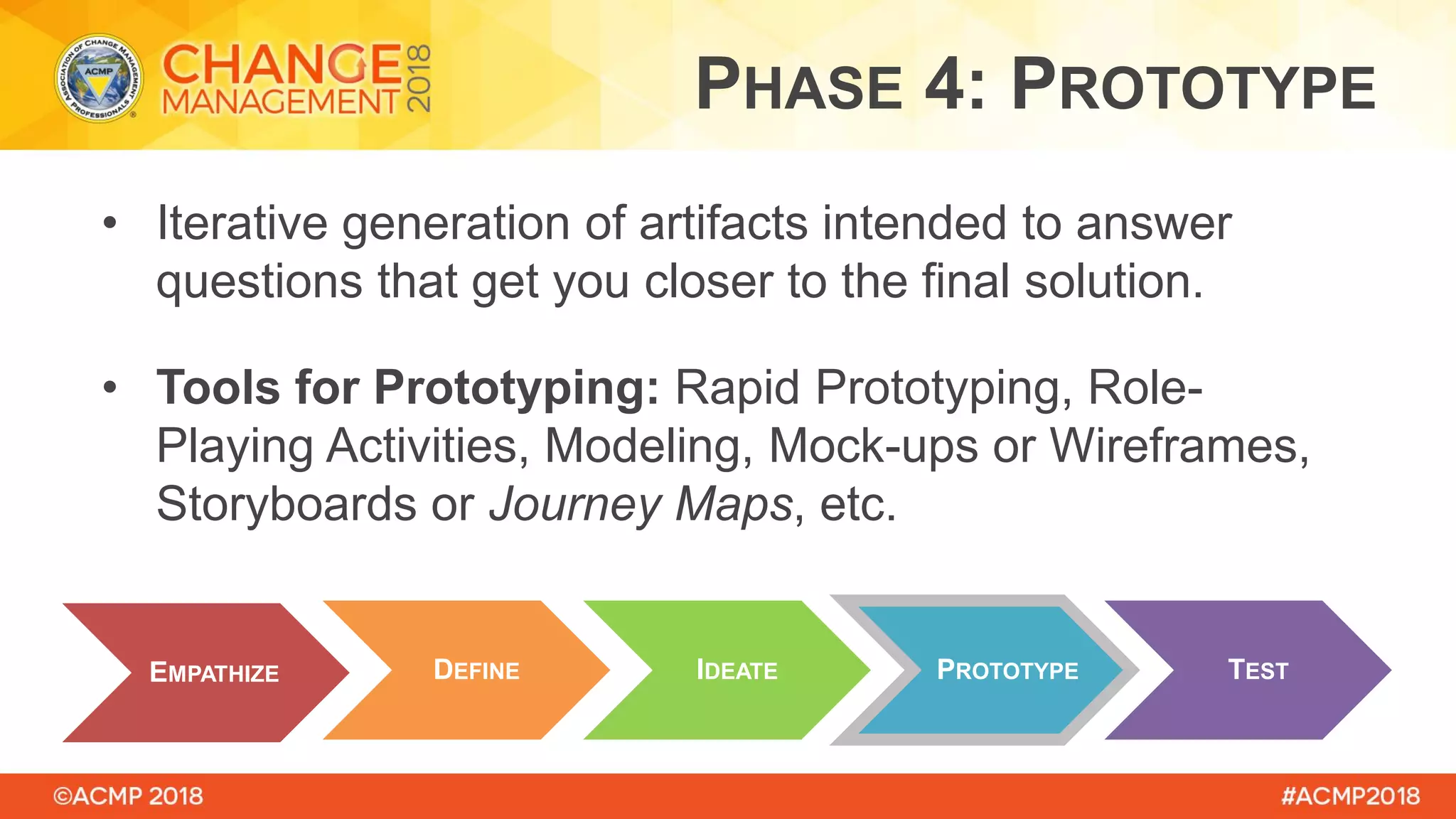
• Iterative generation of artifacts intended to answer
questions that get you closer to the final solution.
• Tools for Prototyping: Rapid Prototyping, Role-
Playing Activities, Modeling, Mock-ups or Wireframes,
Storyboards or Journey Maps, etc.
EMPATHIZE DEFINE PROTOTYPEIDEATE TEST
PHASE 4: PROTOTYPE
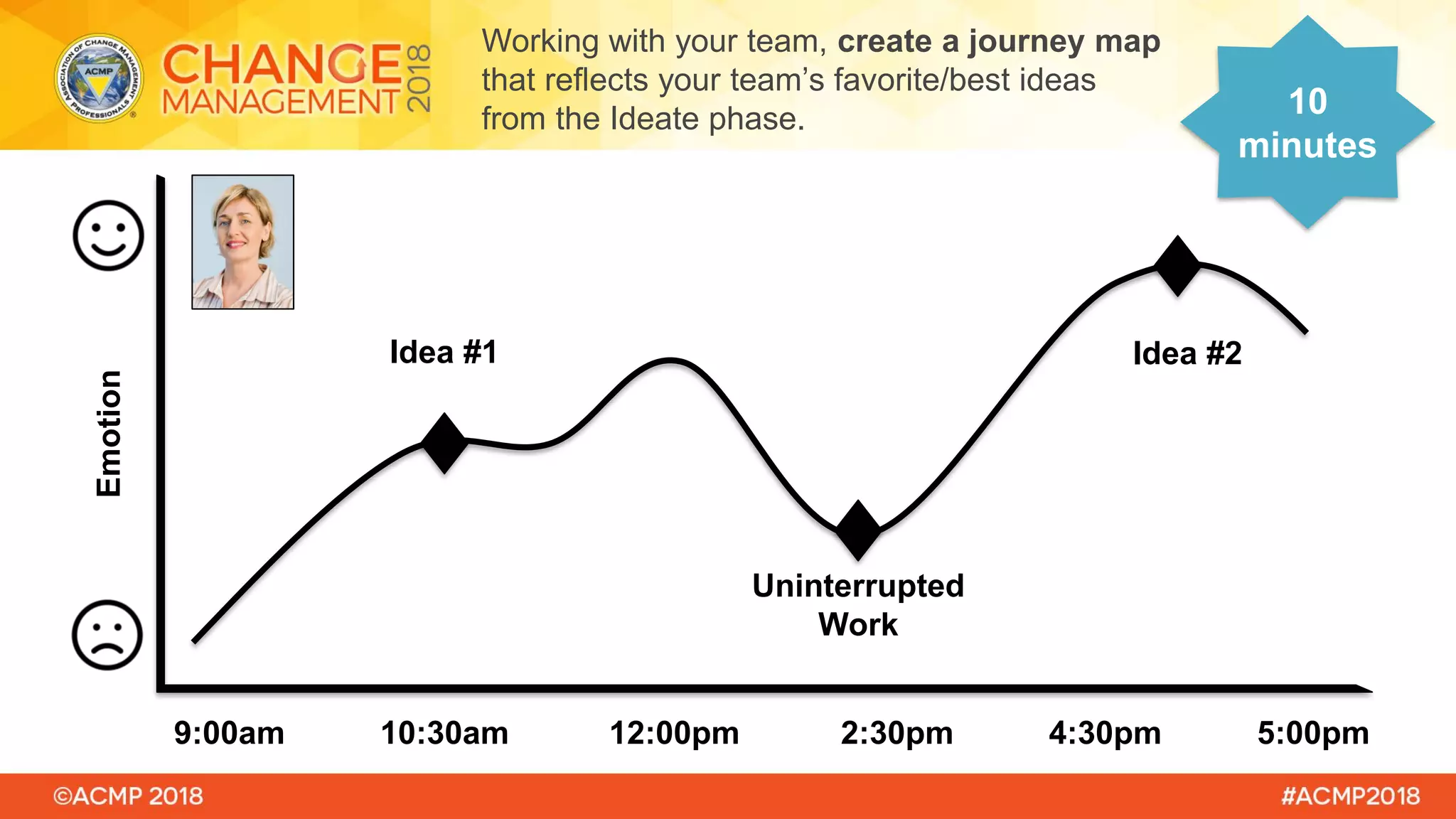
• A customer journey map is a visualization of the
process that a person goes through in order to
accomplish a goal.
• You will work with your team to create a journey
map that reflects your team’s favorite/best ideas
from the Ideate phase.
10
minutes
9:00am 10:30am 12:00pm 2:30pm 4:30pm 5:00pm
Emotion
Idea #1
Uninterrupted
Work
Idea #2
Working with your team, create a journey map
that reflects your team’s favorite/best ideas
from the Ideate phase.
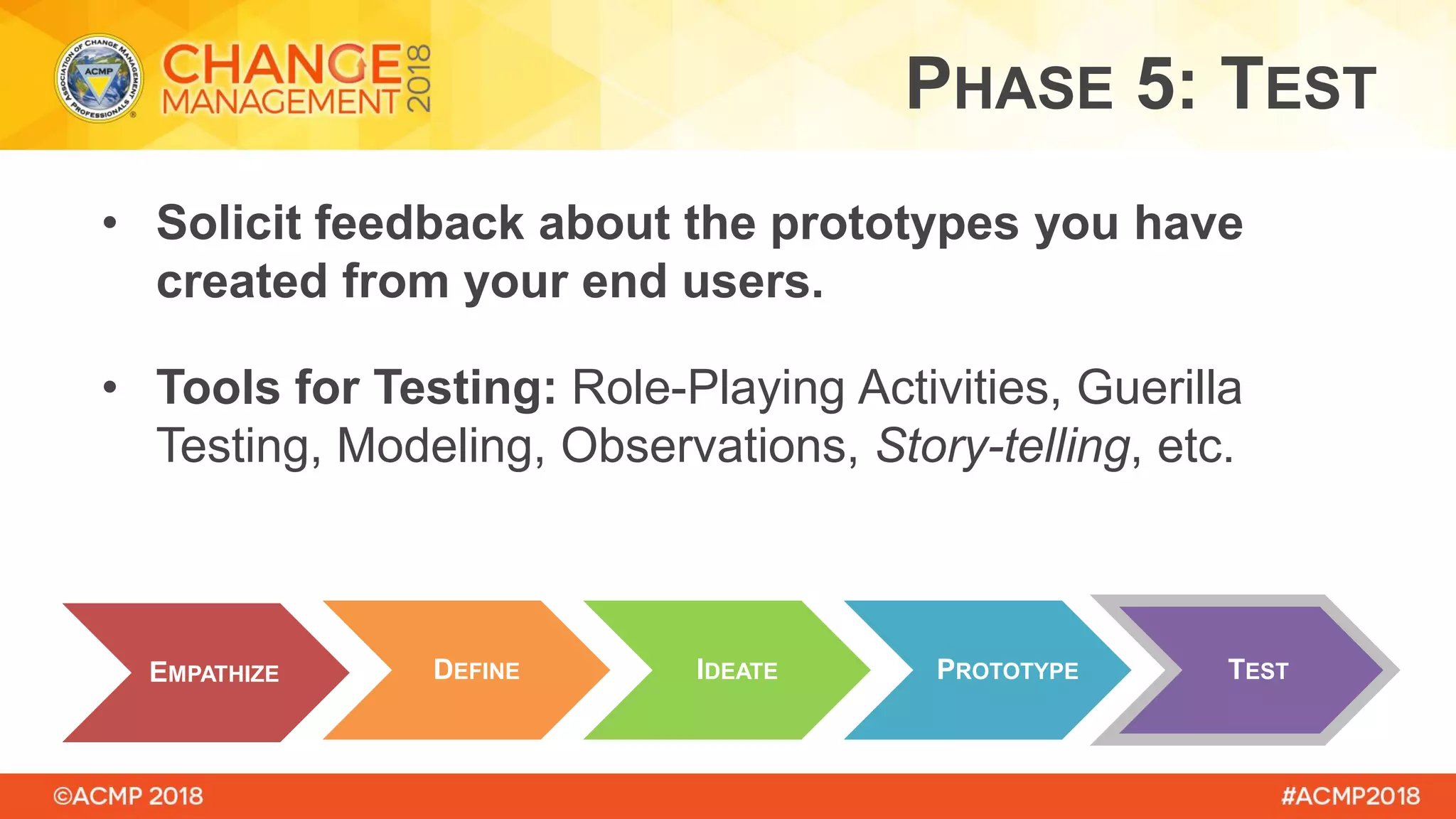
• Solicit feedback about the prototypes you have
created from your end users.
• Tools for Testing: Role-Playing Activities, Guerilla
Testing, Modeling, Observations, Story-telling, etc.
EMPATHIZE DEFINE PROTOTYPEIDEATE TEST
PHASE 5: TEST
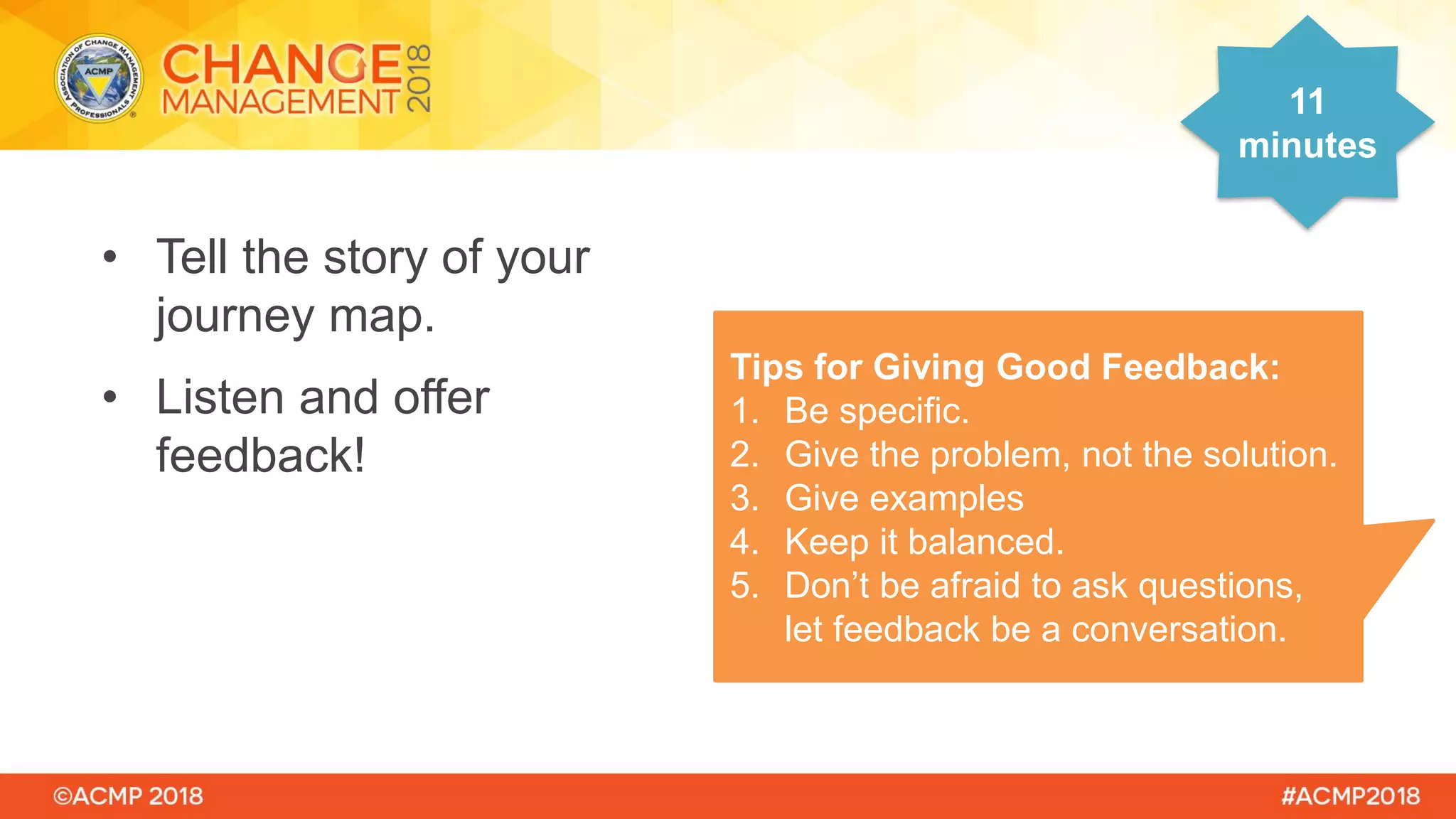
• Tell the story of your
journey map.
• Listen and offer
feedback!
11
minutes
Tips for Giving Good Feedback:
1. Be specific.
2. Give the problem, not the solution.
3. Give examples
4. Keep it balanced.
5. Don’t be afraid to ask questions,
let feedback be a conversation.
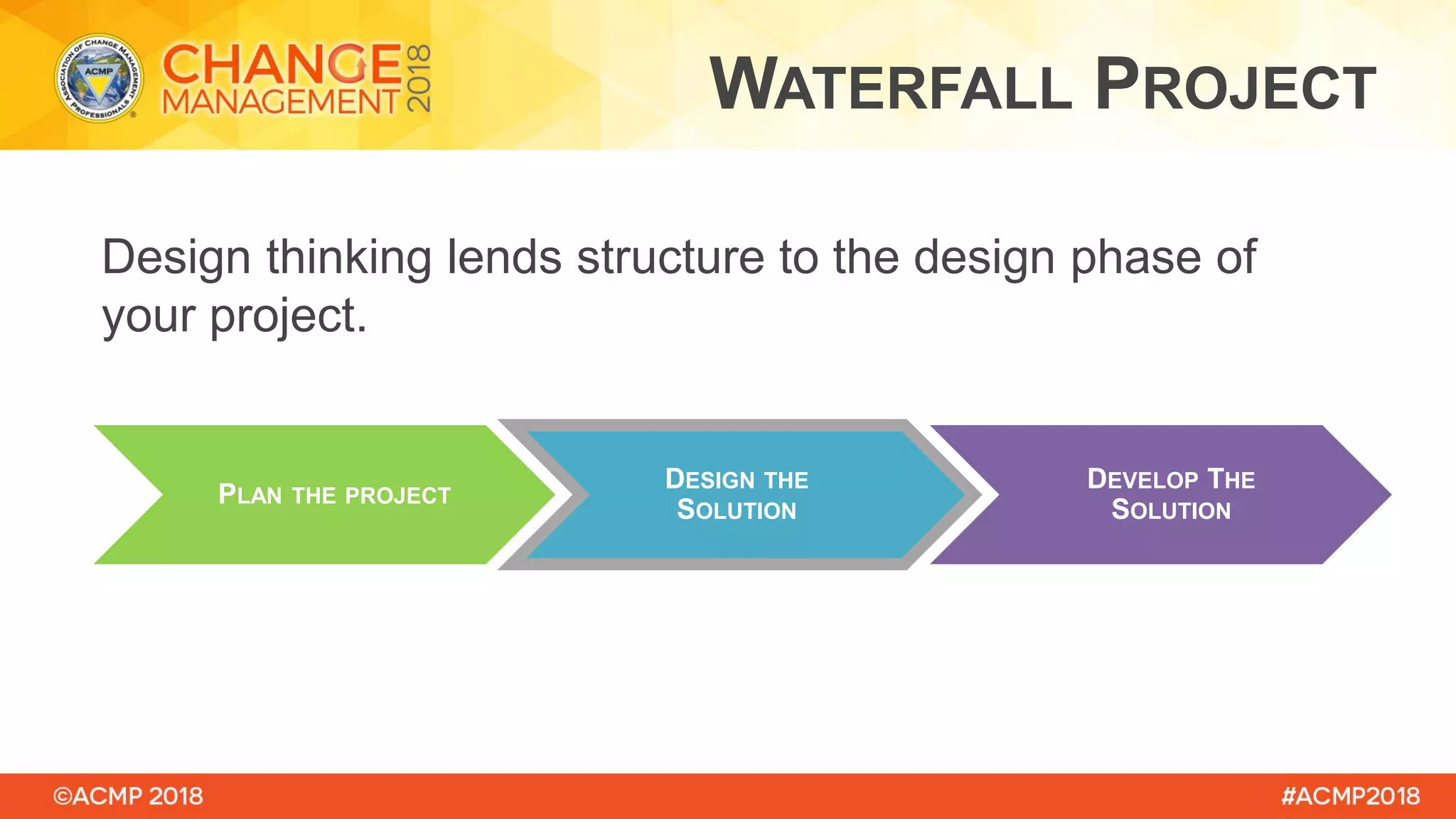
Design thinking lends structure to the design phase of
your project.
DESIGN THE
SOLUTION
PLAN THE PROJECT
DEVELOP THE
SOLUTION
WATERFALL PROJECT
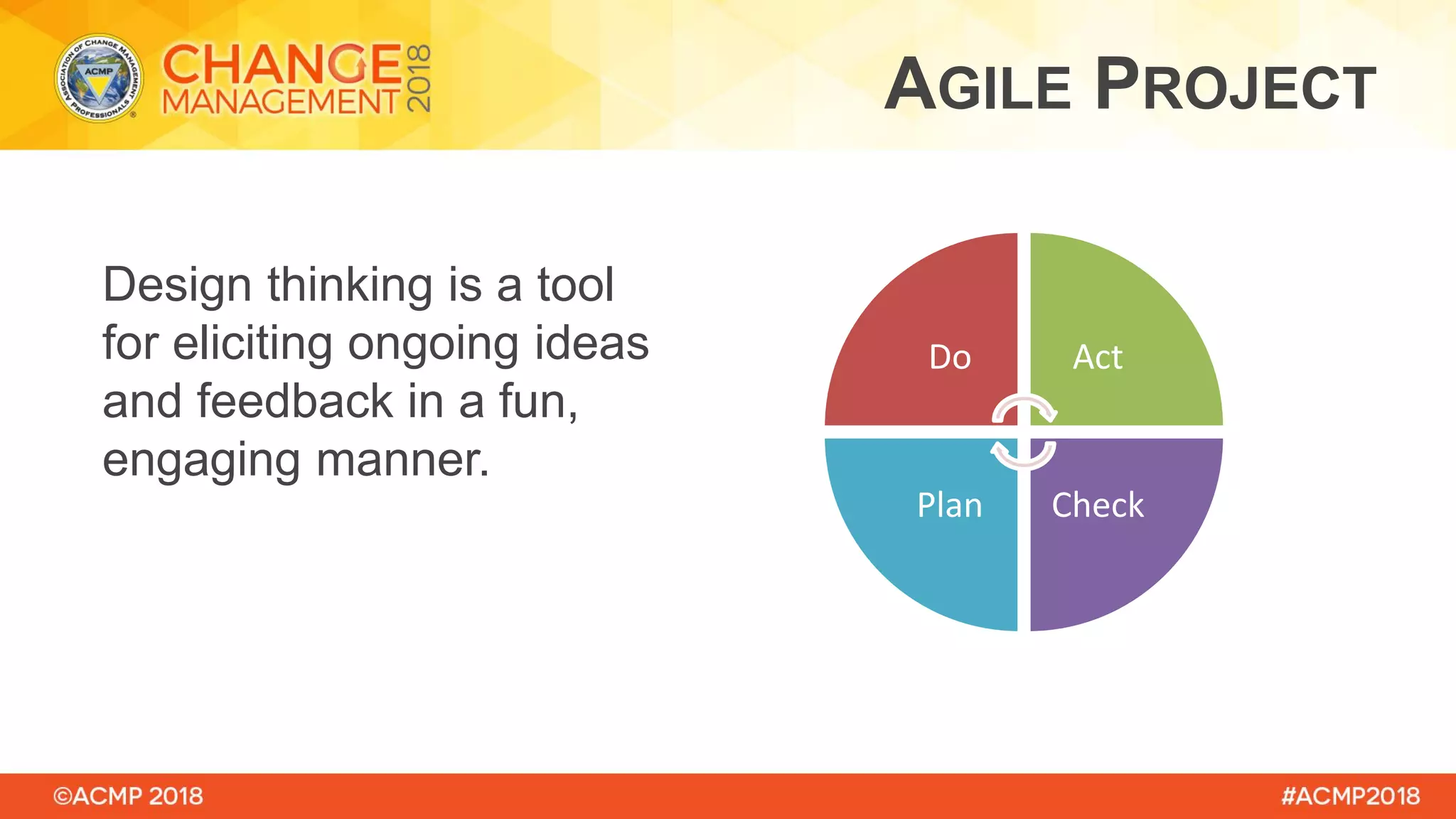
Design thinking is a tool
for eliciting ongoing ideas
and feedback in a fun,
engaging manner.
AGILE PROJECT
Do Act
CheckPlan
By the conclusion of this workshop, participants will be
able to:
1. Articulate the phases of Design Thinking.
2. Apply the Design Thinking framework to co-design
an example workshop solution.
3. Utilize the Design Thinking framework when co-
designing solution in change initiatives.
WORKSHOP OBJECTIVES
Q A&

Design Thinking to Co-Design Solutions: Presented at ACMP 2018

  • 2.
    Claire Brawdy, RebeccaWyatt March 26, 2018 DESIGN THINKING TO CO-DESIGN SOLUTIONS
  • 3.
    REBECCA WYATT SENIOR CONSULTANT, ENTERPRISEKNOWLEDGE AREAS OF FOCUS: Technical Training, Hands-On Activity Facilitation, Agile Product Ownership, Search UX CLAIRE BRAWDY SENIOR ANALYST, ENTERPRISE KNOWLEDGE AREAS OF FOCUS: Design Thinking, UX/UI Design, KM Strategy, Taxonomy Design, Visual Design
  • 4.
    By the conclusionof this workshop, participants will be able to: 1. Articulate the phases of Design Thinking. 2. Apply the Design Thinking framework to co-design an example workshop solution. 3. Utilize the Design Thinking framework when co- designing solutions in change initiatives. WORKSHOP OBJECTIVES
  • 5.
    • A human-centeredapproach to problem solving that brings together the needs of people, technology, and business to solve complex problems with innovative solutions. • In practice, this process is carried out in a more flexible and non-linear fashion, with stages being conducted concurrently. WHAT IS DESIGN THINKING?
  • 6.
    • Focuses onthe end user(s). • Challenges assumptions. • Leverages collective expertise. • Employs empathy. • Utilizes constant iteration. As opposed to… • Jumping immediately to solutions. • “We have this technology, what can we use it for?” • “Our competitors just launched X; how can we do X quickly?” WHY DESIGN THINKING?
  • 7.
    • Active participationis crucial. – Activities denoted by blue star. • The process will feel rushed, and that’s purposeful! • Don’t jump ahead to solutions (until the Ideate phase). • We’re playing the role of facilitators, not instructors. • We are learning by doing, therefore the emphasis is on the process, not the outcomes. • Have fun and embrace the process! GROUND RULES
  • 8.
    THE CHALLENGE Design theideal office environment.
  • 9.
    • The workyou do to understand people, within the context of your design challenge. • Tools for Gaining Empathy: Interviews, Focus Groups, Observations, Immersion, Creating Empathy Maps, Creating Personas, etc. EMPATHIZE DEFINE PROTOTYPEIDEATE TEST PHASE 1: EMPATHIZE
  • 10.
    MEET YOUR PERSONAS DorothyPeterson, 42 Regional Director Introvert Tech Savvy Entry Level Linear Thinker Extrovert Tech Challenged Senior Manager Creative Thinker Jeff Connors, 28 Developer Introvert Tech Savvy Entry Level Linear Thinker Extrovert Tech Challenged Senior Manager Creative Thinker
  • 11.
    • Define thechallenge you are taking on, based on what you have learned about your user and about the context. • Tools for Defining the Challenge: Finding Themes, Prioritizing, Creating How Might We (HMW) Questions, etc. EMPATHIZE DEFINE PROTOTYPEIDEATE TEST PHASE 2: DEFINE
  • 12.
    • “How mightwe” (HMW) questions are short questions that launch brainstorms. – Tip #1: Question an assumption – Tip #2: Amp up the good – Tip #3: Remove the bad – Tip #4: Go after adjectives – Tip #5: Break it down How might we make Dorothy’s office environment better? Tip #1: Question an assumption. How might we recreate Dorothy’s office experience at home?
  • 13.
    • “How mightwe” (HMW) questions are short questions that launch brainstorms. – Tip #1: Question an assumption – Tip #2: Amp up the good – Tip #3: Remove the bad – Tip #4: Go after adjectives – Tip #5: Break it down How might we make Dorothy’s office environment better? Tip #2: Amp up the good. How might we upgrade existing technical systems?
  • 14.
    • “How mightwe” (HMW) questions are short questions that launch brainstorms. – Tip #1: Question an assumption – Tip #2: Amp up the good – Tip #3: Remove the bad – Tip #4: Go after adjectives – Tip #5: Break it down How might we make Dorothy’s office environment better? Tip #4: Go after adjectives. How might we make Dorothy’s office environment productive?
  • 15.
    • Brainstorm afew “How Might We” questions to address your persona’s needs. • Pick a How Might We question to move forward with. 7 minutes Tip #1: Question an assumption. Tip #2: Amp up the good. Tip #3: Remove the bad. Tip #4: Go after adjectives. Tip #5: Break it down.
  • 16.
    • The workyou do to generate ideas, mentally a process of “going wide”. • Tools for Ideating: Brainstorming, Bundling Ideas, Creating Frameworks, Gut Checks, Mash-Ups, Co- Create, Role Play, etc. EMPATHIZE DEFINE PROTOTYPEIDEATE TEST PHASE 3: IDEATE
  • 17.
    In your group,list adjectives which describe the ideal office environment. 1 minute Collaborative
  • 18.
    In your group,discuss and decide on an adjective that would appeal to your persona. Circle it. 1 minute Collaborative
  • 19.
    • Brainstorm differentbrands, products, and services which align with that adjective. • e.g. Collaborative – WordPress; WeWork office sharing; Lyft 2 minutes
  • 20.
    Q: What dowe like about [your brands, products, services] that could be translated to our ideal office environment? • e.g. Collaborative + WordPress = Open source, developed and maintained by the community surrounding it • e.g. Collaborative + WeWork = Communal desks and open floor plans • e.g. Collaborative + Lyft = Centralized information sharing 6 minutes
  • 21.
    • Iterative generationof artifacts intended to answer questions that get you closer to the final solution. • Tools for Prototyping: Rapid Prototyping, Role- Playing Activities, Modeling, Mock-ups or Wireframes, Storyboards or Journey Maps, etc. EMPATHIZE DEFINE PROTOTYPEIDEATE TEST PHASE 4: PROTOTYPE
  • 22.
    • A customerjourney map is a visualization of the process that a person goes through in order to accomplish a goal. • You will work with your team to create a journey map that reflects your team’s favorite/best ideas from the Ideate phase.
  • 23.
    10 minutes 9:00am 10:30am 12:00pm2:30pm 4:30pm 5:00pm Emotion Idea #1 Uninterrupted Work Idea #2 Working with your team, create a journey map that reflects your team’s favorite/best ideas from the Ideate phase.
  • 24.
    • Solicit feedbackabout the prototypes you have created from your end users. • Tools for Testing: Role-Playing Activities, Guerilla Testing, Modeling, Observations, Story-telling, etc. EMPATHIZE DEFINE PROTOTYPEIDEATE TEST PHASE 5: TEST
  • 25.
    • Tell thestory of your journey map. • Listen and offer feedback! 11 minutes Tips for Giving Good Feedback: 1. Be specific. 2. Give the problem, not the solution. 3. Give examples 4. Keep it balanced. 5. Don’t be afraid to ask questions, let feedback be a conversation.
  • 26.
    Design thinking lendsstructure to the design phase of your project. DESIGN THE SOLUTION PLAN THE PROJECT DEVELOP THE SOLUTION WATERFALL PROJECT
  • 27.
    Design thinking isa tool for eliciting ongoing ideas and feedback in a fun, engaging manner. AGILE PROJECT Do Act CheckPlan
  • 28.
    By the conclusionof this workshop, participants will be able to: 1. Articulate the phases of Design Thinking. 2. Apply the Design Thinking framework to co-design an example workshop solution. 3. Utilize the Design Thinking framework when co- designing solution in change initiatives. WORKSHOP OBJECTIVES
  • 29.