




Consulting from Within:
Best Practices for the Solo
Taxonomist
Bonnie Griffin
Taxonomy Consultant
Enterprise Knowledge
Taxonomy Bootcamp, Nov 2024
ENTERPRISE KNOWLEDGE
Bonnie
Semantic/Knowledge Engineering Practice
GRIFFIN
Experienced developing taxonomies
across sectors including human resources,
customer support, and financial services.
ENTERPRISE KNOWLEDGE
Quick Poll
⬢ How many of you work on a team
of 2 or more taxonomists?
⬢ How many of you work on a team
of 10 or more taxonomists?
⬢ Who here is the only taxonomist
at their organization?
ENTERPRISE KNOWLEDGE
Agenda
⬢ Introducing Taxonomy
⬢ Project Scoping
⬢ Taxonomy Development:
In Progress
⬢ Adapting to Changing
Priorities
⬢ “Finishing” a Project
Introducing Taxonomy
& Getting Started
ENTERPRISE KNOWLEDGE
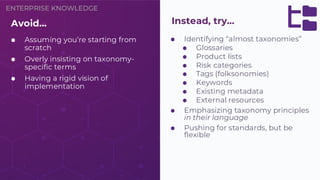
⬢ Identifying “almost taxonomies”
⬢ Glossaries
⬢ Product lists
⬢ Risk categories
⬢ Tags (folksonomies)
⬢ Keywords
⬢ Existing metadata
⬢ External resources
⬢ Emphasizing taxonomy principles
in their language
⬢ Pushing for standards, but be
flexible
Avoid…
⬢ Assuming you’re starting from
scratch
⬢ Overly insisting on taxonomy-
specific terms
⬢ Having a rigid vision of
implementation
Instead, try…
ENTERPRISE KNOWLEDGE
⬢ Continually re-introducing
taxonomy in various mediums
⬢ Cloning yourself! Identify allies
who can accurately introduce
taxonomy as well as you could, in
your own words
Avoid…
⬢ Assuming retention of prior
knowledge-sharing
⬢ Expecting to be successful as a
solo taxonomist*
*unless you enlist allies
Instead, try…
ENTERPRISE KNOWLEDGE
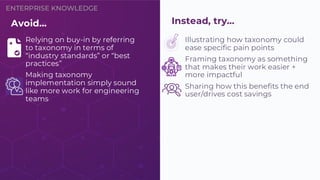
Illustrating how taxonomy could
ease specific pain points
Framing taxonomy as something
that makes their work easier +
more impactful
Sharing how this benefits the end
user/drives cost savings
Avoid…
Relying on buy-in by referring
to taxonomy in terms of
“industry standards” or “best
practices”
Making taxonomy
implementation simply sound
like more work for engineering
teams
Instead, try…
Taxonomy Project
Scoping
ENTERPRISE KNOWLEDGE
⬢ Setting realistic expectations
⬢ Communicating the need for
resources, train others
Avoid…
⬢ Over-promising
⬢ Promising to deliver the full
project yourself
Instead, try…
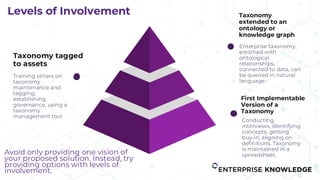
1
3
2
Taxonomy
extended to an
ontology or
knowledge graph
Enterprise taxonomy,
enriched with
ontological
relationships,
connected to data, can
be queried in natural
language.
First Implementable
Version of a
Taxonomy
Conducting
interviews, identifying
concepts, getting
buy-in, aligning on
definitions. Taxonomy
is maintained in a
spreadsheet.
Taxonomy tagged
to assets
Training others on
taxonomy
maintenance and
tagging,
establishing
governance, using a
taxonomy
management tool
Levels of Involvement
Avoid only providing one vision of
your proposed solution. Instead, try
providing options with levels of
involvement.
During the Project
ENTERPRISE KNOWLEDGE
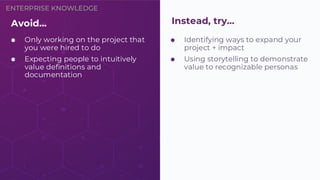
⬢ Identifying ways to expand your
project + impact
⬢ Using storytelling to demonstrate
value to recognizable personas
Avoid…
⬢ Only working on the project that
you were hired to do
⬢ Expecting people to intuitively
value definitions and
documentation
Instead, try…
ENTERPRISE KNOWLEDGE
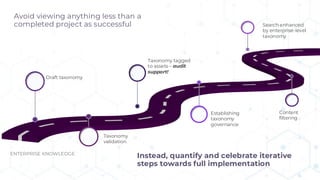
Instead, quantify and celebrate iterative
steps towards full implementation
Draft taxonomy
Taxonomy tagged
to assets – audit
support!
Avoid viewing anything less than a
completed project as successful Search enhanced
by enterprise-level
taxonomy
Establishing
taxonomy
governance
Content
filtering
Taxonomy
validation
ENTERPRISE KNOWLEDGE
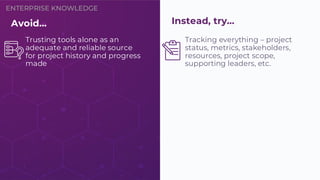
Tracking everything – project
status, metrics, stakeholders,
resources, project scope,
supporting leaders, etc.
Avoid…
Trusting tools alone as an
adequate and reliable source
for project history and progress
made
Instead, try…
Adapting to
Changing Priorities
ENTERPRISE KNOWLEDGE
⬢ Developing a working knowledge
of generative AI, and developing a
realistic plan for integration
(exclusions)
⬢ Identifying case studies where
semantics + generative AI yielded
better outcomes
Avoid…
⬢ Saying “taxonomy can improve
generative AI output” without
providing actionable next steps
Instead, try…
“Finishing” a Project
ENTERPRISE KNOWLEDGE
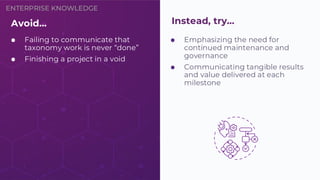
⬢ Emphasizing the need for
continued maintenance and
governance
⬢ Communicating tangible results
and value delivered at each
milestone
Avoid…
⬢ Failing to communicate that
taxonomy work is never “done”
⬢ Finishing a project in a void
Instead, try…
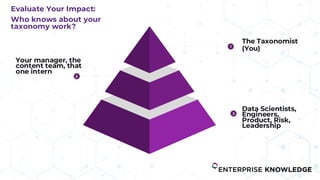
1
3
2
The Taxonomist
(You)
Data Scientists,
Engineers,
Product, Risk,
Leadership
Your manager, the
content team, that
one intern
Evaluate Your Impact:
Who knows about your
taxonomy work?
Q&A
Thank you for
listening.
Questions?

Solo Taxonomist Taxonomy Bootcamp Presentation

  • 1.
    Consulting from Within: BestPractices for the Solo Taxonomist Bonnie Griffin Taxonomy Consultant Enterprise Knowledge Taxonomy Bootcamp, Nov 2024
  • 2.
    ENTERPRISE KNOWLEDGE Bonnie Semantic/Knowledge EngineeringPractice GRIFFIN Experienced developing taxonomies across sectors including human resources, customer support, and financial services.
  • 3.
  • 4.
    ENTERPRISE KNOWLEDGE Quick Poll ⬢How many of you work on a team of 2 or more taxonomists? ⬢ How many of you work on a team of 10 or more taxonomists? ⬢ Who here is the only taxonomist at their organization?
  • 5.
    ENTERPRISE KNOWLEDGE Agenda ⬢ IntroducingTaxonomy ⬢ Project Scoping ⬢ Taxonomy Development: In Progress ⬢ Adapting to Changing Priorities ⬢ “Finishing” a Project
  • 6.
  • 7.
    ENTERPRISE KNOWLEDGE ⬢ Identifying“almost taxonomies” ⬢ Glossaries ⬢ Product lists ⬢ Risk categories ⬢ Tags (folksonomies) ⬢ Keywords ⬢ Existing metadata ⬢ External resources ⬢ Emphasizing taxonomy principles in their language ⬢ Pushing for standards, but be flexible Avoid… ⬢ Assuming you’re starting from scratch ⬢ Overly insisting on taxonomy- specific terms ⬢ Having a rigid vision of implementation Instead, try…
  • 8.
    ENTERPRISE KNOWLEDGE ⬢ Continuallyre-introducing taxonomy in various mediums ⬢ Cloning yourself! Identify allies who can accurately introduce taxonomy as well as you could, in your own words Avoid… ⬢ Assuming retention of prior knowledge-sharing ⬢ Expecting to be successful as a solo taxonomist* *unless you enlist allies Instead, try…
  • 9.
    ENTERPRISE KNOWLEDGE Illustrating howtaxonomy could ease specific pain points Framing taxonomy as something that makes their work easier + more impactful Sharing how this benefits the end user/drives cost savings Avoid… Relying on buy-in by referring to taxonomy in terms of “industry standards” or “best practices” Making taxonomy implementation simply sound like more work for engineering teams Instead, try…
  • 10.
  • 11.
    ENTERPRISE KNOWLEDGE ⬢ Settingrealistic expectations ⬢ Communicating the need for resources, train others Avoid… ⬢ Over-promising ⬢ Promising to deliver the full project yourself Instead, try…
  • 12.
    1 3 2 Taxonomy extended to an ontologyor knowledge graph Enterprise taxonomy, enriched with ontological relationships, connected to data, can be queried in natural language. First Implementable Version of a Taxonomy Conducting interviews, identifying concepts, getting buy-in, aligning on definitions. Taxonomy is maintained in a spreadsheet. Taxonomy tagged to assets Training others on taxonomy maintenance and tagging, establishing governance, using a taxonomy management tool Levels of Involvement Avoid only providing one vision of your proposed solution. Instead, try providing options with levels of involvement.
  • 13.
  • 14.
    ENTERPRISE KNOWLEDGE ⬢ Identifyingways to expand your project + impact ⬢ Using storytelling to demonstrate value to recognizable personas Avoid… ⬢ Only working on the project that you were hired to do ⬢ Expecting people to intuitively value definitions and documentation Instead, try…
  • 15.
    ENTERPRISE KNOWLEDGE Instead, quantifyand celebrate iterative steps towards full implementation Draft taxonomy Taxonomy tagged to assets – audit support! Avoid viewing anything less than a completed project as successful Search enhanced by enterprise-level taxonomy Establishing taxonomy governance Content filtering Taxonomy validation
  • 16.
    ENTERPRISE KNOWLEDGE Tracking everything– project status, metrics, stakeholders, resources, project scope, supporting leaders, etc. Avoid… Trusting tools alone as an adequate and reliable source for project history and progress made Instead, try…
  • 17.
  • 18.
    ENTERPRISE KNOWLEDGE ⬢ Developinga working knowledge of generative AI, and developing a realistic plan for integration (exclusions) ⬢ Identifying case studies where semantics + generative AI yielded better outcomes Avoid… ⬢ Saying “taxonomy can improve generative AI output” without providing actionable next steps Instead, try…
  • 19.
  • 20.
    ENTERPRISE KNOWLEDGE ⬢ Emphasizingthe need for continued maintenance and governance ⬢ Communicating tangible results and value delivered at each milestone Avoid… ⬢ Failing to communicate that taxonomy work is never “done” ⬢ Finishing a project in a void Instead, try…
  • 21.
    1 3 2 The Taxonomist (You) Data Scientists, Engineers, Product,Risk, Leadership Your manager, the content team, that one intern Evaluate Your Impact: Who knows about your taxonomy work?
  • 22.