ENTERPRISE KNOWLEDGE
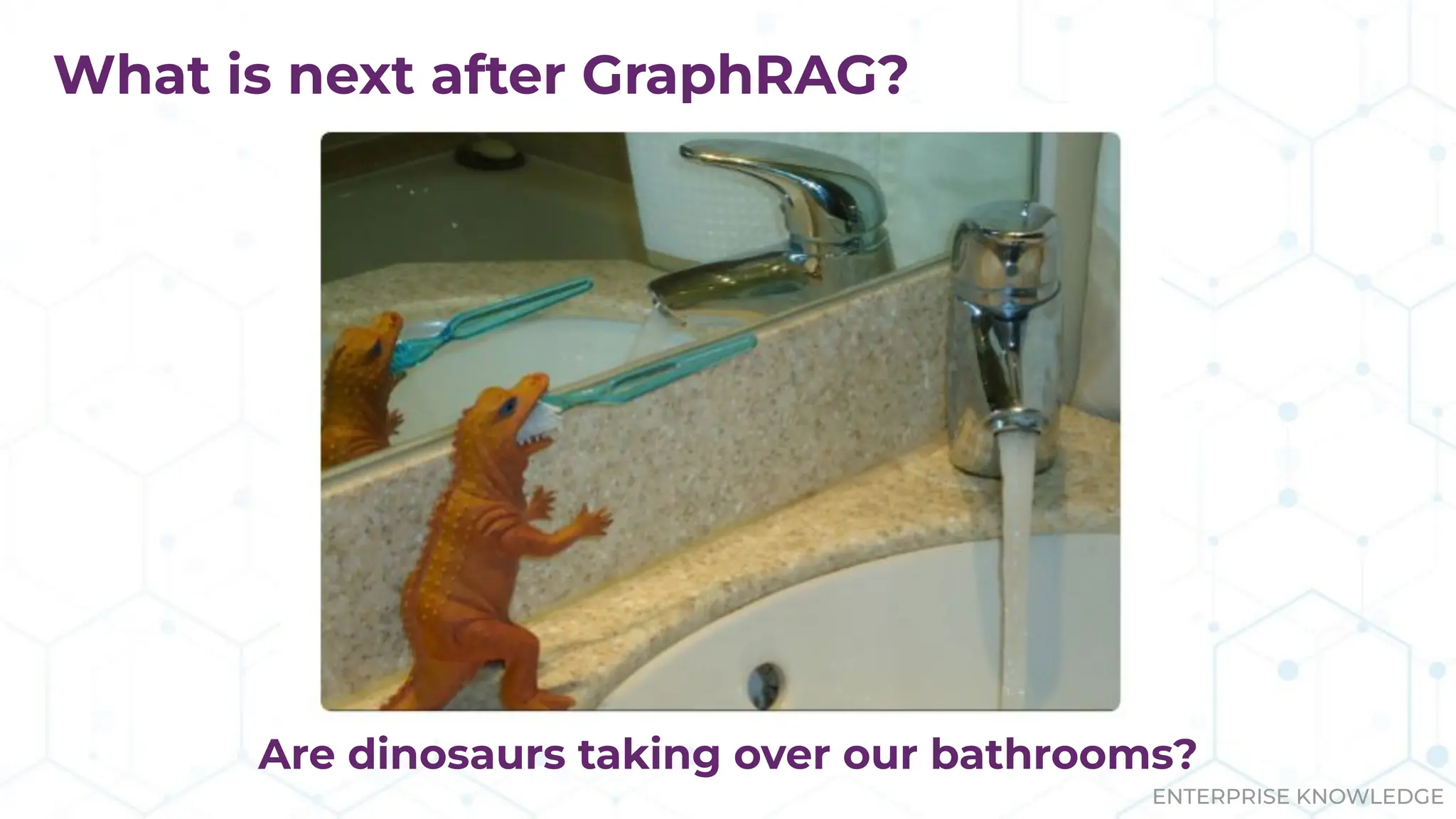
What is next after GraphRAG?
Are dinosaurs taking over our bathrooms?
ENTERPRISE KNOWLEDGE
What is the role of images in RAG?
A toy dinosaur…
ENTERPRISE KNOWLEDGE
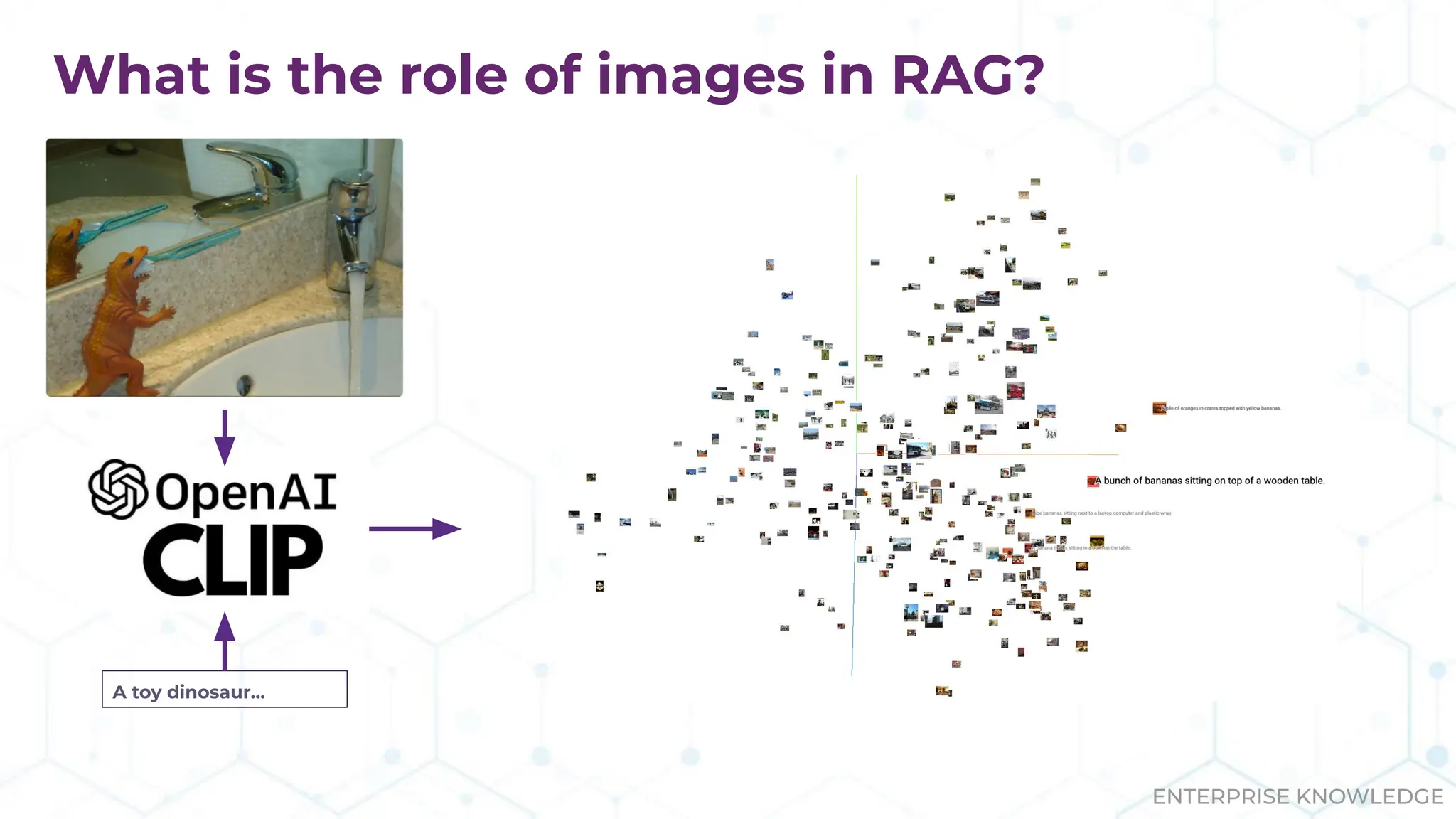
What is the role of images in RAG?
A toy dinosaur…
ENTERPRISE KNOWLEDGE
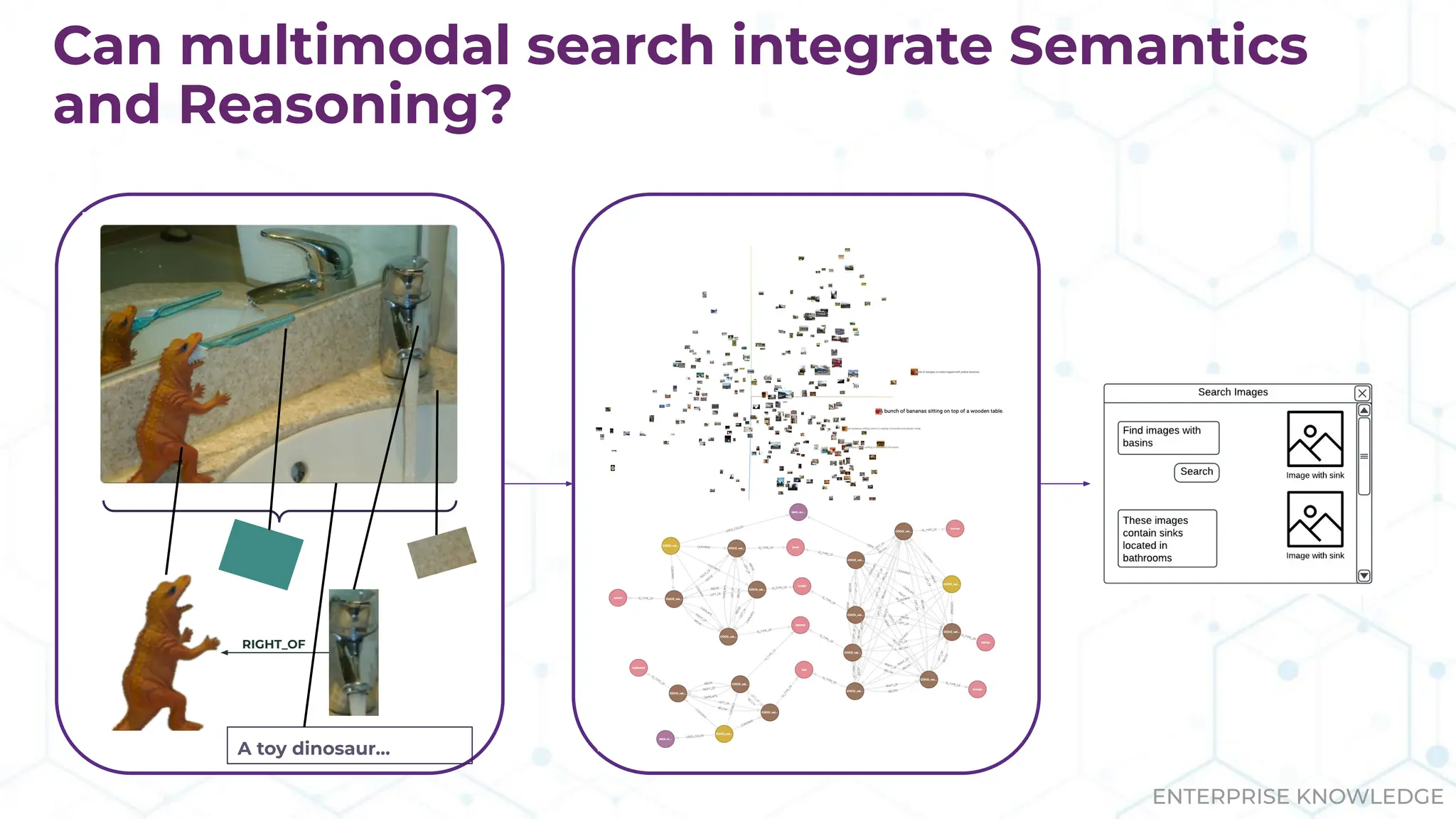
Can multimodal search integrate Semantics
and Reasoning?
RIGHT_OF
A toy dinosaur…
ENTERPRISE KNOWLEDGE
mmGraphRAG Analytics
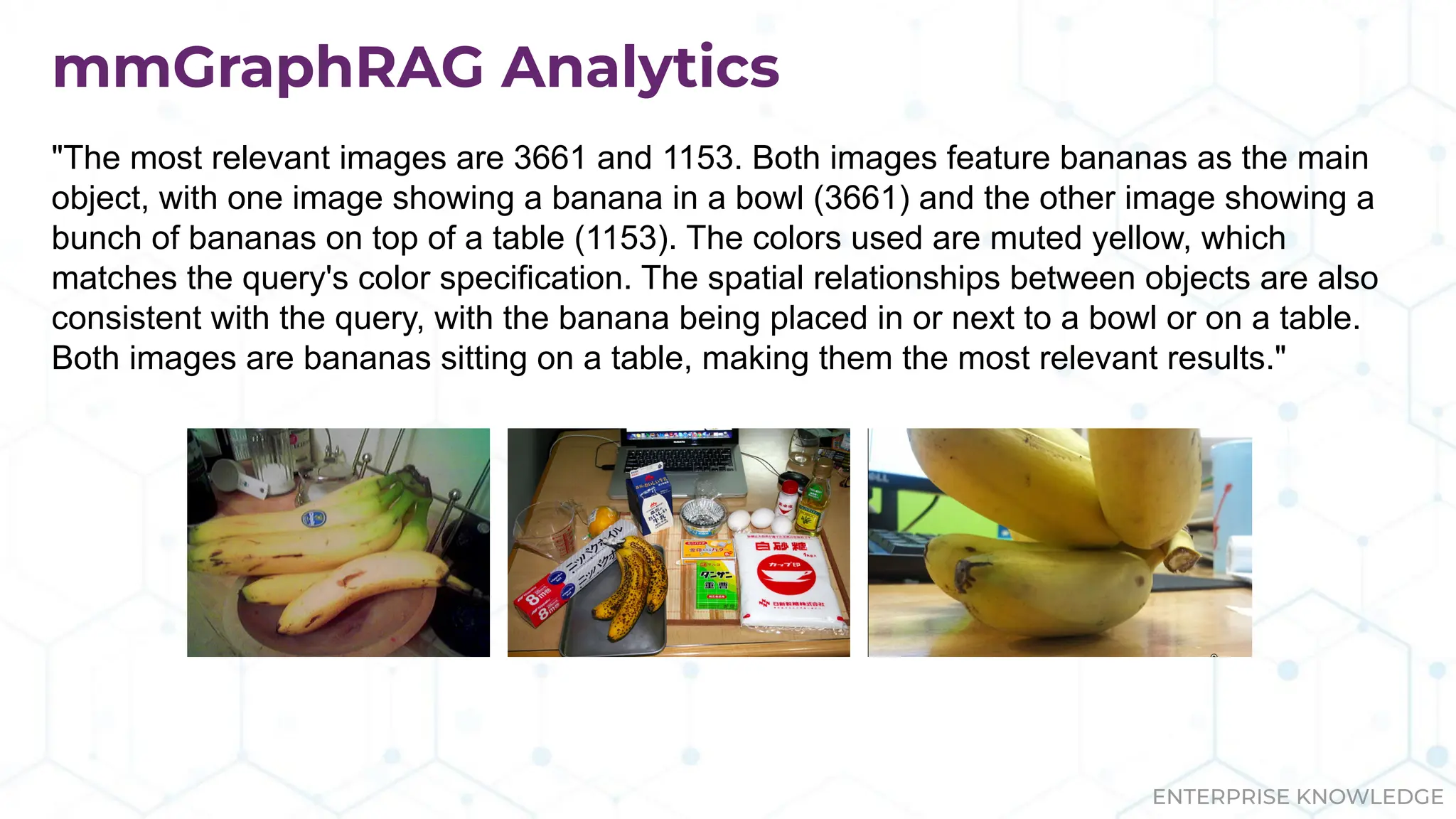
"The most relevant images are 3661 and 1153. Both images feature bananas as the main
object, with one image showing a banana in a bowl (3661) and the other image showing a
bunch of bananas on top of a table (1153). The colors used are muted yellow, which
matches the query's color specification. The spatial relationships between objects are also
consistent with the query, with the banana being placed in or next to a bowl or on a table.
Both images are bananas sitting on a table, making them the most relevant results."
Multimodal Graph RAG (mmGraphRAG):
Incorporating Vision in Search and Analytics
Data Day Texas - 2025
David Hughes
Principal Solution Architect
Advanced Data Services and Enterprise AI
Enterprise Knowledge, LLC.
“I research problem solving in complex domains”
Objectives Demonstrate how
mmGraphRAG works.
Highlight the integration of
vision models, hypervectors,
and graph databases.
Showcase real-world
applications and benefits.
Introduce BAML Agentic
Workflows.
ENTERPRISE KNOWLEDGE
Why Are We All Here Today?
⬢ Modern systems are overwhelmed by
the growing volume of multimodal data.
⬢ Visual and textual data are often siloed,
leading to incomplete insights.
⬢ Lack of tools that can explain complex
multimodal queries in an intuitive way.
⬢ Reduced search accuracy impacts
reputation and user trust.
⬢ Siloed decisions, missing holistic context.
⬢ Delays in retrieving actionable insights
due to incomplete or inaccurate search
results.
⬢ Inability to identify trends or patterns
hidden in multimodal data.
⬢ Vision search without interpretability of
the results, xAI.
The Challenge Persists What It’s Costing Us
ENTERPRISE KNOWLEDGE
What is mmGraphRAG?
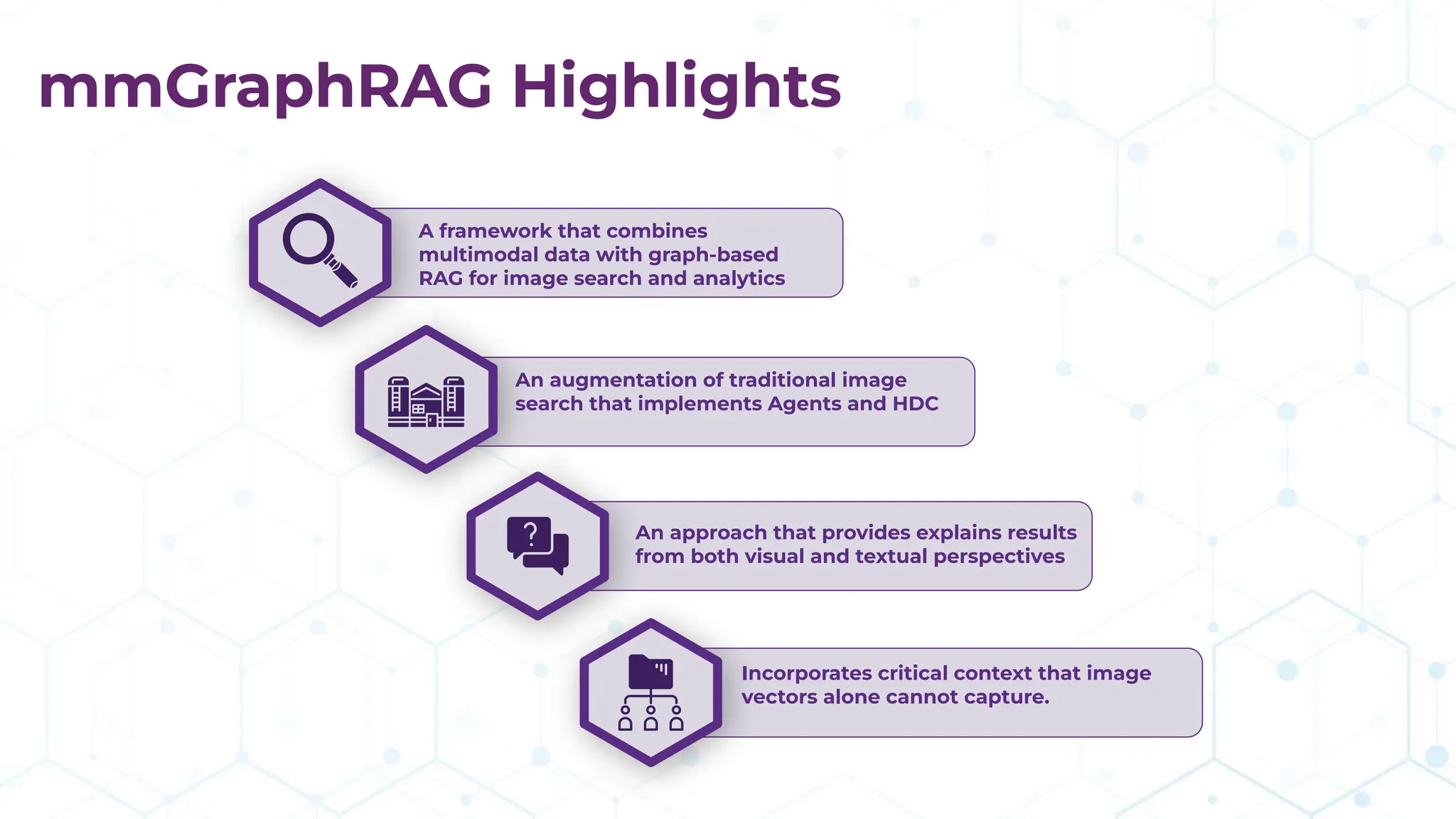
mmGraphRAG Highlights
A framework that combines
multimodal data with graph-based
RAG for image search and analytics
An augmentation of traditional image
search that implements Agents and HDC
An approach that provides explains results
from both visual and textual perspectives
Incorporates critical context that image
vectors alone cannot capture.
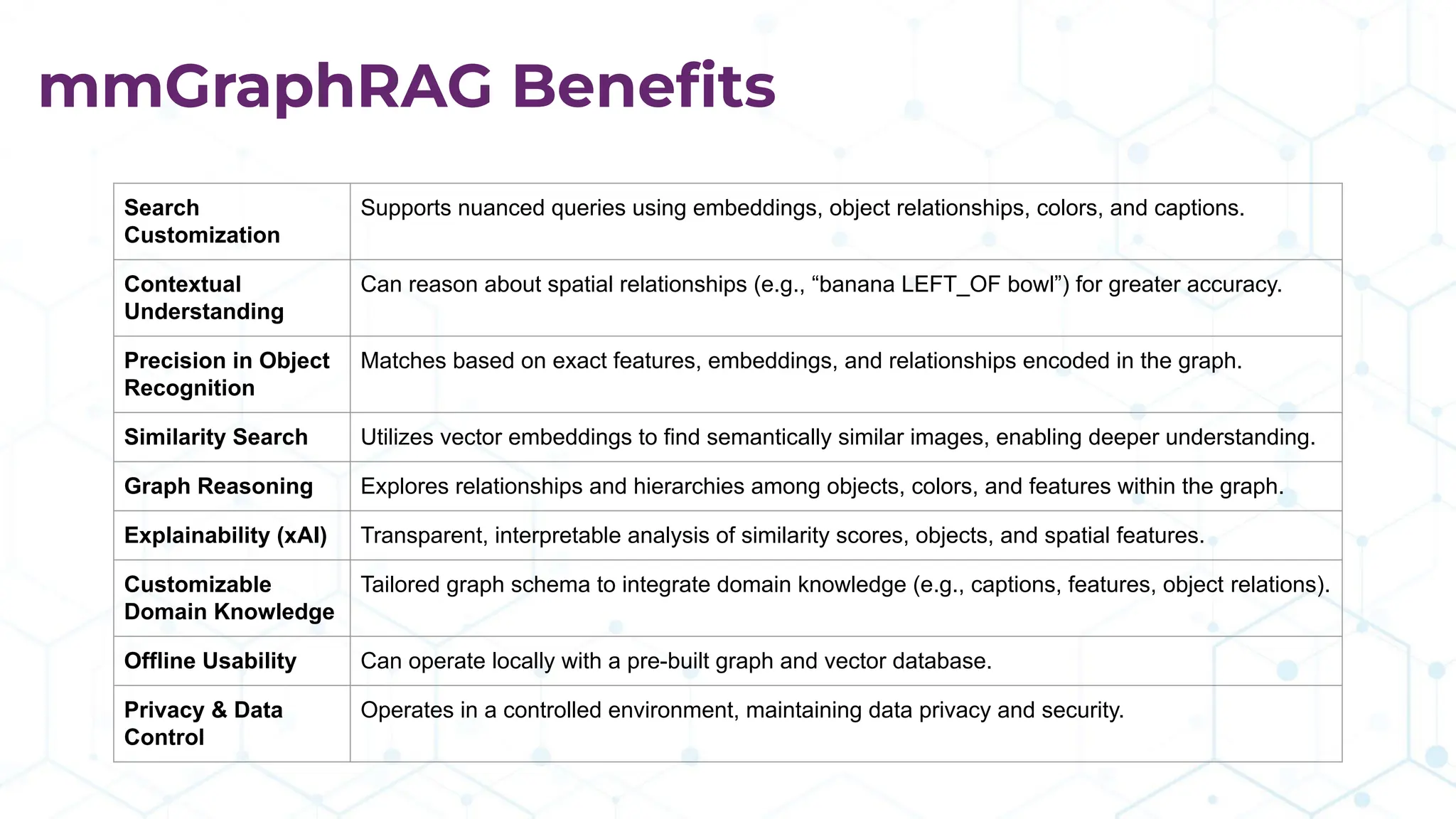
mmGraphRAG Benefits
Search
Customization
Supports nuanced queries using embeddings, object relationships, colors, and captions.
Contextual
Understanding
Can reason about spatial relationships (e.g., “banana LEFT_OF bowl”) for greater accuracy.
Precision in Object
Recognition
Matches based on exact features, embeddings, and relationships encoded in the graph.
Similarity Search Utilizes vector embeddings to find semantically similar images, enabling deeper understanding.
Graph Reasoning Explores relationships and hierarchies among objects, colors, and features within the graph.
Explainability (xAI) Transparent, interpretable analysis of similarity scores, objects, and spatial features.
Customizable
Domain Knowledge
Tailored graph schema to integrate domain knowledge (e.g., captions, features, object relations).
Offline Usability Can operate locally with a pre-built graph and vector database.
Privacy & Data
Control
Operates in a controlled environment, maintaining data privacy and security.
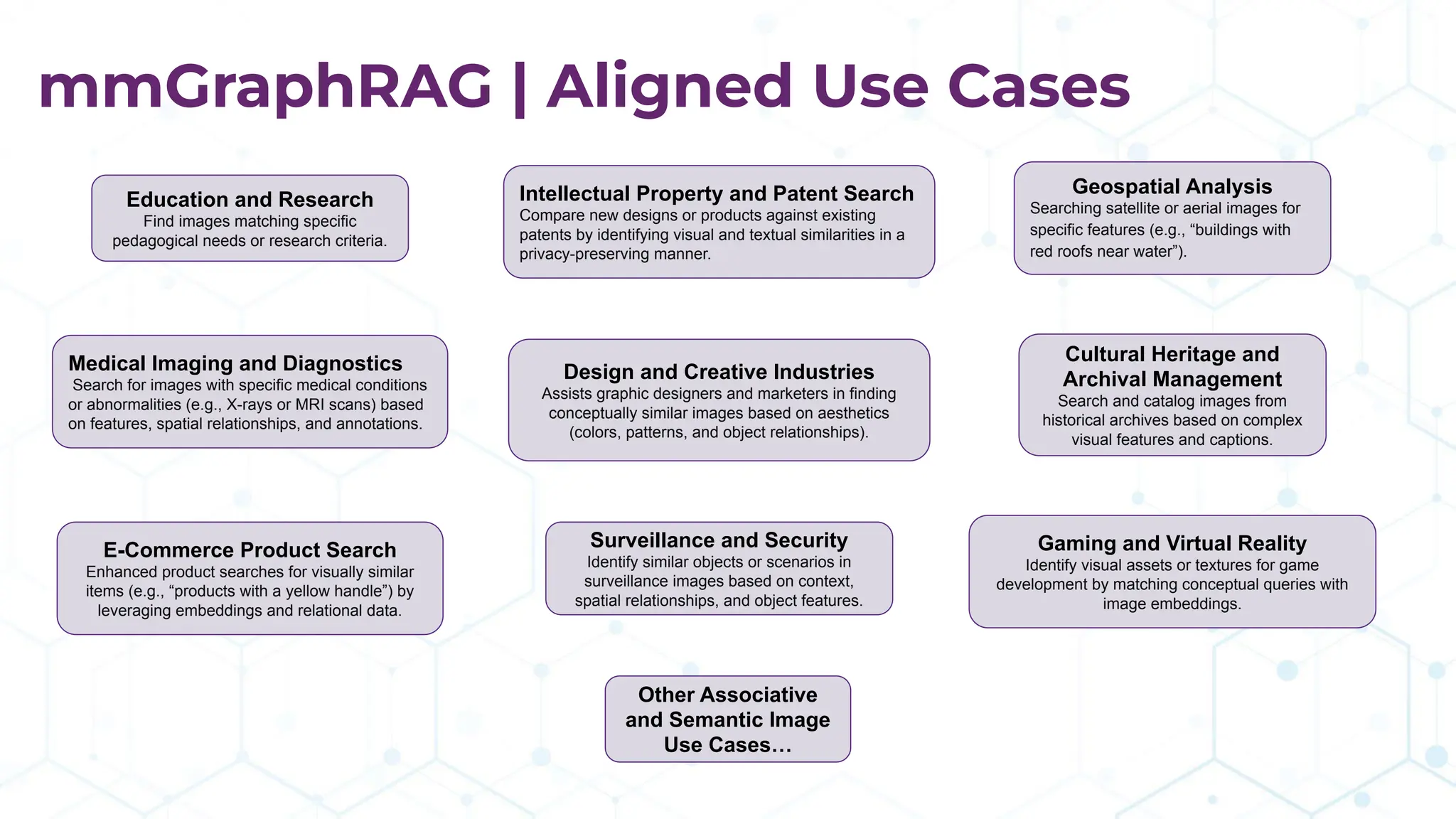
mmGraphRAG | Aligned Use Cases
Intellectual Property and Patent Search
Compare new designs or products against existing
patents by identifying visual and textual similarities in a
privacy-preserving manner.
Medical Imaging and Diagnostics
Search for images with specific medical conditions
or abnormalities (e.g., X-rays or MRI scans) based
on features, spatial relationships, and annotations.
Education and Research
Find images matching specific
pedagogical needs or research criteria.
Surveillance and Security
Identify similar objects or scenarios in
surveillance images based on context,
spatial relationships, and object features.
Design and Creative Industries
Assists graphic designers and marketers in finding
conceptually similar images based on aesthetics
(colors, patterns, and object relationships).
Cultural Heritage and
Archival Management
Search and catalog images from
historical archives based on complex
visual features and captions.
E-Commerce Product Search
Enhanced product searches for visually similar
items (e.g., “products with a yellow handle”) by
leveraging embeddings and relational data.
Geospatial Analysis
Searching satellite or aerial images for
specific features (e.g., “buildings with
red roofs near water”).
Gaming and Virtual Reality
Identify visual assets or textures for game
development by matching conceptual queries with
image embeddings.
Other Associative
and Semantic Image
Use Cases…
ENTERPRISE KNOWLEDGE
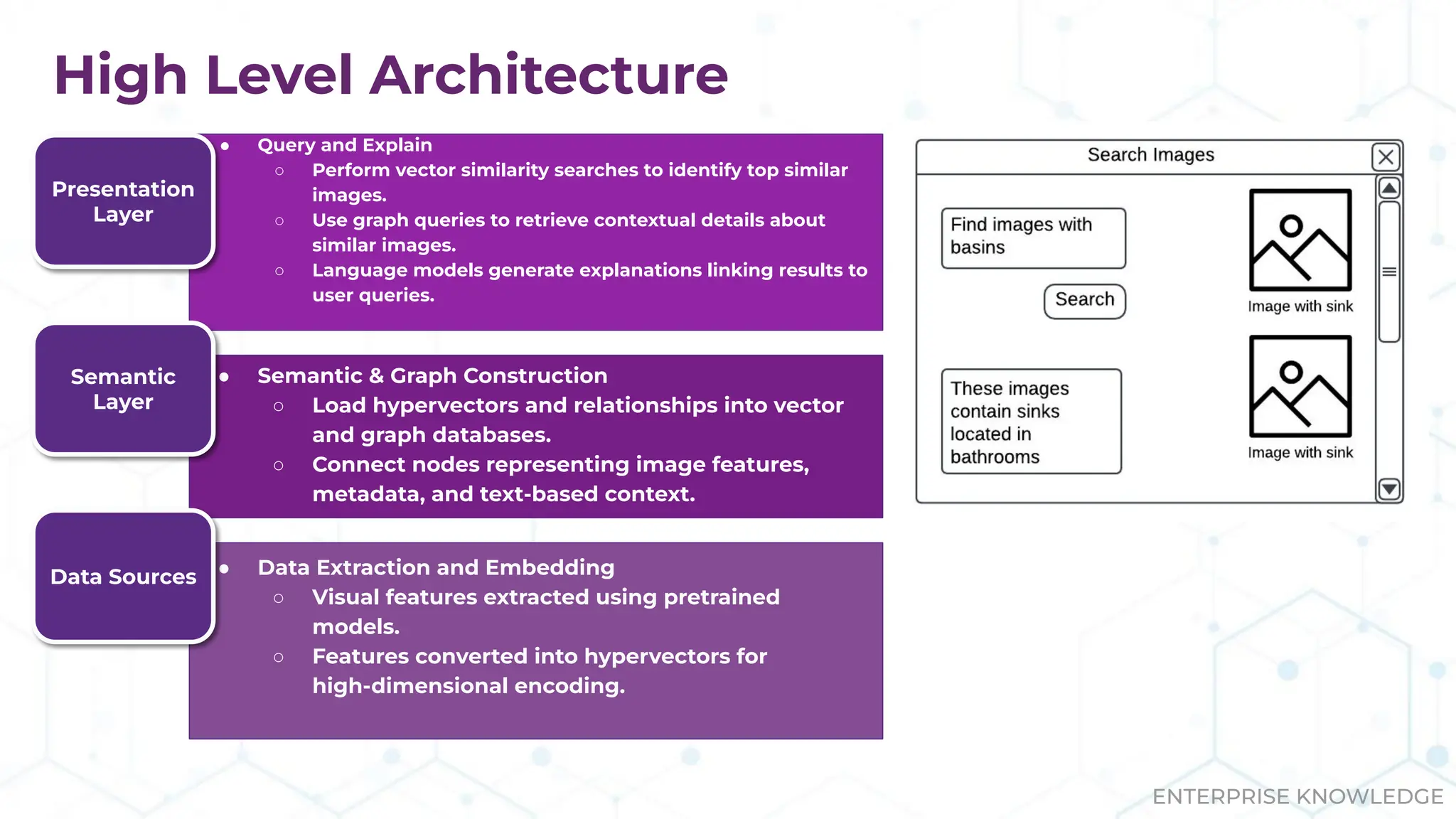
High Level Architecture
● Data Extraction and Embedding
○ Visual features extracted using pretrained
models.
○ Features converted into hypervectors for
high-dimensional encoding.
● Query and Explain
○ Perform vector similarity searches to identify top similar
images.
○ Use graph queries to retrieve contextual details about
similar images.
○ Language models generate explanations linking results to
user queries.
● Semantic & Graph Construction
○ Load hypervectors and relationships into vector
and graph databases.
○ Connect nodes representing image features,
metadata, and text-based context.
Semantic
Layer
Data Sources
Presentation
Layer
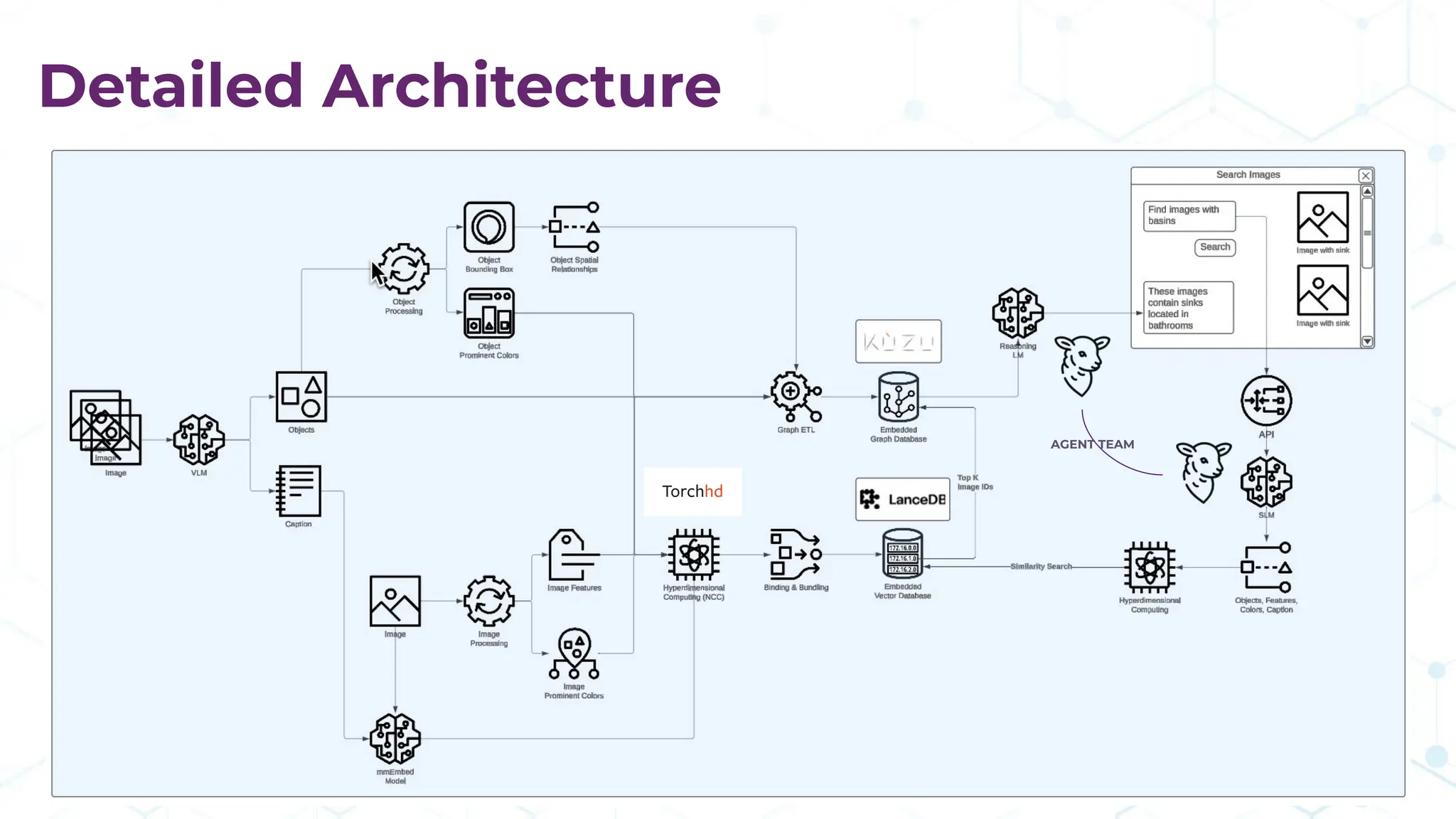
Detailed Architecture
AGENT TEAM
ENTERPRISE KNOWLEDGE
Agentic Workflows
(:Agents)-[:ORCHESTRATED_IN]->( )
ENTERPRISE KNOWLEDGE
What is Hyperdimensional Computing?
Sunday Session:
Hyperdimensional Horizons:
Exploring Neuromorphic
Intelligence and Graph
Applications
We'll explore the principles of HDC, its alignment with brain-inspired
architectures, and its transformative potential in graph-baed applications.
ENTERPRISE KNOWLEDGE
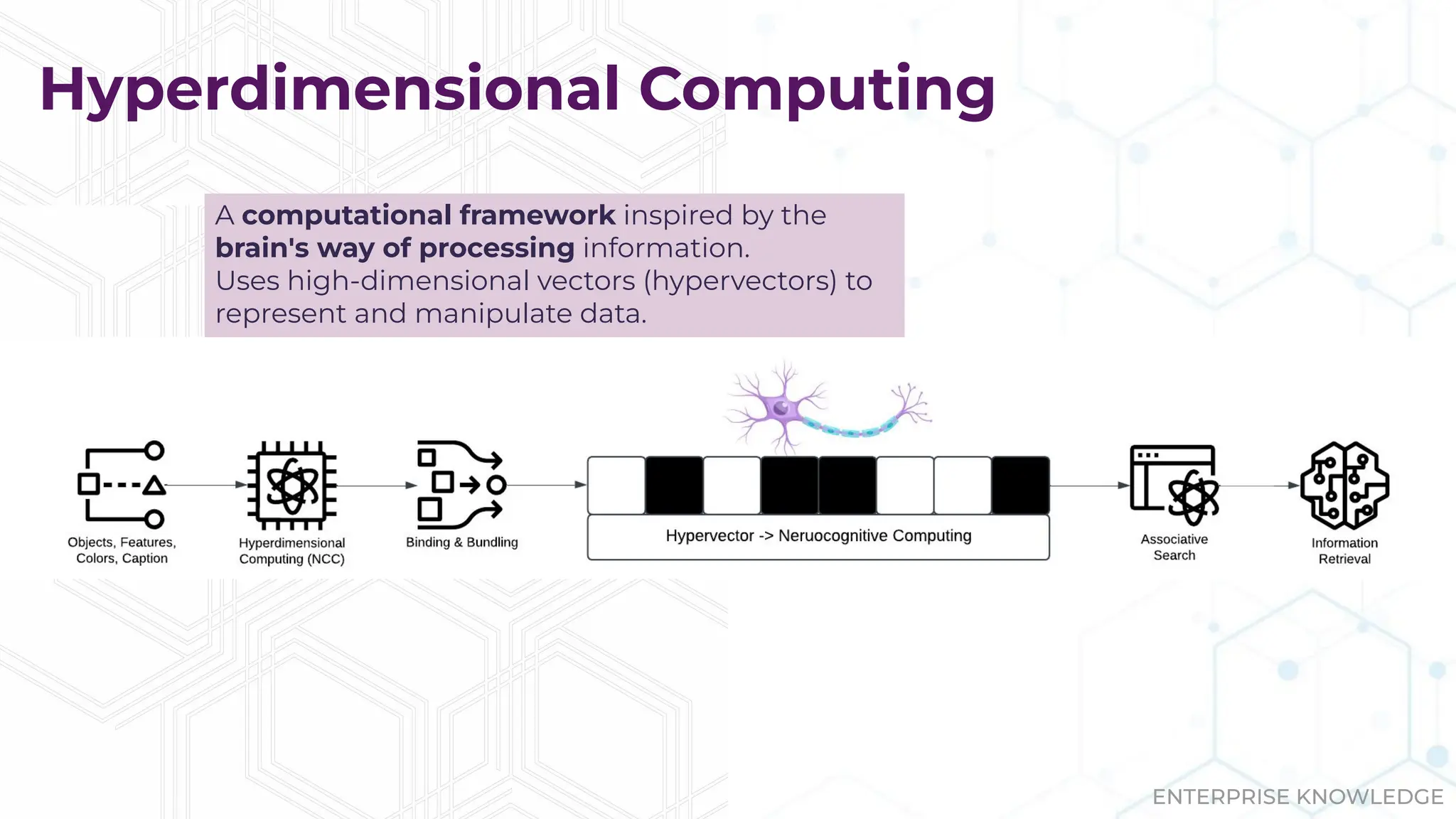
Hyperdimensional Computing
A computational framework inspired by the
brain's way of processing information.
Uses high-dimensional vectors (hypervectors) to
represent and manipulate data.
ENTERPRISE KNOWLEDGE
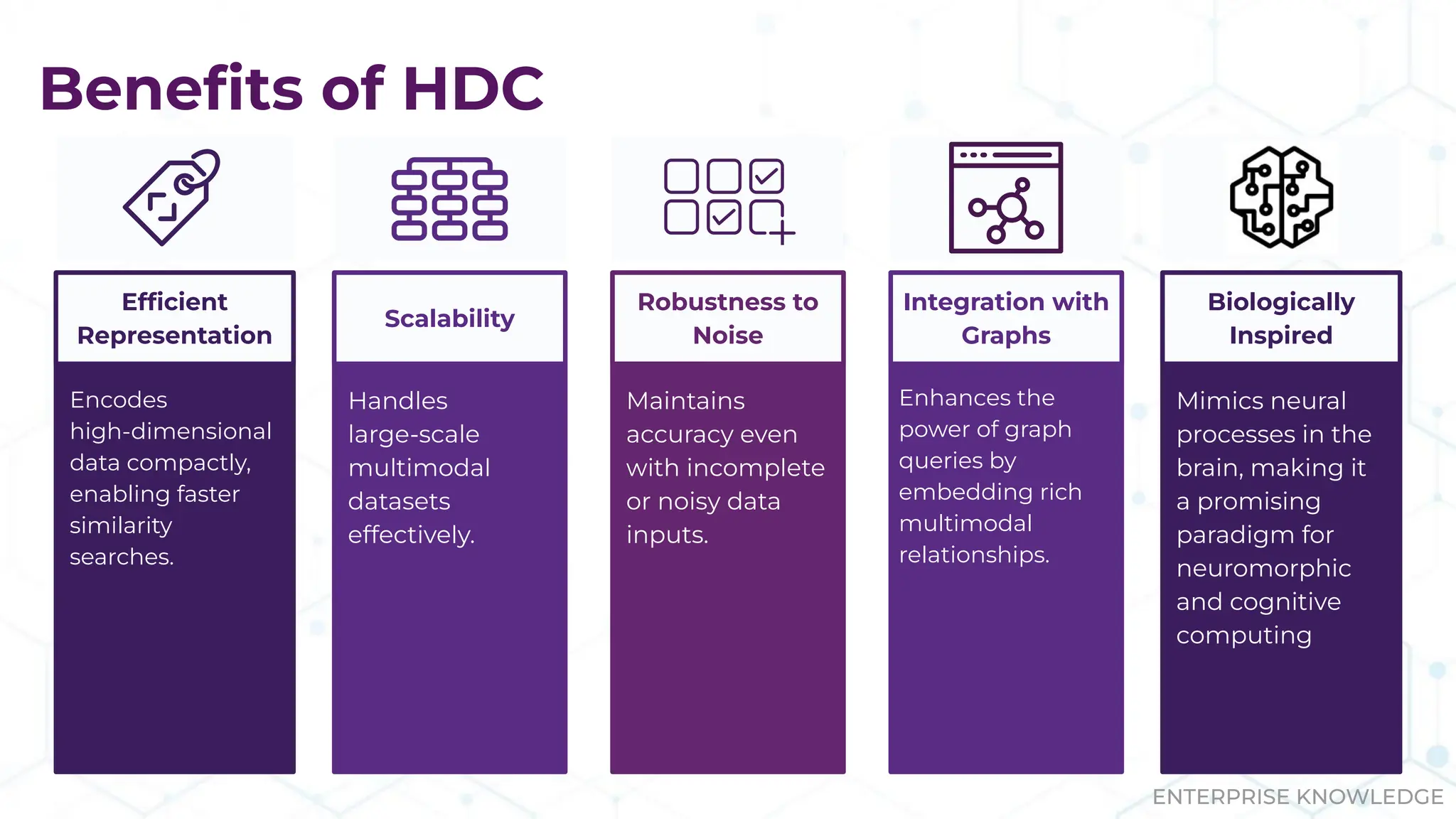
Benefits of HDC
Handles
large-scale
multimodal
datasets
effectively.
Scalability
Enhances the
power of graph
queries by
embedding rich
multimodal
relationships.
Integration with
Graphs
Encodes
high-dimensional
data compactly,
enabling faster
similarity
searches.
Efficient
Representation
Maintains
accuracy even
with incomplete
or noisy data
inputs.
Robustness to
Noise
Mimics neural
processes in the
brain, making it
a promising
paradigm for
neuromorphic
and cognitive
computing
Biologically
Inspired
ENTERPRISE KNOWLEDGE
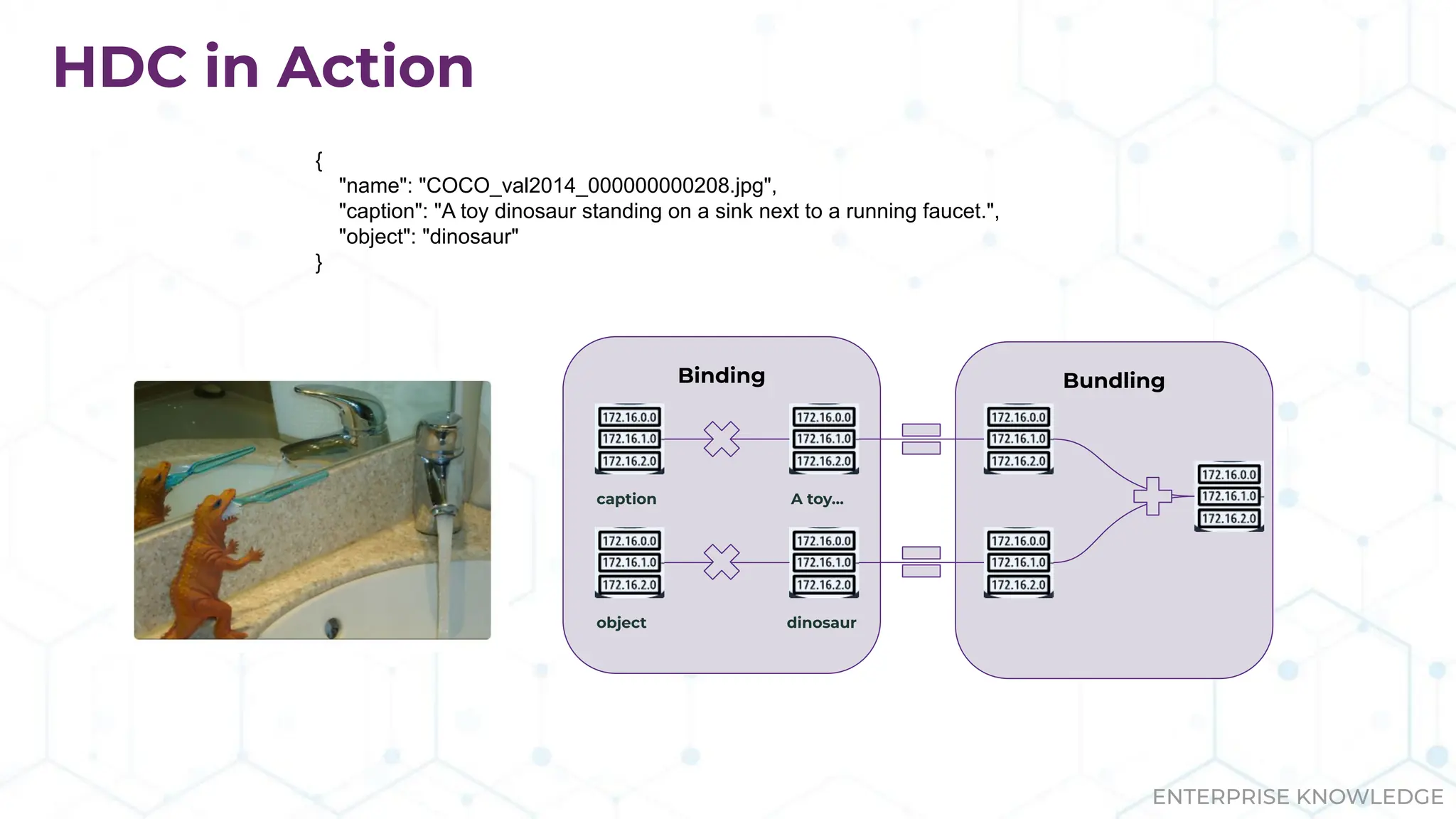
Bundling
Binding
HDC in Action
{
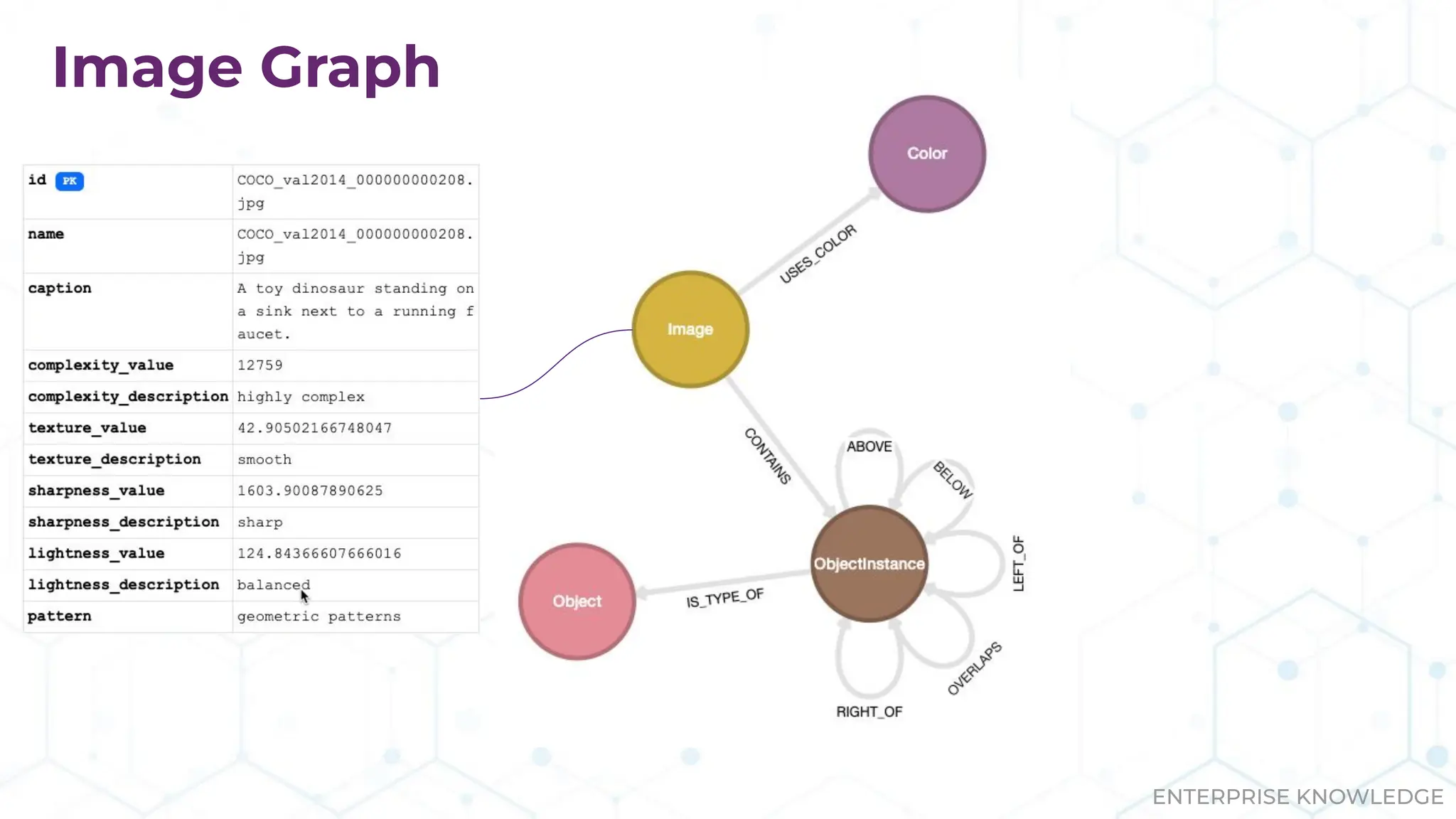
"name": "COCO_val2014_000000000208.jpg",
"caption": "A toy dinosaur standing on a sink next to a running faucet.",
"object": "dinosaur"
}
caption A toy…
object dinosaur
ENTERPRISE KNOWLEDGE
HDC - The Semantic Layer
ENTERPRISE KNOWLEDGE
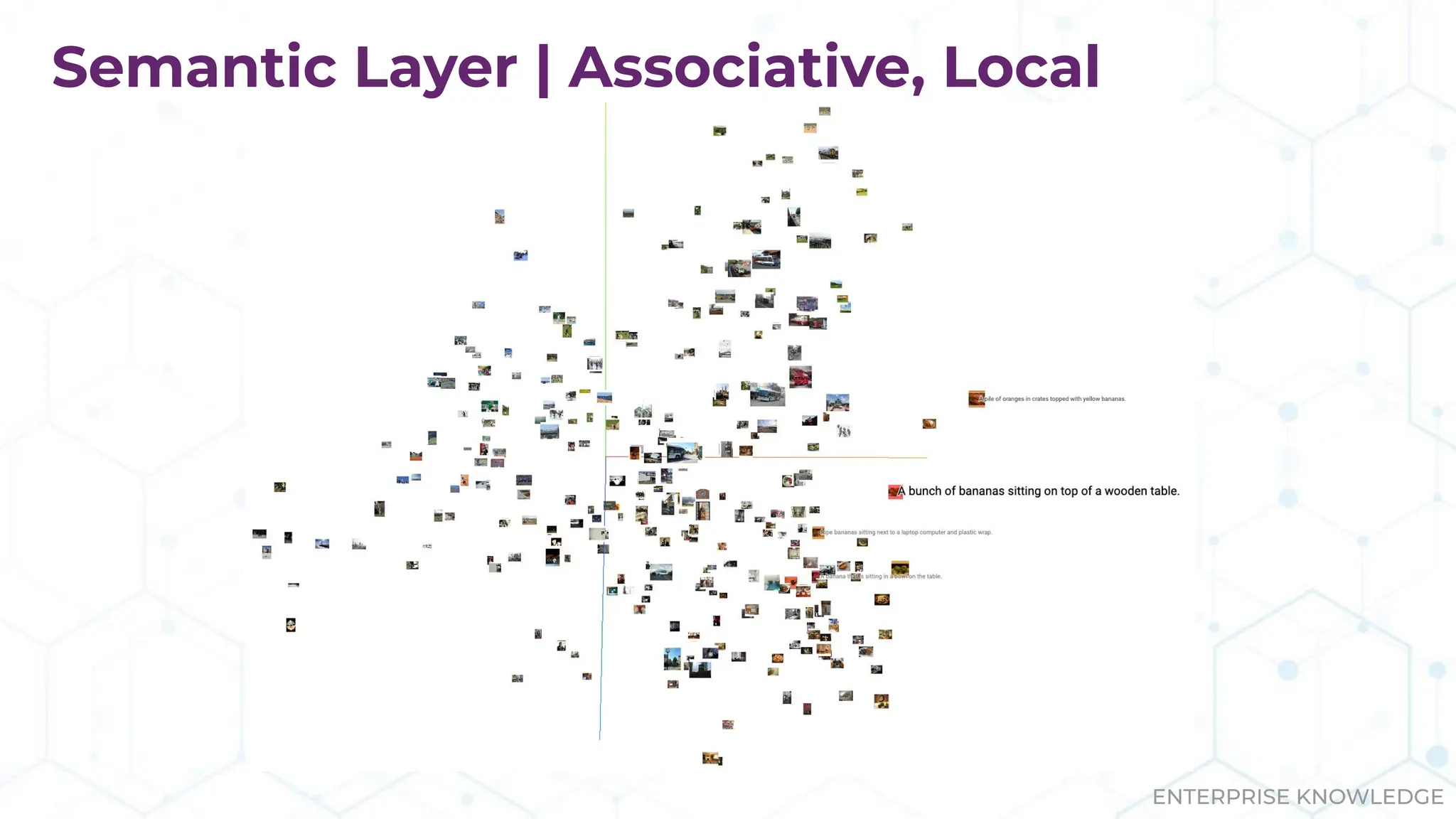
Semantic Layer | Associative, Local
ENTERPRISE KNOWLEDGE
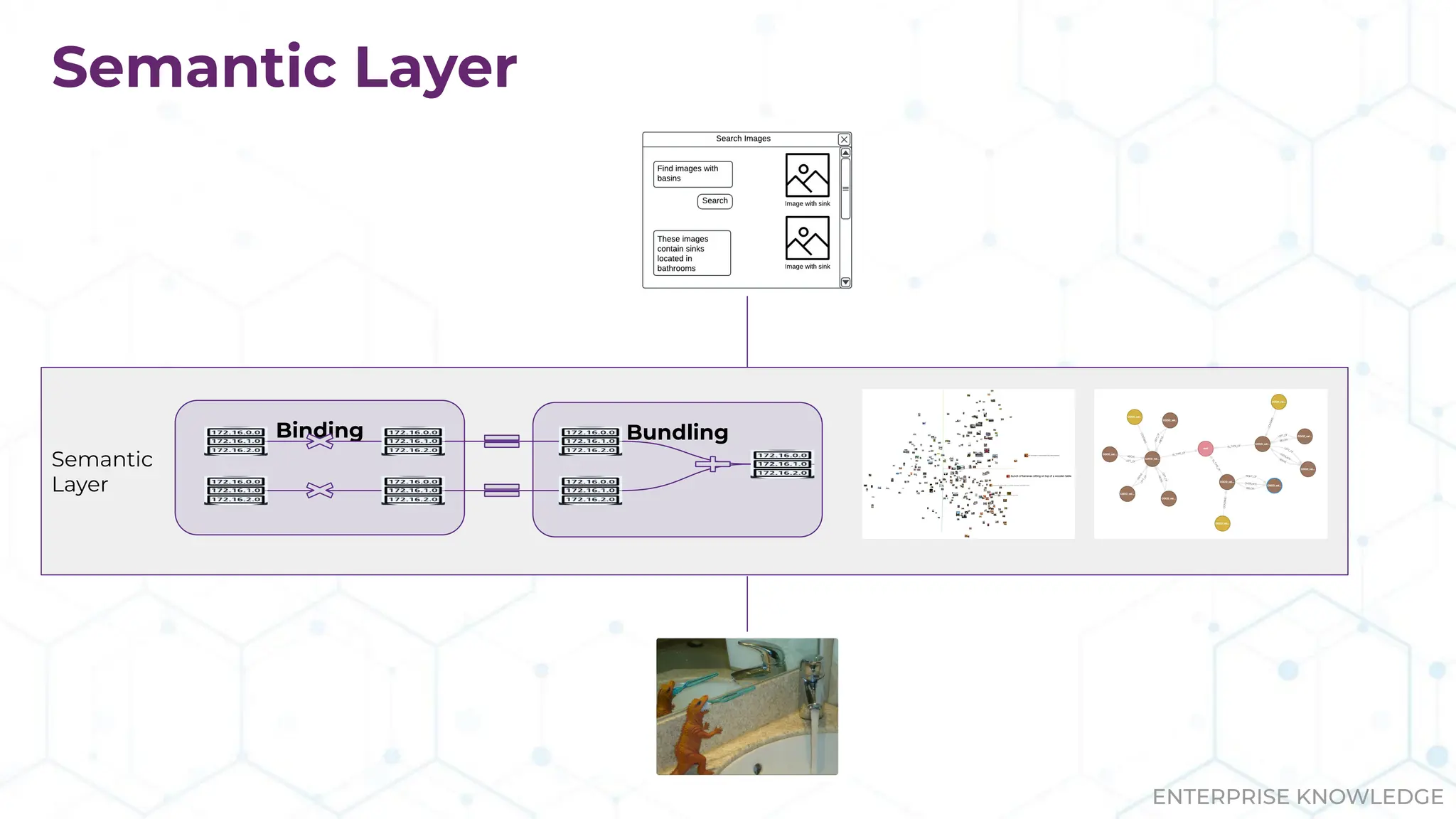
Semantic
Layer
Semantic Layer
Bundling
Binding
ENTERPRISE KNOWLEDGE
The Graph Layer
ENTERPRISE KNOWLEDGE
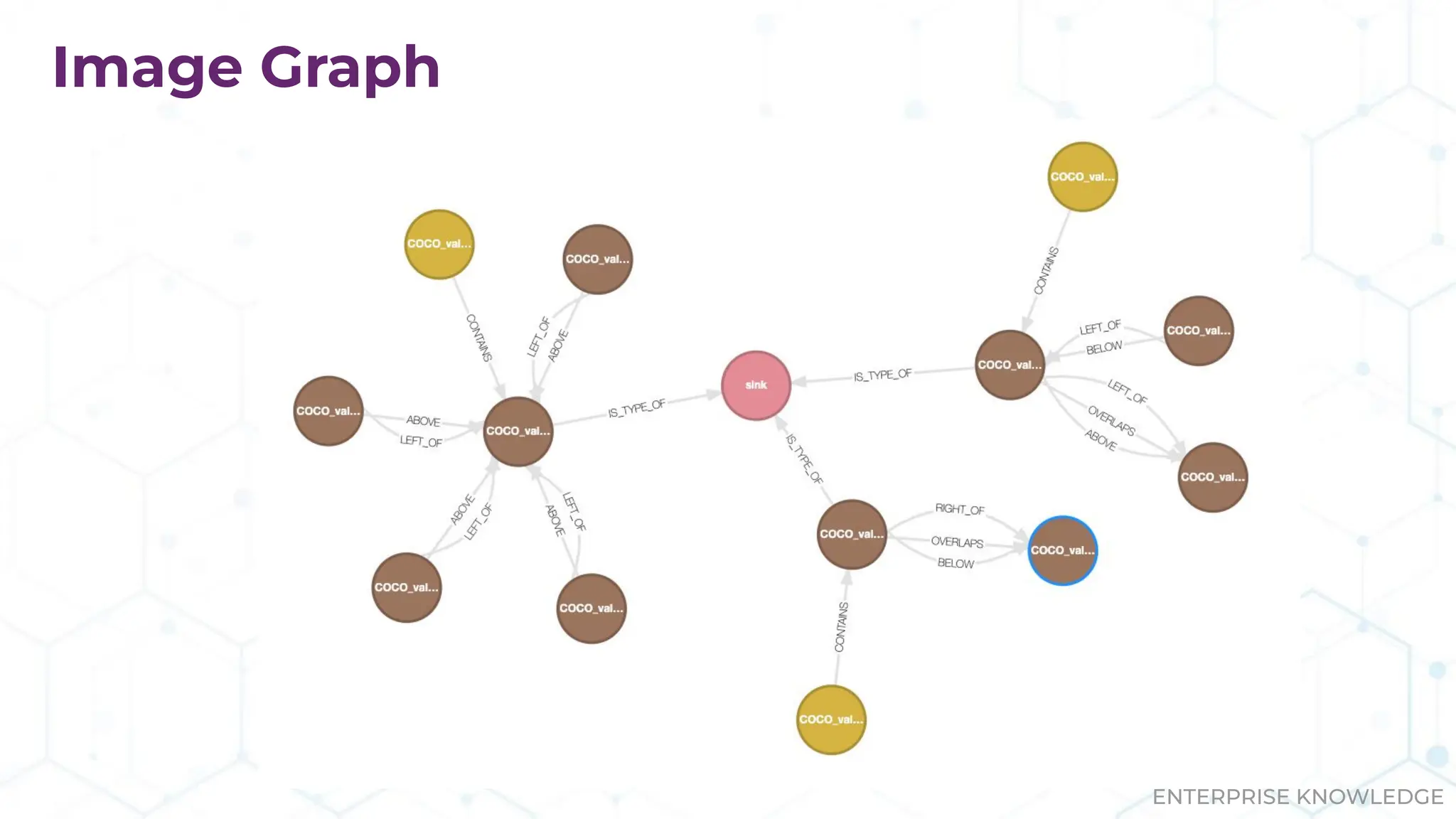
Image Graph
ENTERPRISE KNOWLEDGE
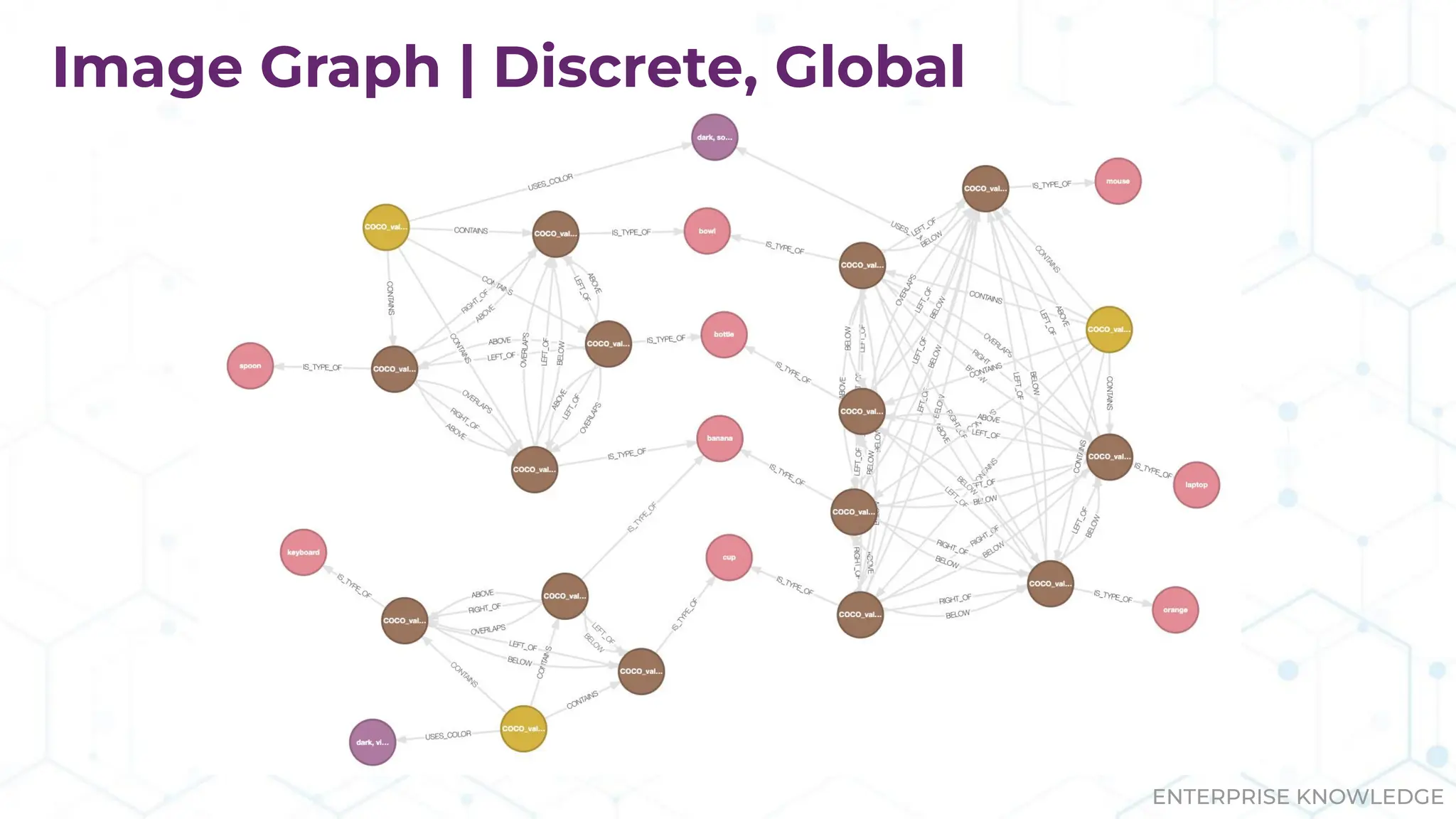
Image Graph | Discrete, Global
ENTERPRISE KNOWLEDGE
Image Graph
ENTERPRISE KNOWLEDGE
DEMO
ENTERPRISE KNOWLEDGE
Request & Agent Processing
{
“request”:”Find images of bananas on a brown wooden table.”
"query_features": {
"objects": [
"bananas",
"table"
],
"colors": [
"brown"
],
"caption": "A bunch of bananas sitting on top of a brown wooden table."
}
ENTERPRISE KNOWLEDGE
Vector Similarity Search Results
"results": [
{
"name": "COCO_val2014_000000003661.jpg",
"similarity_score": 0.7162067890167236,
"objects": [
"banana"
],
"colors": [
"dark, vivid yellow"
],
"caption": "A bunch of bananas sitting on top of a wooden table.",
"complexity": "unknown",
"pattern": "none"
}
ENTERPRISE KNOWLEDGE
Graph Results
"results": [
{
"name": "COCO_val2014_000000003661.jpg",
"similarity_score": 0.7162067890167236,
"objects": [
"medium, muted yellow bowl (LEFT_OF: banana, RIGHT_OF: spoon, ABOVE: spoon, BELOW:
banana, OVERLAPS: banana, ABOVE: bottle, LEFT_OF: bottle)",
"medium, soft yellow banana (LEFT_OF: bowl, RIGHT_OF: spoon, ABOVE: spoon, BELOW: bowl,
OVERLAPS: bowl, OVERLAPS: spoon, OVERLAPS: bottle, ABOVE: bottle, LEFT_OF: bottle)",
"medium, muted yellow spoon (LEFT_OF: bottle, RIGHT_OF: bowl, ABOVE: bowl, OVERLAPS:
banana, ABOVE: banana, ABOVE: bottle, RIGHT_OF: banana)",
"medium, muted yellow bottle (LEFT_OF: bowl, ABOVE: bowl, OVERLAPS: banana, ABOVE:
banana, ABOVE: spoon, LEFT_OF: banana, LEFT_OF: spoon)"
],
"colors": [
"dark, soft yellow"
],
"caption": "A banana that is sitting in a bowl on the table."
},
ENTERPRISE KNOWLEDGE
Graph Results
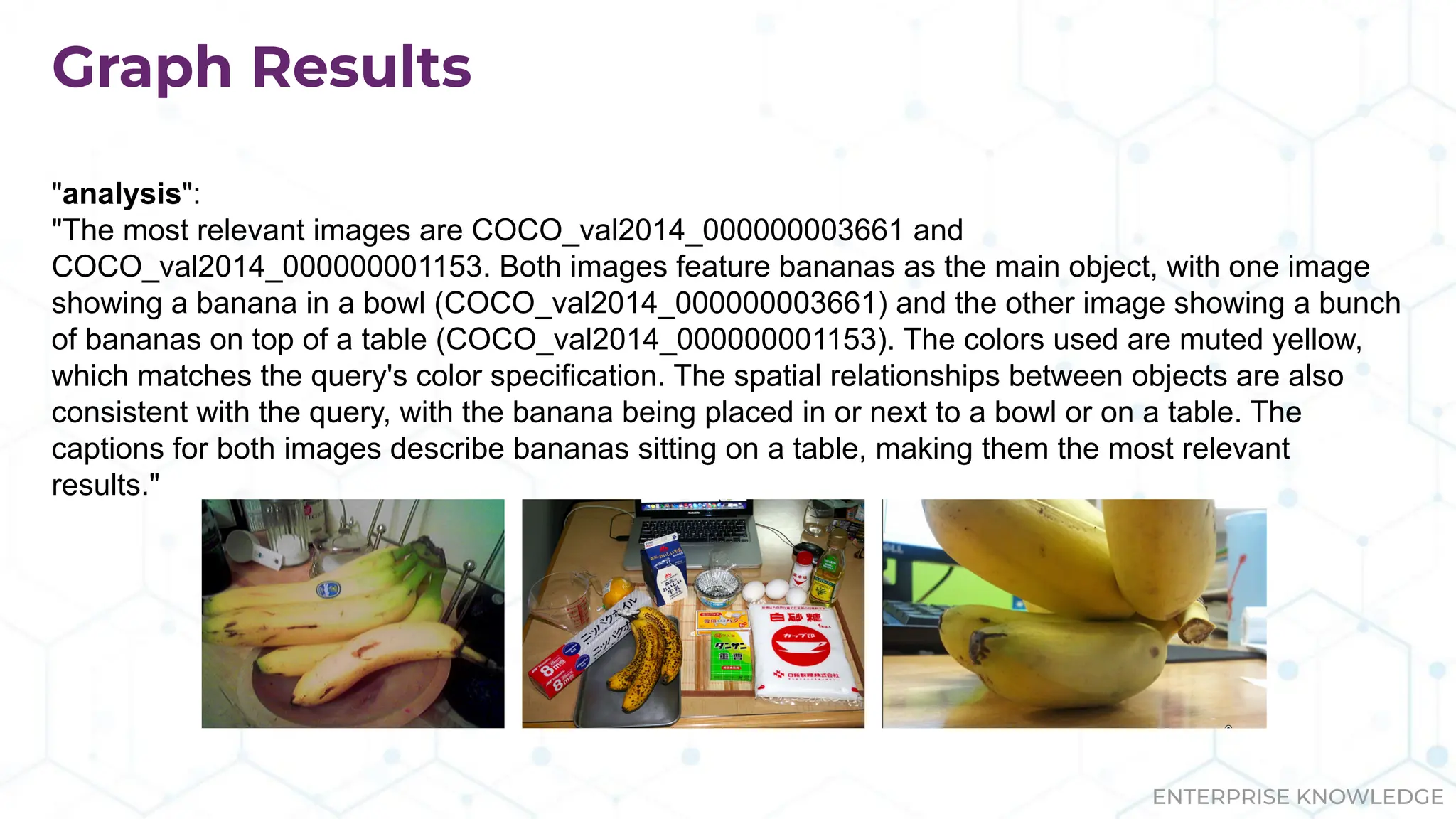
"analysis":
"The most relevant images are COCO_val2014_000000003661 and
COCO_val2014_000000001153. Both images feature bananas as the main object, with one image
showing a banana in a bowl (COCO_val2014_000000003661) and the other image showing a bunch
of bananas on top of a table (COCO_val2014_000000001153). The colors used are muted yellow,
which matches the query's color specification. The spatial relationships between objects are also
consistent with the query, with the banana being placed in or next to a bowl or on a table. The
captions for both images describe bananas sitting on a table, making them the most relevant
results."
ENTERPRISE KNOWLEDGE
Future Directions
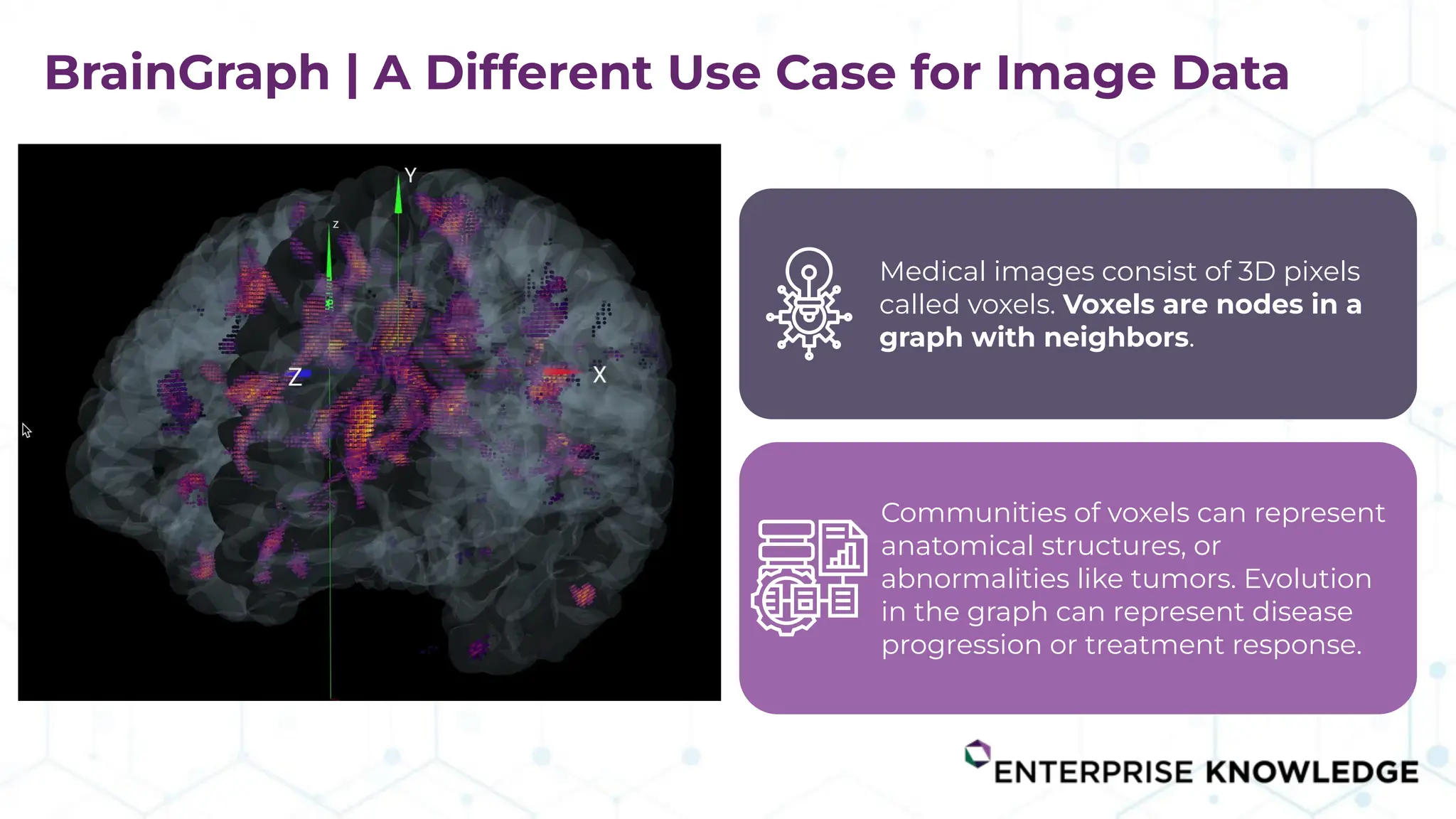
BrainGraph | A Different Use Case for Image Data
Medical images consist of 3D pixels
called voxels. Voxels are nodes in a
graph with neighbors.
Communities of voxels can represent
anatomical structures, or
abnormalities like tumors. Evolution
in the graph can represent disease
progression or treatment response.
Q&A
Thank You!
David Hughes
WWW.LINKEDIN.COM/IN/DAHUGH/
DHUGHES@ENTERPRISE-KNOWLEDGE.COM

Multimodal Graph RAG (mmGraphRAG): Incorporating Vision in Search and Analytics

  • 1.
    ENTERPRISE KNOWLEDGE What isnext after GraphRAG? Are dinosaurs taking over our bathrooms?
  • 2.
    ENTERPRISE KNOWLEDGE What isthe role of images in RAG? A toy dinosaur…
  • 3.
    ENTERPRISE KNOWLEDGE What isthe role of images in RAG? A toy dinosaur…
  • 4.
    ENTERPRISE KNOWLEDGE Can multimodalsearch integrate Semantics and Reasoning? RIGHT_OF A toy dinosaur…
  • 5.
    ENTERPRISE KNOWLEDGE mmGraphRAG Analytics "Themost relevant images are 3661 and 1153. Both images feature bananas as the main object, with one image showing a banana in a bowl (3661) and the other image showing a bunch of bananas on top of a table (1153). The colors used are muted yellow, which matches the query's color specification. The spatial relationships between objects are also consistent with the query, with the banana being placed in or next to a bowl or on a table. Both images are bananas sitting on a table, making them the most relevant results."
  • 6.
    Multimodal Graph RAG(mmGraphRAG): Incorporating Vision in Search and Analytics Data Day Texas - 2025 David Hughes Principal Solution Architect Advanced Data Services and Enterprise AI Enterprise Knowledge, LLC. “I research problem solving in complex domains”
  • 7.
    Objectives Demonstrate how mmGraphRAGworks. Highlight the integration of vision models, hypervectors, and graph databases. Showcase real-world applications and benefits. Introduce BAML Agentic Workflows.
  • 8.
    ENTERPRISE KNOWLEDGE Why AreWe All Here Today? ⬢ Modern systems are overwhelmed by the growing volume of multimodal data. ⬢ Visual and textual data are often siloed, leading to incomplete insights. ⬢ Lack of tools that can explain complex multimodal queries in an intuitive way. ⬢ Reduced search accuracy impacts reputation and user trust. ⬢ Siloed decisions, missing holistic context. ⬢ Delays in retrieving actionable insights due to incomplete or inaccurate search results. ⬢ Inability to identify trends or patterns hidden in multimodal data. ⬢ Vision search without interpretability of the results, xAI. The Challenge Persists What It’s Costing Us
  • 9.
  • 10.
    mmGraphRAG Highlights A frameworkthat combines multimodal data with graph-based RAG for image search and analytics An augmentation of traditional image search that implements Agents and HDC An approach that provides explains results from both visual and textual perspectives Incorporates critical context that image vectors alone cannot capture.
  • 11.
    mmGraphRAG Benefits Search Customization Supports nuancedqueries using embeddings, object relationships, colors, and captions. Contextual Understanding Can reason about spatial relationships (e.g., “banana LEFT_OF bowl”) for greater accuracy. Precision in Object Recognition Matches based on exact features, embeddings, and relationships encoded in the graph. Similarity Search Utilizes vector embeddings to find semantically similar images, enabling deeper understanding. Graph Reasoning Explores relationships and hierarchies among objects, colors, and features within the graph. Explainability (xAI) Transparent, interpretable analysis of similarity scores, objects, and spatial features. Customizable Domain Knowledge Tailored graph schema to integrate domain knowledge (e.g., captions, features, object relations). Offline Usability Can operate locally with a pre-built graph and vector database. Privacy & Data Control Operates in a controlled environment, maintaining data privacy and security.
  • 12.
    mmGraphRAG | AlignedUse Cases Intellectual Property and Patent Search Compare new designs or products against existing patents by identifying visual and textual similarities in a privacy-preserving manner. Medical Imaging and Diagnostics Search for images with specific medical conditions or abnormalities (e.g., X-rays or MRI scans) based on features, spatial relationships, and annotations. Education and Research Find images matching specific pedagogical needs or research criteria. Surveillance and Security Identify similar objects or scenarios in surveillance images based on context, spatial relationships, and object features. Design and Creative Industries Assists graphic designers and marketers in finding conceptually similar images based on aesthetics (colors, patterns, and object relationships). Cultural Heritage and Archival Management Search and catalog images from historical archives based on complex visual features and captions. E-Commerce Product Search Enhanced product searches for visually similar items (e.g., “products with a yellow handle”) by leveraging embeddings and relational data. Geospatial Analysis Searching satellite or aerial images for specific features (e.g., “buildings with red roofs near water”). Gaming and Virtual Reality Identify visual assets or textures for game development by matching conceptual queries with image embeddings. Other Associative and Semantic Image Use Cases…
  • 13.
    ENTERPRISE KNOWLEDGE High LevelArchitecture ● Data Extraction and Embedding ○ Visual features extracted using pretrained models. ○ Features converted into hypervectors for high-dimensional encoding. ● Query and Explain ○ Perform vector similarity searches to identify top similar images. ○ Use graph queries to retrieve contextual details about similar images. ○ Language models generate explanations linking results to user queries. ● Semantic & Graph Construction ○ Load hypervectors and relationships into vector and graph databases. ○ Connect nodes representing image features, metadata, and text-based context. Semantic Layer Data Sources Presentation Layer
  • 14.
  • 15.
  • 16.
  • 17.
    ENTERPRISE KNOWLEDGE What isHyperdimensional Computing? Sunday Session: Hyperdimensional Horizons: Exploring Neuromorphic Intelligence and Graph Applications We'll explore the principles of HDC, its alignment with brain-inspired architectures, and its transformative potential in graph-baed applications.
  • 18.
    ENTERPRISE KNOWLEDGE Hyperdimensional Computing Acomputational framework inspired by the brain's way of processing information. Uses high-dimensional vectors (hypervectors) to represent and manipulate data.
  • 19.
    ENTERPRISE KNOWLEDGE Benefits ofHDC Handles large-scale multimodal datasets effectively. Scalability Enhances the power of graph queries by embedding rich multimodal relationships. Integration with Graphs Encodes high-dimensional data compactly, enabling faster similarity searches. Efficient Representation Maintains accuracy even with incomplete or noisy data inputs. Robustness to Noise Mimics neural processes in the brain, making it a promising paradigm for neuromorphic and cognitive computing Biologically Inspired
  • 20.
    ENTERPRISE KNOWLEDGE Bundling Binding HDC inAction { "name": "COCO_val2014_000000000208.jpg", "caption": "A toy dinosaur standing on a sink next to a running faucet.", "object": "dinosaur" } caption A toy… object dinosaur
  • 21.
    ENTERPRISE KNOWLEDGE HDC -The Semantic Layer
  • 22.
  • 23.
  • 24.
  • 25.
  • 26.
  • 27.
  • 28.
  • 29.
    ENTERPRISE KNOWLEDGE Request &Agent Processing { “request”:”Find images of bananas on a brown wooden table.” "query_features": { "objects": [ "bananas", "table" ], "colors": [ "brown" ], "caption": "A bunch of bananas sitting on top of a brown wooden table." }
  • 30.
    ENTERPRISE KNOWLEDGE Vector SimilaritySearch Results "results": [ { "name": "COCO_val2014_000000003661.jpg", "similarity_score": 0.7162067890167236, "objects": [ "banana" ], "colors": [ "dark, vivid yellow" ], "caption": "A bunch of bananas sitting on top of a wooden table.", "complexity": "unknown", "pattern": "none" }
  • 31.
    ENTERPRISE KNOWLEDGE Graph Results "results":[ { "name": "COCO_val2014_000000003661.jpg", "similarity_score": 0.7162067890167236, "objects": [ "medium, muted yellow bowl (LEFT_OF: banana, RIGHT_OF: spoon, ABOVE: spoon, BELOW: banana, OVERLAPS: banana, ABOVE: bottle, LEFT_OF: bottle)", "medium, soft yellow banana (LEFT_OF: bowl, RIGHT_OF: spoon, ABOVE: spoon, BELOW: bowl, OVERLAPS: bowl, OVERLAPS: spoon, OVERLAPS: bottle, ABOVE: bottle, LEFT_OF: bottle)", "medium, muted yellow spoon (LEFT_OF: bottle, RIGHT_OF: bowl, ABOVE: bowl, OVERLAPS: banana, ABOVE: banana, ABOVE: bottle, RIGHT_OF: banana)", "medium, muted yellow bottle (LEFT_OF: bowl, ABOVE: bowl, OVERLAPS: banana, ABOVE: banana, ABOVE: spoon, LEFT_OF: banana, LEFT_OF: spoon)" ], "colors": [ "dark, soft yellow" ], "caption": "A banana that is sitting in a bowl on the table." },
  • 32.
    ENTERPRISE KNOWLEDGE Graph Results "analysis": "Themost relevant images are COCO_val2014_000000003661 and COCO_val2014_000000001153. Both images feature bananas as the main object, with one image showing a banana in a bowl (COCO_val2014_000000003661) and the other image showing a bunch of bananas on top of a table (COCO_val2014_000000001153). The colors used are muted yellow, which matches the query's color specification. The spatial relationships between objects are also consistent with the query, with the banana being placed in or next to a bowl or on a table. The captions for both images describe bananas sitting on a table, making them the most relevant results."
  • 33.
  • 34.
    BrainGraph | ADifferent Use Case for Image Data Medical images consist of 3D pixels called voxels. Voxels are nodes in a graph with neighbors. Communities of voxels can represent anatomical structures, or abnormalities like tumors. Evolution in the graph can represent disease progression or treatment response.
  • 35.