DESIGN THINKING
for Change Management
Angel Medinilla
angel.medinilla@proyectalis.com
www.proyectalis.com/en/AngelMedinilla
(Slides, Videos, Newsletter, Books, Blog, LinkedIn, Sketchnotes, Twitter...)
Twitter: @angel_m
(pictures, followers & feedback welcome)
<vanity>
www.improvement21.com
facebook.com/improvement21
@improvement_21
We help people and companies create
continuous improvement habits
My
Pleasure!
(all drawings by yours trully)
</vanity>
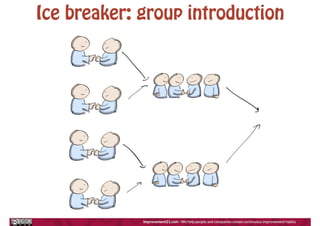
Ice breaker: group introduction
Design Thinking
Design thinking is a
user-centered approach
to innovation
Design thinking is a
user-centered approach
to innovation
Design thinking is a
user-centered approach
to problem solving
More at http://Slideshare.net/proyectalis
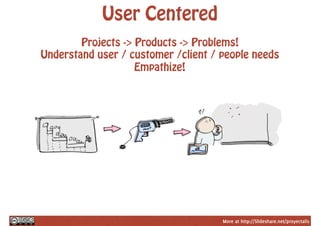
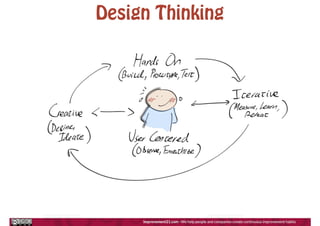
User Centered
Projects -> Products -> Problems!
Understand user / customer /client / people needs
Empathize!
More at http://Slideshare.net/proyectalis
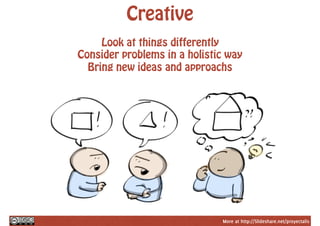
Creative
Look at things differently
Consider problems in a holistic way
Bring new ideas and approachs
More at http://Slideshare.net/proyectalis
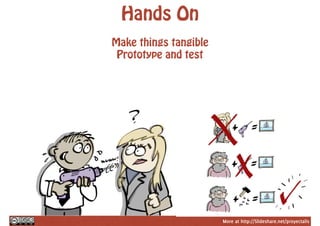
Hands On
Make things tangible
Prototype and test
More at http://Slideshare.net/proyectalis
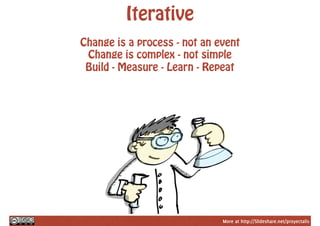
Iterative
Change is a process - not an event
Change is complex - not simple
Build - Measure - Learn - Repeat
Design Thinking
More at http://Slideshare.net/proyectalis
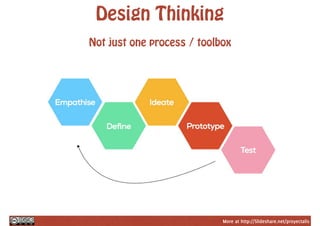
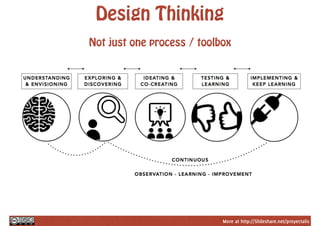
Design Thinking
Not just one process / toolbox
More at http://Slideshare.net/proyectalis
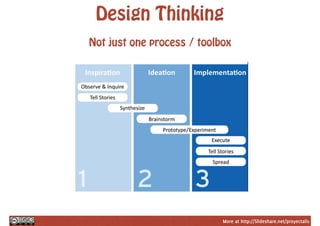
Design Thinking
Not just one process / toolbox
More at http://Slideshare.net/proyectalis
Design Thinking
Not just one process / toolbox
More at http://Slideshare.net/proyectalis
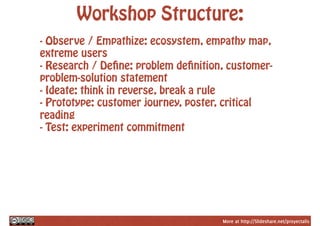
Workshop Structure:
- Observe / Empathize: ecosystem, empathy map,
extreme users
- Research / Define: problem definition, customer-
problem-solution statement
- Ideate: think in reverse, break a rule
- Prototype: customer journey, poster, critical
reading
- Test: experiment commitment
More at http://Slideshare.net/proyectalis
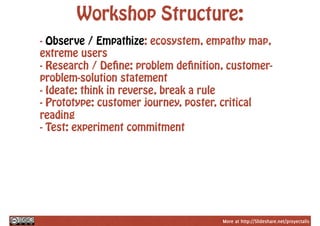
Workshop Structure:
- Observe / Empathize: ecosystem, empathy map,
extreme users
- Research / Define: problem definition, customer-
problem-solution statement
- Ideate: think in reverse, break a rule
- Prototype: customer journey, poster, critical
reading
- Test: experiment commitment
More at http://Slideshare.net/proyectalis
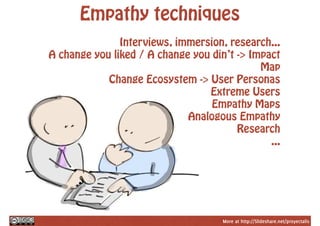
Empathy techniques
Interviews, immersion, research...
A change you liked / A change you din’t -> Impact
Map
Change Ecosystem -> User Personas
Extreme Users
Empathy Maps
Analogous Empathy
Research
...
More at http://Slideshare.net/proyectalis
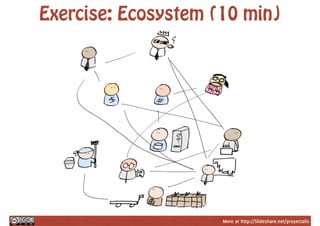
Exercise: Ecosystem (10 min)
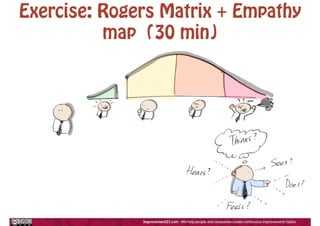
Exercise: Rogers Matrix + Empathy
map (30 min)
More at http://Slideshare.net/proyectalis
Workshop Structure:
- Observe / Empathize: ecosystem, empathy map,
extreme users
- Research / Define: problem definition, customer-
problem-solution statement,
- Ideate: think in reverse, break a rule
- Prototype: customer journey, poster, critical
reading
- Test: experiment commitment
More at http://Slideshare.net/proyectalis
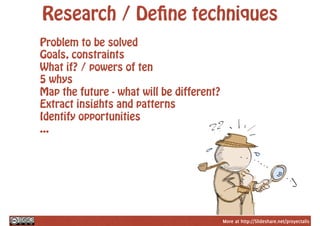
Research / Define techniques
Problem to be solved
Goals, constraints
What if? / powers of ten
5 whys
Map the future - what will be different?
Extract insights and patterns
Identify opportunities
...
More at http://Slideshare.net/proyectalis
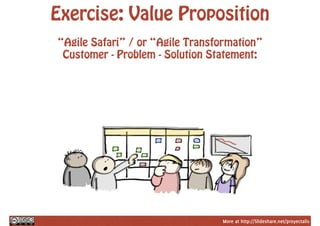
Exercise: Value Proposition
“Agile Safari” / or “Agile Transformation”
Customer - Problem - Solution Statement:
More at http://Slideshare.net/proyectalis
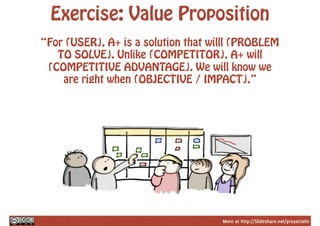
Exercise: Value Proposition
“For (USER), A+ is a solution that willl (PROBLEM
TO SOLVE). Unlike (COMPETITOR), A+ will
(COMPETITIVE ADVANTAGE). We will know we
are right when (OBJECTIVE / IMPACT).”
More at http://Slideshare.net/proyectalis
Workshop Structure:
- Observe / Empathize: ecosystem, empathy map,
extreme users
- Research / Define: problem definition, customer-
problem-solution statement
- Ideate: think in reverse, break a rule
- Prototype: customer journey, poster, critical
reading
- Test: experiment commitment
More at http://Slideshare.net/proyectalis
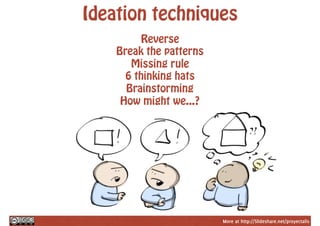
Ideation techniques
Reverse
Break the patterns
Missing rule
6 thinking hats
Brainstorming
How might we...?
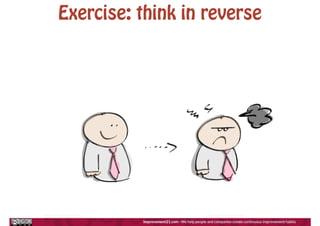
Exercise: think in reverse
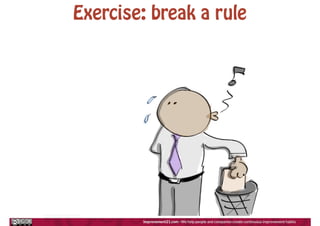
Exercise: break a rule
More at http://Slideshare.net/proyectalis
Workshop Structure:
- Observe / Empathize: ecosystem, empathy map,
extreme users
- Research / Define: problem definition, customer-
problem-solution statement
- Ideate: think in reverse, break a rule
- Prototype: customer journey, poster, critical
reading
- Test: experiment commitment
More at http://Slideshare.net/proyectalis
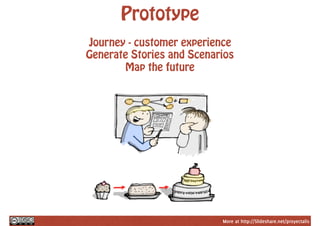
Prototype
Journey - customer experience
Generate Stories and Scenarios
Map the future
More at http://Slideshare.net/proyectalis
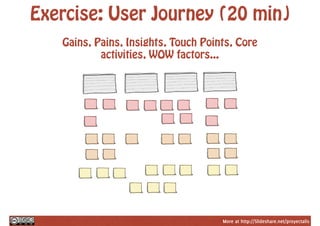
Exercise: User Journey (20 min)
Gains, Pains, Insights, Touch Points, Core
activities, WOW factors...
More at http://Slideshare.net/proyectalis
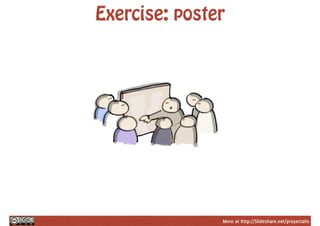
Exercise: poster
More at http://Slideshare.net/proyectalis
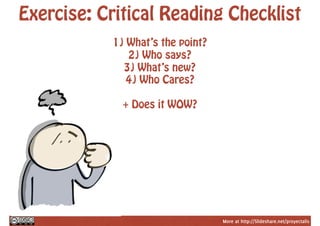
Exercise: Critical Reading Checklist
1) What’s the point?
2) Who says?
3) What’s new?
4) Who Cares?
+ Does it WOW?
More at http://Slideshare.net/proyectalis
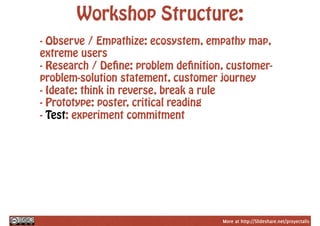
Workshop Structure:
- Observe / Empathize: ecosystem, empathy map,
extreme users
- Research / Define: problem definition, customer-
problem-solution statement, customer journey
- Ideate: think in reverse, break a rule
- Prototype: poster, critical reading
- Test: experiment commitment
More at http://Slideshare.net/proyectalis
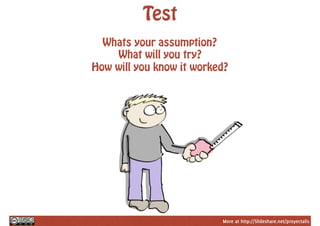
Test
Whats your assumption?
What will you try?
How will you know it worked?
More at http://Slideshare.net/proyectalis
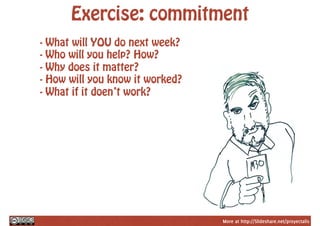
Exercise: commitment
- What will YOU do next week?
- Who will you help? How?
- Why does it matter?
- How will you know it worked?
- What if it doen’t work?
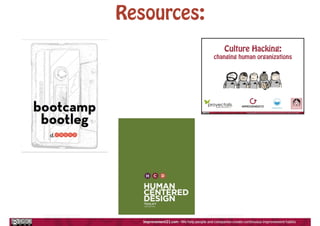
Resources:
More at http://Slideshare.net/proyectalis
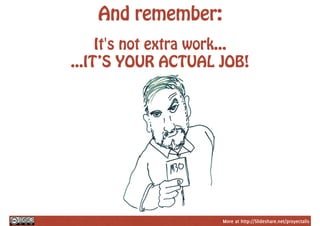
And remember:
It's not extra work...
...IT’S YOUR ACTUAL JOB!
Thank you and... Share it!
http://www.proyectalis.com/en/AngelMedinilla
www.improvement21.com
http://creativecommons.org/licenses/by-nc-nd/3.0/
This presentation is based upon the ideas and
work of many people. And while I’ve tried to
recognize copyrights and give credit and
attribution where possible, I cannot possibly
list them all, so if you feel like there’s
something that should be added, changed or
removed from this presentation, please drop
me an e-mail at
angel.medinilla@proyectalis.com
All drawings and materials in this presentation
are CC BY-NC-ND by Angel Medinilla. You are
free to use them in the terms of this license.

Design Thinking for Change Management