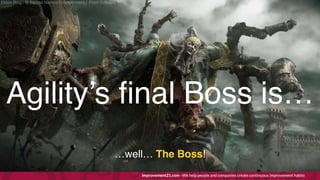
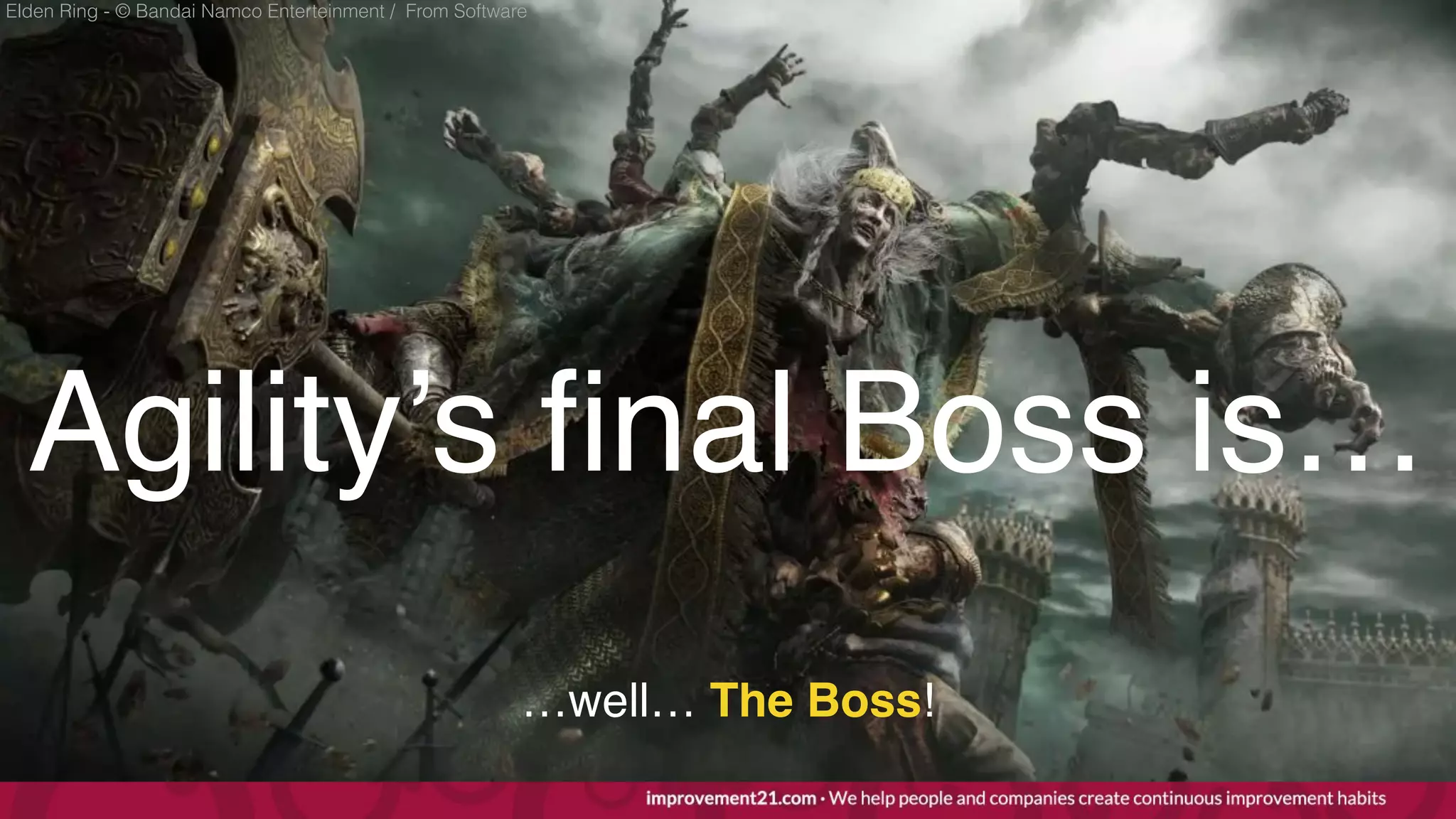
Agility’sfi
nal Boss is
…

…well… The Boss!
Elden Ring - © Bandai Namco Enterteinment / From Software
Hi, I’m Ángel Medinilla!
- Organizational transformation & improvement consultant.
Agility trainer, leadership coach at Improvement21.


- Pragmatist & agnostic - hands-on experience on a broad
set of industries (banking, telco, government, pharma,
aerospace, insurance, tourism, retail, mobile, gaming…).


- Author: “Agile Management” & “Agile Kaizen” (Springer),
International Speaker (duh! :P).


- Management 3.0 Licensed Trainer (5th most active
worldwide).


angel.medinilla@improvement21.com / @angel_m
My own path as a ‘Boss’
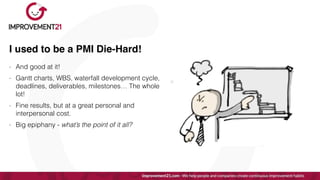
I used to be a PMI Die-Hard!
- And good at it!


- Gantt charts, WBS, waterfall development cycle,
deadlines, deliverables, milestones… The whole
lot!


- Fine results, but at a great personal and
interpersonal cost.


- Big epiphany - what’s the point of it all?
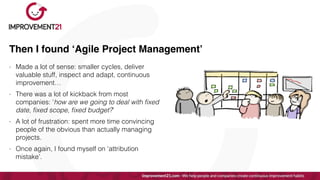
Then I found ‘Agile Project Management’
- Made a lot of sense: smaller cycles, deliver
valuable stuff, inspect and adapt, continuous
improvement…


- There was a lot of kickback from most
companies: ‘how are we going to deal with
fi
xed
date,
fi
xed scope,
fi
xed budget?’


- A lot of frustration: spent more time convincing
people of the obvious than actually managing
projects.


- Once again, I found myself on ‘attribution
mistake’.
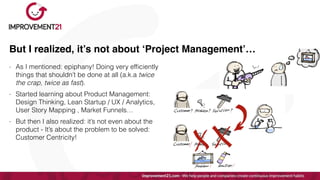
But I realized, it’s not about ‘Project Management’…
- As I mentioned: epiphany! Doing very ef
fi
ciently
things that shouldn’t be done at all (a.k.a twice
the crap, twice as fast).


- Started learning about Product Management:
Design Thinking, Lean Startup / UX / Analytics,
User Story Mapping , Market Funnels…


- But then I also realized: it’s not even about the
product - It’s about the problem to be solved:
Customer Centricity!
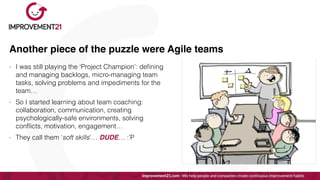
Another piece of the puzzle were Agile teams
- I was still playing the ‘Project Champion’: de
fi
ning
and managing backlogs, micro-managing team
tasks, solving problems and impediments for the
team…


- So I started learning about team coaching:
collaboration, communication, creating
psychologically-safe environments, solving
con
fl
icts, motivation, engagement…


- They call them ‘soft skills’… DUDE… :’P
And then…the box!
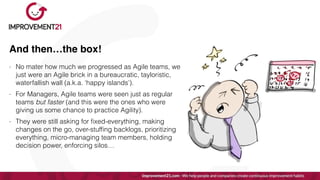
- No mater how much we progressed as Agile teams, we
just were an Agile brick in a bureaucratic, tayloristic,
waterfallish wall (a.k.a. ‘happy islands’).


- For Managers, Agile teams were seen just as regular
teams but faster (and this were the ones who were
giving us some chance to practice Agility).


- They were still asking for
fi
xed-everything, making
changes on the go, over-stuf
fi
ng backlogs, prioritizing
everything, micro-managing team members, holding
decision power, enforcing silos…
Here came Management 3.0 to the rescue
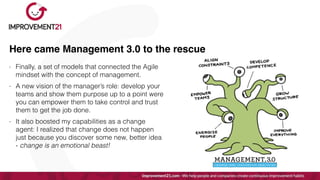
- Finally, a set of models that connected the Agile
mindset with the concept of management.


- A new vision of the manager’s role: develop your
teams and show them purpose up to a point were
you can empower them to take control and trust
them to get the job done.


- It also boosted my capabilities as a change
agent: I realized that change does not happen
just because you discover some new, better idea
- change is an emotional beast!
We achieved some pretty amazing things
“In 2011, this unit in (some guys you probable hate) with several thousand people embraced
Agile. Before 2011, (these guys) would build its systems on a
fi
ve-year cycle, with a unit
housing several thousand employees. When the system was
fi
nally built, it would be shipped to
the telecoms and there would be an extended period of adjustment as the system was adapted
to
fi
t their needs. Now with Agile management, (this same company) has over 100 small teams
working with its customers’ needs in three-week cycles. The result is faster development that
is more relevant to the speci
fi
c needs of the customers. The client gets value sooner. They have
less work in progress. And (the aforementioned guys) are deploying one to two years earlier
than it otherwise would, so that its revenue comes in one to two years earlier”.


http://www.forbes.com/sites/stevedenning/2016/11/26/can-big-organizations-be-agile/
Still… ‘Cargo Cult’ everywhere!
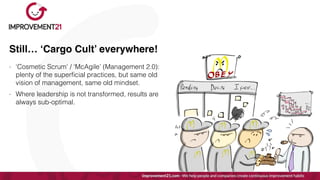
- ‘Cosmetic Scrum’ / ‘McAgile’ (Management 2.0):
plenty of the super
fi
cial practices, but same old
vision of management, same old mindset.


- Where leadership is not transformed, results are
always sub-optimal.
Where am I?
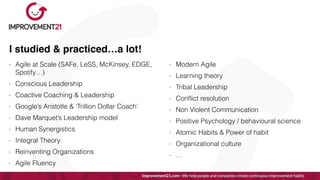
I studied & practiced…a lot!
- Agile at Scale (SAFe, LeSS, McKinsey, EDGE,
Spotify…)


- Conscious Leadership


- Coactive Coaching & Leadership


- Google’s Aristotle & ‘Trillion Dollar Coach’


- Dave Marquet’s Leadership model


- Human Synergistics


- Integral Theory


- Reinventing Organizations


- Agile Fluency
- Modern Agile


- Learning theory


- Tribal Leadership


- Con
fl
ict resolution


- Non Violent Communication


- Positive Psychology / behavioural science


- Atomic Habits & Power of habit


- Organizational culture


- …
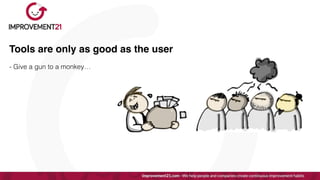
Tools are only as good as the user
- Give a gun to a monkey…
“There is no ten-step program for doing this. Getting away from
how organizations have been run for over
fi
fty years, and becoming
Agile, is a creative activity. [...] If you start by saying, “Let’s
implement a practice”, you will get to the end of it very quickly and
you will have changed very little in your organization and then you
will
fi
nd yourself at a dead end.”

Gary Hamel - Strategos


Wall Street Journal’s Most In
fl
uential Business
Thinker 2016
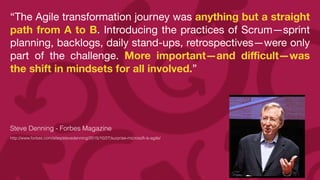
“The Agile transformation journey was anything but a straight
path from A to B. Introducing the practices of Scrum—sprint
planning, backlogs, daily stand-ups, retrospectives—were only
part of the challenge. More important—and di
ffi
cult—was
the shift in mindsets for all involved.”

Steve Denning - Forbes Magazine


http://www.forbes.com/sites/stevedenning/2015/10/27/surprise-microsoft-is-agile/
Self Actualization
 

& Ego Management
Tools, Methods, Techniques
Integrity
Listening
Emotional
competence
Humbleness
Responsibility
Communication
Purpose
Culture
Change
Delegation
Empowerment
Alignment
Motivation
Engagement
Awareness
Agility
Human
development
Teamwork
Innovation
Mentoring
Coaching
Feedback
Negotiation
Hiring
Conflict
resolution
Rewards
Scrum
Kanban
Design
Thinking
Effective
meetings
Facilitation
Non Violent
Communication
OKRs
Delegation
Boards 360 Feedback
Core Skills
Leadership Mindset
Trust
UPR
Empathy
Compassion
Mindset is powerful… up to a point
- Tools & Mindset are both needed.


- But even the right mindset can’t be brought to life
by people who lack the ability and skills needed
to:


- Mindset says ‘delegate’, but you don’t trust your
teams.


- Mindset says ‘collaborate’, but you are easily
triggered by con
fl
ict or disagreement


- Mindset says ‘fail frequently & fast’, but you live
in fear of failure and it’s consequences.


- …
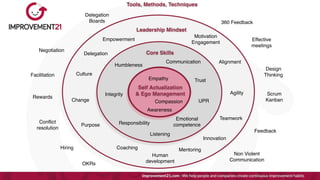
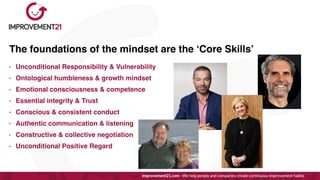
The foundations of the mindset are the ‘Core Skills’
- Unconditional Responsibility & Vulnerabilit
y

- Ontological humbleness & growth mindse
t

- Emotional consciousness & competenc
e

- Essential integrity & Trus
t

- Conscious & consistent conduc
t

- Authentic communication & listenin
g

- Constructive & collective negotiatio
n

- Unconditional Positive Regard
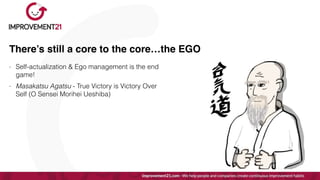
There’s still a core to the core…the EGO
- Self-actualization & Ego management is the end
game!


- Masakatsu Agatsu - True Victory is Victory Over
Self (O Sensei Morihei Ueshiba)
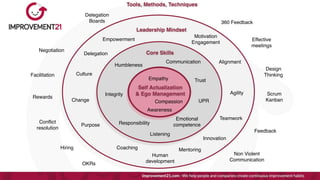
Self Actualization
 

& Ego Management
Tools, Methods, Techniques
Integrity
Listening
Emotional
competence
Humbleness
Responsibility
Communication
Purpose
Culture
Change
Delegation
Empowerment
Alignment
Motivation
Engagement
Awareness
Agility
Human
development
Teamwork
Innovation
Mentoring
Coaching
Feedback
Negotiation
Hiring
Conflict
resolution
Rewards
Scrum
Kanban
Design
Thinking
Effective
meetings
Facilitation
Non Violent
Communication
OKRs
Delegation
Boards 360 Feedback
Core Skills
Leadership Mindset
Trust
UPR
Empathy
Compassion
And now what?
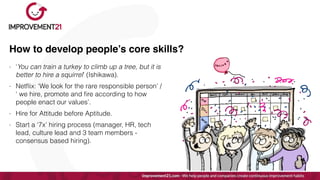
How to develop people’s core skills?
- ‘You can train a turkey to climb up a tree, but it is
better to hire a squirrel’ (Ishikawa).


- Net
fl
ix: ‘We look for the rare responsible person’ /
‘ we hire, promote and
fi
re according to how
people enact our values’.


- Hire for Attitude before Aptitude.


- Start a ‘7x’ hiring process (manager, HR, tech
lead, culture lead and 3 team members -
consensus based hiring).
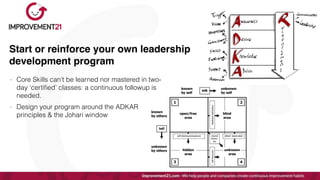
Start or reinforce your own leadership
development program
- Core Skills can’t be learned nor mastered in two-
day ‘certi
fi
ed’ classes: a continuous followup is
needed.


- Design your program around the ADKAR
principles & the Johari window
Yes, but…
- Would you hire that person today?


- Coach or
fi
re: Net
fl
ix rule, ‘No Brilliant Jerks’. Bill
Campbell’s rule: ‘some eccentricity must be
expected on technical environments, just don’t let
them cross the line that hurts teamwork’.


- There’s a cost of
fi
ring, and a cost of not doing so.
The latter is dif
fi
cult to
fi
gure out - give it a try and
you’ll be surprised.
How to manage your Ego?
- Here’s the part where I risk sounding as a cultist…BUT…


- Buddhism - Anatta (there is no separate self), Anicca (impermanence)


- Stoicism - re
fl
ect frequently on your own impermanence.


- Meditation:


- Awareness / consciousness / mindfulness (Sati).


- Concentration / meditation (Samadhi).


- Equanimity (Upekkha).


- Patience (Khanti) and Practice (Viriya: energy, ‘many, many try’).


- Loving kindness / compassion (Metta).
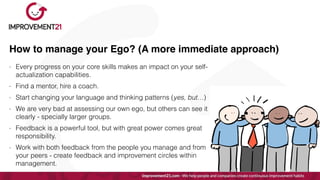
How to manage your Ego? (A more immediate approach)
- Every progress on your core skills makes an impact on your self-
actualization capabilities.


- Find a mentor, hire a coach.


- Start changing your language and thinking patterns (yes, but…)


- We are very bad at assessing our own ego, but others can see it
clearly - specially larger groups.


- Feedback is a powerful tool, but with great power comes great
responsibility.


- Work with both feedback from the people you manage and from
your peers - create feedback and improvement circles within
management.
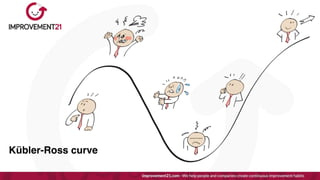
Kübler-Ross curve
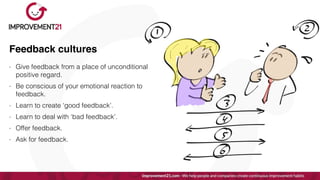
Feedback cultures
- Give feedback from a place of unconditional
positive regard.


- Be conscious of your emotional reaction to
feedback.


- Learn to create ‘good feedback’.


- Learn to deal with ‘bad feedback’.


- Offer feedback.


- Ask for feedback.
Conclusion…
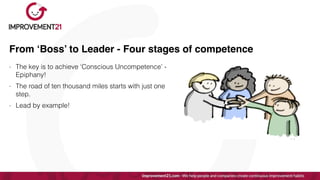
From ‘Boss’ to Leader - Four stages of competence
- The key is to achieve ‘Conscious Uncompetence’ -
Epiphany!


- The road of ten thousand miles starts with just one
step.


- Lead by example!
Main action points
- Develop a common vision of management.


- Reestructure accordingly.


- Review the team coach / team facilitator role.


- Provide coaches for the managerial levels.


- Enforce a cultural-match based, collaborative hiring
process.


- Separate people coaching from stuff management.


- Start a feedback culture program.


- Start a Leadership development program and
management feedback / improvement circles.
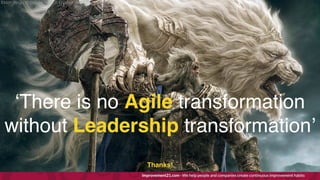
‘There is no Agile transformation
without Leadership transformation
’

Thanks!
Elden Ring - © Bandai Namco Enterteinment / From Software

Agility's Final Boss is The Boss

  • 1.
    Agility’sfi nal Boss is … …well…The Boss! Elden Ring - © Bandai Namco Enterteinment / From Software
  • 2.
    Hi, I’m ÁngelMedinilla! - Organizational transformation & improvement consultant. Agility trainer, leadership coach at Improvement21. - Pragmatist & agnostic - hands-on experience on a broad set of industries (banking, telco, government, pharma, aerospace, insurance, tourism, retail, mobile, gaming…). - Author: “Agile Management” & “Agile Kaizen” (Springer), International Speaker (duh! :P). - Management 3.0 Licensed Trainer (5th most active worldwide). angel.medinilla@improvement21.com / @angel_m
  • 3.
    My own pathas a ‘Boss’
  • 4.
    I used tobe a PMI Die-Hard! - And good at it! - Gantt charts, WBS, waterfall development cycle, deadlines, deliverables, milestones… The whole lot! - Fine results, but at a great personal and interpersonal cost. - Big epiphany - what’s the point of it all?
  • 5.
    Then I found‘Agile Project Management’ - Made a lot of sense: smaller cycles, deliver valuable stuff, inspect and adapt, continuous improvement… - There was a lot of kickback from most companies: ‘how are we going to deal with fi xed date, fi xed scope, fi xed budget?’ - A lot of frustration: spent more time convincing people of the obvious than actually managing projects. - Once again, I found myself on ‘attribution mistake’.
  • 6.
    But I realized,it’s not about ‘Project Management’… - As I mentioned: epiphany! Doing very ef fi ciently things that shouldn’t be done at all (a.k.a twice the crap, twice as fast). - Started learning about Product Management: Design Thinking, Lean Startup / UX / Analytics, User Story Mapping , Market Funnels… - But then I also realized: it’s not even about the product - It’s about the problem to be solved: Customer Centricity!
  • 8.
    Another piece ofthe puzzle were Agile teams - I was still playing the ‘Project Champion’: de fi ning and managing backlogs, micro-managing team tasks, solving problems and impediments for the team… - So I started learning about team coaching: collaboration, communication, creating psychologically-safe environments, solving con fl icts, motivation, engagement… - They call them ‘soft skills’… DUDE… :’P
  • 9.
    And then…the box! -No mater how much we progressed as Agile teams, we just were an Agile brick in a bureaucratic, tayloristic, waterfallish wall (a.k.a. ‘happy islands’). - For Managers, Agile teams were seen just as regular teams but faster (and this were the ones who were giving us some chance to practice Agility). - They were still asking for fi xed-everything, making changes on the go, over-stuf fi ng backlogs, prioritizing everything, micro-managing team members, holding decision power, enforcing silos…
  • 10.
    Here came Management3.0 to the rescue - Finally, a set of models that connected the Agile mindset with the concept of management. - A new vision of the manager’s role: develop your teams and show them purpose up to a point were you can empower them to take control and trust them to get the job done. - It also boosted my capabilities as a change agent: I realized that change does not happen just because you discover some new, better idea - change is an emotional beast!
  • 11.
    We achieved somepretty amazing things “In 2011, this unit in (some guys you probable hate) with several thousand people embraced Agile. Before 2011, (these guys) would build its systems on a fi ve-year cycle, with a unit housing several thousand employees. When the system was fi nally built, it would be shipped to the telecoms and there would be an extended period of adjustment as the system was adapted to fi t their needs. Now with Agile management, (this same company) has over 100 small teams working with its customers’ needs in three-week cycles. The result is faster development that is more relevant to the speci fi c needs of the customers. The client gets value sooner. They have less work in progress. And (the aforementioned guys) are deploying one to two years earlier than it otherwise would, so that its revenue comes in one to two years earlier”. http://www.forbes.com/sites/stevedenning/2016/11/26/can-big-organizations-be-agile/
  • 12.
    Still… ‘Cargo Cult’everywhere! - ‘Cosmetic Scrum’ / ‘McAgile’ (Management 2.0): plenty of the super fi cial practices, but same old vision of management, same old mindset. - Where leadership is not transformed, results are always sub-optimal.
  • 13.
  • 14.
    I studied &practiced…a lot! - Agile at Scale (SAFe, LeSS, McKinsey, EDGE, Spotify…) - Conscious Leadership - Coactive Coaching & Leadership - Google’s Aristotle & ‘Trillion Dollar Coach’ - Dave Marquet’s Leadership model - Human Synergistics - Integral Theory - Reinventing Organizations - Agile Fluency - Modern Agile - Learning theory - Tribal Leadership - Con fl ict resolution - Non Violent Communication - Positive Psychology / behavioural science - Atomic Habits & Power of habit - Organizational culture - …
  • 15.
    Tools are onlyas good as the user - Give a gun to a monkey…
  • 16.
    “There is noten-step program for doing this. Getting away from how organizations have been run for over fi fty years, and becoming Agile, is a creative activity. [...] If you start by saying, “Let’s implement a practice”, you will get to the end of it very quickly and you will have changed very little in your organization and then you will fi nd yourself at a dead end.” Gary Hamel - Strategos Wall Street Journal’s Most In fl uential Business Thinker 2016
  • 17.
    “The Agile transformationjourney was anything but a straight path from A to B. Introducing the practices of Scrum—sprint planning, backlogs, daily stand-ups, retrospectives—were only part of the challenge. More important—and di ffi cult—was the shift in mindsets for all involved.” Steve Denning - Forbes Magazine http://www.forbes.com/sites/stevedenning/2015/10/27/surprise-microsoft-is-agile/
  • 18.
    Self Actualization &Ego Management Tools, Methods, Techniques Integrity Listening Emotional competence Humbleness Responsibility Communication Purpose Culture Change Delegation Empowerment Alignment Motivation Engagement Awareness Agility Human development Teamwork Innovation Mentoring Coaching Feedback Negotiation Hiring Conflict resolution Rewards Scrum Kanban Design Thinking Effective meetings Facilitation Non Violent Communication OKRs Delegation Boards 360 Feedback Core Skills Leadership Mindset Trust UPR Empathy Compassion
  • 19.
    Mindset is powerful…up to a point - Tools & Mindset are both needed. - But even the right mindset can’t be brought to life by people who lack the ability and skills needed to: - Mindset says ‘delegate’, but you don’t trust your teams. - Mindset says ‘collaborate’, but you are easily triggered by con fl ict or disagreement - Mindset says ‘fail frequently & fast’, but you live in fear of failure and it’s consequences. - …
  • 20.
    The foundations ofthe mindset are the ‘Core Skills’ - Unconditional Responsibility & Vulnerabilit y - Ontological humbleness & growth mindse t - Emotional consciousness & competenc e - Essential integrity & Trus t - Conscious & consistent conduc t - Authentic communication & listenin g - Constructive & collective negotiatio n - Unconditional Positive Regard
  • 21.
    There’s still acore to the core…the EGO - Self-actualization & Ego management is the end game! - Masakatsu Agatsu - True Victory is Victory Over Self (O Sensei Morihei Ueshiba)
  • 22.
    Self Actualization &Ego Management Tools, Methods, Techniques Integrity Listening Emotional competence Humbleness Responsibility Communication Purpose Culture Change Delegation Empowerment Alignment Motivation Engagement Awareness Agility Human development Teamwork Innovation Mentoring Coaching Feedback Negotiation Hiring Conflict resolution Rewards Scrum Kanban Design Thinking Effective meetings Facilitation Non Violent Communication OKRs Delegation Boards 360 Feedback Core Skills Leadership Mindset Trust UPR Empathy Compassion
  • 23.
  • 24.
    How to developpeople’s core skills? - ‘You can train a turkey to climb up a tree, but it is better to hire a squirrel’ (Ishikawa). - Net fl ix: ‘We look for the rare responsible person’ / ‘ we hire, promote and fi re according to how people enact our values’. - Hire for Attitude before Aptitude. - Start a ‘7x’ hiring process (manager, HR, tech lead, culture lead and 3 team members - consensus based hiring).
  • 25.
    Start or reinforceyour own leadership development program - Core Skills can’t be learned nor mastered in two- day ‘certi fi ed’ classes: a continuous followup is needed. - Design your program around the ADKAR principles & the Johari window
  • 26.
    Yes, but… - Wouldyou hire that person today? - Coach or fi re: Net fl ix rule, ‘No Brilliant Jerks’. Bill Campbell’s rule: ‘some eccentricity must be expected on technical environments, just don’t let them cross the line that hurts teamwork’. - There’s a cost of fi ring, and a cost of not doing so. The latter is dif fi cult to fi gure out - give it a try and you’ll be surprised.
  • 27.
    How to manageyour Ego? - Here’s the part where I risk sounding as a cultist…BUT… - Buddhism - Anatta (there is no separate self), Anicca (impermanence) - Stoicism - re fl ect frequently on your own impermanence. - Meditation: - Awareness / consciousness / mindfulness (Sati). - Concentration / meditation (Samadhi). - Equanimity (Upekkha). - Patience (Khanti) and Practice (Viriya: energy, ‘many, many try’). - Loving kindness / compassion (Metta).
  • 28.
    How to manageyour Ego? (A more immediate approach) - Every progress on your core skills makes an impact on your self- actualization capabilities. - Find a mentor, hire a coach. - Start changing your language and thinking patterns (yes, but…) - We are very bad at assessing our own ego, but others can see it clearly - specially larger groups. - Feedback is a powerful tool, but with great power comes great responsibility. - Work with both feedback from the people you manage and from your peers - create feedback and improvement circles within management.
  • 30.
  • 31.
    Feedback cultures - Givefeedback from a place of unconditional positive regard. - Be conscious of your emotional reaction to feedback. - Learn to create ‘good feedback’. - Learn to deal with ‘bad feedback’. - Offer feedback. - Ask for feedback.
  • 32.
  • 33.
    From ‘Boss’ toLeader - Four stages of competence - The key is to achieve ‘Conscious Uncompetence’ - Epiphany! - The road of ten thousand miles starts with just one step. - Lead by example!
  • 34.
    Main action points -Develop a common vision of management. - Reestructure accordingly. - Review the team coach / team facilitator role. - Provide coaches for the managerial levels. - Enforce a cultural-match based, collaborative hiring process. - Separate people coaching from stuff management. - Start a feedback culture program. - Start a Leadership development program and management feedback / improvement circles.
  • 35.
    ‘There is noAgile transformation without Leadership transformation ’ Thanks! Elden Ring - © Bandai Namco Enterteinment / From Software