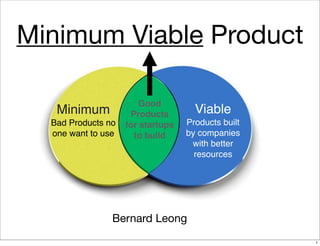
Minimum Viable Product
Bernard Leong
Minimum
Bad Products no
one want to use
Viable
Products built
by companies
with better
resources
Good
Products
for startups
to build
1
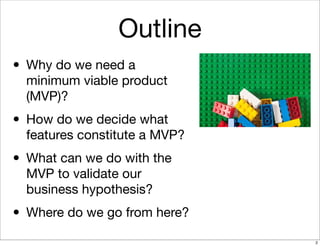
Outline
• Why do we need a
minimum viable product
(MVP)?
• How do we decide what
features constitute a MVP?
• What can we do with the
MVP to validate our
business hypothesis?
• Where do we go from here?
2
Session Objective
• To learn the concept of minimum viable product
(MVP) in a lean startup setting.
• To figure out how to construct a MVP in a
startup team.
• To discern what are the considerations and
decisions required to build a MVP.
3
“A minimum viable product is the version of a new product
which allows a team to collect the maximum amount of
validated learning about customers with the least effort.”
- Eric Ries, “The Lean Startup”
4
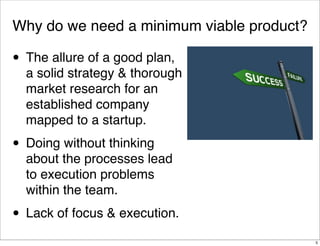
Why do we need a minimum viable product?
• The allure of a good plan,
a solid strategy & thorough
market research for an
established company
mapped to a startup.
• Doing without thinking
about the processes lead
to execution problems
within the team.
• Lack of focus & execution.
5
The goal of customer discovery is to test your
understanding of the customer’s problem & see
if your solution will prompt him to use/buy the
product based on the important features alone.
6
Early adopters love to use MVPs. Tailor the initial
product to satisfy their needs. If no one thinks your
MVP is interesting or sufficient, iterate or pivot with
qualitative until they say “yes”.
7
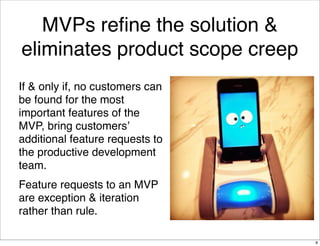
MVPs refine the solution &
eliminates product scope creep
If & only if, no customers can
be found for the most
important features of the
MVP, bring customers’
additional feature requests to
the productive development
team.
Feature requests to an MVP
are exception & iteration
rather than rule.
8
The goal of the MVP is to build the
smallest feature set.
9
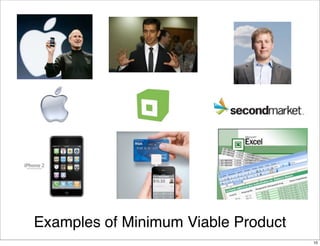
Examples of Minimum Viable Product
10
How do you decide features in a MVP?
11
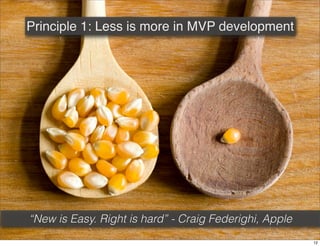
Principle 1: Less is more in MVP development
“New is Easy. Right is hard” - Craig Federighi, Apple
12
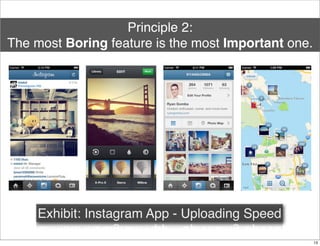
Exhibit: Instagram App - Uploading Speed
Principle 2:
The most Boring feature is the most Important one.
13
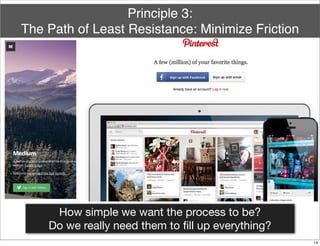
How simple we want the process to be?
Do we really need them to fill up everything?
Principle 3:
The Path of Least Resistance: Minimize Friction
14
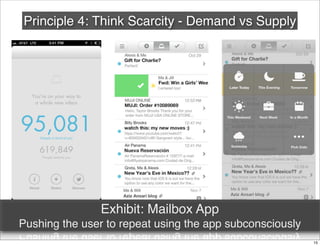
Principle 4: Think Scarcity - Demand vs Supply
Exhibit: Mailbox App
Pushing the user to repeat using the app subconsciously
15
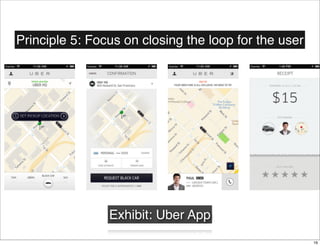
Exhibit: Uber App
Principle 5: Focus on closing the loop for the user
16
Principle 6:
Iterate & Refine with User Feedback & Usage Data
17
What are the killer metrics that inspire users to come back?
Exhibit: Fab.com
18
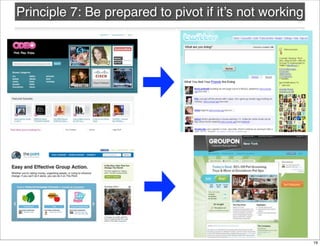
Principle 7: Be prepared to pivot if it’s not working
19
Learn from Everyone,
Follow no one,
Observe the Patterns,
Work Like Hell.
Final Thoughts
http://www.bernardleong.com
Slideshare/Twitter/GMail: bleongcw
20
Exercise 1a
• You are the product manager of the startup team who is building a photo
sharing website such that your customers are able to store, share and
organize their pictures on a desktop, tablet or mobile phone. The
objective is to (a) come up with a specifications of a product which can
be built and deployed within 3 months & (b) figure out whether
customers will print their pictures onto postcards and calendars.
• Gather the team around and start working out a set of features which
you will need for this photo sharing website.
• At the same time, also come up with a list of 10 measurable metrics
which are important to your customer discovery process.
• Hint: A good strategy is to devise categories for different feature sets of
a product.
21
Exercise 1b
• You are the product manager of the startup team who is building a
video sharing website such that your customers are able to store,
share and organize their 1 minute videos on a desktop, tablet or mobile
phone. The objective is (a) to come up with a specifications of a
product which can be built and deployed within 3 months and (b) figure
out whether customers will pay for storage up to a certain size up to
the team’s discretion.
• Gather the team around and start working out a set of features which
you will need for this photo sharing website.
• At the same time, also come up with a list of 10 measurable metrics
which are important to your customer discovery process.
• Hint: A good strategy is to devise categories for different feature sets
of a product.
22
Exercise 1c
• You are the product manager of the startup team who is building a e-
commerce site that sells premium or luxury baby products to
consumers and works on both desktop and tablet. The objective is (a)
to come up with a specifications of a product which can be built and
deployed within 3 months and (b) figure out whether customers are
willing to pay in a range between $500-$2000 for the luxury baby
products.
• Gather the team around and start working out a set of features which
you will need for this photo sharing website.
• At the same time, also come up with a list of 10 measurable metrics
which are important to your customer discovery process.
• Hint: A good strategy is to devise categories for different feature sets
of a product.
23
Exercise 1d
• You are the product manager of the startup team who is building a
website that allows a consumer to print stamps for postage. The
objective is (a) to come up with a specifications of a product which can
be built and deployed within 3 months and (b) figure out whether
customers are willing to buy and print stamps and sending them
immediately with the postal service. Assume that you have a
partnership with the postal service and the stamps printed are valid.
• Gather the team around and start working out a set of features which
you will need for this website.
• At the same time, also come up with a list of 10 measurable metrics
which are important to your customer discovery process.
• Hint: A good strategy is to devise categories for different feature sets
of a product.
24
Exercise 1e
• You are the product manager of the startup team who is building a
mobile application that can allow users to search and discover fashion
boutiques around the region. The objective is (a) to come up with a
specifications of a product which can be built and deployed within 3
months and (b) figure out how to attract more users to use the mobile
application and at the same time, getting them to buy from the mobile
phone.
• Gather the team around and start working out a set of features which
you will need for the native app. You have to decide whether you want
to build iOS or Android app.
• At the same time, also come up with a list of 10 measurable metrics
which are important to your customer discovery process.
• Hint: A good strategy is to devise categories for different feature sets
of a product.
25
Exercise 2
• From exercise (1), do the following:
• Work out the top 3 features from the list you
have brainstormed.
• Map out the timeline to how you can deliver
this product in 3 months.
• Hint: The best strategy is to say “no” to some
features and argue out why they are not
necessary.
26

Minimum Viable Product

  • 1.
    Minimum Viable Product BernardLeong Minimum Bad Products no one want to use Viable Products built by companies with better resources Good Products for startups to build 1
  • 2.
    Outline • Why dowe need a minimum viable product (MVP)? • How do we decide what features constitute a MVP? • What can we do with the MVP to validate our business hypothesis? • Where do we go from here? 2
  • 3.
    Session Objective • Tolearn the concept of minimum viable product (MVP) in a lean startup setting. • To figure out how to construct a MVP in a startup team. • To discern what are the considerations and decisions required to build a MVP. 3
  • 4.
    “A minimum viableproduct is the version of a new product which allows a team to collect the maximum amount of validated learning about customers with the least effort.” - Eric Ries, “The Lean Startup” 4
  • 5.
    Why do weneed a minimum viable product? • The allure of a good plan, a solid strategy & thorough market research for an established company mapped to a startup. • Doing without thinking about the processes lead to execution problems within the team. • Lack of focus & execution. 5
  • 6.
    The goal ofcustomer discovery is to test your understanding of the customer’s problem & see if your solution will prompt him to use/buy the product based on the important features alone. 6
  • 7.
    Early adopters loveto use MVPs. Tailor the initial product to satisfy their needs. If no one thinks your MVP is interesting or sufficient, iterate or pivot with qualitative until they say “yes”. 7
  • 8.
    MVPs refine thesolution & eliminates product scope creep If & only if, no customers can be found for the most important features of the MVP, bring customers’ additional feature requests to the productive development team. Feature requests to an MVP are exception & iteration rather than rule. 8
  • 9.
    The goal ofthe MVP is to build the smallest feature set. 9
  • 10.
    Examples of MinimumViable Product 10
  • 11.
    How do youdecide features in a MVP? 11
  • 12.
    Principle 1: Lessis more in MVP development “New is Easy. Right is hard” - Craig Federighi, Apple 12
  • 13.
    Exhibit: Instagram App- Uploading Speed Principle 2: The most Boring feature is the most Important one. 13
  • 14.
    How simple wewant the process to be? Do we really need them to fill up everything? Principle 3: The Path of Least Resistance: Minimize Friction 14
  • 15.
    Principle 4: ThinkScarcity - Demand vs Supply Exhibit: Mailbox App Pushing the user to repeat using the app subconsciously 15
  • 16.
    Exhibit: Uber App Principle5: Focus on closing the loop for the user 16
  • 17.
    Principle 6: Iterate &Refine with User Feedback & Usage Data 17
  • 18.
    What are thekiller metrics that inspire users to come back? Exhibit: Fab.com 18
  • 19.
    Principle 7: Beprepared to pivot if it’s not working 19
  • 20.
    Learn from Everyone, Followno one, Observe the Patterns, Work Like Hell. Final Thoughts http://www.bernardleong.com Slideshare/Twitter/GMail: bleongcw 20
  • 21.
    Exercise 1a • Youare the product manager of the startup team who is building a photo sharing website such that your customers are able to store, share and organize their pictures on a desktop, tablet or mobile phone. The objective is to (a) come up with a specifications of a product which can be built and deployed within 3 months & (b) figure out whether customers will print their pictures onto postcards and calendars. • Gather the team around and start working out a set of features which you will need for this photo sharing website. • At the same time, also come up with a list of 10 measurable metrics which are important to your customer discovery process. • Hint: A good strategy is to devise categories for different feature sets of a product. 21
  • 22.
    Exercise 1b • Youare the product manager of the startup team who is building a video sharing website such that your customers are able to store, share and organize their 1 minute videos on a desktop, tablet or mobile phone. The objective is (a) to come up with a specifications of a product which can be built and deployed within 3 months and (b) figure out whether customers will pay for storage up to a certain size up to the team’s discretion. • Gather the team around and start working out a set of features which you will need for this photo sharing website. • At the same time, also come up with a list of 10 measurable metrics which are important to your customer discovery process. • Hint: A good strategy is to devise categories for different feature sets of a product. 22
  • 23.
    Exercise 1c • Youare the product manager of the startup team who is building a e- commerce site that sells premium or luxury baby products to consumers and works on both desktop and tablet. The objective is (a) to come up with a specifications of a product which can be built and deployed within 3 months and (b) figure out whether customers are willing to pay in a range between $500-$2000 for the luxury baby products. • Gather the team around and start working out a set of features which you will need for this photo sharing website. • At the same time, also come up with a list of 10 measurable metrics which are important to your customer discovery process. • Hint: A good strategy is to devise categories for different feature sets of a product. 23
  • 24.
    Exercise 1d • Youare the product manager of the startup team who is building a website that allows a consumer to print stamps for postage. The objective is (a) to come up with a specifications of a product which can be built and deployed within 3 months and (b) figure out whether customers are willing to buy and print stamps and sending them immediately with the postal service. Assume that you have a partnership with the postal service and the stamps printed are valid. • Gather the team around and start working out a set of features which you will need for this website. • At the same time, also come up with a list of 10 measurable metrics which are important to your customer discovery process. • Hint: A good strategy is to devise categories for different feature sets of a product. 24
  • 25.
    Exercise 1e • Youare the product manager of the startup team who is building a mobile application that can allow users to search and discover fashion boutiques around the region. The objective is (a) to come up with a specifications of a product which can be built and deployed within 3 months and (b) figure out how to attract more users to use the mobile application and at the same time, getting them to buy from the mobile phone. • Gather the team around and start working out a set of features which you will need for the native app. You have to decide whether you want to build iOS or Android app. • At the same time, also come up with a list of 10 measurable metrics which are important to your customer discovery process. • Hint: A good strategy is to devise categories for different feature sets of a product. 25
  • 26.
    Exercise 2 • Fromexercise (1), do the following: • Work out the top 3 features from the list you have brainstormed. • Map out the timeline to how you can deliver this product in 3 months. • Hint: The best strategy is to say “no” to some features and argue out why they are not necessary. 26