IJRET: International Journal of Research in Engineering and Technology eISSN: 2319-1163 | pISSN: 2321-7308
_______________________________________________________________________________________
Volume: 04 Issue: 02 | Feb-2015, Available @ http://www.ijret.org 169
A DESIGN OF MULTIFUNCTIONAL LED WRITTEN SCREEN BASED
ON WIRELESS TRANSMISSION
Yunsheng Gao1
, Shouxi Zhu2
1
Flying College, Binzhou University, Binzhou, Shandong, China
2
Information Technology R&D Center, Binzhou University, Binzhou, Shandong, China
Abstract
This paper presents a design of a LED dot matrix written display system using Single Chip Micyoco (SCM). It completes the data
acquisition function through the light pen with excellent photographic performance phototransistor, then it can achieve the
following functions, such as click light, draw light, reverse display, entire screen erasure, stroke erasure, multi characters written
and so on. The display includes two parts, handwriting screen and color dot matrix screen display, which are connected by
wireless. By light pen writing in the writing area, it can display in color dot matrix display area, it also has the function of key
operation and has a USB interface. Therefore, it can transfer text and picture messages to dot matrix display area. This paper
presents the hardware design and its schematics, gives the general flowchart of software. This design is a low-cost wireless
display design scheme, it has the advantages of simple design, easy to use, etc.
Keywords: LED, Wireless transmission, Light pen, SCM
--------------------------------------------------------------------***----------------------------------------------------------------------
1. INTRODUCTION
LED (Light Emitting Diode) display is a new information
display media developed rapidly in the late eighties on a
global scale. As a new luminous body, LED has been
closely watched from the day it was invented. Especially in
the 21st century, the display technology has entered the era
of flat panel display, LED display as one of the leading flat
panel display products will undoubtedly have greater
development, and it may be one of the representative
mainstream products of flat panel display in the 21st century
[1]. LED dot matrix display screen is currently widely used
in daily life, such as traditional light boxes in outdoor
advertising media, neon lamp and so on which are replaced
by the LED display [2]. However, the traditional control
method of the LED display is by a computer that connected
with LED display, which generally uses the data
transmission standard of RS232 and usually no more than a
maximum baud rate of 115200bps. Its inherent limitations of
low-speed characteristics limit the fast content
synchronization update of LED display, or download the
updated information to the mobile hard disk and then copy it
to the LED display. This control method not only labor
intensive but also cost intensive and inefficient, and bring a
great inconvenience to our work and life.
In recent years, a LED display screen of wireless
transmission has been achieved by sending SMS to the LED
display to achieve information transmission and control [3].
Another common method of wireless transmission is using
GPRS under a mobile communication network for remote
LED display screen on and off and text editing. Those
control methods will not be limited by the distance, but there
may be a series of problems in practical applications, such
as communication delay, information loss, etc.
In this paper, we design a low-cost wireless LED writing
display screen system, which includes two parts of
handwriting dot matrix display screen and color dot matrix
display screen. Both of them are connected by wireless. It
can achieve a variety of functions, such as stroke erasure,
multi characters written, and so on. The biggest advantage
of this design is not dependent on the computer to download
the display information, but by writing on the handwriting
input screen, which greatly solves the problem of high
dependency on the computer.
2. DESIGN OF HARDWARE SYSTEM
The hardware schematic diagram of this design is shown in
figure 1. The system consists of seven parts: main control
module, light pen detection module, LED dot matrix
handwriting input and display module, wireless transmission
module, keyboard input module, LCD real-time status
display, USB flash disk reader module and other
components.
IJRET: International Journal of Research in Engineering and Technology eISSN: 2319-1163 | pISSN: 2321-7308
_______________________________________________________________________________________
Volume: 04 Issue: 02 | Feb-2015, Available @ http://www.ijret.org 170
Handwriting
input
main control
module
Display
main
control
module
32*32 dot
handwriting
input screen
key module
Light-pen
detection
LCD
module
Wireless
communi
-cation
32*64 dot
display screen
USB flash disk
reader module
Fig -1: Hardware schematic diagram
2.1 Main Control System
As shown in figure 2, in this paper, we use a 89C52 chip as the system master control chip. 89C52 chip is a basic product of
MCS-51 microcontroller series in INTEL Corporation [4]. It is a high-performance 8-bit microcontroller which uses ATMEL
Corporation CMOS process technology, and belongs to the standard MCS-51 product of HCMOS. This chip combines the high-
speed, high-density technology and low-power characteristics of CMOS, which is based on the standard MCS-51 microcontroller
microarchitecture and instruction system. The 89C52 chip is inexpensive but without powerful processing capabilities. In order to
enable it to meet the design requirements, we adopt dynamic scanning [5], the transistor drive in parallel with one side of the LED
light tube, the other foot of LED light tube connect with General Purpose Input/Output (GPIO), and control it on or off. This
method can drive more LED, and is more flexible. It also can save the resources of SCM.
Fig -2: Design of main control system
IJRET: International Journal of Research in Engineering and Technology eISSN: 2319-1163 | pISSN: 2321-7308
_______________________________________________________________________________________
Volume: 04 Issue: 02 | Feb-2015, Available @ http://www.ijret.org 171
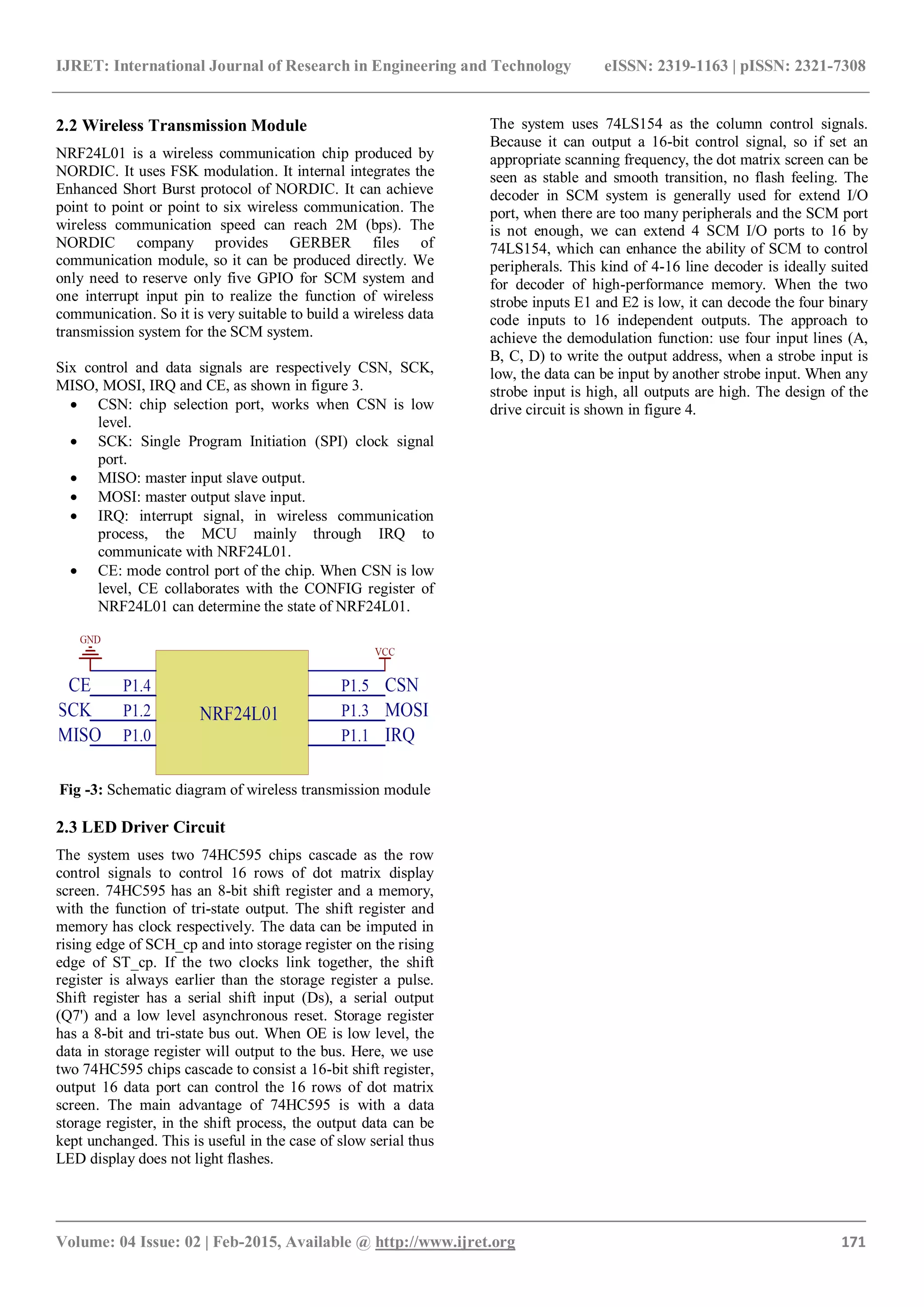
2.2 Wireless Transmission Module
NRF24L01 is a wireless communication chip produced by
NORDIC. It uses FSK modulation. It internal integrates the
Enhanced Short Burst protocol of NORDIC. It can achieve
point to point or point to six wireless communication. The
wireless communication speed can reach 2M (bps). The
NORDIC company provides GERBER files of
communication module, so it can be produced directly. We
only need to reserve only five GPIO for SCM system and
one interrupt input pin to realize the function of wireless
communication. So it is very suitable to build a wireless data
transmission system for the SCM system.
Six control and data signals are respectively CSN, SCK,
MISO, MOSI, IRQ and CE, as shown in figure 3.
 CSN: chip selection port, works when CSN is low
level.
 SCK: Single Program Initiation (SPI) clock signal
port.
 MISO: master input slave output.
 MOSI: master output slave input.
 IRQ: interrupt signal, in wireless communication
process, the MCU mainly through IRQ to
communicate with NRF24L01.
 CE: mode control port of the chip. When CSN is low
level, CE collaborates with the CONFIG register of
NRF24L01 can determine the state of NRF24L01.
Fig -3: Schematic diagram of wireless transmission module
2.3 LED Driver Circuit
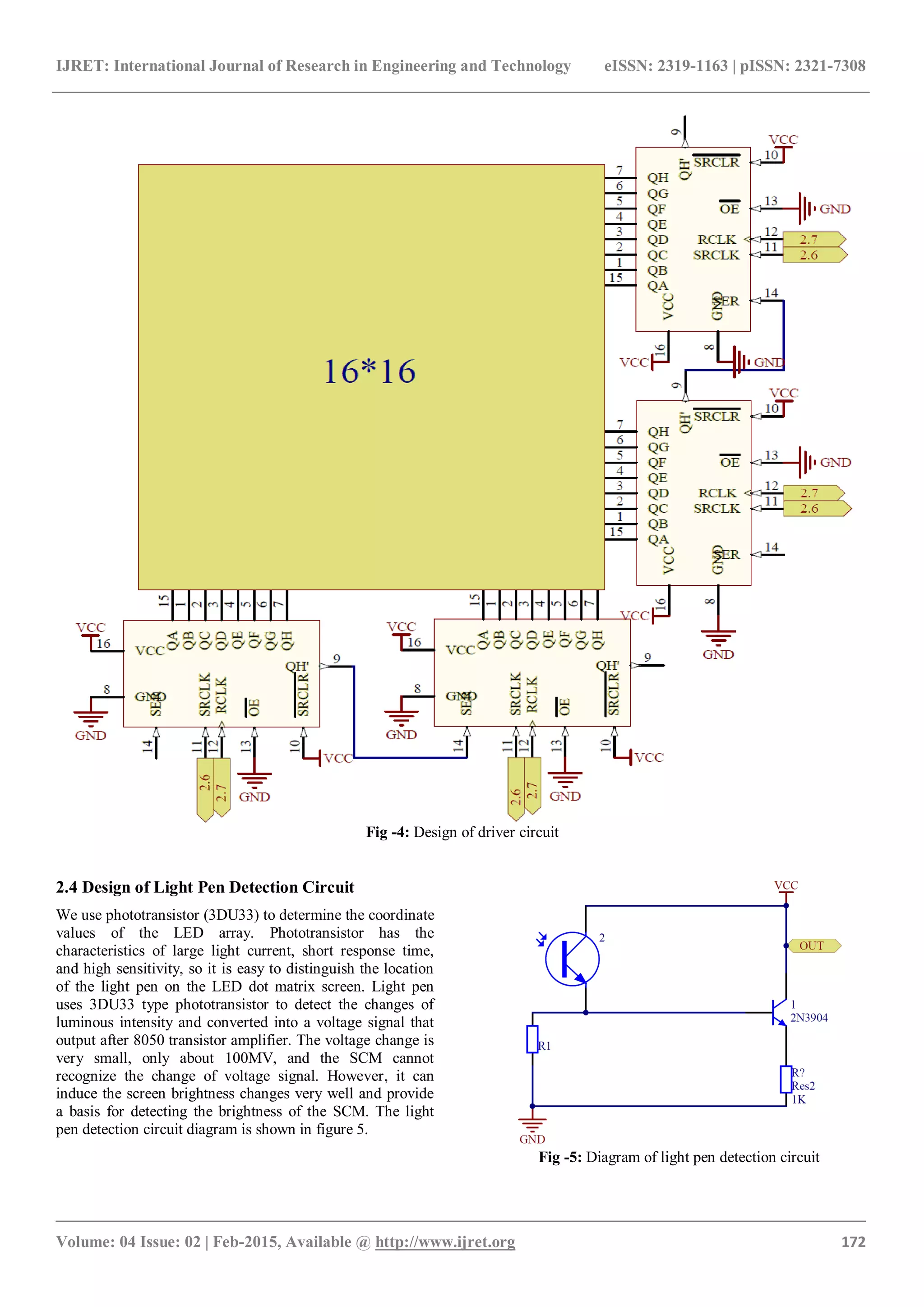
The system uses two 74HC595 chips cascade as the row
control signals to control 16 rows of dot matrix display
screen. 74HC595 has an 8-bit shift register and a memory,
with the function of tri-state output. The shift register and
memory has clock respectively. The data can be imputed in
rising edge of SCH_cp and into storage register on the rising
edge of ST_cp. If the two clocks link together, the shift
register is always earlier than the storage register a pulse.
Shift register has a serial shift input (Ds), a serial output
(Q7') and a low level asynchronous reset. Storage register
has a 8-bit and tri-state bus out. When OE is low level, the
data in storage register will output to the bus. Here, we use
two 74HC595 chips cascade to consist a 16-bit shift register,
output 16 data port can control the 16 rows of dot matrix
screen. The main advantage of 74HC595 is with a data
storage register, in the shift process, the output data can be
kept unchanged. This is useful in the case of slow serial thus
LED display does not light flashes.
The system uses 74LS154 as the column control signals.
Because it can output a 16-bit control signal, so if set an
appropriate scanning frequency, the dot matrix screen can be
seen as stable and smooth transition, no flash feeling. The
decoder in SCM system is generally used for extend I/O
port, when there are too many peripherals and the SCM port
is not enough, we can extend 4 SCM I/O ports to 16 by
74LS154, which can enhance the ability of SCM to control
peripherals. This kind of 4-16 line decoder is ideally suited
for decoder of high-performance memory. When the two
strobe inputs E1 and E2 is low, it can decode the four binary
code inputs to 16 independent outputs. The approach to
achieve the demodulation function: use four input lines (A,
B, C, D) to write the output address, when a strobe input is
low, the data can be input by another strobe input. When any
strobe input is high, all outputs are high. The design of the
drive circuit is shown in figure 4.
IJRET: International Journal of Research in Engineering and Technology eISSN: 2319-1163 | pISSN: 2321-7308
_______________________________________________________________________________________
Volume: 04 Issue: 02 | Feb-2015, Available @ http://www.ijret.org 172
Fig -4: Design of driver circuit
2.4 Design of Light Pen Detection Circuit
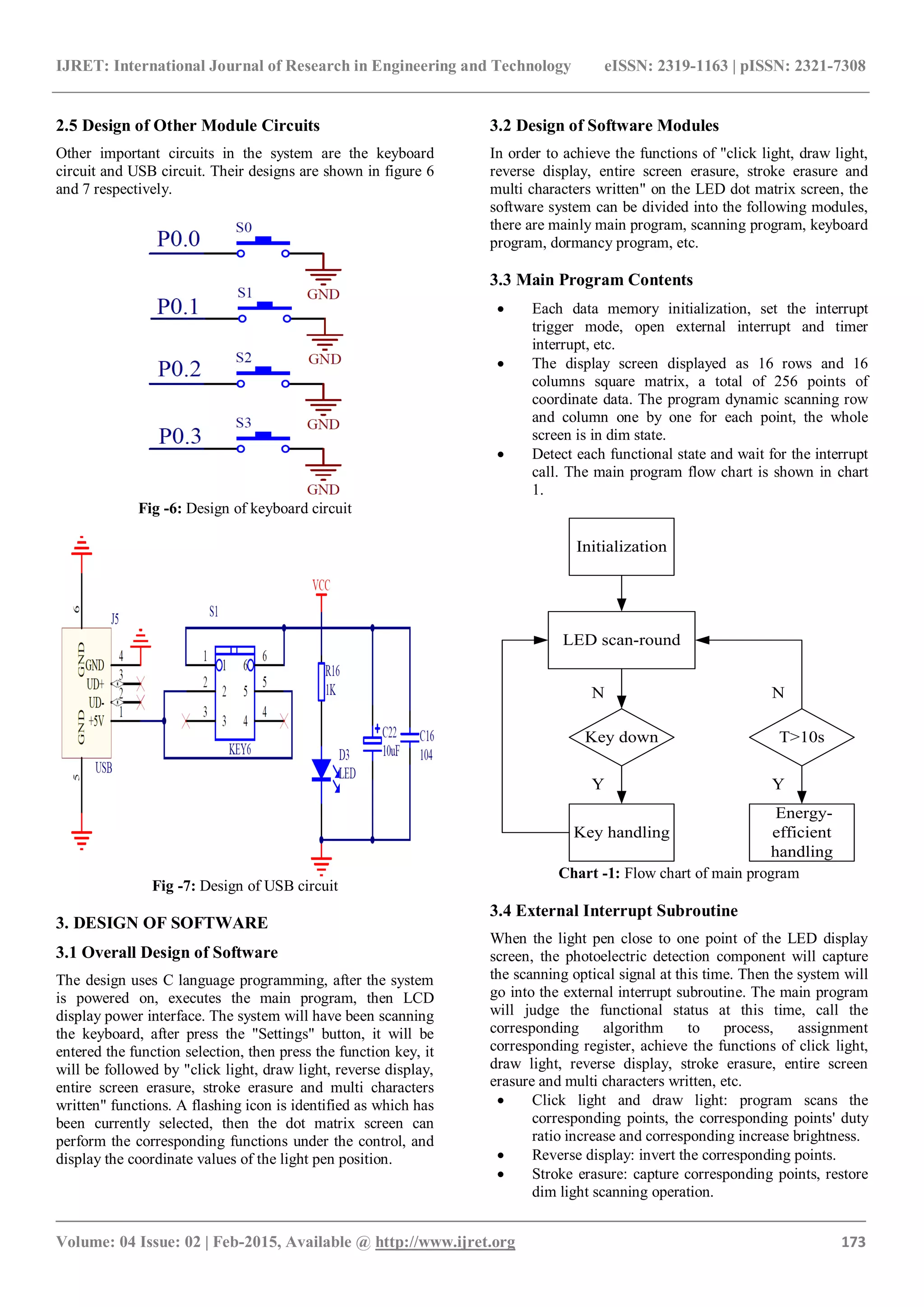
We use phototransistor (3DU33) to determine the coordinate
values of the LED array. Phototransistor has the
characteristics of large light current, short response time,
and high sensitivity, so it is easy to distinguish the location
of the light pen on the LED dot matrix screen. Light pen
uses 3DU33 type phototransistor to detect the changes of
luminous intensity and converted into a voltage signal that
output after 8050 transistor amplifier. The voltage change is
very small, only about 100MV, and the SCM cannot
recognize the change of voltage signal. However, it can
induce the screen brightness changes very well and provide
a basis for detecting the brightness of the SCM. The light
pen detection circuit diagram is shown in figure 5.
Fig -5: Diagram of light pen detection circuit
IJRET: International Journal of Research in Engineering and Technology eISSN: 2319-1163 | pISSN: 2321-7308
_______________________________________________________________________________________
Volume: 04 Issue: 02 | Feb-2015, Available @ http://www.ijret.org 173
2.5 Design of Other Module Circuits
Other important circuits in the system are the keyboard
circuit and USB circuit. Their designs are shown in figure 6
and 7 respectively.
Fig -6: Design of keyboard circuit
Fig -7: Design of USB circuit
3. DESIGN OF SOFTWARE
3.1 Overall Design of Software
The design uses C language programming, after the system
is powered on, executes the main program, then LCD
display power interface. The system will have been scanning
the keyboard, after press the "Settings" button, it will be
entered the function selection, then press the function key, it
will be followed by "click light, draw light, reverse display,
entire screen erasure, stroke erasure and multi characters
written" functions. A flashing icon is identified as which has
been currently selected, then the dot matrix screen can
perform the corresponding functions under the control, and
display the coordinate values of the light pen position.
3.2 Design of Software Modules
In order to achieve the functions of "click light, draw light,
reverse display, entire screen erasure, stroke erasure and
multi characters written" on the LED dot matrix screen, the
software system can be divided into the following modules,
there are mainly main program, scanning program, keyboard
program, dormancy program, etc.
3.3 Main Program Contents
 Each data memory initialization, set the interrupt
trigger mode, open external interrupt and timer
interrupt, etc.
 The display screen displayed as 16 rows and 16
columns square matrix, a total of 256 points of
coordinate data. The program dynamic scanning row
and column one by one for each point, the whole
screen is in dim state.
 Detect each functional state and wait for the interrupt
call. The main program flow chart is shown in chart
1.
Initialization
LED scan-round
Key down
Key handling
T>10s
Energy-
efficient
handling
Y
NN
Y
Chart -1: Flow chart of main program
3.4 External Interrupt Subroutine
When the light pen close to one point of the LED display
screen, the photoelectric detection component will capture
the scanning optical signal at this time. Then the system will
go into the external interrupt subroutine. The main program
will judge the functional status at this time, call the
corresponding algorithm to process, assignment
corresponding register, achieve the functions of click light,
draw light, reverse display, stroke erasure, entire screen
erasure and multi characters written, etc.
 Click light and draw light: program scans the
corresponding points, the corresponding points' duty
ratio increase and corresponding increase brightness.
 Reverse display: invert the corresponding points.
 Stroke erasure: capture corresponding points, restore
dim light scanning operation.
IJRET: International Journal of Research in Engineering and Technology eISSN: 2319-1163 | pISSN: 2321-7308
_______________________________________________________________________________________
Volume: 04 Issue: 02 | Feb-2015, Available @ http://www.ijret.org 174
 Entire screen erasure: the whole screen resumes dim
light scanning operation.
 Multi characters written: multiple characters can be
written.
The flow chart of interrupt program is shown in chart 2.
Draw light
Multi characters
written
Erase all
Stroke erasure
Click light
Reverse display
External interruption
Multi characters
written
subroutine
Erase all
subroutine
Stroke erasure
subroutine
Reverse display
subroutine
Draw light
subroutine
Click light
subroutine
RETI
Chart -2: Flow chart of interrupt program
4. CONCLUSION
As a new luminous element, LED has been closely watched
since birth, and LED dot matrix display is widely used in
daily life at present. Currently, the functions of most LED
display screen on the market need computer, so the
operation is complex. This paper proposes a user-friendly
LED dot matrix display. Operators do not need a computer
to control the dot matrix display, only need a matched light
pen to write, and then the character display can be realized.
This design only needs simply manual operation to achieve
information display and don't need the cable transmission,
so it solves the wiring problem. Compared to other LED
display screen, its unique advantage is inexpensive and
greatly reduced the dependence on computer while changing
the operating mode. Core parts of this design are LED
screen and wireless transmission module. These types of
modules are cheap, more economical and practical.
Therefore, in this pursuit of low-carbon green society, this
design has a strong adaptability and broad application
prospects.
ACKNOWLEDGEMENTS
This research was financially supported by National College
Students Innovative Training Program of Binzhou
University (Grant NO. 201310449131).
REFERENCES
[1]. HONG zhen, A Summary of LED Displayer Industry
Development [J]. Information technology &
Standardization, 2010(10): 22-25.
[2]. ZHANG Ming, REN Qing. Some Control and Their
Comparison of LED Scress Display [J]. Journal of Jianghan
University, 2001,18(3): 67-69.
[3]. J. D. Reynders, E. Wright. Practical TCP/IP and
Ethernet Networking [M]. Burlington: IDC Technologies,
2003: 125-127.
[4]. FENG Zhuo-li. The Design of Temperature Control
Heater Based on STC Single-Chip [J]. Techniques of
Automation and Applications, 2014, 33: 104-108.
[5]. Michael Day. TLC5940 dot correction components for
variations in LED brightness [J]. Texas Instruments
Incorporated Power Management, 2005(4): 21-24.
BIOGRAPHIES
Yunsheng Gao is a student in Flying
College of Binzhou University, he is
pursuing Bachelor's Degree in traffic
engineering in Flying College of Binzhou
University, Binzhou, Shandong, China.
Shouxi Zhu (corresponding author) is
working as a teacher and a researcher in
Flying College of Binzhou University. His
research interests include Avionics and
Aviation Human Factor Engineering.
E-mail: zhushouxi@163.com

A design of multifunctional led written screen based on wireless transmission

  • 1.
    IJRET: International Journalof Research in Engineering and Technology eISSN: 2319-1163 | pISSN: 2321-7308 _______________________________________________________________________________________ Volume: 04 Issue: 02 | Feb-2015, Available @ http://www.ijret.org 169 A DESIGN OF MULTIFUNCTIONAL LED WRITTEN SCREEN BASED ON WIRELESS TRANSMISSION Yunsheng Gao1 , Shouxi Zhu2 1 Flying College, Binzhou University, Binzhou, Shandong, China 2 Information Technology R&D Center, Binzhou University, Binzhou, Shandong, China Abstract This paper presents a design of a LED dot matrix written display system using Single Chip Micyoco (SCM). It completes the data acquisition function through the light pen with excellent photographic performance phototransistor, then it can achieve the following functions, such as click light, draw light, reverse display, entire screen erasure, stroke erasure, multi characters written and so on. The display includes two parts, handwriting screen and color dot matrix screen display, which are connected by wireless. By light pen writing in the writing area, it can display in color dot matrix display area, it also has the function of key operation and has a USB interface. Therefore, it can transfer text and picture messages to dot matrix display area. This paper presents the hardware design and its schematics, gives the general flowchart of software. This design is a low-cost wireless display design scheme, it has the advantages of simple design, easy to use, etc. Keywords: LED, Wireless transmission, Light pen, SCM --------------------------------------------------------------------***---------------------------------------------------------------------- 1. INTRODUCTION LED (Light Emitting Diode) display is a new information display media developed rapidly in the late eighties on a global scale. As a new luminous body, LED has been closely watched from the day it was invented. Especially in the 21st century, the display technology has entered the era of flat panel display, LED display as one of the leading flat panel display products will undoubtedly have greater development, and it may be one of the representative mainstream products of flat panel display in the 21st century [1]. LED dot matrix display screen is currently widely used in daily life, such as traditional light boxes in outdoor advertising media, neon lamp and so on which are replaced by the LED display [2]. However, the traditional control method of the LED display is by a computer that connected with LED display, which generally uses the data transmission standard of RS232 and usually no more than a maximum baud rate of 115200bps. Its inherent limitations of low-speed characteristics limit the fast content synchronization update of LED display, or download the updated information to the mobile hard disk and then copy it to the LED display. This control method not only labor intensive but also cost intensive and inefficient, and bring a great inconvenience to our work and life. In recent years, a LED display screen of wireless transmission has been achieved by sending SMS to the LED display to achieve information transmission and control [3]. Another common method of wireless transmission is using GPRS under a mobile communication network for remote LED display screen on and off and text editing. Those control methods will not be limited by the distance, but there may be a series of problems in practical applications, such as communication delay, information loss, etc. In this paper, we design a low-cost wireless LED writing display screen system, which includes two parts of handwriting dot matrix display screen and color dot matrix display screen. Both of them are connected by wireless. It can achieve a variety of functions, such as stroke erasure, multi characters written, and so on. The biggest advantage of this design is not dependent on the computer to download the display information, but by writing on the handwriting input screen, which greatly solves the problem of high dependency on the computer. 2. DESIGN OF HARDWARE SYSTEM The hardware schematic diagram of this design is shown in figure 1. The system consists of seven parts: main control module, light pen detection module, LED dot matrix handwriting input and display module, wireless transmission module, keyboard input module, LCD real-time status display, USB flash disk reader module and other components.
  • 2.
    IJRET: International Journalof Research in Engineering and Technology eISSN: 2319-1163 | pISSN: 2321-7308 _______________________________________________________________________________________ Volume: 04 Issue: 02 | Feb-2015, Available @ http://www.ijret.org 170 Handwriting input main control module Display main control module 32*32 dot handwriting input screen key module Light-pen detection LCD module Wireless communi -cation 32*64 dot display screen USB flash disk reader module Fig -1: Hardware schematic diagram 2.1 Main Control System As shown in figure 2, in this paper, we use a 89C52 chip as the system master control chip. 89C52 chip is a basic product of MCS-51 microcontroller series in INTEL Corporation [4]. It is a high-performance 8-bit microcontroller which uses ATMEL Corporation CMOS process technology, and belongs to the standard MCS-51 product of HCMOS. This chip combines the high- speed, high-density technology and low-power characteristics of CMOS, which is based on the standard MCS-51 microcontroller microarchitecture and instruction system. The 89C52 chip is inexpensive but without powerful processing capabilities. In order to enable it to meet the design requirements, we adopt dynamic scanning [5], the transistor drive in parallel with one side of the LED light tube, the other foot of LED light tube connect with General Purpose Input/Output (GPIO), and control it on or off. This method can drive more LED, and is more flexible. It also can save the resources of SCM. Fig -2: Design of main control system
  • 3.
    IJRET: International Journalof Research in Engineering and Technology eISSN: 2319-1163 | pISSN: 2321-7308 _______________________________________________________________________________________ Volume: 04 Issue: 02 | Feb-2015, Available @ http://www.ijret.org 171 2.2 Wireless Transmission Module NRF24L01 is a wireless communication chip produced by NORDIC. It uses FSK modulation. It internal integrates the Enhanced Short Burst protocol of NORDIC. It can achieve point to point or point to six wireless communication. The wireless communication speed can reach 2M (bps). The NORDIC company provides GERBER files of communication module, so it can be produced directly. We only need to reserve only five GPIO for SCM system and one interrupt input pin to realize the function of wireless communication. So it is very suitable to build a wireless data transmission system for the SCM system. Six control and data signals are respectively CSN, SCK, MISO, MOSI, IRQ and CE, as shown in figure 3.  CSN: chip selection port, works when CSN is low level.  SCK: Single Program Initiation (SPI) clock signal port.  MISO: master input slave output.  MOSI: master output slave input.  IRQ: interrupt signal, in wireless communication process, the MCU mainly through IRQ to communicate with NRF24L01.  CE: mode control port of the chip. When CSN is low level, CE collaborates with the CONFIG register of NRF24L01 can determine the state of NRF24L01. Fig -3: Schematic diagram of wireless transmission module 2.3 LED Driver Circuit The system uses two 74HC595 chips cascade as the row control signals to control 16 rows of dot matrix display screen. 74HC595 has an 8-bit shift register and a memory, with the function of tri-state output. The shift register and memory has clock respectively. The data can be imputed in rising edge of SCH_cp and into storage register on the rising edge of ST_cp. If the two clocks link together, the shift register is always earlier than the storage register a pulse. Shift register has a serial shift input (Ds), a serial output (Q7') and a low level asynchronous reset. Storage register has a 8-bit and tri-state bus out. When OE is low level, the data in storage register will output to the bus. Here, we use two 74HC595 chips cascade to consist a 16-bit shift register, output 16 data port can control the 16 rows of dot matrix screen. The main advantage of 74HC595 is with a data storage register, in the shift process, the output data can be kept unchanged. This is useful in the case of slow serial thus LED display does not light flashes. The system uses 74LS154 as the column control signals. Because it can output a 16-bit control signal, so if set an appropriate scanning frequency, the dot matrix screen can be seen as stable and smooth transition, no flash feeling. The decoder in SCM system is generally used for extend I/O port, when there are too many peripherals and the SCM port is not enough, we can extend 4 SCM I/O ports to 16 by 74LS154, which can enhance the ability of SCM to control peripherals. This kind of 4-16 line decoder is ideally suited for decoder of high-performance memory. When the two strobe inputs E1 and E2 is low, it can decode the four binary code inputs to 16 independent outputs. The approach to achieve the demodulation function: use four input lines (A, B, C, D) to write the output address, when a strobe input is low, the data can be input by another strobe input. When any strobe input is high, all outputs are high. The design of the drive circuit is shown in figure 4.
  • 4.
    IJRET: International Journalof Research in Engineering and Technology eISSN: 2319-1163 | pISSN: 2321-7308 _______________________________________________________________________________________ Volume: 04 Issue: 02 | Feb-2015, Available @ http://www.ijret.org 172 Fig -4: Design of driver circuit 2.4 Design of Light Pen Detection Circuit We use phototransistor (3DU33) to determine the coordinate values of the LED array. Phototransistor has the characteristics of large light current, short response time, and high sensitivity, so it is easy to distinguish the location of the light pen on the LED dot matrix screen. Light pen uses 3DU33 type phototransistor to detect the changes of luminous intensity and converted into a voltage signal that output after 8050 transistor amplifier. The voltage change is very small, only about 100MV, and the SCM cannot recognize the change of voltage signal. However, it can induce the screen brightness changes very well and provide a basis for detecting the brightness of the SCM. The light pen detection circuit diagram is shown in figure 5. Fig -5: Diagram of light pen detection circuit
  • 5.
    IJRET: International Journalof Research in Engineering and Technology eISSN: 2319-1163 | pISSN: 2321-7308 _______________________________________________________________________________________ Volume: 04 Issue: 02 | Feb-2015, Available @ http://www.ijret.org 173 2.5 Design of Other Module Circuits Other important circuits in the system are the keyboard circuit and USB circuit. Their designs are shown in figure 6 and 7 respectively. Fig -6: Design of keyboard circuit Fig -7: Design of USB circuit 3. DESIGN OF SOFTWARE 3.1 Overall Design of Software The design uses C language programming, after the system is powered on, executes the main program, then LCD display power interface. The system will have been scanning the keyboard, after press the "Settings" button, it will be entered the function selection, then press the function key, it will be followed by "click light, draw light, reverse display, entire screen erasure, stroke erasure and multi characters written" functions. A flashing icon is identified as which has been currently selected, then the dot matrix screen can perform the corresponding functions under the control, and display the coordinate values of the light pen position. 3.2 Design of Software Modules In order to achieve the functions of "click light, draw light, reverse display, entire screen erasure, stroke erasure and multi characters written" on the LED dot matrix screen, the software system can be divided into the following modules, there are mainly main program, scanning program, keyboard program, dormancy program, etc. 3.3 Main Program Contents  Each data memory initialization, set the interrupt trigger mode, open external interrupt and timer interrupt, etc.  The display screen displayed as 16 rows and 16 columns square matrix, a total of 256 points of coordinate data. The program dynamic scanning row and column one by one for each point, the whole screen is in dim state.  Detect each functional state and wait for the interrupt call. The main program flow chart is shown in chart 1. Initialization LED scan-round Key down Key handling T>10s Energy- efficient handling Y NN Y Chart -1: Flow chart of main program 3.4 External Interrupt Subroutine When the light pen close to one point of the LED display screen, the photoelectric detection component will capture the scanning optical signal at this time. Then the system will go into the external interrupt subroutine. The main program will judge the functional status at this time, call the corresponding algorithm to process, assignment corresponding register, achieve the functions of click light, draw light, reverse display, stroke erasure, entire screen erasure and multi characters written, etc.  Click light and draw light: program scans the corresponding points, the corresponding points' duty ratio increase and corresponding increase brightness.  Reverse display: invert the corresponding points.  Stroke erasure: capture corresponding points, restore dim light scanning operation.
  • 6.
    IJRET: International Journalof Research in Engineering and Technology eISSN: 2319-1163 | pISSN: 2321-7308 _______________________________________________________________________________________ Volume: 04 Issue: 02 | Feb-2015, Available @ http://www.ijret.org 174  Entire screen erasure: the whole screen resumes dim light scanning operation.  Multi characters written: multiple characters can be written. The flow chart of interrupt program is shown in chart 2. Draw light Multi characters written Erase all Stroke erasure Click light Reverse display External interruption Multi characters written subroutine Erase all subroutine Stroke erasure subroutine Reverse display subroutine Draw light subroutine Click light subroutine RETI Chart -2: Flow chart of interrupt program 4. CONCLUSION As a new luminous element, LED has been closely watched since birth, and LED dot matrix display is widely used in daily life at present. Currently, the functions of most LED display screen on the market need computer, so the operation is complex. This paper proposes a user-friendly LED dot matrix display. Operators do not need a computer to control the dot matrix display, only need a matched light pen to write, and then the character display can be realized. This design only needs simply manual operation to achieve information display and don't need the cable transmission, so it solves the wiring problem. Compared to other LED display screen, its unique advantage is inexpensive and greatly reduced the dependence on computer while changing the operating mode. Core parts of this design are LED screen and wireless transmission module. These types of modules are cheap, more economical and practical. Therefore, in this pursuit of low-carbon green society, this design has a strong adaptability and broad application prospects. ACKNOWLEDGEMENTS This research was financially supported by National College Students Innovative Training Program of Binzhou University (Grant NO. 201310449131). REFERENCES [1]. HONG zhen, A Summary of LED Displayer Industry Development [J]. Information technology & Standardization, 2010(10): 22-25. [2]. ZHANG Ming, REN Qing. Some Control and Their Comparison of LED Scress Display [J]. Journal of Jianghan University, 2001,18(3): 67-69. [3]. J. D. Reynders, E. Wright. Practical TCP/IP and Ethernet Networking [M]. Burlington: IDC Technologies, 2003: 125-127. [4]. FENG Zhuo-li. The Design of Temperature Control Heater Based on STC Single-Chip [J]. Techniques of Automation and Applications, 2014, 33: 104-108. [5]. Michael Day. TLC5940 dot correction components for variations in LED brightness [J]. Texas Instruments Incorporated Power Management, 2005(4): 21-24. BIOGRAPHIES Yunsheng Gao is a student in Flying College of Binzhou University, he is pursuing Bachelor's Degree in traffic engineering in Flying College of Binzhou University, Binzhou, Shandong, China. Shouxi Zhu (corresponding author) is working as a teacher and a researcher in Flying College of Binzhou University. His research interests include Avionics and Aviation Human Factor Engineering. E-mail: zhushouxi@163.com