CONCRETE TECHNOLOGY
&
MASONRY STRUCTURES
PREPARED BY: ER. RUPA SHRESTHA
PART II:MASONRY STRUCTURES
8. Design of Masonry Walls for Gravity Loads
(8hrs)
8 .1 Introduction to codal provisions(NBC 109) and
guidelines(NBC 202)
8.2 Design for gravity loads(solid wall, wall with
opening, wall with eccentric loading & wall acting
as column)
8.3 Bonding elements in masonry: bond-stones,
bands & dowels
Introduction to codal provision
• In the past, there was no any code for designing masonry construction &
at that time design is based on thumb rule. The thickness of wall is found
very large & uneconomical beyond 3/4 stories.
• Since 1950’s intensive theoretical & experimental research has been
conducted & code of practice were developed.
• Code for design of masonry:-
i. IS 1905:1987- Code of practice for structural use of unreinforced
masonry.
ii. NBC 205:2015- Guidelines on load bearing masonry
iii. NBC 109:1994- Masonry: unreinforced
• “NBC 109:1994”, This code should be read in conjunction with the Indian
Standard IS 1905-1987, Code of practice for structural use of
unreinforced masonry(third revision).
• This NBC 109:1994 cannot be applied for walls constructed in mud
mortar.
Walls
• Most essential component of building.
• Enclose or divide space of building.
• Provide privacy, afford security & protection against heat. Rain &
cold.
• Design wall should have strength & stability, weather resistance &
thermal insulation, durability & fire resistance, sound insulation etc.
• Vertical load bearing member, width of which exceeds 4 times the
thickness.
• Load bearing wall: Designed to carry superimposed load & self
weight.
• Non-load bearing wall: Design to carry self weight only.
Types of Walls
i. Free standing wall: Compound wall/parapet on building.
ii. Retaining wall: Wall constructed to retain soil pressure.
iii. Shear wall: Wall that carry vertical as well as large in plane loads.
iv. Partition wall: Interior non-load bearing wall.
v. Panel wall: Exterior non-load bearing wall in framed construction.
vi. Faced wall: It is a wall in the facing & backing of two different materials
are bounded together to ensure common action under load.
vii. Veneered wall: It is a wall in which facing is attached to the backing but
not so bounded as a result in a common action under load.
viii. Cavity wall: Wall comprising two leaves separated by cavity.
ix. Curtain wall: Self supporting wall carrying no other vertical load but
subjected to lateral loads.
x. Cross wall: Load bearing walls constructed in which all loads are carried
by internal walls, running at right angles to the length of building.
Design Consideration:-
• Masonry structures gain stability from the support offered by cross walls,
floors, roof, piers, buttress, etc. Load bearing walls are structurally more
efficient when the load is uniformly distributed & structure is so planned
that eccentricity of loading on the members is as small as possible.
• Lateral supports & stability.
Lateral supports for masonry intended to
i. Limit slenderness of a masonry element so as to prevent or reduce possibility
of buckling of member due to vertical loads.
ii. Resist horizontal components of forces so as to ensure stability of a structure
against overturning.
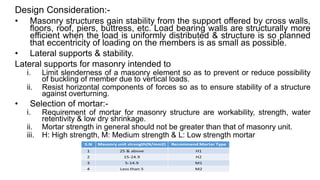
• Selection of mortar:-
i. Requirement of mortar for masonry structure are workability, strength, water
retentivity & low dry shrinkage.
ii. Mortar strength in general should not be greater than that of masonry unit.
iii. H: High strength, M: Medium strength & L: Low strength mortar
Design Consideration:-
• Effective height for walls:-
a) The height of wall or column to be considered for calculating
slenderness ratio.
b) Effective height of a wall shall be taken as shown in Table 4.
i. Lateral as well as rotational restraint(that is, full restraint) at top and
bottom-0.75H
ii. Lateral as well as rotational restraint( that is, full restraint ) at one end
and only lateral restraint ( that is, partial restraint) at the other-0.85H
iii. Lateral restraint, without rotational restraint (that is, partial restraint)on
both -1H
iv. Lateral restraint as well as rotational restraint ( that is, full restraint ) at
bottom but have no restraint at the top-1.5H
Where, H= the height of wall between centers of support in case of RCC
slabs and timber floors. In case of footings or foundation block, height (H)
is measured from top of footing or foundation block.
In case of roof truss, height (H) is measured up to
Design Consideration:-
• Effective length:- The length of wall or column to be considered for calculating
slenderness ratio. The effective length of wall is given in Table 5.
• Effective height for Column:-effective height shall be taken as actual height for
the direction it is laterally supported and as twice the actual height for the
direction it is not laterally supported.
• Effective height for opening in walls :- When openings occur in a wall such that
masonry between the openings is by definition a column, effective height of
masonry between the openings shall be reckoned as follows:
a) When wall has full restraint at the top:
i. Effective height for the direction perpendicular to the plane of the wall,
Heff=0.75H+0.25H1,
Where, H is the distance between supports and Hi is the height of the taller
opening
Design Consideration:-
ii. Effective height for the direction parallel to the wall equals H, that
is, the distance between the supports.
Heff=H,
b) When wall has partial restraint at the top:
i. Effective height for the direction perpendicular to plane of wall ,
• Heff=H , when height of neither opening exceeds 0.5 H
• Heff=2H,when height of any opening exceeds 0.5 H, and
ii. Effective height for the direction parallel to the plane of the wall,
Heff=2H
Design Consideration:-
• Effective Thickness:- The thickness of wall or column to be
considered for calculating slenderness ratio of a wall.
i. For solid walls, faced walls or columns, effective thickness shall be the
actual thickness.
ii. For solid walls adequately bonded into piers/buttresses, effective thickness
for determining slenderness ratio based on effective height shall be the
actual thickness of wall multiplied
iii. by stiffening coefficient as given in Table 6. No modification in effective
thickness, when slenderness ratio is based on effective length of walls.
Sp=c/c spacing of pier/cross wall
tp= thickness of pier
tw= Actual thickness of wall
Wp=Width of pier in the direction of wall
Design Consideration:-
i. For solid walls or faced walls stiffened by cross walls, appropriate stiffening
coefficient may be determined from Table 6 on the assumption that the
cross walls re equivalent to piers of width equal t d the thickness of the
cross wall and of thickness equal to three times the thickness of stiffened
wall.
ii. For cavity walls with both leaves of uniform thickness throughout, effective
thickness be taken as two-thirds the sum of the actual thickness of the two
leaves.
Design Consideration:-
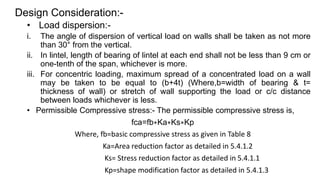
• Load dispersion:-
i. The angle of dispersion of vertical load on walls shall be taken as not more
than 30° from the vertical.
ii. In lintel, length of bearing of lintel at each end shall not be less than 9 cm or
one-tenth of the span, whichever is more.
iii. For concentric loading, maximum spread of a concentrated load on a wall
may be taken to be equal to (b+4t) (Where,b=width of bearing & t=
thickness of wall) or stretch of wall supporting the load or c/c distance
between loads whichever is less.
• Permissible Compressive stress:- The permissible compressive stress is,
fca=fb∗Ka∗Ks∗Kp
Where, fb=basic compressive stress as given in Table 8
Ka=Area reduction factor as detailed in 5.4.1.2
Ks= Stress reduction factor as detailed in 5.4.1.1
Kp=shape modification factor as detailed in 5.4.1.3
Design Consideration:-
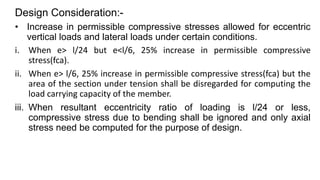
• Increase in permissible compressive stresses allowed for eccentric
vertical loads and lateral loads under certain conditions.
i. When e> l/24 but e<l/6, 25% increase in permissible compressive
stress(fca).
ii. When e> l/6, 25% increase in permissible compressive stress(fca) but the
area of the section under tension shall be disregarded for computing the
load carrying capacity of the member.
iii. When resultant eccentricity ratio of loading is l/24 or less,
compressive stress due to bending shall be ignored and only axial
stress need be computed for the purpose of design.
Design Consideration:-
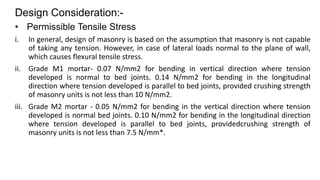
• Permissible Tensile Stress
i. In general, design of masonry is based on the assumption that masonry is not capable
of taking any tension. However, in case of lateral loads normal to the plane of wall,
which causes flexural tensile stress.
ii. Grade M1 mortar- 0.07 N/mm2 for bending in vertical direction where tension
developed is normal to bed joints. 0.14 N/mm2 for bending in the longitudinal
direction where tension developed is parallel to bed joints, provided crushing strength
of masonry units is not less than 10 N/mm2.
iii. Grade M2 mortar - 0.05 N/mm2 for bending in the vertical direction where tension
developed is normal bed joints. 0.10 N/mm2 for bending in the longitudinal direction
where tension developed is parallel to bed joints, providedcrushing strength of
masonry units is not less than 7.5 N/mm*.
Design Consideration:-
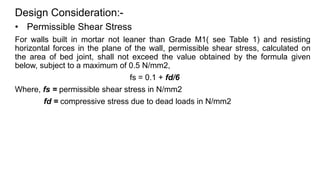
• Permissible Shear Stress
For walls built in mortar not leaner than Grade M1( see Table 1) and resisting
horizontal forces in the plane of the wall, permissible shear stress, calculated on
the area of bed joint, shall not exceed the value obtained by the formula given
below, subject to a maximum of 0.5 N/mm2,
fs = 0.1 + fd/6
Where, fs = permissible shear stress in N/mm2
fd = compressive stress due to dead loads in N/mm2
THANK YOU

Design masonry walls for gravity loads.pdf

  • 1.
  • 2.
  • 3.
    8. Design ofMasonry Walls for Gravity Loads (8hrs) 8 .1 Introduction to codal provisions(NBC 109) and guidelines(NBC 202) 8.2 Design for gravity loads(solid wall, wall with opening, wall with eccentric loading & wall acting as column) 8.3 Bonding elements in masonry: bond-stones, bands & dowels
  • 4.
    Introduction to codalprovision • In the past, there was no any code for designing masonry construction & at that time design is based on thumb rule. The thickness of wall is found very large & uneconomical beyond 3/4 stories. • Since 1950’s intensive theoretical & experimental research has been conducted & code of practice were developed. • Code for design of masonry:- i. IS 1905:1987- Code of practice for structural use of unreinforced masonry. ii. NBC 205:2015- Guidelines on load bearing masonry iii. NBC 109:1994- Masonry: unreinforced • “NBC 109:1994”, This code should be read in conjunction with the Indian Standard IS 1905-1987, Code of practice for structural use of unreinforced masonry(third revision). • This NBC 109:1994 cannot be applied for walls constructed in mud mortar.
  • 5.
    Walls • Most essentialcomponent of building. • Enclose or divide space of building. • Provide privacy, afford security & protection against heat. Rain & cold. • Design wall should have strength & stability, weather resistance & thermal insulation, durability & fire resistance, sound insulation etc. • Vertical load bearing member, width of which exceeds 4 times the thickness. • Load bearing wall: Designed to carry superimposed load & self weight. • Non-load bearing wall: Design to carry self weight only.
  • 6.
    Types of Walls i.Free standing wall: Compound wall/parapet on building. ii. Retaining wall: Wall constructed to retain soil pressure. iii. Shear wall: Wall that carry vertical as well as large in plane loads. iv. Partition wall: Interior non-load bearing wall. v. Panel wall: Exterior non-load bearing wall in framed construction. vi. Faced wall: It is a wall in the facing & backing of two different materials are bounded together to ensure common action under load. vii. Veneered wall: It is a wall in which facing is attached to the backing but not so bounded as a result in a common action under load. viii. Cavity wall: Wall comprising two leaves separated by cavity. ix. Curtain wall: Self supporting wall carrying no other vertical load but subjected to lateral loads. x. Cross wall: Load bearing walls constructed in which all loads are carried by internal walls, running at right angles to the length of building.
  • 7.
    Design Consideration:- • Masonrystructures gain stability from the support offered by cross walls, floors, roof, piers, buttress, etc. Load bearing walls are structurally more efficient when the load is uniformly distributed & structure is so planned that eccentricity of loading on the members is as small as possible. • Lateral supports & stability. Lateral supports for masonry intended to i. Limit slenderness of a masonry element so as to prevent or reduce possibility of buckling of member due to vertical loads. ii. Resist horizontal components of forces so as to ensure stability of a structure against overturning. • Selection of mortar:- i. Requirement of mortar for masonry structure are workability, strength, water retentivity & low dry shrinkage. ii. Mortar strength in general should not be greater than that of masonry unit. iii. H: High strength, M: Medium strength & L: Low strength mortar
  • 8.
    Design Consideration:- • Effectiveheight for walls:- a) The height of wall or column to be considered for calculating slenderness ratio. b) Effective height of a wall shall be taken as shown in Table 4. i. Lateral as well as rotational restraint(that is, full restraint) at top and bottom-0.75H ii. Lateral as well as rotational restraint( that is, full restraint ) at one end and only lateral restraint ( that is, partial restraint) at the other-0.85H iii. Lateral restraint, without rotational restraint (that is, partial restraint)on both -1H iv. Lateral restraint as well as rotational restraint ( that is, full restraint ) at bottom but have no restraint at the top-1.5H Where, H= the height of wall between centers of support in case of RCC slabs and timber floors. In case of footings or foundation block, height (H) is measured from top of footing or foundation block. In case of roof truss, height (H) is measured up to
  • 9.
    Design Consideration:- • Effectivelength:- The length of wall or column to be considered for calculating slenderness ratio. The effective length of wall is given in Table 5. • Effective height for Column:-effective height shall be taken as actual height for the direction it is laterally supported and as twice the actual height for the direction it is not laterally supported. • Effective height for opening in walls :- When openings occur in a wall such that masonry between the openings is by definition a column, effective height of masonry between the openings shall be reckoned as follows: a) When wall has full restraint at the top: i. Effective height for the direction perpendicular to the plane of the wall, Heff=0.75H+0.25H1, Where, H is the distance between supports and Hi is the height of the taller opening
  • 10.
    Design Consideration:- ii. Effectiveheight for the direction parallel to the wall equals H, that is, the distance between the supports. Heff=H, b) When wall has partial restraint at the top: i. Effective height for the direction perpendicular to plane of wall , • Heff=H , when height of neither opening exceeds 0.5 H • Heff=2H,when height of any opening exceeds 0.5 H, and ii. Effective height for the direction parallel to the plane of the wall, Heff=2H
  • 11.
    Design Consideration:- • EffectiveThickness:- The thickness of wall or column to be considered for calculating slenderness ratio of a wall. i. For solid walls, faced walls or columns, effective thickness shall be the actual thickness. ii. For solid walls adequately bonded into piers/buttresses, effective thickness for determining slenderness ratio based on effective height shall be the actual thickness of wall multiplied iii. by stiffening coefficient as given in Table 6. No modification in effective thickness, when slenderness ratio is based on effective length of walls. Sp=c/c spacing of pier/cross wall tp= thickness of pier tw= Actual thickness of wall Wp=Width of pier in the direction of wall
  • 12.
    Design Consideration:- i. Forsolid walls or faced walls stiffened by cross walls, appropriate stiffening coefficient may be determined from Table 6 on the assumption that the cross walls re equivalent to piers of width equal t d the thickness of the cross wall and of thickness equal to three times the thickness of stiffened wall. ii. For cavity walls with both leaves of uniform thickness throughout, effective thickness be taken as two-thirds the sum of the actual thickness of the two leaves.
  • 13.
    Design Consideration:- • Loaddispersion:- i. The angle of dispersion of vertical load on walls shall be taken as not more than 30° from the vertical. ii. In lintel, length of bearing of lintel at each end shall not be less than 9 cm or one-tenth of the span, whichever is more. iii. For concentric loading, maximum spread of a concentrated load on a wall may be taken to be equal to (b+4t) (Where,b=width of bearing & t= thickness of wall) or stretch of wall supporting the load or c/c distance between loads whichever is less. • Permissible Compressive stress:- The permissible compressive stress is, fca=fb∗Ka∗Ks∗Kp Where, fb=basic compressive stress as given in Table 8 Ka=Area reduction factor as detailed in 5.4.1.2 Ks= Stress reduction factor as detailed in 5.4.1.1 Kp=shape modification factor as detailed in 5.4.1.3
  • 14.
    Design Consideration:- • Increasein permissible compressive stresses allowed for eccentric vertical loads and lateral loads under certain conditions. i. When e> l/24 but e<l/6, 25% increase in permissible compressive stress(fca). ii. When e> l/6, 25% increase in permissible compressive stress(fca) but the area of the section under tension shall be disregarded for computing the load carrying capacity of the member. iii. When resultant eccentricity ratio of loading is l/24 or less, compressive stress due to bending shall be ignored and only axial stress need be computed for the purpose of design.
  • 15.
    Design Consideration:- • PermissibleTensile Stress i. In general, design of masonry is based on the assumption that masonry is not capable of taking any tension. However, in case of lateral loads normal to the plane of wall, which causes flexural tensile stress. ii. Grade M1 mortar- 0.07 N/mm2 for bending in vertical direction where tension developed is normal to bed joints. 0.14 N/mm2 for bending in the longitudinal direction where tension developed is parallel to bed joints, provided crushing strength of masonry units is not less than 10 N/mm2. iii. Grade M2 mortar - 0.05 N/mm2 for bending in the vertical direction where tension developed is normal bed joints. 0.10 N/mm2 for bending in the longitudinal direction where tension developed is parallel to bed joints, providedcrushing strength of masonry units is not less than 7.5 N/mm*.
  • 16.
    Design Consideration:- • PermissibleShear Stress For walls built in mortar not leaner than Grade M1( see Table 1) and resisting horizontal forces in the plane of the wall, permissible shear stress, calculated on the area of bed joint, shall not exceed the value obtained by the formula given below, subject to a maximum of 0.5 N/mm2, fs = 0.1 + fd/6 Where, fs = permissible shear stress in N/mm2 fd = compressive stress due to dead loads in N/mm2
  • 17.