CON 122
Concrete Admixtures


Session 3
Air Entraining Admixtures
Air-Entraining Admixtures
         ASTM C 260 or AASHTO M 154
   Improve durability in concrete exposed to
       Freeze-thaw
       Deicers
       Sulfates
       Alkali-reactive environments
   Improve workability
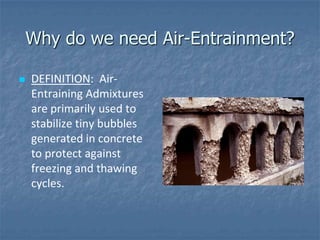
Why do we need Air-Entrainment?

   DEFINITION: Air-
    Entraining Admixtures
    are primarily used to
    stabilize tiny bubbles
    generated in concrete
    to protect against
    freezing and thawing
    cycles.
History
   Air-entrainment was
    discovered accidentally
    in the 1930s
       Several pavements in
        New York had survived
        severe freeze-thaw
        exposure
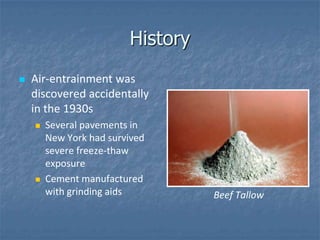
       Cement manufactured
        with grinding aids         Beef Tallow
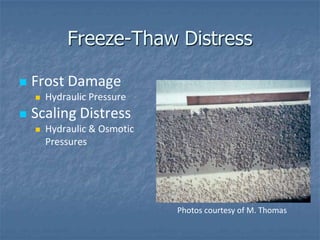
Freeze-Thaw Distress

   Frost Damage
       Hydraulic Pressure
   Scaling Distress
       Hydraulic & Osmotic
        Pressures


                              Photos courtesy of M. Thomas
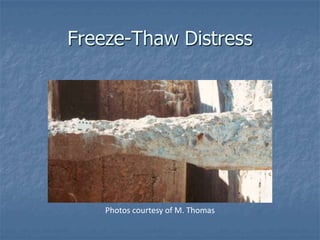
Freeze-Thaw Distress


    Photos courtesy of M. Thomas
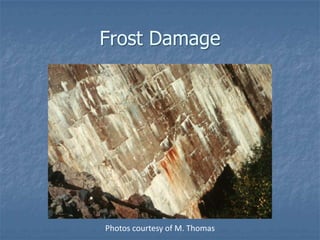
Frost Damage


Photos courtesy of M. Thomas
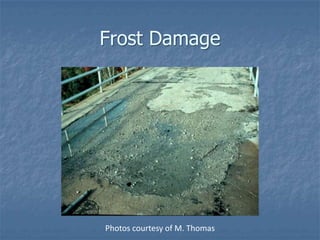
Frost Damage


Photos courtesy of M. Thomas
Air Entraining Admixtures

   Air entrained admixtures produce voids
       Anionic
       Hydrophobic (repel water)
       Electric charged
   Mechanical mixing dispersed
       Size: 10-1000 microns
       Bubbles not interconnected
Concrete Air Voids

   Non-air entrained concrete
       1 in (25mm) max size
       Entrapped air voids: 11/2%
   Air-entrained concrete
       1 in (25mm) max size
       Entrained air voids: 6%
       Total air consists of entrapped and entrained
Freezing and Thawing
   Concrete water freezes
       Produces Osmotic and hydraulic pressures
       As pressure exceeds tensile strength of paste
        cavity will dilate and rupture
   Effect of successive F-T cycles
       Disruption of paste and aggregate
       Expansion of concrete and deterioration
       Water travels to nearest air void for relief
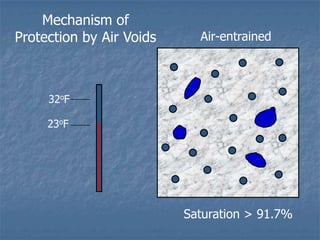
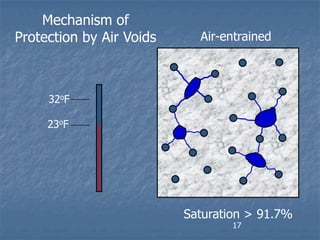
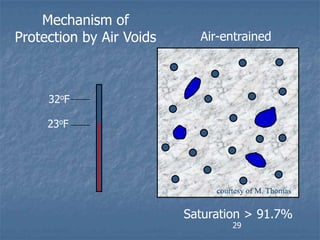
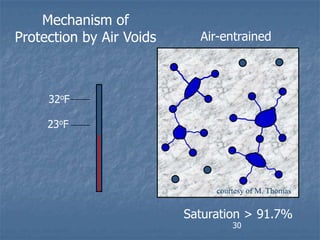
Mechanism of Protection by Air Voids

   As the temperature of saturated
    concrete(.91.7%) in service is lowered, the
    water held in the capillary pores in the harden
    concrete paste freezes.
Mechanism of
Protection by Air Voids     Air-entrained


     32oF

     23oF


                          Saturation > 91.7%
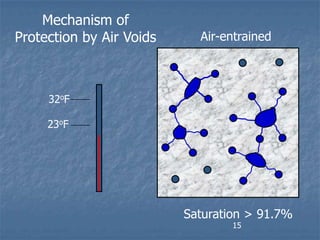
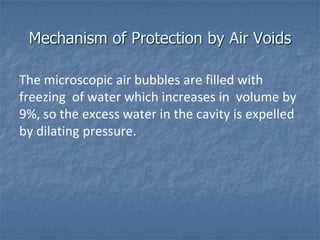
Mechanism of Protection by Air Voids

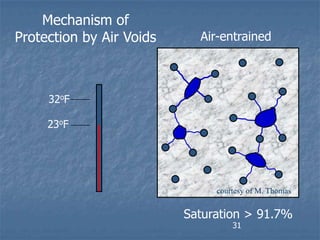
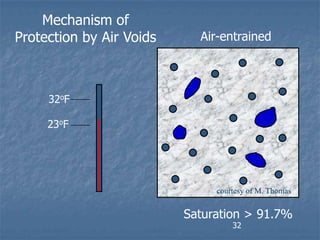
The microscopic air bubbles are filled with
freezing of water which increases in volume by
9%, so the excess water in the cavity is expelled
by dilating pressure.
Mechanism of
Protection by Air Voids     Air-entrained


     32oF

     23oF


                          Saturation > 91.7%
                                  15
Mechanism of Protection by Air Voids

   Diffusion of water leading to a growth of a
    relatively small number of bodies of ice.
   When salts are used for de-icing, they are
    absorbed by the upper part of the concrete.
   This produces an osmotic pressure with a
    consequence movement of water towards the
    coldest zone where freezing takes place.
Mechanism of
Protection by Air Voids     Air-entrained


     32oF

     23oF


                          Saturation > 91.7%
                                  17
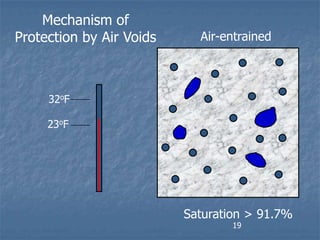
Mechanism of Protection by Air Voids

The microscopic air bubbles are filled with
freezing of water which increases in volume by
9%, so the excess water in the cavity is expelled
by dilating pressure.
Mechanism of
Protection by Air Voids     Air-entrained


     32oF

     23oF


                          Saturation > 91.7%
                                  19
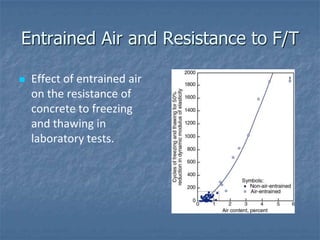
Entrained Air and Resistance to F/T

   Effect of entrained air
    on the resistance of
    concrete to freezing
    and thawing in
    laboratory tests.
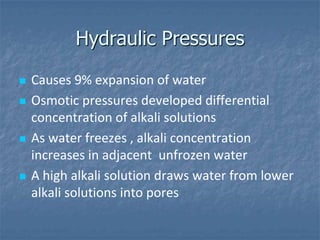
Hydraulic Pressures

   Causes 9% expansion of water
   Osmotic pressures developed differential
    concentration of alkali solutions
   As water freezes , alkali concentration
    increases in adjacent unfrozen water
   A high alkali solution draws water from lower
    alkali solutions into pores
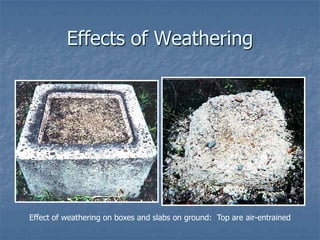
Effects of Weathering


Effect of weathering on boxes and slabs on ground: Top are air-entrained
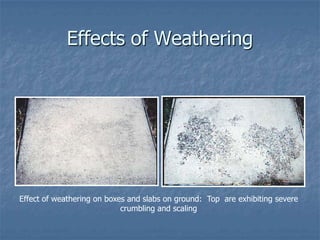
Effects of Weathering


Effect of weathering on boxes and slabs on ground: Top are exhibiting severe
                            crumbling and scaling
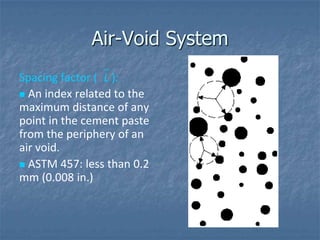
Air-Void System
Spacing factor ( L ):
 An index related to the
maximum distance of any
point in the cement paste
from the periphery of an
air void.
 ASTM 457: less than 0.2
mm (0.008 in.)
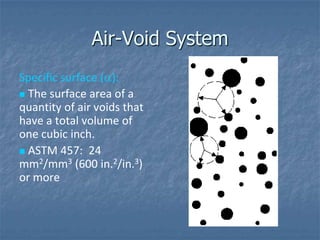
Air-Void System
Specific surface ( ):
 The surface area of a
quantity of air voids that
have a total volume of
one cubic inch.
 ASTM 457: 24
mm2/mm3 (600 in.2/in.3)
or more
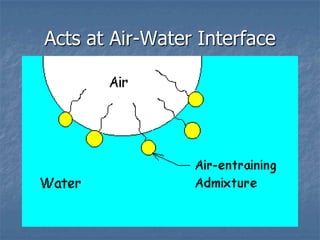
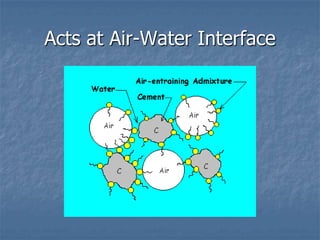
Acts at Air-Water Interface
Mechanism of
Protection by Air Voids     Air-entrained


     32oF

     23oF


                               courtesy of M. Thomas


                          Saturation > 91.7%
                                   29
Mechanism of
Protection by Air Voids     Air-entrained


     32oF

     23oF


                               courtesy of M. Thomas


                          Saturation > 91.7%
                                   30
Mechanism of
Protection by Air Voids     Air-entrained


     32oF

     23oF


                               courtesy of M. Thomas


                          Saturation > 91.7%
                                   31
Mechanism of
Protection by Air Voids     Air-entrained


     32oF

     23oF


                               courtesy of M. Thomas


                          Saturation > 91.7%
                                   32
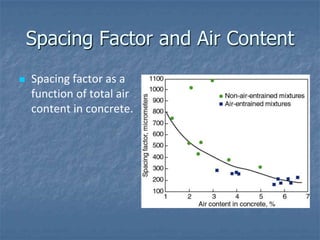
Spacing Factor and Air Content
   Spacing factor as a
    function of total air
    content in concrete.
Improved Freeze Thaw Resistance

   Good Quality Aggregates
   Low Water/Cement ratio (max 0.45)
   Minimum cementitious content (564 lbs/yd3;
    335 kg/m3)
   Proper curing practices
   Compressive strength at 28 days of 4000 psi
    or 28 MPa
Improved Deicer-Scaling Resistance

   Low Water/Cement ratio (max 0.45)
   Slump: less 4 in (100 mm); use plasticizer
   Minimum cementitious content
   Proper finishing( bleed water evaporation)
   Adequate drainage
   Minimum compressive strength
   Minimum 30 day drying period
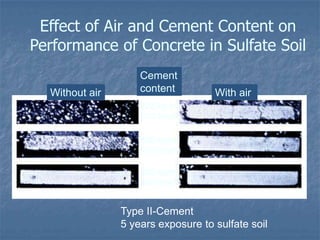
Effect of Air and Cement Content on
Performance of Concrete in Sulfate Soil
                    Cement
  Without air       content         With air
                    222 kg/m3
                    (375 lb/yd3)


                    306 kg/m3
                    (515 lb/yd3)

                    392 kg/m3
                    (660 lb/yd3)


                Type II-Cement
                5 years exposure to sulfate soil
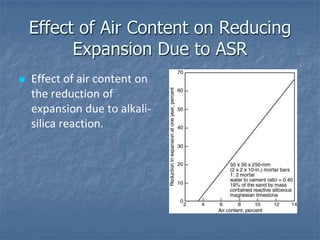
Effect of Air Content on Reducing
          Expansion Due to ASR
   Effect of air content on
    the reduction of
    expansion due to alkali-
    silica reaction.
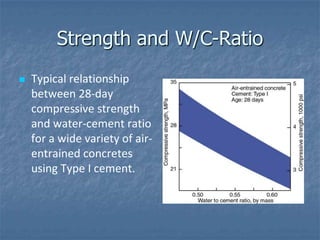
Strength and W/C-Ratio
   Typical relationship
    between 28-day
    compressive strength
    and water-cement ratio
    for a wide variety of air-
    entrained concretes
    using Type I cement.
Effect of Air Entrainment on
                 Concrete
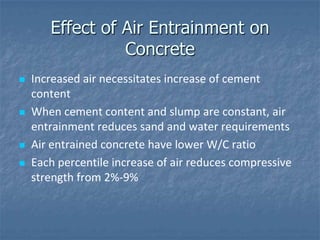
   Increased air necessitates increase of cement
    content
   When cement content and slump are constant, air
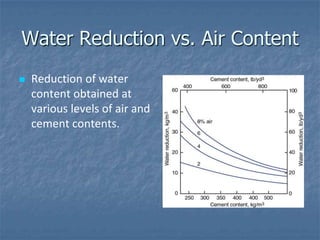
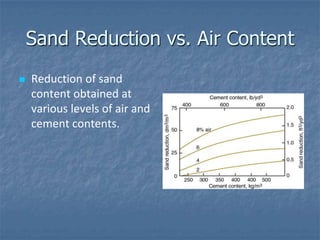
    entrainment reduces sand and water requirements
   Air entrained concrete have lower W/C ratio
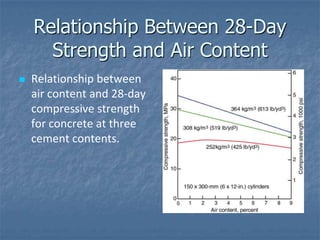
   Each percentile increase of air reduces compressive
    strength from 2%-9%
Water Reduction vs. Air Content
   Reduction of water
    content obtained at
    various levels of air and
    cement contents.
Sand Reduction vs. Air Content
   Reduction of sand
    content obtained at
    various levels of air and
    cement contents.
Relationship Between 28-Day
      Strength and Air Content
   Relationship between
    air content and 28-day
    compressive strength
    for concrete at three
    cement contents.
Workability
   Entrained air improves workability
   Very effective in lean cement content
   Mixes with angular and poorly graded aggregates
    workability improved
   Freshly mixed air-entrained concrete is
    cohesive, easier to handle
   Entrained air also reduces segregation and bleeding
   High air mixes are sticky and difficult to finish
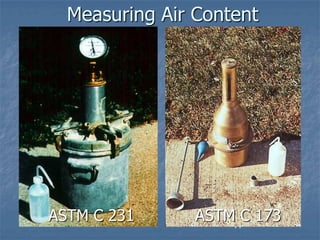
Measuring Air Content


ASTM C 231      ASTM44C 173
Tests for Air Content

Hardened Concrete
(ASTM 457):

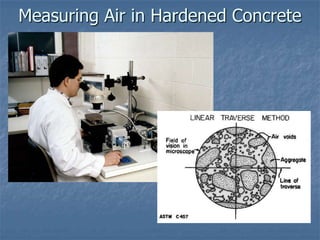
   Linear-Traverse Method
   Point-Count Method
Measuring Air in Hardened Concrete
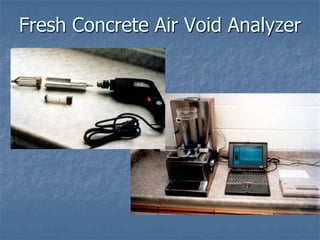
Fresh Concrete Air Void Analyzer
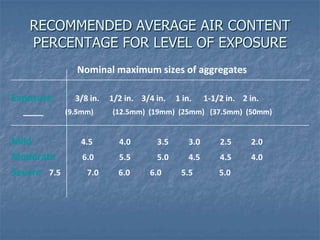
RECOMMENDED AVERAGE AIR CONTENT
   PERCENTAGE FOR LEVEL OF EXPOSURE
               Nominal maximum sizes of aggregates

Exposure       3/8 in.   1/2 in. 3/4 in.   1 in.     1-1/2 in. 2 in.
             (9.5mm)     (12.5mm) (19mm) (25mm) (37.5mm) (50mm)


Mild            4.5        4.0       3.5       3.0       2.5     2.0
Moderate         6.0       5.5       5.0       4.5       4.5     4.0
Severe 7.5        7.0      6.0     6.0      5.5          5.0
Air Entraining

Please return to Blackboard and watch the
following video:
 Video 1: Air Entrainment

CON 122 Session 3 - Air-Entraining Admixtures

  • 1.
    CON 122 Concrete Admixtures Session3 Air Entraining Admixtures
  • 2.
    Air-Entraining Admixtures ASTM C 260 or AASHTO M 154  Improve durability in concrete exposed to  Freeze-thaw  Deicers  Sulfates  Alkali-reactive environments  Improve workability
  • 3.
    Why do weneed Air-Entrainment?  DEFINITION: Air- Entraining Admixtures are primarily used to stabilize tiny bubbles generated in concrete to protect against freezing and thawing cycles.
  • 4.
    History  Air-entrainment was discovered accidentally in the 1930s  Several pavements in New York had survived severe freeze-thaw exposure  Cement manufactured with grinding aids Beef Tallow
  • 5.
    Freeze-Thaw Distress  Frost Damage  Hydraulic Pressure  Scaling Distress  Hydraulic & Osmotic Pressures Photos courtesy of M. Thomas
  • 6.
    Freeze-Thaw Distress Photos courtesy of M. Thomas
  • 7.
  • 8.
  • 9.
    Air Entraining Admixtures  Air entrained admixtures produce voids  Anionic  Hydrophobic (repel water)  Electric charged  Mechanical mixing dispersed  Size: 10-1000 microns  Bubbles not interconnected
  • 10.
    Concrete Air Voids  Non-air entrained concrete  1 in (25mm) max size  Entrapped air voids: 11/2%  Air-entrained concrete  1 in (25mm) max size  Entrained air voids: 6%  Total air consists of entrapped and entrained
  • 11.
    Freezing and Thawing  Concrete water freezes  Produces Osmotic and hydraulic pressures  As pressure exceeds tensile strength of paste cavity will dilate and rupture  Effect of successive F-T cycles  Disruption of paste and aggregate  Expansion of concrete and deterioration  Water travels to nearest air void for relief
  • 12.
    Mechanism of Protectionby Air Voids  As the temperature of saturated concrete(.91.7%) in service is lowered, the water held in the capillary pores in the harden concrete paste freezes.
  • 13.
    Mechanism of Protection byAir Voids Air-entrained 32oF 23oF Saturation > 91.7%
  • 14.
    Mechanism of Protectionby Air Voids The microscopic air bubbles are filled with freezing of water which increases in volume by 9%, so the excess water in the cavity is expelled by dilating pressure.
  • 15.
    Mechanism of Protection byAir Voids Air-entrained 32oF 23oF Saturation > 91.7% 15
  • 16.
    Mechanism of Protectionby Air Voids  Diffusion of water leading to a growth of a relatively small number of bodies of ice.  When salts are used for de-icing, they are absorbed by the upper part of the concrete.  This produces an osmotic pressure with a consequence movement of water towards the coldest zone where freezing takes place.
  • 17.
    Mechanism of Protection byAir Voids Air-entrained 32oF 23oF Saturation > 91.7% 17
  • 18.
    Mechanism of Protectionby Air Voids The microscopic air bubbles are filled with freezing of water which increases in volume by 9%, so the excess water in the cavity is expelled by dilating pressure.
  • 19.
    Mechanism of Protection byAir Voids Air-entrained 32oF 23oF Saturation > 91.7% 19
  • 20.
    Entrained Air andResistance to F/T  Effect of entrained air on the resistance of concrete to freezing and thawing in laboratory tests.
  • 21.
    Hydraulic Pressures  Causes 9% expansion of water  Osmotic pressures developed differential concentration of alkali solutions  As water freezes , alkali concentration increases in adjacent unfrozen water  A high alkali solution draws water from lower alkali solutions into pores
  • 22.
    Effects of Weathering Effectof weathering on boxes and slabs on ground: Top are air-entrained
  • 23.
    Effects of Weathering Effectof weathering on boxes and slabs on ground: Top are exhibiting severe crumbling and scaling
  • 24.
    Air-Void System Spacing factor( L ):  An index related to the maximum distance of any point in the cement paste from the periphery of an air void.  ASTM 457: less than 0.2 mm (0.008 in.)
  • 25.
    Air-Void System Specific surface( ):  The surface area of a quantity of air voids that have a total volume of one cubic inch.  ASTM 457: 24 mm2/mm3 (600 in.2/in.3) or more
  • 26.
  • 27.
  • 28.
    Mechanism of Protection byAir Voids Air-entrained 32oF 23oF courtesy of M. Thomas Saturation > 91.7% 29
  • 29.
    Mechanism of Protection byAir Voids Air-entrained 32oF 23oF courtesy of M. Thomas Saturation > 91.7% 30
  • 30.
    Mechanism of Protection byAir Voids Air-entrained 32oF 23oF courtesy of M. Thomas Saturation > 91.7% 31
  • 31.
    Mechanism of Protection byAir Voids Air-entrained 32oF 23oF courtesy of M. Thomas Saturation > 91.7% 32
  • 32.
    Spacing Factor andAir Content  Spacing factor as a function of total air content in concrete.
  • 33.
    Improved Freeze ThawResistance  Good Quality Aggregates  Low Water/Cement ratio (max 0.45)  Minimum cementitious content (564 lbs/yd3; 335 kg/m3)  Proper curing practices  Compressive strength at 28 days of 4000 psi or 28 MPa
  • 34.
    Improved Deicer-Scaling Resistance  Low Water/Cement ratio (max 0.45)  Slump: less 4 in (100 mm); use plasticizer  Minimum cementitious content  Proper finishing( bleed water evaporation)  Adequate drainage  Minimum compressive strength  Minimum 30 day drying period
  • 35.
    Effect of Airand Cement Content on Performance of Concrete in Sulfate Soil Cement Without air content With air 222 kg/m3 (375 lb/yd3) 306 kg/m3 (515 lb/yd3) 392 kg/m3 (660 lb/yd3) Type II-Cement 5 years exposure to sulfate soil
  • 36.
    Effect of AirContent on Reducing Expansion Due to ASR  Effect of air content on the reduction of expansion due to alkali- silica reaction.
  • 37.
    Strength and W/C-Ratio  Typical relationship between 28-day compressive strength and water-cement ratio for a wide variety of air- entrained concretes using Type I cement.
  • 38.
    Effect of AirEntrainment on Concrete  Increased air necessitates increase of cement content  When cement content and slump are constant, air entrainment reduces sand and water requirements  Air entrained concrete have lower W/C ratio  Each percentile increase of air reduces compressive strength from 2%-9%
  • 39.
    Water Reduction vs.Air Content  Reduction of water content obtained at various levels of air and cement contents.
  • 40.
    Sand Reduction vs.Air Content  Reduction of sand content obtained at various levels of air and cement contents.
  • 41.
    Relationship Between 28-Day Strength and Air Content  Relationship between air content and 28-day compressive strength for concrete at three cement contents.
  • 42.
    Workability  Entrained air improves workability  Very effective in lean cement content  Mixes with angular and poorly graded aggregates workability improved  Freshly mixed air-entrained concrete is cohesive, easier to handle  Entrained air also reduces segregation and bleeding  High air mixes are sticky and difficult to finish
  • 43.
    Measuring Air Content ASTMC 231 ASTM44C 173
  • 44.
    Tests for AirContent Hardened Concrete (ASTM 457):  Linear-Traverse Method  Point-Count Method
  • 45.
    Measuring Air inHardened Concrete
  • 46.
    Fresh Concrete AirVoid Analyzer
  • 47.
    RECOMMENDED AVERAGE AIRCONTENT PERCENTAGE FOR LEVEL OF EXPOSURE Nominal maximum sizes of aggregates Exposure 3/8 in. 1/2 in. 3/4 in. 1 in. 1-1/2 in. 2 in. (9.5mm) (12.5mm) (19mm) (25mm) (37.5mm) (50mm) Mild 4.5 4.0 3.5 3.0 2.5 2.0 Moderate 6.0 5.5 5.0 4.5 4.5 4.0 Severe 7.5 7.0 6.0 6.0 5.5 5.0
  • 48.
    Air Entraining Please returnto Blackboard and watch the following video:  Video 1: Air Entrainment

Editor's Notes

  • #15 The microscopic air bubbles are filled with freezing of water which increases in volume by 9%, so the excess water in the cavity is expelled by dilating pressure.
  • #19 The microscopic air bubbles are filled with freezing of water which increases in volume by 9%, so the excess water in the cavity is expelled by dilating pressure.