PRAKASH PAUDEL
GRAPHIC ERA UNIVERSITY
FIRST SEMESTER SEMINAR
Performance of Non-Engineered masonry Buildings
During Earthquakes
 Stone masonry buildings tend to perform poorly in
earthquakes owing to the low strength of the stone and
mortar used and the lack of adequate wall connections
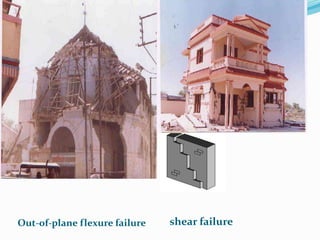
 The failure pattern of such masonry structures during
earthquake can be classified as
Out-of-plane flexure failure shear failure
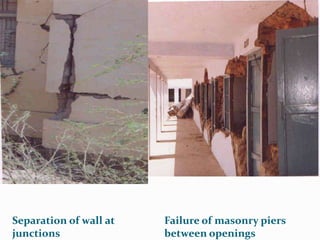
Separation of wall at
junctions
Failure of masonry piers
between openings
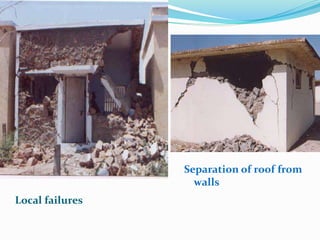
Local failures
Separation of roof from
walls
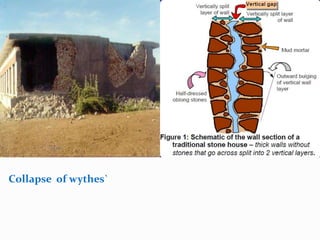
Collapse of wythes`
Simplicity and symmetry in plan and elevation
Building Height
 In general, stone masonry buildings should not be taller
than 2 storeys when built in cement mortar, and 1 storey
when built in lime or mud mortar
Roofs
 Lighter roofs are preferable to heavy roofs. Sheeted roofs
are better than tiled roofs All elements of a roof should
be so integrated that it may have the capability of acting
as one stiff unit in plan for holding the walls together
EARTHQUAKE PROTECTION MESURES:-
Architectural Design Features:-
Floors
For holding the walls together, the floor elements should
have full bearing on the walls
Opening in Walls
For better seismic behavior openings should be as small and
centrally located as functionally feasible
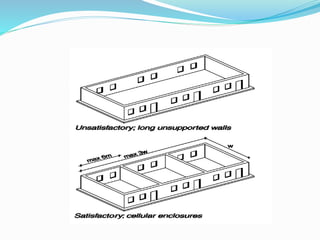
Enclosed space
Within a building, smaller rooms with bonded long and
short walls forming a crate like enclosure, are seismically
stronger than rooms with long uninterrupted masonry walls
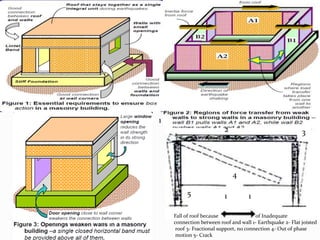
Fall of roof because of Inadequate
connection between roof and wall 1- Earthquake 2- Flat joisted
roof 3- Fractional support, no connection 4- Out of phase
motion 5- Crack
1 1
2 3
5
1
4
Quality of Construction and Maintenance
Good quality of building materials - mortar and
building units of good strength
Proper bond so as to break vertical joints in walls
Construction of walls truly vertical
Proper continuity at corners and wall junctions
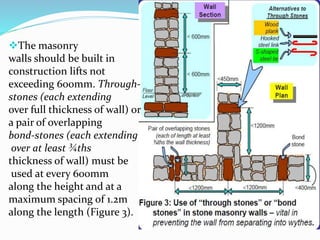
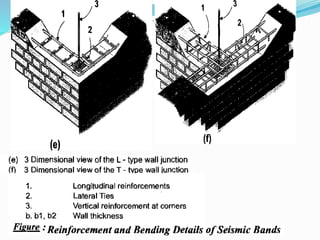
The masonry
walls should be built in
construction lifts not
exceeding 600mm. Through-
stones (each extending
over full thickness of wall) or
a pair of overlapping
bond-stones (each extending
over at least ¾ths
thickness of wall) must be
used at every 600mm
along the height and at a
maximum spacing of 1.2m
along the length (Figure 3).
Ensure proper wall construction
 The wall thickness should not exceed 450mm.
Round stone boulders should not be used in the
Construction Instead, the stones should be
shaped using chisels and hammer
Control on overall dimensions and heights
The unsupported length of walls between cross
walls should be limited to 5/6m
 for longer walls, cross supports raised from the
ground level called buttresses should be provided
at spacing not more than 4m.
The height of each storey should not exceed 3.0m
Horizontal Bands
 Why are Horizontal Bands necessary in Masonry
Building
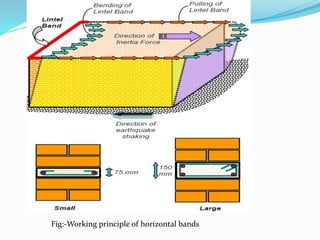
 providing out-of-plane bending resistance to the wall
by forming a rigid horizontal frame with continuity at
the corners
 reducing the unsupported vertical height of the wall to
that between the two consecutive bands, like plinth and
lintel
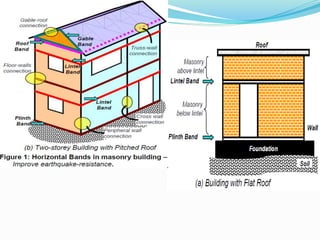
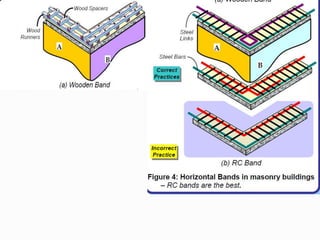
There are four types of bands in a typical masonry
building, namely gable band, roof band, lintel band
and plinth band , named after their location in the
building
 The lintel band is the most important of all and
needs to be provided in almost all buildings
 The gable band is employed only in buildings
with pitched or sloped roofs
Fig:-Working principle of horizontal bands
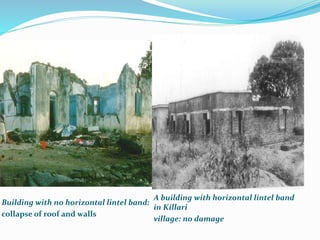
Building with no horizontal lintel band:
collapse of roof and walls
A building with horizontal lintel band
in Killari
village: no damage
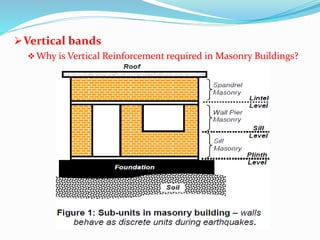
Vertical bands
Why is Vertical Reinforcement required in Masonry Buildings?
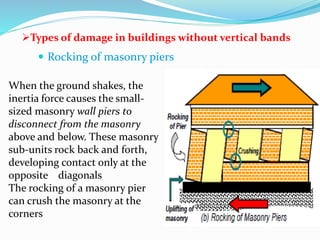
Types of damage in buildings without vertical bands
 Rocking of masonry piers
When the ground shakes, the
inertia force causes the small-
sized masonry wall piers to
disconnect from the masonry
above and below. These masonry
sub-units rock back and forth,
developing contact only at the
opposite diagonals
The rocking of a masonry pier
can crush the masonry at the
corners
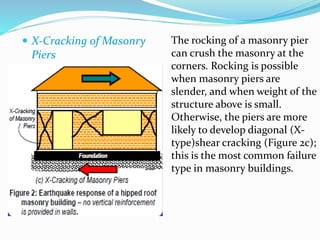
 X-Cracking of Masonry
Piers
The rocking of a masonry pier
can crush the masonry at the
corners. Rocking is possible
when masonry piers are
slender, and when weight of the
structure above is small.
Otherwise, the piers are more
likely to develop diagonal (X-
type)shear cracking (Figure 2c);
this is the most common failure
type in masonry buildings.
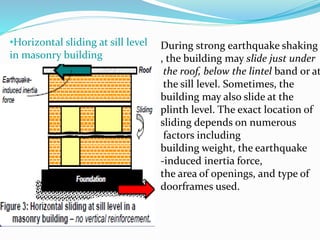
•Horizontal sliding at sill level
in masonry building
During strong earthquake shaking
, the building may slide just under
the roof, below the lintel band or at
the sill level. Sometimes, the
building may also slide at the
plinth level. The exact location of
sliding depends on numerous
factors including
building weight, the earthquake
-induced inertia force,
the area of openings, and type of
doorframes used.
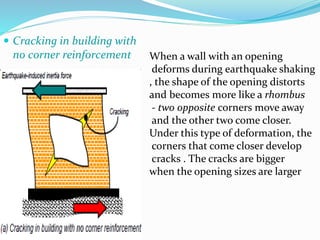
When a wall with an opening
deforms during earthquake shaking
, the shape of the opening distorts
and becomes more like a rhombus
- two opposite corners move away
and the other two come closer.
Under this type of deformation, the
corners that come closer develop
cracks . The cracks are bigger
when the opening sizes are larger
 Cracking in building with
no corner reinforcement
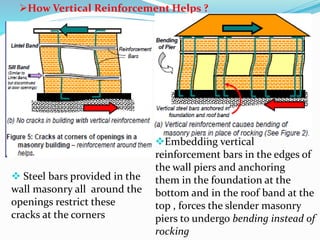
How Vertical Reinforcement Helps ?
Embedding vertical
reinforcement bars in the edges of
the wall piers and anchoring
them in the foundation at the
bottom and in the roof band at the
top , forces the slender masonry
piers to undergo bending instead of
rocking
 Steel bars provided in the
wall masonry all around the
openings restrict these
cracks at the corners
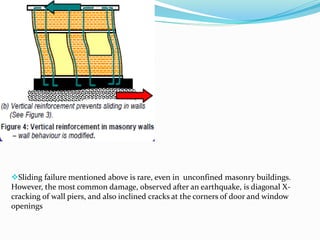
Sliding failure mentioned above is rare, even in unconfined masonry buildings.
However, the most common damage, observed after an earthquake, is diagonal X-
cracking of wall piers, and also inclined cracks at the corners of door and window
openings
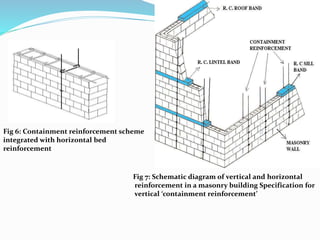
Fig 6: Containment reinforcement scheme
integrated with horizontal bed
reinforcement
Fig 7: Schematic diagram of vertical and horizontal
reinforcement in a masonry building Specification for
vertical ‘containment reinforcement’
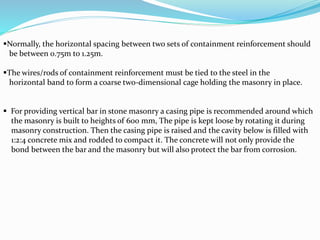
Normally, the horizontal spacing between two sets of containment reinforcement should
be between 0.75m to 1.25m.
The wires/rods of containment reinforcement must be tied to the steel in the
horizontal band to form a coarse two-dimensional cage holding the masonry in place.
 For providing vertical bar in stone masonry a casing pipe is recommended around which
the masonry is built to heights of 600 mm, The pipe is kept loose by rotating it during
masonry construction. Then the casing pipe is raised and the cavity below is filled with
1:2:4 concrete mix and rodded to compact it. The concrete will not only provide the
bond between the bar and the masonry but will also protect the bar from corrosion.
THE END

Improve Earthquake Resistivity of Stone masonry Buildings

  • 1.
    PRAKASH PAUDEL GRAPHIC ERAUNIVERSITY FIRST SEMESTER SEMINAR
  • 2.
    Performance of Non-Engineeredmasonry Buildings During Earthquakes  Stone masonry buildings tend to perform poorly in earthquakes owing to the low strength of the stone and mortar used and the lack of adequate wall connections  The failure pattern of such masonry structures during earthquake can be classified as
  • 3.
  • 4.
    Separation of wallat junctions Failure of masonry piers between openings
  • 5.
  • 6.
  • 7.
    Simplicity and symmetryin plan and elevation Building Height  In general, stone masonry buildings should not be taller than 2 storeys when built in cement mortar, and 1 storey when built in lime or mud mortar Roofs  Lighter roofs are preferable to heavy roofs. Sheeted roofs are better than tiled roofs All elements of a roof should be so integrated that it may have the capability of acting as one stiff unit in plan for holding the walls together EARTHQUAKE PROTECTION MESURES:- Architectural Design Features:-
  • 8.
    Floors For holding thewalls together, the floor elements should have full bearing on the walls Opening in Walls For better seismic behavior openings should be as small and centrally located as functionally feasible Enclosed space Within a building, smaller rooms with bonded long and short walls forming a crate like enclosure, are seismically stronger than rooms with long uninterrupted masonry walls
  • 10.
    Fall of roofbecause of Inadequate connection between roof and wall 1- Earthquake 2- Flat joisted roof 3- Fractional support, no connection 4- Out of phase motion 5- Crack 1 1 2 3 5 1 4
  • 11.
    Quality of Constructionand Maintenance Good quality of building materials - mortar and building units of good strength Proper bond so as to break vertical joints in walls Construction of walls truly vertical Proper continuity at corners and wall junctions
  • 12.
    The masonry walls shouldbe built in construction lifts not exceeding 600mm. Through- stones (each extending over full thickness of wall) or a pair of overlapping bond-stones (each extending over at least ¾ths thickness of wall) must be used at every 600mm along the height and at a maximum spacing of 1.2m along the length (Figure 3).
  • 13.
    Ensure proper wallconstruction  The wall thickness should not exceed 450mm. Round stone boulders should not be used in the Construction Instead, the stones should be shaped using chisels and hammer Control on overall dimensions and heights The unsupported length of walls between cross walls should be limited to 5/6m  for longer walls, cross supports raised from the ground level called buttresses should be provided at spacing not more than 4m. The height of each storey should not exceed 3.0m
  • 14.
    Horizontal Bands  Whyare Horizontal Bands necessary in Masonry Building  providing out-of-plane bending resistance to the wall by forming a rigid horizontal frame with continuity at the corners  reducing the unsupported vertical height of the wall to that between the two consecutive bands, like plinth and lintel
  • 15.
    There are fourtypes of bands in a typical masonry building, namely gable band, roof band, lintel band and plinth band , named after their location in the building  The lintel band is the most important of all and needs to be provided in almost all buildings  The gable band is employed only in buildings with pitched or sloped roofs
  • 17.
    Fig:-Working principle ofhorizontal bands
  • 18.
    Building with nohorizontal lintel band: collapse of roof and walls A building with horizontal lintel band in Killari village: no damage
  • 21.
    Vertical bands Why isVertical Reinforcement required in Masonry Buildings?
  • 22.
    Types of damagein buildings without vertical bands  Rocking of masonry piers When the ground shakes, the inertia force causes the small- sized masonry wall piers to disconnect from the masonry above and below. These masonry sub-units rock back and forth, developing contact only at the opposite diagonals The rocking of a masonry pier can crush the masonry at the corners
  • 23.
     X-Cracking ofMasonry Piers The rocking of a masonry pier can crush the masonry at the corners. Rocking is possible when masonry piers are slender, and when weight of the structure above is small. Otherwise, the piers are more likely to develop diagonal (X- type)shear cracking (Figure 2c); this is the most common failure type in masonry buildings.
  • 24.
    •Horizontal sliding atsill level in masonry building During strong earthquake shaking , the building may slide just under the roof, below the lintel band or at the sill level. Sometimes, the building may also slide at the plinth level. The exact location of sliding depends on numerous factors including building weight, the earthquake -induced inertia force, the area of openings, and type of doorframes used.
  • 25.
    When a wallwith an opening deforms during earthquake shaking , the shape of the opening distorts and becomes more like a rhombus - two opposite corners move away and the other two come closer. Under this type of deformation, the corners that come closer develop cracks . The cracks are bigger when the opening sizes are larger  Cracking in building with no corner reinforcement
  • 26.
    How Vertical ReinforcementHelps ? Embedding vertical reinforcement bars in the edges of the wall piers and anchoring them in the foundation at the bottom and in the roof band at the top , forces the slender masonry piers to undergo bending instead of rocking  Steel bars provided in the wall masonry all around the openings restrict these cracks at the corners
  • 27.
    Sliding failure mentionedabove is rare, even in unconfined masonry buildings. However, the most common damage, observed after an earthquake, is diagonal X- cracking of wall piers, and also inclined cracks at the corners of door and window openings
  • 28.
    Fig 6: Containmentreinforcement scheme integrated with horizontal bed reinforcement Fig 7: Schematic diagram of vertical and horizontal reinforcement in a masonry building Specification for vertical ‘containment reinforcement’
  • 29.
    Normally, the horizontalspacing between two sets of containment reinforcement should be between 0.75m to 1.25m. The wires/rods of containment reinforcement must be tied to the steel in the horizontal band to form a coarse two-dimensional cage holding the masonry in place.  For providing vertical bar in stone masonry a casing pipe is recommended around which the masonry is built to heights of 600 mm, The pipe is kept loose by rotating it during masonry construction. Then the casing pipe is raised and the cavity below is filled with 1:2:4 concrete mix and rodded to compact it. The concrete will not only provide the bond between the bar and the masonry but will also protect the bar from corrosion.
  • 30.

Editor's Notes

  • #2  Essential Elements for Earthquake Safety
  • #19 www